
That stubborn cigar smell in your basement is not going away on its own. I know because I have dealt with it firsthand, and after trying every method under the sun, I can tell you exactly what works and what wastes your time.
Cigar smoke is one of the most persistent odors you will ever face in a home. It coats walls, seeps into concrete, hides in carpet fibers, and settles inside your HVAC ducts. Basements make the problem worse because they have limited ventilation and naturally higher humidity, which traps smoke particles against every surface.
Learning how to get cigar smoke smell out of a basement requires a systematic approach. You cannot just spray air freshener and hope for the best. It takes ventilation, deep cleaning, odor sealing, and sometimes professional-grade treatments to fully eliminate the smell.
This guide walks you through every step I have tested and refined. Whether you are dealing with a weekend of cigar smoking or years of accumulated odor from a previous owner, these methods will help you reclaim your basement.
Table of Contents
Why Cigar Smoke Is Harder to Remove Than Cigarette Smoke
Cigar smoke and cigarette smoke are not the same beast. Most cleaning guides lump them together, but understanding the difference helps you choose the right attack strategy.
Cigars produce significantly more smoke per session than cigarettes. A single cigar can generate as much smoke as an entire pack of cigarettes. That means more tar, more nicotine, and more odor-causing compounds deposited on your basement surfaces with each smoking session.
Cigar smoke is also denser and more resinous. The tobacco used in cigars is air-cured and fermented, producing a heavier, oilier residue that clings to walls and ceilings. This resinous film is what makes cigar odor so notoriously difficult to remove compared to cigarette smoke.
The tar and nicotine from cigar smoke create what experts call thirdhand smoke. This is the residual contamination that lingers on surfaces and in dust long after the visible smoke clears. Thirdhand smoke cannot be washed away with a quick wipe. It requires aggressive cleaning and sometimes sealing of the affected surfaces.
Why Basements Trap Smoke Odor
Basements are the worst possible environment for smoke odor. They combine everything that makes odor removal difficult into one underground space.
Poor ventilation is the biggest problem. Most basements have minimal windows, limited airflow, and no natural cross-ventilation. When cigar smoke fills that enclosed space, it has nowhere to go. Instead of dispersing outdoors, it concentrates and penetrates deeper into every porous material.
High humidity makes matters worse. Basements naturally retain moisture from the ground, and damp air holds onto odors much longer than dry air. The moisture combines with smoke particles and literally bakes the odor into your walls, floors, and furniture.
Porous concrete is another culprit. Unsealed concrete walls and floors act like sponges, absorbing smoke particles deep into their structure. Painted drywall is slightly better but still absorbs odor over time. Any untreated wood, carpet, or fabric in the basement will trap smoke particles indefinitely without intervention.
How to Get Cigar Smoke Smell Out of a Basement: Step-by-Step Process
Removing cigar smoke smell from a basement requires a seven-step process that attacks the odor from every angle. Follow these steps in order for the best results.
Step 1: Open Up and Ventilate the Space
Before you touch a single cleaning product, get air moving through the basement. Ventilation is your first line of defense and should run for 24 to 48 hours before you start deep cleaning.
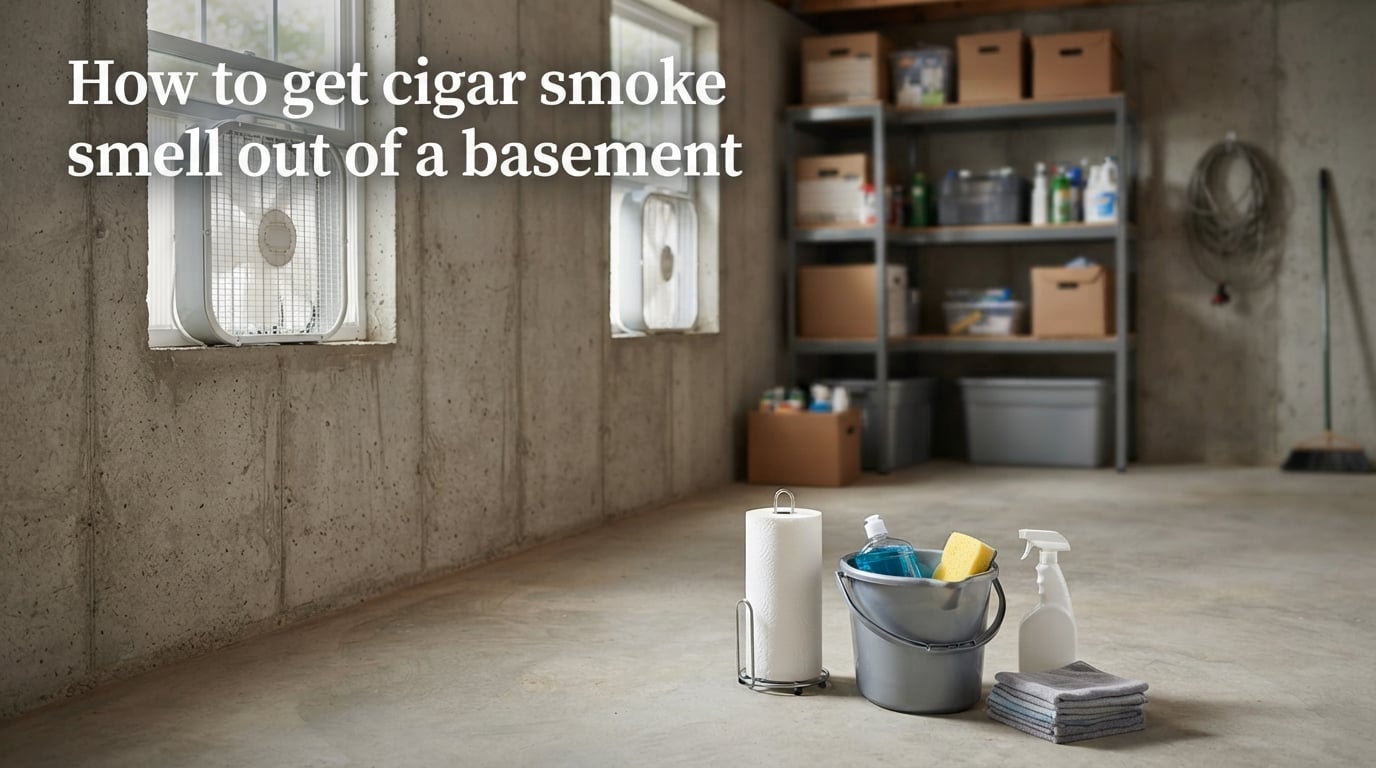
Open every window and door you can. If your basement has egress windows or a walkout entrance, use them to create cross-ventilation. Place a box fan in one window blowing outward to pull stale air out, and another fan in an opposite window blowing fresh air in.
For basements with no windows, use your existing mechanical ventilation. Run bathroom exhaust fans continuously. Position floor fans to move air toward the stairs and up into the main level. Keep the basement door open at the top of the stairs.
This initial ventilation phase removes loose smoke particles from the air. It will not eliminate the embedded odor, but it clears the air so you can work safely and prevents new smoke particles from settling during cleaning.
Step 2: Remove All Smoke-Absorbing Materials
Now it is time to get ruthless. Anything porous in your basement has been absorbing cigar smoke, and much of it needs to go.
Start with fabrics. Remove all curtains, throw pillows, blankets, and cloth-covered furniture. Wash what you can in hot water with a cup of white vinegar added to the rinse cycle. Items that cannot be thoroughly washed may need professional dry cleaning or replacement.
Cardboard is a major odor trap. Those stacks of moving boxes and storage containers in the corner have been soaking up smoke for months or years. Remove all cardboard boxes and replace them with plastic storage bins if you want to keep items stored in the basement.
Old newspapers, magazines, and paper products need to go too. Paper absorbs smoke odor like nothing else, and no amount of cleaning will save them.
Carpet is the toughest decision. If the carpet has been exposed to heavy cigar smoke for months or years, replacement is often the most effective option. Professional steam cleaning can help for mild to moderate exposure, but deeply contaminated carpet may never fully lose the smell.
Step 3: Deep Clean All Hard Surfaces
With the porous materials removed, turn your attention to walls, ceilings, floors, and every hard surface in the basement. Always clean from top to bottom so you do not drip dirty water onto already cleaned areas.
For walls and ceilings, use TSP (tri-sodium phosphate) mixed with warm water. TSP is the gold standard for cutting through nicotine and tar residue. Wear gloves and eye protection, and work in small sections. Rinse each section with clean water after scrubbing.
An alternative to TSP is a solution of one cup of white vinegar per gallon of warm water. Vinegar is less aggressive but safer for painted surfaces. For particularly stubborn nicotine stains, an ammonia-based cleaner can break down the sticky residue that holds odor molecules.
Do not forget the spots people miss. Light fixtures, switch plates, outlet covers, ceiling fan blades, and window frames all collect smoke residue. Remove switch plates and wash them separately. Wipe down every surface, no matter how small.
For concrete floors, use a degreasing cleaner followed by a thorough mopping. Unsealed concrete may need an etching treatment to remove deeply embedded smoke particles before you seal it.
Step 4: Seal Walls With Odor-Blocking Primer
Here is a step that most guides skip entirely but forum veterans swear by. After cleaning your walls, seal them with an odor-blocking primer before applying any fresh paint.
Kilz Original oil-based primer is a top recommendation from homeowners who have successfully eliminated stubborn smoke odor. It locks in residual nicotine and tar that cleaning alone cannot reach. Apply one full coat and let it cure completely.
Zinsser BIN shellac-based primer is another excellent option. It dries faster than Kilz and is particularly effective at sealing tough odors. Shellac-based primers penetrate deeper into the surface and create a harder, more impenetrable barrier against trapped smoke particles.
Apply two coats for basements with heavy or long-term smoke exposure. This sealing step prevents any remaining smoke molecules from slowly leaching back through your fresh paint and recontaminating the room.
Once the primer has fully cured, paint with a high-quality latex paint. Use a semi-gloss or satin finish in basements because they are easier to clean and more resistant to moisture than flat paint.
Step 5: Deploy Natural Odor Absorbers
After cleaning and sealing, natural odor absorbers help pull remaining smell molecules out of the air. These work slowly but effectively over several days.
Baking soda is your best friend here. Sprinkle it liberally on carpets, rugs, and upholstery. Let it sit for at least 24 hours before vacuuming. For persistent odors, repeat this process two or three times over the course of a week.
Activated charcoal bags placed in corners and near vents absorb odor molecules from the air. Use several bags throughout the basement and replace them every two to three months. Bamboo charcoal bags are reusable and can be refreshed by placing them in sunlight for a few hours.
Set out bowls of white vinegar around the basement. The acetic acid in vinegar neutralizes alkaline smoke compounds. Leave the bowls out for 24 to 48 hours, and you will notice the vinegar smell fades along with the smoke odor.
Coffee grounds are a lesser-known odor absorber that many forum users recommend. Spread dry coffee grounds on shallow trays and place them around the room. They absorb odor while leaving a pleasant scent behind.
Step 6: Clean the HVAC System and Ductwork
This step is absolutely critical, and skipping it is the number one reason basement smoke smells come back. Smoke particles travel through your HVAC system and settle inside the ductwork, continuously recirculating odor throughout your entire home.
Start by replacing every air filter in your HVAC system. Old filters are packed with trapped smoke particles. Switch to high-efficiency pleated filters with a MERV rating of 11 or higher for ongoing smoke particle capture.
Consider installing a HEPA filtration system and activated carbon filter in your HVAC setup. Activated carbon is specifically designed to adsorb odor molecules, including those from cigar smoke. A whole-house air purifier with both HEPA and activated carbon stages will dramatically improve air quality.
For serious smoke contamination, hire a professional duct cleaning service. They use rotary brushes and high-powered vacuums to physically remove smoke residue from inside your ductwork. This typically costs between $300 and $500 but makes a massive difference in odor elimination.
Clean all return air vents and supply registers with hot soapy water. Remove the vent covers and wash them separately. Wipe inside the vent openings as far as you can reach.
Step 7: Use Ozone Treatment for Stubborn Odor
If you have completed all six previous steps and still detect cigar odor, it is time for the heavy artillery. Ozone treatment is the most powerful DIY odor elimination method available.
An ozone generator produces O3 molecules that react with and destroy odor compounds at the molecular level. Ozone gas penetrates every crack, crevice, and porous surface in your basement, reaching smoke particles that cleaning and scrubbing cannot touch.
Safety is paramount with ozone treatment. Ozone is toxic to humans and pets. You, your family, and all animals must leave the house during treatment. Remove or cover houseplants. Seal the basement as tightly as possible to concentrate the ozone.
Run the ozone generator for 24 to 72 hours depending on the severity of the odor. After treatment, allow the basement to air out for at least 2 hours before re-entering. The ozone will have converted to regular oxygen, but you need to ensure complete ventilation.
An alternative that forum users highly recommend is chlorine dioxide (ClO2) treatment. ClO2 tablets dissolved in water release gas that neutralizes smoke odor similarly to ozone. Many homeowners report excellent results with ClO2 for basement smoke removal, and it can be easier to manage than a full ozone generator setup.
How Long Does It Take to Remove Cigar Smoke Smell?
One of the most common questions I hear is how long this whole process takes. The answer depends on the severity of the smoke contamination.
For light odor from occasional cigar use, expect the process to take 3 to 5 days. Ventilation and surface cleaning usually handle the problem within that timeframe.
Moderate odor from regular smoking over several months typically takes 1 to 2 weeks of active treatment. You will need the full seven-step process, including primer sealing and natural absorbers.
Heavy, long-term smoke contamination from years of cigar smoking requires 2 to 4 weeks of sustained effort. Multiple rounds of cleaning, sealing, and ozone treatment may be necessary. In extreme cases, replacing carpet, drywall, or ceiling tiles is the only path to full odor elimination.
Factors that extend the timeline include high basement humidity, extensive carpeted areas, exposed insulation, and contaminated HVAC ductwork. Running a dehumidifier throughout the process helps speed things up by keeping the air dry.
When to Call Professional Smoke Remediation
Sometimes DIY methods are not enough. Knowing when to call professionals saves you weeks of frustration and wasted effort.
If you have completed all seven steps and still smell cigar smoke after 4 weeks, it is time to bring in the experts. Professional smoke remediation companies have access to industrial-grade equipment that homeowners simply cannot buy.
Professionals use thermal fogging, a process that heats a specialized deodorizing compound into a fog that penetrates every surface the same way smoke did originally. The fog neutralizes odor molecules inside walls, under floors, and throughout ductwork.
They also have commercial ozone generators that are significantly more powerful than consumer models. A professional ozone treatment can accomplish in 8 hours what a residential unit does in 3 days.
If you purchased a home where the previous owner was a heavy smoker, professional remediation is almost always worth the investment. The cost typically ranges from $500 to $2,000 depending on basement size and smoke severity, but it can save you from months of trial and error.
Prevention: Keeping Your Basement Smoke-Free
Once you have eliminated the cigar smoke smell, prevention is straightforward. If someone in your household smokes cigars, create a dedicated smoking area with excellent ventilation rather than smoking directly in the basement.
Run an air purifier with HEPA and activated carbon filtration continuously in any space where smoking occurs. Replace the filters every 3 months to maintain effectiveness.
Keep a dehumidifier running in the basement to maintain humidity below 50 percent. Dry air prevents odor molecules from bonding with surfaces.
Clean all hard surfaces monthly with a vinegar solution. This prevents any nicotine or tar residue from accumulating over time.
FAQs
How do you get the smell of cigar smoke out of your house?
To remove cigar smoke smell from your house, start by ventilating the space with fans and open windows for 24 to 48 hours. Then deep clean all walls, ceilings, and floors using TSP or white vinegar solutions. Remove and wash all fabric items, replace HVAC filters, and seal walls with an odor-blocking primer like Kilz or Zinsser BIN. For stubborn odors, use an ozone generator for 24 to 72 hours.
How long does cigar smoke smell last in the house?
Cigar smoke smell can last indefinitely if left untreated because the tar and nicotine residue penetrates porous surfaces. With active cleaning using the seven-step process described above, light odor takes 3 to 5 days to remove, moderate odor takes 1 to 2 weeks, and heavy long-term contamination takes 2 to 4 weeks or professional remediation.
What smell cancels out cigarette smoke?
White vinegar, activated charcoal, baking soda, and coffee grounds are the most effective natural odor neutralizers for smoke. Vinegar works by neutralizing alkaline smoke compounds, while activated charcoal and baking soda physically absorb odor molecules from the air. None of these just mask the smell like air fresheners do.
What neutralizes tobacco smell?
TSP (tri-sodium phosphate) neutralizes tobacco and nicotine residue on hard surfaces. Ammonia-based cleaners break down stubborn tar buildup. For embedded odors in walls, oil-based or shellac-based odor-blocking primers like Kilz Original and Zinsser BIN seal in the remaining nicotine. Ozone treatment and chlorine dioxide gas destroy odor molecules at the molecular level for complete neutralization.
Final Thoughts on Removing Cigar Smoke From Your Basement
Getting cigar smoke smell out of a basement is not a one-and-done job. It requires patience, the right cleaning products, and a willingness to follow every step thoroughly. Skip steps and the odor will come back.
The combination of ventilation, deep surface cleaning with TSP, odor-blocking primer, natural absorbers, HVAC cleaning, and ozone treatment covers every possible source of smoke odor. Start with the simpler steps and escalate to ozone or professional help only if needed.
Your basement does not have to smell like a cigar lounge forever. With the systematic approach outlined in this guide, you can eliminate even the most stubborn smoke odor and reclaim that space for whatever you have planned next.