
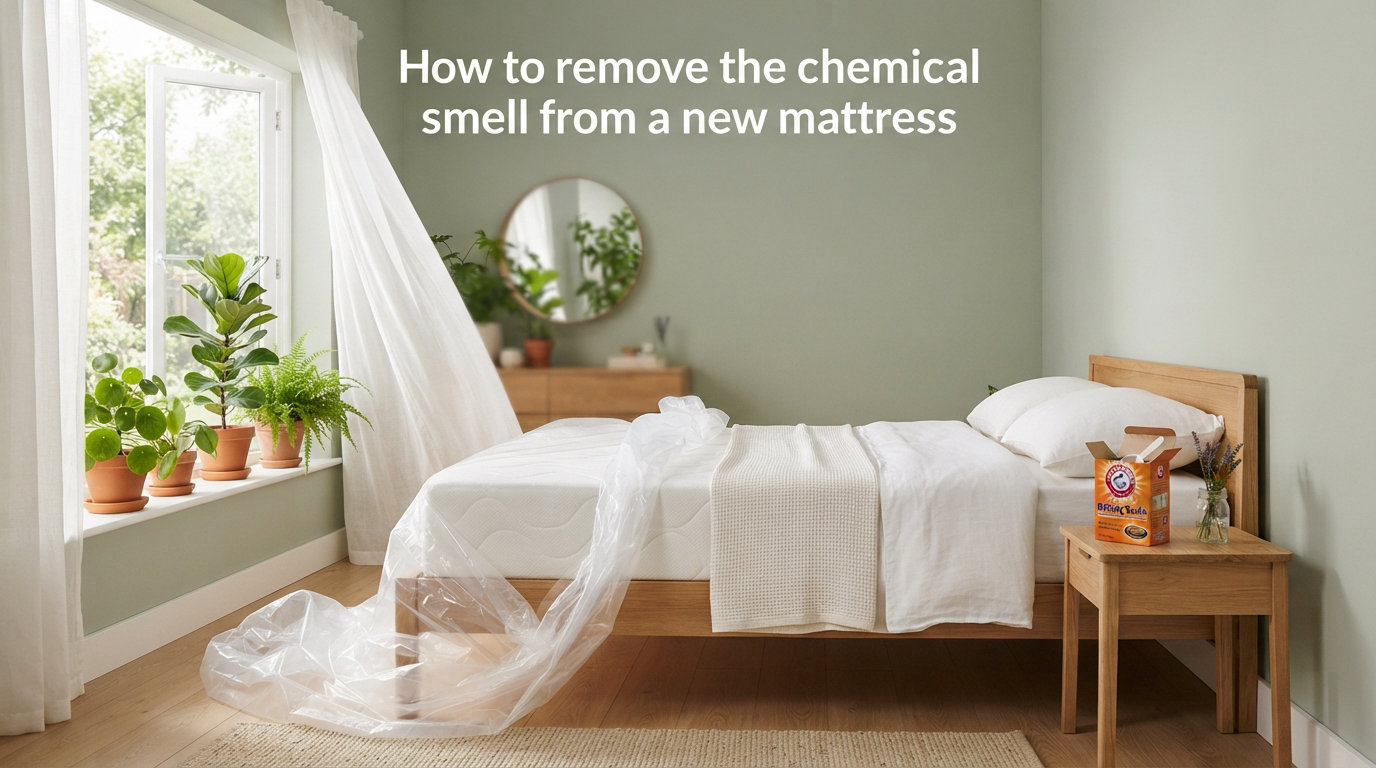
That first night on a brand new mattress should feel like a reward. Instead, you unzip the plastic, and a sharp chemical odor fills the room. If you are wondering how to remove the chemical smell from a new mattress, you are in the right place, because I have dealt with this exact problem more times than I can count.
The good news is that the smell is almost always temporary and manageable. With the right combination of ventilation, odor absorbers, and a little patience, you can dramatically cut down that off-gassing odor in 24 to 72 hours. In this guide, I will walk you through what causes the smell, whether it is safe, and eight proven methods to clear the air fast.
I will also cover what NOT to use, because some popular online tips (like soaking your foam in vinegar) can permanently damage your mattress. Let us start with understanding what you are actually smelling.
Table of Contents
What Causes the New Mattress Chemical Smell?
The chemical smell from a new mattress comes from a process called off-gassing. When manufacturers compress memory foam and synthetic materials, seal them in plastic, and ship them in a box, volatile organic compounds (VOCs) get trapped inside. Once you unroll the mattress, those compounds start evaporating into your bedroom air.
VOCs include chemicals like formaldehyde, benzene, toluene, and remnants of the flame retardants used to meet federal flammability standards. These are byproducts of polyurethane foam production and the adhesives that hold the layers together. As the mattress expands and breathes for the first time, those trapped gases release all at once.
This is why the smell is strongest in the first 48 hours and fades gradually afterward. A vacuum-sealed mattress in a box concentrates the odor far more than a traditionally delivered, flat mattress ever would. The compression itself is not dangerous, but it does mean you get a concentrated wave of VOCs the moment you open it.
It is also worth noting that even mattresses labeled as organic or natural can carry a faint smell. Reddit users in the mattress community point out that almost every new mattress has at least some odor, whether from foam, glue, or the natural scent of materials like latex. The intensity simply varies by type and brand.
Why Memory Foam Smells Worse Than Other Mattress Types
Memory foam mattresses smell stronger than innerspring or latex models because they contain more synthetic material per square inch. Dense polyurethane foam is the primary culprit, and memory foam layers are denser and thicker than the foam used in traditional beds. More foam means more VOCs waiting to release.
Hybrid mattresses fall somewhere in the middle. They combine a coil support core with foam comfort layers, so you get some off-gassing but not as much as an all-foam bed. Innerspring mattresses with minimal foam padding tend to smell the least.
The adhesives matter too. Mattresses with multiple glued foam layers release more chemical odor than those with fewer seams. A budget foam mattress stacked with five glued layers will typically off-gas more than a premium single-block design.
Temperature plays a surprising role here. Foam off-gasses faster in a warm room because heat accelerates the release of VOCs. A mattress opened in a cold basement will smell longer than one opened in a sunlit, warm bedroom. I will use this to our advantage in the methods section.
Is the New Mattress Smell Harmful? Health Effects Explained
For most healthy adults, the new mattress smell is unpleasant but not dangerous when concentrations stay within expected ranges. Manufacturers are required to meet federal flammability and chemical safety standards. However, that does not mean everyone reacts the same way.
Short-term exposure to VOCs can cause headaches, mild nausea, dizziness, and throat or eye irritation. These symptoms usually clear up once the smell dissipates and you increase ventilation. If you notice persistent headaches, dizziness, or respiratory irritation that does not improve, step up your ventilation efforts or sleep in another room until the odor fades.
Some groups are more sensitive to VOC exposure and should take extra care. These include infants and young children, pregnant women, people with asthma or chemical sensitivities, and anyone with compromised respiratory health. For these individuals, even low-level VOC exposure can trigger stronger reactions.
Here is a practical warning sign worth knowing. If the chemical smell has not improved after two weeks of active ventilation, or if you experience severe headaches and nausea every time you enter the room, something may be off with that specific mattress. In that case, contact the manufacturer about a return or exchange under the warranty.
How Long Until the Smell Fades? A Realistic Timeline
Most new mattresses lose the majority of their chemical smell within 3 to 7 days of being opened. The strongest odor hits in the first 24 to 48 hours, then drops off noticeably as the initial burst of VOCs releases. By the end of the first week, most people only notice a faint scent when they press their nose to the surface.
A faint residual smell can linger for up to two weeks, especially with dense memory foam mattresses. This is normal and usually not noticeable unless you are actively sniffing the fabric. Forum users report that leaving windows open with fans running for a full week makes the biggest difference.
If you need results overnight, expect improvement but not a complete cure. You can cut the smell significantly in one night using the methods below, but you will not eliminate it entirely in 12 hours. Set realistic expectations so you are not disappointed.
Temperature matters more than most guides mention. A warm room at around 72 to 75 degrees Fahrenheit will off-gas a mattress faster than a cool room at 60 degrees. If you can safely warm the room and ventilate simultaneously, you speed up the process considerably.
How to Remove the Chemical Smell From a New Mattress: 8 Proven Methods
Here is where we get practical. These eight methods work best when combined rather than used alone. I recommend starting with ventilation and layering in the odor absorbers for the fastest results.
Method 1: Maximize Ventilation With Open Windows and Fans
Ventilation is the single most effective way to remove the chemical smell from a new mattress, and it costs nothing. Open every window in the bedroom and set up a box fan pointing outward to push VOC-laden air outside. Create a cross-breeze by opening a window on the opposite side of the room or house.
Keep this running for at least 72 hours if possible. The more air you move across the mattress surface, the faster those trapped compounds release and leave. Reddit users consistently report that seven days of open windows with fans made the biggest impact of any method they tried.
Method 2: Sprinkle Baking Soda Across the Surface
Baking soda is a natural odor absorber that pulls VOCs and trapped smells out of the mattress fabric. Strip the mattress bare, sprinkle a generous even layer of baking soda across the entire surface, and let it sit for several hours or overnight.
Vacuum the baking soda thoroughly with an upholstery attachment before putting sheets back on. You can repeat this daily for the first few days. Baking soda will not damage foam, so this method is completely safe for all mattress types.
Method 3: Use Activated Charcoal Bags Nearby
Activated charcoal is highly porous, which makes it excellent at trapping airborne odor molecules. Place several charcoal bags or bowls of activated charcoal around the mattress and in the corners of the room. They work passively around the clock to absorb VOCs from the air.
This method works best as a complement to ventilation rather than a standalone fix. Set the charcoal near the mattress, not directly on it, and replace or recharge the bags in sunlight every few weeks. Many forum users swear by charcoal combined with an open window.
Method 4: Run an Air Purifier With a Carbon Filter
An air purifier with a true HEPA and activated carbon filter is one of the most effective tools for clearing mattress VOCs. The carbon filter specifically traps gaseous compounds that HEPA alone cannot catch. Reddit users recommend carbon-filter purifiers more than almost any other single solution.
Run the purifier on its highest setting in the closed room when you are not actively ventilating with open windows. Position it near the mattress for maximum effect. Keep it running for the full first week, especially overnight while you sleep.
Method 5: Increase Room Temperature to Speed Up Off-Gassing
Heat accelerates the release of VOCs from foam, which means a warmer room helps the mattress off-gas faster. Set your thermostat to around 72 to 75 degrees Fahrenheit during the first few days. Combine this with open windows or a fan so the released VOCs actually leave the room.
Do not use a space heater pointed directly at the mattress, and never use a heat gun or hair dryer on foam. Direct high heat can warp or damage the foam layers. Gentle ambient warmth is what you want.
Method 6: Let Sunlight Hit the Mattress If Possible
If your bedroom gets direct sunlight, strip the mattress and let the sun hit the surface for a few hours. UV light helps break down some odor-causing compounds, and the warmth from sunlight also speeds up off-gassing naturally. Prop the mattress near a window or take it to a sunny room if feasible.
Keep an eye on the time. A few hours of indirect to moderate direct sunlight is helpful, but prolonged intense sun exposure can degrade some foam and fabric materials over time. Use this method in moderation during the first week.
Method 7: Add a Mattress Protector as a Barrier
A quality mattress protector will not remove the VOCs, but it creates a breathable barrier between you and the off-gassing foam. This helps reduce your direct exposure while you sleep, especially during those first few nights when the smell is strongest. Look for a waterproof but breathable protector.
Wash the protector once before putting it on. Some protectors carry their own manufacturing smell from the waterproof backing, and washing removes that so you are not adding a second odor source on top of the mattress smell.
Method 8: Use Essential Oils Cautiously to Mask Odor
Essential oils do not neutralize VOCs, but they can make the room more pleasant while you wait for the off-gassing to finish. Add a few drops of lavender, eucalyptus, or lemon to a diffuser placed across the room from the mattress. Never apply oils directly to the mattress, as they can stain fabric and degrade foam.
Treat this as a comfort measure, not a solution. Masking the smell does not make the air safer, so always pair it with proper ventilation. If you are sensitive to fragrances or have asthma, skip the oils entirely and rely on the other seven methods.
What NOT to Use: Products That Can Damage Your Mattress
Some of the most shared tips online will actually ruin your mattress, and this section is where we separate good advice from damaging myths. Here are the products and methods you should avoid.
Do not use white vinegar directly on memory foam. Many guides suggest spraying vinegar to neutralize odors, but vinegar is acidic and can break down the cellular structure of polyurethane foam over time. It can also leave a lingering vinegar smell that is nearly impossible to remove from deep foam layers. If you must use vinegar, apply it only to a removable, washable cover, never the bare foam.
Do not soak or steam clean the foam. Memory foam acts like a sponge. Once water penetrates the foam layers, it takes days to dry and creates a mold and mildew risk. Steam cleaning in particular forces moisture deep into the mattress where it cannot escape.
Avoid bleach and harsh chemical cleaners. Bleach degrades fabric fibers and can discolor the mattress surface permanently. Harsh chemical sprays also add their own VOCs to the air, making your off-gassing problem worse instead of better.
Do not use perfume or body sprays. These add alcohol and synthetic fragrances to the mix without addressing the underlying VOC release. You end up with a chemical smell layered on top of a chemical smell.
Avoid covering the mattress completely with plastic. Wrapping the mattress in plastic traps the VOCs inside and prolongs off-gassing indefinitely. The mattress needs to breathe, not be sealed.
Can You Sleep on a New Mattress the First Night?
For most healthy adults, yes, you can sleep on a new mattress the first night, as long as the room is well ventilated. The VOC levels from a single mattress are generally within safe exposure limits for a healthy person over one night. Keep a window cracked and a fan running if the smell bothers you.
That said, if the odor is overwhelming, you have asthma or chemical sensitivities, or you are pregnant, it is worth sleeping in another room for the first 24 to 48 hours. Let the mattress off-gas with the windows open and fans running while you wait elsewhere.
If you have no choice but to sleep on it immediately, maximize airflow. Open a window, run a carbon-filter air purifier, and use a freshly washed mattress protector as a barrier. The smell will be at its peak that first night, but it improves quickly by day two and three.
Special Safety Tips for Babies, Children, and Sensitive Groups
Infants and young children are more vulnerable to VOC exposure because their respiratory systems are still developing and they breathe more air per pound of body weight than adults. For crib mattresses, I strongly recommend off-gassing the mattress in a separate, well-ventilated room for at least one to two weeks before your baby ever sleeps on it.
Run a fan and open windows in that room daily. Sniff the mattress before moving it to the crib. If you can still smell chemicals clearly, give it more time. The goal is to get the mattress to a point where the odor is barely noticeable before introducing it to a nursery.
Pregnant women should also minimize exposure, especially during the first trimester. If possible, have someone else unbox and set up the mattress, and avoid sleeping in the room during the peak off-gassing window of the first 48 to 72 hours.
People with asthma, multiple chemical sensitivity, or allergies should treat a new mattress the same way as an infant setup. Off-gas it thoroughly before use, run a carbon-filter air purifier, and consider wearing a mask while handling the freshly opened mattress.
How to Prevent Mattress Smell on Your Next Purchase
If you want to avoid this problem entirely on your next mattress, the type of mattress and its certifications matter a lot. Here is what to look for when shopping to minimize or eliminate off-gassing.
Look for CertiPUR-US certified foam. This independent certification means the foam has been tested for specific harmful chemicals and meets strict limits on VOC emissions, flame retardants, heavy metals, and formaldehyde. A CertiPUR-US certified mattress is not guaranteed to be completely odor-free, but it will off-gas significantly less and more safely than uncertified foam. Always check the certification before buying.
Consider natural or organic latex. Natural latex mattresses are made from rubber tree sap rather than petroleum-based polyurethane. They carry a mild natural rubber scent instead of a chemical smell, and most people find it far less bothersome. Look for GOTS or GOLS organic certifications for the cleanest options.
Choose innerspring or hybrid over all-foam. Mattresses with coil support cores and minimal foam layers tend to off-gas the least. If you love the feel of foam but want less smell, a hybrid with a CertiPUR-US certified comfort layer is a good middle ground.
Unbox and air out immediately. The moment your mattress arrives, open it right away. Do not leave it compressed in the box or wrapped in plastic for days, because the VOCs continue building up in that sealed environment. The sooner you unwrap and ventilate, the sooner the smell clears.
Read reviews for smell complaints. Before you buy, search the reviews specifically for terms like smell, odor, chemical, or off-gassing. If multiple buyers report a strong or persistent chemical smell, that is a red flag worth heeding.
FAQs
Why does my new mattress have a chemical smell?
Your new mattress has a chemical smell because of off-gassing, a process where volatile organic compounds (VOCs) trapped in the foam and adhesives release into the air after you unbox the mattress. This is especially common with memory foam and bed-in-a-box mattresses that were compressed and sealed in plastic during shipping.
How to get rid of off-gassing from a new mattress?
The fastest way to get rid of off-gassing is to maximize ventilation by opening windows and running fans for at least 72 hours. Layer in odor absorbers like baking soda on the surface and activated charcoal bags around the room, and run an air purifier with a carbon filter to trap airborne VOCs.
Can you sleep on a mattress that is off-gassing?
Most healthy adults can safely sleep on an off-gassing mattress the first night as long as the room is well ventilated. However, infants, pregnant women, and people with asthma or chemical sensitivities should wait 48 to 72 hours and let the mattress air out in a separate room first.
How long does it take for a new mattress to offgas?
Most of the chemical smell fades within 3 to 7 days of unboxing, with the strongest odor in the first 48 hours. A faint residual scent can linger up to two weeks, especially with dense memory foam. Warm room temperatures and active ventilation speed up the process significantly.
The Bottom Line
Learning how to remove the chemical smell from a new mattress comes down to one core principle: move air and absorb odors. Ventilation is your strongest tool, backed up by baking soda, activated charcoal, and a carbon-filter air purifier. Combine these for the first three to seven days and the smell will fade dramatically.
Avoid the common mistakes, especially spraying vinegar directly on foam or soaking your mattress with water. Protect sensitive sleepers like babies and pregnant women by off-gassing in a separate room first. And on your next purchase, look for CertiPUR-US certified foam or natural latex to minimize the problem before it starts.
Your new mattress should be something you look forward to, not something you endure. Give it a few days of fresh air, and you will be sleeping soundly in no time.