
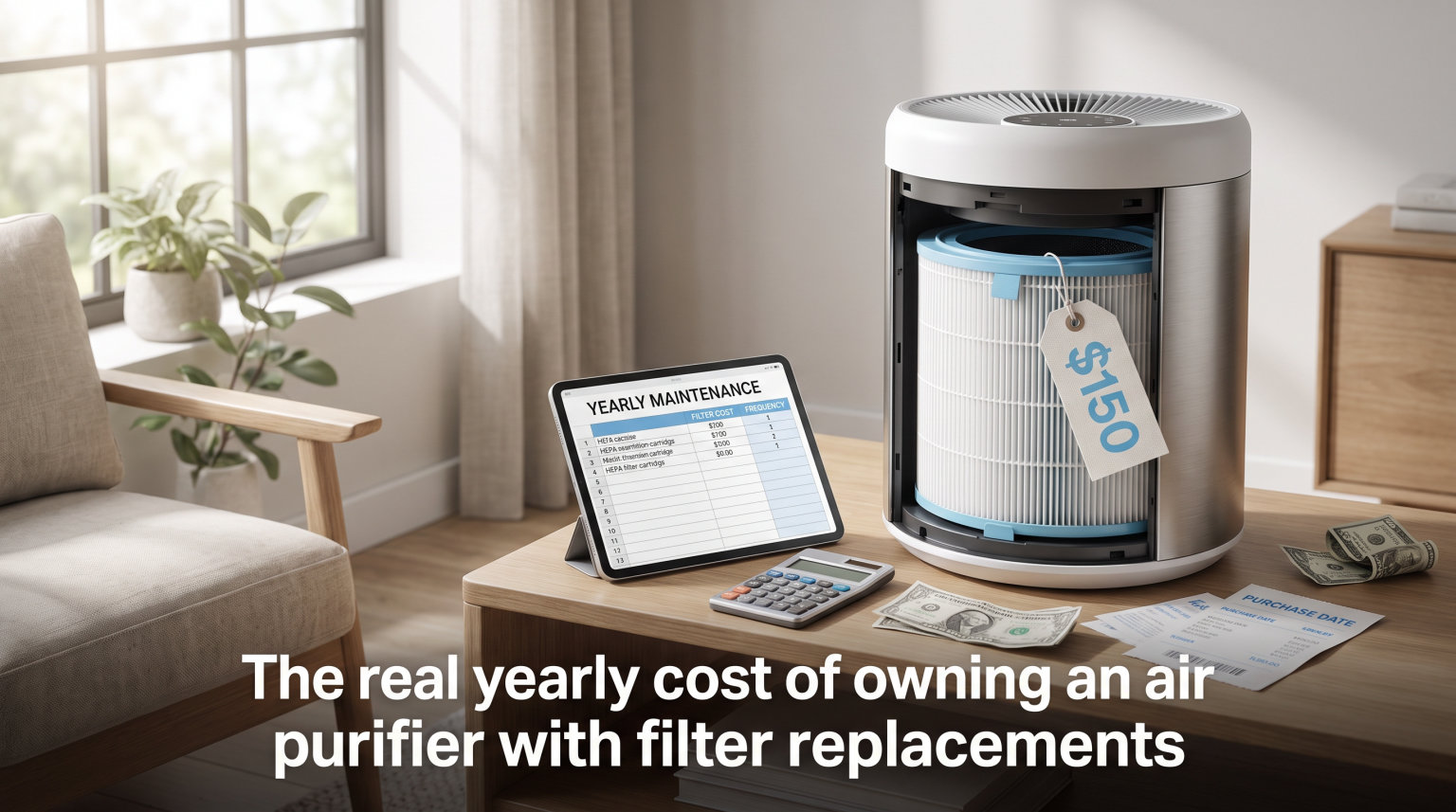
The yearly cost of owning an air purifier runs between $50 and $300+ per year when you add up filter replacements, electricity, and routine maintenance. The biggest expense is almost always the filter itself, with HEPA replacements costing $20 to $200+ annually depending on the brand tier you choose. Energy use typically adds another $10 to $50 per year if you run the unit most of the day.
Most buyers focus on the sticker price of the machine and forget that an air purifier keeps charging you for as long as you own it. I see this play out constantly in online forums, where people who paid $90 for a budget unit end up surprised by $100 annual filter bills. Understanding the yearly cost of owning an air purifier before you buy is what separates a smart purchase from an expensive paperweight.
In this guide I break down every recurring expense you should expect, from HEPA and activated carbon filter swaps to the electricity that quietly shows up on your utility bill. I will also share real-world numbers from Reddit discussions, explain how brand tier changes the math, and show you how to slash costs without wrecking your air quality.
Table of Contents
The Real Yearly Cost of Owning an Air Purifier, Broken Down
Three cost categories make up the real yearly cost of owning an air purifier: filter replacements, electricity, and occasional maintenance like pre-filter cleaning or UV bulb swaps. Filter replacements dominate the total, usually accounting for 60 to 80 percent of your annual spend. Electricity and maintenance split the rest, and they vary based on how often you run the unit and how dusty your environment is.
Here is what you can expect across brand tiers. Budget purifiers like Levoit typically cost $40 to $90 per year to operate. Mid-range models from Coway, Winix, Honeywell, and Blueair usually run $80 to $160 per year. Premium units from IQAir or Austin Air can cost $200 to $400+ annually because their proprietary filters are large, dense, and priced accordingly.
Reddit users in r/AirPurifiers report annual costs ranging from a low of $60 for small bedroom units to over $260 for whole-floor premium systems. That real-world range matches what the manufacturers themselves admit in their replacement schedules, so treat $50 as the floor and $300+ as the ceiling for most homeowners.
Filter Replacement Costs: The Biggest Recurring Expense
Replacement filters are the single largest ongoing cost of owning an air purifier, and the price varies wildly based on the filter type and the brand you choose. Most modern purifiers use a combination of a true HEPA filter for particles and an activated carbon filter for odors and gases, and each one has its own replacement schedule.
HEPA Filter Replacement Cost
A true HEPA filter captures 99.97 percent of particles down to 0.3 microns, and it needs replacing every 6 to 12 months in typical home use. Replacement HEPA filters cost anywhere from $20 for budget brands like Levoit up to $100 or more for premium brands like IQAir and Austin Air. The general rule: the larger the filter and the more proprietary the design, the more you will pay.
Filter lifespan depends heavily on your environment. In a clean home with no pets and light traffic, a HEPA filter can stretch to 12 to 18 months before it needs swapping. In a home with multiple shedding pets, wildfire smoke exposure, or heavy dust, that same filter may clog in 4 to 6 months and cost you double what you expected.
Activated Carbon Filter Replacement Cost
Activated carbon filters handle odors, smoke, and volatile organic compounds (VOCs), and they typically wear out faster than HEPA filters. You will usually replace them every 3 to 6 months at a cost of $15 to $50 per swap, which adds $30 to $100 per year on top of your HEPA costs. If you rely on your purifier for cooking smells, pet odors, or wildfire smoke, budget for the higher end.
Some budget brands combine HEPA and carbon into one cartridge, which can simplify replacement but often means replacing both even when only the carbon is exhausted. Premium brands tend to separate them so you can swap each one on its own schedule, which usually saves money over time.
Cost by Brand Tier
Here is how annual filter costs break down by tier based on manufacturer replacement schedules and real user reports:
Budget tier (Levoit, GermGuardian, Hathaspace): $40 to $80 per year. These units use cheaper composite filters and benefit from a healthy market of generic alternatives that can cut costs by 30 to 50 percent.
Mid-range tier (Coway, Winix, Honeywell, Blueair): $80 to $160 per year. Filters last 6 to 12 months, and you usually replace a multi-stage cartridge as a single unit. Blueair’s SmokeStop carbon add-on pushes some owners closer to the top of this range.
Premium tier (IQAir, Austin Air, Alen): $150 to $400+ per year. IQAir’s HyperHEPA filters and Austin Air’s combined HEGA filters are large, dense, and proprietary, with no generic equivalents. You pay for performance, but the recurring cost is significant.
Forum users consistently flag filter replacement as the expense that catches them off guard. One common complaint is that a $90 budget purifier can rack up $100 in filter costs within its first 18 months, making it more expensive long-term than a mid-range unit with longer filter life.
Air Purifier Energy Consumption: The Quiet Second Cost
Electricity is the second piece of the yearly cost of owning an air purifier, and it is the easiest one to underestimate because the charge sneaks into your monthly utility bill. The good news is that most portable purifiers draw modest wattage, so the annual cost is usually only $10 to $50 per year for typical use.
Here is how the math works. A purifier rated at 50 watts running on high for 12 hours a day uses 0.6 kilowatt-hours (kWh) per day. Multiply by 365 days and you get about 219 kWh per year. At the U.S. average electricity rate of roughly $0.16 per kWh, that works out to about $35 per year.
Run the same unit 24 hours a day on high and you double that figure to roughly $70 per year. Drop it to low speed, where many units draw only 5 to 15 watts, and your annual cost can fall under $10. Fan speed matters more than almost any other variable here.
Energy Star certified purifiers use about 40 percent less energy than non-certified models, according to Consumer Reports testing. Over five years that efficiency gap can save you $50 to $100 in electricity alone, which makes an Energy Star sticker worth seeking out even if the unit costs slightly more upfront.
Regional electricity rates also matter. If you live in a state like California or Massachusetts where rates top $0.25 per kWh, your annual energy cost can double compared to someone in Washington or Idaho where rates hover around $0.10. Multiply your unit’s wattage by your local rate before you commit to running it around the clock.
Other Maintenance Costs You Should Expect
Filter replacements and electricity are the two costs most buyers anticipate, but a few smaller expenses round out the real yearly cost of owning an air purifier. These are usually small, but they add up over five years of ownership.
Washable Pre-Filters
Many mid-range and premium purifiers include a washable pre-filter that catches large particles like hair and lint before they hit the HEPA layer. Cleaning this pre-filter every two to four weeks extends the life of your expensive HEPA filter by weeks or months. The cleaning is free, but skipping it will cost you a new HEPA filter sooner than scheduled.
UV-C Bulb Replacement
Some purifiers like GermGuardian models use UV-C bulbs to kill airborne germs, and those bulbs degrade over time. Expect to replace a UV-C bulb every 10 to 12 months at a cost of $15 to $30 per bulb. It is not a huge expense, but it is one more line item in your yearly budget.
Sensor and Housing Cleaning
Air quality sensors, vents, and the housing itself collect dust and need occasional wiping with a dry or lightly damp cloth. This is free labor, but ignoring it can cause false readings and force the unit to run harder, which inflates both your energy bill and your filter wear.
Occasional Parts Replacement
Over five or more years you may need to replace a worn fan motor, a broken latch, or a malfunctioning control board. These costs vary widely but typically run $30 to $100 per repair. For budget units, a single major repair often costs more than replacing the entire machine.
First-Year vs 5-Year Cost Projections by Tier
Looking at the yearly cost of owning an air purifier over a single year hides the real picture. The first year always looks worse because you pay full price for your first filter replacement, but the 5-year cumulative cost is what actually reveals which tier offers the best value.
First-Year Total Cost
Budget tier: $90 to $250 total. This includes the machine plus one filter swap, electricity, and minor maintenance. The low sticker price is appealing, but you are already spending nearly the cost of the unit again in its first year.
Mid-range tier: $250 to $500 total. You pay more upfront, but the per-year cost stabilizes because filters last longer and the units are more energy efficient.
Premium tier: $500 to $1,200+ total. The machine is expensive, the filters are expensive, and the maintenance is expensive. The payoff comes from superior CADR ratings, longer filter life in clean environments, and better performance against serious allergens or wildfire smoke.
5-Year Cumulative Cost
Over five years, budget purifiers often cost $400 to $700 total when you add replacement filters, electricity, and the likely replacement of the machine itself. Mid-range units typically run $700 to $1,200 total. Premium units can hit $1,500 to $3,000+ over five years.
Here is the surprising takeaway from forum discussions and long-term owner reports: over five years, a well-chosen mid-range unit is often cheaper than a budget unit that you have to replace twice. The mid-range tier tends to hit the sweet spot of reasonable filter costs, decent durability, and energy efficiency that keeps the total cost manageable.
Premium units are worth the money only if you genuinely need their performance for severe allergies, asthma, wildfire smoke, or large spaces. For a typical bedroom or apartment, the premium tier’s extra cost rarely translates into proportionally better air quality.
How to Save Money on Air Purifier Filters
You cannot avoid filter replacement entirely if you want clean air, but you can cut your yearly cost of owning an air purifier by 30 to 60 percent with a few practical strategies. Forum users and long-term owners consistently recommend the same handful of tactics.
Try Generic Aftermarket Filters
Generic replacement filters can cost 30 to 50 percent less than OEM (original equipment manufacturer) filters, and for popular brands like Levoit and Honeywell the quality gap is often small. Read reviews carefully before buying, because some generics do not seal properly or use thinner HEPA material. Stick with aftermarket brands that have thousands of positive reviews and clear return policies.
Use the Washable Pre-Filter Religiously
If your unit has a washable pre-filter, cleaning it every two to four weeks is the single highest-ROI maintenance habit you can develop. A clean pre-filter can extend HEPA filter life by 20 to 40 percent, which directly delays your next $40 to $100 purchase.
Run on Auto or Low Speed
Running your purifier on low or auto mode instead of high can cut your electricity cost by 50 to 80 percent and extend filter life at the same time. Auto mode uses an air quality sensor to ramp up only when needed, which is both quieter and cheaper than running on turbo all day.
Buy Filters in Bulk or Subscribe
Amazon, manufacturer websites, and major retailers often offer 5 to 15 percent discounts for filter subscriptions or multipack purchases. If you know you will need two filters per year, buying a two-pack up front usually beats paying full price twice.
Extend Filter Life in Cleaner Seasons
In seasons when pollen, smoke, and pet dander are lower, you can often stretch a filter a month or two past its official replacement date. Check the filter visually: if you can still see light through the HEPA media and airflow feels normal, it likely has life left. Do not extend in heavy-use seasons or if anyone in the home has serious respiratory conditions.
Vacuum the Filter Between Swaps
Gently vacuuming the HEPA filter surface every two to three months removes surface dust and can add weeks to its lifespan. This is a hack some long-term owners swear by, but it will not restore a truly saturated filter. Treat it as a way to stretch, not skip, replacement.
Frequently Asked Questions
Are air purifiers expensive to maintain?
Air purifiers are moderately expensive to maintain, with yearly costs ranging from $50 for small budget units to $300 or more for premium brands. The main expense is filter replacement, which runs $20 to $200+ per year depending on the model. Energy use adds $10 to $50 per year, and occasional parts like UV bulbs add a small amount more. Compared to other home appliances, an air purifier is not cheap to run, but the cost is predictable and controllable.
What is the 2/3 rule for air purifiers?
The 2/3 rule for air purifiers recommends buying a unit rated for at least two-thirds of your room’s square footage if you run it on high, or one that covers the full room if you run it on a lower, quieter speed. For example, if your room is 300 square feet, choose a purifier rated for around 450 square feet so it can deliver enough clean air changes per hour without straining on high speed. Following this rule extends filter life and keeps operating costs lower.
Do you actually need to replace an air purifier filter?
Yes, you do need to replace air purifier filters because they lose effectiveness as they clog with particles. A saturated HEPA filter restricts airflow, forces the motor to work harder, and stops capturing new contaminants. Activated carbon filters stop absorbing odors and gases once their pores are full. Skipping replacement wastes electricity and defeats the purpose of running the purifier. Most HEPA filters need replacing every 6 to 12 months and carbon filters every 3 to 6 months.
Is there a downside to air purifiers?
The main downsides of air purifiers are the ongoing cost of replacement filters, the electricity they consume, the noise on higher fan speeds, and the environmental waste from disposable filters. Some ozone-generating models can irritate lungs if used incorrectly. Most of these downsides are manageable with the right unit choice and good maintenance habits, but they are real costs and trade-offs worth understanding before you buy.
Final Thoughts on the Yearly Cost of Owning an Air Purifier
The yearly cost of owning an air purifier realistically falls between $50 and $300+ depending on your brand tier, your environment, and how aggressively you run the unit. Filters dominate the bill, electricity is a distant second, and small maintenance items fill in the rest. Plan for at least $100 per year for any unit you expect to actually use.
If you want the best long-term value, focus on mid-range models with Energy Star certification, longer filter life, and a healthy market of generic filter alternatives. Run the unit on auto or low speed whenever possible, clean the pre-filter regularly, and buy filters in bulk when you can. Those small habits will keep your annual cost near the bottom of the range while still delivering clean air every day.