
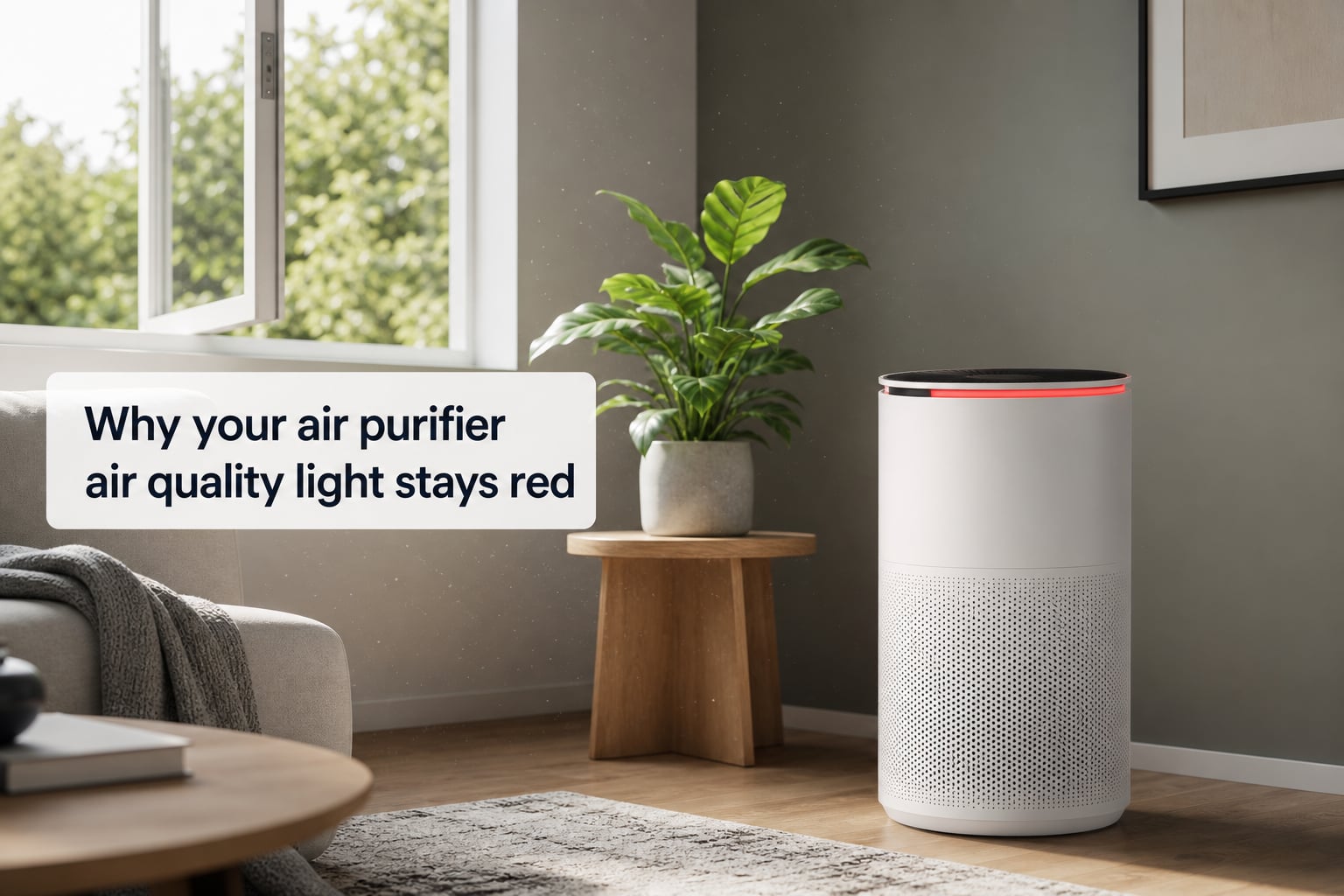
If your air purifier air quality light stays red, it usually means the unit detects poor air quality or that a separate filter-change reminder needs attention. The light by itself cannot tell you which one applies, so identify the icon and check the instructions for your model before taking action.
Red can be a normal response to frying food, an open window during smoky or high-pollen conditions, or dust stirred up while cleaning. It can also persist because airflow is restricted, the sensor is dirty, or the purifier is trying to clean a room that is too large.
This 2026 guide explains the practical checks that separate a real air problem from a maintenance alert or an unreliable sensor reading. The aim is not simply to change the display color; it is to address the cause.
Table of Contents
A red light usually means poor air or a filter reminder
On a purifier with a live air-quality display, red commonly means its sensor detects an elevated concentration of airborne particles. Fine particles, often described as PM2.5, can come from smoke, cooking fumes, dust, pollen, pet dander, candles, aerosol sprays, and outdoor pollution.
On other units, red is a filter indicator rather than a live measurement. That light is often based on elapsed operating time, not on how dirty the filter looks, so it can turn red on schedule even when the room looks clean.
A steady red light usually reports a current air condition
A steady red air-quality indicator generally means the sensor is seeing poor air right now. It should respond over time after the source stops, the air mixes, and the purifier has enough capacity to clean the room.
Color systems are not standardized. Blue often represents good air, green fair air, amber moderate air, and red poor air, but the colors and their thresholds differ by brand, so the manual is the deciding source.
A blinking red light often signals a service task or error
A blinking red light is more likely to be a filter replacement alert, a reset prompt, a setup status, or an error code. A filter-shaped icon points to maintenance, while a particulate or air-quality icon points to sensor data.
Do not reset a filter timer merely to remove the color when the filter is genuinely overdue. A reset clears a reminder; it does not restore a blocked filter or correct poor air quality.
A red light explains why your air purifier air quality light stays red
The most common reason is that the purifier detects a pollutant source faster than it can clear the room. That is likely if the light turns red during cooking, after a scented spray, when a pet sheds, or when outdoor conditions are poor.
Real particles and fumes can keep the reading high
Frying, searing, broiling, and even toasting can release particles and gases. A sensor can remain red after visible haze fades because fine particles stay suspended and are not always easy to see.
Smoke, candles, incense, vaping, fireplaces, and aerosol cleaners can produce the same pattern. HEPA filtration targets particles, while activated carbon can reduce some gases and odors; the two filter stages do different jobs.
Outdoor air also matters. An open window, a leaky door, or a frequently used entry may keep feeding pollen, traffic-related pollution, or wildfire smoke indoors, leaving the unit in a continuous catch-up cycle.
A room that is too large can keep the purifier from catching up
A purifier needs time and sufficient clean-air delivery for the space. In a large open-plan area, hallway, or room with doors opening repeatedly, it may improve air near the unit while the sensor continues to see particles from other parts of the home.
Placement can slow cleaning too. Keep the intake and outlet clear of curtains, furniture, walls, and clutter, and do not place the unit behind a sofa or in a tight corner.
Auto mode may choose a fan setting that feels too gentle after a large particle spike. Temporarily choosing a higher speed is a useful test, provided the filters are fitted correctly and airflow paths are clear.
A loaded or incorrectly fitted filter restricts airflow
A dirty pre-filter can reduce airflow before the main HEPA filter reaches its expected replacement point. Hair, lint, and dust on the outer screen limit the air reaching the filter, making the machine run longer without improving the air-quality display.
Check that every filter is seated in the intended direction and that all shipping plastic was removed at installation. A filter left in its wrapper can make a purifier sound normal while doing very little cleaning.
The filter light may remain red after a replacement because many units require a manual reset. The reset method varies, so use the official instructions instead of holding random buttons.
A dirty sensor can give a falsely high reading
Many purifiers use a laser particle sensor, photoelectric sensor, or another particle-sensing method to estimate airborne contamination. Dust around the sensor opening can interfere with the air sample and make a sensor problem look like a persistent pollution problem.
People commonly report that the purifier runs on high for hours but remains red in a room with no obvious source. Community discussions also report red readings with a humidifier nearby, because water droplets or mineral dust may be counted as particles by some sensors.
Steam from a shower, high humidity, and a diffuser near the intake can have a similar effect. Move these sources away, let the room air dry or mix, and watch for a change before assuming a sensor failure.
Nighttime red readings can be real rather than a sensor fault
Darkness does not normally make an air-quality sensor detect more particles. A closed bedroom can, however, collect particles from bedding, pet movement, outdoor air leaking through gaps, or evening cooking that happened before bedtime.
Sleep mode also uses less airflow, so recovery after a spike can take longer. If the light appears only overnight, run a higher setting for a short period before sleep, keep humidifiers away from the unit, and compare the result on a dry night.
A seven-step check resolves most persistent red-light problems
Work through the following checks in order. This helps you avoid replacing a filter when the issue is sensor-related, or resetting a timer while the room still has poor air.
Step 1: Identify the type of red indicator
Check the display, icon, and manual. Note whether the light is steady or blinking, whether a filter symbol appears, and whether the color reacts to activities such as cooking or vacuuming.
This is the fastest way to avoid confusing a timer-based maintenance reminder with an air-quality warning. It also shows whether a reset is relevant later.
Step 2: Remove obvious pollution sources
Turn off candles, incense, diffusers, and aerosol products, then complete or ventilate cooking if practical. Close nearby windows and doors when outdoor pollen, smoke, dust, or traffic pollution may be entering.
Give the room time to settle after vacuuming, dusting, or making the bed. Those tasks can lift particles briefly, and a working sensor should react to that change.
Step 3: Improve placement and use a higher fan setting
Place the unit on a stable surface with open space around its intake and outlet. Close the room door when you are cleaning one room, then run a higher fan setting for a reasonable test period.
Do not judge the result after only a few minutes following a large cooking or smoke event. In a space larger than the purifier can handle, or one connected to active rooms, new particles may enter as quickly as the unit removes them.
Step 4: Inspect the pre-filter, main filter, and fit
Turn the unit off and unplug it before opening the filter compartment. Remove hair and lint from a washable or vacuumable pre-filter only when the manual permits that method.
Check the main filter for proper orientation, intact seals, and forgotten packaging. Replace it according to the manufacturer’s schedule or earlier under heavy smoke, pet, or construction-dust conditions; do not wash a HEPA filter unless it is specifically marked washable.
Step 5: Clean the air-quality sensor gently
Find the sensor vent or lens location in the manual, then power the unit off before cleaning. If the official instructions permit it, use a soft dry brush or a careful vacuum-brush pass around the external vent without touching internal parts.
Afterward, keep humidifiers, steam, and diffusers away from the sensor inlet. Restart the unit and allow it time in a quiet room before deciding whether the reading has changed.
Step 6: Reset only a filter reminder after maintenance
If you confirmed that the red signal is a filter alert and installed the correct replacement, follow the documented air purifier filter reset process. This often involves holding a marked button, but the control and timing differ by model.
A reset does not change a red air-quality reading. It only clears the filter timer, so it is not a fix for particles the sensor still detects.
Step 7: Compare the pattern and ask for support when it is implausible
Observe whether the color reacts sensibly to known events such as cooking, opening a window, or moving a humidifier. A sensor that remains red in a clean, dry, closed room for a long period and never responds to changed conditions may need manufacturer support.
Seek support sooner for an error code, unusual heat, burning smell, repeated shutdowns, or a damaged power cord. Do not open the electronic housing or attempt an internal repair.
Regular maintenance prevents many red-light surprises
Check the pre-filter regularly, especially in homes with pets, carpets, or noticeable dust. Removing surface buildup before it restricts airflow makes the purifier more effective in auto mode.
Inspect the sensor vent during normal cleaning and keep it away from moisture sources. Replace the main filter on the stated schedule, adjusted for heavy smoke, pets, construction dust, or frequent high-speed operation.
Keep a simple note of filter-install dates and the activities that trigger red readings. It can reveal a predictable source, such as evening cooking, instead of making every red light feel like an appliance failure.
A red light is normal after a known pollutant event
A temporary red indicator after cooking, vacuuming, or outdoor smoke is useful feedback. The important question is whether it begins to improve after the source stops, the room is contained, and the unit has clear airflow.
It is generally fine to run an air purifier overnight when it is used according to its instructions and placed safely. Sleep mode is quieter, though a higher setting may be more effective after a recent particle spike.
A persistent red light needs attention when the pattern makes no sense
Take a constant red signal more seriously when there is no identifiable source, the room is dry and closed, filters are fitted correctly, and the reading never responds to normal changes. If anyone has breathing symptoms, visible smoke, or a suspected combustion source, get to fresh air when needed and address the source instead of relying on the display alone.
An air purifier is not a carbon monoxide alarm, gas-leak detector, or a substitute for repairing mold, ventilation, and combustion problems. Use the appropriate safety alarms and seek qualified help for those hazards.
A red-light answer resolves the most common air-purifier questions
How do I get rid of the red light on my air purifier?
First identify whether red is an air-quality indicator or a filter reminder. Remove pollution sources, close windows if outdoor air is poor, run the unit with clear airflow, inspect filters, and clean the sensor as directed. Reset only a filter reminder after the required maintenance is complete.
What does red air quality mean in an air purifier?
Red usually means the purifier’s sensor detects poor air quality or an elevated particle level. The exact threshold and color system differ by model. If the red light has a filter icon or blinks, it may instead be a filter-change or service reminder.
Why is my filter light still red after changing the filter?
Many filter lights are timers that must be reset manually after a new filter is installed. Check that the filter is correctly seated and that all packaging was removed, then follow the manual’s designated reset procedure. A reset will not clear a separate red air-quality reading.
Why is my air purifier red at night but blue during the day?
The difference may reflect lower airflow in sleep mode, particles stirred from bedding or pets, an earlier cooking event, or moisture from a nearby humidifier. Darkness itself does not normally cause a particle sensor to read red. Test the purifier on a dry night with the humidifier moved away.
Is it okay to sleep with an air purifier on all night?
Yes, it is generally fine to run an air purifier overnight when it is placed safely and maintained according to its instructions. Keep its intake and outlet clear, avoid damaged cords, and use a fan setting that matches air-quality conditions in the room.
Why is my air purifier constantly red even after cleaning?
Real pollutants may still be entering from cooking, open windows, smoke, dust, or a room that is too large for the purifier. If those causes are ruled out, inspect the pre-filter and installation, clean the sensor using the official instructions, and contact support if the reading remains implausible or the unit shows an error.
A practical check is the right next step
Why your air purifier air quality light stays red usually comes down to a real particle load, limited cleaning capacity, a maintenance reminder, or a sensor that needs attention. Start by identifying the indicator, remove likely sources, check airflow and filters, then clean or reset only what the manufacturer directs.
If the red reading still makes no sense after those checks, manufacturer support is the sensible next step. A color-coded display is useful evidence, but maintained filters, sensible ventilation, and appropriate home safety alarms matter too.