
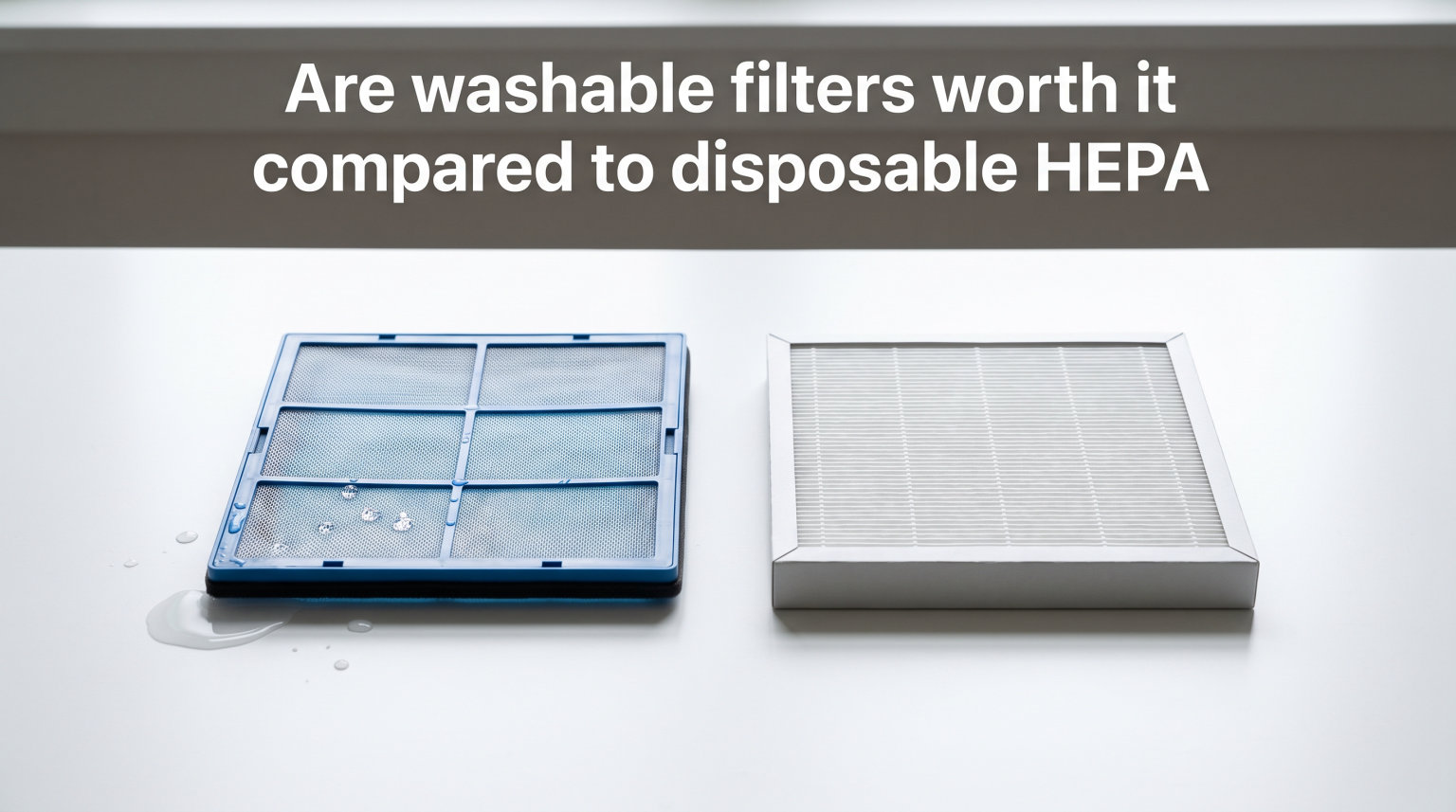
Indoor air quality matters more than most people realize. The EPA estimates we spend roughly 90% of our time indoors, where pollutant levels can run two to five times higher than outdoor air. Your choice of air filter plays a direct role in what you breathe every single day.
If you are weighing washable filters vs disposable HEPA, you are asking exactly the right question. Both promise cleaner air, but they take very different approaches to getting there. One prioritizes maximum particle capture. The other focuses on reusability and long-term savings.
I have spent months researching filter technologies, digging through HVAC professional discussions on Reddit, and comparing real-world cost data from homeowners who have used both types. What I found surprised me. The answer is not as straightforward as marketing materials suggest.
Washable filters appeal to anyone tired of buying replacements every few months. They sound practical and eco-friendly. But disposable HEPA filters dominate when it comes to actual particle removal rates. The trade-offs between convenience, cost, and effectiveness deserve careful consideration before you commit.
This guide breaks down exactly how each filter type works, compares their filtration performance using real MERV ratings, and lays out a five-year cost analysis with actual dollar amounts. You will also find household-specific recommendations based on whether you have pets, allergies, or particular indoor air quality concerns.
By the end, you will have a clear answer tailored to your situation rather than a generic recommendation. Let us get into the details.
Table of Contents
How Disposable HEPA Filters Work
Disposable HEPA filters represent the gold standard for particulate filtration. The term HEPA stands for High-Efficiency Particulate Air, and it is not just a marketing label. To qualify as true HEPA under DOE standards, a filter must capture at least 99.97% of airborne particles measuring 0.3 microns or larger.
That 0.3 micron threshold matters because it represents the Most Penetrating Particle Size, or MPPS. Particles at this size are the hardest to trap because they follow the airflow most easily. If a filter catches nearly everything at 0.3 microns, it performs even better on both larger and smaller particles.
HEPA media uses a dense mat of randomly arranged fiberglass fibers. These fibers trap particles through four distinct mechanisms working simultaneously. Interception grabs particles that follow an air stream line close enough to touch a fiber. Impaction forces larger particles to embed directly into fibers as they change direction.
Diffusion causes the smallest particles to move erratically and collide with fibers through Brownian motion. Sieving captures particles larger than the gaps between fibers. Together, these four mechanisms give HEPA its extraordinary capture efficiency across the full particle size spectrum.
In HVAC applications, disposable pleated filters typically carry MERV ratings between 9 and 13. A MERV 13 filter captures over 90% of particles in the 1 to 3 micron range, which includes most pollen, dust mites, and larger bacteria. True HEPA goes further, targeting the sub-micron range where viruses and fine combustion particles live.
The trade-off is that HEPA density creates significant airflow resistance. Your HVAC system or air purifier must work harder to push air through, which can increase energy consumption. Denser filtration also means the media loads up with particles faster and needs replacement every 6 to 12 months depending on usage and air quality conditions.
How Washable Filters Work
Washable filters take a fundamentally different approach to air cleaning. Instead of dense fiberglass media designed for one-time use, they rely on materials engineered to survive repeated cleaning cycles. Most use layered synthetic fibers, electrostatically charged plastic mesh, or aluminum frames with foam inserts.
The filtration mechanism in washable filters relies heavily on electrostatic attraction. As air passes through, the filter material develops a static charge that grabs and holds passing particles. This works reasonably well for larger contaminants like dust, pet hair, and lint. The charge acts like a magnet for airborne debris.
Here is where the performance gap appears. Most washable HVAC filters carry MERV ratings between 4 and 8. That means they capture larger particles effectively but miss many smaller contaminants. HVAC professionals on Reddit frequently note that washable filters typically catch only about 70% to 75% of larger particles, compared to 95% or better for MERV 9 through 12 disposable filters.
Washable air purifier filters perform somewhat better than their HVAC counterparts. Some models combine a washable prefilter with electrostatic collection plates. These can achieve higher capture rates for fine particles, though they still generally fall short of true HEPA performance standards.
The cleaning process itself is straightforward in concept. You remove the filter, rinse it with water to dislodge trapped particles, and let it dry completely before reinstalling. Some manufacturers recommend mild soap for stubborn residue. The key limitation is that oily or sticky particulates can be difficult to remove fully, and incomplete cleaning degrades performance over time.
Despite the marketing claims, most washable filters are not truly permanent. Manufacturers typically rate them for 5 to 8 years of use before the filtration media degrades. Electrostatic charge can diminish with repeated washing cycles. The frame may last longer, but the actual filtering material eventually needs replacement.
Washable Filters vs Disposable HEPA: Effectiveness Compared
When it comes to raw filtration power, disposable HEPA wins decisively. The numbers tell a clear story. A true HEPA filter captures 99.97% of particles at 0.3 microns. Most washable filters capture roughly 70% to 80% of particles in the 3 to 10 micron range and significantly less for finer particles.
This difference matters most for specific airborne threats. Pollen grains typically measure 10 to 100 microns, so both filter types handle them adequately. Dust mite debris falls between 0.5 and 50 microns, where the performance gap becomes visible. Mold spores range from 1 to 30 microns, and pet dander sits around 0.5 to 5 microns.
For these mid-range particles, disposable filters with MERV 11 or higher ratings consistently outperform washable options. The gap widens dramatically as particle sizes decrease.
The most critical difference involves sub-micron particles. Bacteria, virus carriers, fine smoke particles, and combustion byproducts measure well below 1 micron. Only true HEPA filtration effectively addresses these contaminants. Washable filters, even electrostatic ones, allow most sub-micron particles to pass straight through.
However, effectiveness depends partly on how you use the filter. Reddit users in HVAC communities report that washable filters work well as prefilters. They catch large particles before air reaches a finer disposable filter downstream. This extends the life of your primary HEPA filter and reduces overall replacement frequency noticeably.
One factor often overlooked is filter loading behavior. As a disposable HEPA filter fills with particles, its capture efficiency actually increases temporarily before airflow drops off. Washable filters behave differently. As they load up, their electrostatic charge weakens and capture efficiency can decline before you notice visible dirt buildup on the surface.
For allergy sufferers, the effectiveness gap is not academic. Research referenced by the EPA shows that HEPA filtration in air purifiers can reduce allergy symptoms by removing the specific particle sizes that trigger immune responses. Washable filters simply cannot match this level of fine particle removal, no matter how diligently you clean them.
Are Washable Filters Worth the Money? Cost Breakdown
Cost is where washable filters have their strongest argument. Let me break down real numbers based on current market prices for standard 20x25x1 HVAC filters.
A quality disposable pleated filter with a MERV 11 rating costs roughly $10 to $15 per unit. With quarterly replacement, that runs $40 to $60 per year. Over five years, you spend $200 to $300 on filters alone. Add the slightly higher energy costs from denser filtration media, and the total creeps toward $350 for the period.
A washable electrostatic filter costs $40 to $75 upfront. You clean it yourself with no replacement purchases for roughly 5 years. The only ongoing cost is water and a small amount of mild soap. Over the same five-year period, your total cost stays near that initial $40 to $75 investment.
That represents a potential savings of $125 to $275 over five years for a single filter slot. Homes with multiple return air vents multiply this advantage significantly. A house with three filter slots could save $375 to $825 over five years by switching to washable filters across all vents.
For standalone air purifiers, the math shifts somewhat. True HEPA replacement cartridges for quality air purifiers cost $30 to $90 each and typically need replacement every 6 to 12 months. Washable air purifier filters cost more upfront but eliminate those recurring expenses. Over three to five years, the savings can reach $180 to $450 per unit.
The catch is that washable filters only deliver savings if you actually clean them on schedule. Forget to clean for a few months and your HVAC system works harder, driving up energy bills. The electricity cost of a clogged filter can add $20 to $50 per month to your utility bill, wiping out any savings in a matter of weeks.
Lifespan also affects the calculation. Most washable filters last 5 to 8 years with proper care. If you need to replace one after 3 years due to damage or media degradation, the cost advantage shrinks considerably. Quality matters here, and cheaper washable filters often degrade faster than premium options from established brands.
Maintenance Requirements: Time and Effort Compared
Disposable filters win on convenience hands down. You swap one out every 3 to 6 months, toss the old one, and slide the new one in. The entire process takes about 5 minutes and requires zero cleanup. This is the definition of set-and-forget filtration for busy households.
Washable filters demand a regular cleaning routine that you cannot skip without consequences. Most manufacturers recommend cleaning every 1 to 3 months depending on air quality and household conditions. Homes with pets or high dust levels may need monthly cleaning to maintain decent airflow through the system.
The cleaning process itself takes 20 to 40 minutes per filter when done properly. You need to remove the filter, rinse it thoroughly with a hose or in a utility sink, apply mild soap if needed, scrub gently to remove trapped debris, and then let it dry completely before reinstalling.
Rushing the drying step leads to mold and mildew problems that Reddit users frequently complain about. Drying time is the real bottleneck. Most washable filters need 20 to 30 minutes of air drying, and some require longer depending on humidity levels. You cannot reinstall a damp filter without risking biological growth inside your HVAC system.
This means you either need a backup filter to use during drying time or you run your system without filtration temporarily. Neither option is ideal.
Some users report frustration with oily or sticky particulates that resist simple rinsing. Cooking grease, cigarette smoke residue, and certain pet dander oils cling to filter fibers and require multiple washes to remove. Over time, stubborn buildup can permanently reduce filter effectiveness even with careful cleaning.
Disposable filters also require some maintenance awareness. You still need to check them periodically and replace them before they become dangerously clogged. A neglected disposable filter causes the same airflow problems as a neglected washable one. The difference is that replacement takes minutes while cleaning takes substantially longer.
For busy households, the maintenance burden of washable filters is the most common reason people switch back to disposables. The promised savings only materialize if you commit to the cleaning schedule for years without interruption.
Environmental Impact: Which Filter Creates Less Waste?
Washable filters generate significantly less physical waste over their lifespan. A single washable filter can replace 20 to 40 disposable filters over 5 years. For a household using 4 disposable filters per year across multiple vents, that adds up to dozens of filters heading to landfills annually.
Most disposable HVAC filters are not recyclable. They combine fiberglass or synthetic fiber media with cardboard frames and wire supports. The mixed materials make separation impractical for recycling facilities. Used filters also contain trapped contaminants like dust, pollen, and mold spores that complicate any recycling process.
The environmental picture gets more complex when you factor in energy consumption. Denser disposable filters increase airflow resistance, which means your HVAC blower motor draws more electricity. Over months and years, this additional energy use has a real carbon footprint that offsets some of the waste reduction benefits of switching.
Washable filters generally allow better airflow, reducing strain on your HVAC system and lowering energy draw. However, the cleaning process uses water and sometimes soap. For households in drought-prone areas, the water usage for regular filter cleaning may be a legitimate concern. The environmental math depends heavily on your local water and energy situation.
Manufacturing impact also differs between the two options. A washable filter requires more raw materials and energy to produce initially compared to a single disposable. That upfront environmental cost only pays off if the filter actually reaches its projected lifespan. Premature replacement negates the manufacturing advantage entirely.
The most environmentally conscious approach may be a hybrid system. Using a washable prefilter to capture large particles extends the life of your disposable HEPA filter. You replace the HEPA less frequently, reducing waste while maintaining high filtration standards. This approach minimizes both landfill contribution and energy waste simultaneously.
Ozone Emissions and Safety Considerations
Some washable air purifier filters use electrostatic precipitation technology. These systems charge particles electrically and collect them on metal plates or charged surfaces. While effective at capturing certain contaminants, they can produce ozone as a byproduct of the ionization process.
Ozone is a lung irritant that can worsen asthma symptoms and damage respiratory health over time. The California Air Resources Board sets a strict ozone emission limit of 50 parts per billion for indoor air cleaning devices. Some electrostatic filter designs exceed this threshold, which is why certain models cannot legally be sold in California.
If you are considering a washable electrostatic air purifier, check its ozone certification carefully. Look for models that meet CARB standards or carry UL 867 certification for ozone safety compliance. This detail is rarely mentioned in marketing materials but matters significantly for respiratory health.
Disposable HEPA filters produce zero ozone. Their mechanical filtration process involves no electrical charging or ion generation whatsoever. For households with asthma sufferers, young children, or elderly residents, this safety advantage reinforces the case for HEPA filtration.
Standard washable HVAC filters do not produce ozone since they rely on passive electrostatic charge in the filter material itself, not active electronic precipitation. The ozone concern applies primarily to plug-in electronic air cleaners and ionizer-based washable air purifiers, not to passive washable HVAC filters.
Which Filter Type Fits Your Household?
After analyzing the data and reading hundreds of real user experiences across Reddit HVAC and homeowner communities, clear patterns emerge for who benefits most from each filter type.
Best Candidates for Disposable HEPA Filters
Allergy and asthma sufferers should strongly prefer HEPA filtration. The 99.97% capture rate at 0.3 microns directly addresses the particle sizes that trigger immune responses. Pollen, dust mite debris, mold spores, and pet dander all fall into ranges where HEPA dramatically outperforms washable alternatives.
Households in areas with wildfire smoke, heavy traffic pollution, or industrial emissions need sub-micron filtration. Fine particulate matter from combustion sources measures well below 1 micron. Only HEPA-grade filtration effectively removes these contaminants from indoor air.
Anyone with compromised immune systems or respiratory conditions benefits from the superior bacterial and viral particle capture of HEPA media. The peace of mind from maximum filtration justifies the ongoing replacement costs for these households.
Best Candidates for Washable Filters
Budget-conscious homeowners without specific air quality concerns can save meaningfully with washable filters. If no one in your household has allergies or respiratory issues, the filtration gap may not matter for everyday comfort and dust control.
Pet owners often appreciate washable filters for high-traffic areas. Pet hair and large dander particles clog disposable filters quickly. A washable prefilter or primary filter lets you clean frequently without buying replacements constantly, which Reddit pet owners consistently highlight as a major advantage.
Eco-conscious consumers who want to reduce landfill waste find washable filters appealing. The waste reduction is real and measurable over years of use, especially for homes with multiple filter slots running year-round.
Busy households without indoor air quality concerns can manage the lighter maintenance schedule that washable filters require. If quarterly replacement sounds easier than monthly cleaning, disposables may still be your better fit despite the cost difference.
Hybrid Filter Systems: Getting the Best of Both
The hybrid approach deserves far more attention than it typically receives in filter comparisons. This setup pairs a washable prefilter with a disposable HEPA or high-MERV filter positioned downstream. The prefilter catches large particles, extending the life of the more expensive primary filter significantly.
In practice, this can double or triple the lifespan of your HEPA filter. Instead of replacing every 3 months, you might stretch replacement intervals to 6 or 9 months. The washable prefilter handles the bulk of large particle capture while the HEPA focuses on the fine particulates that actually impact health.
For standalone air purifiers, many quality models already use this architecture out of the box. A washable foam or mesh prefilter wraps around the HEPA cartridge. You clean the prefilter monthly and replace the HEPA annually instead of every 6 months, cutting replacement costs in half.
The cost math works well here. You spend more upfront for two filter stages but reduce replacement frequency for the expensive component. Over five years, a hybrid system can cost less than disposable-only setups while maintaining superior air quality throughout your home.
Reddit HVAC discussions consistently favor this approach. Professional technicians note that prefilters protect equipment by reducing the particle load on primary filtration media. Less loading means less strain on blower motors and longer equipment life overall.
If you cannot decide between washable and disposable, the hybrid path lets you capture the benefits of both without fully committing to either extreme. It is the most pragmatic solution for households that want good air quality without overspending.
How to Clean Washable Filters Properly
Proper cleaning technique determines whether your washable filter delivers its promised value over the years. Follow these steps to maintain effectiveness and extend filter lifespan as long as possible.
Step 1: Remove the filter carefully to avoid releasing trapped particles back into your air. Carry it directly outside or to a utility sink rather than shaking it indoors.
Step 2: Rinse with a steady stream of water from a garden hose or faucet. Start from the clean side and work toward the dirty side. This pushes debris out rather than driving it deeper into the filtration media where it becomes harder to remove.
Step 3: Apply mild dish soap if the filter has oily residue or sticky buildup. Work it gently into the material with your hands or a soft brush. Avoid harsh chemicals, solvents, or pressure washers that can damage the delicate filtration fibers.
Step 4: Rinse thoroughly until water runs completely clear. Any soap residue left behind will attract particles and reduce the electrostatic charge effectiveness that gives washable filters their capturing power.
Step 5: Shake off excess water and let the filter dry completely in a well-ventilated area. This typically takes 20 to 30 minutes depending on humidity. Never reinstall a damp filter, as trapped moisture promotes mold growth inside your HVAC system and can create serious air quality problems.
Step 6: Inspect the filter for damage before reinstalling. Look for tears in the media, warped frames, or areas where the material has thinned significantly. Replace immediately if you notice structural damage that compromises filtration integrity.
Clean your washable filter every 1 to 3 months depending on household conditions. Homes with pets, high foot traffic, or construction nearby need monthly attention. Mark your calendar or set a phone reminder, because forgetting to clean defeats the entire purpose of choosing washable over disposable.
FAQs
Are washable HEPA filters as effective?
No. True HEPA filters capture 99.97% of particles at 0.3 microns, while most washable filters achieve only 70% to 80% capture rates for particles in the 3 to 10 micron range and significantly less for finer particles. Washable filters typically carry MERV ratings of 4 to 8, compared to MERV 11 or higher for quality disposable filters. The filtration gap is most noticeable for sub-micron particles like bacteria, fine smoke, and combustion byproducts.
Are washable air filters worth the money?
It depends on your priorities. Washable filters cost $40 to $75 upfront but can save $125 to $275 over five years compared to quarterly disposable replacements for a single filter slot. However, these savings only materialize if you clean the filter regularly. If you skip cleanings, clogged filters increase energy bills by $20 to $50 monthly, eliminating any savings quickly. Households without allergy concerns benefit most from the cost advantage.
How long does a washable filter last?
Most washable filters are rated for 5 to 8 years of use with proper cleaning and maintenance. The frame may last longer, but the filtration media degrades over time as electrostatic charge weakens and fibers break down. Cheaper models may need replacement after 3 years. Regular gentle cleaning and careful handling extend the effective lifespan toward the upper end of that range.
Is a washable filter better than a HEPA filter?
Neither is universally better. HEPA filters win on filtration effectiveness, capturing particles that washable filters miss entirely. Washable filters win on long-term cost savings and reduced landfill waste. For allergy sufferers and those needing maximum air quality, HEPA is the clear choice. For budget-conscious households without specific air quality concerns, washable filters offer practical savings. A hybrid system using both types captures benefits from each.
Can you wash a true HEPA filter?
No. True HEPA filters are not designed to be washed or reused. Water damages the dense fiberglass media, destroying the fiber matrix that provides the 99.97% filtration efficiency. Washing can also introduce moisture that promotes mold growth within the filter material itself. Attempting to wash and reuse a HEPA filter significantly reduces its effectiveness and may create additional air quality problems in your home.
Do washable air filters really work?
Yes, but with important limitations. Washable filters effectively capture large particles like dust, pet hair, and lint through electrostatic attraction. They work well as prefilters that protect finer downstream filtration stages. However, they miss many smaller particles that HEPA captures, particularly in the sub-micron range. For basic dust control in homes without allergy concerns, washable filters perform adequately. For fine particle removal and respiratory protection, their performance falls well short of HEPA standards.
Are reusable filters better for the environment?
Reusable filters generate less landfill waste since one filter can replace 20 to 40 disposable filters over five years. However, the manufacturing impact is higher initially, and the cleaning process uses water and sometimes soap. The environmental benefit depends on whether the filter reaches its projected lifespan and on your local water and energy resources. A hybrid system using a washable prefilter plus disposable HEPA offers the best environmental balance by extending HEPA life while reducing overall waste.
Conclusion
The washable filters vs disposable HEPA debate does not have a single right answer. Your best choice depends entirely on your household priorities, budget constraints, and specific air quality needs.
For maximum filtration and respiratory protection, disposable HEPA remains the clear winner. The 99.97% capture rate at 0.3 microns addresses the exact particle sizes that impact health. Allergy sufferers, asthma patients, and anyone in polluted areas should choose HEPA without hesitation.
For cost savings and waste reduction, washable filters deliver genuine value. The five-year savings of $125 to $275 per filter slot adds up quickly, especially in homes with multiple return vents. Just commit to the cleaning schedule, or those savings evaporate through higher energy bills.
The hybrid approach offers the smartest compromise for many households. A washable prefilter captures large particles while extending the life of your disposable HEPA filter. You get superior air quality with reduced replacement frequency and lower long-term costs across the board.
Whichever path you choose, consistency matters more than the filter type itself. A regularly maintained filter of either type outperforms a neglected one every time. Set reminders, follow your replacement or cleaning schedules, and your indoor air quality will reflect the effort you put in.