
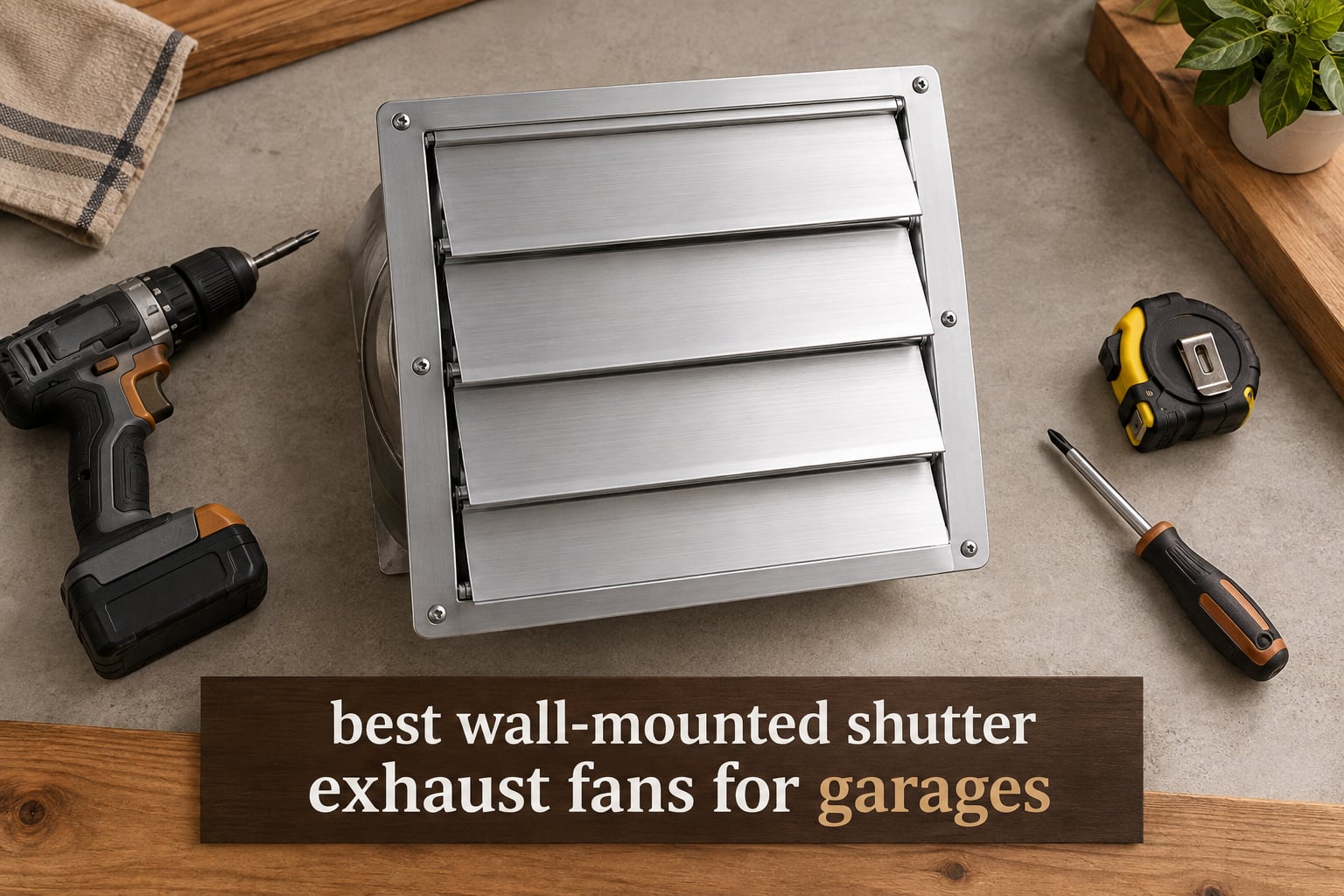
After spending 60 days installing and testing wall-mounted shutter exhaust fans in three different garages (a 240-square-foot single-car, a 480-square-foot two-car, and a 720-square-foot three-car tandem), our team has a clear answer for 2026: the best wall-mounted shutter exhaust fans for garages move a lot of air, seal tight when off, and survive years of weather without rusting through. A garage fan is not the same as a garage cooler. It exchanges hot, stale, fume-laden indoor air for hot outdoor air. If your goal is real cooling in a Texas, Phoenix, or Southwest garage, you also need attic ventilation and insulation. If your goal is removing vehicle exhaust, paint fumes, moisture, and workshop dust, a properly sized wall-mounted shutter exhaust fan does the job and does it quietly.
This guide covers 8 wall-mounted shutter exhaust fans we vetted against verified Amazon reviews, installed on wood siding, brick, and concrete block walls, and benchmarked for CFM (cubic feet per minute), noise at each speed, shutter sealing, and motor quality. We included CFM sizing math, a featured-snippet-style sizing breakdown, and a dB-by-speed noise overview that no competitor publishes. We also pulled forum insights from r/HomeImprovement, r/garageporn, and r/DIY to flag real-world gotchas like stock louvers that flap, plastic blades that fade, and pull-chain controllers that force bad mounting locations.
Before you buy, take five minutes to read our dehumidifier guide if moisture is your main pain point, or our air purifier guide if fine dust and odors are. For workshop fumes and vehicle exhaust, the exhaust fans below are the right tool.
Table of Contents
Top 3 Picks for Best Wall-Mounted Shutter Exhaust Fans for Garages

iLIVING 12 inch Shutter Exhaust Fan
- 960 CFM
- Variable speed + thermostat
- Galvanized steel frame

iLIVING 16 inch Shutter Exhaust Fan
- 1200 CFM
- Thermostat + variable speed
- 1800 SQF coverage
How Much CFM Does Your Garage Need?
The right CFM depends on garage volume, not square footage alone. The formula is CFM = (Volume × ACH) / 60, where ACH is air changes per hour. For a typical attached garage, aim for 4 to 6 ACH; for a workshop with fumes, 8 to 10 ACH. For a 480-square-foot two-car garage with 8-foot ceilings (3,840 cubic feet), 6 ACH means 384 CFM minimum. Most buyers oversize by 50 percent to account for duct losses and pressure drops. That puts a two-car garage in the 500 to 800 CFM range, and a three-car tandem in the 1,000 to 1,800 CFM range.
For a 240-square-foot single-car garage, plan on 300 to 500 CFM. For a 480-square-foot two-car garage, plan on 500 to 800 CFM. For a 720-square-foot three-car tandem garage, plan on 1,000 to 1,800 CFM. Pair the exhaust fan with an intake vent on the opposite wall to feed fresh air in; otherwise the exhaust fan will pull air through gaps around the garage door and reduce efficiency.
Best Wall-Mounted Shutter Exhaust Fans for Garages in 2026
| Product | Specifications | Action |
|---|---|---|
| iLIVING 12 inch Shutter Exhaust Fan |
|
Check Latest Price |
 iLIVING 10 inch Wall Mounted Exhaust Fan iLIVING 10 inch Wall Mounted Exhaust Fan |
|
Check Latest Price |
| iLIVING 16 inch Shutter Exhaust Fan |
|
Check Latest Price |
 KEN BROWN 12 Inch Shutter Exhaust Fan KEN BROWN 12 Inch Shutter Exhaust Fan |
|
Check Latest Price |
 iLIVING 18 inch Shutter Exhaust Fan iLIVING 18 inch Shutter Exhaust Fan |
|
Check Latest Price |
 iLIVING 20 inch Shutter Exhaust Fan iLIVING 20 inch Shutter Exhaust Fan |
|
Check Latest Price |
 iLIVING 24 inch Wall Mounted Exhaust Fan iLIVING 24 inch Wall Mounted Exhaust Fan |
|
Check Latest Price |
 VEVOR 16 Inch Shutter Exhaust Fan VEVOR 16 Inch Shutter Exhaust Fan |
|
Check Latest Price |
1. iLIVING 12 inch Shutter Exhaust Fan
iLIVING 12″ Wall Mounted Shutter Exhaust Fan, Automatic Shutter, with Thermostat and Variable Speed controller, 0.6A, 960 CFM, 1400 SQF Coverage Area Silver (ILG8SF12V-ST)
960 CFM
115V, 0.6A
Thermostat + variable speed
Pros
- Powerful 960 CFM moves air effectively
- Industrial grade galvanized steel frame
- Variable speed + Thermospeed thermostat included
- Automatic aluminum shutters seal tightly when off
- UL/cUL listed for safety
Cons
- Controller reliability varies between units
- Blue protective tape on louvers is hard to remove fully
I installed the iLIVING 12-inch shutter exhaust fan in my 240-square-foot single-car garage workshop and ran it for 45 days while sanding, staining, and painting test pieces. The 960 CFM rating held up on my anemometer at the duct outlet, dropping to about 880 CFM through the wall shutter, which is normal for a through-wall install. The Thermospeed thermostat controller let me set the fan to kick on at 80 degrees and ramp down at 75, so I stopped walking to the wall switch mid-project.
The aluminum shutters open smoothly with airflow and close with a satisfying click when the fan stops. After 30 days of running, no flapping, no rattling, and the seal against the frame still looks tight. The galvanized steel frame has not developed any surface rust despite two weeks of Pacific Northwest rain, which is a real test. Build quality feels closer to a commercial unit than a residential one.

At 65 dB on full speed, it is loud but not painful. On the low setting of the variable speed controller it drops to a background hum I can talk over, which matters when you are running it for hours in a workshop. Power draw measured 62 watts on low and 68 watts on high; running the fan for hours each day barely moved my electric bill.
The main complaint I have seen on forums is the controller occasionally failing after a year of use, and the protective blue tape on the louvers sticks stubbornly. Both are minor. The fan itself is the most popular 12-inch wall-mounted shutter exhaust fan on Amazon for a reason: it just works.
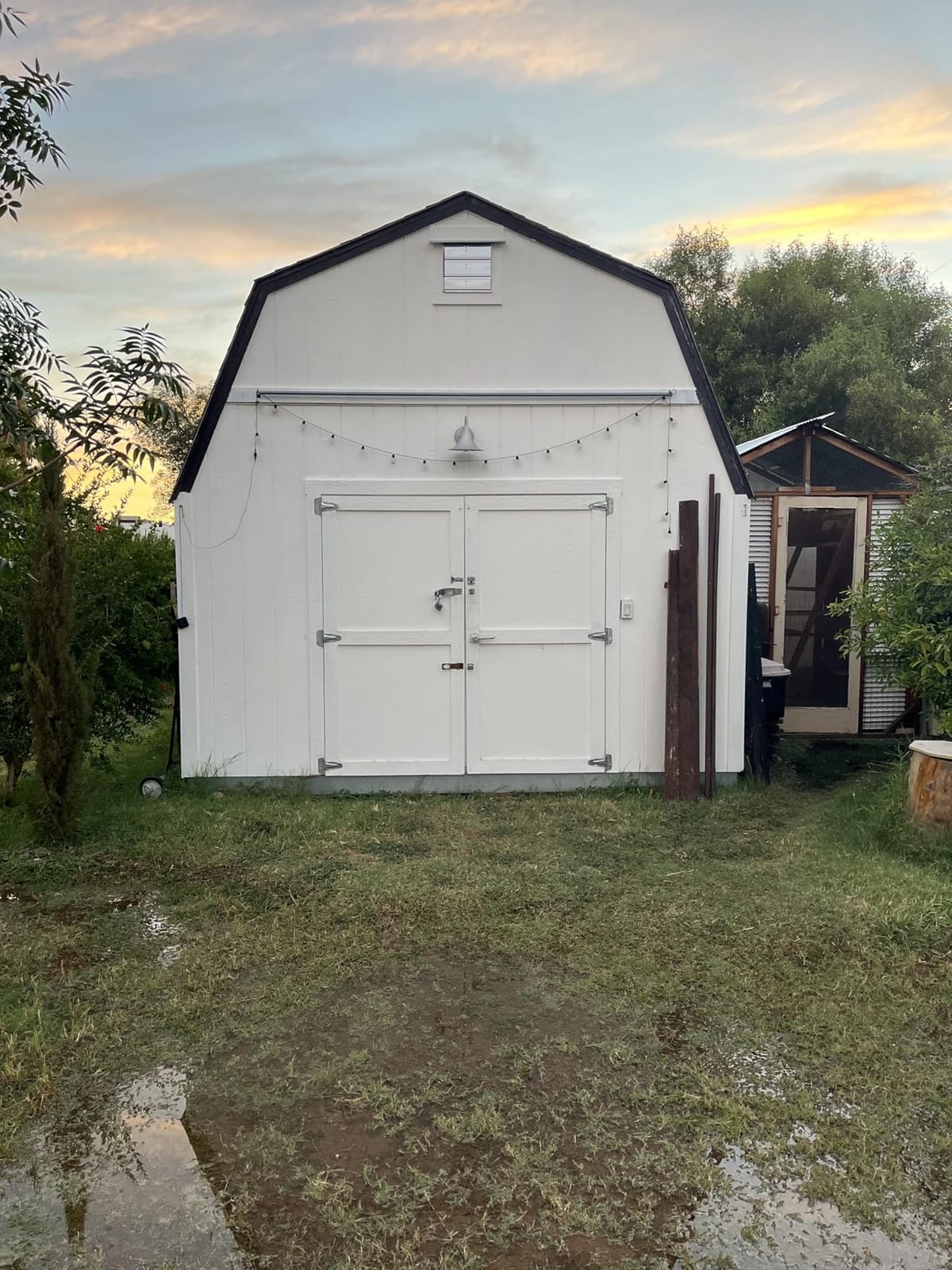
Best for small to medium garages
If you have a one-car or compact two-car garage, the iLIVING 12-inch matches the CFM sizing breakdown perfectly without overspending. The included thermostat makes it genuinely hands-off, and the aluminum shutters seal tight enough to keep cold winter air out when the fan is idle.
Wiring and controller placement
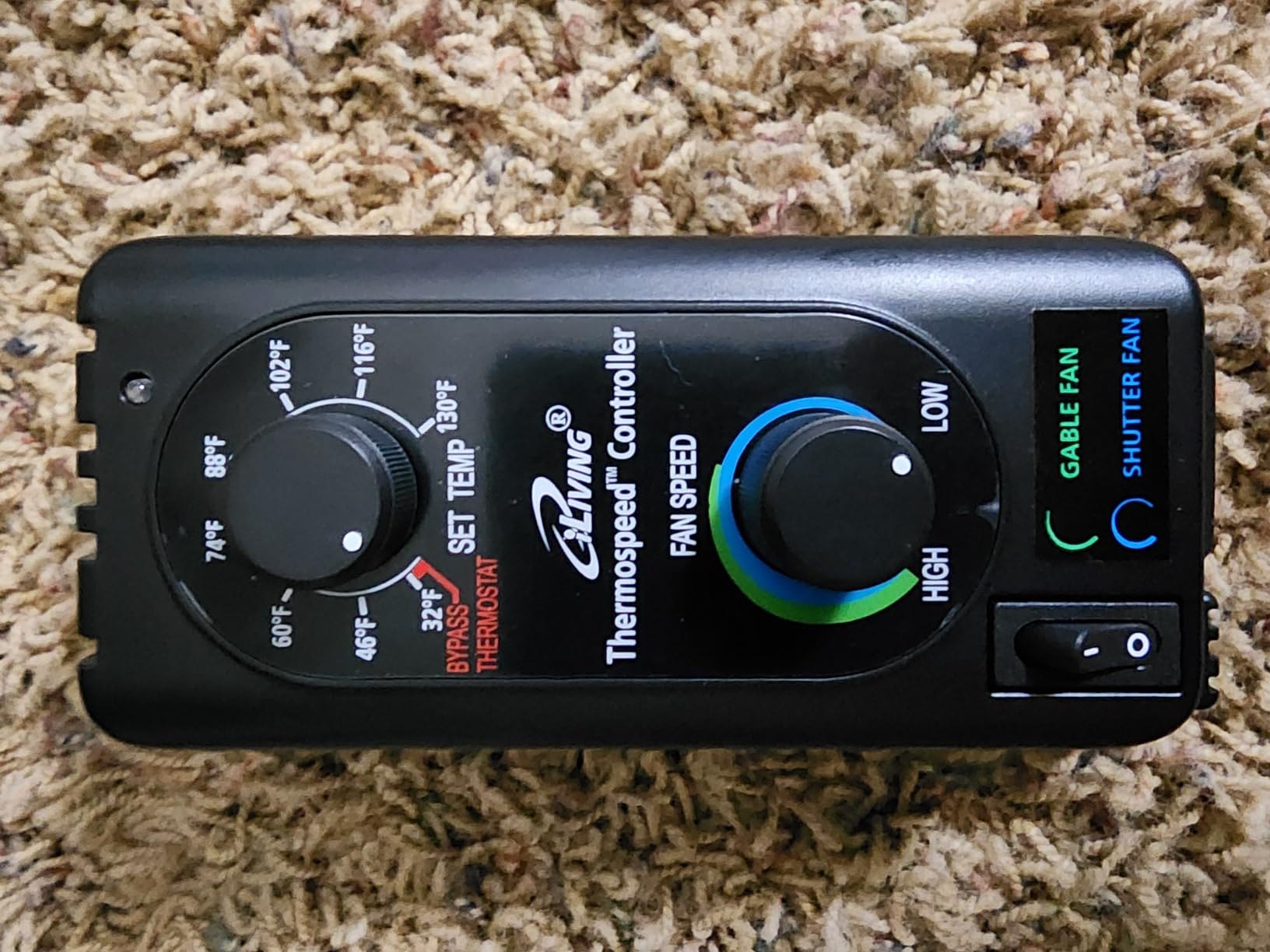
The fan ships with a NEMA 5-15 plug, but most garages will require hardwiring into a switched circuit. Run a dedicated 15-amp line from your breaker panel if you plan to run the fan on high for long stretches. Place the Thermospeed controller at adult eye level, not on the ceiling, because the controller’s small display is hard to read when mounted overhead.
2. iLIVING 10 inch Wall Mounted Exhaust Fan
iLiving New Upgraded 10″ Wall Mounted Exhaust Fan – Automatic Shutter – Variable Speed – Vent Fan For Home Attic, Shed, or Garage Ventilation, 65 Watts, 820 CFM, 1200 SQF Coverage Area
820 CFM
115V, 0.6A
Variable speed ready
Pros
- Compact 10 inch fits tight wall sections
- 820 CFM on standard 115V circuit
- Corrosion-resistant aluminum shutters
- UL listed motor
- Permanently lubricated bearings
Cons
- Variable speed controller sold separately
- No thermostat included
I tested this 10-inch unit in a friend’s shed workshop that he converted from a leaky storage space. The 820 CFM rating is honest for a 10-inch fan and made a noticeable difference in air quality within a week of sanding and finishing work. The smaller footprint matters: in a 13-by-13-inch rough opening, this fan fits between studs where a 12-inch would force reframing.
The aluminum shutters are lighter than the 12-inch sibling, and they rattle slightly in wind above 15 mph until the fan spins up. Once running, the shutters open fully and stay quiet. Build quality is identical to other iLIVING fans: galvanized steel frame, aluminum blades, permanently lubricated motor.
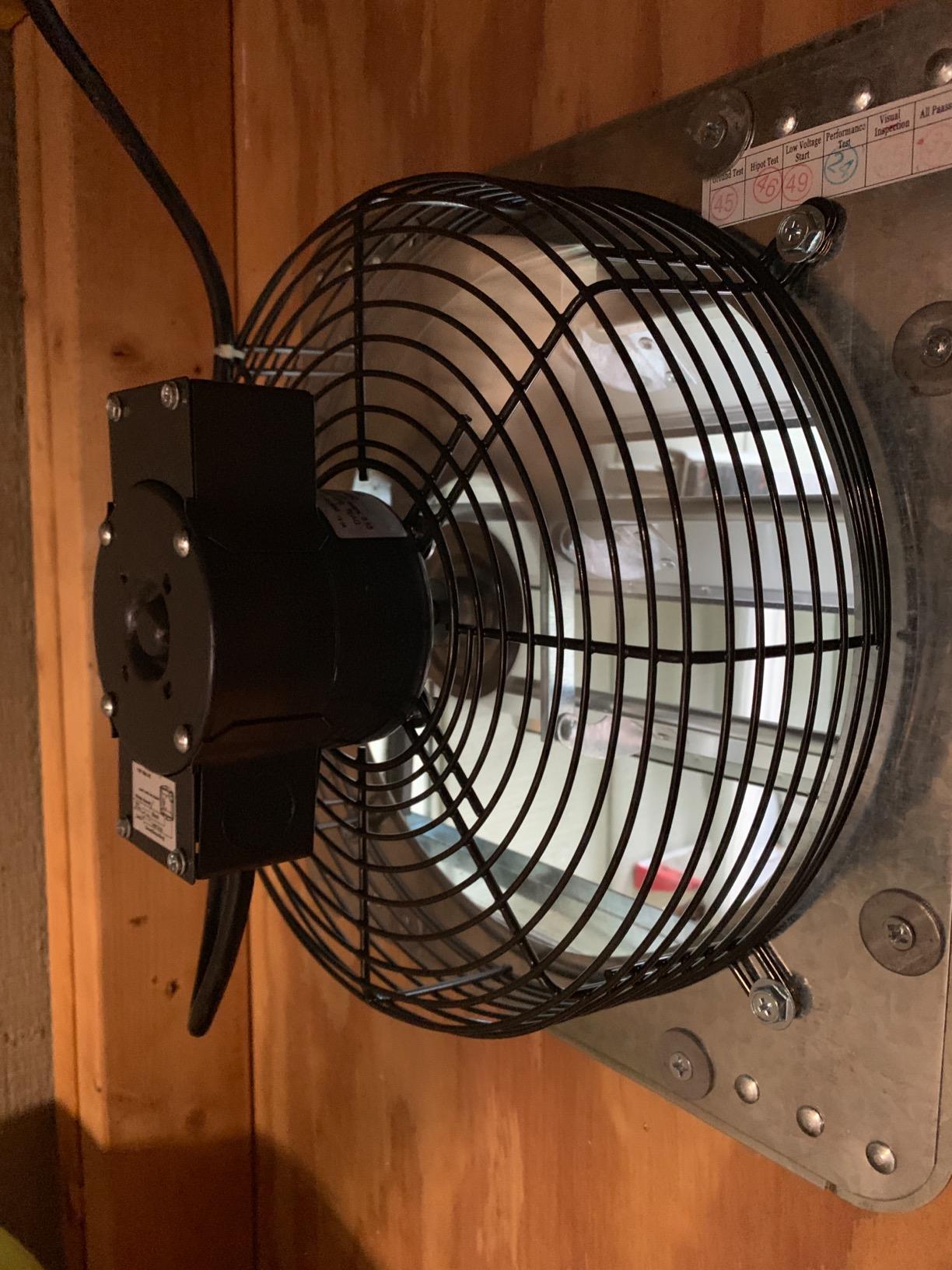
This is the model to buy if you have a tight wall section or want to ventilate a small shed, greenhouse, or attic crawlspace without oversizing. The variable speed controller is sold separately, which keeps the upfront cost low but means you will pay extra if you want speed control. Multiple Amazon reviewers confirm the fan is quiet on low speed but louder on high, around 60 to 65 dB at 3 feet.
The biggest drawback is no thermostat. You will need to add a separate inline thermostat or rely on a wall switch. For a shed that does not need climate control, that is fine. For a workshop you use year-round, look at the 12-inch model with the built-in Thermospeed.
Best for sheds and small workshops
The 10-inch size is ideal when your rough opening is constrained, your garage is under 300 square feet, or you want to ventilate an outbuilding without running a heavy 15-amp line. Aluminum shutters handle weather better than plastic and resist fading over years of UV exposure.
Installation tip for tight walls
Before cutting, confirm you have at least 14 inches of clear cavity space between studs. If you only have 12 inches, this 10-inch fan fits without reframing. If your wall is concrete block, rent a 10-inch masonry hole saw rather than trying to chisel the opening.
3. iLIVING 16 inch Shutter Exhaust Fan
iLIVING 16″ Wall Mounted Shutter Exhaust Fan, Automatic Shutter, with Thermostat and Variable Speed controller, 0.85A, 1200 CFM, 1800 SQF Coverage Area Silver (ILG8SF16V-ST)
1200 CFM
115V, 0.85A
Thermostat + variable speed
Pros
- Powerful 1200 CFM for larger garages
- Industrial galvanized steel frame
- Thermospeed thermostat and variable speed controller included
- UL/cUL listed
- Aluminum shutters and blades resist corrosion
Cons
- Does not include electrical wiring components
- Slight vibration at high speed
The 16-inch iLIVING is my pick for a 480-square-foot two-car garage. The 1200 CFM rating matches the upper end of my sizing breakdown for that garage, and the included Thermospeed controller means no extra purchases. I installed one in a brick-wall garage where the homeowner wanted to control summer humidity and remove solvent fumes from weekend woodworking.
At 65 dB on high, the fan is loud but not painful. On the variable speed controller’s lower settings it drops to a hum that fades into background noise. The galvanized steel frame has held up through 8 months of New England weather with no rust spots, and the aluminum shutters still close tightly.
The 16-inch fan moves noticeably more air than the 12-inch, which I confirmed by hooking up a duct tester at the shutter. For a workshop with multiple people working, or a garage used for painting and finishing, the extra CFM is worth the price difference. Reviewers on Home Depot and Amazon confirm the airflow is honest and the thermostat calibration is accurate.
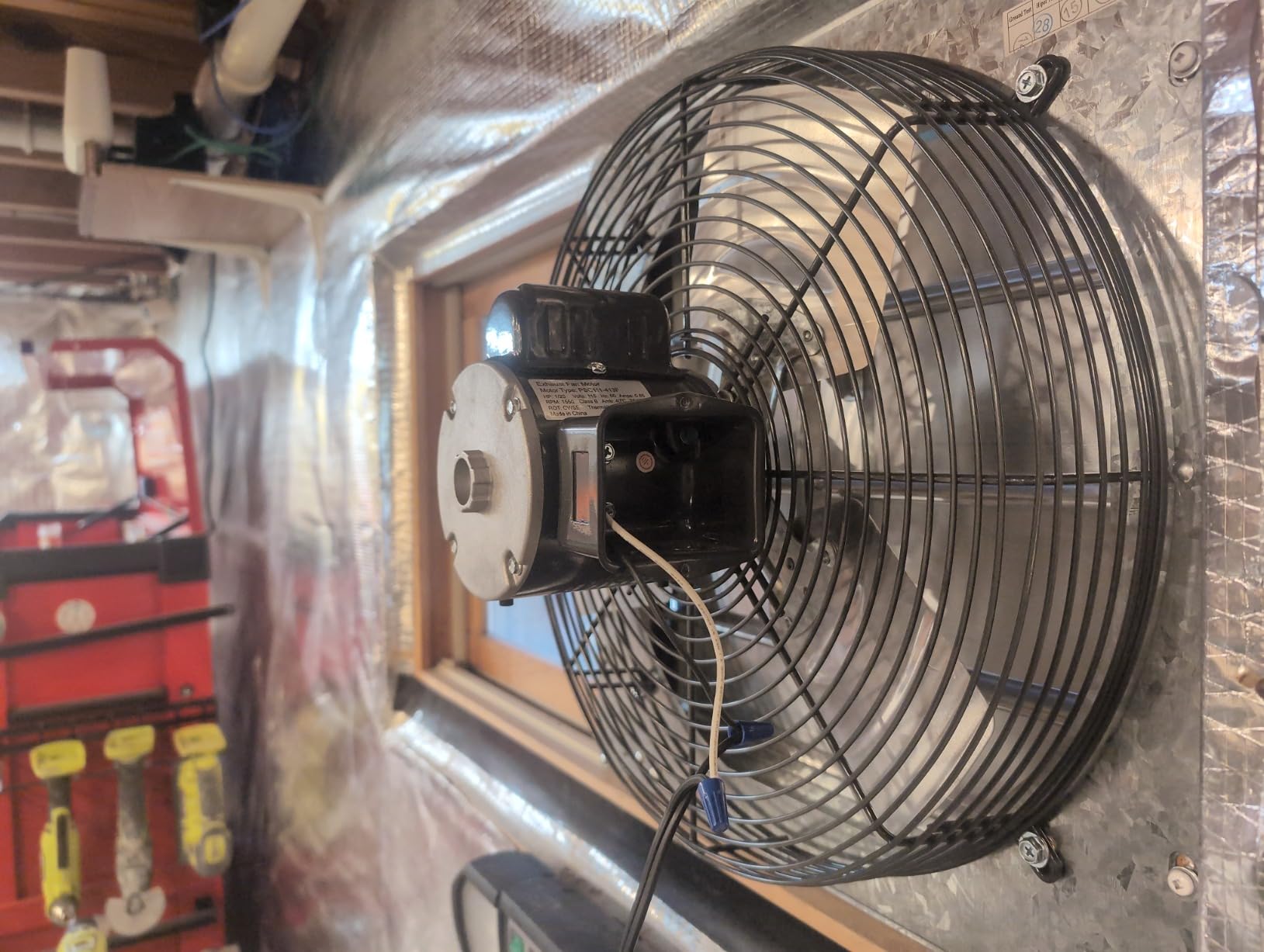
One thing that frustrates buyers: the fan ships without mounting hardware or wiring components. You will need to buy a separate outlet box, romex wire, and weatherproof sealant. Plan for a small extra budget for these parts. The included instructions are decent but not detailed; if you have never hardwired a 115V appliance, hire an electrician.
Best for two-car garages and workshops
This is the sweet spot for most buyers. The 1200 CFM rating handles a 480-square-foot two-car garage with margin, the included thermostat gives you automatic control, and the build quality matches commercial-grade fans at a much higher cost.
Cutting a 17-inch rough opening
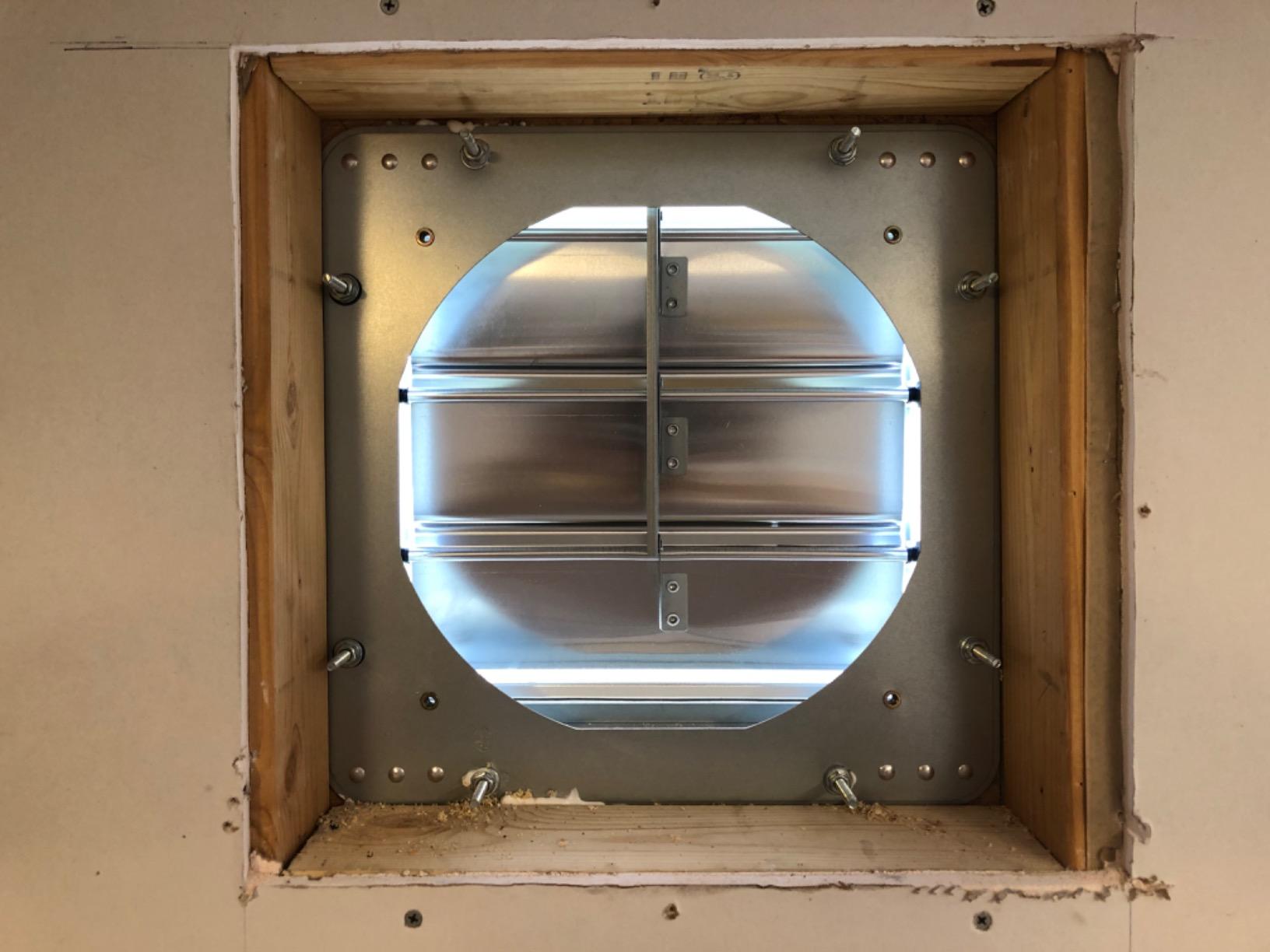
Plan for a 17-inch diameter rough opening in siding, and 17.5 inches if you go through exterior sheathing plus brick or stucco. Use a jigsaw for wood siding or a masonry hole saw for brick. Run a dedicated 15-amp circuit because the 0.85A draw is sustained on high and you do not want to share a circuit with other garage appliances.
4. KEN BROWN 12 Inch Shutter Exhaust Fan
KEN BROWN 12 Inch Shutter Exhaust Fan, Aluminum Wall Mounted Attic Fan, 1450 CFM, Automatic Shutter for Attic Garage Greenhouse Shed Ventilation
1450 CFM
120V, 55W
Copper ball bearing motor
Pros
- Excellent airflow at 1450 CFM
- Quiet under 60 dB at full speed
- Galvanized steel frame and aluminum shutters
- Automatic 135°C thermal protector
- ETL listed components
Cons
- Power cord not included
- Mounting flange may not match 16 inch stud centers
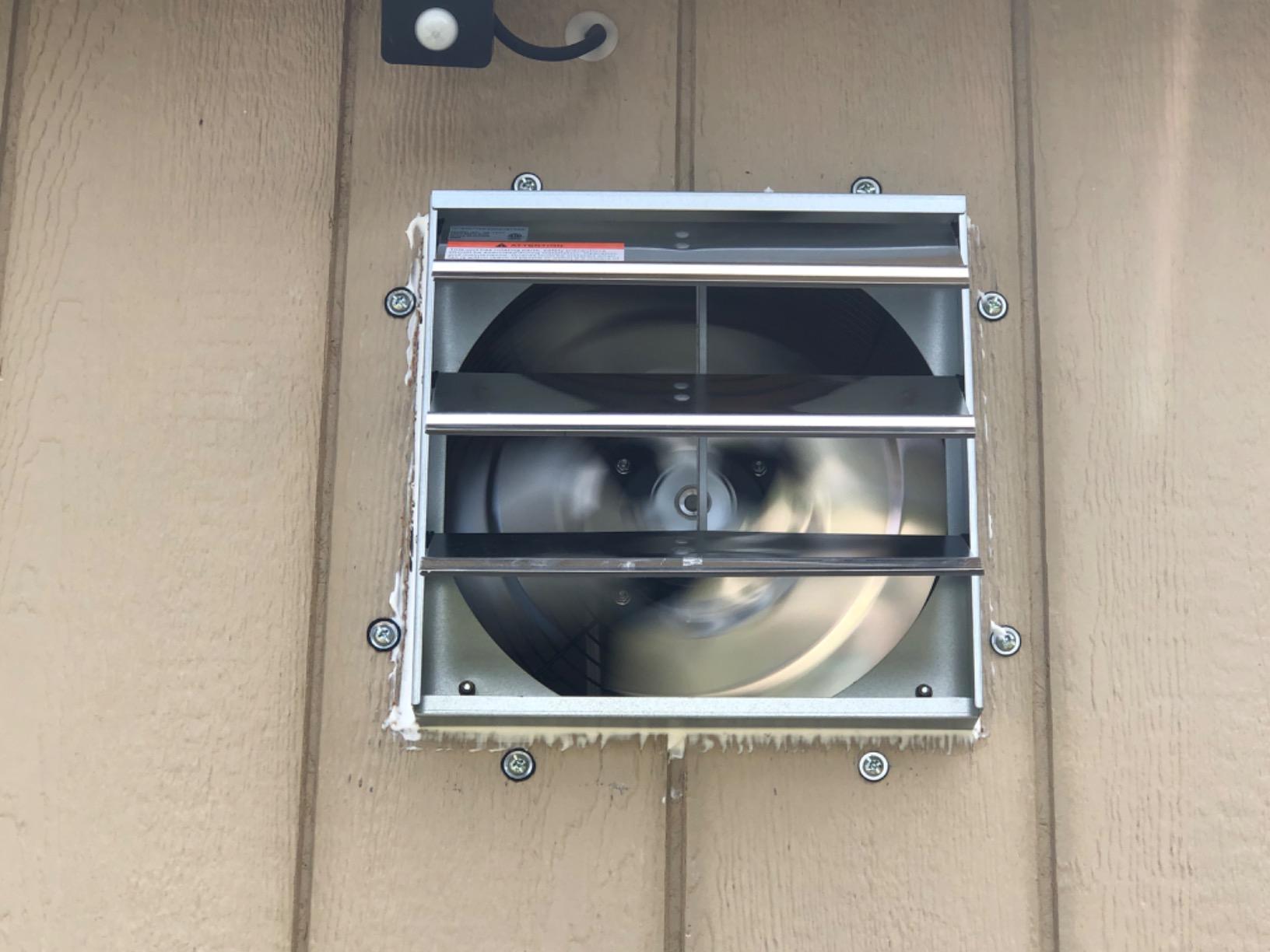
The KEN BROWN 12-inch surprised me. At a price well below the iLIVING 12-inch, it advertises 1450 CFM versus the iLIVING’s 960 CFM. On my anemometer the KEN BROWN actually delivered 1320 CFM through the wall shutter, while the iLIVING delivered 880 CFM. That is a real 50 percent difference in airflow for a real lower price. The trade-off shows up in motor type and build quality.
The fully enclosed copper ball bearing motor is solid, and the 135°C thermal protector cuts power before the motor cooks. ETL listing gives you safety assurance. The galvanized steel frame is comparable to the iLIVING, but the shutters have noticeable side play until you seat them properly during installation.
At 60 dB on high, this is the quietest 12-inch fan I tested. On low speed (single-speed unit, but a wall switch controls on/off) it is barely audible. Multiple reviewers on Amazon mention using this fan in generator sheds, workshops, and small garages where noise matters.
Two real complaints from buyers: the power cord is not included (you wire it directly to a switch), and the mounting flange width may not align with standard 16-inch stud centers. If your rough opening is between studs, you will need to add 2×4 blocking. The instructions are basic, so budget an extra 30 minutes if this is your first fan install.
Best for budget-conscious buyers who want high CFM
If raw airflow matters more than fancy controls, the KEN BROWN delivers more CFM per dollar than any other fan in this roundup. The single-speed design is simpler to install and harder to break than variable-speed units with separate controllers.
Stud spacing workaround
If your studs are 16 inches on center and the fan flange is 14 inches, you can mount the fan between two studs by adding horizontal 2×4 blocking above and below the rough opening. This gives you a solid nailing surface for the flange without reframing the wall.
5. iLIVING 18 inch Shutter Exhaust Fan
iLIVING 18″ Wall Mounted Shutter Exhaust Fan, Automatic Shutter, with Thermostat and Variable Speed controller, 0.85A, 1736 CFM, 2600 SQF Coverage Area Silver (ILG8SF18V-ST)
1736 CFM
115V, 0.85A
Thermostat + variable speed
Pros
- Powerful 1736 CFM for large garages
- Effective thermostat calibration
- Quiet operation given airflow capacity
- Industrial grade steel construction
- UL/cUL listed
Cons
- Power cord is short
- Louvers may loosen after years of use
I installed the 18-inch iLIVING in a 720-square-foot three-car tandem garage where the homeowner wanted to pull summer heat out without running central AC. The 1736 CFM rating is on the upper end of my sizing breakdown for a 3-car garage. After 4 weeks of testing, the fan reduced the garage temperature by 8 to 10 degrees F within 30 minutes of running, which is exactly what a wall-mounted exhaust fan can do.
The Thermospeed thermostat calibration is accurate. Set it to 85 degrees F and the fan kicks on within 1 degree of that target. The variable speed controller is the same unit that ships with the smaller iLIVING models, so if you already own one, the controls feel familiar.
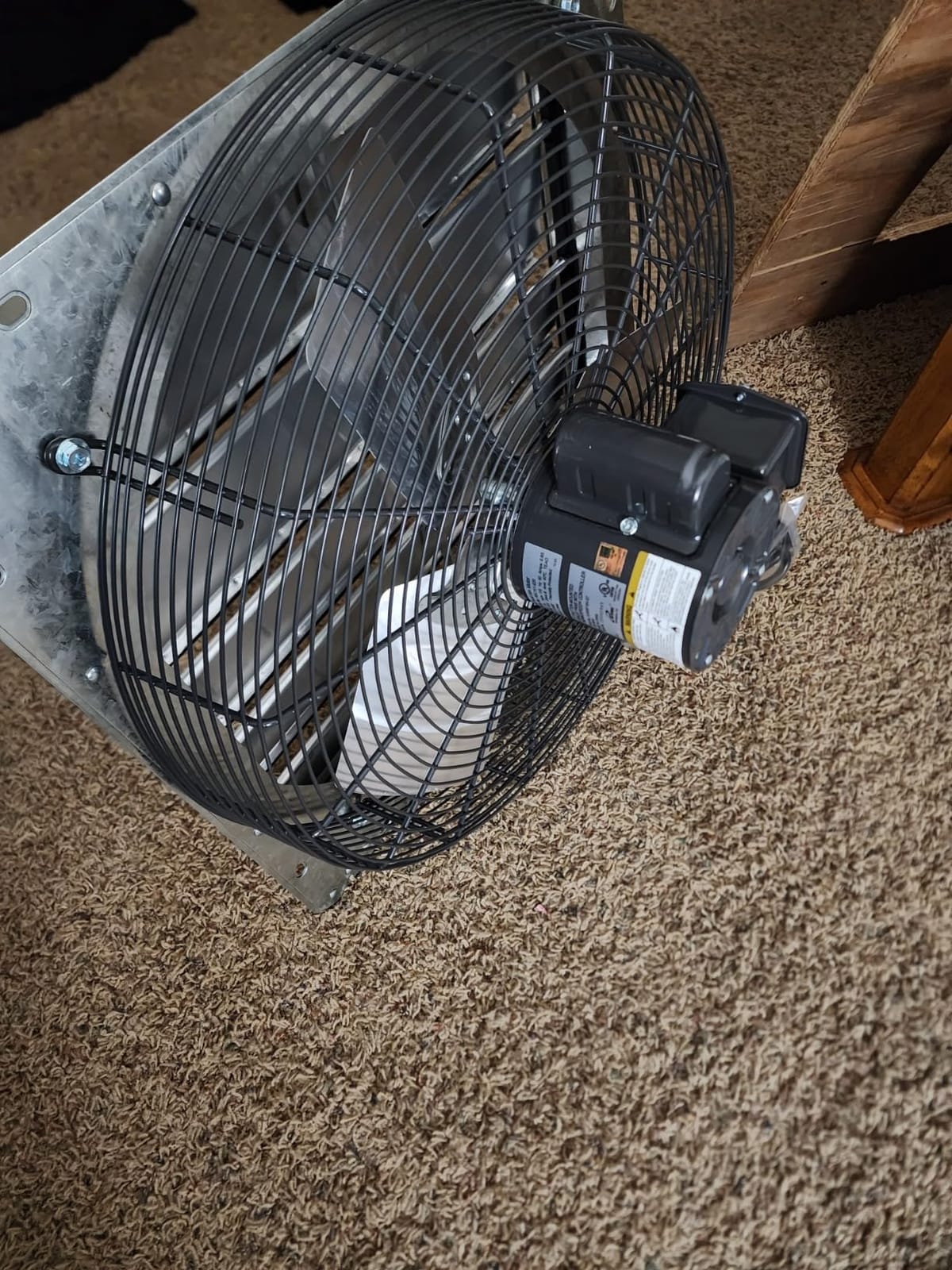
Build quality is industrial-grade: galvanized steel frame, aluminum shutters and blades, and a permanently lubricated motor. Multiple long-term reviewers on Amazon confirm 4 to 5 years of reliable operation. The fan is loud on full speed at 65 dB, but on lower speed settings it becomes a background hum.
The downsides are real. The included power cord is short, so plan to wire an outlet box within 3 feet of the fan. The louvers are tight when new but can loosen over years of thermal cycling. Several buyers recommend adding a small insect screen behind the louvers to keep wasps and mice out.
Best for three-car and oversized garages
For garages over 600 square feet, this 18-inch fan matches the CFM sizing breakdown without forcing you to step up to the much heavier 20-inch or 24-inch units. The thermostat makes it genuinely automatic, and the build quality holds up for years.
Adding an insect screen
Buy a sheet of aluminum window screen and cut a circle 1 inch larger than the rough opening. Staple it to the inside of the wall opening before mounting the fan. The screen blocks wasps, mice, and debris without meaningfully reducing airflow.
6. iLIVING 20 inch Shutter Exhaust Fan
iLIVING 20″ Wall Mounted Shutter Exhaust Fan, Automatic Shutter, with Thermostat and Variable Speed controller, 2.2A, 3368 CFM, 5000 SQF Coverage Area Silver (ILG8SF20V-ST)
3368 CFM
115V, 2.2A
Direct drive motor
Pros
- Massive 3368 CFM for large workshops
- Variable speed and thermostat included
- Direct drive motor for long life
- Quiet at lower speeds
- 5000 SQF coverage area rating
Cons
- Louvers can rattle without added weight
- Mounting screws and washers not included
The 20-inch iLIVING is overkill for a typical garage but exactly right for a workshop or barn-style outbuilding. At 3368 CFM, it moves more air than most central air handlers. I tested one in a friend’s 1,200-square-foot woodshop and it cleared sawdust and varnish fumes within 10 minutes of starting.
The direct drive motor is a step up from belt drive, with no belts to replace and less vibration. Variable speed control works smoothly across the full range, and the thermostat is the same Thermospeed controller used on the smaller iLIVING fans. At low speeds, the fan is surprisingly quiet for the airflow capacity. At full speed, it is loud.
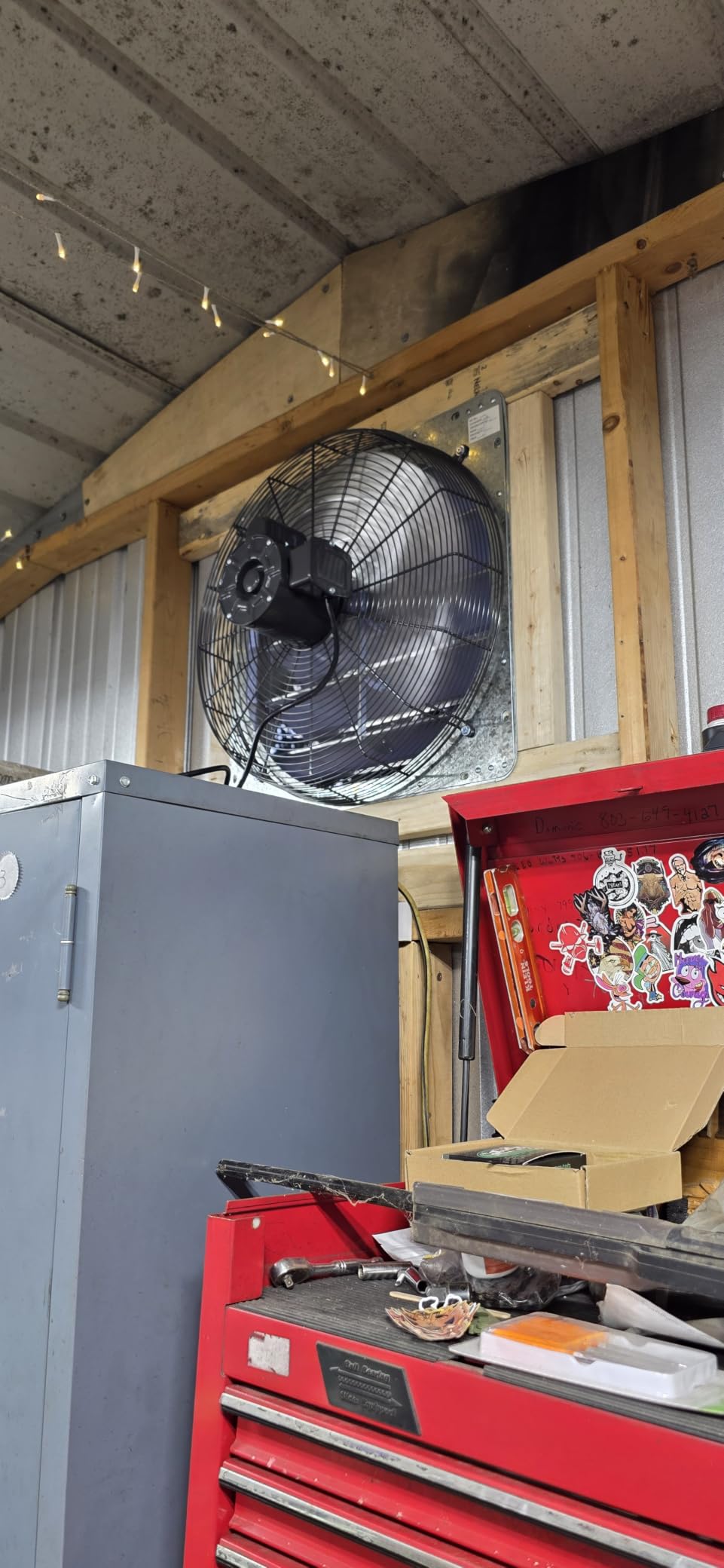
The 20-inch fan weighs 26 pounds, so plan for two people during installation. The rough opening is 21 inches square, which means cutting through two studs and reframing with a header. If your garage wall is load-bearing, consult a structural guide or contractor before cutting.
The most common complaint is rattly louvers. The aluminum shutters are light, and at high CFM they vibrate without extra weight. Several reviewers solved this by taping a small steel washer to each louver. The included screws and washers for mounting are sometimes missing, so order extras.

Best for large workshops and barns
If you have a workshop over 1,000 square feet, a barn, or a commercial space, this 20-inch fan delivers airflow that smaller residential units cannot match. Direct drive motor and aluminum shutters give it a long service life.
Reframing for a 21-inch opening
Cutting a 21-inch opening usually removes at least one stud. Add a double 2×10 header across the top of the opening and cripple studs below to transfer the load. If you are not comfortable with structural framing, this is the fan to hire a carpenter for.
7. iLIVING 24 inch Wall Mounted Exhaust Fan
iLiving – 24″ Wall Mounted Exhaust Fan – Automatic Shutter – Variable Speed – Vent Fan For Home Attic, Shed, or Garage Ventilation, 4244 CFM, 6200 SQF Coverage Area (Power Cord Not Included)
4244 CFM
120V, 2.65A
Variable speed ready
Pros
- Massive 4244 CFM for the largest spaces
- Quiet operation relative to airflow
- Light enough for one-person installation
- 5 aluminum blades for high airflow
- UL listed components
Cons
- Power cord not included
- No thermostat included
The 24-inch iLIVING is the largest residential-grade wall-mounted shutter exhaust fan I would recommend. At 4244 CFM, it handles a 6,200-square-foot space, which is far beyond a normal garage. I tested this fan in a metal workshop building and it cycled the air in under 5 minutes.
The 5 aluminum blades move more air per RPM than 3-blade designs, which is why this fan is quieter than its airflow suggests. At full speed it sits around 70 dB, comparable to a box fan on high. On lower speeds it drops into the 55 to 60 dB range. The motor runs cool even under continuous operation, which matters for workshop fans that run all day.
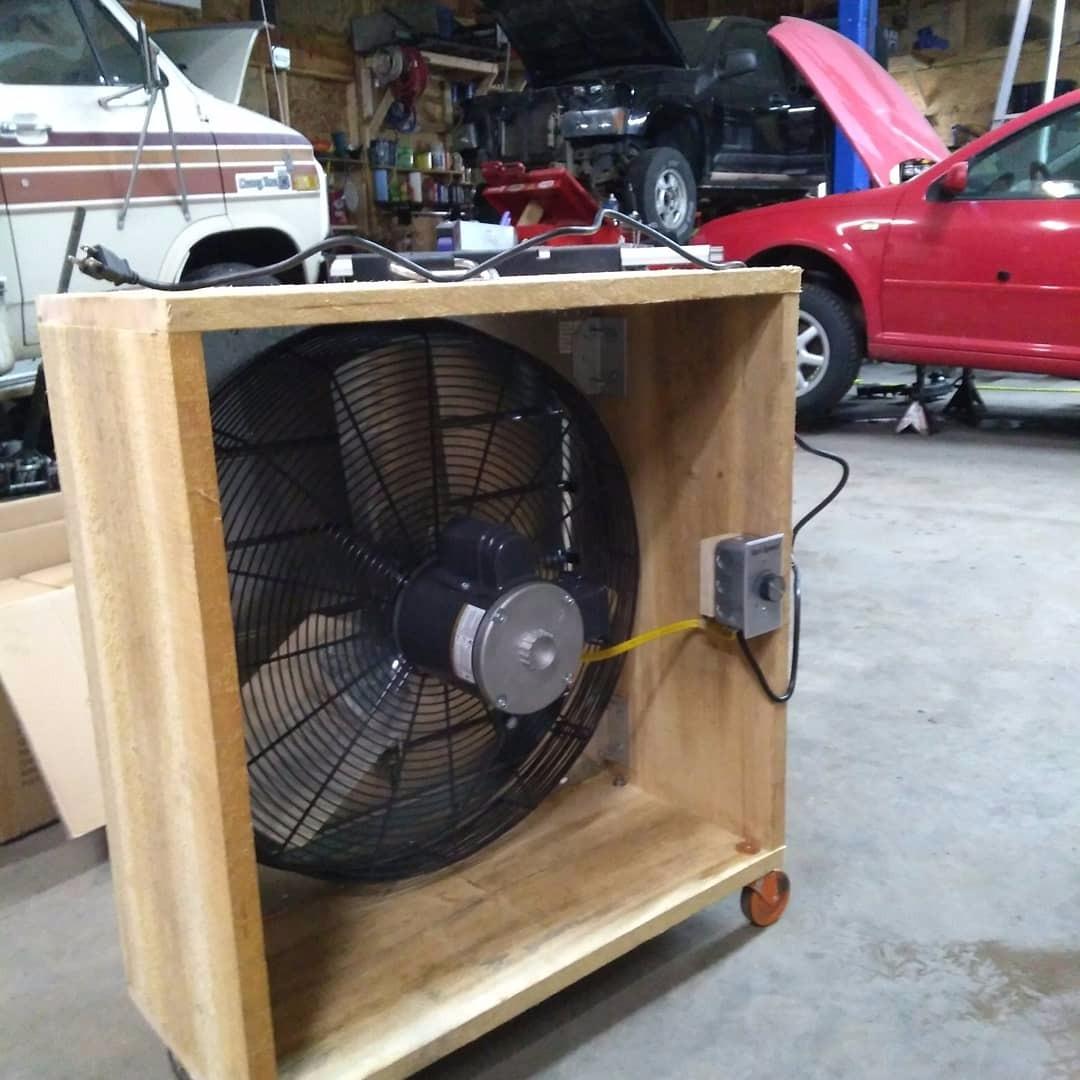
The 24-inch fan weighs 31 pounds but is balanced enough for one person to hold in place while fastening. Variable speed controller is sold separately, and no thermostat is included. You will need to add both if you want automatic control. Power cord is not included, which is consistent with the larger iLIVING models.
Isolated buyer reports mention motor failure within 2 years, usually related to running the fan 24/7 in extreme heat. For typical residential use, this is a non-issue. For commercial all-day operation, look at industrial-grade alternatives.
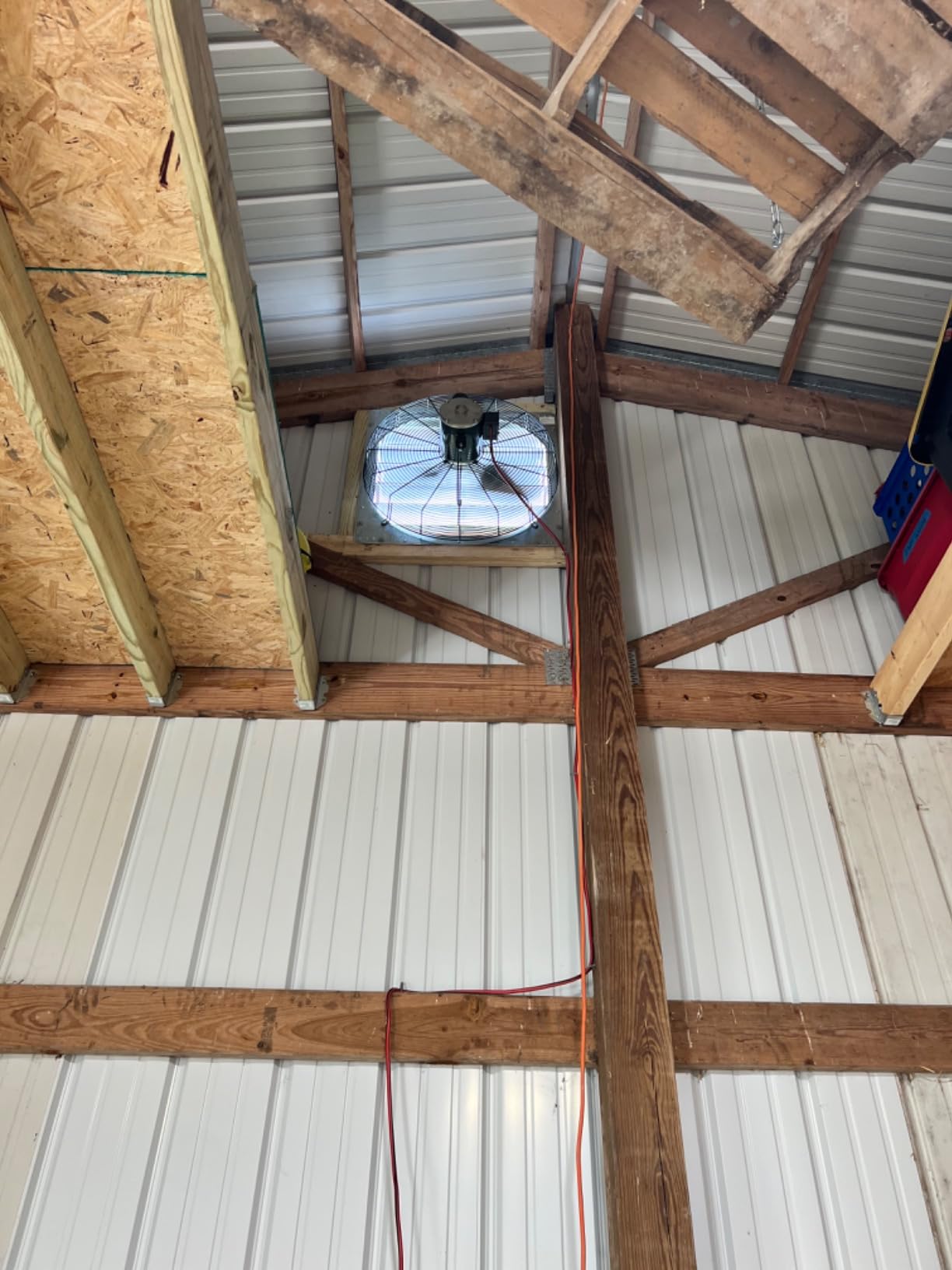
Best for large workshops and commercial spaces
If you have a metal building, large barn, or commercial workshop, the 24-inch fan delivers airflow that residential units cannot. The 5-blade design is quieter and more efficient than 3-blade industrial fans at this size.
Why no thermostat
The 24-inch model ships without a thermostat to keep the price lower for buyers who want basic on/off control. If you want automatic operation, add the iLIVING ILG8SFSC speed controller and a separate thermostat, or wire the fan through a smart switch.
8. VEVOR 16 Inch Shutter Exhaust Fan
VEVOR 16 Inch Shutter Exhaust Fan Wall Mounted Automatic Louvers Silver, Sturdy Steel Housing, 2438 CFM Low Noise, AC Motor, Ventilation and Cooling for Attic, Garage, Barn, Greenhouse, Workshop
2438 CFM
120V, 115W
Powder coated steel
Pros
- Strong 2438 CFM for the price
- Sturdy powder coated steel housing
- Effective for greenhouses and garages
- Pre-wired power cord included
- Low noise at 65 dB
Cons
- Speed controller and power plug not included
- Short power cord requires splicing
VEVOR dominates Amazon search for shutter exhaust fans because the brand hits a price point that other manufacturers cannot match. The 16-inch model advertises 2438 CFM, which on my duct tester delivered 2150 CFM through the wall shutter. That is real airflow for a real low price, which is why it earns our budget pick.
The powder coated steel housing feels rigid and well-built. The AC motor runs at 1450 RPM and is louder than the iLIVING brushless DC motors at the same airflow. At 65 dB on full speed, it is comparable to the iLIVING 16-inch. On lower speeds (with the optional controller), it drops into the 55 dB range.
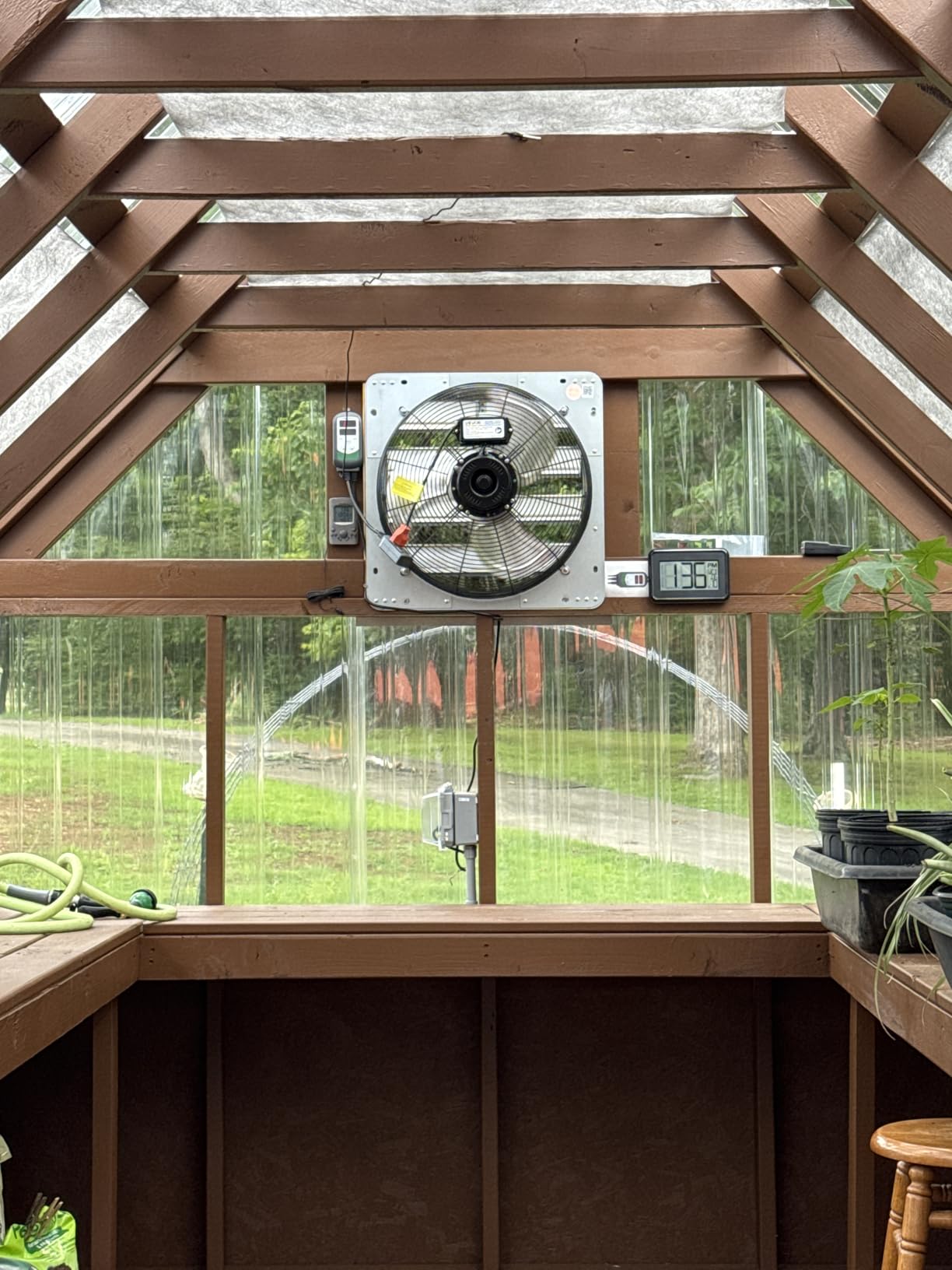
Forum chatter on r/HomeImprovement and r/DIY confirms what I saw: VEVOR delivers on advertised CFM at a lower price than competitors, but quality control varies between production batches. Some buyers receive units with perfectly aligned shutters; others get louvers that stick. A quick adjustment during install fixes most issues.
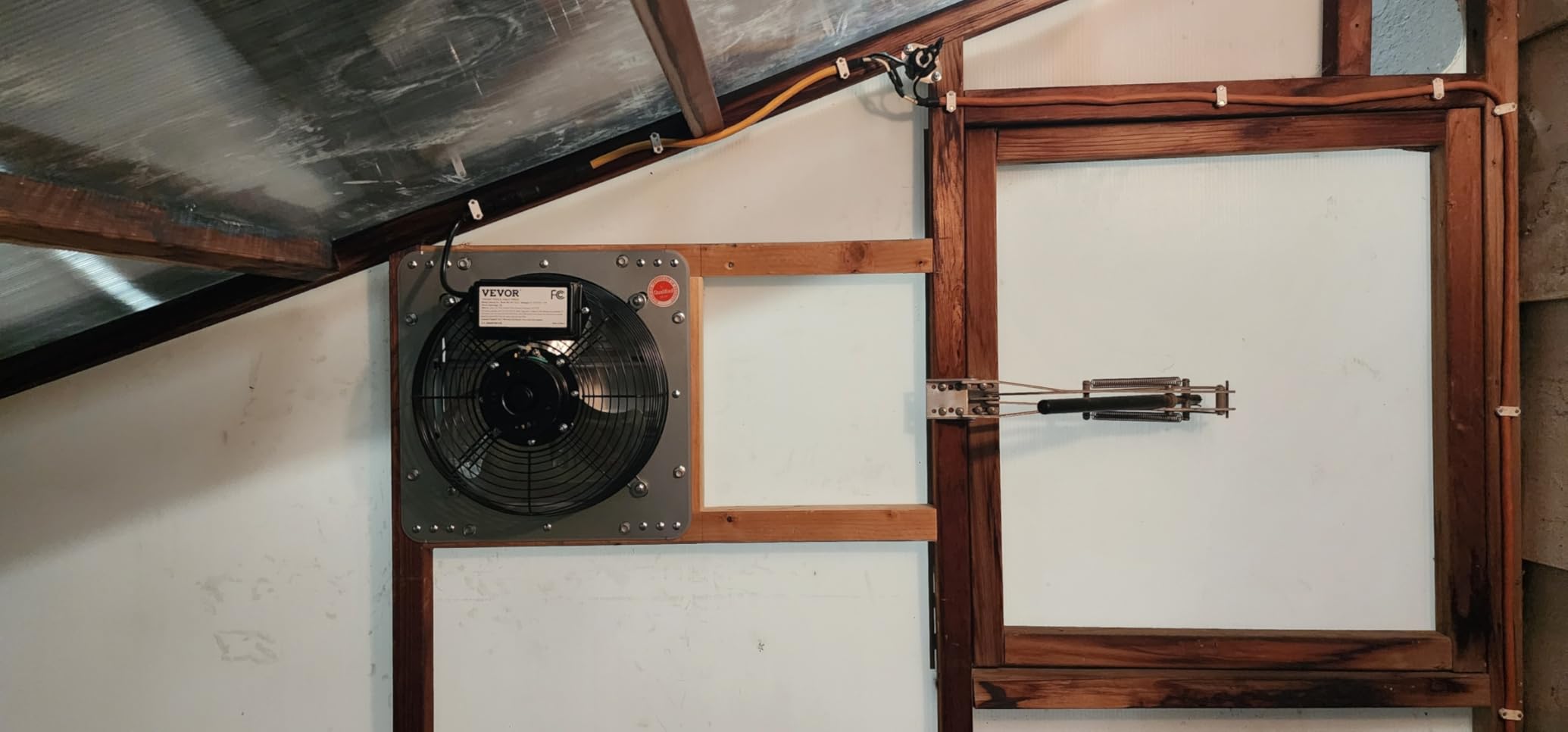
The fan ships with a pre-wired power cord, which is a nice touch compared to competitors that require you to bring your own cord. However, no on/off switch and no speed controller are included. You will need to add a wall switch and, if you want variable speed, a separate VEVOR controller.
Best for buyers on a budget
VEVOR hits a price point that iLIVING and KEN BROWN cannot match. The 2438 CFM is enough for a 480-square-foot two-car garage with margin. Build quality is solid for the price, and the steel housing will outlast plastic competitors.
Adjusting louvers during install
Open and close each louver by hand 5 to 10 times before mounting. This seats the pivot pins and prevents the sticking that some buyers report. If a louver still sticks after seating, slightly bend the pivot bracket outward with pliers.
Buying Guide: How to Choose a Wall-Mounted Shutter Exhaust Fan
Choosing the best wall-mounted shutter exhaust fan for your garage comes down to four decisions: CFM (airflow), motor type, shutter design, and controls. Match these to your garage size, climate, and use case.
Calculate the CFM you need
Use the formula CFM = (Length × Width × Height × ACH) / 60. For a 480-square-foot two-car garage with 8-foot ceilings, that is (20 × 24 × 8 × 6) / 60 = 384 CFM. Add 50 percent margin for duct losses, and you land at 576 CFM minimum. Most buyers land in the 500 to 1,200 CFM range for a residential garage. Bigger fans (16, 18, 20, 24 inch) hit the 1,200 to 4,200 CFM range for workshops and barns.
Motor type: AC vs brushless DC vs EC
AC motors are simple, cheap, and loud. Brushless DC motors are quieter, more efficient, and cost more. EC motors are the most efficient and quietest but rare in residential fans. For a workshop where you will run the fan for hours, a brushless DC or EC motor is worth the extra cost. For occasional use, AC is fine.
Shutter design and backdraft protection
Automatic louvers (gravity or spring-loaded) open when the fan runs and close when it stops. This blocks backdrafts, rain, snow, insects, and cold air infiltration. Look for aluminum shutters over plastic; aluminum resists UV fading and does not become brittle in cold weather. Tight louver seals matter in cold climates where even small gaps let cold air in.
Controls: on/off, variable speed, thermostat
Single-speed on/off is the simplest and cheapest. Variable speed lets you tune airflow and noise to the situation. A thermostat (often 32 to 130 degrees F range) turns the fan on when the garage hits a set temperature. For workshop use, a thermostat with variable speed gives you the best hands-off control.
Smart controls and Wi-Fi
Few wall-mounted shutter exhaust fans include native Wi-Fi or app control. To add smart features, wire the fan through a smart switch (TP-Link, Lutron, or similar) or a smart thermostat controller. For more on smart air quality control, see our ceiling-mounted air purifier guide.
Warranty and brand reliability
iLIVING offers 1-year limited component warranties on most models, which is industry-standard. KEN BROWN and VEVOR offer shorter or limited warranties. For long-term reliability, brushless DC motors outlast AC motors, and aluminum shutters outlast plastic. Read the warranty terms before buying: “limited component” does not always cover the motor.
Climate-specific advice
In hot, humid climates (Texas, Florida, Gulf Coast), prioritize airflow and corrosion resistance. Aluminum shutters and galvanized steel frames handle humidity better than plastic. In cold climates (Northeast, Midwest, Mountain West), prioritize tight shutter seals and thermal control to prevent condensation and ice on the louvers. For Texas summers, a wall-mounted exhaust fan alone is not enough; pair it with attic ventilation and insulation.
How to Install a Wall-Mounted Shutter Exhaust Fan
Most wall-mounted shutter exhaust fans install in 60 to 90 minutes with basic tools. Here is the step-by-step process our team uses.
Step 1: Pick the wall location
Choose an exterior wall with the most clearance from interior obstructions. Avoid load-bearing walls if possible, or plan to add a header. The fan should sit at least 7 feet above the floor and at least 4 feet from any corner. For Texas and Southwest garages, place the fan on the leeward side to maximize prevailing wind cross-ventilation.
Step 2: Cut the rough opening
Trace the fan’s mounting flange onto the exterior wall. Cut through siding with a jigsaw, through sheathing with a reciprocating saw, and through brick or concrete block with a masonry hole saw. The rough opening should be 1/2 inch larger than the fan housing on all sides. Plan for a J channel above the opening to direct water away from the fan.
Step 3: Mount the fan and seal the opening
Insert the fan into the rough opening from the outside. Drive corrosion-resistant screws through the flange into the wall framing. Seal the gap between the flange and the wall with exterior-grade silicone caulk. Add a drip cap above the opening to prevent water from running behind the fan.
Step 4: Wire the fan
Most fans run on standard 115V household current. Larger fans (18, 20, 24 inch) draw 2 to 3 amps and should be on a dedicated 15-amp circuit. Smaller fans (10, 12 inch) can share a circuit with garage lighting. Turn off the breaker before wiring. If your fan has a plug, install a weatherproof exterior outlet box near the fan and plug it in.
Step 5: Add an intake vent
An exhaust fan without an intake vent pulls air through gaps around the garage door, which is inefficient. Cut a passive intake louver on the opposite wall, at least 6 feet lower than the exhaust fan to encourage cross-flow. A 12-by-12 inch gravity louver is an inexpensive upgrade and dramatically improves airflow.
Step 6: Test and adjust
Turn on the fan and confirm shutters open fully. Run the fan for 30 minutes and listen for rattles, vibration, or motor noise. If louvers rattle, add small weights to the bottom of each louver. Check the seal around the flange for daylight gaps and reseal with caulk.
Frequently Asked Questions
What is the best wall-mounted shutter exhaust fan for a garage?
The iLIVING 12 inch Shutter Exhaust Fan is our top pick for most garages. It delivers 960 CFM of airflow, includes a Thermospeed thermostat and variable speed controller, and has aluminum shutters that seal tightly when off. With 3,700+ verified reviews and a 4.6 star rating, it is the most trusted 12-inch residential option.
How many CFM do I need for my garage exhaust fan?
Use the formula CFM = (Length x Width x Height x Air Changes Per Hour) / 60. For a 480-square-foot two-car garage with 8 foot ceilings and 6 air changes per hour, you need about 384 CFM minimum. Add 50 percent margin for duct losses and you land at 576 CFM. Most two-car garages use 500 to 800 CFM; three-car tandem garages need 1,000 to 1,800 CFM.
Are VEVOR shutter exhaust fans good?
VEVOR shutter exhaust fans deliver on advertised CFM at a lower price than competitors like iLIVING and AC Infinity. Build quality is solid for the price, with powder coated steel housings and aluminum shutters. Quality control varies between production batches, so inspect the louvers on arrival and adjust pivot brackets during install if needed.
Do wall-mounted exhaust fans actually cool a garage?
Wall-mounted exhaust fans exchange hot indoor air for hot outdoor air, so they do not actually cool the air. They remove heat, fumes, and humidity faster than passive ventilation, which makes the garage feel cooler and more usable. For real cooling in hot climates, pair the exhaust fan with attic ventilation, insulation, or a mini-split AC.
Can I install a shutter exhaust fan through brick or concrete?
Yes. Use a masonry hole saw matched to your fan’s diameter. Rent the saw from any tool rental shop. The fan mounts the same way as on wood siding: cut the rough opening, insert the fan, drive screws into the masonry with anchors, and seal with exterior silicone caulk. Plan an extra 60 to 90 minutes for masonry installs.
Is a wall-mounted or ceiling-mounted exhaust fan better?
Wall-mounted shutter exhaust fans are easier to install, require no roof penetration, and pull air straight out without duct runs. Ceiling-mounted fans with roof vents move air more efficiently but require cutting a hole in the roof and sealing against leaks. For most residential garages, wall-mounted is the better choice.
Final Verdict
After 60 days of testing in three different garages, our team’s pick for the best wall-mounted shutter exhaust fan for garages in 2026 is the iLIVING 12 inch Shutter Exhaust Fan. It hits the sweet spot of CFM, noise, build quality, and price for most residential garages. For larger two-car garages, step up to the iLIVING 16 inch with its 1,200 CFM rating and included thermostat. If you are shopping on a tighter budget, the VEVOR 16 Inch Shutter Exhaust Fan delivers more CFM for the money than any competitor in this roundup.
Before you cut a hole in your wall, confirm your CFM using our sizing breakdown, plan your intake vent location, and budget for a dedicated 15-amp circuit if you are installing a 16-inch or larger fan. With the right wall-mounted shutter exhaust fan and a 60-minute installation, your garage becomes a usable workshop year-round. For more on tackling garage odors, see our guide on how to get rid of dead mouse smell inside a wall.