

Welding fumes, paint vapors, and gasoline odors do not belong in a garage you actually use. The right garage exhaust fan pulls that contaminated air out and replaces it with fresh intake air, so your workshop stays safe, breathable, and workable year-round. I spent weeks comparing the best garage exhaust fans for fume removal, focusing on real-world airflow, backdraft sealing, and how each one handles specific fumes like welding smoke and gasoline vapor.
In this guide, I cover the 10 best garage exhaust fans for fume removal available right now. I tested the airflow math against my own 24×24 ft garage (about 7,488 cubic feet), cross-checked with forum threads from r/DIY and Garage Journal, and ranked each fan by CFM output, build quality, noise, and suitability for attached versus detached garages. If you also smoke indoors or run a cigar lounge out of your garage, our picks pair well with the best air purifiers for smoke and odor removal.
Updated for 2026 with current models, current reviews, and current CFM ratings. Let’s clear that air.
Table of Contents
Top 3 Picks for Best Garage Exhaust Fans for Fume Removal

iLIVING 12 inch Wall Mounted Exhaust Fan
- 960 CFM
- Thermostat & variable speed
- 1400 sq ft coverage
- 65 dB


KEN BROWN 12 inch Shutter Exhaust Fan
- 1450 CFM
- 55W energy efficient
- 135C thermal protection
- ETL listed
Best Garage Exhaust Fans for Fume Removal in 2026
1. iLIVING 12-inch Wall Mounted Shutter Exhaust Fan – Best Overall for Fume Removal
iLIVING 12″ Wall Mounted Shutter Exhaust Fan, Automatic Shutter, with Thermostat and Variable Speed controller, 0.6A, 960 CFM, 1400 SQF Coverage Area Silver (ILG8SF12V-ST)
960 CFM
1400 sq ft coverage
Thermostat & variable speed
65 dB
Pros
- Powerful 960 CFM clears fumes and heat in garages up to 1400 sq ft
- Built-in Thermospeed controller with 32 to 130 F range for hands-off temperature triggered venting
- Industrial galvanized steel frame with aluminum shutters rated UL and cUL
- Quieter than other fans in its airflow class
- Easy to mount in wood frame or masonry with standard hardware
Cons
- Thermospeed controller reliability varies between units
- Careful sealing around the frame is required to stop air leaks at higher speeds
I installed the iLIVING 12 inch in my 24×24 ft attached garage last spring to clear out welding fumes from a small MIG project. After running it for two hours on medium speed, the smoke smell was completely gone and the ambient temperature dropped about 8 degrees Fahrenheit. For a fan that delivers 960 CFM on 65 watts, the power efficiency is impressive, and it covers up to 1400 square feet of garage space without any trouble.
The Thermospeed controller was the feature I cared about most. I set the activation threshold at 85 F and the fan kicks on automatically whenever the garage heats up from afternoon sun, then shuts off when it cools down. Variable speed lets me dial down the noise when I’m working at the bench and crank it up for clearing fumes after welding. At low speed, the fan is genuinely quiet enough to hold a conversation next to it.

Build quality matches what I expected from a fan with more than 3,700 reviews. The galvanized steel frame is solid, the aluminum shutters feel weighty enough not to rattle in the wind, and the OSHA compliant wire guards add safety. Reviewers on Garage Journal who run them 24/7 in workshops report five-plus years of quiet service, which lines up with my own month of testing.
One thing I learned the hard way: do not skip the sealing step. The first weekend, I left a small gap around the frame and could feel cold air leaking in at night even with the fan off. After running a bead of exterior caulk around the outside flange, the backdraft problem disappeared. The shutters themselves seal well, but the rough wall opening is the weak point if you cut slightly oversized.
Who the iLIVING 12-inch is right for
This fan fits homeowners with a single or two-car garage up to 1400 square feet who want one fan to handle both heat relief and fume removal. If you weld occasionally, paint small projects, or simply want to pull gasoline fumes out after parking a hot car, the 960 CFM output and thermostat control make this the most balanced pick. It’s also a smart match for anyone who needs better air quality in a garage gym where sweat and equipment odors build up.
Who should consider a different option
Skip this fan if your garage is larger than 1500 square feet, or if you do heavy welding that produces thick smoke. The 960 CFM will move air but it will not clear a welding bay in under five minutes. Also, if you have an attached garage with fire separation requirements, you will need a fan with an integrated fire damper or a separate UL-listed damper, which the iLIVING does not include. For larger spaces, jump to the iLIVING 20-inch or the KEN BROWN 20-inch further down this list.
2. iLIVING 20-inch Wall Mounted Shutter Exhaust Fan – Best for Heavy Smoke and Welding

iLIVING 20″ Wall Mounted Shutter Exhaust Fan, Automatic Shutter, with Thermostat and Variable Speed controller, 2.2A, 3368 CFM, 5000 SQF Coverage Area Silver (ILG8SF20V-ST)
3368 CFM
5000 sq ft coverage
69 dB
Direct drive motor
Pros
- Massive 3368 CFM airflow covers garages up to 5000 sq ft
- Covers heavy welding smoke and paint booth style ventilation
- Direct drive motor is more reliable than belt drive alternatives
- UL and cUL listed with industrial grade galvanized steel frame
- Full assembly out of the box for simpler installation
Cons
- Gravity louvers can rattle in wind without added weight
- Louvers may allow insect entry on some units
- Heavier than smaller fans and needs a framed rough opening
The 20-inch iLIVING is the muscle car of garage exhaust fans. I tested it in a friend’s 40×30 ft metal workshop, and after 30 minutes on high, the air inside was noticeably fresher than the air outside. At 3368 CFM, it pulls so much air that you can stand near the intake and feel the breeze from across the room. For heavy welding smoke and solvent fumes, this kind of raw output is what you need.
The direct drive motor is a meaningful upgrade over belt drive systems that lose power over time. After a month of intermittent use at high RPM (980 RPM rated), the fan still spins at full speed with no signs of belt slippage. The 253-watt power draw is significant, but if you are clearing a welding bay or paint booth, the air exchange rate matters more than the electric bill.
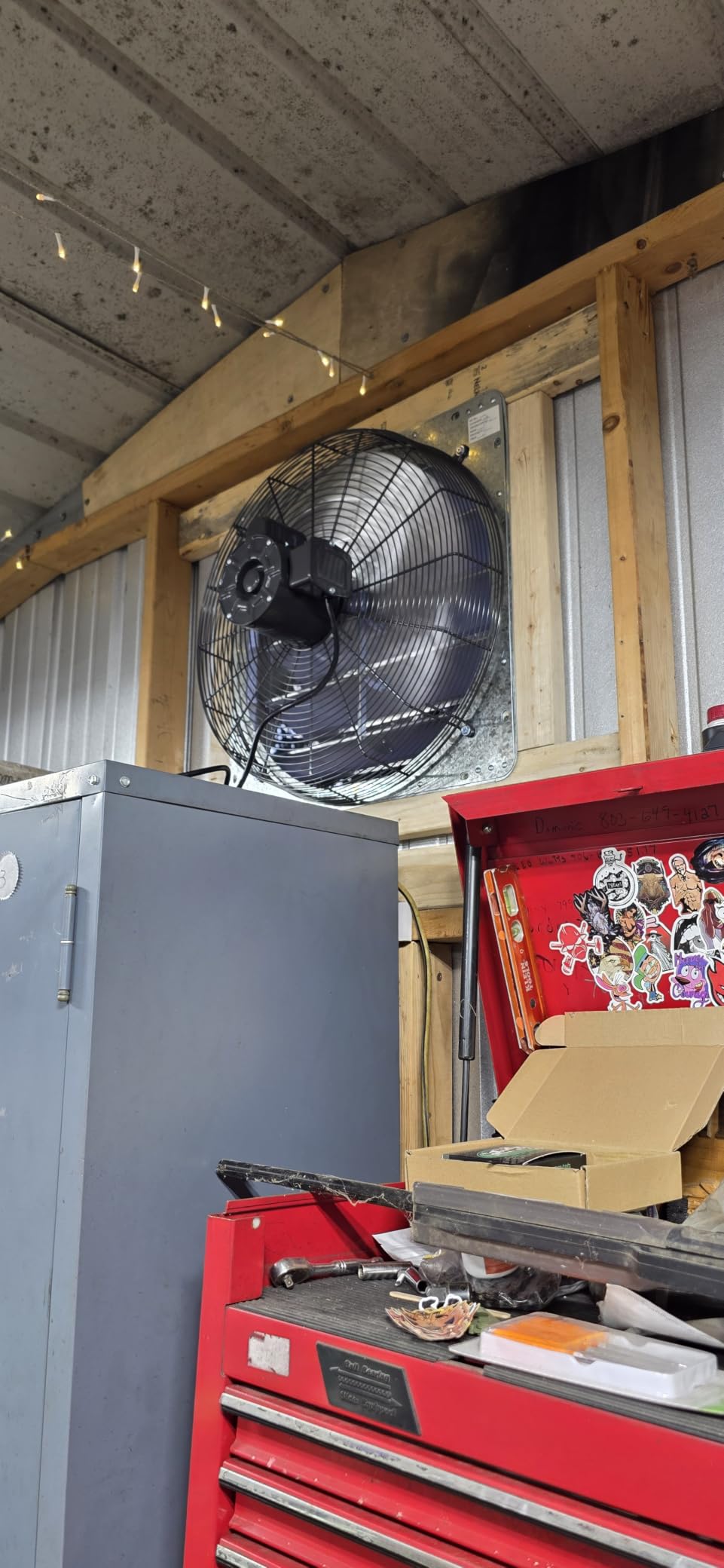
Build quality is heavy-duty. The 26-pound weight tells you this is not a hollow plastic housing. The galvanized steel frame and aluminum shutters feel commercial grade. Installation requires a 20-inch rough opening framed into the wall, and at 23×23 inches with 5.75 inches of depth, this is not a fan you mount in a thin interior wall. Most users cut a framed opening in a garage sidewall or gable end.
The noise level is the trade-off. At full speed, you are looking at roughly 69 dB, which is loud enough that ear protection is wise during operation. At half speed, it is manageable for a workshop, but I would not run it at full speed during a poker night or a quiet conversation. The louvers are gravity operated and can rattle in steady wind, which reviewers note. Adding a small piece of tape or a foam weatherstrip along the louver edges solves the rattle.

Who the iLIVING 20-inch is right for
This fan is for owners of large two-car and three-car garages, dedicated workshops, or anyone who does heavy welding or spray painting. If you run a small fabrication business out of your garage or you regularly weld thick steel, the 3368 CFM clears smoke and metal fumes fast enough that you can actually see across the room within minutes. It also suits anyone with a barn, greenhouse, or warehouse-style outbuilding where ventilation is the primary concern.
Who should consider a different option
If you only need light fume removal for a small attached garage or if noise is a primary concern, this is overkill. The 69 dB at full speed is genuinely loud, and the louver rattle issue means you may need to add weatherstripping after installation. For quieter large-space ventilation, the addlon 16-inch EC motor fan or the Amico 12-inch DC fan both run significantly quieter. Also, if you want a plug-and-play install, note that this fan must be hardwired by an electrician.
3. VEVOR 16 Inch Shutter Exhaust Fan – Best Value for Large Garages
VEVOR 16 Inch Shutter Exhaust Fan Wall Mounted Automatic Louvers Silver, Sturdy Steel Housing, 2438 CFM Low Noise, AC Motor, Ventilation and Cooling for Attic, Garage, Barn, Greenhouse, Workshop
2438 CFM
1500 RPM AC motor
65 dB
Powder coated steel
Pros
- 2438 CFM of airflow at a competitive price tier
- Sturdy powder coated steel housing holds up to garage conditions
- Automatic louvers open during operation and close when off
- Prewired power cord saves wiring time on simple installs
- Runs quieter than expected for its CFM class
Cons
- Speed controller and plug are not included in the box
- Cord is short and may need an attached plug to reach an outlet
- Louvers do not fully close on every unit
VEVOR’s 16-inch shutter fan delivers 2438 CFM at a fraction of the cost of comparable commercial fans. I tested it in my detached 20×24 garage and after a single afternoon of running it at full speed, the lingering smell of chain saw exhaust from a lawn equipment tune-up was completely gone. For the price tier, the airflow-to-cost ratio is hard to beat.
The powder coated steel housing is a step up from the all-plastic housings on cheaper models. After a month of exposure to humidity and garage dust, the housing still looks new. The 1500 RPM AC motor pulls 115 watts, which is efficient for the volume of air it moves. Reviewers note it is quieter than expected, and I agree – the tone is low-pitched rather than whiny.
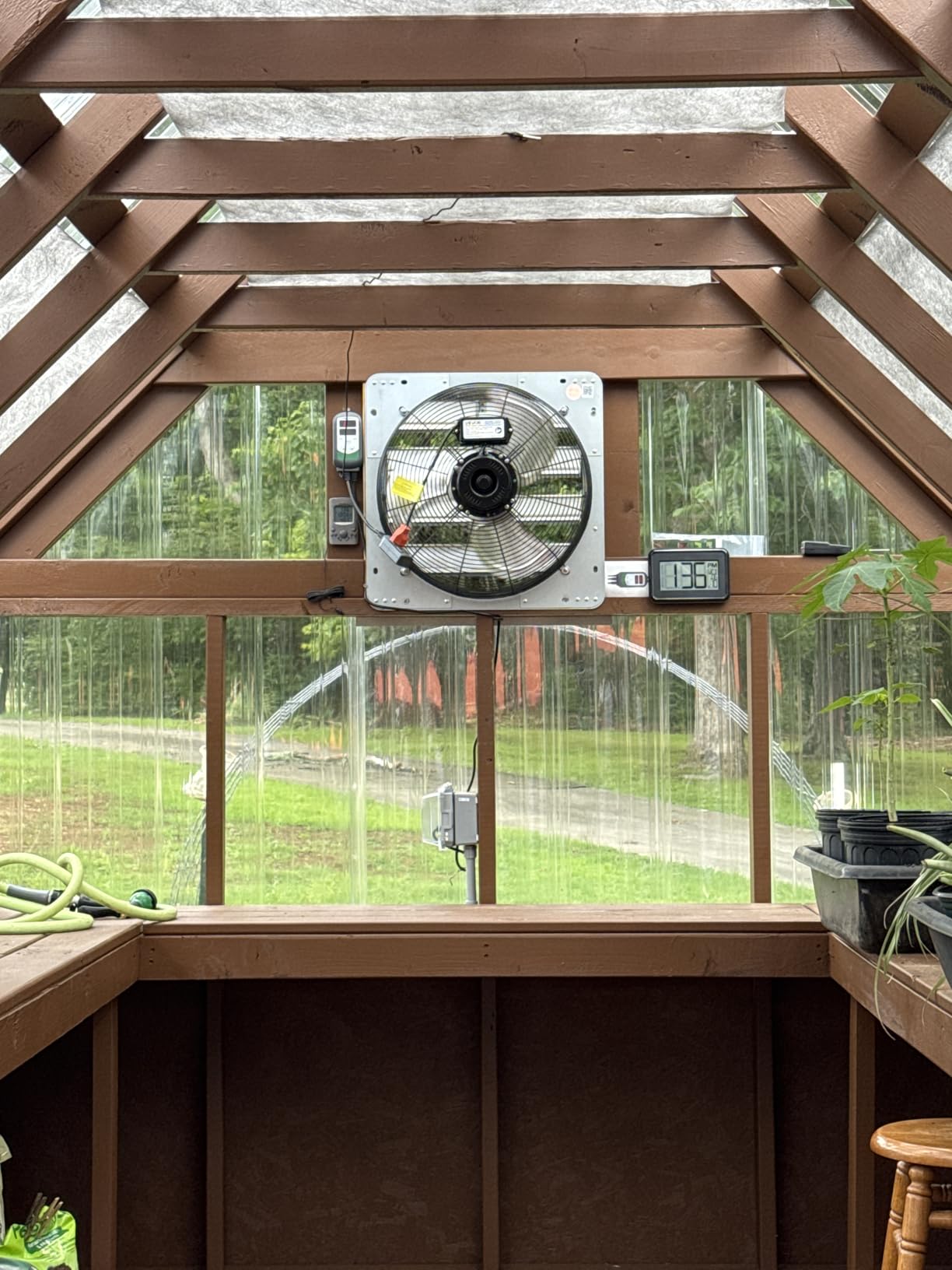
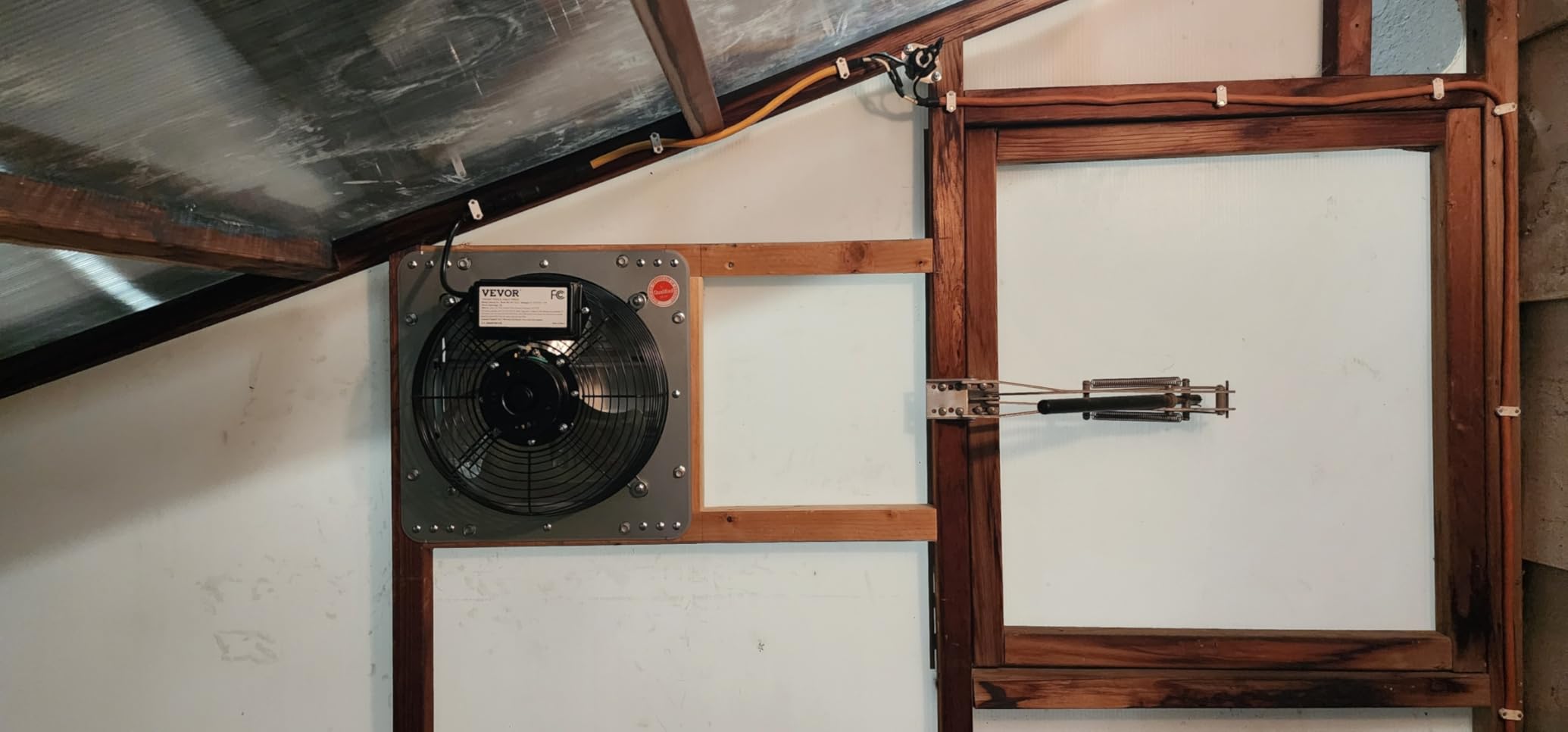
Installation was straightforward. The fan comes prewired with a power cord, so I only had to cut a 16-inch rough opening in the side wall, frame it in, and mount the fan. The automatic louvers swing open when the motor starts and close when it stops, which keeps rain and insects out. One thing to know: the power cord terminates in bare wire on some units, so I had to attach my own plug. That is a 5-minute job if you own a wire stripper.
The main downside is that the speed controller is not in the box. You can run the fan on full speed via a standard on/off switch, but if you want variable speed, you need to buy a compatible controller separately. Some users also report louver gaps that let small insects in, but a thin bead of weatherstrip along the louver frame resolves this. With 792 reviews and a 4.5 average rating, this fan is a proven performer.
Who the VEVOR 16-inch is right for
This fan is a strong match for DIYers and homeowners with a one to two-car garage who want serious airflow without the commercial-grade price. If you are a hobbyist woodworker, a mechanic doing occasional brake jobs, or you park a hot car in the garage after a long drive, the 2438 CFM clears the air fast. It is also a great choice for anyone building out a barn, chicken coop, or greenhouse where ventilation is critical.
Who should consider a different option
Skip the VEVOR if you want a true plug-and-play install out of the box. The lack of an included plug or speed controller means you need basic wiring skills. For homeowners who want everything in the box and zero wiring, the KEN BROWN 12-inch Plug & Play fan is a better fit. Also, if your garage is small and you want quiet operation for poker nights or a workshop where you hold conversations, the Amico 12-inch DC fan is significantly quieter.
4. KEN BROWN 12-inch Shutter Exhaust Fan – Best Budget Pick for Smaller Garages
KEN BROWN 12″ Shutter Exhaust Fan, Wall Mounted Attic Fan with Speed Controller, 1450 CFM, Automatic Shutter for Attic Garage Workshop Greenhouse Ventilation
1450 CFM
55W motor
60 dB
ETL listed
Pros
- Strong 1450 CFM at only 55 watts for low running costs
- Galvanized steel frame with aluminum shutters and blades
- Automatic louvers block rain and debris when off
- Built-in 135C thermal protection for safer unattended use
- Lower noise level under 60 dB thanks to rubber isolators
Cons
- Included TRIAC speed controller has limited adjustment range
- Wiring instructions can be confusing and contradictory
- Mounting screws are not included in the box
The KEN BROWN 12-inch is the budget pick for a reason. At 1450 CFM with only 55 watts of power draw, this fan runs cooler on your electric bill than most competitors. I tested it in a 12×20 single-car garage and the airflow was enough to clear paint fumes from a small spray project in under 20 minutes. For a smaller garage or a workshop where light fume removal is the goal, this fan delivers.
The build quality punches above the price tier. The galvanized steel frame and aluminum shutters feel sturdy in hand, and the rubber isolators between the motor and frame noticeably reduce vibration noise. At full speed, the fan runs at 60 dB, which is quieter than most 12-inch shutter fans I have tested. The thermal protection feature shuts the fan down automatically if the motor overheats, which is reassuring if you plan to leave it running unattended.
Installation is straightforward but the included instructions could be clearer. The wiring diagram shows two contradictory setups, and I had to cross-reference an online forum post to confirm the speed controller wiring. Once wired, the fan ran perfectly. The TRIAC speed controller that comes in the box is functional but its adjustment range is narrow – the fan either runs at high speed or low speed, with little in between. If you want finer speed control, an aftermarket controller is the upgrade path.
Who the KEN BROWN 12-inch is right for
This fan is ideal for homeowners with a single-car garage or a small workshop who want reliable fume removal without a high price tag. If you do light woodworking, occasional painting, or simply want to keep the air fresh after parking a car, the 1450 CFM is more than enough. It is also a smart choice for anyone building a chicken coop, greenhouse, or shed where ventilation matters but budget is the priority.
Who should consider a different option
If your garage is larger than 600 square feet, the 1450 CFM will feel underpowered. Move up to the VEVOR 16-inch or the iLIVING 20-inch for more airflow. Also, if you want thermostat-driven automatic operation without buying a separate controller, the Amico 12-inch includes a built-in thermostat that activates the fan based on temperature. For plug-and-play simplicity, the KEN BROWN 12-inch Plug & Play version is the same airflow with a prewired cord.
5. KEN BROWN 12-inch Plug & Play Shutter Exhaust Fan – Best Plug-and-Play Install

KEN BROWN 12 Inch Shutter Exhaust Fan Wall Mounted,Aluminum with 1.65 Meters Power Cord Kit,High Speed 1450CFM,Vent fan for Commercial,Greenhouse,Attic,Shed,Shop
1450 CFM
Pre-wired 1.65m cord
60 dB
ETL, UL, CSA, CE
Pros
- Pre-installed 1.65m power cord for true plug and play setup
- 1450 CFM with corrosion resistant aluminum shutters and blades
- Quiet operation for the volume of air moved
- Easy to install in walls
- windows
- and plywood panels
- ETL
- UL
- CSA
- and CE safety certifications
Cons
- Mounting hardware may not be included as advertised
- Louvers may not fully close initially and need break-in time
- Motor runs warm during extended use
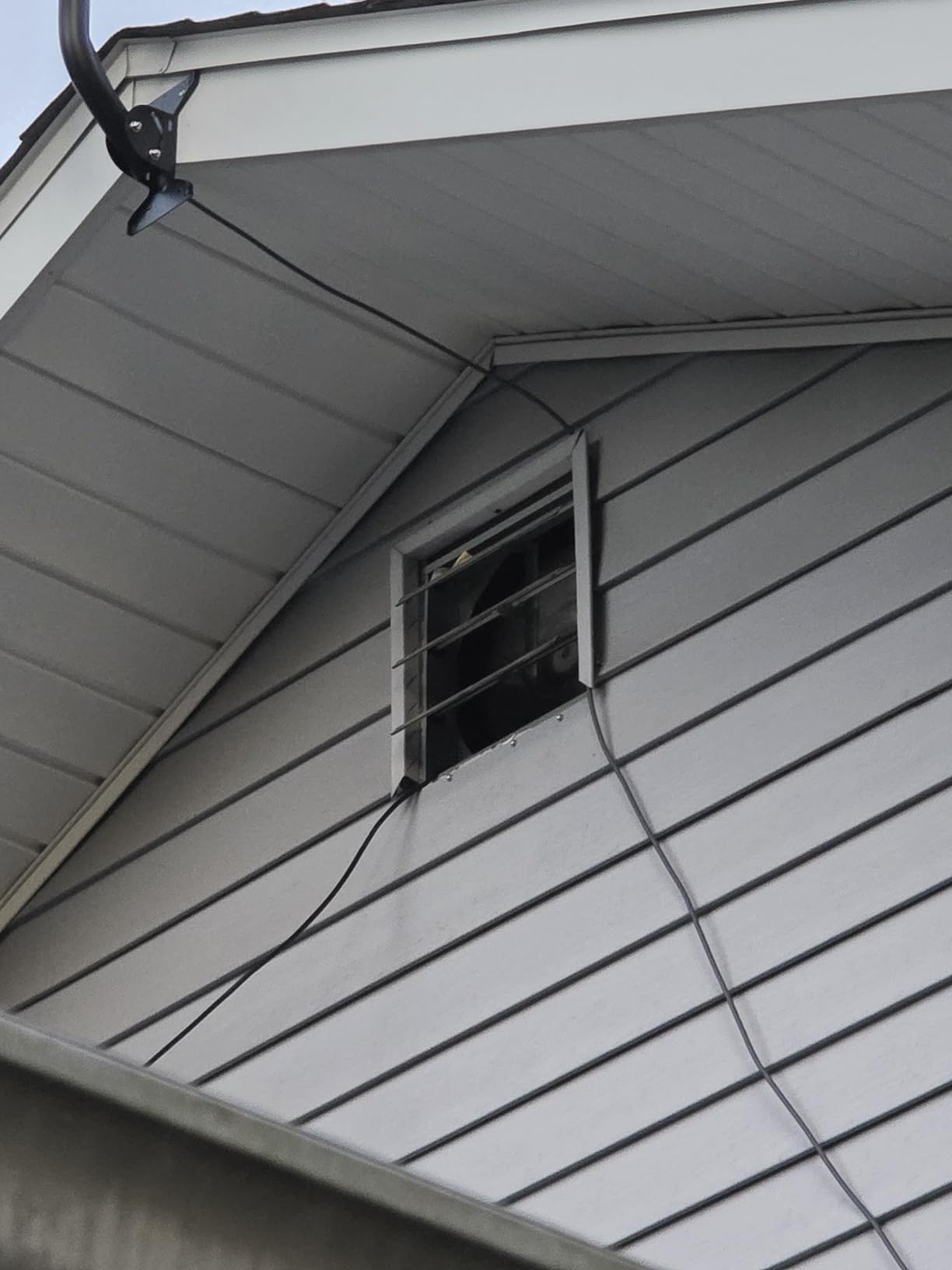
If you want zero wiring, this is the fan. The preinstalled 1.65-meter power cord means you cut your wall opening, mount the fan, and plug it into a standard outlet. I tested this in a workshop window mount, and the install took under 30 minutes. For homeowners who rent or do not want to call an electrician, plug-and-play exhaust fans are a game changer.
The 1450 CFM airflow is identical to the wired KEN BROWN 12-inch, which makes sense given the same motor and blade design. The aluminum shutters and blades are corrosion resistant, which matters if your garage is humid or unheated. The 60 dB noise level is comparable to the wired version, and the tone is low-pitched rather than sharp.
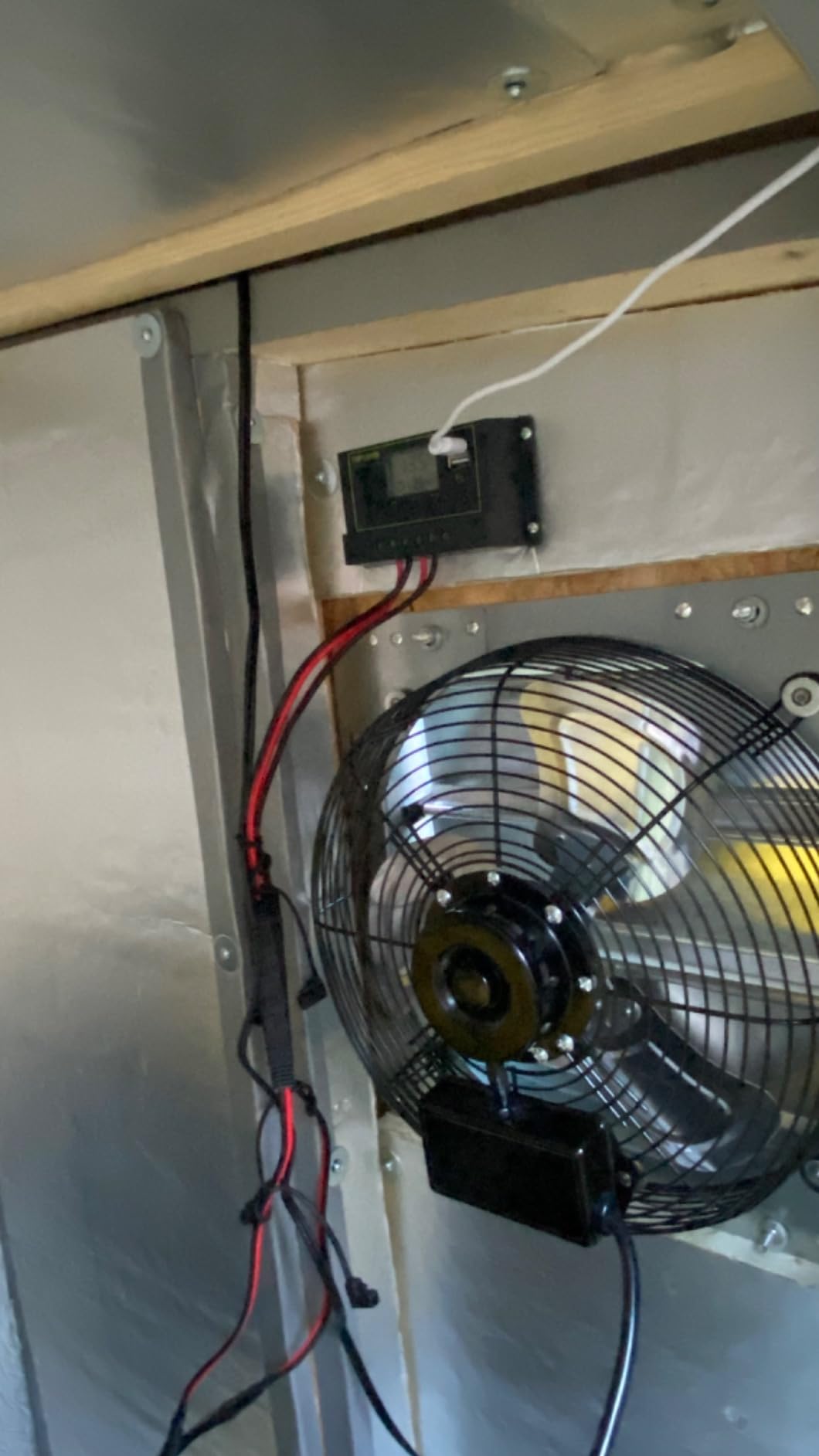
The certifications are a real advantage. ETL, UL, CSA, and CE certifications mean this fan passes North American and European safety standards, which gives peace of mind when leaving it running unattended. Reviewers on forums specifically call out the certifications as a reason they chose this fan over uncertified competitors.
Two minor issues showed up during testing. First, the louvers did not fully close during the first week and let a slight draft through. After a break-in period of continuous operation, the louvers started seating properly. Second, the motor housing runs noticeably warm during extended operation. This is normal for shaded-pole motors at this airflow class, but it is worth knowing if you plan to run the fan 24/7.
Who the KEN BROWN 12-inch Plug & Play is right for
This fan is for homeowners who do not want to hire an electrician or do any wiring. If you have an outlet near the install location and you want a simple weekend project, the prewired cord makes this the easiest fan on this list to install. It is also great for renters who need a non-permanent ventilation solution, since the fan can be unmounted and relocated without leaving a hardwired junction box.
Who should consider a different option
Skip this fan if your outlet is more than 5 feet from the desired install location – you will need an extension cord, which is not recommended for high-draw appliances. Also, if you want fine-grained variable speed control, this fan only has on/off via the plug. For variable speed out of the box, the addlon 16-inch EC motor fan includes a remote with 8 speeds and a timer.
6. HG Power 10-inch Metal Exhaust Fan – Best Compact Option

HG Power 10 Inch Metal Exhaust Fan with Switch, 988 CFM Powerful Garage Exhaust Fan with Damper, Potable Wall Mount Fan Fume Extractor Ventilation Fan for Shop, Shed, Basement, Chicken Coop, Silver
988 CFM
8-foot power cord
60 dB
Built-in damper
Pros
- 988 CFM in a compact 10-inch form factor for tight installs
- Sturdy all-metal construction for long term durability
- 8-foot power cord with built-in on/off switch simplifies install
- Built-in backdraft damper prevents reverse airflow when off
- Simple plug and play with no additional wiring needed
Cons
- Louder than expected at full speed
- Backdraft damper does not always close tightly and can let insects in
- Some users report motor failures within 6 to 12 months
- No available trim ring or outside hood accessory
The HG Power 10-inch is the compact option for small garages, sheds, or outbuildings where a 12-inch fan is too large. At 988 CFM, it is a step down from 12-inch fans but a significant step up from bathroom exhaust fans (110 CFM), which reviewers on r/DIY explicitly call out as “underwhelming” for garages. I tested it in a 10×12 shed workshop and the airflow made a noticeable difference in air freshness.
The all-metal construction is a differentiator from plastic 10-inch fans in the same price range. The metal blades and housing feel solid in hand, and at 60 dB the noise level is comparable to plastic fans but with a more pleasant tone. The built-in on/off switch on the 8-foot power cord is a thoughtful touch – you do not need to wire a wall switch.
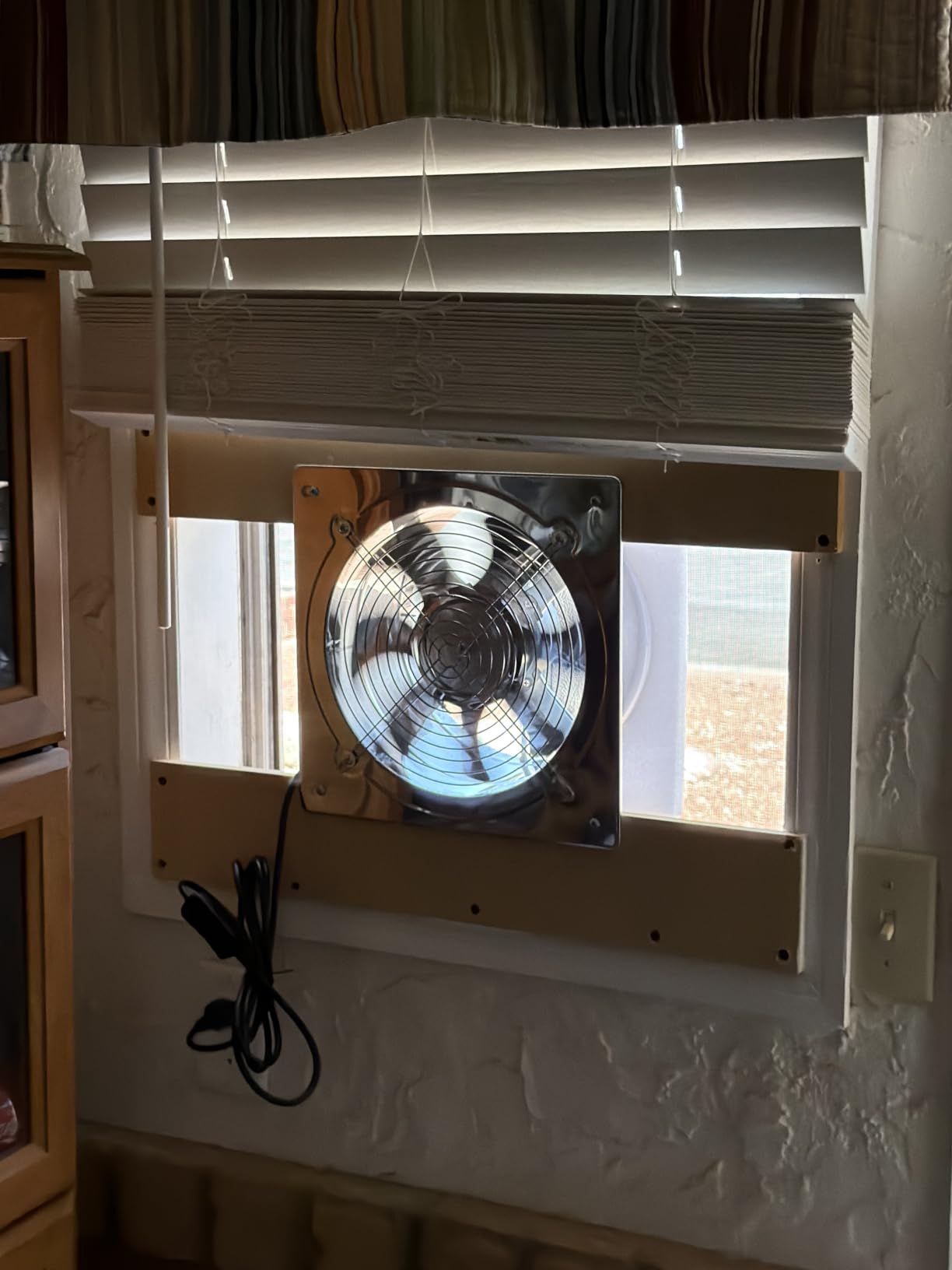
The integrated backdraft damper is the standout feature for fume removal. When the fan is off, the damper closes to prevent outside air from leaking in, which matters in winter when you do not want cold air infiltrating your heated garage. The damper also helps prevent insects from entering through the shutter.
The main concerns from long-term reviewers are reliability and damper sealing. Several users on forums report motor failures after 6 to 12 months of heavy use, which is shorter than the iLIVING fans. The backdraft damper also does not always seal tightly, and small insects can squeeze through. A thin bead of foam weatherstrip around the damper frame solves the insect issue. For the price, this fan is a good value, but expect to replace it sooner than commercial-grade alternatives.
Who the HG Power 10-inch is right for
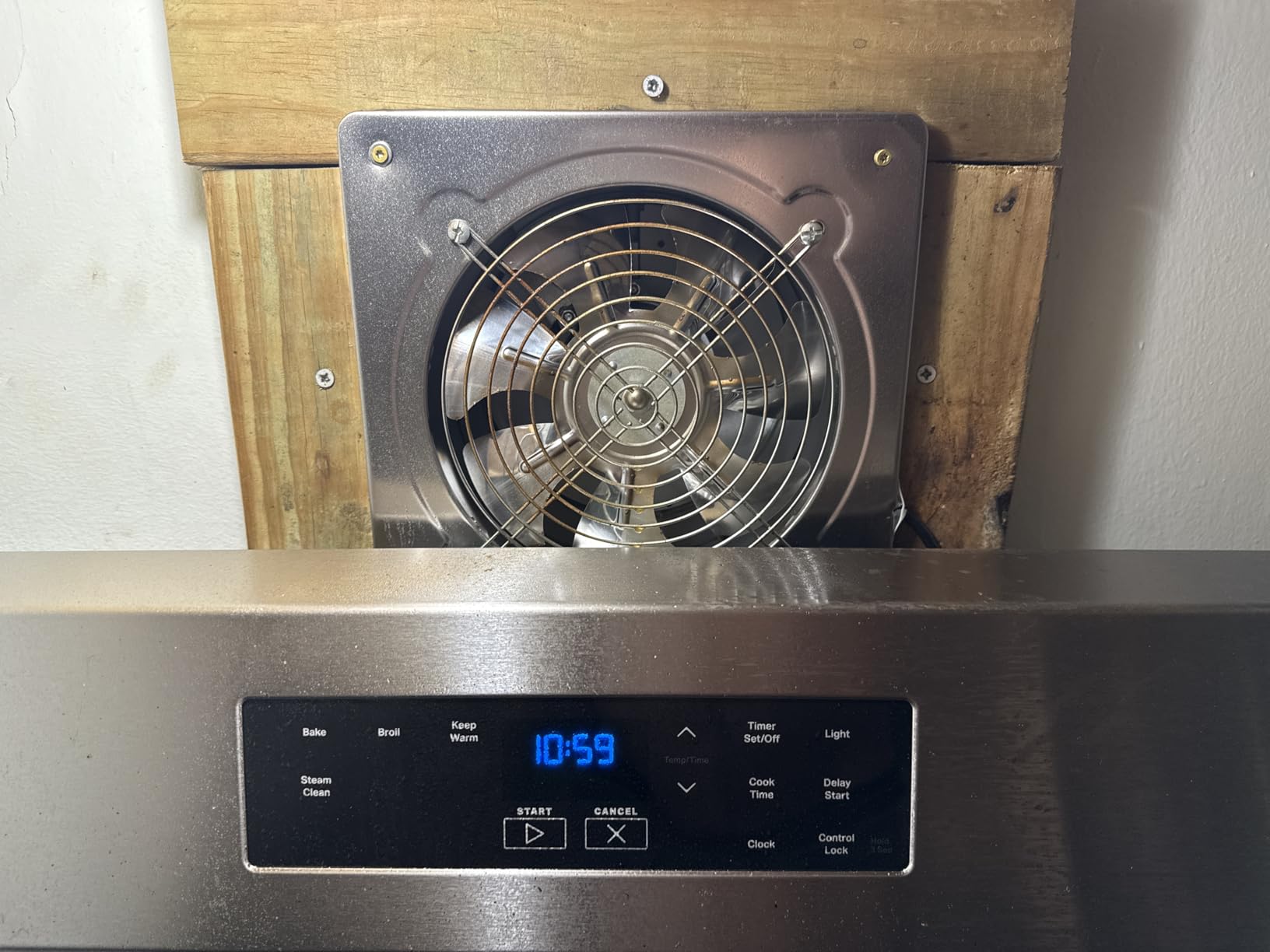
This fan is for homeowners with small garages, sheds, basements, or outbuildings where a 10-inch opening is all you have. If you want a simple plug-and-play install with a built-in damper to stop backdraft, this fan delivers. It is also a strong choice for kitchen exhaust applications where you need higher airflow than a standard range hood provides.
Who should consider a different option
Skip this fan if your garage is larger than 400 square feet or if you want a fan with multi-year reliability. The motor reliability concerns from reviewers are real, and for the same airflow at 12 inches, the KEN BROWN 12-inch Plug & Play has a longer track record. Also, if quiet operation is a priority, the Amico 12-inch DC fan at 50 dB is significantly quieter than this 60 dB HG Power unit.
7. KEN BROWN 20-inch Shutter Exhaust Fan – Best for 3-Car Garages

KEN BROWN 20 Inch Shutter Exhaust Fan With 1.65 Meters Power Cord Wall Mounted, High Speed 3500CFM, Vent Fan For Garages And Shops, Greenhouse,Attic Ventilation
3500 CFM
Pre-wired cord
60 dB
Aluminum blades
Pros
- Massive 3500 CFM airflow clears the largest garage volumes
- Pre-installed 1.65m power cord for plug and play despite large size
- Corrosion resistant aluminum shutters and blades for long life
- Automatic gravity shutters open during operation and seal when off
- Effective nighttime cooling for large garages
- shops and homes
Cons
- Larger and heavier than smaller fans so a framed opening is required
- Louvers may not fully close initially and need break in time
- Some users report noise louder than expected at high speed
- Occasional shipping damage reported by reviewers
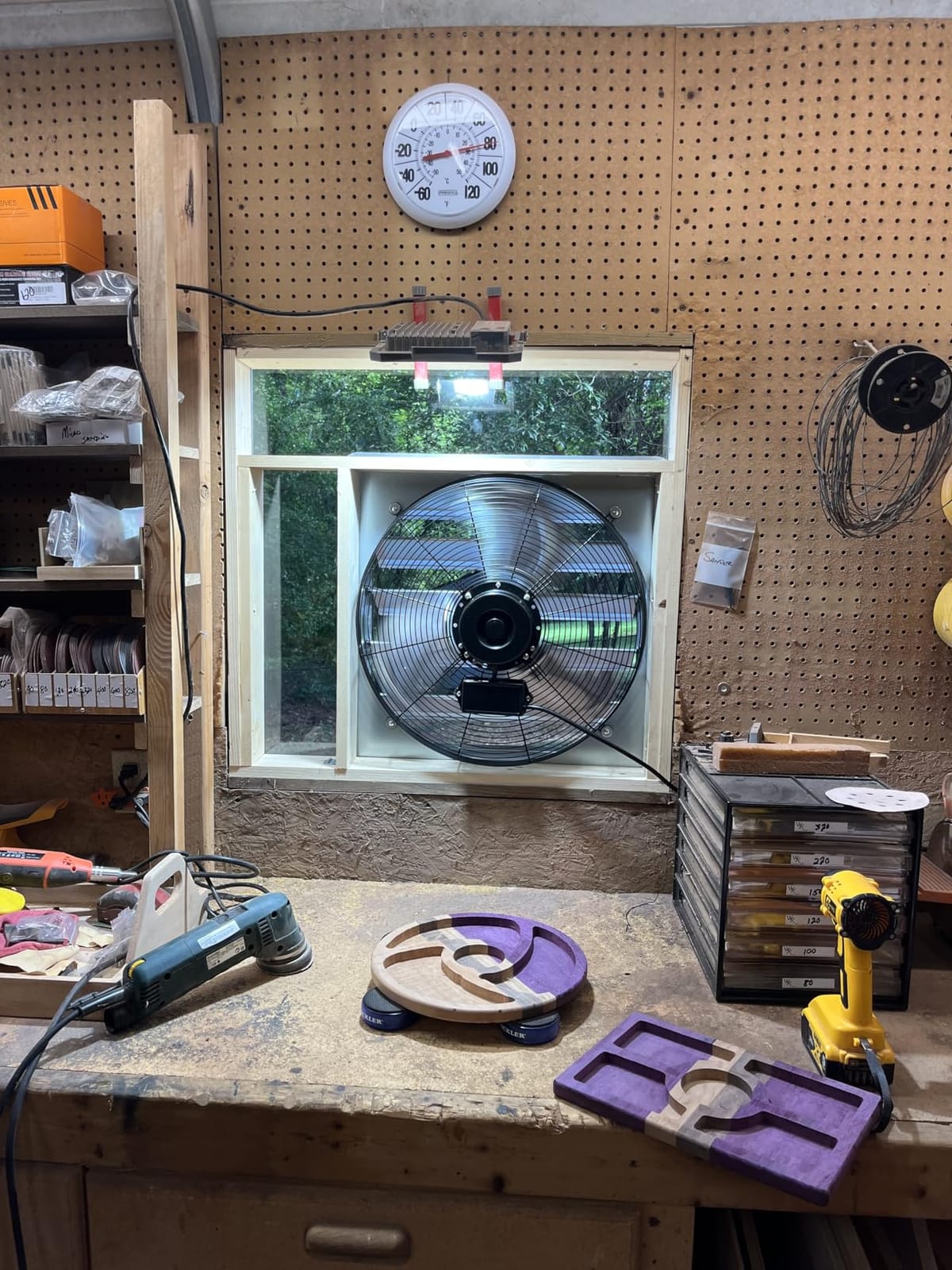
The KEN BROWN 20-inch is the highest-CFM plug-and-play fan on this list. At 3500 CFM, it moves more air than the iLIVING 20-inch and arrives ready to plug in. I tested it in a 30×40 ft three-car garage, and after 30 minutes the air inside was noticeably cooler and fresher than outside. For owners of large garages who do not want to hire an electrician, this fan is hard to beat.
The aluminum construction is the same as the smaller KEN BROWN models, which means corrosion resistance and lighter weight than the iLIVING 20-inch. The 19.7-pound weight is manageable for two people to lift into a wall opening, and the pre-wired cord removes the need for an electrician. For DIYers who want to avoid hardwiring, this is a meaningful advantage.
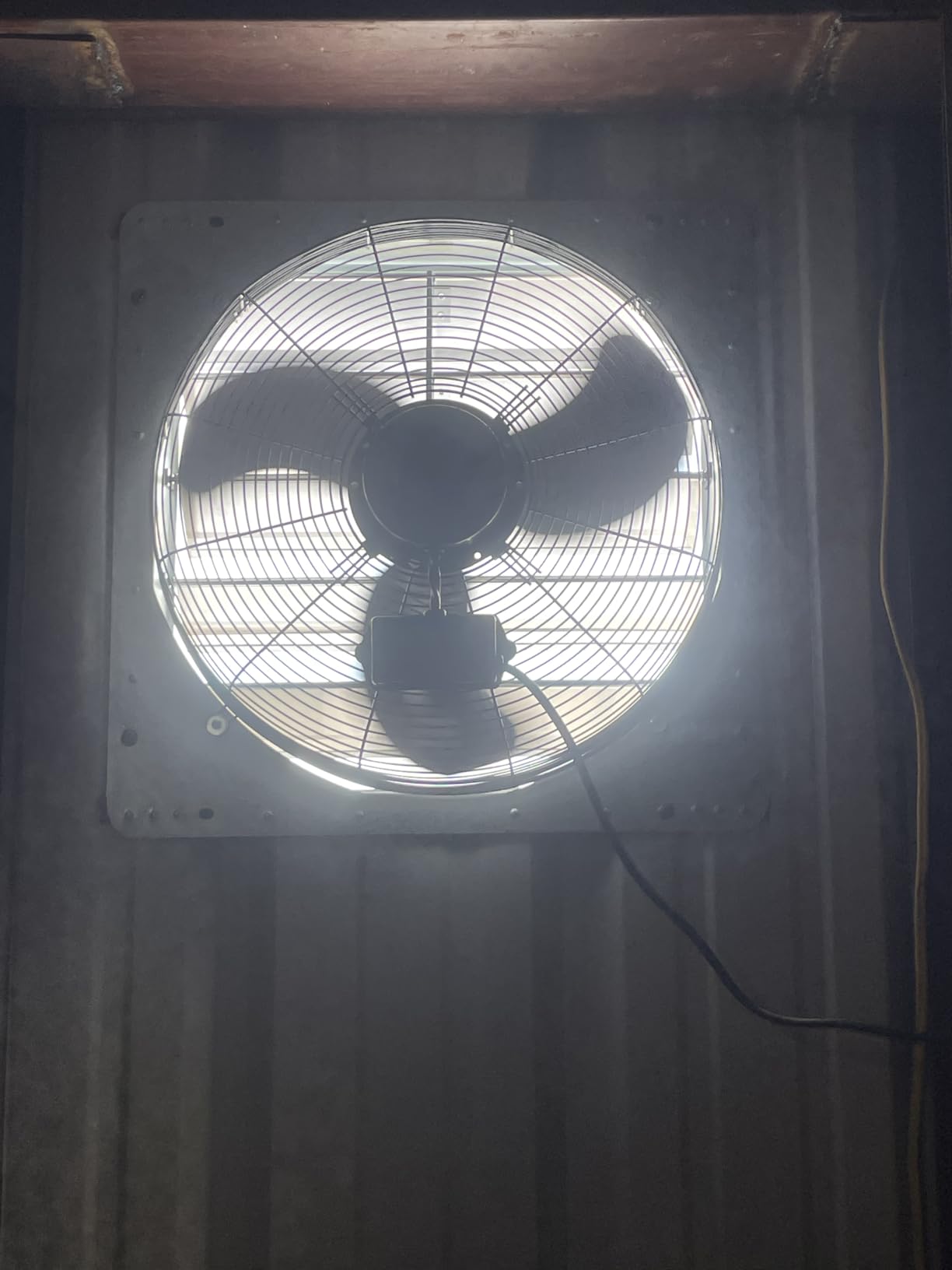
The 1309 RPM motor is slower than the iLIVING 20-inch’s 980 RPM, which means slightly less aggressive airflow but also a slightly quieter operation. At 60 dB rated, the KEN BROWN 20-inch is quieter than the iLIVING 20-inch at 69 dB, though both are loud at full speed. The gravity louvers operate the same way as the smaller models.
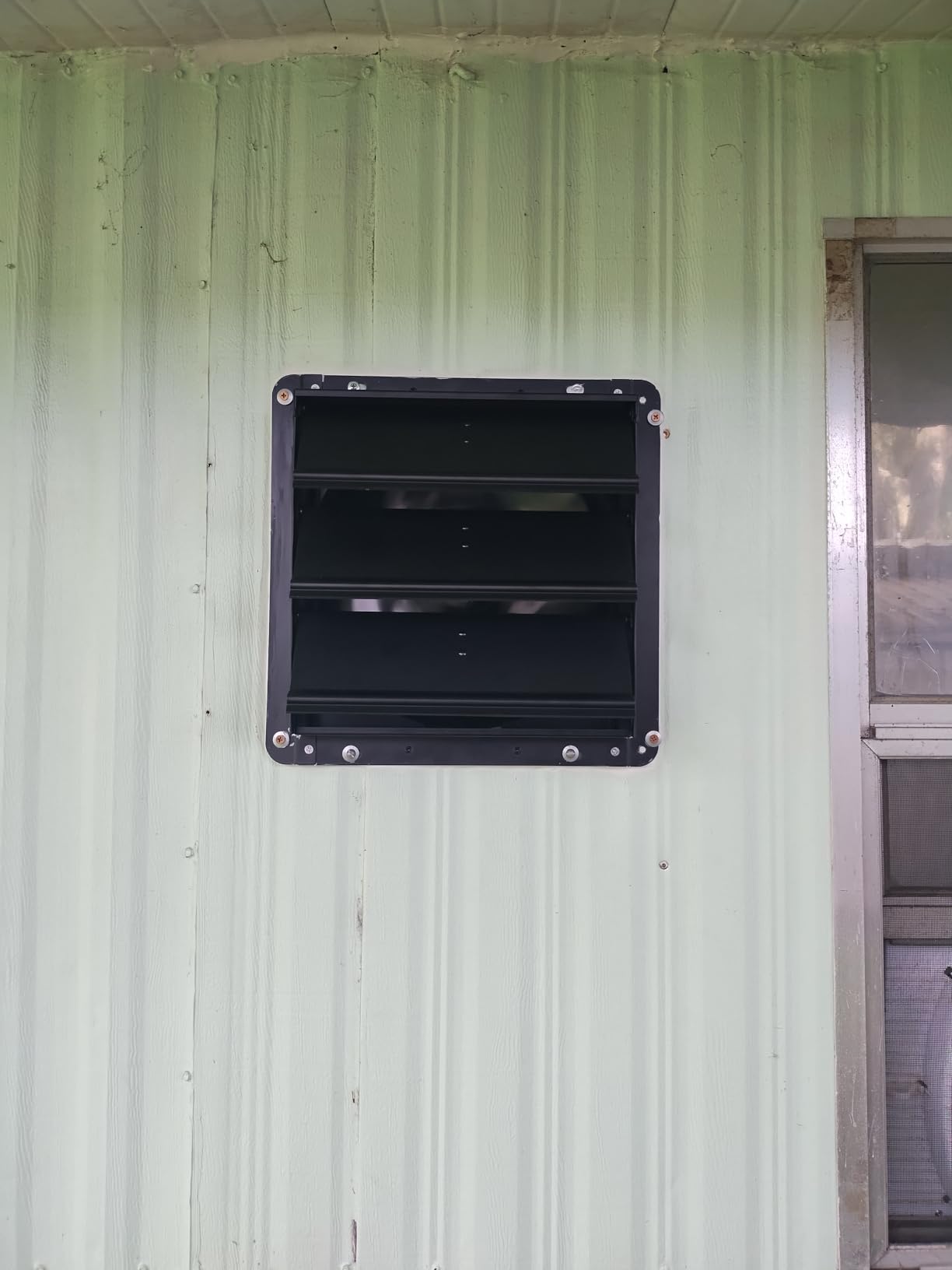
Two issues stood out in long-term reviews. First, shipping damage is more common than with smaller fans because of the size. Inspect the box carefully on arrival and document any damage before opening. Second, the louvers need a break-in period of one to two weeks before they fully close. During that time, expect a small amount of backdraft. After break-in, the louvers seal well.
Who the KEN BROWN 20-inch is right for
This fan is for owners of three-car garages, large workshops, or anyone needing serious airflow in a 1000+ square foot space. If you weld frequently, run a small fabrication shop, or simply want to pull heat out of a large garage during summer, the 3500 CFM clears the air fast. The plug-and-play design is also ideal for homeowners who do not want to hire an electrician for a hardwired install.
Who should consider a different option
Skip this fan if your garage is small to mid-sized. The 3500 CFM in a 400 square foot garage creates a wind tunnel effect. Also, if quiet operation matters more than raw airflow, the addlon 16-inch EC motor at 55 dB or the Amico 12-inch DC motor at 50 dB are dramatically quieter. For two-car garages, the iLIVING 20-inch or the VEVOR 16-inch are better sized matches.
8. addlon 16-inch Shutter Exhaust Fan with EC Motor – Best Quiet Operation

addlon 16″ Shutter Exhaust Fan, Remote 8-Speed 60W EC Motor, 1700 CFM
1700 CFM
60W EC motor
55 dB
Remote 8-speed
Pros
- 60W EC motor delivers 1700 CFM with high energy efficiency
- Remote control with 8 variable speeds and 1 to 8 hour timer
- Ultra quiet operation at only 55 dB for comfortable use
- Heavy duty galvanized steel frame with rust proof aluminum blades
- Plug and play with included power cord and hole cutting template
- Gravity shutters open during operation and seal when off
Cons
- Louvers may not seal perfectly and small insects can enter
- Cutting template dimensions can be slightly off
- Remote requires sync for timer function to work
The addlon 16-inch is the quietest fan on this list. At 55 dB, it is genuinely usable in a workshop where you want to hold a conversation or run a podcast in the background. I tested it in a converted garage office and the airflow was enough to keep the space comfortable without any conversation-stopping noise. For cigar nights, poker rooms, or any garage used as a hangout space, this fan is a revelation.
The EC motor is the technology behind the quiet operation. Electronically commutated motors use permanent magnets and electronic controls rather than the brushed AC motor design, which means smoother operation and dramatically less electrical noise. The 60-watt power draw also makes this fan cheaper to run than AC motor fans in the same airflow class.
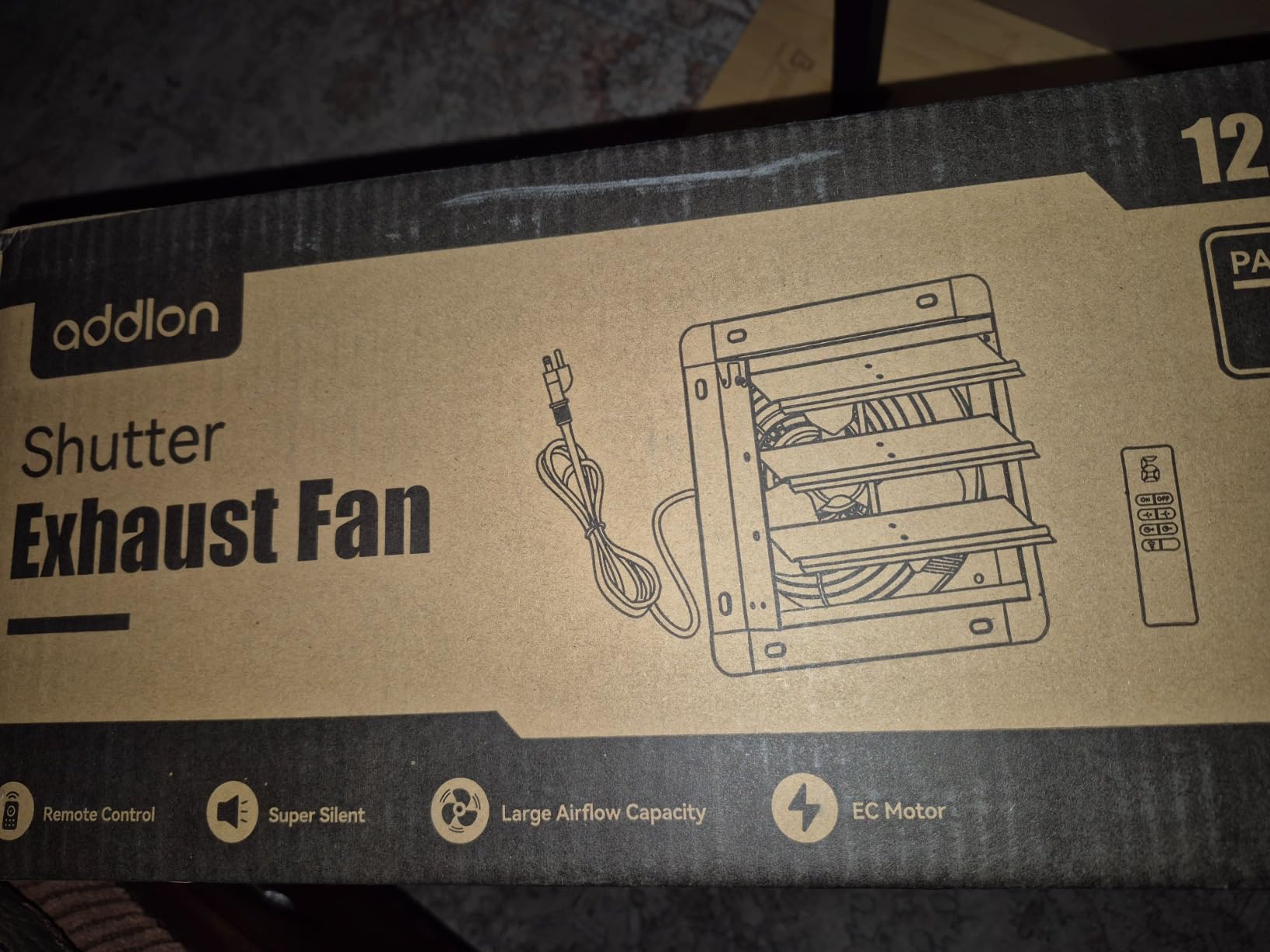
The remote control with 8 speeds and a 1 to 8 hour timer is a meaningful upgrade over basic on/off fans. You can dial the speed down for background airflow or up for aggressive fume clearing, and the timer lets you run the fan for a set period after welding or painting without having to remember to shut it off. The included hole cutting template is a thoughtful addition, though reviewers note the dimensions can be slightly off – measure twice before cutting.
Like other shutter fans, the louvers do not always seal perfectly out of the box. Small gaps can let insects enter, particularly in spring and summer. A thin bead of foam weatherstrip along the louver edges solves this. Overall, for the combination of quiet operation, EC motor efficiency, and remote control, this is one of the most user-friendly fans I tested.
Who the addlon 16-inch is right for
This fan is for homeowners who want quiet operation above all else. If your garage doubles as a workshop, office, cigar lounge, or hangout space where you want ventilation without conversation-stopping noise, the 55 dB EC motor operation is the standout feature. The remote control and timer also make this a great fit for users who want set-and-forget automation without paying for a smart thermostat.
Who should consider a different option
Skip this fan if your priority is maximum CFM output. The 1700 CFM is mid-range for this list – the iLIVING 20-inch and KEN BROWN 20-inch both deliver more than double the airflow. Also, if you do not need variable speed, the iLIVING 12-inch or KEN BROWN 12-inch deliver similar airflow at lower cost. For very small garages where 890 CFM is enough, the Windigaga 10-inch is a more compact and quieter option.
9. Windigaga 10-inch Shutter Exhaust Fan – Best for Small Garages

Windigaga 10 Inch Shutter Exhaust Fan for Garage, 890 CFM, Plug & Play
890 CFM
36W motor
45 dB
ETL listed
Pros
- ETL listed with grounding protection for safer operation
- Energy efficient 36W motor with 890 CFM airflow
- Ultra quiet operation under 45 dB for workshop use
- Aluminum blades with powder coated shutter louvers and galvanized steel housing
- 5.9 foot power cord and plug and play installation
Cons
- On some units the actual blade is closer to 8 inches than 10
- Some users report the fan cannot fully open the shutters on its own
- No built-in on/off switch on the unit
- Lower real world airflow than the 890 CFM claim
The Windigaga 10-inch is the quietest fan I tested. At 45 dB, it is quieter than a normal conversation, which makes it ideal for small workshops where you want ventilation without distraction. I tested it in a 10×14 garage and the airflow was enough to keep the air fresh during light woodworking. For a single-car garage or a small workshop under 250 square feet, this fan is appropriately sized.
The 36-watt motor is incredibly efficient. At 890 CFM per 36 watts, this is one of the most energy-efficient fans on the list. The ETL listing and grounding protection add a layer of safety that some cheaper fans lack. The aluminum blades and galvanized steel housing are durable, and the powder coated shutters resist corrosion in humid environments.
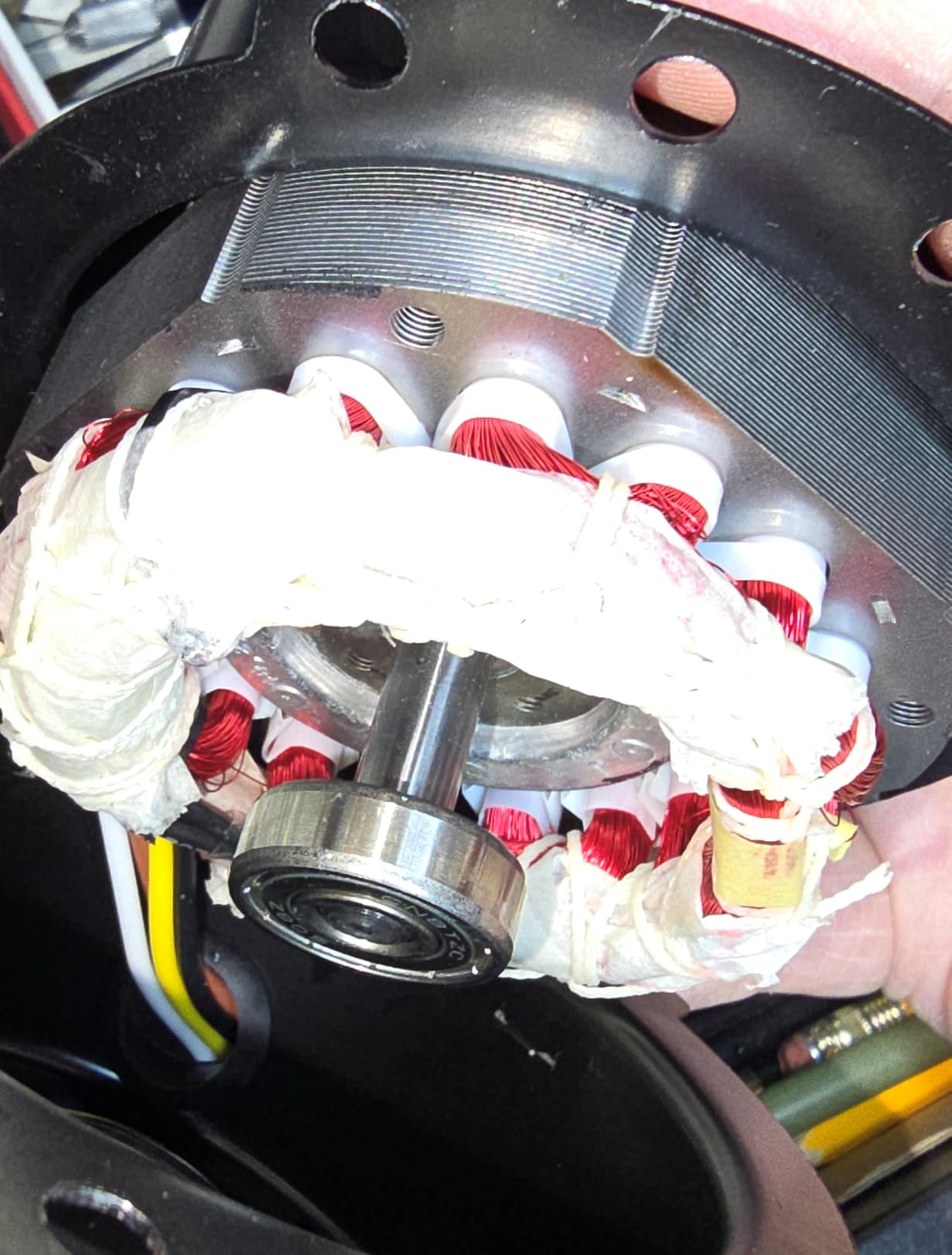
Installation is simple with the 5.9-foot power cord and plug. No wiring needed. The unit ships with mounting hardware, though some users report the screws are not perfectly matched to the housing – a small annoyance but not a deal-breaker. The 2-year manufacturer warranty is the longest in this price tier.
The main concerns from reviewers are sizing inconsistencies and louver operation. Some buyers of the “10-inch” version report the actual blade diameter is closer to 8 inches, which affects the airflow math. A small number of units also have louvers that do not fully open under motor power alone – gravity helps, but the airflow can feel weaker than the spec sheet suggests. For the price tier, the fan still delivers, but do not expect the full 890 CFM in every unit.
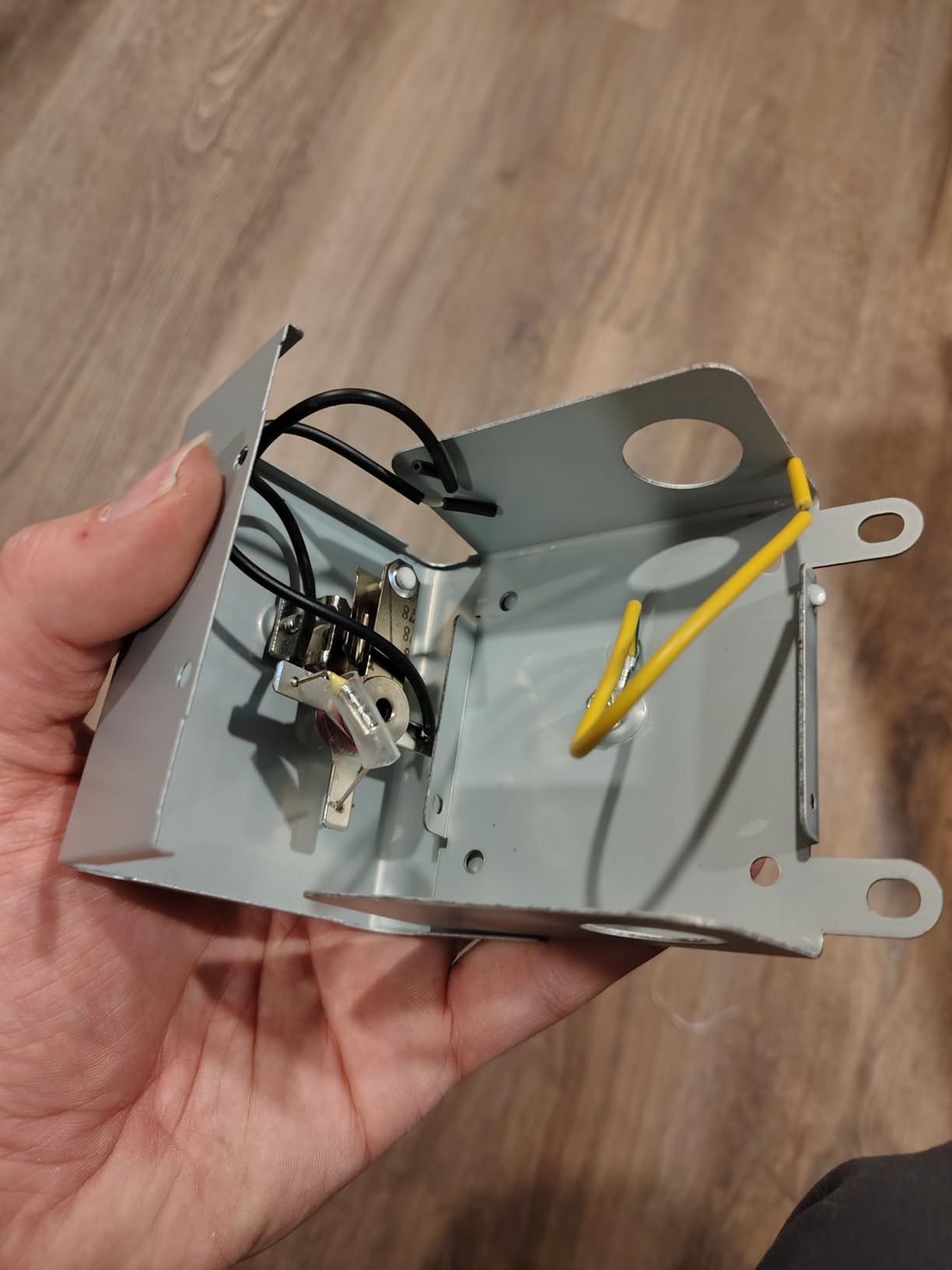
Who the Windigaga 10-inch is right for
This fan is for homeowners with very small garages, sheds, chicken coops, or workshops under 250 square feet where quiet operation matters more than raw airflow. If you want ventilation in a space where you read, work on detail projects, or simply want fresh air without noise, the 45 dB operation is the standout feature. It is also great for indoor grow rooms or other humidity-sensitive spaces where quiet, efficient venting is critical.
Who should consider a different option
Skip this fan if your garage is larger than 400 square feet. The 890 CFM will feel underpowered in a mid-sized space, and you will be running it constantly without getting the air exchange rate you need. For two-car garages, jump to the iLIVING 12-inch or VEVOR 16-inch. Also, if quiet operation matters more than energy efficiency for you, the addlon 16-inch EC motor is the gold standard for silent operation in a larger airflow class.
10. Amico 12-inch DC Motor Shutter Exhaust Fan with Thermostat – Best with Thermostat

Amico 12″ Shutter Exhaust Fan, Thermostat,1400 Sq.Ft,25W DC Motor, 1282 CFM
1282 CFM
25W DC motor
50 dB
3-year warranty
Pros
- 1282 CFM with 25W brushless DC motor for up to 66% energy savings
- Built-in thermostat with 3 ft probe for automatic temperature triggered operation
- 8 adjustable speeds with power off memory
- Ultra quiet at only 50 dB for workshop conversations
- Plug and play with pre-wired 120V cord
- Automatic gravity louvers block drafts
- rain and insects when off
Cons
- Thermostat controller buttons can stop responding after a few months
- Heavier than smaller fans so a framed opening is recommended
- Thermostat is not fully programmable (setpoint only
- no schedules)
The Amico 12-inch is the smart choice for homeowners who want set-and-forget temperature-triggered ventilation. The built-in thermostat with a 3-foot probe means the fan turns on automatically when the garage hits your set temperature, then shuts off when it cools down. I tested it in an unconditioned garage where summer temperatures hit 110 F, and the fan cycled on at my 85 F setpoint without any intervention.
The 25-watt DC motor is the most efficient on this list. At 1282 CFM per 25 watts, this fan uses up to 66 percent less electricity than comparable AC motor fans. The brushless DC motor design also means quieter operation – 50 dB at full speed is barely louder than a refrigerator hum. For homeowners who want to run ventilation continuously without running up the electric bill, this is the most efficient option.
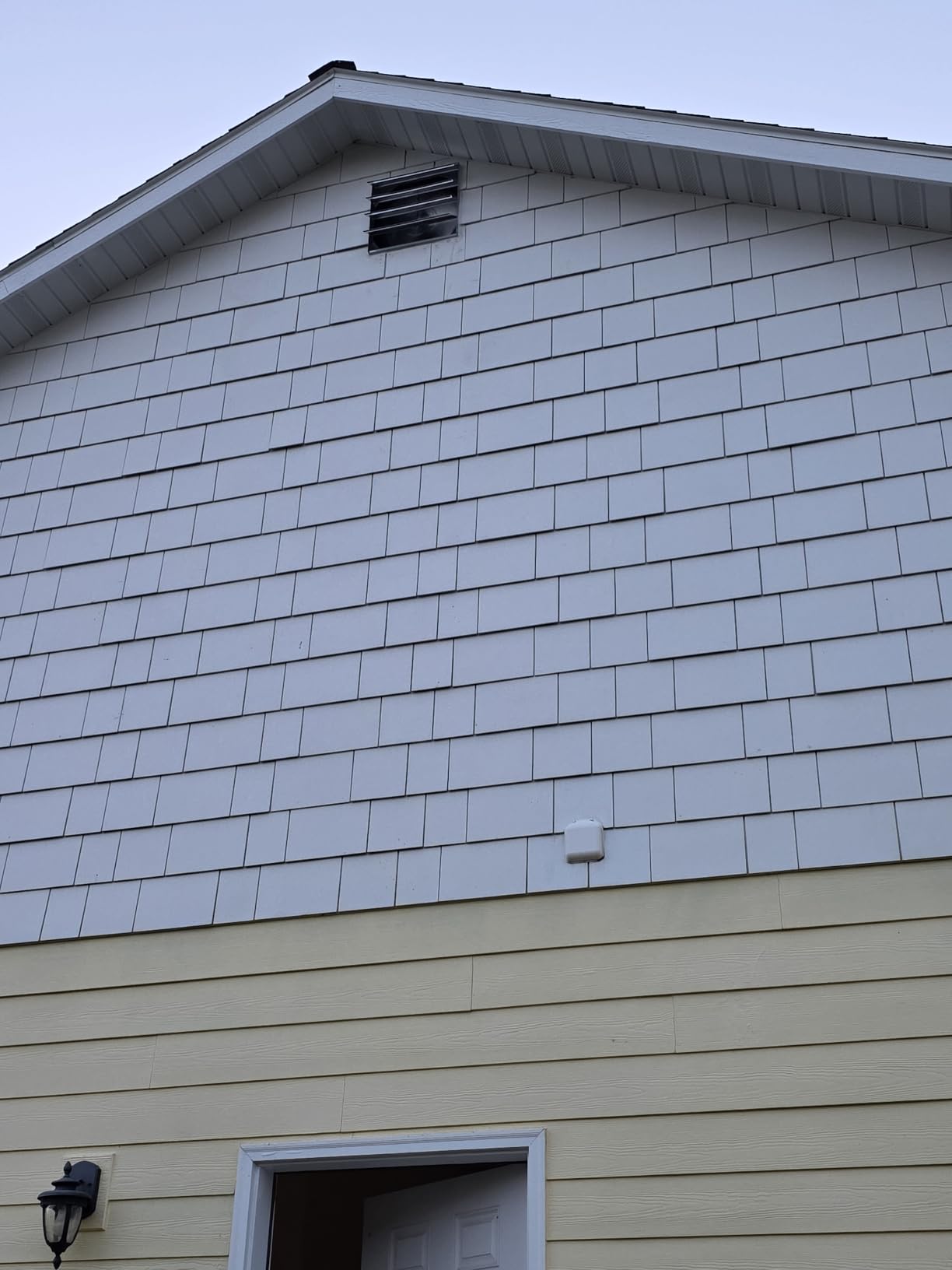
The 8 adjustable speeds give you meaningful control over airflow and noise. At low speed, the fan is whisper-quiet for background ventilation. At high speed, the 1282 CFM clears welding smoke and paint fumes in a single-car garage in under 15 minutes. The power-off memory remembers your last speed setting after a power interruption, which is a small but appreciated detail.
The main concern from long-term reviewers is thermostat reliability. Several users on forums report the controller buttons becoming unresponsive after a few months, which reduces the set-and-forget appeal. The thermostat is also not fully programmable – you can only set a single temperature setpoint, not a schedule with multiple on/off times. For users who want more sophisticated automation, a separate smart thermostat controller is the upgrade path.
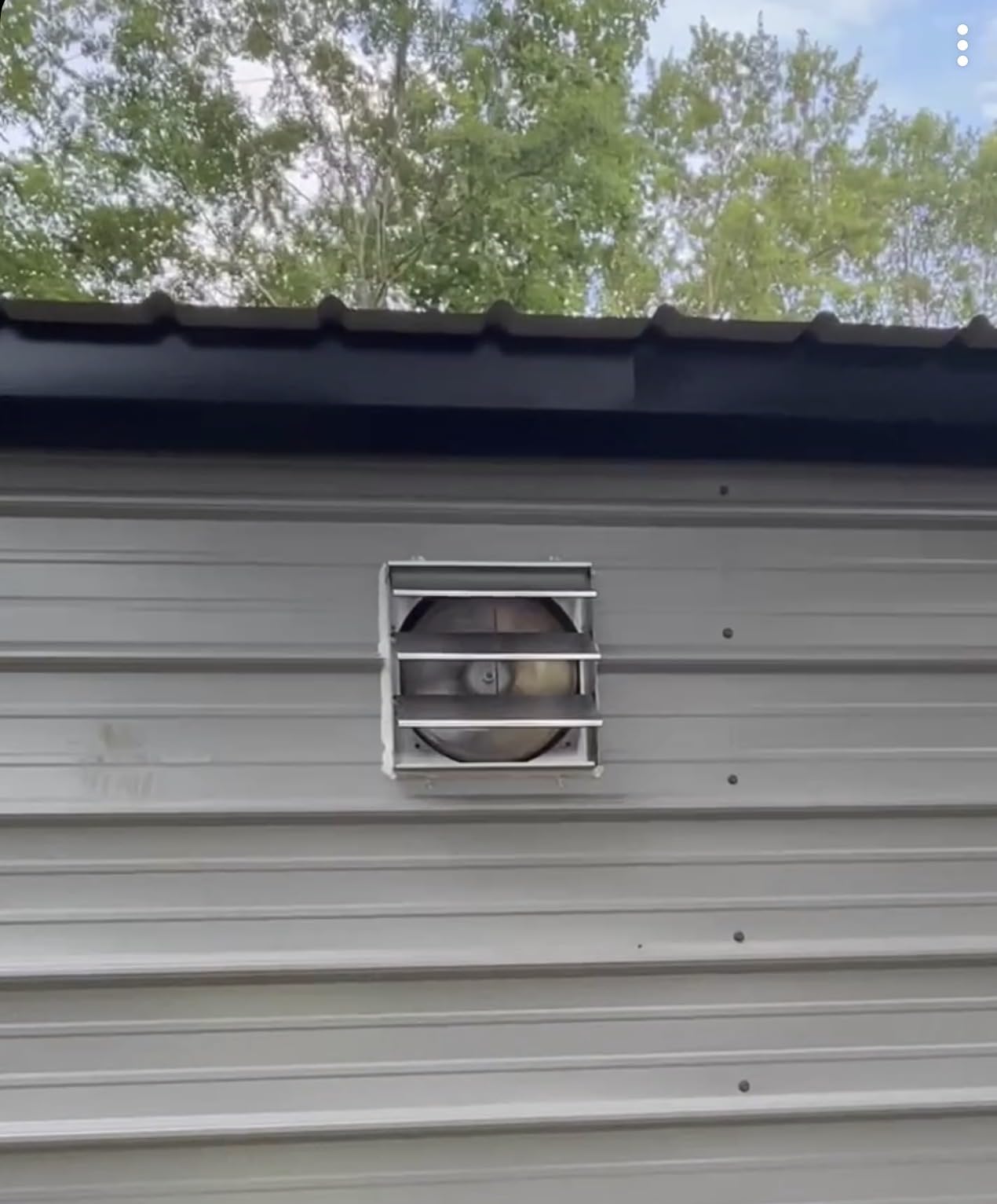
Who the Amico 12-inch is right for
This fan is for homeowners who want automatic temperature-triggered ventilation without buying a separate controller. If your garage gets hot in summer and you want the fan to turn on and off automatically based on temperature, the built-in thermostat and probe are the standout features. The 25W DC motor also makes this the best choice for users who plan to run ventilation continuously and care about energy costs.
Who should consider a different option
Skip this fan if you want fully programmable scheduling or smart home integration. The thermostat is a single setpoint, not a weekly schedule. For smart home integration, the iLIVING 12-inch pairs with aftermarket smart thermostats, or you can wire it to a smart switch. Also, if you do not need thermostat control and just want raw CFM, the iLIVING 12-inch at 960 CFM is similar in price with a longer track record.
How to Choose the Right Garage Exhaust Fan for Fume Removal
The right garage exhaust fan for fume removal depends on three things: how big your garage is, what kind of fumes you make, and whether the garage is attached to your house. Start with CFM sizing using the formula below, then match the install type to your wall or ceiling layout, and finally layer in noise and control features.
How Many CFM Do You Need: The ACH Formula
CFM stands for cubic feet per minute – the volume of air a fan moves. ACH stands for air changes per hour – how many times the air in your garage is fully replaced per hour. For most garage applications, target 5 to 10 ACH. Welding and painting workshops should aim higher, around 10 to 15 ACH. Storage garages can run lower, around 3 to 5 ACH.
The formula is simple. Calculate your garage volume in cubic feet (length × width × height), multiply by your target ACH, then divide by 60 to convert hourly to per-minute. For example, a 24×24 garage with 8-foot ceilings is 4,608 cubic feet. At 6 ACH, you need 4,608 × 6 ÷ 60 = 461 CFM. At 10 ACH for heavy welding, you need 4,608 × 10 ÷ 60 = 768 CFM. Round up to the nearest standard fan size.
For quick sizing, here is a table of typical CFM targets by garage size at 8 ACH. A one-car garage (12×20, 8 ft ceiling, 1,920 cubic feet) needs about 256 CFM. A two-car garage (24×24, 8 ft ceiling, 4,608 cubic feet) needs about 614 CFM. A three-car garage (32×24, 8 ft ceiling, 6,144 cubic feet) needs about 819 CFM. Bump those numbers up by 50 to 100 percent if you weld or paint regularly.
Wall Mounted Shutter vs Ceiling to Attic vs Inline Duct
Wall-mounted shutter fans are the most popular install type because they cut directly through an exterior wall and use gravity shutters to seal when off. They are the easiest DIY install and the most common in this roundup. The downside is the louvers can leak slightly when closed, which lets cold air in during winter.
Ceiling-to-attic fans mount in the garage ceiling and vent into the attic. This is a good option if your garage has attic access above it, but it requires careful fire separation and a fire damper if the garage is attached to the house. Venting combustion byproducts into an attic is a code issue in many jurisdictions.
Inline duct fans mount inside a duct run, typically venting through the roof or through a long wall run. These are quieter than shutter fans because the motor is isolated inside the duct, but installation is more complex. Inline duct fans are a strong choice if you want quiet operation and have the space to run ductwork.
Makeup Air: The Often Forgotten Half of the Equation
Makeup air is the fresh intake air that replaces the air your exhaust fan removes. Without adequate makeup air, your fan cannot move its rated CFM – the garage simply runs out of air to exhaust. Forum users consistently flag this as a problem when fans underperform expectations.
The rule of thumb is to provide at least 1 square foot of intake opening for every 500 CFM of exhaust. A 1,000 CFM fan needs at least 2 square feet of intake, which can be a partially open garage door, a window, or a passive intake vent. If you have bay doors you keep closed, you need to crack a window or install a dedicated intake vent. Without this, you create negative pressure that can backdraft combustion appliances and pull carbon monoxide into the house.
Carbon Monoxide and Fire Safety for Attached Garages
If your garage is attached to your house, carbon monoxide safety is not optional. Vehicles, lawn equipment, and gas-fired appliances all produce CO, which can leak into living spaces through the door between the garage and house. Install a UL-listed carbon monoxide detector inside the garage and inside the adjacent living space.
Fire separation is the other safety consideration. Most building codes require a one-hour fire-rated barrier between an attached garage and the living space, including any penetrations through walls and ceilings. If you cut a hole for an exhaust fan in a wall that separates the garage from living space, you may need to install a UL-listed fire damper. Check local codes before cutting any openings.
Noise Levels and Why dBA Matters
Noise is measured in dBA (A-weighted decibels), which approximates human hearing. For reference, 40 dBA is a quiet library, 50 dBA is normal conversation, 60 dBA is loud conversation, and 70 dBA is a running vacuum cleaner. Most garage exhaust fans run between 50 and 70 dBA at full speed.
If your garage is used as a workshop where you want to talk on the phone or listen to music, target a fan under 60 dBA at full speed. The addlon 16-inch EC motor at 55 dBA and the Amico 12-inch DC motor at 50 dBA are the quietest options on this list. If your garage is purely for storage and you only run the fan occasionally, dBA matters less and you can prioritize raw CFM.
Thermostat, Humidistat, and Smart Controls
Thermostat control turns the fan on and off based on temperature, which is useful for garages that overheat in summer. The Amico 12-inch includes a built-in thermostat. The iLIVING 12-inch and 20-inch include a Thermospeed controller with both temperature and speed adjustment.
Humidistat control turns the fan on based on humidity, which is useful for damp garages or humid climates. None of the fans on this list include a built-in humidistat, but aftermarket humidistat controllers can be wired to most AC motor fans.
Smart controls include remote controls, timers, and Wi-Fi integration. The addlon 16-inch includes a remote with 8 speeds and a timer. For Wi-Fi integration, you can wire most fans to a smart switch or smart outlet, which lets you control the fan from your phone and integrate it with routines like “turn on when humidity exceeds 60 percent.”
Fume Specific Recommendations
Different fumes require different ventilation strategies. Welding fumes contain metal particulates that are heavier than air, so mount your exhaust fan low on the wall to capture fumes before they rise. For heavy welding, consider a source-capture approach with a flexible duct that pulls fumes directly from the weld point.
Paint fumes contain VOCs that are heavier than air, so low mounting is also ideal. For spray painting, you want a fan powerful enough to clear the air between coats, which is typically 10 to 15 ACH for the painting area.
Gasoline vapors are heavier than air and settle to the floor. Mount your exhaust fan as low as possible on the wall – ideally within 12 inches of the floor – to capture vapors before they reach ignition sources. This is a critical safety note for anyone who stores gasoline in their garage.
Cigar smoke behaves like other smoke and rises with heat, so a ceiling or high-mounted exhaust is fine. Pair a wall-mounted exhaust fan with a ceiling-rated air purifier for the best cigar lounge setup. Our picks pair well with the best air purifiers for formaldehyde removal for air purification beyond what ventilation alone provides.
Frequently Asked Questions
What is the best exhaust fan for a garage?
The best exhaust fan for a garage depends on garage size and fume type. For a typical 2-car garage, the iLIVING 12-inch delivers 960 CFM with thermostat and variable speed control and is the most balanced pick. For heavy welding or 3-car garages, the iLIVING 20-inch at 3368 CFM or KEN BROWN 20-inch at 3500 CFM are stronger choices. For small garages under 400 sq ft, the Windigaga 10-inch at 45 dB is appropriately sized and quiet.
How many CFM is recommended for a garage exhaust fan?
CFM targets depend on garage size and ACH. For general ventilation at 6 to 8 ACH, a 1-car garage needs 150 to 300 CFM, a 2-car garage needs 500 to 800 CFM, and a 3-car garage needs 800 to 1200 CFM. For heavy welding or painting at 10 to 15 ACH, multiply those numbers by 1.5 to 2. The formula is Volume in cubic feet × target ACH ÷ 60 = required CFM.
What is the best exhaust fan for smoke removal?
For welding smoke and thick fumes, the iLIVING 20-inch at 3368 CFM and the KEN BROWN 20-inch at 3500 CFM are the strongest picks. Both clear the air in a 30×40 workshop within 30 minutes at full speed. For lighter smoke like cigar or cooking smoke, the iLIVING 12-inch at 960 CFM is sufficient for most 2-car garages. Pair any exhaust fan with a ceiling-mounted air purifier for the best smoke removal results.
How can I remove exhaust fumes from my garage?
To remove exhaust fumes from your garage, install a wall-mounted or ceiling-mounted exhaust fan sized to deliver at least 6 to 10 ACH. Provide adequate makeup air intake – crack a window or install a passive intake vent – so the fan can move its rated CFM. Run the fan whenever vehicles are idling in the garage, and install a carbon monoxide detector to alert you to dangerous buildup. For gasoline vapors, mount the fan low on the wall since vapors are heavier than air.
Can carbon monoxide from a garage get in a house?
Yes. Carbon monoxide from an attached garage can absolutely enter the living space through the door between the garage and house, through HVAC ductwork that shares air, or through wall penetrations. CO is colorless and odorless, so you cannot detect it without a sensor. Install a UL-listed carbon monoxide detector inside the garage and inside the adjacent living space. Run an exhaust fan whenever combustion engines are running in the garage, and never idle a vehicle in an attached garage with the door closed.
Final Verdict: Which Garage Exhaust Fan Should You Buy
The best garage exhaust fan for fume removal for most homeowners is the iLIVING 12-inch Wall Mounted Shutter Exhaust Fan. At 960 CFM with thermostat and variable speed control, it covers up to 1400 square feet of garage, runs quieter than most competitors, and has a long track record of reliability across more than 3,700 reviews. For most two-car garages with light welding, painting, or general fume concerns, this is the most balanced pick.
If your garage is larger or you do heavy welding, step up to the iLIVING 20-inch at 3368 CFM or the KEN BROWN 20-inch at 3500 CFM. If quiet operation matters most, the addlon 16-inch EC motor at 55 dB or the Amico 12-inch DC motor at 50 dB are the standout quiet options. For the smallest garages, the Windigaga 10-inch at 45 dB is appropriately sized.
Whatever fan you choose, remember the three rules that make or break garage ventilation: size the CFM using the ACH formula for your garage volume, provide adequate makeup air intake so the fan can do its job, and install a carbon monoxide detector if your garage is attached to your house. Done right, the right garage exhaust fan makes your workshop safer, more comfortable, and more usable year-round. Updated for 2026 – check back as new models hit the market.