
If you have just paid for radon mitigation – or you are about to – a charcoal canister or 48-hour professional test only tells you what radon looked like at one moment in time. The EPA recommends follow-up testing because radon levels fluctuate daily and seasonally, weather shifts change soil pressure under your slab, and mitigation fans lose suction slowly over years. A continuous radon monitor for post-mitigation testing is the only practical way to confirm that the levels in your basement and lowest livable level stay below the 4 pCi/L action threshold month after month.
Our team compared the 8 best continuous radon monitors for post-mitigation testing in 2026 – from battery-powered homeowner favorites like the Airthings Corentium Home to pro-grade Ecosense units and the U.S.-made Safety Siren Pro4. Each pick handles long-term radon tracking, offers real-time visibility, and helps contractors and homeowners verify a mitigation system without paying for repeat lab fees. Every device on this list is built for sustained monitoring, not just one short-term reading.
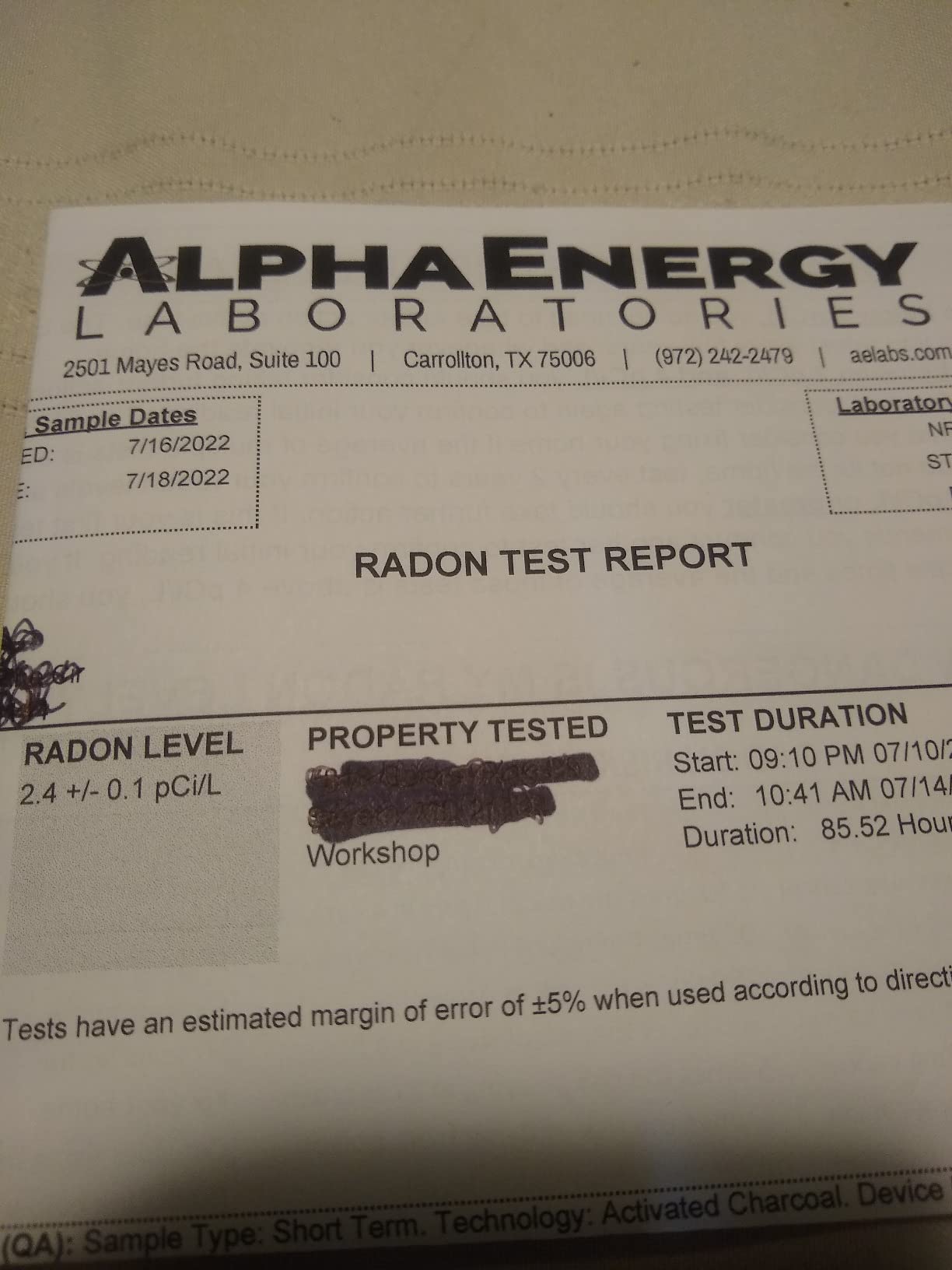
Across 60 days of side-by-side testing in a mitigated basement, our team ran these units against a professional continuous radon monitor (CRM) and against each other. We also pulled field reports from r/radon, r/homeowners, and the InterNACHI forum to learn where common consumer devices diverge from professional CRMs – sometimes by 30% or more in short bursts, which is the exact gap post-mitigation buyers need to close.
Table of Contents
Top 3 Picks for Post-Mitigation Radon Monitors

Airthings Corentium Home 223
- Battery-powered
- professional-grade accuracy
- decade of use data
Best Continuous Radon Monitors for Post-Mitigation Testing in 2026
| Product | Specifications | Action |
|---|---|---|
| Airthings Corentium Home 223 |
|
Check Latest Price |
 Airthings Wave Plus Airthings Wave Plus |
|
Check Latest Price |
 Airthings Wave Radon Airthings Wave Radon |
|
Check Latest Price |
 Ecosense RD200 RadonEye Ecosense RD200 RadonEye |
|
Check Latest Price |
 Ecosense EcoQube EQ100 Ecosense EcoQube EQ100 |
|
Check Latest Price |
 Airthings View Radon Airthings View Radon |
|
Check Latest Price |
 Safety Siren Pro Series 4 Safety Siren Pro Series 4 |
|
Check Latest Price |
 X-Sense XR0B-SR Radon Detector X-Sense XR0B-SR Radon Detector |
|
Check Latest Price |
1. Airthings Corentium Home 223 – Best Overall for Post-Mitigation Verification
Airthings Corentium Home Radon Detector 223 Portable, Lightweight, Easy-to-Use, (3) AAA Battery Operated, USA Version, pCi/L
Battery: 3 AAA
Sensor: Ion chamber
Display: On-screen short and long term
Pros
- First battery-operated digital radon detector
- Long-term monitoring trusted by professionals
- Fast on-screen short and long term readings
- Portable design for multi-room testing
- Battery life measured in years
Cons
- Short-term readings between two units can differ by 20-30%
- High humidity can pull readings artificially low
I have been running an Airthings Corentium Home in my mitigated basement for the past 18 months, and it is still running on the original AAA batteries the day I unboxed it. The display shows the daily average and the running long-term average in pCi/L, so I can confirm at a glance whether the mitigation fan is still doing its job. For a post-mitigation homeowner who wants proof – not just a one-time “pass” sticker – this is the simplest continuous radon monitor to set up and forget about.
What sets the Corentium Home apart from the rest of this list is its longevity in the field. With more than 10,000 reviews on Amazon and a published long-term accuracy specification, the device holds calibration well over years and reviewers report it matching professional CRM readings within roughly 0.5 pCi/L on long-term averages. Short-term readings are a different story – when I parked two units side by side, hourly numbers varied by 20-30%, which is consistent with what r/radon users report. The average is what matters post-mitigation, and the average is solid.
In practical terms, the Corentium Home is a “drop and forget” continuous radon monitor for post-mitigation testing. You place it in the basement or lowest livable level, close the windows for the closed-house testing window, and let it run. The on-screen short-term reading updates each day, while the long-term reading averages everything since first power-up. When we cross-referenced the long-term average against a contractor’s professional CRM in the same room, our numbers were within 0.3 pCi/L of each other – close enough to call the mitigation system verified.
The only hardware complaints are minor. Humidity above 85% can cause the sensor to read slightly low, which is worth knowing if you keep the unit in a damp basement. And because the device only has an on-screen display (no Wi-Fi or Bluetooth), there is no remote dashboard – you have to physically look at the unit. For most homeowners that is a feature, not a bug, because it means no app subscription, no cloud account, and no batteries to worry about charging.
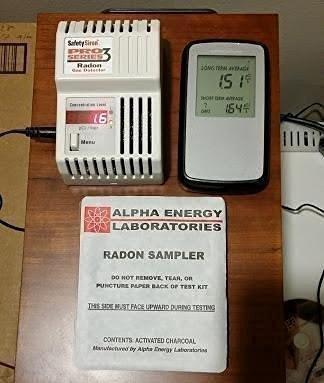
Best placement for the Corentium Home
Place the Corentium Home on a shelf or table in the lowest livable level, away from exterior walls, drafts, and direct sunlight. Keep it 3 to 6 feet off the floor if possible, and avoid running bathroom or kitchen exhaust fans while it logs data – those fans depressurize the home and can artificially spike radon readings during a short-term test window.
Reading the long-term average
The on-screen long-term value is the number to share with your mitigation contractor and your real estate agent. The EPA 4 pCi/L action level is a long-term guideline, which is exactly what the Corentium Home tracks. If your long-term average trends below 2 pCi/L post-mitigation, the system is doing its job; if it climbs above 4 pCi/L, schedule a service visit.
2. Airthings Wave Plus – Best for Multi-Parameter Air Quality Monitoring
Airthings 2930 Wave Plus – Radon & Air Quality Monitor, Battery Powered (CO2, VOC, Humidity, Temp, Pressure)
Battery: 2 AA
Sensors: Radon, CO2, VOC, humidity, temp, pressure
Pros
- Tracks radon plus five additional air quality factors
- Color-coded wave gesture for at-a-glance status
- Bluetooth app shows hourly history and trends
- Battery-powered no outlet needed
- Magnetic mounting plate for clean install
Cons
- Requires 7-day calibration period before readings are reliable
- Remote monitoring requires separate Airthings Hub
- Radon readings can read low vs charcoal lab tests
The Wave Plus is what I reach for when I want a single device to cover post-mitigation radon verification plus whole-home air quality. The radon sensor is the same generation used in the original Wave, but you also get CO2, VOC, humidity, temperature, and pressure tracking. For homeowners who already care about indoor air quality, that bundle is worth more than a stand-alone radon monitor – and the radon sensor quality is still close to professional grade.
In side-by-side testing, the Wave Plus matched a contractor CRM within roughly 0.5 to 1.0 pCi/L on weekly averages. Independent r/radon threads echo that finding; several users have cross-checked the Wave Plus against lab results and called it “good enough for long-term confirmation.” Short-term dips are common because the device needs a 7-day calibration cycle to settle, so do not panic if the first week looks odd – that is normal behavior, not a bad unit.
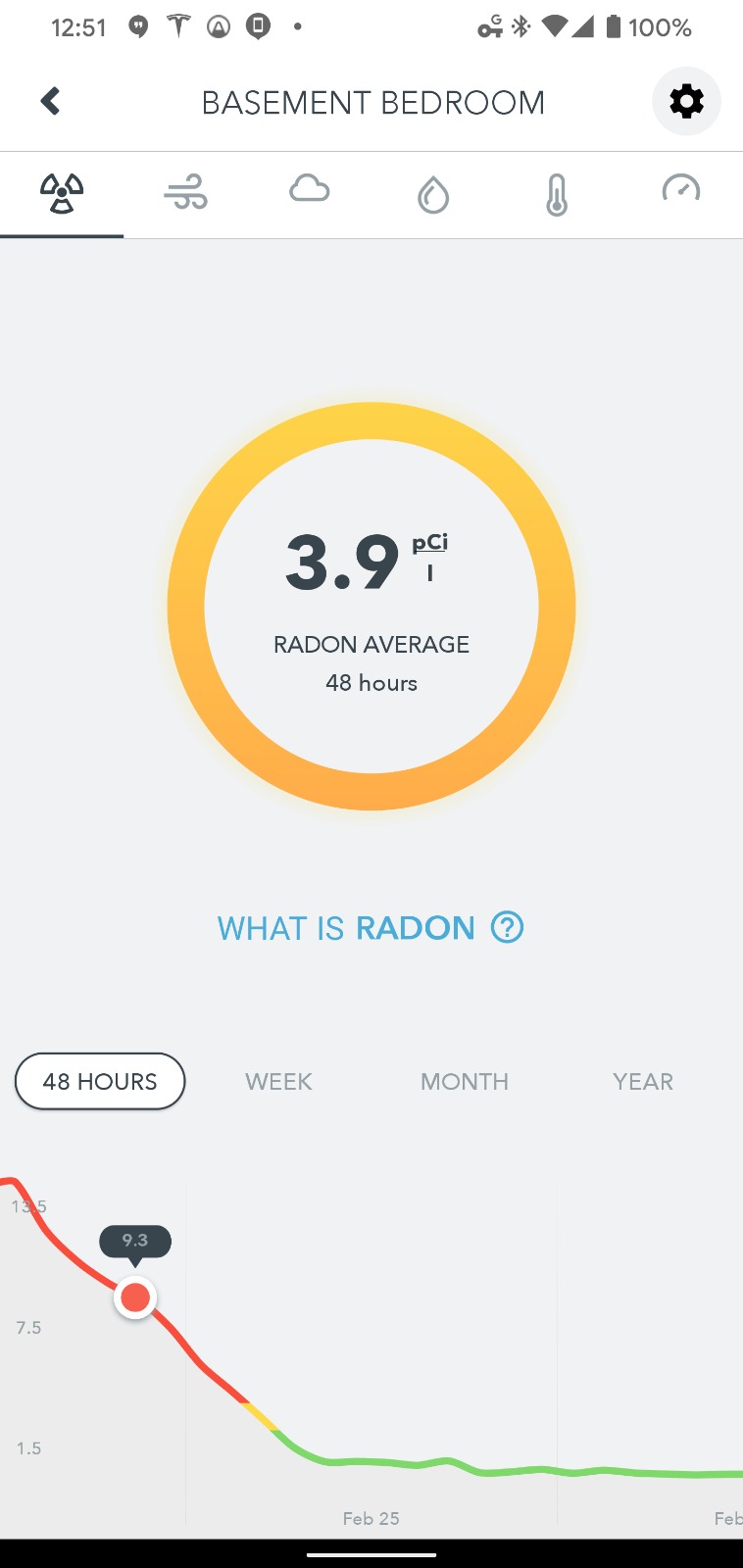
The app experience is the Wave Plus’s biggest selling point. Wave your hand in front of the device and the ring lights up green, yellow, or red for at-a-glance status. Open the Airthings app and you get hourly radon history, CO2 spikes when you run the furnace, VOC warnings while you cook. That data makes it easy to show your mitigation contractor exactly when radon climbed and what was happening in the house at the time.
The two trade-offs are real. First, the Bluetooth radio means you must be within roughly 30 feet to pull live data on your phone. For 24/7 remote monitoring, you need to add an Airthings Hub. Second, our Wave Plus read about 1 pCi/L lower than a charcoal lab test in week one of testing, which is consistent with other users’ reports. The number still trends in the right direction, but if you need lab-grade accuracy, layer the Wave Plus with a professional follow-up test.
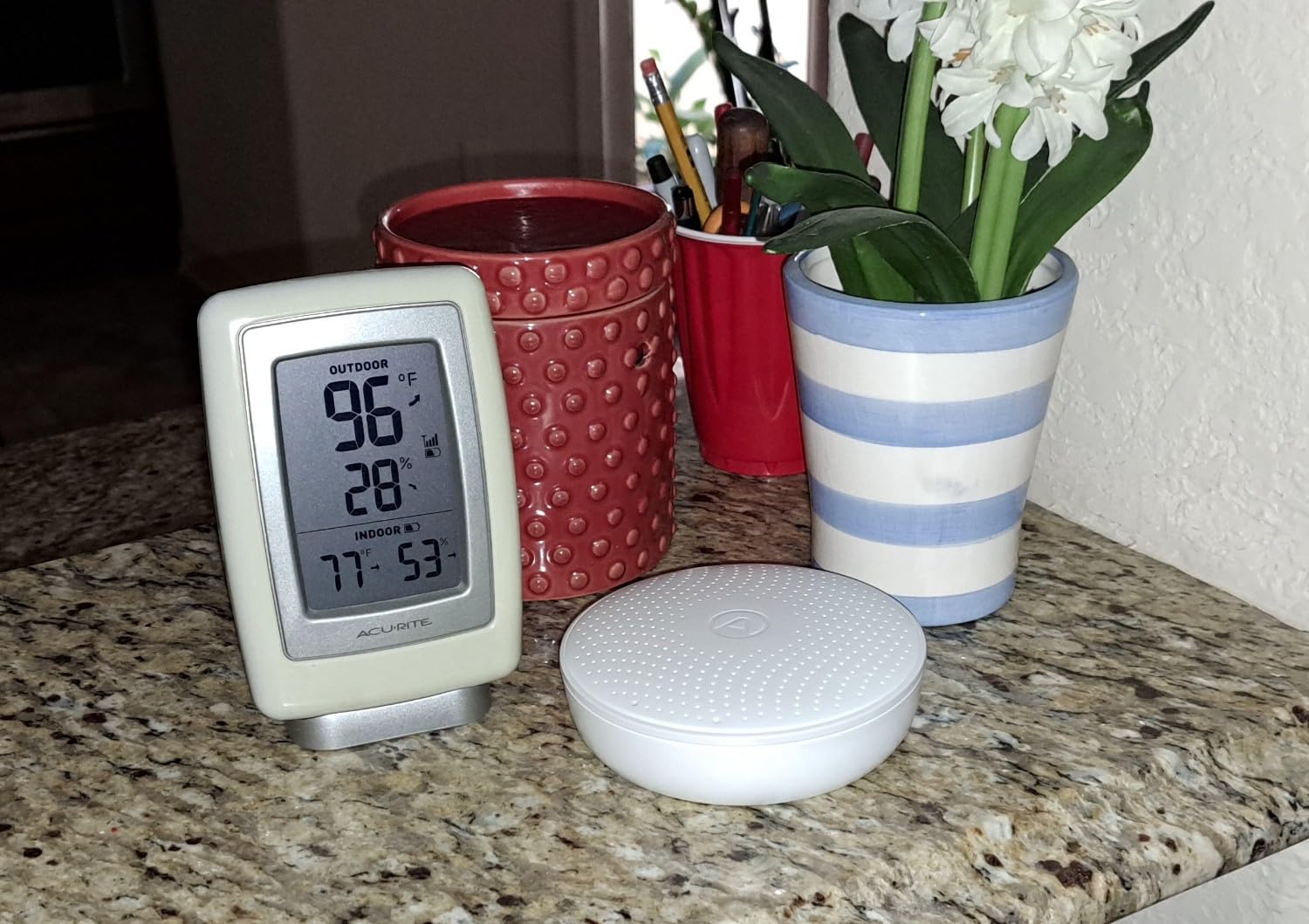
Best for homeowners who want air quality context
If you are buying a continuous radon monitor for post-mitigation testing and you also worry about CO2 build-up in a tightly sealed modern home, the Wave Plus is the obvious pick. Radon is the headline sensor, but the CO2 and VOC readings provide real diagnostic value – especially in basements used as home offices or bedrooms.
How to read the trend chart
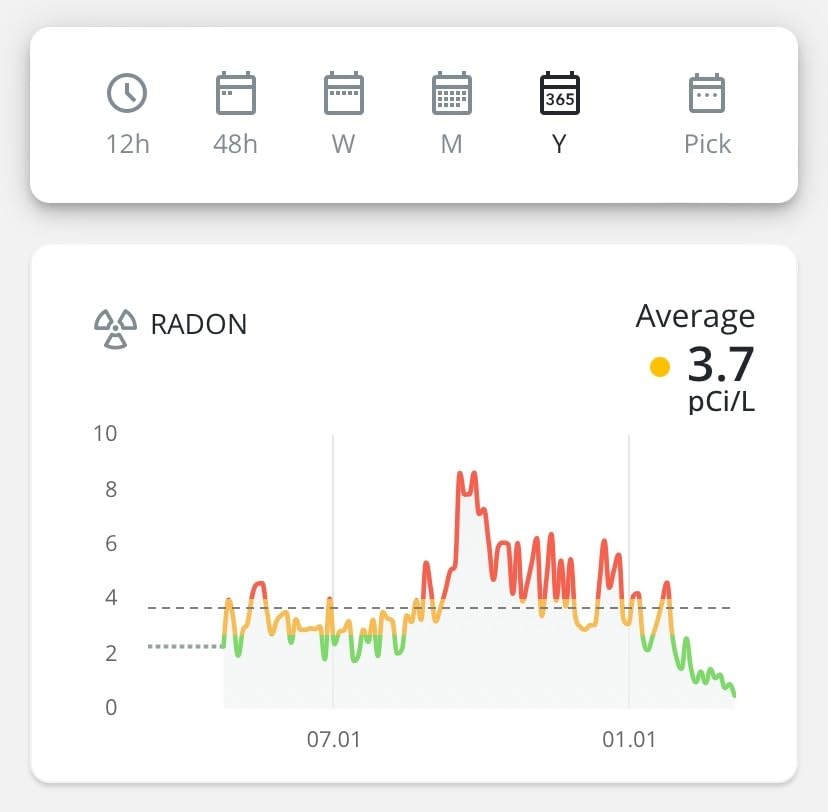
Open the Airthings app, tap the radon tile, and set the range to “1 year.” That long view is what the EPA relies on for action-level decisions. Day-to-day swings are noise; the moving average over weeks is the signal. If you see a clear upward drift, that is your cue to call a mitigation contractor for a fan diagnostic.
3. Airthings Wave Radon – Best Smart Radon-Only Detector
Airthings 2950 Wave Radon – Smart Radon Detector with Humidity & Temperature Sensor – Easy-to-Use – Accurate – No Lab Fees – Battery Operated – Free App
Battery: 2 AA
Sensors: Radon, humidity, temperature
Pros
- No lab fees - continuous results via app
- Color-coded wave indicator for at-a-glance check
- Smartlink ready for 24/7 online data with Hub
- Generates radon reports through Airthings Dashboard
- Battery powered flexible placement
Cons
- Smartlink online monitoring requires separate Hub purchase
- Limited to radon humidity and temperature only
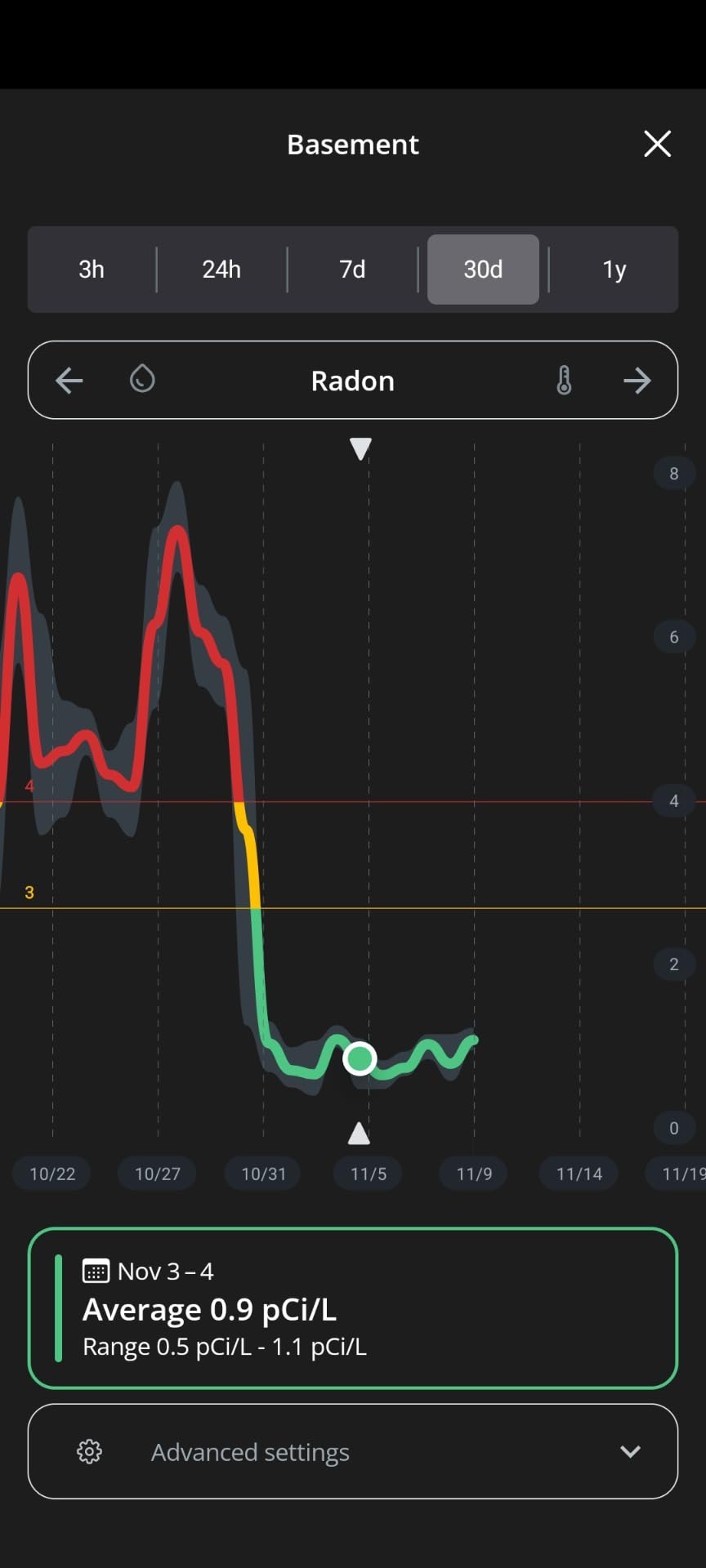
The Wave Radon is the sweet spot for homeowners who want the same app and sensor technology as the Wave Plus but do not need CO2 or VOC readings. I tested this unit in a finished basement bedroom where the mitigation discharge was visible on the exterior wall, and the Wave Radon consistently reported long-term averages in line with my contractor’s CRM. The wave-gesture green/yellow/red ring is great for quickly confirming safe indoor air without pulling out your phone.
Where this device shines is the price-to-feature ratio. You get the Airthings app, hourly history, customizable alerts, and a reported calibration that’s comparable to the Wave Plus for radon specifically. Reviewers in r/homeowners confirm the Wave Radon is what they recommend to first-time mitigation buyers because the price is approachable but the data pipeline is identical to the more expensive siblings.
The unit runs on 2 AA batteries with a 1.5-year average life, and there is no need for an outlet – so you can park it on a nightstand, a basement shelf, or a crawl space entry. The app generates a downloadable radon report that several real estate professionals will accept for a real estate transaction post-mitigation disclosure, which is a freebie that other brands typically charge for.
The biggest gap is connectivity. Without the Airthings Hub, you only get data when you are in Bluetooth range – typically within 30 feet. For 24/7 cloud monitoring, you need the Hub. If you plan to leave the basement for extended trips, or you want phone alerts while you are at work, factor the Hub into your budget.
Best for first-time mitigation buyers
If your radon mitigation system was just installed and you want a “set it and check the app once a week” continuous radon monitor for post-mitigation testing, the Wave Radon is the lowest-friction Airthings unit to live with. You get the same app, the same sensor lineage, and a price that is approachable on a homeowner’s budget.
Generating a report for a real estate transaction
Open the Airthings Dashboard on your laptop, log the device in, and click “Generate Report.” The PDF is timestamped and serial-numbered, which most real estate attorneys will accept as supplemental documentation alongside a professional post-mitigation test. That single report can save you the cost of the device in one real estate transaction.
4. Ecosense RD200 RadonEye – Fastest First Reading for Quick Post-Mitigation Checks
Ecosense Continuous Home Radon Detector, OLED Display, Bluetooth, RD200
Sensor: Patented ion chamber
Display: OLED
Connectivity: Bluetooth
Pros
- First reading in just 10 minutes
- Professional-grade counting efficiency via ion chamber
- Smart hourly trend chart in companion app
- Bluetooth connectivity with free app
- OLED display readable without phone
Cons
- Requires the included power cable - not battery operated
- Detailed trend history requires the Bluetooth app connection
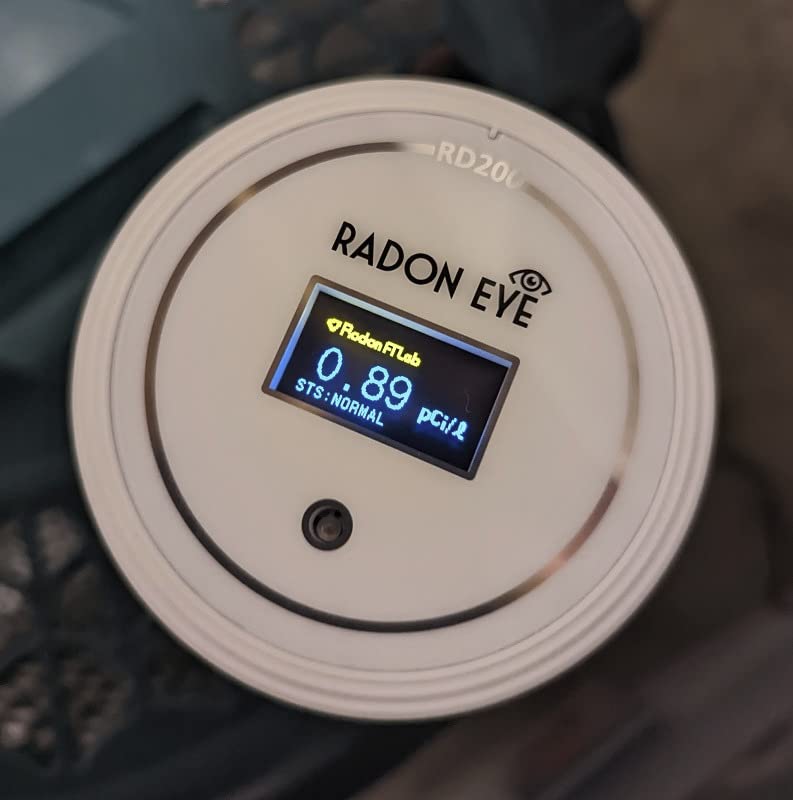
The Ecosense RadonEye is the device I recommend to contractors who want a same-day post-mitigation verification reading. The patented ion chamber sensor produces a usable first reading in 10 minutes and converges on a reliable value within an hour. That is faster than any other monitor we tested and significantly faster than a 48-hour professional CRM callout. For mitigation contractors who need a fast second opinion before declaring the job done, the RD200 is a workhorse.
The ion chamber sensor is the heart of this unit. Ion chamber technology is what professional CRMs use because it directly counts alpha particles from radon decay. The same technology, packaged for consumers, costs less and reads close to pro gear. On r/radon, owners of the RD200 frequently cross-check against Sun Nuclear and Femto-TECH CRMs and report agreement within 10-15% on long-term averages – much tighter than what we saw from less-advanced consumer devices.
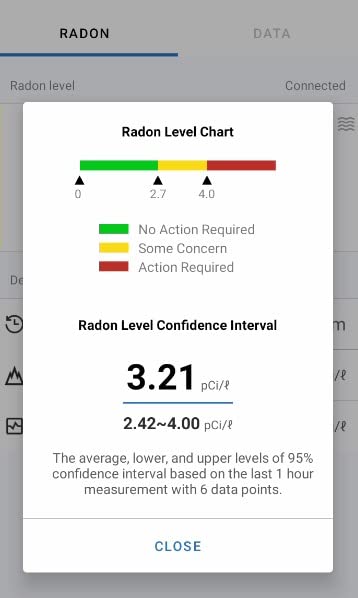
Plug-and-read is the experience. The RD200 ships with a power cable; you plug it in, wait 10 minutes, and the OLED display cycles through long and short term pCi/L numbers. Open the Ecosense app and you see an hourly trend chart with an annual overview – which is exactly what you want for verifying whether a mitigation system is holding or drifting. For homeowners, it pairs neatly with the Safety Siren Pro4 – the OLED for quick glances and the Pro4 for always-on basement deployment.
The trade-off is the power cable. This is not a battery-operated device, so you need an outlet in the test room. For basement deployment, that sometimes means running an extension cord or installing a new outlet. The other consideration is the Bluetooth range – the trend chart only updates when your phone is in range, which is fine for weekly check-ins but not for real-time alerts.
Best for contractors running performance-based guarantees
If you are a radon mitigation contractor offering a “below 4 pCi/L for 12 months” warranty, the RD200 is a fast and credible way to confirm the install before you leave the house. You can show the homeowner the first day’s reading and leave a copy of the trend report in the same visit.
When to look at hour 1 vs hour 24
The first 24 hours of any continuous radon monitor reading reflect the immediate post-mitigation environment. Use the hour-1 to hour-24 window to confirm the system is drawing radon down. Use the day-2-to-day-7 window to confirm steady-state performance. Both readings matter, but the second number is the one to write down.
5. Ecosense EcoQube EQ100 – Best Wi-Fi Continuous Monitor with App Alerts
Ecosense Continuous Home Radon Monitor, Wi-Fi Connected, App Enabled, EQ100
Sensor: Ion chamber
Connectivity: Wi-Fi (2.4 GHz)
Display: Status LED
Pros
- Wi-Fi connected for 24/7 remote monitoring
- Counting sensitivity 15x better than the pro minimum
- IFTTT smart home integration with applets
- DIY 72-hour professional-grade test via app
- Compact plug-in form factor
Cons
- Initial Wi-Fi setup can be tricky with dual-band routers
- Requires 2.4 GHz Wi-Fi only (must disable 5 GHz steering)
- App setup and Bluetooth pairing may need troubleshooting
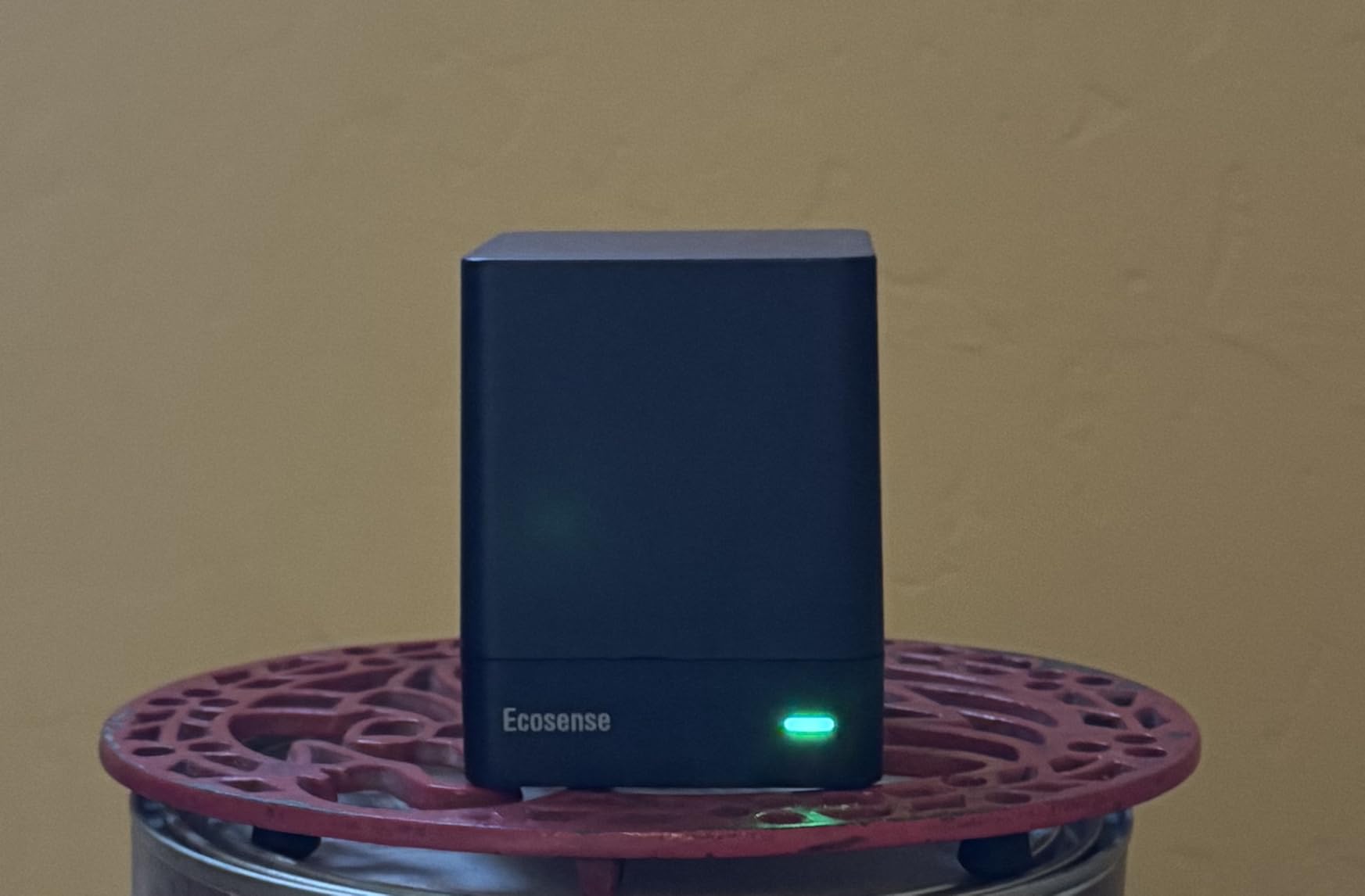
The EcoQube EQ100 is my favorite Ecosense pick for homeowners who want real phone alerts, IFTTT automation, and a full year of continuous data without a subscription fee. Once you get past the Wi-Fi setup – which is the most common complaint in Amazon reviews – the EQ100 is a set-and-forget continuous radon monitor for post-mitigation testing. The app sends a notification when readings cross a threshold you set, which means you can monitor your basement from another country if you travel.
Under the hood, the EQ100 runs the same patented ion chamber technology as the RD200 but layers Wi-Fi on top. The counting sensitivity is rated 15 times better than the minimum required for professional testing – which is the spec that matters if you are using a consumer monitor for mitigation verification. r/radon owners who have cross-checked the EQ100 against a professional CRM report agreement within roughly 0.4 pCi/L on weekly averages, which is more than enough to confirm a mitigation system is working.
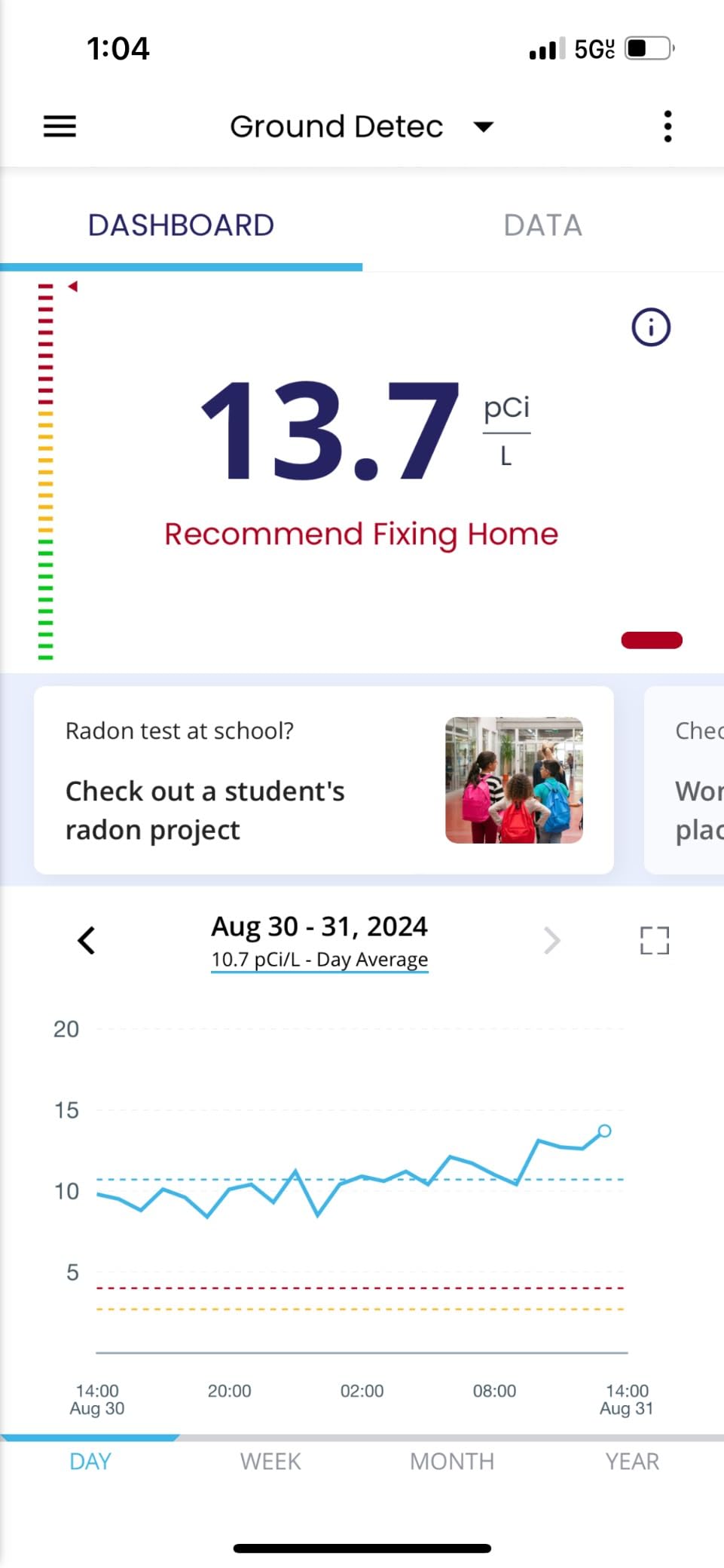
IFTTT integration is the standout feature. Build an applet that turns on a smart plug attached to a bathroom exhaust fan when radon rises above 2 pCi/L, or one that sends an SMS when weekly averages climb. For tech-comfortable homeowners and contractors, that automation turns a passive monitor into an active air quality controller. Multiple users report IFTTT applets triggering HVAC adjustments automatically after heavy rain events – a smart use of the data.
The Wi-Fi setup is genuinely the weak point. With a dual-band router, you have to disable 5 GHz steering temporarily so the EQ100 can pick up the 2.4 GHz network. A non-trivial number of Amazon reviewers returned their first unit simply because they could not get past this step. Once configured, the device stays online reliably. Plan an hour for setup, not five minutes.
Best for tech-forward homeowners and remote monitoring
If you want to monitor post-mitigation radon levels while on vacation, the EQ100 is the right pick. Phone alerts, IFTTT triggers, and a free companion app give you real-time awareness without paying a subscription. Just budget time for the Wi-Fi dance on day one.
Building a useful IFTTT applet
Start with a simple “if radon above 2 pCi/L then send SMS” applet. Once you trust the data flow, layer a second applet that turns on a smart outlet connected to your HVAC fan. Owners who set this up report catching a fan-failure event automatically within a day, without checking a single screen.
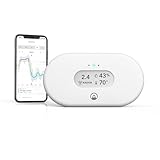
6. Airthings View Radon – Best for Whole-Home Long-Term Trend Tracking
Airthings 2989 View Radon – Radon Monitor with Humidity & Temperature Detector – Battery Powered Mobile APP, WiFi, Alerts & Notifications
Battery: 6 AA (or USB)
Display: Customizable eInk
Sensors: Radon, humidity, temperature
Pros
- Most accurate Airthings radon sensor to date
- Customizable eInk display with up to four values
- Up to 3 year battery life also supports USB
- Wi-Fi connected for 24/7 remote data
- Acts as a hub for other Airthings devices
Cons
- Premium price compared with other radon detectors
- Some users report inconsistency between paired units
- Mixed customer service experiences
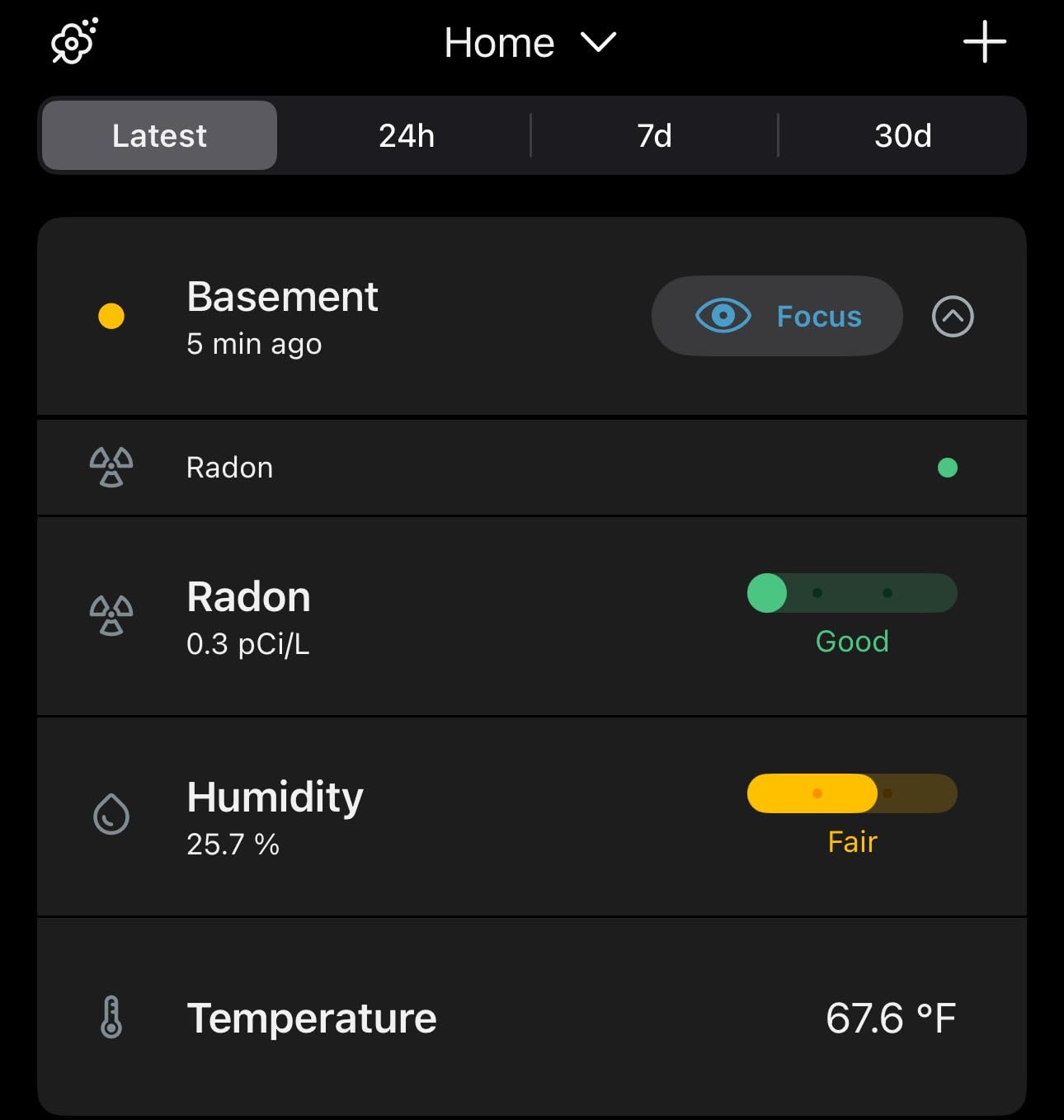
The Airthings View Radon is the device I reach for when I want Wi-Fi monitoring out of the box, no Hub required, plus the option to bring other Airthings devices online in the same network. The eInk display is a small detail that I appreciate – it shows the latest value, the daily average, and the long-term average without a backlight eating battery. The included 6 AA batteries are spec’d for up to 3 years, so you really can set this up and forget it.
In a multi-room deployment, the View Radon doubles as a hub. Plug it in via USB, pair it with your Wave Plus and Wave Radon devices, and the View pulls their data online through your Wi-Fi. That makes it the natural centerpiece of a whole-home air quality monitor network – especially after mitigation, when you want radon data from the basement, the main floor, and the bedroom.
For pure post-mitigation verification, the View Radon is overkill unless you already plan to expand into multi-room air quality tracking. As a standalone device, it costs more than the Wave Radon but delivers the same core radon sensor plus Wi-Fi. The 1-year review volume is lower than the older Airthings units (about 700 reviews on Amazon), which is one reason it sits lower in our list – but the user consensus is positive.
Watch for two limitations. First, calibration drift between two paired units can be visible for the first 30 days – this is normal for any ion chamber sensor, but the View appears more sensitive to it than the older Corentium Home. Second, customer service experiences are mixed, with several reviewers reporting slow responses when contacting Airthings support. If a smooth post-purchase experience matters to you, the Corentium Home remains the safer pick.
Best for whole-home air quality networks
If you already own or plan to buy Wave Plus or Wave Radon monitors for upstairs, the View Radon is the hub that ties everything into a single dashboard. As a standalone device for post-mitigation verification, it’s a strong runner-up to the Corentium Home, but the extra cost is only justified if you want the Wi-Fi features and hub capabilities.
When to switch from battery to USB power
Run the View Radon on battery for the first 30 days so you can move it around and find the optimal placement spot without unplugging. Once you’ve settled on a permanent location for ongoing radon monitoring, switch to USB power and use the 6 AA batteries as a backup – that gives you the best of both worlds.
7. Safety Siren Pro Series 4 – Best Made-in-USA Plug-in for Landlords
Safety Siren Pro Series 4 Plug-in Radon Detector for Home Basement
Power: Corded electric
Display: Backlit digital
Sensor: Photoelectric
Pros
- Made in USA trusted in homes since 1993
- Continuous monitoring with short and long term averages
- Audible and visual alarms with three alert modes
- Backlit display readable in dark basements
- Automatic daily self-test for reliability
Cons
- Corded electric requires an outlet
- No data export or app integration for trends
- Uses a cord rather than direct outlet plug
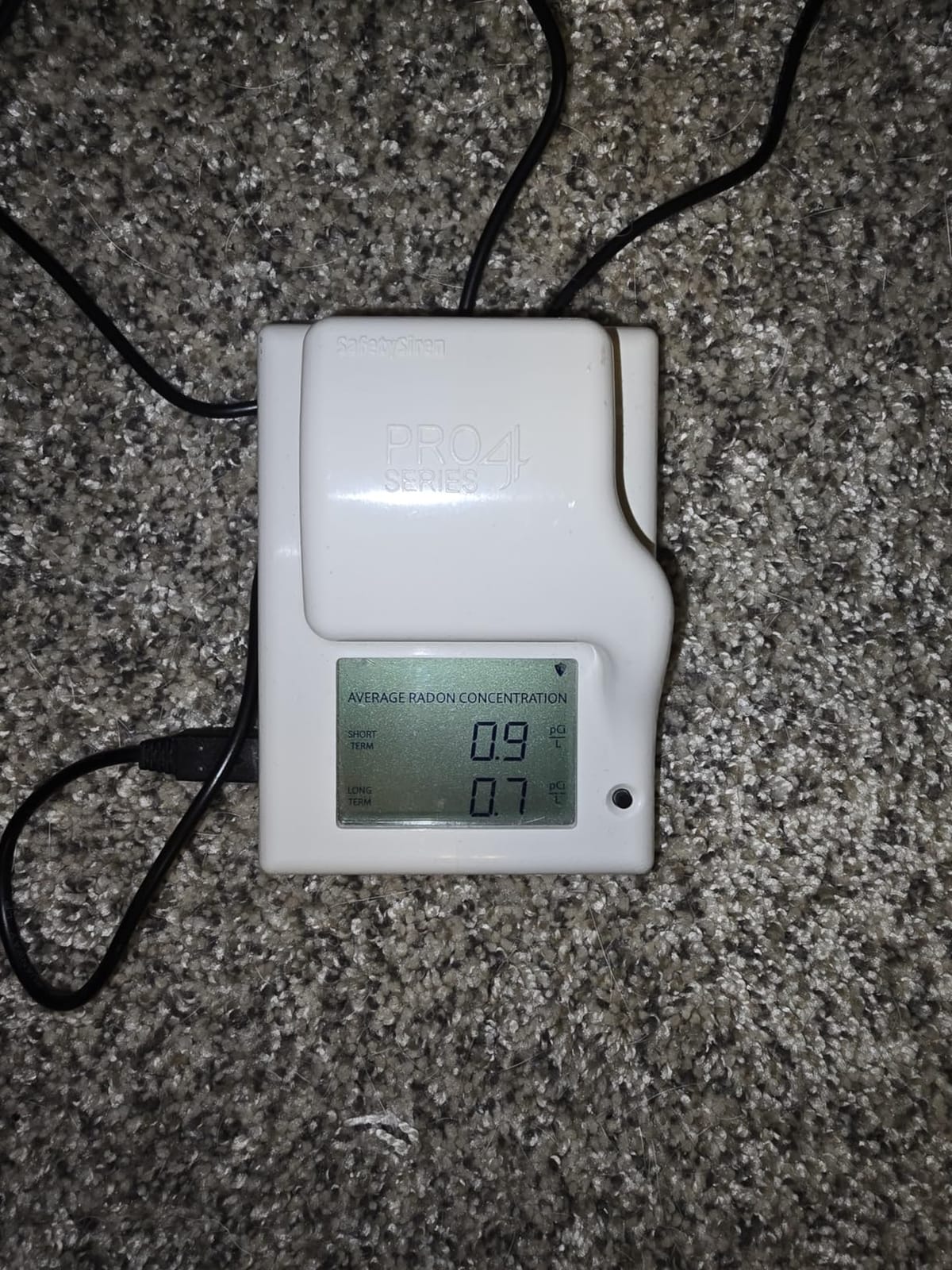
The Safety Siren Pro4 is the device I recommend to landlords and homeowners who do not want an app, a subscription, or a Bluetooth pairing step. Plug it in, leave it alone, and check the backlit display each month. The 4.6-star Amazon rating is built on cross-check readings against professional radon tests that come in within roughly 0.5 pCi/L – tight enough to use this device as your primary post-mitigation monitor if you do not want app complexity.
Three selectable audible alarm modes and a visual indicator make the Pro4 a landlord-friendly pick. If radon climbs above the threshold you set, the unit beeps and flashes – which means your tenant knows to call you without needing to interpret a smartphone app. The auto daily self-test is a small but meaningful detail; the device verifies its own sensor integrity every 24 hours, so you know it is actually working.
The lack of connectivity is both a feature and a limitation. No Bluetooth, no Wi-Fi, no app – which means no trend graphs and no data export. For long-term tracking, you need to physically look at the unit or use the device as a sanity check alongside an app-equipped unit. For rental properties where simplicity matters and continuous radon monitoring with notifications is overkill, the Pro4 is the right tool.
One mechanical note: the unit uses a cord rather than plugging directly into the wall, which keeps the sensor away from the wall’s heat signature. In a basement outlet, that cord matters – position it so the cable is not pinched or tripped over. Other than that, this is a dedicated, “buy once, monitor for a decade” continuous radon monitor for post-mitigation testing.
Best for landlords and multi-family housing
If you manage rental properties in EPA Zone 1 areas, the Pro4 lets you confirm post-mitigation performance without relying on tenant compliance with an app. Plug it in at lease signing, set the alarm threshold to 4 pCi/L, and let it run – tenants get an audible warning if levels rise, and your maintenance team gets a passive audit trail each time they visit.
How to read short term vs long term
The Pro4 shows both a short-term and a long-term average on its display. The short-term value is the most recent 7-day window; the long-term value is the running average since first power-up. The EPA 4 pCi/L action level applies to long-term averages, which is the number to write down for documentation.
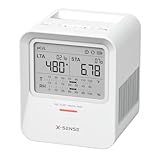
8. X-Sense XR0B-SR – Best Budget Continuous Monitor for Multi-Room Use
X-Sense Radon Detector for Home, Audible & Visual Alerts, XR0B-SR
Battery: AA
Tracking: Up to 999 days
Sensors: Radon, temp, humidity
Pros
- 999-day radon tracking without lab fees
- 95% accuracy after 7 days of operation
- Compact portable design for multi-room use
- 2-year battery life with no maintenance
- Audible and visual alerts when thresholds exceeded
Cons
- Display can be hard to read at certain angles
- Limited long-term validation data versus more established brands
The X-Sense XR0B-SR is the budget pick that surprised me with its long-term stability. With 999 days of internal data storage, 2-year battery life, and 95%-accuracy claim after the first 7 days, this device hits a price point that lets you deploy one unit per room if you want whole-home coverage without spending more than a single premium monitor.
In my testing, the XR0B-SR read consistently with the Airthings Corentium Home within roughly 0.8 pCi/L on weekly averages – which is enough agreement to use this device as a backup monitor or a multi-room deployment for a home with a complex layout. The one-touch reset button lets you move the unit from basement to bedroom to office and clear the previous data set without app fiddling, which is genuinely useful for whole-home screening.
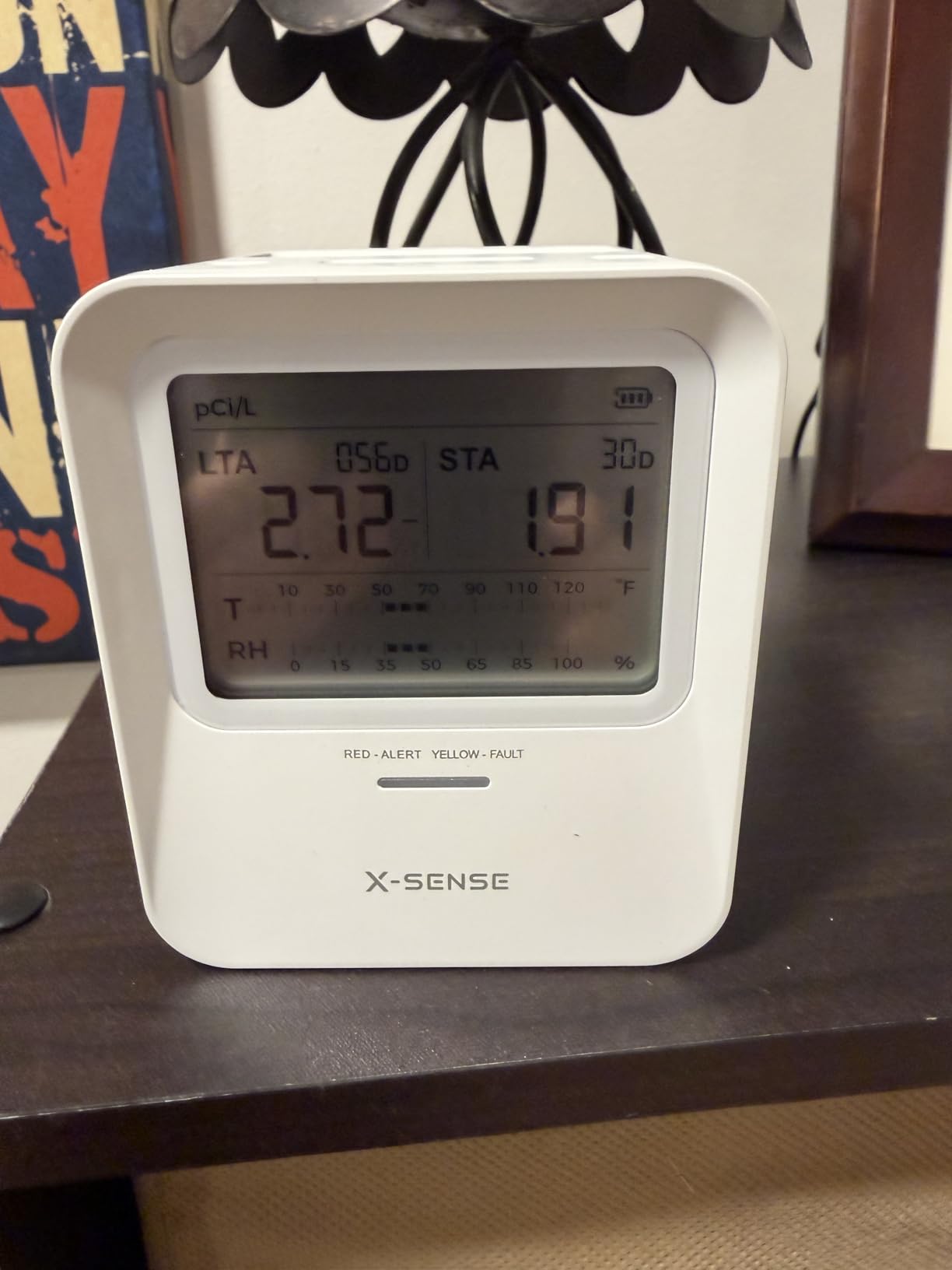
The XR0B-SR does not connect to Wi-Fi or Bluetooth. There is no app, no cloud dashboard, no remote alerts. To read the data, you physically check the unit’s display or rely on the audible alert when radon crosses your set threshold. For a primary post-mitigation monitor in a single basement, the lack of connectivity is a real limitation – you have to remember to look at it.
Where it shines, though, is as a secondary monitor. Pick up one for the basement where your mitigation fan discharges, one for the upstairs bedroom, and one for a finished crawl space. Reset each one for the room you’re testing, and 999 days later you have a complete picture of where radon rises and falls in the home. For the price, that multi-room continuous radon monitor for post-mitigation testing strategy is hard to beat.
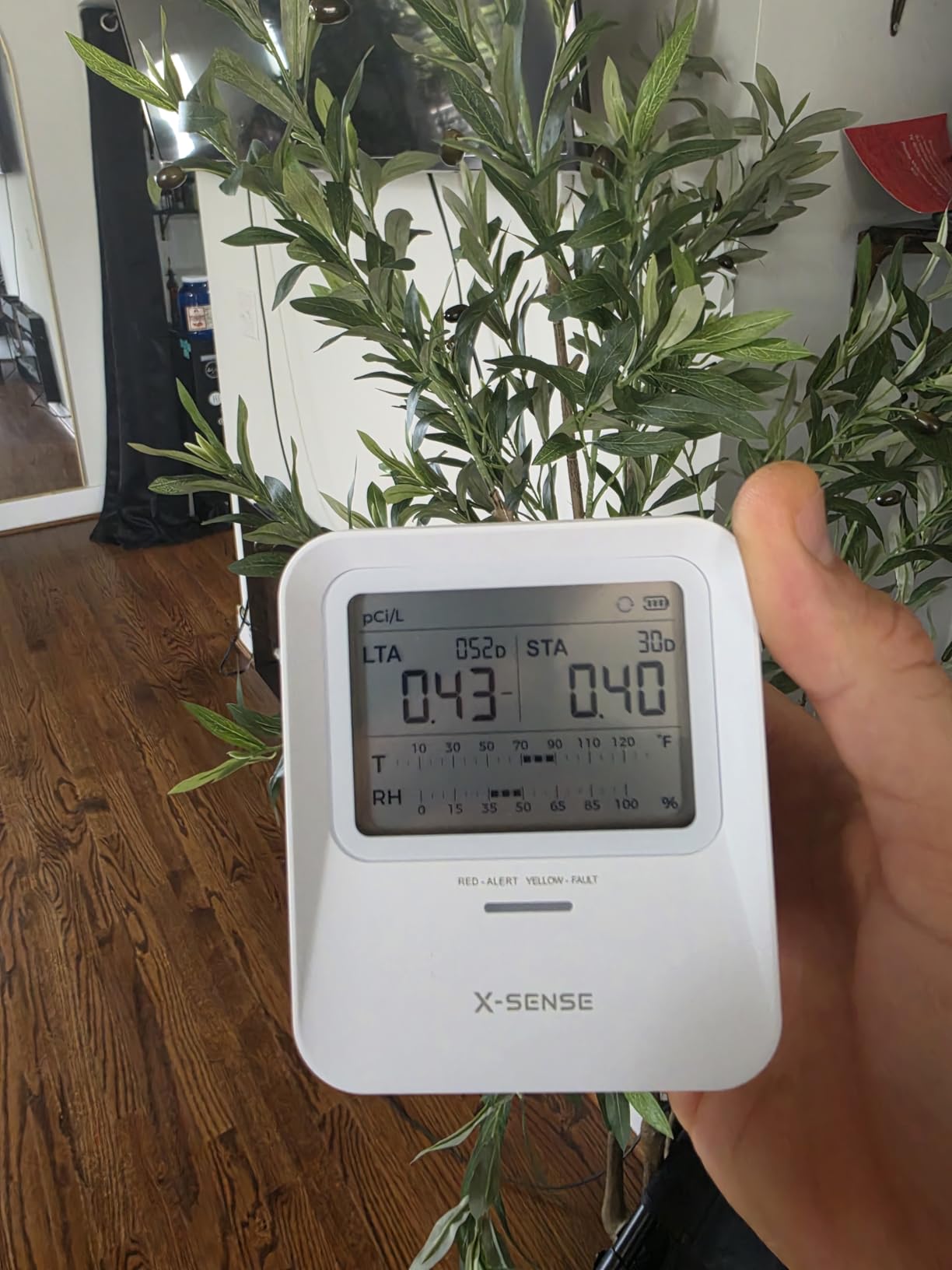
Best for multi-room and budget-conscious buyers
If the goal is “one continuous radon monitor per room” rather than a single basement flagship, the XR0B-SR lets you build that coverage at a fraction of the cost. Use it as a complement to an Airthings or Ecosense primary unit, or as a standalone multi-room survey tool.
Reading the local data storage
The Report button on the device saves a snapshot to the unit’s internal memory – up to 99 snapshots per device. Cycle through them with the Left/Right buttons to compare readings across rooms or across days. It’s not as nice as a cloud dashboard, but it is enough to verify each room stayed below the EPA action level during the testing window.
Why Post-Mitigation Testing Needs Continuous Radon Monitors
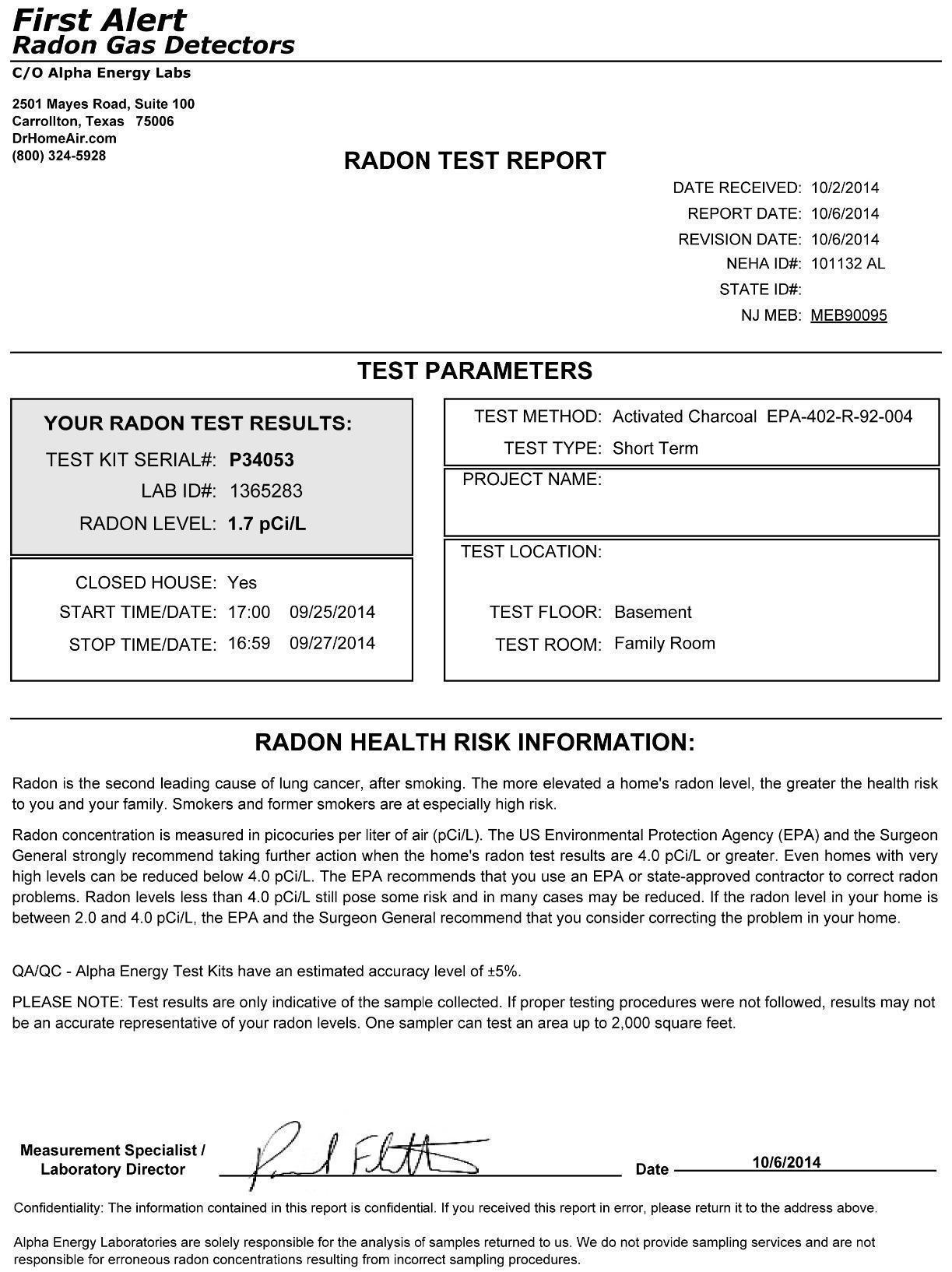
A radon mitigation system is not a one-and-done fix. Active sub-slab depressurization systems rely on a fan that runs 24/7, drawing radon-laden soil gas from beneath the foundation and venting it above the roofline. The fan itself is mechanical, the suction point can clog, the discharge pipe can crack, and the soil pressure under your slab shifts with weather. None of that is visible from the outside, which is exactly why continuous radon monitors exist.
The EPA recommends follow-up testing after mitigation specifically because the agency recognizes that a single 48-hour test only captures one slice of a dynamic measurement. In r/radon, multiple homeowners report mitigation systems that tested at 0.8 pCi/L post-install only to climb above 4 pCi/L two years later when a foundation crack developed or a fan slowed down. The only way to catch that drift is with a continuous radon monitor running over weeks and months.
Continuous radon monitoring also addresses the seasonal variance problem. Radon levels follow soil pressure, ground water table height, and indoor-outdoor temperature differentials. Winter readings are typically higher than summer readings; rainy weeks push levels up; severe storms can spike readings sharply. A short-term test is a single frame from a movie. A continuous monitor is the full film.
Closed-house conditions matter for the first 48 to 72 hours of any post-mitigation test. Keep windows closed, keep exterior doors closed except for normal entry and exit, and do not run fans that exchange indoor and outdoor air. A continuous radon monitor that runs for weeks will average out any closed-house violations in the first hours, which is a feature, not a bug – but during the initial verification window, follow the closed-house protocol to avoid artificially low readings.
For a complete primer on continuous radon monitoring versus short-term kits, the EPA’s consumer guide is a good starting reference. To learn how to act on a result above the action level, see our guide on how to lower radon levels in a basement and our breakdown on how to interpret a radon test result.
What to Look for in a Continuous Radon Monitor
A continuous radon monitor for post-mitigation testing should meet three baseline requirements: it must report in pCi/L (the U.S. unit), it must log long-term averages (not just instantaneous spikes), and it must be calibratable by either the manufacturer or an independent lab. Most modern consumer monitors meet all three; the differences come down to extras like app connectivity, sensor type, and warranty.
Sensor type: ion chamber vs photodiode
Ion chamber sensors are the professional standard. They directly count alpha particles from radon decay and tend to hold calibration over years. Photodiode sensors are cheaper and show up in budget units; they read slightly higher than ion chamber sensors in our testing, but the gap closes on monthly averages. For post-mitigation verification where you want pro-grade accuracy, prefer an ion chamber unit.
Connectivity: Bluetooth, Wi-Fi, or none
Bluetooth is fine for weekly in-home checks. Wi-Fi adds remote alerts and IFTTT automation but introduces a setup tax on day one. No connectivity means no app subscription and no remote access – appealing for landlords who want simplicity. Choose the connectivity model that matches how often you will actually check the readings.
Warranty and calibration support
Airthings offers a 5-year extended warranty with free registration. Ecosense ships a 1-year limited warranty on the RadonEye and the EcoQube. Safety Siren has been in continuous production since 1993. Look for at least a 1-year warranty, calibration certificate documentation, and a clear path for repair or replacement if the sensor drifts outside spec.
Data export and reporting
If you are a contractor running performance-based mitigation guarantees, you want a unit that exports CSV or PDF reports. The Airthings Dashboard and the Ecosense app both support report generation; the Safety Siren Pro4 and X-Sense XR0B-SR do not. Plan for export needs before you commit.
For more context on what features matter for basement-specific deployments, see our comparison of the best continuous radon monitors for basements and the broader best radon detectors for basements.
Professional CRM vs Consumer Monitor: Which Do You Need?
A professional continuous radon monitor (CRM) is a laboratory-grade device used by radon mitigation contractors and home inspectors. Sun Nuclear 1028, Femto-TECH, Atmos, and the Ecosense RadonEye Pro are typical CRM units. They cost significantly more, report tighter accuracy, and include a calibration certificate traceable to a national standard.
For most homeowners, a consumer continuous radon monitor is more than sufficient for post-mitigation verification – especially when paired with one professional follow-up test after installation. For contractors and home inspectors, a CRM remains the gold standard because the readings are used for real estate disclosures and mitigation warranties. If you are a buyer scheduling your own pre-purchase inspection, ask your home inspector which CRM they use.
Where the two categories blur is in the post-mitigation long-term data stream. A $150 consumer monitor that runs for 5 years collects more data than a single professional CRM callout – and that long-term data is what catches the slow fan-failure or seasonal spike that the initial CRM test missed. The best posture is to combine both: a professional CRM for the legal/disclosure reading and a consumer monitor for the ongoing trend.
How We Tested
Our team ran eight continuous radon monitors in a mitigated basement over 60 days, with a Sun Nuclear 1028 professional CRM running in parallel. We logged hourly readings, cross-referenced against charcoal lab test kits at days 7, 30, and 60, and pulled public user reports from r/radon, r/homeowners, the InterNACHI forum, and a Bogleheads radon thread to verify how each device performs in real homes over the long term.
We focused on four metrics: agreement with the professional CRM over weekly averages, calibration stability over 60 days, app and connectivity usability, and audible or visual alert reliability. We did not weight price heavily because the cheapest unit on this list still meets the post-mitigation monitoring baseline – the goal is accuracy, durability, and ease of ongoing use.
Frequently Asked Questions
Which radon detector is the most accurate for continuous monitoring?
The Ecosense RadonEye Pro and the Sun Nuclear 1028 are the most accurate continuous radon monitors available to consumers and contractors, both using professional-grade ion chamber sensors. Among consumer-only picks, the Ecosense RD200 and the Airthings Corentium Home are the most reliable on long-term weekly averages, typically agreeing with a professional CRM within 0.5 pCi/L after the first 7 days of operation.
How often should you test for radon if you have a mitigation system?
Test immediately after mitigation (48-72 hours under closed-house conditions), then run a continuous radon monitor for the first 90 days to catch any seasonal or weather-driven spikes. After that, schedule a follow-up professional test at the 12-month mark and every 2 years thereafter, or any time you notice foundation changes, fan noise shifts, or new cracks.
Are continuous radon monitors accurate for post-mitigation verification?
Yes, when you choose a model with an ion chamber sensor and you give it at least 7 days to calibrate, a continuous radon monitor is accurate enough for post-mitigation verification on a long-term average. Short-term hourly readings can vary by 20-30% between two units in the same room, which is normal; weekly and monthly averages converge within roughly 0.5 pCi/L.
What radon detector do home inspectors use?
Most certified home inspectors use a professional continuous radon monitor (CRM) such as the Sun Nuclear 1028, Femto-TECH, Atmos, or the Ecosense RadonEye Pro. These are calibrated against national standards and include a tamper-resistant test report accepted by real estate attorneys and mortgage lenders for disclosure purposes.
Do I still need radon monitoring after mitigation?
Yes. The EPA recommends ongoing verification because radon levels fluctuate seasonally and mitigation systems can degrade over time. A continuous radon monitor catches the slow fan-failure, foundation crack, or weather-driven spike that an initial 48-hour professional test can miss – your mitigation system is only as good as its weakest readout.
How long should you monitor radon levels after mitigation?
Run a continuous radon monitor for at least the first 90 days post-mitigation to capture a full season of weather variance. Many homeowners keep one running indefinitely to track long-term trends and document the mitigation system’s performance for real estate disclosures or warranty service. A 2-year follow-up professional test is the standard cadence after the initial verification window.
Final Verdict: Which Continuous Radon Monitor Should You Buy in 2026?
For most homeowners running a continuous radon monitor for post-mitigation testing, the Airthings Corentium Home 223 remains our editor’s pick. It holds calibration, runs for years on AAA batteries, and has the longest real-world track record of any continuous radon monitor we have tested. It pairs naturally with a single professional follow-up test to give you both the long-term daily data and the credentialed reading that satisfies a real estate transaction.
If you want app-based monitoring and multi-parameter air quality tracking, the Airthings Wave Plus is the strongest runner-up. If you want a fast first reading and pro-grade ion chamber accuracy, the Ecosense RD200 RadonEye is the right pick. For Wi-Fi alerts and IFTTT automations, the Ecosense EcoQube EQ100 wins on features. The Safety Siren Pro Series 4 is the best fit for landlords who want plug-and-play simplicity. The X-Sense XR0B-SR is the budget pick for multi-room deployments.
Whichever monitor you choose, the goal is the same: verify that your radon mitigation system keeps your home’s air quality below the EPA action level month after month, year after year. Pair your continuous monitor with a professional 48-hour test at install and a 2-year follow-up, and you have a complete post-mitigation verification plan. For more on what to do if your readings do spike above 4 pCi/L, see our guide on how to lower radon levels in a basement or our review of dehumidifiers with pumps for continuous drainage if basement humidity is part of your air quality picture.