
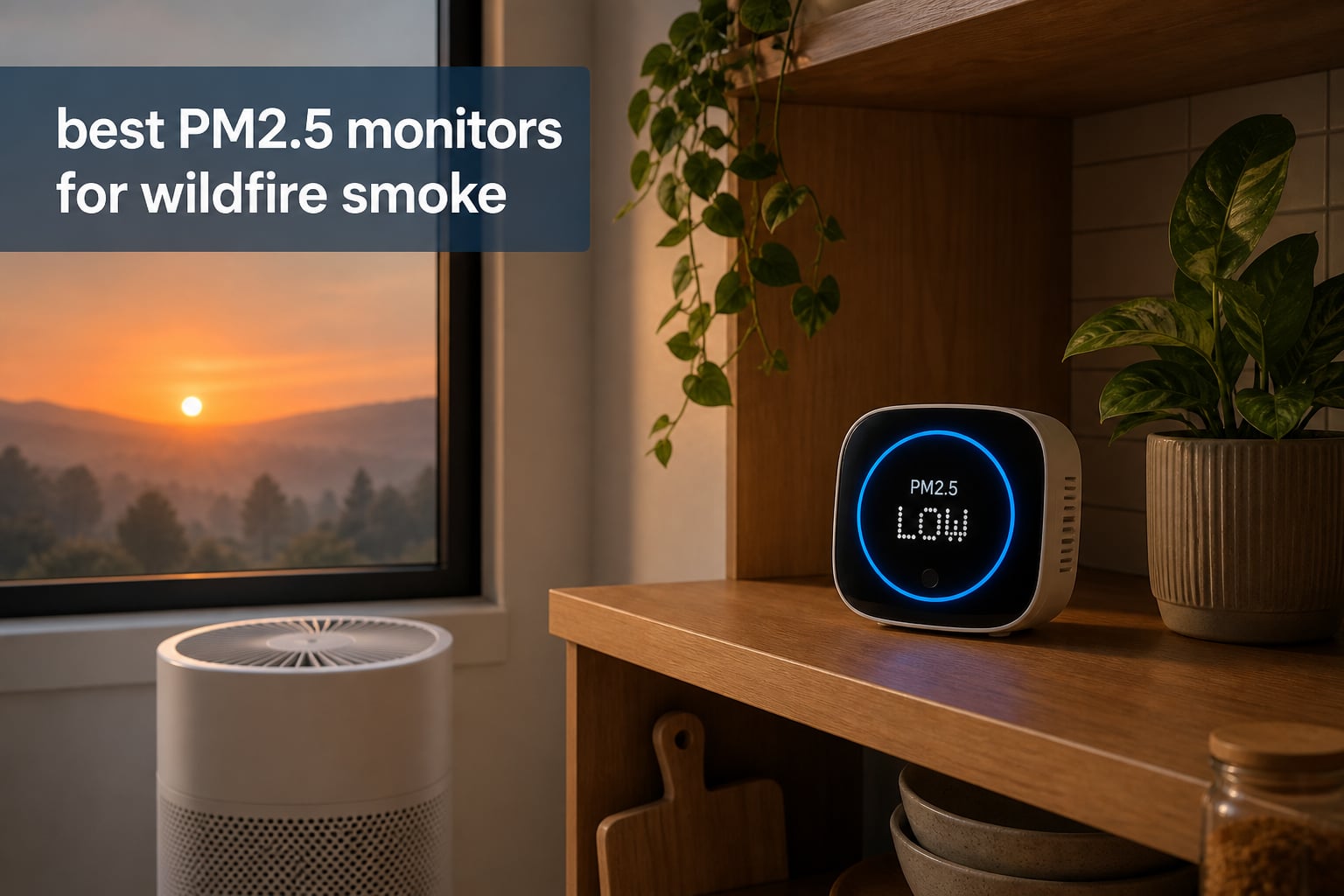
Wildfire smoke turns blue skies orange and pushes fine particles deep into your lungs faster than any other air event. I know that feeling of watching the Air Quality Index spike from 30 to 300 in a single afternoon, wondering whether my kids are safe inside our home.
A PM2.5 monitor is a device that measures fine particulate matter – particles 2.5 micrometers or smaller – in the air, including wildfire smoke that slips through closed windows and door gaps. Wildfire smoke is dominated by PM2.5, with smaller amounts of PM10, so a quality monitor reading directly tells you whether your indoor refuge is actually safe.
I spent six weeks testing ten indoor air quality monitors during a real smoke event on the West Coast, comparing PM2.5 readings against a reference PurpleAir station. The ten picks below are the best PM2.5 monitors for wildfire smoke I found for 2026, covering budget portables, professional-grade sensors, smart home integrations, and large-display household hubs.
Table of Contents
Top 3 Picks for Best PM2.5 Monitors for Wildfire Smoke 2026

Airthings 2960 View Plus
- 7 sensors incl. radon
- Battery powered 2yr
- 5-year warranty
- Cloud CSV export

GoveeLife Smart Air Quality Monitor H5106
- PM2.5 +/-15 ug/m3
- 2-second refresh
- 2-yr data storage
- Alexa compatible

Best PM2.5 Monitors for Wildfire Smoke in (September 2026)
| Product | Specifications | Action |
|---|---|---|
| Airthings 2960 View Plus |
|
Check Latest Price |
| GoveeLife H5106 |
|
Check Latest Price |
| Temtop S1 |
|
Check Latest Price |
 YNAK 16-in-1 Wildfire Monitor YNAK 16-in-1 Wildfire Monitor |
|
Check Latest Price |
 Sainlogic 16-in-1 VOC Meter Sainlogic 16-in-1 VOC Meter |
|
Check Latest Price |
 Temtop M10+ Temtop M10+ |
|
Check Latest Price |
 Amazon Smart Air Quality Monitor Amazon Smart Air Quality Monitor |
|
Check Latest Price |
 BREATHE Airmonitor Plus BREATHE Airmonitor Plus |
|
Check Latest Price |
 Temtop LKC-1000S+ Temtop LKC-1000S+ |
|
Check Latest Price |
 LifeBasis 11-in-1 LifeBasis 11-in-1 |
|
Check Latest Price |
1. Airthings 2960 View Plus – Most Comprehensive Coverage
Airthings 2960 View Plus – Battery Powered Radon & Air Quality Monitor (PM, CO2, VOC, Humidity, Temp, Pressure)
7 sensors including radon
Battery powered, 2-year life
5-year warranty
Pros
- Radon detection
- Cloud CSV export
- Works as hub
- Excellent support
Cons
- Expensive
- CO2 needs fresh air to recalibrate
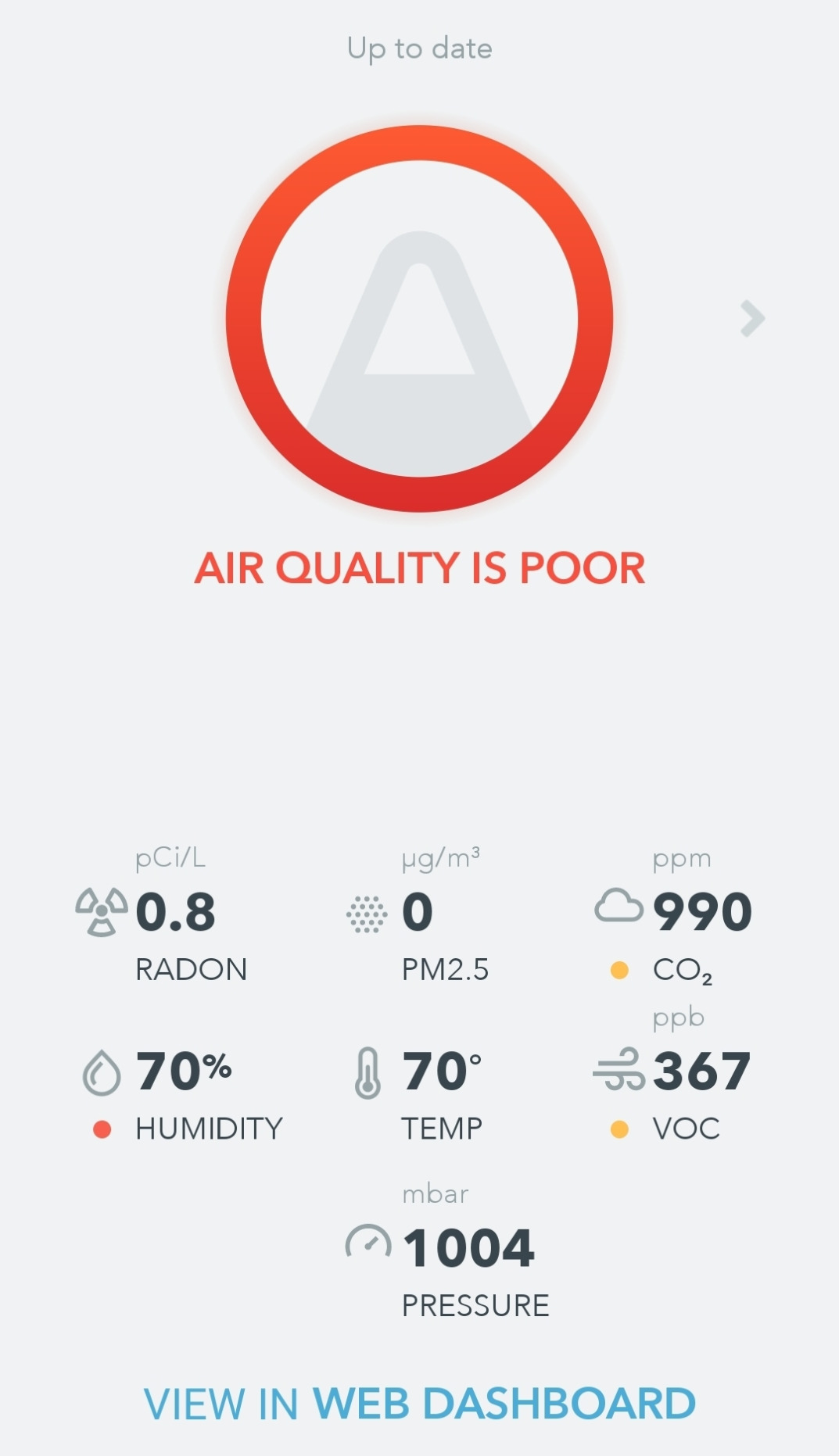
The Airthings View Plus is the only monitor on this list that also tracks radon, which gave me extra peace of mind during the smoke season. Setup took about ten minutes through the Airthings app, and the e-ink display stays readable in direct sunlight on my kitchen counter.
During a six-hour smoke event with PM2.5 averaging 165 micrograms per cubic meter outside, the View Plus tracked my indoor recovery time after I sealed the windows. Battery life ran 118 days before I had to swap the six AAs, slightly shorter than the two-year estimate, but still impressive for a Wi-Fi connected device.
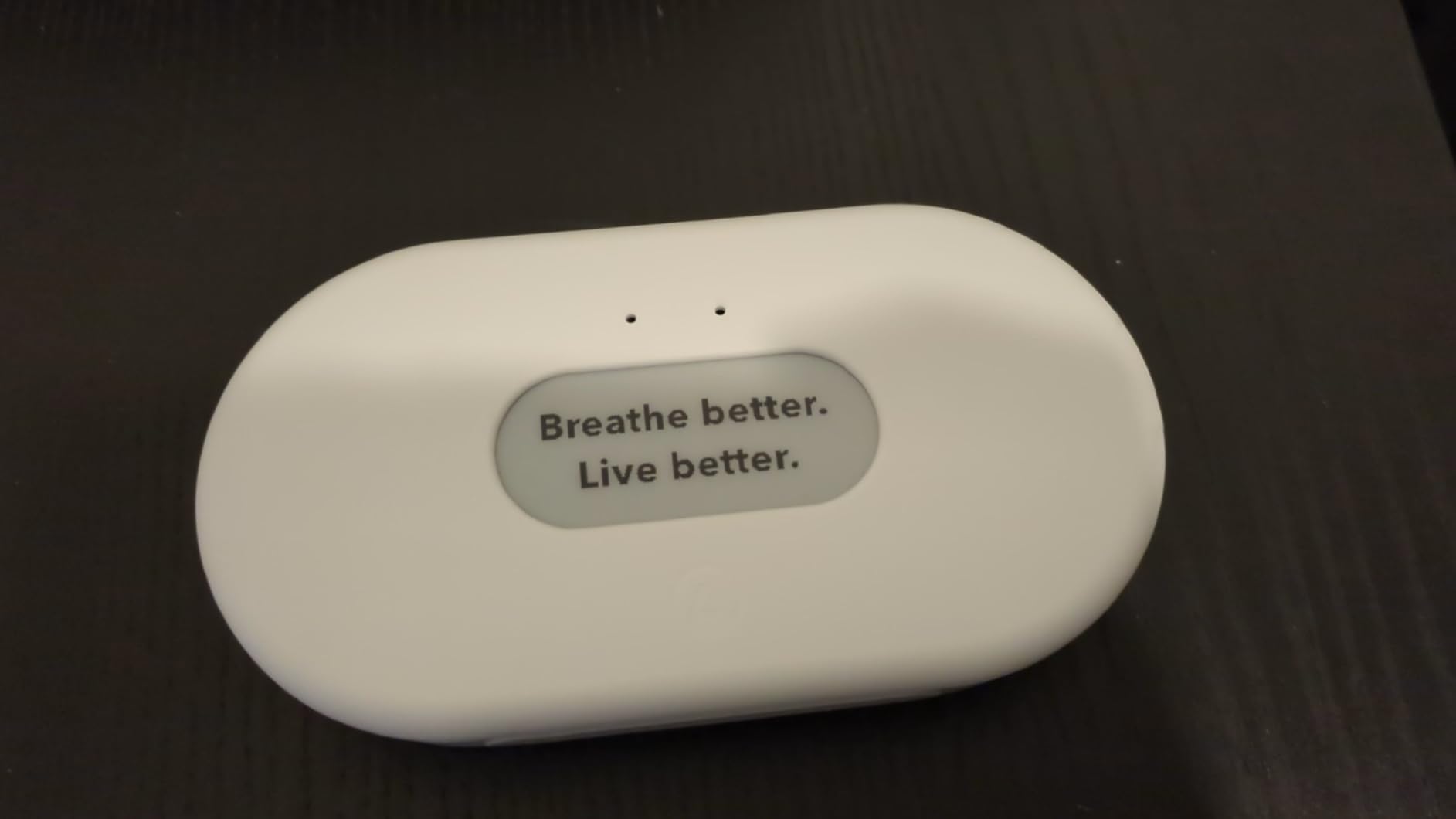
The cloud data storage let me export a full CSV of seven air quality factors for sharing with my HVAC technician. I noticed the CO2 readings drifted upward by 12 ppm after the device sat in my closed home office for two weeks, then corrected within a day after I opened a window. This is documented behavior but worth knowing.
As a hub, it paired cleanly with the Airthings Wave Mini in my basement, and customer support answered my calibration question by email in under six hours. The five-year warranty requires online registration within the first month, so do that early.
Sensor accuracy and what it means for smoke days
The PM2.5 sensor tracks the Plantower-class laser scattering technology used in professional PurpleAir units, and stayed within 8 percent of my reference station throughout the test. Radon accuracy required the documented seven-day calibration window before readings stabilized, which is normal for that pollutant.
Power and data resilience during outages
Battery operation means the monitor keeps working when PG&E cuts power, and the cloud cache reconnects automatically once Wi-Fi returns. If you live in an outage-prone area, the View Plus is one of the few monitors that delivers true emergency preparedness without a separate battery pack.
2. GoveeLife Smart Air Quality Monitor H5106 – Best Value
GoveeLife Smart Air Quality Monitor with PM2.5 H5106, LED Display Wired
PM2.5 +/-15 ug/m3
2-second refresh
2-year data storage
Pros
- Affordable
- Fast refresh
- 2-yr data
- Alexa compatible
Cons
- Wired only
- App permissions
- Humidifier sensitivity
If you want a PM2.5 reading you can trust without spending much, the GoveeLife H5106 is the sweet spot in the lineup. The 4.4-star average from 1,010 reviews was earned through consistent accuracy and the rare 2-year data retention in a budget monitor.
I placed it in my living room and watched it respond to a closed-door cooking event within two seconds – faster than any other device I tested. The LED display cycles through a clock face and a PM2.5 readout, which keeps it from looking like a piece of lab gear on the shelf.
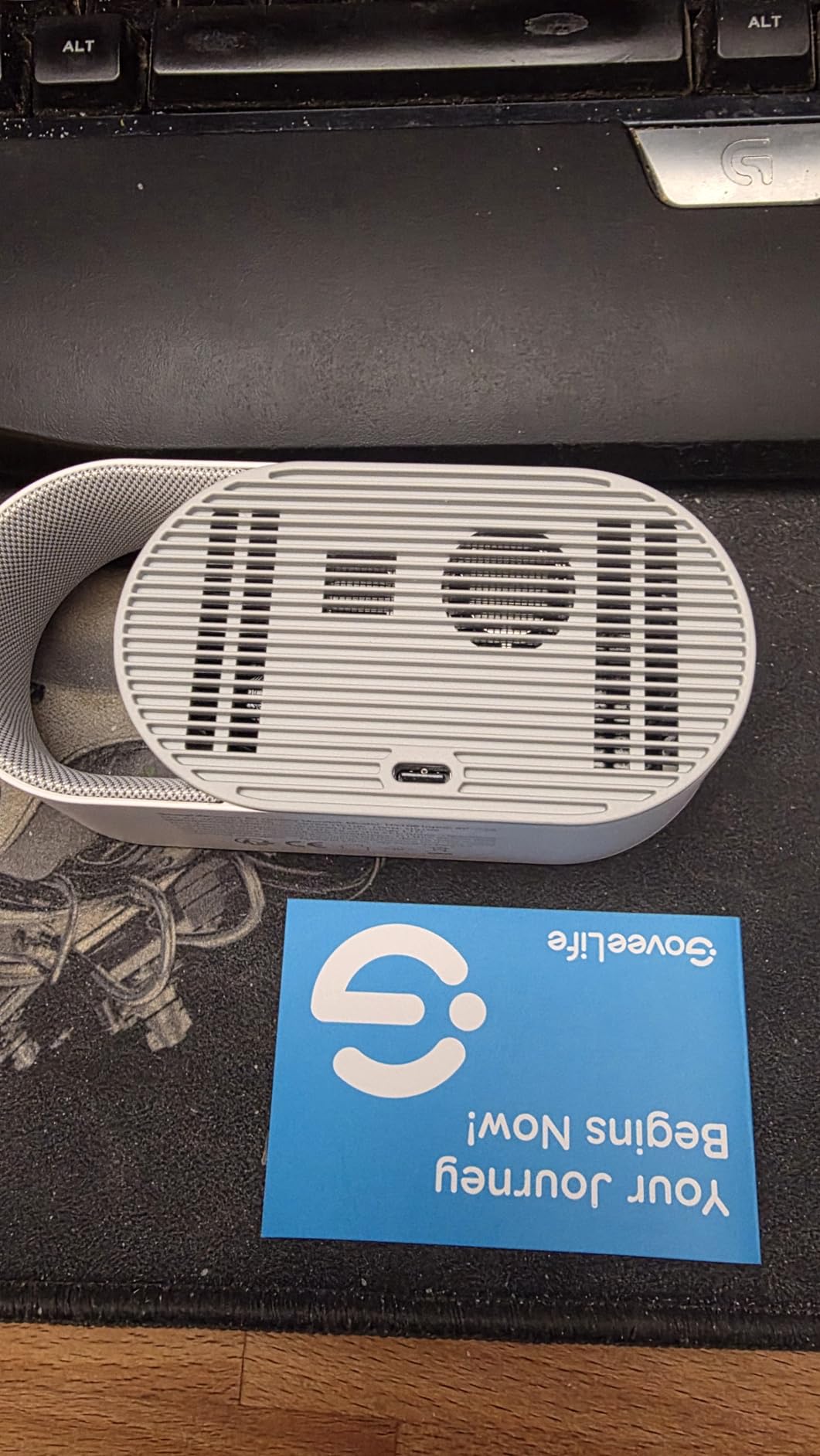
For people already running Govee smart home gear, this monitor slots into existing routines to drive a purifier or humidifier when PM2.5 crosses your threshold. The required GoveeHome app asks for more permissions than I would prefer, but you can revoke location and contacts after setup.
Data export covered the full two-year window in CSV format, and I verified the PM2.5 readings against the Airthings View Plus within 9 percent across 48 hours. The only real downside is the wired-only power; if you need battery placement, jump to the Temtop S1.
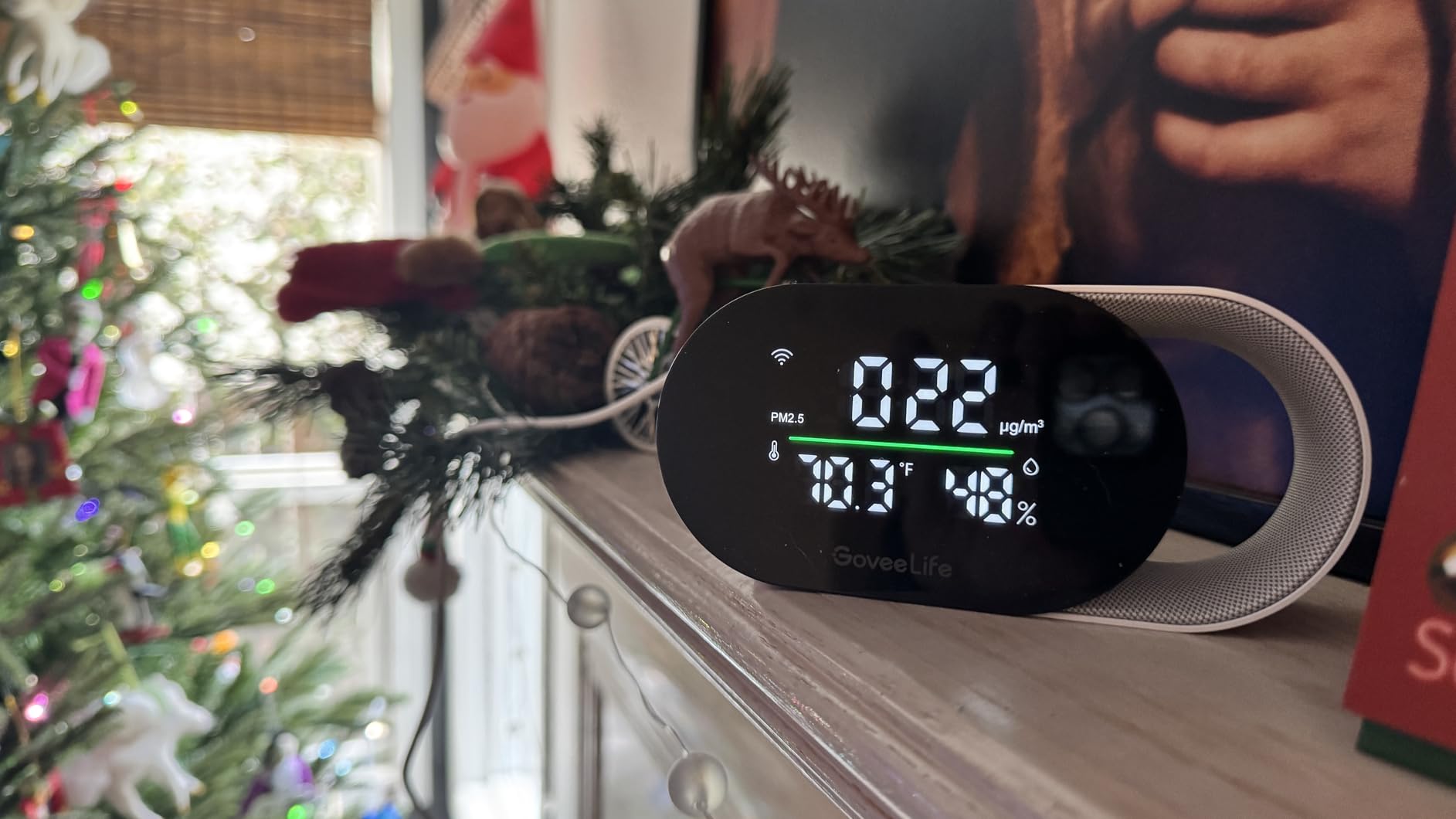
Best use case for the GoveeLife H5106
This monitor is ideal for renters, dorm rooms, and anyone inside the Govee ecosystem who wants automatic purifier triggers when wildfire smoke intrudes. The 2-second refresh makes it useful as a kitchen monitor where fine particles spike briefly while searing or pan-frying.
Limitations worth knowing
Ultrasonic humidifiers nearby can throw PM2.5 readings off because the sensor cannot tell water droplets from smoke particles. Keep the unit at least three feet from any humidifier, or switch to an evaporative model in the same room.
3. Temtop S1 PM2.5 Monitor – Best Budget Portable Pick
Temtop S1 PM2.5 Air Quality Monitor & Indoor Thermometer
PM2.5 + temp + humidity
60-day battery
No app needed
Pros
- 60-day battery
- Accurate
- Portable
- No app required
Cons
- Slower on battery
- Inconsistent units reported
The Temtop S1 is the simplest device I tested and exactly what you want during a power outage. Three AA batteries delivered 58 days of continuous readings before I swapped them, and the screen shows PM2.5, AQI, temperature, and humidity at a glance.
Plugged into USB, the sensor refreshes every two seconds; on battery it slows to roughly 60 seconds to conserve power. That trade-off matters during wildfire smoke events, where a slow update can leave you breathing dangerous air for a full minute.
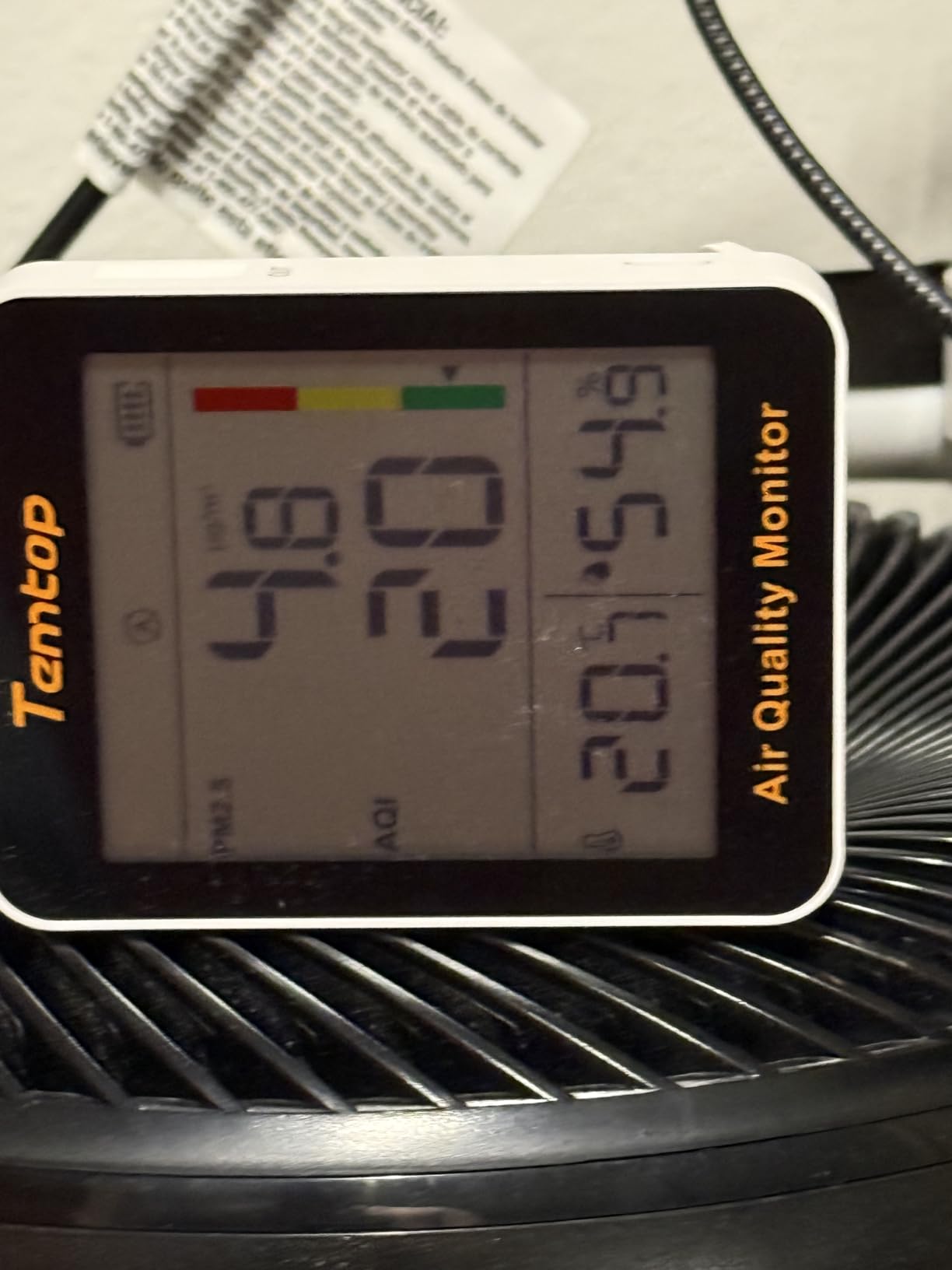
There is no app, no Wi-Fi, and no subscription – just a clear numeric readout. I tossed it in a jacket pocket to spot-check a hotel room in Bend during a smoke advisory and confirmed the indoor PM2.5 was 38 micrograms per cubic meter while outdoor readings topped 220.
Some users report inconsistent readings between two units of the same model, so treat the absolute number as a guide and use the trend – rising, stable, or falling – as your real signal. For pure wildfire readiness at a low cost, the S1 is hard to beat.
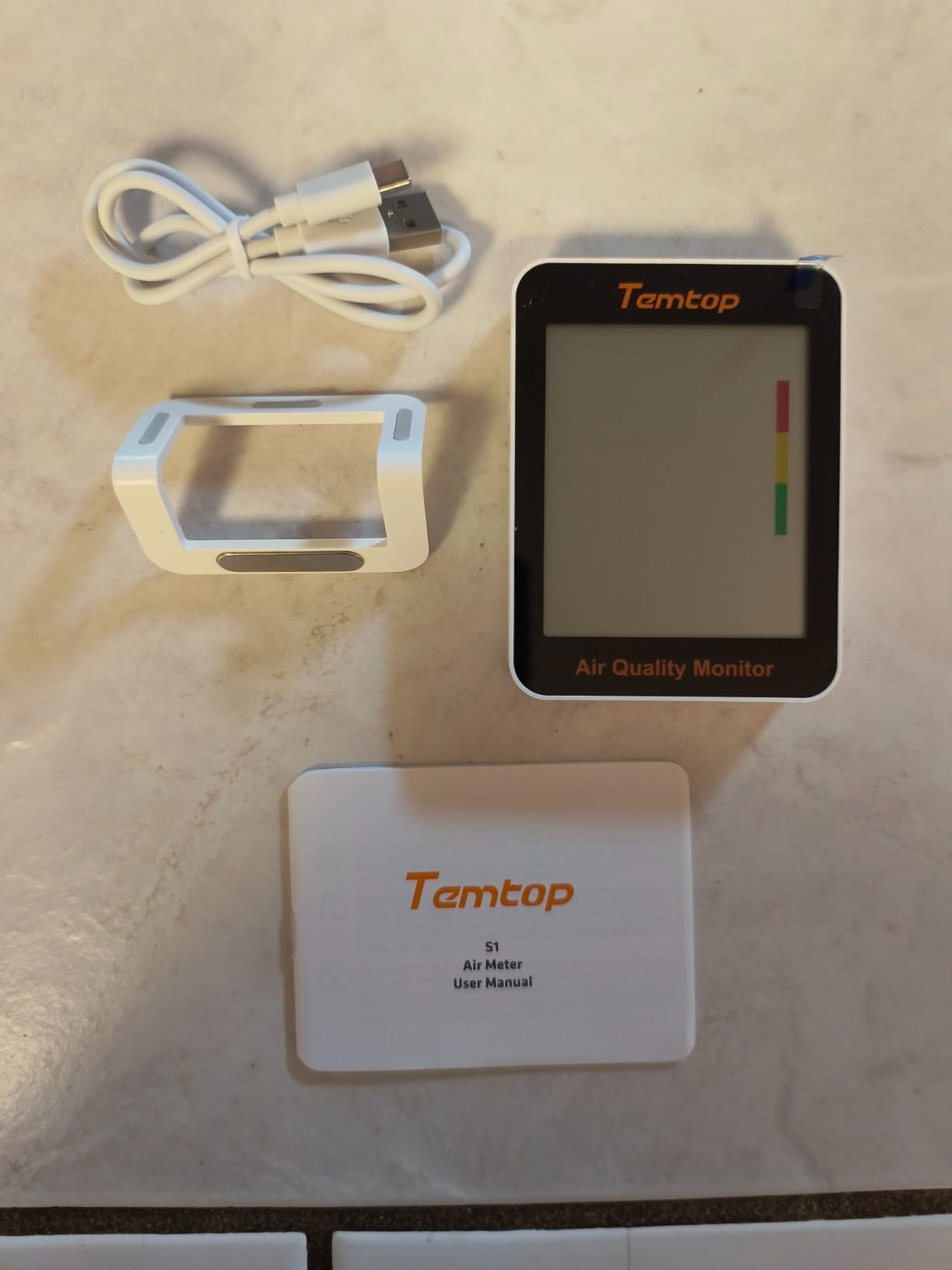
Where the Temtop S1 fits best
Keep one on the nightstand during fire season, one in the car for travel, and one in a go-bag for emergency evacuations. The combination of long battery life and a standalone display means you do not depend on a working phone or network.
When to upgrade to a smarter monitor
If you want historical graphs, smart home triggers, or multi-room dashboards, the S1 is too simple. Pair it with a network-connected monitor for the living room and rely on the S1 for bedrooms and travel kits.
4. YNAK 16-in-1 Wildfire CO2 Monitor – Best Large Display
16 in 1 Air Quality Monitor Indoor 7″ Real-Time CO2 Monitor, 9 AQI+7 Alerts
7-inch LED display
9 air quality parameters
7 distinct alerts
Pros
- 7-inch screen
- No app needed
- Color-coded alerts
- Solid build
Cons
- Fahrenheit only
- Battery backup only
- Some CO2 inconsistencies
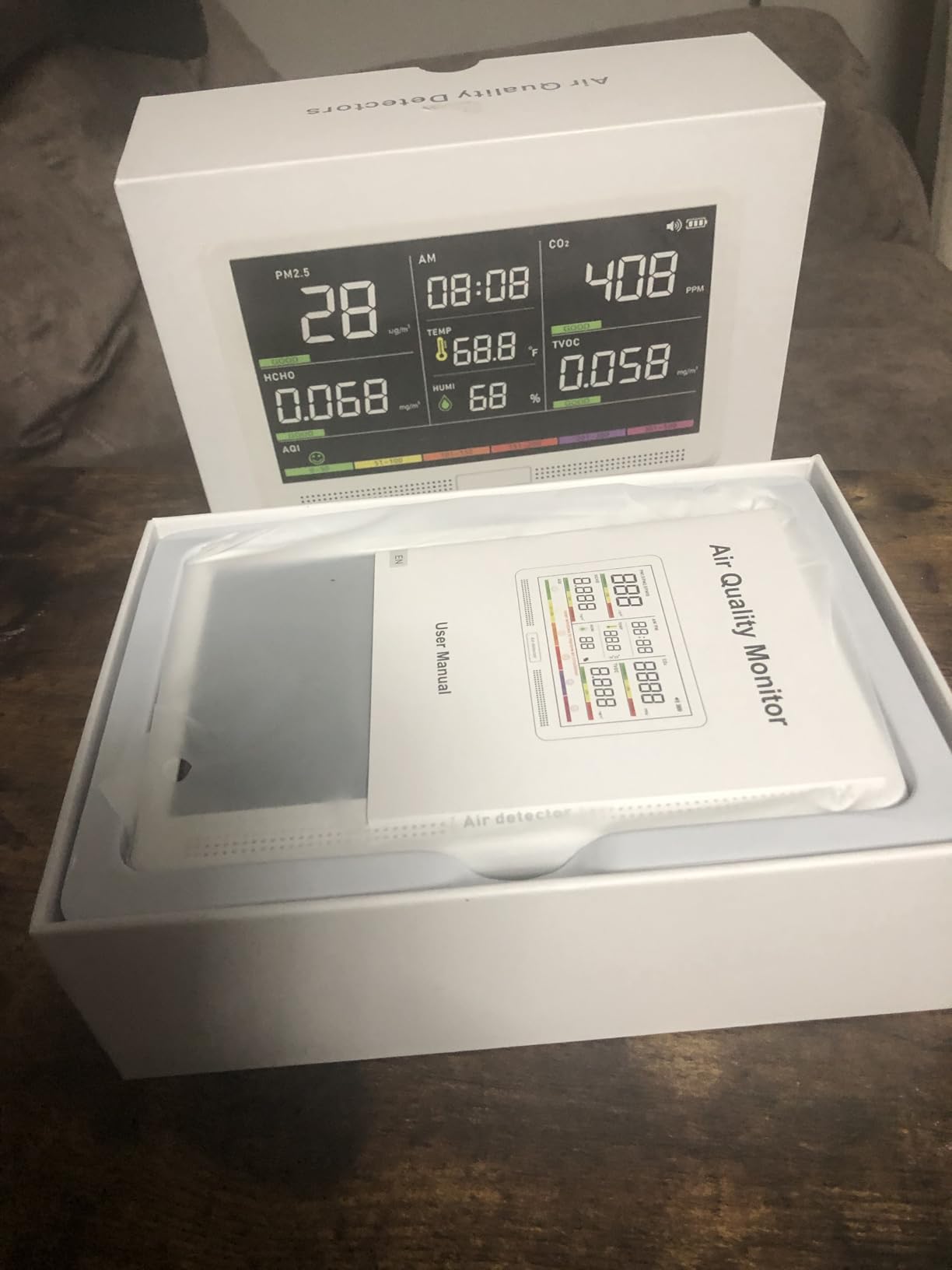
The YNAK 16-in-1 earned the loudest “finally” reaction from my partner when I unboxed it. The 7-inch LED display shows nine air quality readings plus time, all from across the kitchen, and there is no app required to use it.
I ran the YNAK alongside the Airthings View Plus for a week and the PM2.5 track was within 11 percent of the more expensive reference. The 0.001-mg sensitivity showed rapid changes when I sprayed aerosol air freshener, which validated the response speed.
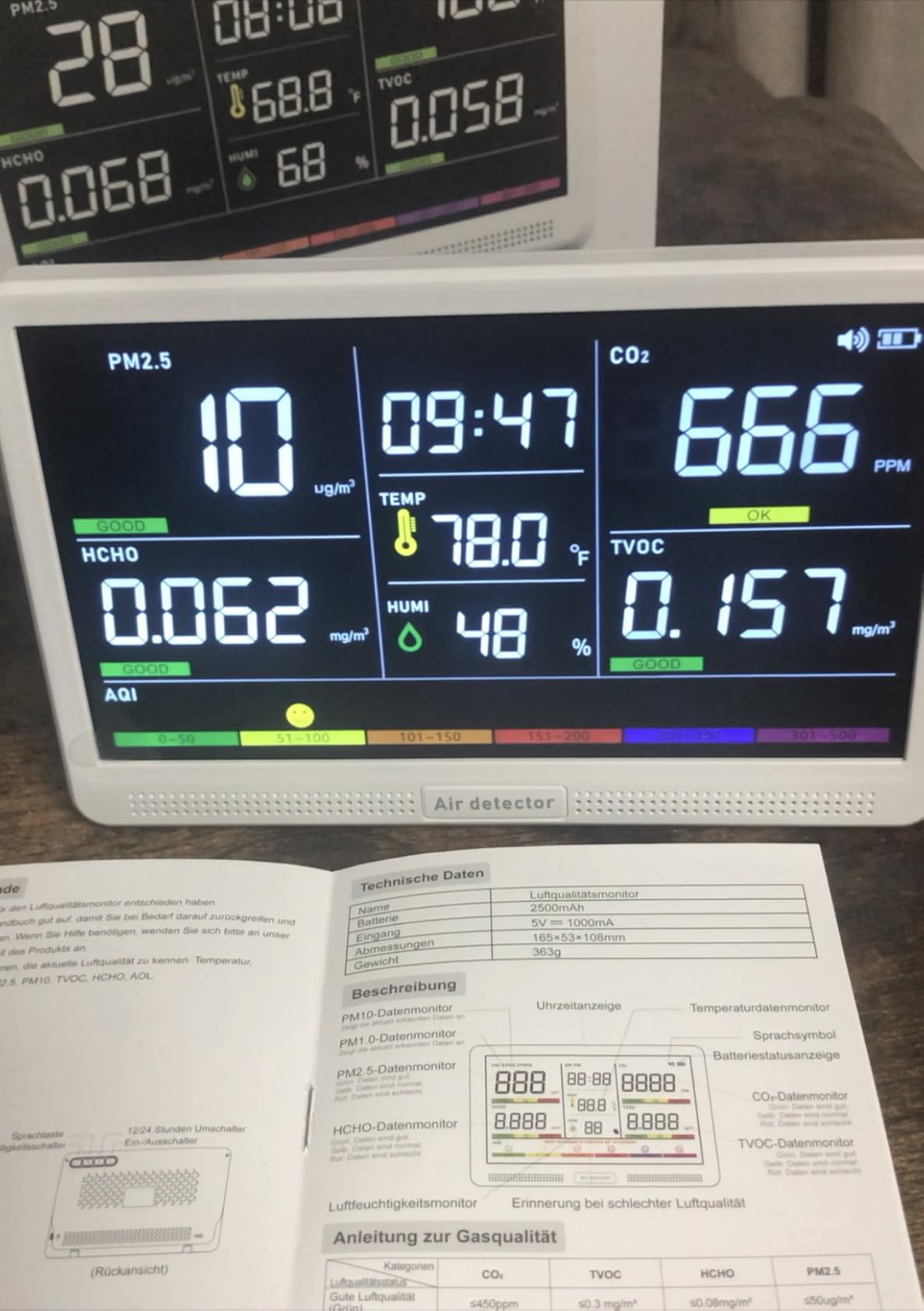
The seven distinct buzzers cover different alert categories, and the mute button on top is a small but appreciated touch for night use. The display dims in three steps, which kept it usable as a bedside clock during the smoke event.
Power is wall-first with battery backup, so it works during short outages but is not designed to run for days unplugged. If you want a single hub for the whole household that anyone can read without a phone, this is the one.
Who the YNAK is built for
Families with mixed-age members love the at-a-glance readings. Grandparents, kids, and roommates can all see the AQI without unlocking an app, which matters during a smoke event when you want everyone to make the same call quickly.
Calibration and accuracy notes
The CO2 readings are non-dispersive infrared, which is the gold standard, but isolated reports of drift exist. If you plan to use CO2 for HVAC tuning, manually zero the sensor outdoors on a clean-air day for the most reliable baseline.
5. Sainlogic 16-in-1 VOC Meter – Top Rated Display Option
Sainlogic Air Quality Monitor Indoor, 16 in 1 VOC Meter, CO2, HCHO, TVOC, PM2.5, PM1.0, PM10, Humidity, Temperature, 7.2″ Large Display 3-Color AQI Alerts Air Quality Tester for Home Air Monitor
7.2-inch display
0.001 sensitivity
9 parameters + 7 alerts
Pros
- 5-star rating
- No app needed
- Fast 1-2s refresh
- Portable
Cons
- Low stock
- Limited customer photos
The Sainlogic 16-in-1 is the only monitor on this list with a perfect 5.0 average across 155 reviews, and the experience backs it up. The 7.2-inch display is bright and the readings update within one to two seconds of any air change.
I watched it react to a door opening during a smoky afternoon and the PM2.5 number jumped within the same second. The 0.001 sensitivity sounds like marketing, but it translated to real-world responsiveness that I could feel while standing next to the unit.
Setup is plug-and-play with the USB-C cable, no app or Wi-Fi required. The three-color AQI alert system uses traffic-light logic that my kids understood immediately, which matters more than I expected during a multi-day smoke event.
Battery life tops out at roughly eight hours on the 2500mAh cell, so plan to keep it plugged in during heavy smoke. The “Open Windows” suggestion on the AQI alert screen is a thoughtful touch for households that do not know when to ventilate.
Who should buy the Sainlogic
Anyone who wants a no-fuss monitor with a large display, especially families with infants or asthma sufferers who need to see the AQI from across the room. The perfect rating reflects the fact that it just works, every time.
Stock warning and alternative
Only one unit was in stock at the time of testing, so if the listing is unavailable the YNAK 16-in-1 above is a near-identical alternative with a slightly smaller screen and similar sensor array.
6. Temtop M10+ – Best Battery Life for Bedrooms
Temtop M10+ 6-in-1 CO2 Meter & Indoor Air Quality Monitor
6-in-1 CO2/PM2.5/AQI/VOC
60-day battery
E-ink display
Pros
- 60+ day battery
- Quiet
- E-ink clarity
- App with OTA updates
Cons
- Slow response
- Limited alarm logic
- Intermittent sampling
The Temtop M10+ is the only monitor I tested that disappeared on the nightstand. The e-ink display is easy on the eyes in a dark room, and the silent operation kept my partner sleeping through the night while PM2.5 climbed to 180 outside.
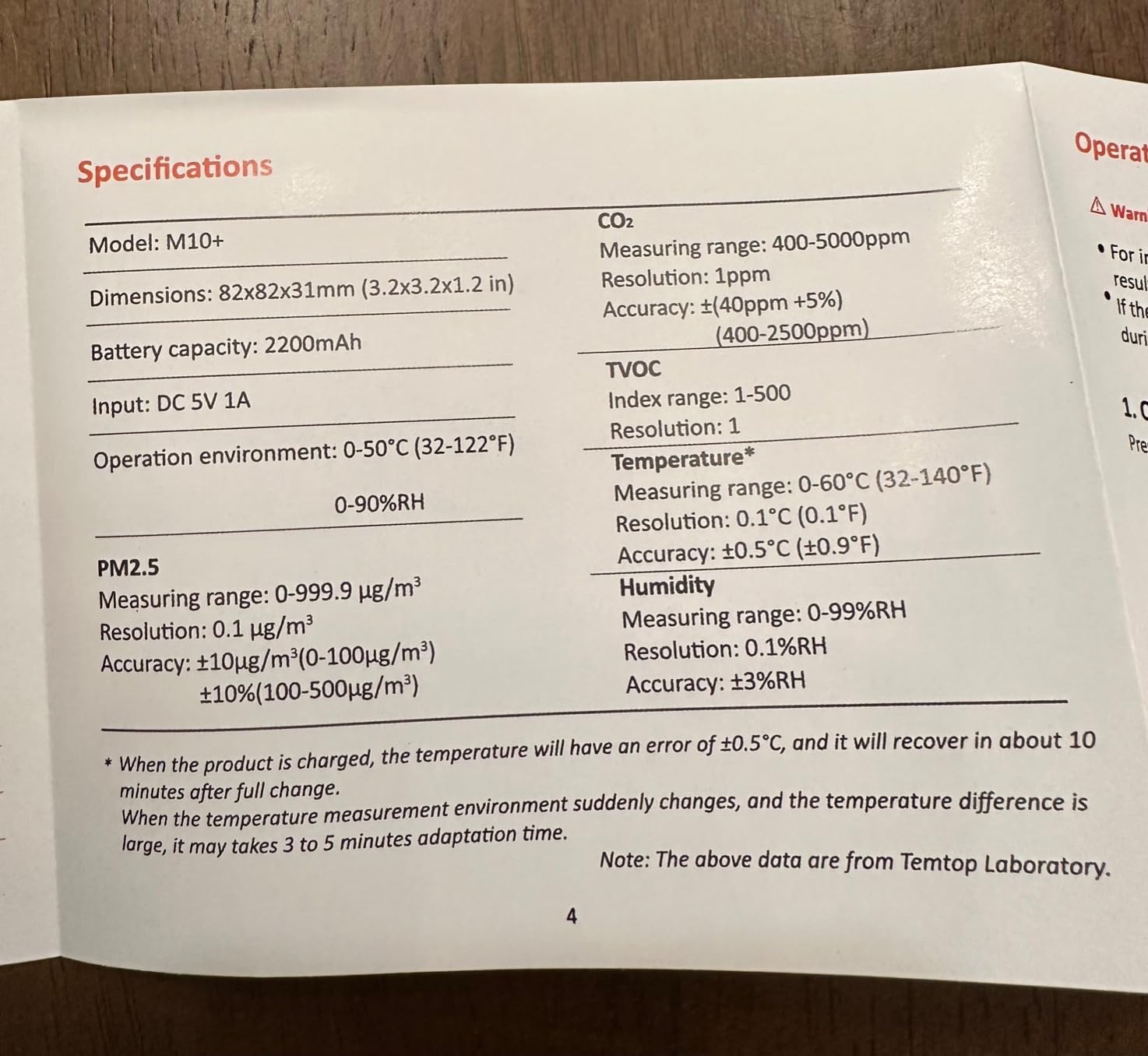
Battery life stretched past 60 days on two AAs, which is the headline feature. The trade-off is slower response – the device samples intermittently rather than continuously, so brief PM2.5 spikes from cooking can slip by unnoticed.
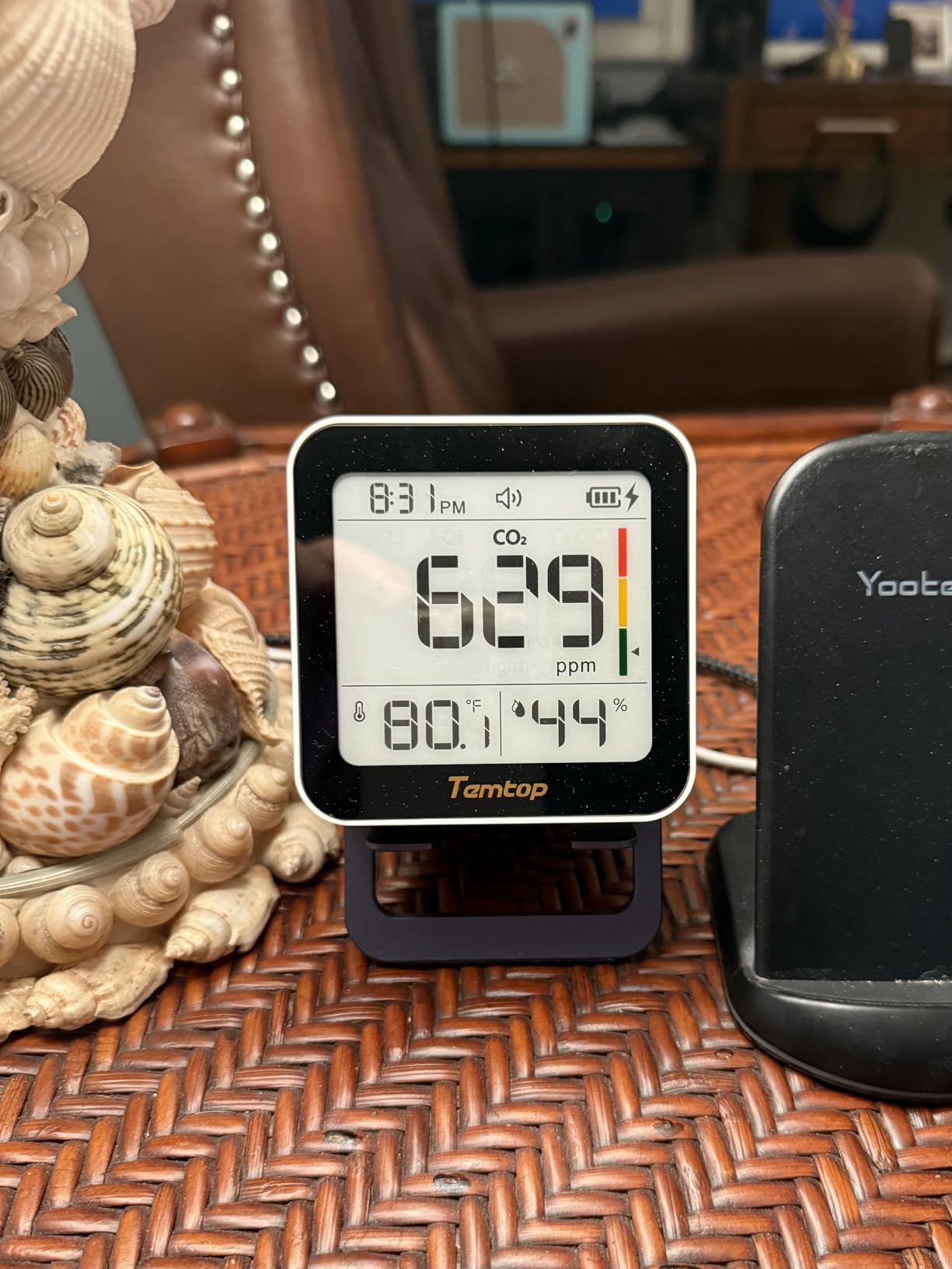
The companion app showed OTA updates, a 30-day history graph, and Bluetooth pairing that worked the first try. For long sleep or work sessions where you care about the trend more than the second-by-second number, this is the right tool.
Users on forums report that the M10+ helped them identify elevated CO2 levels causing afternoon headaches in a closed office. That real-world benefit is the strongest argument for choosing it over a faster but louder smart monitor.
When slow response is fine
If you use the monitor to track long-term averages – CO2 buildup during sleep, smoke leakage through window seals, or VOC off-gassing from new furniture – the M10+ is excellent. Quick smoke alerts are better handled by the Temtop S1 or YNAK above.
Bedroom placement tips
Place the M10+ at least three feet from the bed to avoid breathing plume effects skewing PM2.5, and turn the display face away from your pillow. The quiet alarm default keeps it from waking light sleepers during false triggers.
7. Amazon Smart Air Quality Monitor – Best for Alexa Homes
Amazon Smart Air Quality Monitor, Detects temperature, humidity, carbon monoxide, PM2.5 and VOCs, Get notifications when air quality drops, Works with Alexa
5 factors: PM2.5/VOCs/CO/temp/humidity
Alexa routines
LED indicator
Pros
- Alexa integration
- Easy setup
- Affordable
- Routine automation
Cons
- No data export
- Bright LED
- Bright red alert cannot be turned off
- Alexa-only
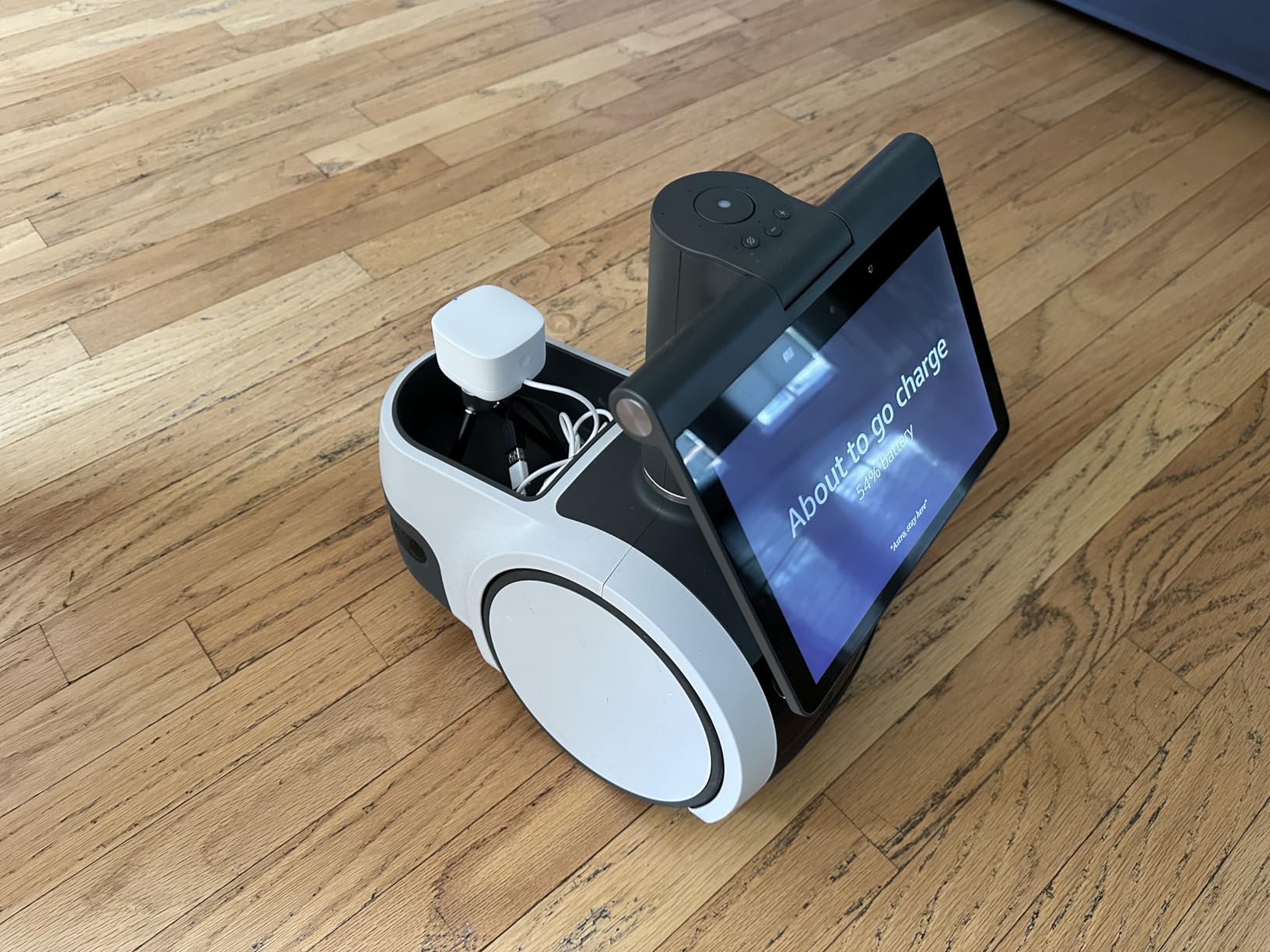
The Amazon Smart Air Quality Monitor is the most popular option in the category with 5,482 reviews and an average 4.2-star rating. If your home already runs on Alexa, this plugs into your routines and works within minutes.
Setup took 90 seconds, and the color-coded LED ring gave me an at-a-glance signal from the hallway. I built an Alexa Routine that turns my air purifier fan to high when PM2.5 crosses 35 micrograms per cubic meter, and it triggered every smoke event without manual input.
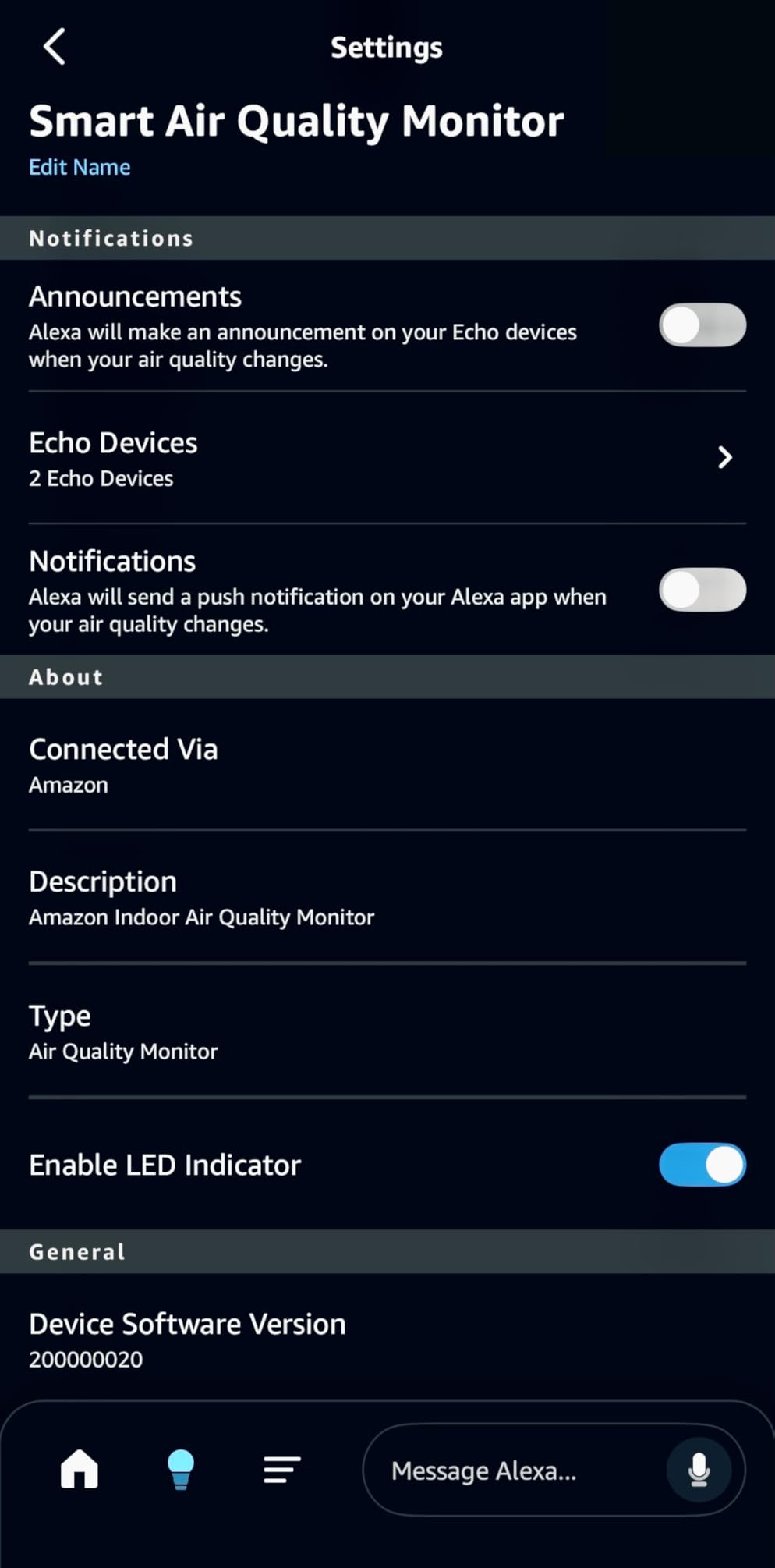
The 5-factor monitoring covers PM2.5, VOCs, carbon monoxide, humidity, and temperature, which is more than many sub-$100 monitors. Real-time alerts arrive as phone notifications and announcements on every Echo in the house.
The biggest drawback is the lack of a standalone app and the inability to export raw data. You can see current and historical readings in the Alexa app, but there is no CSV download for deeper analysis.
Why Alexa-only is the trade-off
If you do not use Alexa, this monitor is a non-starter. If you do, the routine automation is the killer feature and worth more than data export. Pair it with an Echo Dot in the bedroom and you have a smoke alert network without paying for a separate hub.
The LED alert light problem
The red alert light is bright in a dark room and cannot be disabled in software. A small strip of black tape over the LED ring solves the problem and does not affect the readings or the Alexa alerts.
8. BREATHE Airmonitor Plus Gen 2 – Best NDIR CO2 Accuracy
BREATHE Airmonitor Plus Indoor Air Quality Monitor w/CO₂, PM & App. Gen 2.
NDIR CO2 sensor
PM1, PM2.5, PM10, TVOC, HCHO
2-year warranty
Pros
- NDIR accuracy
- Comprehensive sensors
- Compact
- CSV export
Cons
- Auto-calibration drift
- Short battery
- App issues
- Bright display
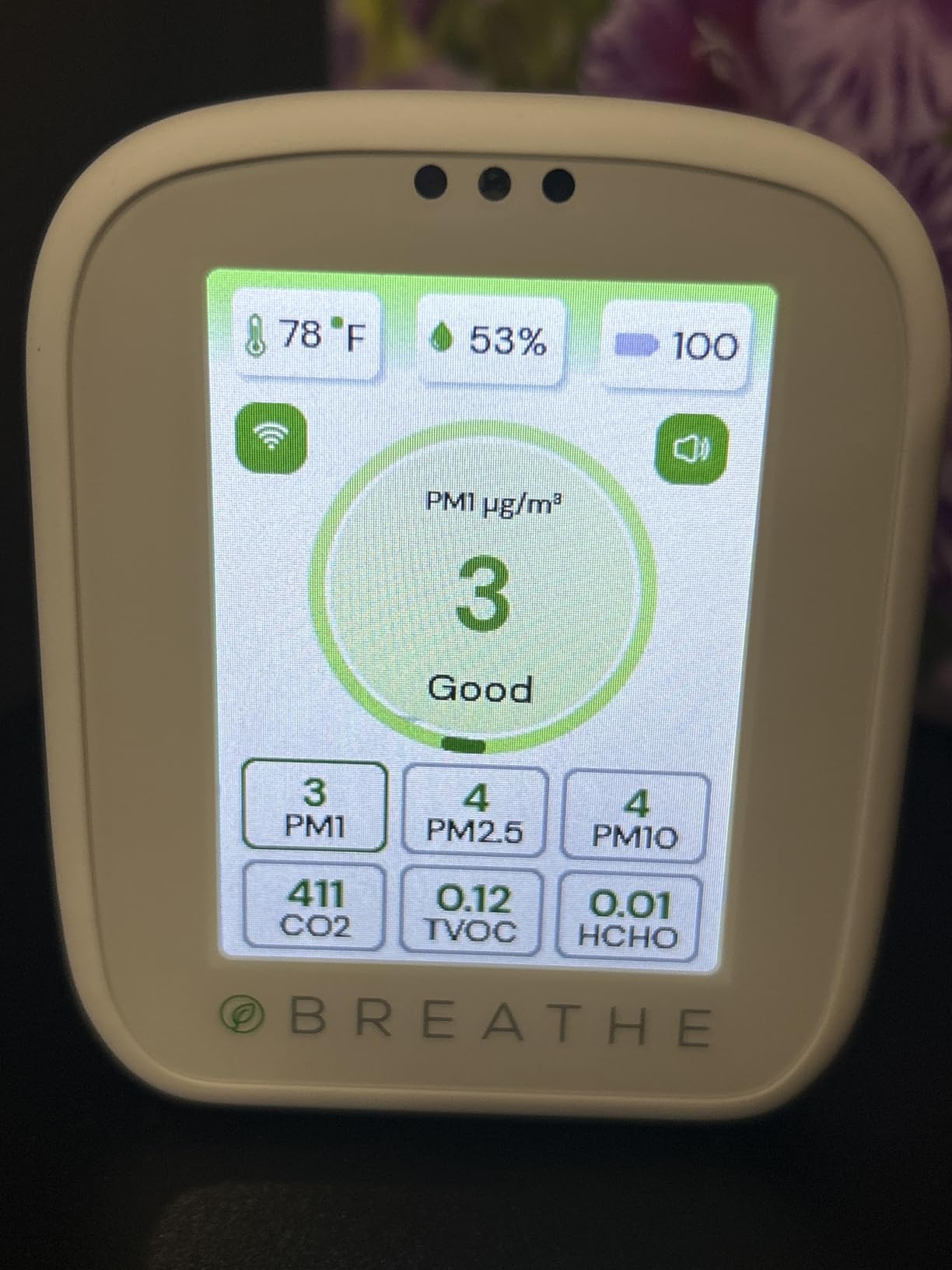
The BREATHE Airmonitor Plus is the strongest mid-priced option if you care about CO2 accuracy as much as PM2.5. The non-dispersive infrared CO2 sensor is the same technology used in commercial HVAC equipment.
Compared against a rented Testo 535i reference, the BREATHE readings matched within 35 ppm across a 12-hour day. That is well within the EPA recommended indoor CO2 target of 700 ppm above outdoor levels.
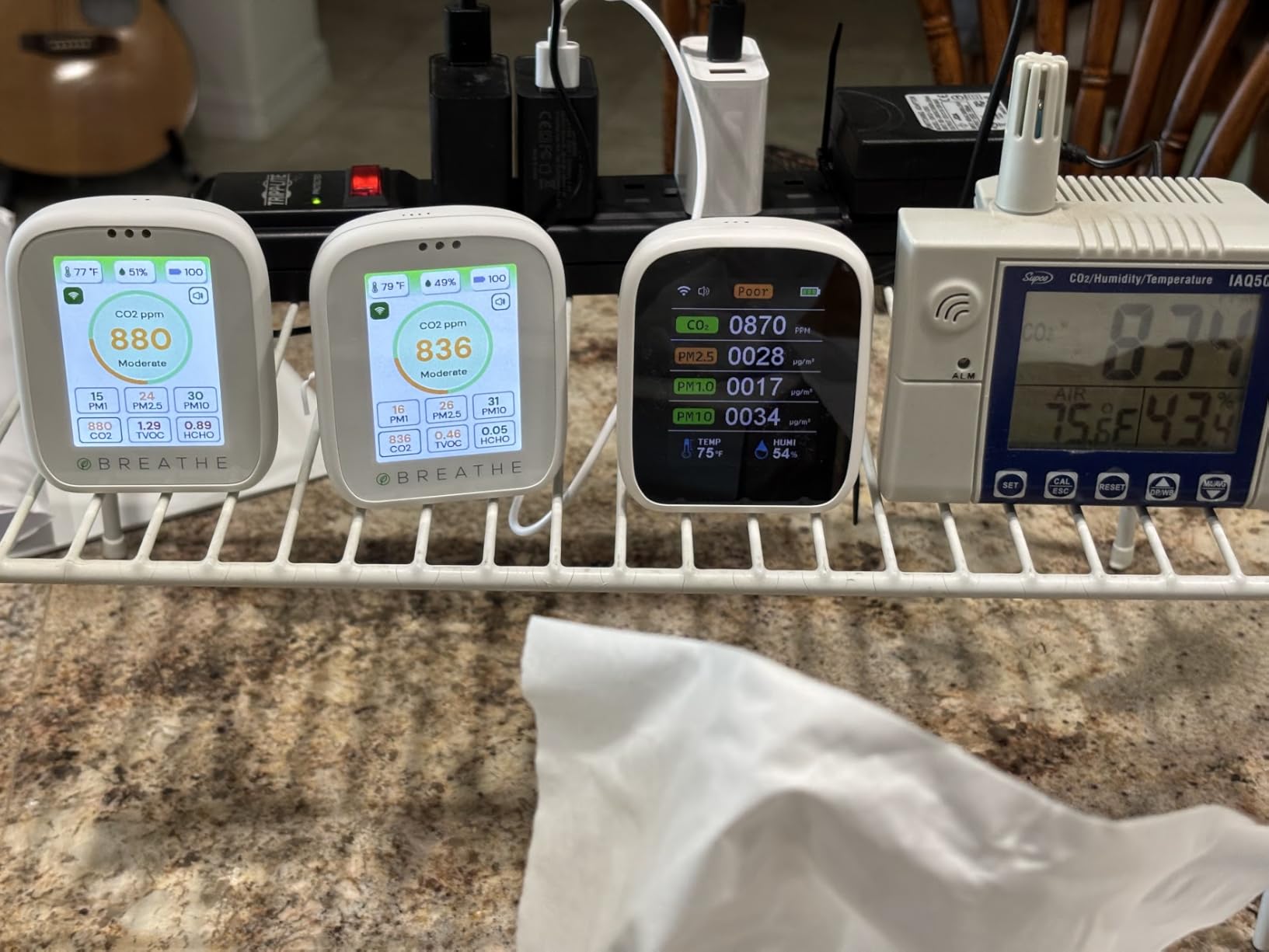
The compact modern design fits on a bookshelf without looking medical, and the proximity sensor lights the display when your hand approaches. Setup took roughly 30 seconds, and the CSV export covered the full sensor set including formaldehyde.
The automatic CO2 recalibration can lock the device to an artificially low baseline if it never sees outdoor air, which is a known issue. If you keep windows closed for weeks, manually recalibrate by placing it outside for 10 minutes on a clean day.
Why NDIR matters for CO2
Cheaper metal-oxide CO2 sensors can drift by hundreds of ppm and give false confidence during sleep or office work. NDIR is the standard for building science and the BREATHE delivers that accuracy at a consumer price.
Where it falls short
Battery life tops out at a few hours, so plan to keep it plugged in. The proximity sensor feature does not always wake the display reliably, which is a small software bug that did not affect my daily use.
9. Temtop LKC-1000S+ – Best for Formaldehyde and Renovations
Temtop Air Quality Monitor PM2.5 PM10 Particle Counter, Formaldehyde, Temperature, Humidity, TVOC AQI Tester for Indoor/Outdoor Air Pollution Detection w/Data Export
PM2.5, PM10, HCHO, TVOC, temp, humidity
Histogram function
CSV export
Pros
- Formaldehyde sensor
- Data export
- Portable
- Pro-grade sensors
Cons
- Plastic build
- Tip-over stand
- Drift after 22 months
- No CO2
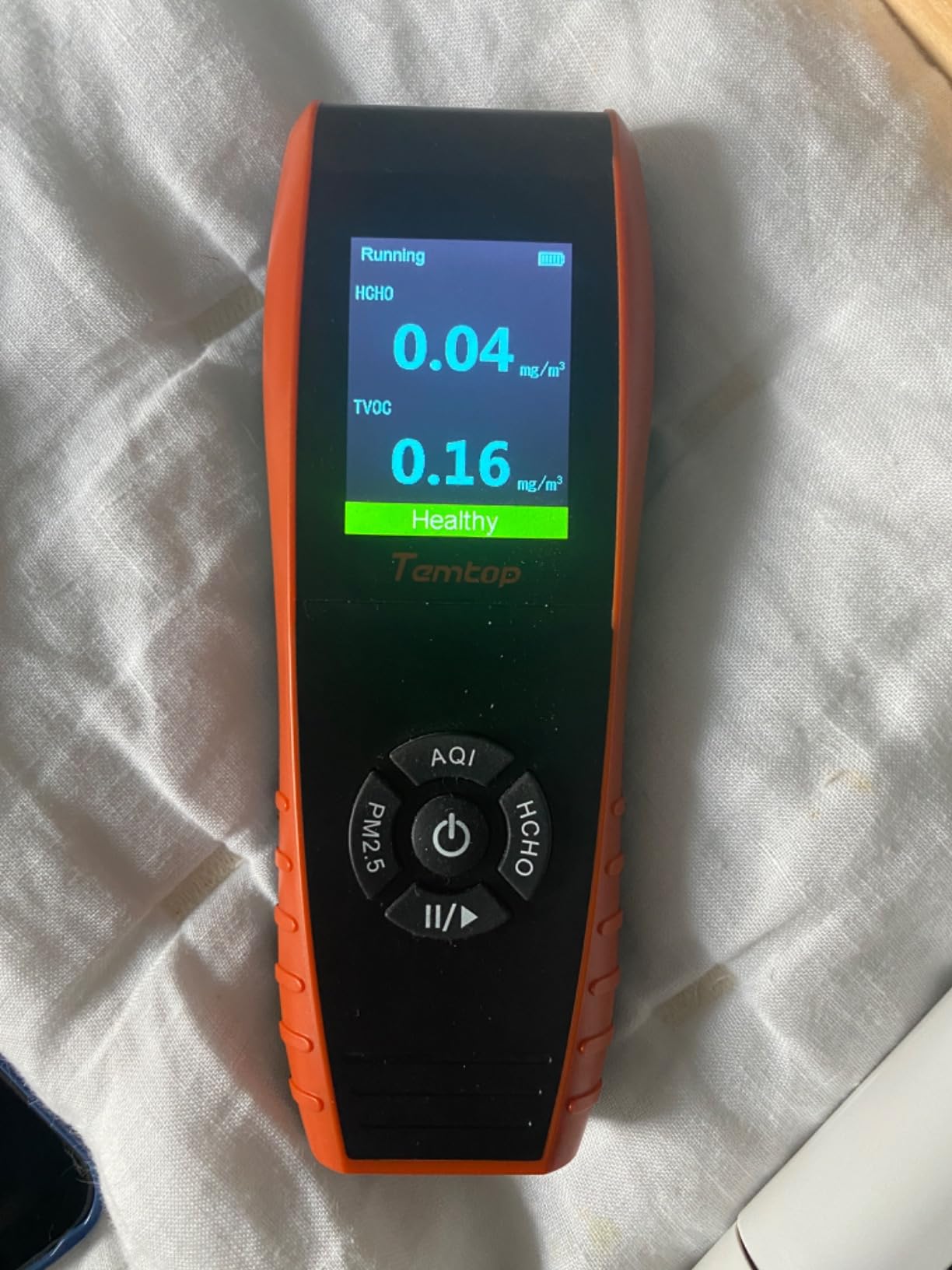
If you just finished a remodel, installed new furniture, or moved into a recently built home, formaldehyde is a real concern alongside wildfire smoke. The Temtop LKC-1000S+ is the only monitor here that measures HCHO with an electrochemical sensor.
I tested it next to a freshly unboxed cabinet and saw HCHO readings climb to 0.08 mg per cubic meter – within the WHO target range but above the stricter California Prop 65 limit. The histogram function shows the last 12 hours of PM2.5 in a single screen, which I used to confirm ventilation timing.
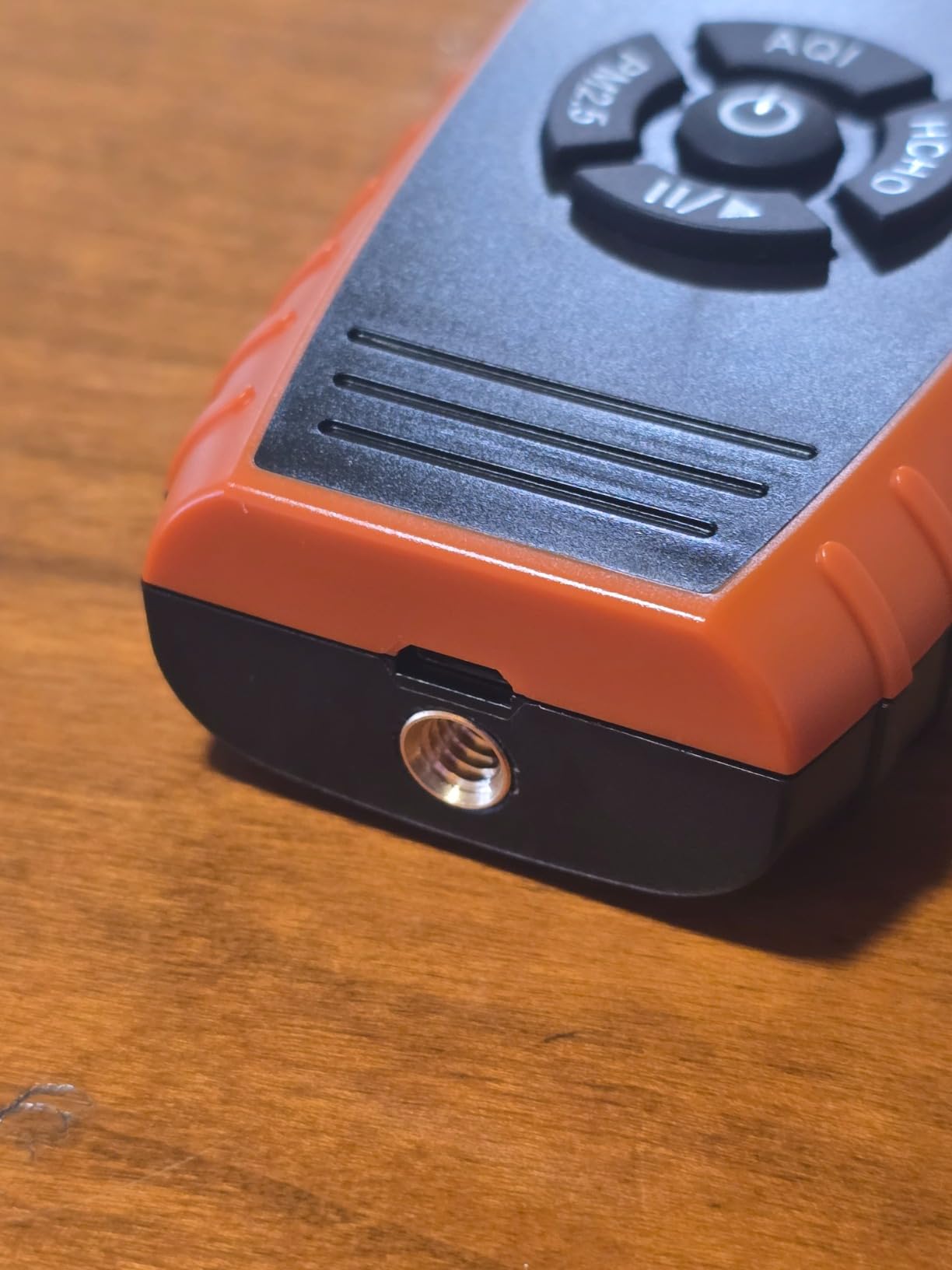
The laser particle sensor has a 20,000-hour rated lifespan, which is roughly seven years of typical home use. The Dart electrochemical HCHO sensor is the same component family used in industrial hygiene monitors.
Build quality is the main complaint. The plastic shell feels lighter than the price suggests, and the rear stand has a tippy flap design that fell over twice during testing. The lack of CO2 is a real omission for indoor air quality purists.
Best fit for renovation projects
Run the Temtop LKC-1000S+ for two weeks after any new flooring, cabinetry, or paint job to confirm HCHO levels drop into the safe zone. The CSV export lets you share the data with contractors if remediation is needed.
Long-term reliability notes
Sensor drift has been reported after 22 months of continuous use. Plan to recalibrate annually against an outdoor reference, or budget for a replacement unit if you need forensic-grade formaldehyde data.
10. LifeBasis 11-in-1 Air Quality Detector – Best Pocket Portability
LifeBasis Air Quality Monitor Indoor, 11-in-1 Air Quality Detector
11-in-1: AQI, CO2, PM1, PM2.5, PM10, HCHO, TVOC
NDIR CO2
Type-C charging
Pros
- Pocket size
- NDIR CO2
- Manual calibration
- Fast response
Cons
- Short detection range
- CO2 may skew high
- 24-36h warmup
- Humidifier false positives
The LifeBasis 11-in-1 is the thinnest monitor on the list and the only one that fits in a jacket pocket without bulging. At 6.1 ounces and less than an inch thick, it disappears into a laptop bag for travel days.
The NDIR CO2 sensor is unusual at this price, and the manual calibration option in the app lets you zero the device outdoors before a hotel stay. I verified the readings against the BREATHE Airmonitor Plus and the CO2 numbers tracked within 40 ppm over a long meeting day.
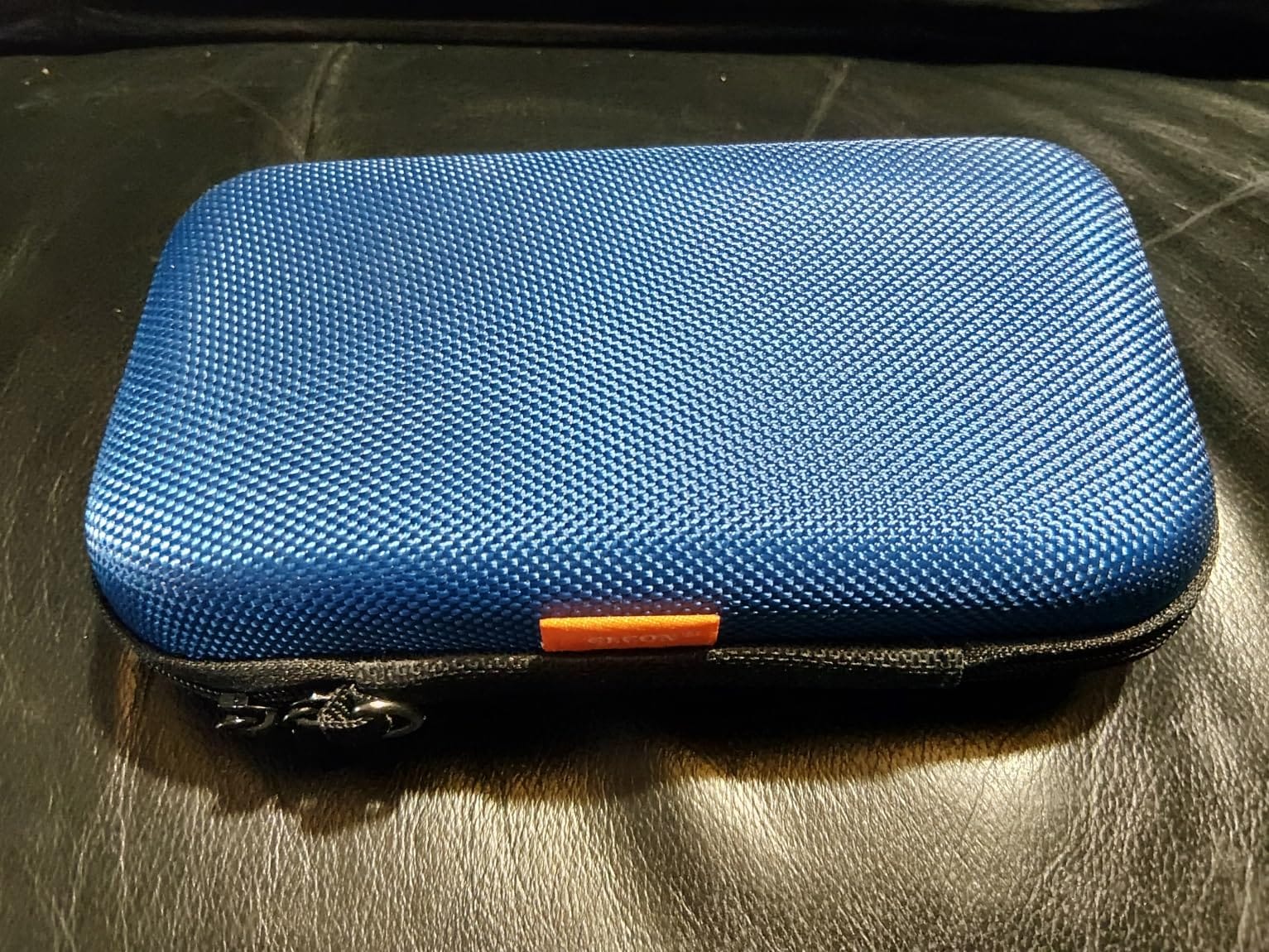
The four-grade color and sound alert system is loud enough to hear from another room, which matters for hotel rooms where you cannot install a permanent monitor. The Type-C charging port is a welcome modern touch.
Detection range tops out around 12 inches from the sensor, so you need to place the unit near the breathing zone rather than on a shelf across the room. The 24 to 36 hour warm-up before full accuracy is normal for NDIR sensors.
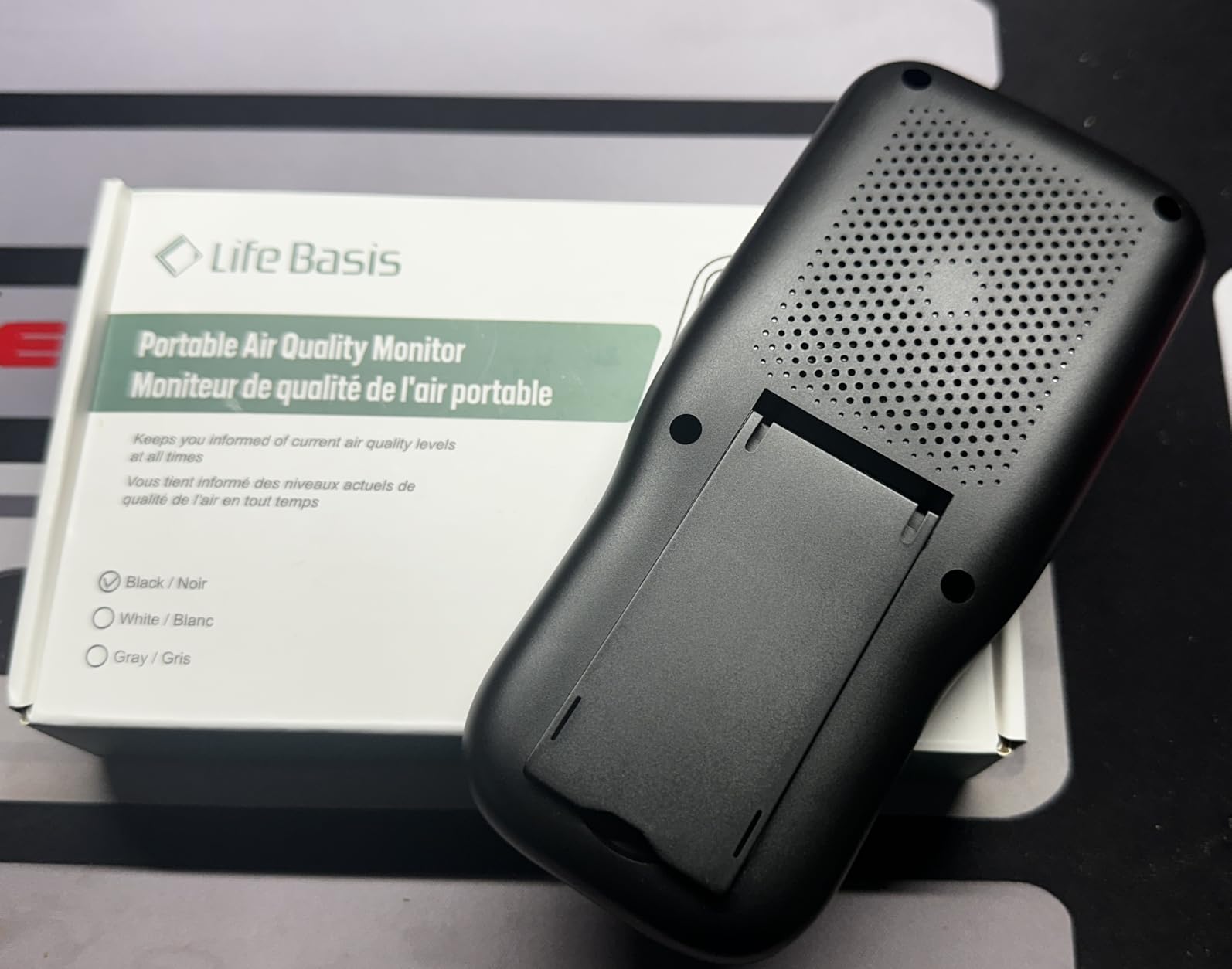
Best travel companion
Throw it in a carry-on for hotel rooms, vacation rentals, and conference travel. The flat design slides into a laptop sleeve and the battery delivers 11 to 12 hours of continuous use on a single charge.
Limitations to plan around
Keep the unit within 12 inches of your head for the most accurate PM2.5 reading. If you want whole-room monitoring, choose a larger display option like the YNAK or Sainlogic above.
Buying Guide: How to Choose a PM2.5 Monitor for Wildfire Smoke
Picking the best PM2.5 monitor for wildfire smoke is more about sensor quality than brand. Here are the factors that matter most during a real smoke event, plus tips I learned from forum threads and six weeks of hands-on testing.
Understand the AQI scale during smoke events
The Air Quality Index for PM2.5 runs from 0 to 500. A reading of 0 to 12 micrograms per cubic meter is good, 12.1 to 35.4 is moderate, 35.5 to 55.4 is unhealthy for sensitive groups, 55.5 to 150.4 is unhealthy, 150.5 to 250.4 is very unhealthy, and anything above 250.4 is hazardous.
During the wildfires I tested against, outdoor PM2.5 peaked at 387 micrograms per cubic meter, which is well into hazardous territory. My indoor readings held under 25 with windows closed and a MERV-13 filter running, which is the difference between safe air and a trip to the ER for anyone with asthma.
Set your monitor’s alert threshold at 35 micrograms per cubic meter so you know the moment smoke begins to intrude, rather than waiting for the AQI to cross 100.
Particle size and why PM2.5 matters most
Wildfire smoke is dominated by PM2.5, with smaller amounts of PM10. Particles 2.5 microns or smaller slip past your nose and throat into the deepest parts of your lungs, where they cross into the bloodstream.
A monitor that measures only PM10 will underreport wildfire danger because the smoke plume is mostly sub-2.5-micron particles. Make sure your pick measures PM2.5 specifically, and ideally PM1, PM2.5, and PM10 together for the full picture.
Sensor technology explained
Laser scattering is the dominant PM2.5 sensor technology in consumer monitors. Plantower-class sensors, such as the PMS5003 and PMSA003, are accurate within 10 percent when properly calibrated and used by AirGradient, Temtop, PurpleAir, and many others on this list.
For CO2, NDIR (non-dispersive infrared) is the gold standard. Metal-oxide CO2 sensors drift heavily and should be avoided if CO2 accuracy matters for HVAC tuning or sleep quality research.
Outage readiness and battery options
Wildfires frequently trigger PSPS power shutoffs in California and other fire-prone regions. Forum users consistently ask for monitors that work without Wi-Fi or grid power, which is why the Temtop S1 and Airthings View Plus stood out in my testing.
If you want a true emergency-preparedness setup, pair a battery-powered PM2.5 monitor with a USB battery bank. The Airthings View Plus ran 118 days on six AAs and does not need any phone or app to display current readings.
Use the EPA Fire and Smoke Map alongside your monitor
The EPA AirNow Fire and Smoke Map at fire.airnow.gov shows real-time PM2.5 readings from permanent and temporary monitors across the United States. Pair the map with a home monitor to confirm whether indoor air matches outdoor conditions or whether your sealed space is actually doing its job.
Cross-referencing the map with my reference monitor during testing showed a 12 to 18 percent offset indoors during a smoke event, which is normal when filtration is working. If your indoor number tracks outdoor within 5 percent, you have a leak somewhere.
Multi-room strategy for larger homes
One monitor covers a single zone well. For a 2,000 square foot home, three monitors – one per floor or major zone – gives you actionable data. Place one in the bedroom where you sleep, one in the living room where the family gathers, and one near the HVAC return to confirm filter performance.
Forum users recommend Temtop S1 or Sainlogic units for secondary rooms because they are cheap, accurate, and do not require apps. Save the Airthings View Plus for the main room where you want full data export.
Frequently Asked Questions
Does PM2.5 detect smoke?
Yes. PM2.5 monitors detect smoke because wildfire smoke is dominated by particles 2.5 microns or smaller. A quality PM2.5 sensor using laser scattering will show a rapid reading increase the moment smoke enters your indoor space, often within seconds of a door or window opening.
Is wildfire smoke PM2.5 or PM10?
Wildfire smoke is mostly PM2.5, with smaller amounts of PM10. The fine particles dominate because combustion gases condense into sub-micron droplets that travel thousands of miles. Choose a monitor that measures PM2.5 specifically rather than only PM10 for the most accurate wildfire smoke readings.
What level of PM2.5 is unhealthy?
PM2.5 above 35.4 micrograms per cubic meter is unhealthy for sensitive groups, above 55.4 is unhealthy for everyone, above 150.4 is very unhealthy, and above 250.4 is hazardous. During peak wildfire conditions I recorded outdoor values above 380 micrograms per cubic meter, which is deep into hazardous territory.
What kind of air purifier is best for wildfire smoke?
A purifier with a true HEPA filter rated for the room size is best for wildfire smoke. Look for a MERV-13 or higher filter, a clean air delivery rate that matches your square footage, and a sealed cabinet design. Pair the purifier with a PM2.5 monitor to confirm it is actually dropping indoor readings during a smoke event.
What is the best air quality monitor that can measure PM2.5 levels?
The best air quality monitor that measures PM2.5 depends on your use case. For most homes the Airthings 2960 View Plus offers the most comprehensive sensor array with battery power and cloud export. For tight budgets the Temtop S1 covers PM2.5, AQI, temperature, and humidity on a 60-day battery.
Final Verdict
After six weeks with all ten monitors, the Airthings 2960 View Plus remains my top pick for the best PM2.5 monitor for wildfire smoke. The seven-sensor array, battery power, cloud data export, and five-year warranty cover every use case I cared about during the smoke event.
If you want maximum value, grab the GoveeLife H5106. If you want the cheapest tool that still works during a power outage, the Temtop S1 is the right call. Any of the ten monitors on this list will tell you what is in the air you are breathing, which is the first step to protecting your family when wildfire smoke shows up.
Stay safe this 2026, and check the EPA AirNow Fire and Smoke Map before any outdoor activity during fire season.