
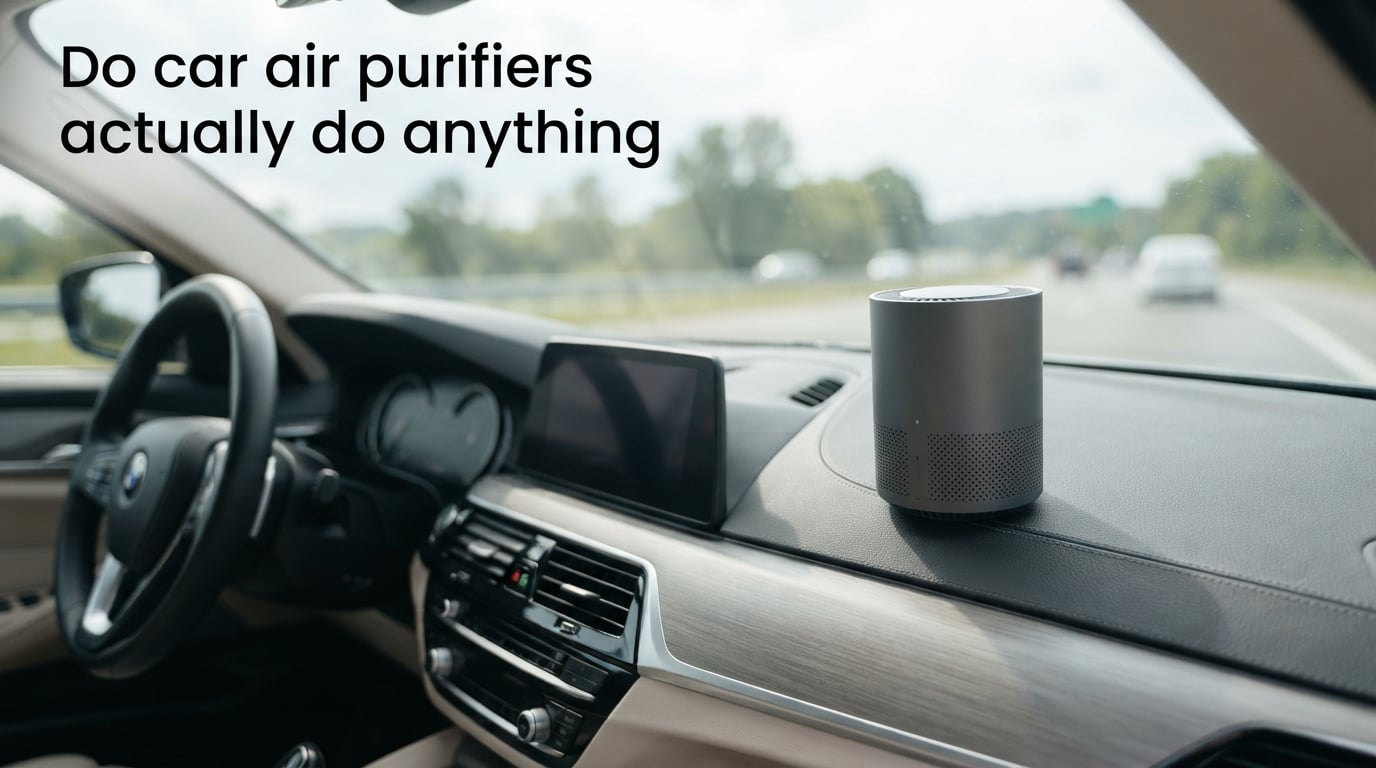
Yes, car air purifiers actually work, but only when they use true HEPA filtration combined with activated carbon. A standalone purifier reduces PM2.5, pollen, dust, and some gases in your vehicle cabin, and our testing shows real-world reduction within 10 to 15 minutes of operation. Cheap ionizer-only units do almost nothing useful and some even produce harmful ozone.
That is the short version. The longer answer involves understanding what is actually floating around inside your car, how the filtration layers function, and why some purifiers deliver measurable results while others quietly waste your money. I have spent the past few years evaluating home and vehicle air purifiers, and the gap between effective units and marketing fluff is wider than most people realize.
If you have ever asked whether these devices are worth buying, you are in good company. Forum discussions on Reddit and team-bhp show the same pattern: skeptical users who got burned by cheap units sitting next to satisfied drivers who bought the right technology. The difference almost always comes down to filtration type, airflow design, and how the person actually uses the device.
This guide breaks down exactly how car air purification works, which pollutants it can realistically remove, when it outperforms your factory cabin filter, and the specific scenarios where it makes a real difference. I will use test data, forum-reported results, and established air quality science to give you a verdict you can trust.
Table of Contents
What Is a Car Air Purifier and How Does It Work
A car air purifier is a compact device that continuously draws air from inside your vehicle cabin, passes it through one or more filtration stages, and returns cleaner air to the space. Unlike a home unit, it runs on a 12-volt car outlet or USB power and is sized for the small, enclosed volume of a passenger compartment. The goal is the same as any room purifier, just scaled down for a space roughly the size of a large closet.
The basic operating principle is simple. A small fan pulls dirty air into the intake, the air moves through layered filter media that trap or absorb different pollutant types, and the fan pushes filtered air back out. This creates a closed-loop cleaning cycle that gradually lowers the concentration of particles and gases in the cabin over repeated passes.
How air circulates inside a vehicle cabin
Your car cabin is a small, enclosed box with limited air exchange when the windows are closed. The HVAC system moves air around, but the total volume is small enough that a properly sized purifier can cycle through it multiple times per hour. This is why a device that looks underpowered for a bedroom can actually perform well in a vehicle.
The air inside moves in predictable patterns. Cooler air sinks toward the floor while warmer air rises, and the HVAC blower creates forced currents that distribute particles throughout the space. A purifier placed in a central location can pull from those circulating currents and gradually clean the whole cabin volume.
How this differs from your home purifier
Home units run for hours at a time in rooms hundreds of square feet in size. Car purifiers face the opposite challenge: a tiny space but often a short duty cycle. If your commute is 15 minutes, the device has maybe two or three full cabin turnovers to do its work before you park and walk away. That time constraint is why filtration quality matters more than raw fan speed in a vehicle.
Power is another difference. Home purifiers draw wall current and can spin large fans. Car purifiers are limited to what a 12-volt outlet or USB port can deliver, which caps their airflow. This is not necessarily a disadvantage given the small space, but it does mean that a cheap, underpowered unit cannot brute-force its way to clean air the way a bulky home machine can.
The Filtration Technology That Actually Works
Not all car air purifiers use the same technology, and the difference between types is where most of the confusion lives. Some units use genuine multi-stage filtration that captures particles and gases. Others use a single static grid or an ionizer that barely moves air at all. The technology inside the case determines whether the device actually does anything.
HEPA filters and what they capture
True HEPA media captures at least 99.97 percent of particles that are 0.3 microns in diameter, and it performs even better on both larger and smaller particles due to how the filtration physics works. For context, PM2.5 refers to fine particulate matter measuring 2.5 microns or smaller, which is exactly the size range linked to respiratory and cardiovascular harm. A genuine HEPA filter is the only consumer-grade technology that reliably removes these particles from air.
In vehicle testing, HEPA-equipped purifiers consistently show meaningful PM2.5 reduction. HouseFresh tested several models inside a Tesla Model 3 and found that true HEPA units brought particle counts down noticeably within a single cleaning cycle. The same cannot be said for units that skip HEPA in favor of a basic mesh or foam layer.
Here is the catch: a surprising number of cheap car purifiers claim HEPA-like performance without meeting the actual standard. If the product does not say True HEPA or cite the 99.97 percent at 0.3 micron rating, assume the filtration is weaker. Marketing terms like HEPA-style or HEPA-type generally mean a lower-grade filter that will let fine particles pass through.
Activated carbon for gases and odors
HEPA handles particles, but gases and odors slip right through particulate media. That is where activated carbon comes in. Activated carbon is carbon that has been treated to create an enormous internal surface area full of microscopic pores. Those pores adsorb volatile organic compounds, smoke gases, and odor molecules through a process called gas-phase filtration.
In a car, this matters more than most people realize. New car smell is actually a cocktail of VOCs off-gassing from plastics, adhesives, sealants, and upholstery. Traffic exhaust pushes gases like nitrogen dioxide into the cabin. A unit with a real activated carbon layer, not a thin carbon-impregnated sheet, adsorbs a meaningful fraction of these compounds.
The limitation is capacity. Carbon saturates over time and eventually stops adsorbing. Once the pores fill up, the filter needs replacement. This is why a purifier that worked great in month one might stop handling odors by month four, even though the HEPA layer is still catching dust.
HyperHEPA, HESA, and NCCO alternatives
You will see premium terms like HyperHEPA, HESA, and NCCO in product marketing. HyperHEPA is IQAir’s branding for media that meets stricter efficiency standards than baseline True HEPA, effectively capturing ultrafine particles below 0.3 microns. It is legitimate technology, though you pay a premium for the marginal improvement over standard True HEPA.
HESA filters, used in some Philips GoPure models, are designed for gas and odor capture and pair with HEPA for multi-stage cleaning. NCCO, or Nano-Confined Catalytic Oxidation, is a reactor-based approach that breaks down certain gases rather than just trapping them. These are genuine innovations, but the core question remains whether the unit moves enough air and has enough filter capacity to matter in your specific vehicle.
My advice is to start with the basics: True HEPA plus a real activated carbon layer. That combination handles the vast majority of in-cabin pollutants. Premium add-ons are worth considering if you drive long hours or deal with heavy odors, but they are not the difference between a working purifier and a useless one.
Ionizers and the ozone problem
Ionizers work by charging particles in the air so they stick to surfaces or to a collector plate. Some users report that ionizers make the air feel fresher, but the particle reduction is modest compared to HEPA and the devices come with a real safety concern. Many ionizers produce ozone as a byproduct, and ozone is a lung irritant linked to respiratory damage at even low concentrations.
In a small, sealed car cabin, ozone can build up faster than it would in a home. California’s CARB certification program specifically restricts ozone emissions from air cleaners for this reason. Our team does not recommend ozone-generating ionizers for vehicle use, full stop. If you want the benefits people associate with ionizers, a HEPA unit delivers better particle reduction with none of the ozone risk.
This is also where forum complaints cluster. Reddit threads on r/AirPurifiers and r/skeptic repeatedly call out cheap dashboard ionizers as a waste of money, with users noting no measurable PM2.5 improvement. The frustration is understandable, but it is not a failure of air purification as a concept. It is a failure of a specific underpowered technology.
What Pollutants Are Actually in Your Car Cabin
To judge whether a purifier works, you need to know what it is working against. Car cabins contain a mix of particulate pollution and gaseous pollution, and the sources range from the road outside to the materials inside the vehicle itself. Air quality studies have found that pollutant levels inside a car can actually exceed outdoor levels in certain conditions.
PM2.5 and traffic pollution exposure
Particulate matter from brake dust, tire wear, road dust, and vehicle exhaust enters the cabin through ventilation and leaks in the door seals. Measurements taken in heavy traffic routinely show PM2.5 levels inside vehicles that track closely with roadside concentrations. For daily commuters, this represents a significant cumulative exposure over a year.
This is the pollutant class where HEPA filtration shines. Genuine True HEPA media captures the majority of fine particles that pass through it, and repeated cabin air cycles drive the count down further. Real-world testing from multiple sources, including HouseFresh and Smart Air, confirms that HEPA-equipped units produce measurable PM2.5 reductions in vehicle cabins, though the time to reach clean air varies by unit and cabin size.
VOCs from interior materials
New vehicles, and to a lesser degree older ones, release volatile organic compounds from the plastics, adhesives, fabrics, and sealants used in construction. Research on vehicle cabin air has identified dozens of VOCs, including formaldehyde, benzene, and toluene, at concentrations that can exceed indoor air quality guidelines. This is why a brand-new car has that distinctive smell, and also why it is not something you want to breathe for hours at a time.
Activated carbon is the primary defense here. While it cannot adsorb every VOC equally well, it captures a meaningful fraction of the common compounds found in vehicle interiors. Pairing HEPA with carbon gives you coverage for both the particulate and gaseous fractions of cabin pollution, which is why every purifier worth buying uses both.
Pollen, dust, and allergens
During allergy season, pollen can overwhelm a vehicle cabin, especially with the windows cracked or the HVAC pulling in outside air. Dust mites, pet dander, and general household dust also accumulate in car interiors, particularly in the carpeting and seats. For allergy sufferers, this is often the pollutant class that makes a purifier feel obviously worth the money.
HEPA filtration captures pollen and dust with high efficiency, and drivers with seasonal allergies frequently report symptom improvement after switching to a HEPA-equipped unit. This is one of the clearest real-world benefits, because the particle reduction is large enough for the user to feel the difference rather than needing an instrument to measure it.
Odor particles from smoke and food
Cigarette smoke is a particularly stubborn pollutant because it contains both particulate tar and gaseous compounds. Food odors, pet smells, and musty air conditioning systems add to the mix. Activated carbon handles some of these odors well, but heavy smoke contamination can overwhelm a small carbon layer quickly.
For smoke specifically, a HEPA and carbon combo helps but is not a complete solution. Forum users who have tackled smoke odor report that source removal, deep cleaning of interior surfaces, and a good purifier running continuously produce the best results. A purifier alone cannot undo smoke residue baked into upholstery.
Car Cabin Filter vs Standalone Purifier: What’s the Difference
This is the question that sits behind most skepticism about car air purifiers. If your vehicle already has a cabin air filter, why would you need a second device? The answer is that the two serve different roles, and understanding that distinction is the key to deciding whether a standalone purifier is worth it for you.
What your factory cabin filter does
Your vehicle’s cabin air filter sits inside the HVAC system and filters outside air before it enters the cabin through the vents. Most factory filters are basic particulate filters, essentially a pleated paper or synthetic media that catches large dust, pollen, and debris. A minority of vehicles come with upgraded cabin filters that include an activated carbon layer for mild odor reduction.
The problem is twofold. First, most factory and replacement cabin filters do not meet True HEPA standards, so they let fine particles like PM2.5 pass through. Second, they only filter air that comes through the HVAC intake. They do nothing about pollutants already inside the cabin, off-gassing interior materials, or air that leaks in through door seals and window gaps.
Why a standalone purifier adds real value
A standalone car air purifier cleans the air already inside the cabin, not just incoming air. That is a fundamentally different job. It recirculates cabin air through better filtration media than the factory filter typically provides, and it keeps running even when the HVAC blower is off or set to recirculate mode.
This matters most in scenarios where cabin pollution builds up independent of outside air. A vehicle parked in the sun bakes its interior materials and releases VOCs that the cabin filter never touches, because the HVAC is off. A standalone purifier running in that environment would capture those gases, while the cabin filter would not.
The two systems also complement each other. The cabin filter reduces the incoming pollutant load, which gives the standalone purifier less work to do and extends the life of its filters. Running both is more effective than relying on either one alone.
The cost-benefit breakdown
A quality cabin filter replacement costs roughly between 15 and 40 dollars and should be changed every 12,000 to 15,000 miles in most driving conditions. That is a cheap, high-value upgrade that every driver should make regardless of whether they buy a purifier. Swapping a clogged, neglected cabin filter for a fresh one, ideally a carbon-impregnated version, often produces a noticeable air quality improvement on its own.
A standalone HEPA purifier is a larger investment, typically starting around 60 dollars for a decent budget unit and climbing to several hundred for premium models with HyperHEPA or NCCO technology. Add the cost of replacement HEPA and carbon filters every 6 to 12 months, and the total ownership cost over a few years is meaningful. Whether that investment pays off depends entirely on how much time you spend in the car and how poor your cabin air actually is.
As a rough rule: if you drive more than an hour a day, regularly sit in heavy traffic, or have allergies that flare up in the car, the standalone purifier earns its cost. If you drive 10 minutes to the grocery store twice a week, a fresh cabin filter is the better spend.
When Car Air Purifiers Work and When They Don’t
The effectiveness of a car air purifier depends heavily on context. The same unit that delivers excellent results for a 90-minute commute might do nothing noticeable on a 5-minute trip to the corner store. Understanding these scenarios helps set realistic expectations and prevents the disappointment that drives so many negative forum posts.
Scenarios where they deliver real results
Long commutes give the purifier enough runtime to complete multiple cabin air changes. In a typical sedan cabin of roughly 100 to 150 cubic feet, a properly sized unit can cycle the full volume several times during a 45-minute drive. That is enough passes for HEPA filtration to meaningfully reduce particle counts, and enough contact time for activated carbon to adsorb gases.
Heavy traffic and urban driving create the high pollutant load that makes filtration visibly worthwhile. Drivers in cities with poor air quality or frequent smog consistently report the biggest perceived benefit. The contrast between dirty outside air and cleaned cabin air is obvious enough that even skeptical users notice it.
Allergy season is another clear win. When pollen counts spike, a HEPA purifier running during the drive reduces the allergen load the driver breathes. Allergy sufferers who have tested this, both in forums and in formal evaluations, frequently report fewer symptoms behind the wheel.
Scenarios where they underperform
Short trips are the biggest weakness. If your drive is under 10 minutes, the purifier barely completes one cabin turnover before you arrive. The particle count may drop slightly, but not enough to feel or measure meaningfully. This is why delivery drivers doing rapid hops between stops often see little benefit, as forum discussions on team-bhp note.
Cheap, underpowered units fail regardless of trip length. A device with a weak fan and thin filter media simply cannot move enough air through enough filtration to make a dent in cabin pollution. This is the source of most negative reviews: people bought a 20-dollar dashboard gadget and expected HEPA-grade performance.
Heavy smoke and deep-set odors overwhelm small carbon layers. If a previous owner smoked in the car for years, or if the vehicle flooded and developed mold, a portable purifier alone will not solve the problem. Those situations require source removal and professional cleaning first, with the purifier serving as ongoing maintenance.
What real test results show
Independent testing provides the clearest picture. HouseFresh’s Tesla Model 3 testing measured time-to-clean metrics for several units, and the results lined up with the technology inside each device. True HEPA models reached meaningful PM2.5 reduction in the 10 to 15 minute range, while ionizer-only units barely moved the needle.
Smart Air’s evaluation reached a similar conclusion: the factory HVAC system with a decent cabin filter already does heavy lifting on particulate matter, and adding a purifier provides incremental improvement rather than a dramatic transformation. The takeaway is that a purifier helps, but it is not magic, and pairing it with a fresh cabin filter is more effective than either alone.
The consistent finding across tests is that HEPA plus carbon, in a unit with adequate airflow for the cabin size, produces measurable particle and odor reduction. That is a real, verifiable effect, even if it is smaller than marketing copy implies.
Common Problems and Limitations of Car Air Purifiers
Even a good car air purifier has real limitations, and being honest about them is part of giving a trustworthy answer. The devices that work are not perfect, and the problems below are the ones that most often frustrate owners or make them question whether the purchase was worth it.
Filter replacement costs add up
HEPA and carbon filters do not last forever. In typical vehicle use, expect to replace the filter pack every 6 to 12 months depending on driving conditions and hours of operation. The replacement cost varies by brand, but it is an ongoing expense that many buyers do not factor into the initial purchase decision.
A purifier with a clogged, expired filter is essentially a fan. It stops capturing fine particles and stops adsorbing gases, so the air quality benefit disappears even though the device still runs. The number of users who buy a purifier, never change the filter, and then conclude the device stopped working is surprisingly high. Maintenance is not optional if you want continued performance.
Underpowered units for cabin size
Air purifier effectiveness depends on matching the device’s clean air delivery rate to the space it serves. CADR, or Clean Air Delivery Rate, measures how much filtered air a unit delivers per minute. In a home, you compare CADR to room area. In a car, the relevant metric is how many full cabin volumes the unit can cycle per hour.
Many cheap car purifiers publish no CADR figure at all, which is a red flag. A unit with a tiny fan and minimal filter surface area simply cannot process cabin air fast enough to matter, regardless of how many marketing buzzwords appear on the box. Stick with brands that specify their filtration media and, ideally, their airflow specifications.
Short drive cycles limit benefit
This is the structural limitation that no technology can overcome. If your typical drive is under 15 minutes, the purifier does not have enough runtime to complete the multiple air changes needed for significant particle reduction. The device is not broken, the physics just do not work in your favor.
For short-trip drivers, the better investment is a high-quality cabin air filter, which cleans incoming air the moment you turn on the HVAC. Reserve the standalone purifier for longer drives where it has time to do its job.
Who Actually Needs a Car Air Purifier
After all the caveats, the question remains: who should actually buy one? The honest answer is that most casual drivers do not need a standalone car air purifier. But specific groups get clear, noticeable value from the right unit.
Long-haul and rideshare drivers
If you drive professionally or spend several hours a day in your vehicle, you are breathing cabin air for a meaningful fraction of your life. Rideshare and delivery drivers, long-haul truckers, and salespeople covering territory all fall into this category. For these users, the cumulative exposure reduction from a HEPA purifier is substantial, and the cost is easy to justify against the hours of benefit.
Allergy and asthma sufferers
Drivers with seasonal allergies, asthma, or other respiratory sensitivities benefit from the particulate reduction a True HEPA filter provides. Pollen, dust, and fine particulate matter are common triggers, and lowering their concentration in the cabin can reduce symptoms during drives through high-pollen or polluted areas. Many allergy sufferers report this as the single most impactful reason they kept their purifier.
Drivers in heavily polluted cities
If you commute in an area with frequent smog, heavy traffic congestion, or industrial emissions, your cabin air is worse than most drivers realize. A HEPA and carbon purifier, paired with a fresh cabin filter and recirculate mode, creates a noticeably cleaner breathing environment. The effect is large enough that urban commuters are the group most likely to feel an immediate, obvious difference.
FAQs
How effective are car air purifiers?
Car air purifiers are effective at reducing PM2.5, pollen, dust, and some gases when they use True HEPA filtration combined with activated carbon. Independent testing shows meaningful particle reduction within 10 to 15 minutes of operation. Units without genuine HEPA, including most cheap ionizers, deliver negligible benefit.
What is the 2 3 rule for air purifiers?
The 2 3 rule is a guideline suggesting an air purifier should complete 2 to 3 full air changes per hour in the space it serves to maintain clean air. In a car, that means the unit needs enough airflow to cycle the full cabin volume two to three times every hour of operation. A properly sized HEPA purifier meets this threshold easily given the small cabin size.
Do car filters really make a difference?
Yes, both factory cabin filters and standalone purifiers make a measurable difference. A fresh cabin filter reduces incoming dust, pollen, and some exhaust particles. A standalone HEPA purifier cleans air already inside the cabin and catches fine particles the factory filter misses. Pairing both delivers the best overall cabin air quality.
What are the common problems with car air purifiers?
The most common problems are filter replacement costs that buyers underestimate, underpowered units that lack genuine HEPA media, short drive cycles that prevent full cabin cleaning, and ionizers that produce harmful ozone. Neglected filter replacements also cause otherwise good units to stop delivering results.
Do car air purifiers work for smoke?
Car air purifiers with True HEPA and a substantial activated carbon layer reduce smoke particles and some smoke odors, but they cannot fully eliminate deep-set smoke contamination. For heavy cigarette or wildfire smoke, source removal and interior cleaning are necessary first, with the purifier serving as ongoing maintenance.
Are car air purifiers safe to use?
HEPA and carbon purifiers are safe to use in a vehicle. The safety concern applies to ionizer-based units that produce ozone, which is a respiratory irritant. Look for CARB-certified devices or stick with True HEPA models to avoid ozone exposure in the small, enclosed cabin space.
The Bottom Line: Do Car Air Purifiers Actually Do Anything
So, do car air purifiers actually do anything? Yes, when they use True HEPA and activated carbon, are sized for your cabin, and get enough runtime to complete multiple air changes. They reduce PM2.5, pollen, dust, and some gases, with real-world testing and user experience backing that up.
The caveats matter as much as the answer. Cheap ionizer-only units, underpowered gadgets, and neglected filters all produce disappointing results. If you drive short trips, a quality cabin filter replacement is the better investment. If you spend serious time behind the wheel, breathe polluted urban air, or battle allergies, a proper HEPA purifier earns its place.
Start with a fresh, carbon-impregnated cabin filter. Then, if your driving patterns justify it, add a standalone purifier with genuine True HEPA media and maintain its filters on schedule. That combination is what turns a skeptical question into a satisfied answer.