
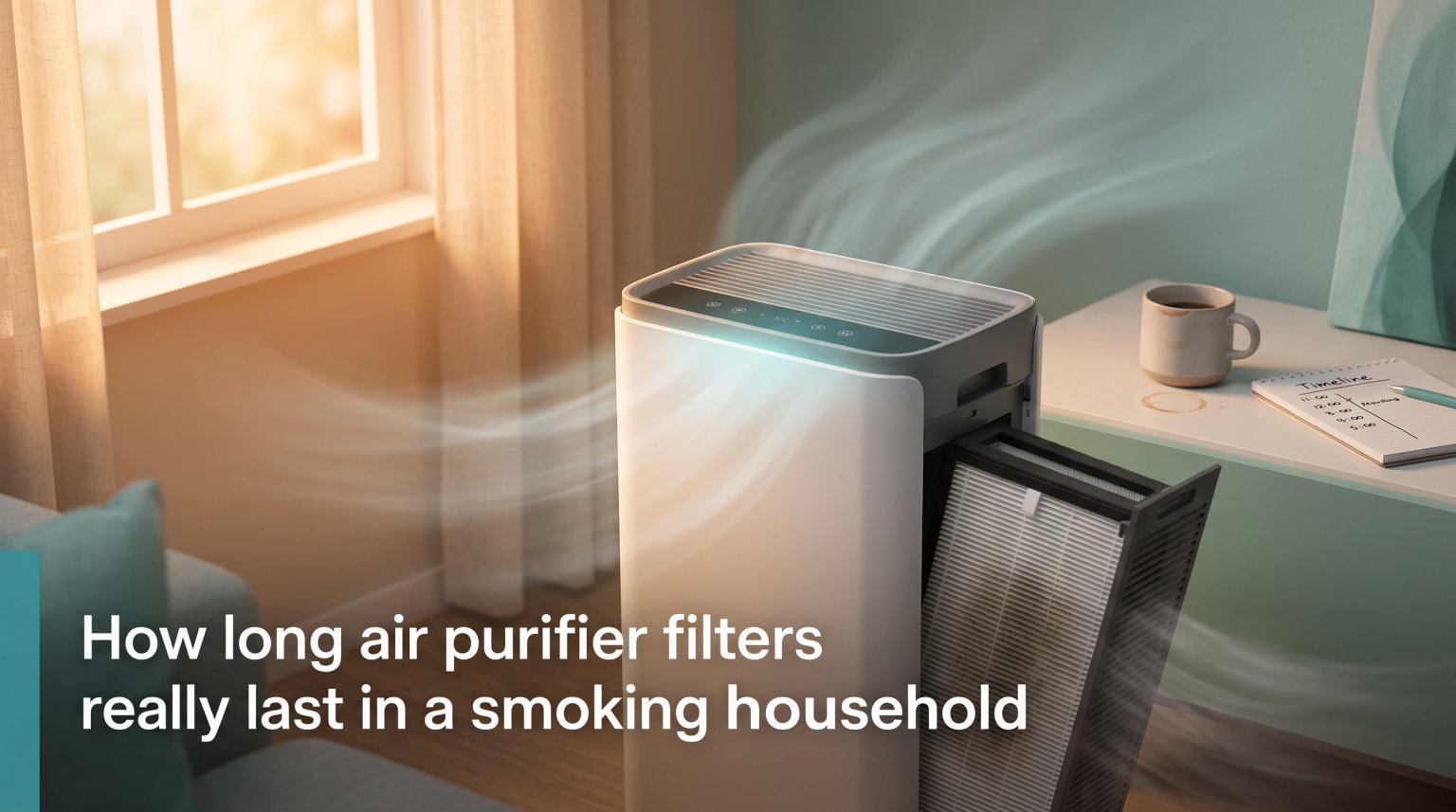
If you smoke indoors or live with someone who does, your air purifier filters are working two to three times harder than they would in a non-smoking home. Cigarette smoke packs a dense mix of tar, fine particulate matter, and volatile organic compounds that loads filters at an accelerated rate. Most manufacturers quote replacement timelines based on clean, average household conditions. In a smoking household, those numbers fall apart fast.
So how long do air purifier filters really last in a smoking household? In my experience and based on real-world reports from smokers and air purifier communities, HEPA filters typically last 3 to 6 months, activated carbon filters last 2 to 4 months, and pre-filters need cleaning every 2 to 4 weeks. Those numbers vary by how much you smoke, your room size, and whether you keep up with maintenance.
This guide breaks down exact timelines by smoking intensity, explains why filters fail faster around tobacco smoke, and gives you the maintenance schedule and replacement signs that actually matter. I have pulled from manufacturer data, forum experiences, and air quality research to give you numbers you can trust, not generic marketing claims.
Table of Contents
How Long Air Purifier Filters Really Last in a Smoking Household
In a smoking household, air purifier filters last roughly half as long as manufacturer guidelines suggest. HEPA filters that are rated for 12 months of normal use need replacement every 3 to 6 months when cigarette smoke is a daily factor. Activated carbon filters, which handle odor and gas removal, exhaust their adsorption capacity even sooner at 2 to 4 months.
The exact timeline depends on how heavily your household smokes. Here is the breakdown I recommend following based on real-world performance rather than idealized lab conditions:
Light smoking (1 to 5 cigarettes per day): HEPA filter replacement at 5 to 6 months, carbon filter at 4 months, pre-filter cleaning every 3 to 4 weeks.
Medium smoking (5 to 15 cigarettes per day): HEPA filter replacement at 4 months, carbon filter at 3 months, pre-filter cleaning every 2 to 3 weeks.
Heavy smoking (more than 15 cigarettes per day, multiple smokers): HEPA filter replacement at 3 months, carbon filter at 2 months, pre-filter cleaning every 2 weeks or sooner.
One Reddit user in the r/AirPurifiers community reported their Philips FY3200 filters showed heavy loading after 8,000 hours of continuous use, which is roughly 12 months of 24/7 operation in a moderate smoking environment. Another user noted that filters rated for 6 months looked visibly dirty and discolored at just 3 months. This matches what I have seen repeatedly: manufacturer timelines are optimistic for smoking households.
The takeaway is simple. Cut the manufacturer recommendation in half, then adjust based on how much smoke your filters are actually processing.
What Cigarette Smoke Does to Your Filters
Cigarette smoke is one of the most punishing indoor air contaminants for any filtration system. It contains over 7,000 chemicals, including tar, nicotine, carbon monoxide, formaldehyde, and fine particulate matter measuring less than 2.5 microns. Each of these attacks your filters in a different way.
Tar is the biggest culprit. This sticky, brownish residue coats filter media on contact and builds up layer by layer. Once tar bonds to HEPA fibers or carbon granules, it cannot be washed off or vacuumed away. The filter is effectively dead for that section. Tar also restricts airflow, which forces your purifier motor to work harder and reduces overall cleaning efficiency.
Fine particulate matter, known as PM2.5, is small enough to penetrate deep into lungs but large enough to clog HEPA media. A single cigarette releases millions of these particles. In a smoking household, your HEPA filter captures them continuously, which fills the filter matrix faster than any other common indoor pollutant.
Volatile organic compounds and gases are where activated carbon comes in. Carbon adsorbs these odor-causing molecules into its porous structure. But carbon has a finite number of pores, and cigarette smoke produces a constant stream of VOCs. Once those pores fill up, the carbon stops working and odors pass straight through. Air quality experts call this odor breakthrough, and it happens months before the filter looks fully spent.
HEPA Filter Lifespan for Smokers
HEPA filters are your primary defense against the solid particles in tobacco smoke. A true HEPA filter captures 99.97 percent of particles down to 0.3 microns, which covers most smoke particulate. In a non-smoking home, a quality HEPA filter lasts 6 to 12 months. In a smoking household, expect 3 to 6 months at best.
The reason is particle loading. Every cigarette sends millions of microscopic particles into the air. Your HEPA filter traps them, but each captured particle takes up space in the filter media. Over weeks and months, the filter becomes increasingly dense with trapped contaminants. Airflow drops, the motor strains, and filtration efficiency actually declines even though the filter still looks like it is working.
You cannot wash or vacuum a HEPA filter back to health. Some manufacturers claim their HEPA filters are washable, but in a smoking environment, tar makes that impossible. The sticky residue bonds permanently to the fibers. Once your HEPA is loaded, the only option is replacement.
Watch for a brown or yellow tint developing on the white HEPA media. That discoloration is tar buildup, and it means the filter is well on its way to saturation. I have seen HEPA filters in smoking homes turn visibly brown within 2 months of installation. If you see that, do not wait for the recommended replacement date.
Activated Carbon Filter Lifespan for Smokers
If HEPA filters handle the particles, activated carbon filters handle the smell. Carbon is the only filter media that effectively adsorbs the gaseous compounds responsible for cigarette odor. Without sufficient carbon, your purifier will remove visible smoke but leave the characteristic stale tobacco smell lingering in the room.
In a smoking household, activated carbon is always the first filter to fail. Typical carbon filters last 2 to 4 months with regular smoking in the home. Light smokers might stretch this to 4 months, while heavy smokers may notice odor returning within 6 weeks.
The tricky part is that carbon filters do not change color dramatically or show obvious physical wear. The filter can look perfectly fine while offering zero odor protection. The most reliable sign is your nose. When cigarette smell starts returning to the room even while the purifier runs at full speed, the carbon is spent.
Thicker carbon filters last longer. A thin carbon sheet or impregnated foam pad might offer only 4 to 6 weeks of real odor control for a smoker. A pellet-based carbon filter with several pounds of media can last 3 to 4 months. If odor control is your priority, look for purifiers with substantial carbon stages, not just a thin carbon pre-filter layer.
Community members on r/AirPurifiers consistently report that the smell comes back within a day when they turn off the purifier, even with fresh carbon. That is normal. Carbon adsorbs odor while the purifier runs, but it does not remove the residue that smoke leaves on walls, furniture, and fabrics. The filter manages the ongoing smell, not the accumulated contamination.
Pre-Filter Maintenance Schedule for Smoking Homes
The pre-filter is your first line of defense and the only filter component you can actually maintain. In a smoking household, the pre-filter catches the largest particles and some of the tar before they reach your more expensive HEPA and carbon filters. Keeping it clean directly extends the life of everything downstream.
I recommend cleaning your pre-filter every 2 to 4 weeks in a smoking home. Light smokers can get away with a monthly cleaning, while heavy smokers should check and clean every 2 weeks. Vacuum the pre-filter with a brush attachment to remove dust and loose debris, then wash it with warm water and mild dish soap if it has visible tar staining. Let it dry completely before reinstalling.
A clogged pre-filter restricts airflow, which reduces filtration efficiency and puts strain on the motor. It also allows more contaminants to reach the HEPA and carbon filters, shortening their already limited lifespan. Spending five minutes on pre-filter maintenance every few weeks can add weeks to your primary filters.
Signs Your Filter Needs Replacement Now
Do not wait for the calendar to tell you when to replace your filters in a smoking household. The replacement indicator on your purifier is often based on run time, not actual air quality or filter condition. Here are the signs I rely on:
Odor returns while the purifier runs: This is the clearest sign your carbon filter is exhausted. If you smell cigarette smoke with the purifier on at full speed, replace the carbon filter immediately.
Visible discoloration on the HEPA media: Brown or yellow staining means tar has saturated the filter. Once you see heavy discoloration across a large area, efficiency is already dropping.
Reduced airflow from the purifier: If you hold your hand near the output and feel noticeably less air movement than when the filter was new, the filter is clogged and restricting flow.
The purifier runs louder or at higher fan speeds: Some smart purifiers compensate for clogged filters by ramping up fan speed. If your unit is suddenly working harder, check the filters.
A persistent burning or stale smell from the unit: This can indicate that trapped contaminants are being recirculated. Replace filters right away.
Dust accumulating faster in the room: If surfaces get dusty quickly despite the purifier running, the HEPA stage may be saturated and letting particles through.
The filter is physically heavy or damp: Saturated filters, especially carbon, can feel heavier than new ones due to trapped moisture and contaminants.
The community advice I see repeated constantly is this: do not trust manufacturer timelines alone. Pull the filter out and look at it. Smell it. Compare it to a new filter if you have one. Your own observation beats any replacement reminder.
Factors That Shorten Filter Life in Smoking Households
Smoking intensity is the biggest factor, but it is not the only one. Several variables determine how quickly your filters load up and need replacement. Understanding these helps you set realistic expectations and plan your replacement budget.
Number of smokers in the home. Two people smoking indoors doubles the contaminant load on your filters compared to one. If you have multiple smokers, treat your home as a heavy-use environment regardless of individual cigarette counts.
Room size versus purifier capacity. A small purifier in a large room runs continuously at high speed, which pulls more air through the filters and loads them faster. Match your purifier’s Clean Air Delivery Rate to your room size to avoid overworking the filters.
Where smoking happens. Smoking in the same room as the purifier loads filters fastest because the unit captures the highest concentration of contaminants at the source. Smoking in a separate room with the door closed reduces the load, though secondhand smoke still spreads.
Ventilation and open windows. Good ventilation helps disperse smoke before the purifier captures it, which extends filter life. However, open windows also introduce outdoor pollutants like pollen and dust that add to the filter load.
Other contaminants in the home. Pet dander, cooking smoke, dust, and candle soot all contribute to filter loading. If you smoke and also have pets or do heavy cooking, your filters handle a compound contaminant load that shortens life further.
Purifier run time. Running your purifier 24 hours a day, 7 days a week is standard practice for smoking households. This maximizes air cleaning but also means filters are processing air constantly. More run time equals faster filter saturation.
How to Make Your Filters Last Longer
You cannot eliminate filter wear in a smoking home, but you can slow it down significantly. These are the habits and strategies that make the biggest difference:
Clean the pre-filter religiously. This single habit does more to extend HEPA and carbon life than anything else. Set a phone reminder for every 2 to 3 weeks and stick to it. A clean pre-filter catches a significant portion of large particles and tar before they reach the expensive filters.
Smoke near an open window when possible. Even cracking a window while smoking reduces the amount of contaminant that reaches your purifier filters. The smoke exits through the window instead of circulating into the filtration system.
Use a dedicated smoking room. Containing smoke to one room with its own purifier concentrates the filter wear in one unit rather than spreading it across multiple filters in multiple rooms.
Choose a purifier with a thick carbon stage. Pellet-based carbon filters with several pounds of media last dramatically longer than thin carbon sheets. The upfront cost is higher, but you replace less often and get better odor control.
Run the purifier on a lower speed when possible. High fan speeds pull more air through the filter, loading it faster. When smoking is not actively happening, drop to a medium or low speed to maintain air quality while reducing filter wear.
Consider a second purifier. In heavy-smoking homes, running two purifiers at lower speeds can actually extend filter life compared to one unit running at maximum speed constantly. The load is distributed across two sets of filters.
What Smokers Actually Spend on Filters Each Year
No major competitor covers this, so let me break down the real annual cost of running an air purifier in a smoking household. These estimates assume a mid-range purifier with separate HEPA and carbon filters.
A typical HEPA filter costs between $30 and $80 depending on the brand. A carbon filter runs $20 to $60. In a medium-smoking household replacing the HEPA every 4 months and carbon every 3 months, you are looking at 3 HEPA replacements and 4 carbon replacements per year.
That puts annual filter costs between $170 and $480 for a single purifier in a medium-smoking home. Heavy smokers with more frequent replacements can spend $300 to $700 or more per year. If you run multiple purifiers, multiply accordingly.
Factor this into your decision when buying a purifier. A cheaper unit with expensive proprietary filters can cost more over two years than a premium unit with affordable, widely available replacements. Check replacement filter prices before you commit to any purifier brand.
FAQs
Do air purifiers really work for cigarette smoke?
Yes, air purifiers with true HEPA and activated carbon filters effectively reduce cigarette smoke particles and odors. HEPA captures the solid particulate matter while carbon adsorbs the gases that cause smell. However, no purifier removes the tar residue that accumulates on walls and furniture in homes smoked in for months or years.
What happens if you haven’t changed your air filter in 2 years?
A filter left unchanged for 2 years in a smoking household is completely saturated and providing little to no filtration. The HEPA media is likely clogged with tar and particulate, the carbon has zero remaining adsorption capacity, and your purifier is working harder for worse results. Replace all filters immediately and clean the pre-filter.
Are you supposed to leave an air purifier on all night?
Yes, in a smoking household you should run your air purifier 24 hours a day. Smoke particles and odors accumulate continuously, and turning the purifier off allows contaminants to settle and linger. Most purifiers are designed for continuous operation and use minimal electricity on low or medium speeds.
How long does it take for an air purifier to get rid of smoke smell?
With fresh filters, an appropriately sized air purifier can noticeably reduce smoke smell within 30 to 60 minutes of active smoking. Complete odor removal from the room takes 2 to 4 hours of continuous operation after smoking stops, provided the carbon filter still has adsorption capacity remaining.
What is the 2-3 rule for air purifiers?
The 2-3 rule refers to running an air purifier at 2 to 3 air changes per hour, meaning the unit filters the entire room volume of air 2 to 3 times every hour. For smoking households, aim for 4 to 5 air changes per hour for effective smoke and odor removal.
The Bottom Line on Filter Lifespan for Smokers
Air purifier filters in a smoking household do not last as long as the box claims. Plan for HEPA replacements every 3 to 6 months, carbon replacements every 2 to 4 months, and pre-filter cleaning every 2 to 4 weeks. Your nose and your eyes are better indicators than any replacement reminder light. Check your filters regularly, clean the pre-filter often, and budget for higher annual replacement costs than a non-smoking household would face.
Understanding how long air purifier filters really last in a smoking household lets you maintain cleaner air, avoid wasted money on overworked filters, and keep your purifier running efficiently for years. When the smell comes back or the HEPA turns brown, replace without waiting for the calendar.