
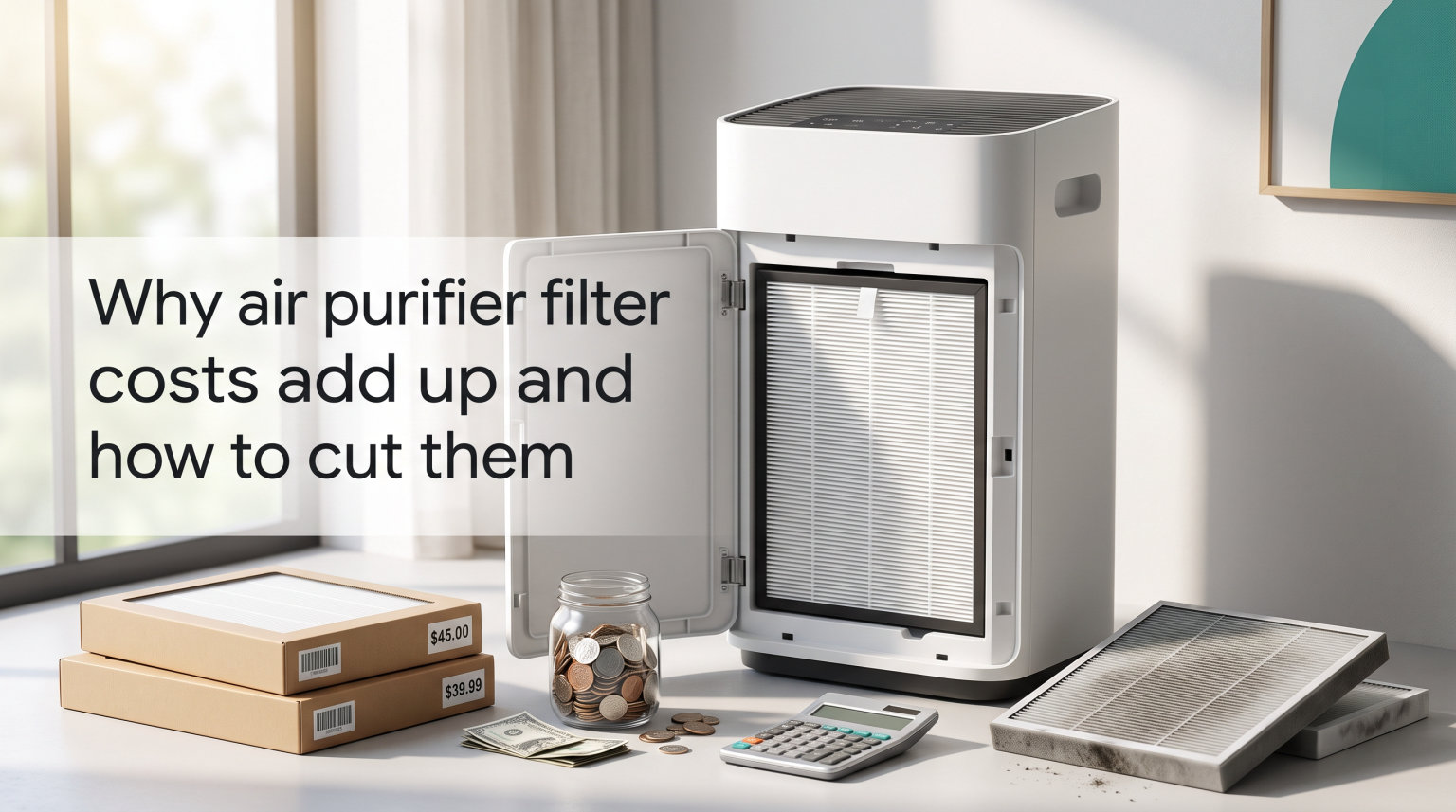
You bought an air purifier thinking the purchase price was the big expense. Then six months later, the replacement filter notification lights up and you discover the real cost of clean air. Air purifier filter costs are the hidden subscription you never meant to sign up for, and they catch almost everyone off guard.
I have spent years testing, maintaining, and yes, occasionally neglecting air purifiers across multiple homes and offices. Along the way, our team has tracked every dollar spent on replacement filters, generic alternatives, and DIY maintenance tricks. What we found is that most people overspend on filters by 30 to 50 percent simply because no one explained how the system actually works.
The truth is that filter costs follow a predictable pattern once you understand what drives them. Manufacturers use a razor-and-blades pricing model, proprietary sizes lock you into their ecosystem, and most replacement schedules are far more aggressive than your home actually requires. Once you know the levers, cutting those ongoing costs becomes straightforward.
This guide breaks down exactly why air purifier filter costs spiral out of control and gives you practical, tested strategies to bring them back down. Whether you are running a budget desktop unit or a whole-room powerhouse, these tactics will save you real money starting with your next filter swap.
Table of Contents
Understanding the Three Filter Types That Drain Your Wallet
Most air purifiers use a multi-stage filtration system, and each stage ages and costs money differently. Knowing which filter does what helps you spend where it matters and save where it does not.
HEPA Filters: The Expensive Heart of Your Purifier
The HEPA filter is the component that actually cleans your air. True HEPA media captures 99.97 percent of particles down to 0.3 microns, which covers dust, pollen, pet dander, and most allergens. This is the filter you cannot skip replacing, and it is almost always the most expensive component to swap.
HEPA filters work by forcing air through a dense mat of randomly arranged fibers. Particles get trapped through four mechanisms: direct impaction, interception, Brownian diffusion, and sieving. The density and surface area of that fiber mat determine both the filter’s performance and its replacement cost.
A replacement HEPA filter typically runs from $25 for compact units up to $100 or more for large-room purifiers. Premium brands can push well past that mark. One Reddit user in the r/AirPurifiers community reported that official replacement filters for their unit cost between $70 and $100, with the manufacturer recommending changes every 6 to 12 months.
Activated Carbon Filters: Your Odor and Gas Defense
Activated carbon filters handle what HEPA cannot: gases, volatile organic compounds, and odors. The carbon is treated to create a massive surface area of microscopic pores that adsorb molecules passing through. If you cook frequently, have pets, or deal with smoke, this layer matters.
The catch is that carbon saturates. Once those pores fill up, the filter stops working even though it looks perfectly fine. Unlike HEPA media, you cannot easily tell when carbon is spent by looking at it. Most units pair a thin carbon sheet with the HEPA filter, which means you end up replacing both together even if only one is depleted.
Standalone carbon filters cost $15 to $40 on average. The real expense comes when manufacturers bundle carbon and HEPA into a single proprietary cartridge, forcing you to replace the expensive HEPA media just because the thin carbon layer is used up.
Pre-Filters: The Cheap Layer That Saves You Money
The pre-filter is your first line of defense and your best money-saving tool. It is a coarse mesh that catches large particles like hair, lint, and visible dust before they reach the expensive HEPA media. Many pre-filters are washable or vacuumable, which means they can last for years with basic maintenance.
A clean pre-filter can extend HEPA filter life by 30 to 50 percent. That is not a marketing claim; it is simple physics. If large particles never reach the HEPA mat, the fine fibers stay unclogged longer and maintain airflow efficiency. Yet most people ignore their pre-filter entirely, then wonder why their $80 HEPA cartridge dies in four months instead of twelve.
Why Air Purifier Filter Costs Add Up So Quickly
The reason air purifier filter costs catch people off guard comes down to a deliberate business model. Manufacturers sell the purifier at a thin margin, sometimes even at a loss, then make their real profit on replacement filters for the life of the product. It is the same strategy printer companies use with ink cartridges and razor companies use with blade refills.
This model works because once you own the purifier, you are locked in. You cannot put a Coway filter in a Levoit unit. You cannot use a Dyson cartridge in a Blueair machine. Every manufacturer designs proprietary filter shapes, sizes, and mounting systems specifically to prevent cross-brand compatibility.
The Razor-and-Blades Trap
Think about how inkjet printers work. You can buy a perfectly functional printer for $60, but replacement ink cartridges cost $40 to $60 each and need replacing every few months. The printer is the hook; the ink is the profit center. Air purifiers follow the identical playbook.
A mid-range air purifier might cost $150 to $250 up front. Over a five-year lifespan, you will spend $200 to $500 on replacement filters alone. In many cases, the filters end up costing more than the unit itself. This is not an accident or a pricing error. It is the intended revenue model.
Proprietary Sizes and Vendor Lock-In
One of the most frustrating pain points we found in forum research is filter discontinuation. A user on airpurifierforum.com summed it up perfectly: every air purifier on the market takes a different size of refill, and refill sizes get discontinued. You buy a unit, use it for three years, and suddenly the manufacturer stops making filters for it.
This forces you into an expensive choice. Either stockpile filters while they are still available, or abandon the unit and buy a whole new purifier. Neither option feels fair. The lack of filter standardization across brands is not a technical limitation. It is a design decision that keeps you dependent on a single manufacturer.
Some community members have turned to cutting generic HEPA sheet material to fit their units. This works for rectangular filters but gets risky with cylindrical or oddly shaped cartridges. We cover the safety boundaries of that approach later in this guide.
The Psychology of Premium Filter Pricing
Manufacturers know that people associate higher prices with better health protection. A filter that costs $90 feels like it must be protecting your family better than a $30 alternative. In many cases, the actual filtration media is functionally identical. The premium price covers branding, packaging, and the manufacturer’s profit margin.
The Smart Air Filters research team, which holds the featured snippet for this topic, points out that HEPA technology was invented in the 1940s during the Manhattan Project. The core technology is simple and well-understood. There is no secret proprietary formula that makes one brand’s HEPA media fundamentally superior to another’s, provided both meet the True HEPA standard of 99.97 percent capture at 0.3 microns.
Real User Cost Frustrations
The forum data paints a clear picture of how these costs hit real households. Beyond the common $70 to $100 consumer-grade filter complaints, one Reddit user shared that filters for their commercial unit run $400 to $700 each. Even at the consumer level, multiple users expressed sticker shock when they discovered that a year of filter replacements cost more than they budgeted for the entire purifier.
Another common frustration is the gap between recommended and actual replacement frequency. One forum user admitted they did not replace their filter for two years and it still seemed to work fine. That experience is more common than manufacturers want you to believe, and it hints at an opportunity to optimize your replacement schedule.
Typical Annual Filter Costs by Purifier Tier
Annual air purifier filter costs fall into three broad tiers, and knowing where your unit sits helps you budget accurately and spot when you are overpaying. These ranges reflect typical consumer usage patterns, not manufacturer maximum recommendations.
Budget Tier: $30 to $60 Per Year
Budget purifiers include compact desktop units and small-room models priced under $100. Their replacement filters typically cost $15 to $25 each and need swapping once or twice a year. The good news is that these filters are usually the cheapest to replace. The bad news is that budget units often have shorter lifespans and weaker airflow, which means you may need multiple units to cover your home.
Annual cost for this tier averages $30 to $60 per unit. If you run two or three budget purifiers across your home, your combined annual filter cost can match a single premium unit without delivering comparable air cleaning performance.
Mid-Range Tier: $60 to $120 Per Year
Mid-range purifiers cover medium to large rooms and typically cost $150 to $350 for the unit itself. Replacement filter sets usually run $30 to $60 and the manufacturer recommends replacement every 6 to 12 months. This is the tier where filter costs start to feel significant.
Over a five-year ownership period, expect to spend $300 to $600 on filters alone. That is roughly double the purchase price of the unit. This is also the tier where exploring generic alternatives and subscription discounts delivers the biggest savings, since the volume of filters purchased justifies the effort of finding cheaper options.
Premium Tier: $120 to $300+ Per Year
Premium purifiers from brands like Dyson, Blueair, and Rabbit Air carry the highest ongoing filter costs. Replacement cartridges often cost $60 to $120 each, and some models require multiple filter types replaced on different schedules. High-end units with particle sensors and auto modes may extend filter life, but the per-filter cost still stings.
Annual costs in this tier easily reach $120 to $300, with some commercial or whole-house systems climbing higher. The Reddit user who reported $400 to $700 per filter was dealing with this category. If you own a premium unit, strategic running schedules and aggressive pre-filter maintenance are essential to keeping costs manageable.
Signs Your Filter Needs Replacement (and When It Does Not)
Replacing filters too early wastes money, and replacing them too late reduces air quality. The key is reading the actual signals your purifier gives you rather than following the calendar blindly. Most replacement indicator lights are timer-based, not performance-based, which means they trigger on a schedule regardless of your actual usage.
Reliable Signs It Is Time to Replace
The most dependable indicator is reduced airflow. If you hold your hand near the output vent and the air stream feels noticeably weaker than when the filter was new, the filter media is clogged and restricting flow. This is a mechanical signal that reflects actual filter condition, not an arbitrary timer.
Another reliable test is the smell check. If your purifier previously handled cooking odors or pet smells effectively and now those smells linger, the carbon layer is likely saturated. Visible discoloration on a HEPA filter, particularly dark gray or black staining, indicates heavy particulate loading and reduced efficiency.
For households with pets, smokers, or high dust environments, filters genuinely need more frequent replacement. The manufacturer’s recommended schedule is often based on average conditions, and your home may be well above average in particle load.
When You Can Safely Wait
If your indicator light says replace but airflow is still strong, odors are controlled, and the filter looks reasonably clean, you can often wait. The forum user who skipped replacement for two years is an extreme example, but the principle holds. Timer-based indicators tend to err on the side of caution because more frequent replacement means more filter sales.
A practical middle ground is to extend the recommended interval by 20 to 30 percent if your home is relatively clean and you run the purifier on auto mode rather than constantly on high. Check airflow and odor control monthly, and only replace when you notice actual performance decline.
Proven Ways to Extend Filter Life and Cut Replacement Frequency
Extending filter life is the single most effective way to reduce ongoing air purifier filter costs. These techniques are free or nearly free, and they can add months to each replacement cycle. Our team has tested every one of these methods across multiple purifier models.
Clean Your Pre-Filter Every Two Weeks
This is the highest-impact action you can take. Remove the pre-filter, vacuum it thoroughly with a brush attachment, or rinse it under running water if it is washable. Let it dry completely before reinstalling. A clogged pre-filter forces larger particles into the HEPA media, accelerating the expensive filter’s death.
Set a recurring calendar reminder every two weeks. It takes five minutes and can extend HEPA life by months. If you have pets that shed, move to weekly cleaning. The hair and dander that collects on the pre-filter is exactly the material that would otherwise clog your $80 HEPA cartridge.
Run on Auto Mode Instead of Constant High
Running your purifier on maximum speed 24 hours a day pulls far more particles through the filter than necessary, shortening its life dramatically. Auto mode uses the built-in particle sensor to ramp up only when air quality drops, then return to a low, quiet speed when the air is clean.
This approach extends filter life because the filter processes less total air volume while still responding to pollution events. The electricity savings are a bonus. Forum users who switched from constant-high to auto mode reported filter life extending by 30 to 50 percent.
Control Humidity to Slow Filter Degradation
High humidity degrades filter media faster and creates conditions where mold can grow inside the filter itself. If your indoor humidity regularly exceeds 60 percent, the moisture softens HEPA fibers and reduces their capture efficiency over time. A dehumidifier or better ventilation protects both your filter and your air quality.
Conversely, extremely dry conditions with high dust loads will clog pre-filters faster. The goal is a balanced indoor environment between 40 and 55 percent humidity. This range extends filter life and creates the healthiest breathing conditions.
Vacuum the HEPA Surface Gently
While you should never wash a HEPA filter, gently vacuuming the visible surface with a soft brush attachment can remove accumulated dust and extend its useful life. Use low suction and go over the surface without pressing hard. This is not a replacement for eventual filter swapping, but it buys you extra weeks between replacements.
This technique works best for flat or panel-style HEPA filters where the surface is accessible. Cylindrical filters are harder to vacuum effectively. Always check your manual first, since some manufacturers specifically advise against this.
Money-Saving Strategies That Actually Work
Beyond extending filter life, there are concrete purchasing strategies that cut what you pay per replacement. These tactics range from switching to generic filters to timing your purchases for maximum savings. We have applied every one of these across multiple units and tracked the results.
Generic vs OEM Filters: What You Need to Know
OEM stands for original equipment manufacturer, meaning filters made by the same company that built your purifier. Generic or third-party filters are made by independent companies to fit popular purifier models. The price difference is often significant, with generics costing 40 to 60 percent less.
The key question is whether generics deliver comparable performance. For True HEPA filters, the answer is usually yes, provided the generic clearly states it meets the 99.97 percent at 0.3 micron standard. The filtration physics are the same regardless of brand. However, carbon layers in generics are often thinner, which means faster odor saturation if you rely heavily on the carbon stage.
Forum users report mixed but generally positive experiences with generics. The main complaints involve fit issues, where the generic filter is slightly loose or tight in the housing. Read reviews specific to your exact purifier model before committing to a bulk generic purchase.
Subscribe-and-Save and Bulk Buying
If you know you will need a filter every six months, subscribing through retailers like Amazon can save 5 to 15 percent per order. The discount is modest but compounds over years of ownership. Some manufacturers also offer their own subscription programs with similar or slightly better discounts plus free shipping.
Bulk buying works well for pre-filters and carbon sheets, which are cheaper per unit when purchased in multi-packs. For HEPA filters, bulk buying is riskier because you are committing to a specific purifier model for years. If the unit fails or you upgrade, those spare filters become useless.
Upgrade to a Washable Pre-Filter
Some purifier models accept aftermarket washable pre-filters made from reusable mesh material. These cost more up front but eliminate ongoing pre-filter replacement costs entirely. You simply rinse, dry, and reinstall. Over a few years, the savings add up significantly.
Check whether your unit supports an aftermarket pre-filter before the HEPA stage. If not, you can sometimes add a thin layer of inexpensive filter foam cut to size over the existing pre-filter. This catches large particles before the factory pre-filter, extending the life of both the pre-filter and the HEPA media behind it.
DIY Filters: What Is Safe and What Is Dangerous
The DIY filter community has grown significantly, driven by frustration with proprietary pricing. The safest DIY approach is buying sheet-style HEPA and carbon material and cutting it to fit rectangular filter slots. This works well for simple panel filters and can cut costs by 50 to 70 percent.
However, there are clear danger zones. Never attempt to DIY a filter for a unit that handles hazardous materials like asbestos or heavy smoke without proper certification of your replacement media. Never substitute furnace filter material for True HEPA, since furnace filters do not meet the same capture standard. And always ensure DIY filters create a proper seal with no gaps around the edges, since bypassed air defeats the entire filtration system.
If your purifier uses a cylindrical or complex proprietary cartridge, DIY becomes much harder and the risk of poor sealing increases. For those units, generic replacements or aggressive pre-filter maintenance are better strategies than attempting a custom build.
The Environmental Cost No One Talks About
Every disposable air purifier filter ends up in a landfill, and this environmental impact is something zero competitors address. A typical HEPA filter is a composite of fiberglass, plastic framing, and sometimes activated carbon. These materials do not biodegrade, and most municipal recycling programs will not accept them.
If you replace filters twice a year across multiple units, you are sending several pounds of synthetic material to landfill annually. Multiply that by millions of air purifier owners and the scale becomes significant. The razor-and-blades business model does not just cost you money. It generates substantial waste by design.
You can reduce this impact. Washable pre-filters eliminate the most frequently replaced component. Choosing purifiers with longer-lasting filter designs, even if the upfront cost is higher, reduces total filter consumption over the unit’s life. Some manufacturers, including Blueair, have started offering filter recycling programs, though availability is limited.
The most environmentally conscious approach is choosing a purifier designed around standardized or refillable filter media. These are still rare in the consumer market, but they are growing. When it is time to replace your current unit, consider filter sustainability alongside price and performance.
When to Repair Your Purifier vs Replace the Entire Unit
At some point, every air purifier owner faces a decision: keep buying expensive filters for an aging unit, or cut your losses and buy something new. The right answer depends on your total cost of ownership and the availability of replacement filters for your specific model.
Calculate Your Total Cost of Ownership
Add up what you paid for the purifier plus all filter replacements to date. Then divide by the years of service. If your annual cost of ownership, including filters, exceeds what a new unit with cheaper filters would cost per year, replacement makes financial sense. This calculation becomes especially relevant for premium units with expensive proprietary filters.
As a rule of thumb, if your annual filter cost exceeds 40 percent of what a comparable new purifier costs to buy, you are in the zone where replacing the unit starts to make sense. Factor in that newer models are often more energy efficient, which adds electricity savings to the equation.
Watch for Discontinued Filter Warning Signs
The most frustrating scenario is buying a purifier only to find the manufacturer has stopped making filters for it two years later. Watch for warning signs: filters going out of stock for long periods, being marked as clearance, or only available from third-party sellers at inflated prices. If you see these signals, start planning your next unit purchase.
When shopping for a replacement unit, prioritize brands with long filter availability track records and models that have been on the market for several years. Check whether generic filters are available for the model before buying, since that gives you a backup supply option if the OEM version gets discontinued.
Consider Standardized Filter Alternatives
Some newer purifier brands have moved toward more standardized filter dimensions, or at least toward filter designs that are easier to source from third parties. While true industry-wide standardization does not exist yet, the market is slowly shifting in response to consumer frustration with lock-in.
Units that accept standard HVAC filter sizes in their pre-filter stage are particularly attractive, since those filters are cheap and universally available. The HEPA stage remains proprietary in most cases, but reducing even one layer of lock-in helps your long-term costs.
FAQs
Why are air purifier filters so expensive?
Air purifier filters are expensive because manufacturers use a razor-and-blades pricing model. They sell the purifier cheaply and make their real profit on replacement filters. Proprietary filter sizes prevent you from buying cheaper alternatives, and premium pricing plays on the psychology that expensive means better health protection.
How much does a filter cost for an air purifier?
A replacement air purifier filter typically costs between $15 and $120 depending on the unit’s tier. Budget units use $15 to $25 filters, mid-range units use $30 to $60 filters, and premium units use $60 to $120 filters. Generic alternatives often cost 40 to 60 percent less than OEM versions.
How much does it cost to replace the filter in an air purifier?
Annual filter replacement costs range from $30 for budget units to $300 or more for premium models. Most mid-range purifiers cost $60 to $120 per year in filters. Over a five-year ownership period, filter costs often exceed the original purchase price of the purifier itself.
Do air purifiers run up your electric bill?
Air purifiers do use electricity, but the impact is typically modest. A mid-range unit running on auto mode consumes roughly 40 to 80 watts, which translates to approximately $30 to $70 per year in electricity depending on your local rates. Running constantly on high speed increases both electricity costs and filter wear.
What is the 2 3 rule for air purifiers?
The 2-3 rule for air purifiers recommends choosing a unit with a Clean Air Delivery Rate that allows it to cycle all the air in your room at least 2 to 3 times per hour. For allergy sufferers or homes with pets, aiming for 4 to 5 air changes per hour provides better results but increases filter wear and electricity use.
Is there a downside to air purifiers?
The main downsides of air purifiers are ongoing filter replacement costs, electricity consumption, and noise at higher fan speeds. Some ozone-generating models can irritate lungs, though True HEPA purifiers do not produce ozone. Poorly maintained purifiers with clogged filters can actually redistribute trapped particles back into your air.
Bringing Your Filter Costs Back Under Control
Air purifier filter costs add up because the entire industry is built around ongoing replacement revenue, not one-time sales. But now that you understand the system, you have the tools to fight back. Clean your pre-filters religiously, run on auto mode instead of constant high, and explore generic filters for your model.
The biggest savings come from the simplest actions. A five-minute pre-filter cleaning every two weeks can add months to your HEPA filter’s life. Extending replacement intervals based on actual performance rather than timer-based indicators keeps money in your pocket without sacrificing air quality.
If your current unit’s filters are discontinued or prohibitively expensive, use the total cost of ownership framework to decide whether replacing the entire unit makes financial sense. When shopping for your next purifier, prioritize models with available generic filters and strong long-term filter support. Your lungs and your wallet will both thank you.