
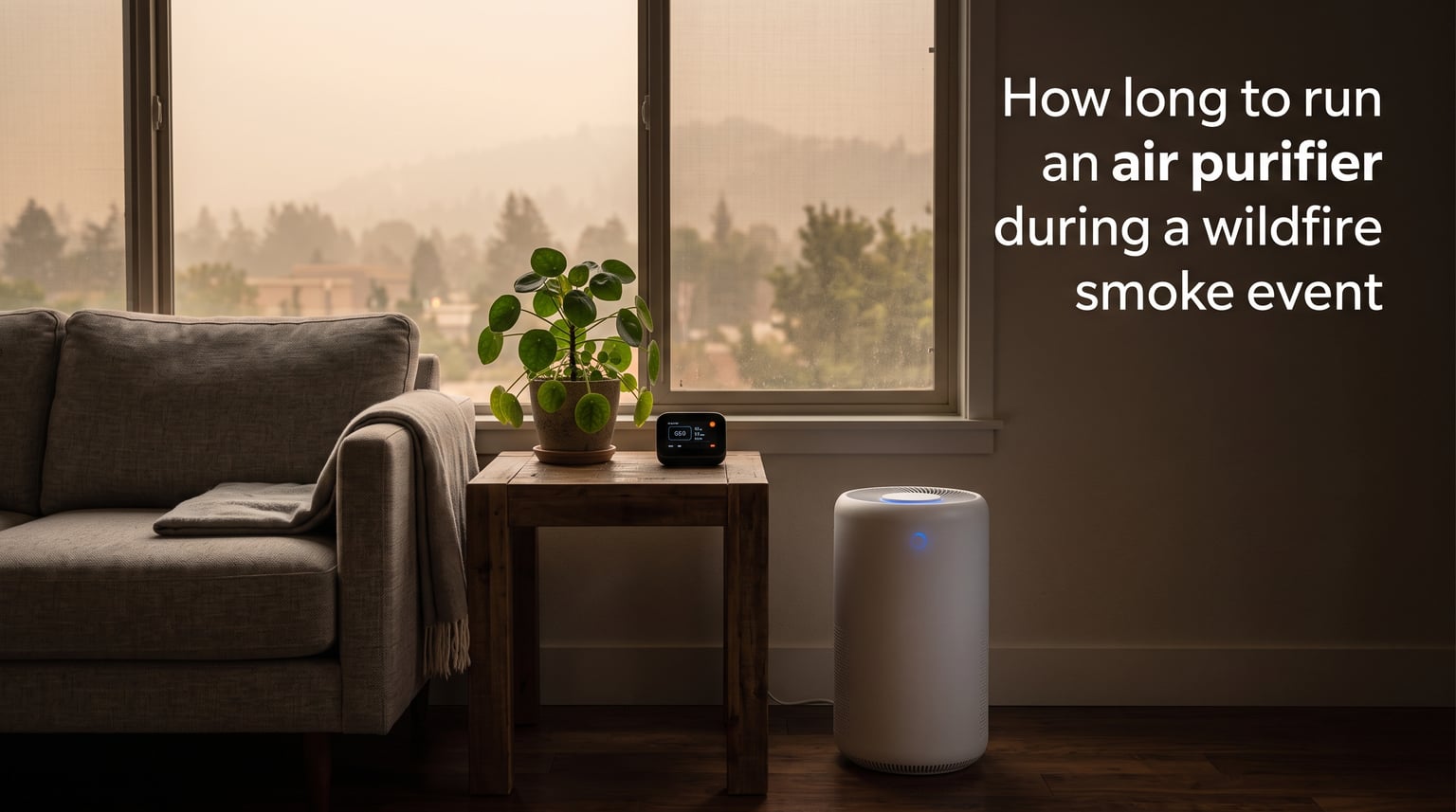
Run an appropriately sized air purifier continuously, 24 hours a day, during a wildfire smoke event. Keep it on while smoke is affecting your area, then continue until outdoor conditions improve and the indoor air in your home has had time to clear.
That is the short answer to how long to run an air purifier during a wildfire smoke event: not for a few hours, and not only when you can smell smoke. Wildfire smoke particles can keep leaking indoors through small gaps, doors, and normal household activity, so stopping the purifier lets particles build back up.
The goal is to lower your exposure to PM2.5, the tiny particles in smoke that can reach deep into the lungs. An air purifier does not make an unsafe building safe in every circumstance, and it does not replace evacuation orders, but continuous air purification is a practical way to improve one room or home when staying indoors is appropriate.
EPA and AirNow guidance puts the wider plan first: watch the Air Quality Index, close windows and doors when smoke is outside, reduce particle-making activities indoors, and create a cleaner-air room if you can. This guide explains the runtime recommendation, the settings that make it useful, filter checks, HVAC support, and what to do after the smoke passes.
Quick answer: Run the purifier 24/7 at a fan setting that gives meaningful airflow for the room. Use its highest tolerable speed while smoke is heavy, and do not turn it off just because the room briefly smells better.
Table of Contents
Run an air purifier continuously throughout a wildfire smoke event.
Continuous operation is the recommended approach because an air purifier cleans air only while room air is moving through it. The machine captures particles during each pass, while new smoke particles can still enter from outdoors or be stirred up from clothing, floors, and other surfaces.
Intermittent use creates a repeating cycle: particle levels fall while the unit runs, then climb again when it stops. Running it 24/7 gives the room repeated filtering cycles and keeps the concentration lower over the full day and night.
Use the highest fan speed that you can comfortably maintain during the worst smoke. A high setting moves more air through the filter per hour, though the sound can be disruptive in a bedroom or work area.
If noise makes the highest setting impractical overnight, choose the highest setting you can sleep with rather than shutting the unit off. A lower overnight setting still provides ongoing filtration, and you can return to high after you wake up.
Continue operating the purifier after the outdoor AQI improves if the home has been smoky. Indoor particles do not disappear the moment the outside reading changes, and opening windows too soon can bring in another dose of polluted air.
There is no universal number of extra hours because room leakage, the severity of the event, purifier airflow, and outdoor conditions differ. A sensible approach is to keep the unit running continuously for the duration of smoky conditions and maintain a lower everyday setting afterward if local air remains variable.
Warning: A purifier is not a reason to ignore public-health instructions. If officials advise evacuation, sheltering elsewhere, or seeking medical care for smoke symptoms, follow that direction rather than relying on indoor filtration alone.
Use the AQI to intensify your response, not to schedule purifier breaks.
The Air Quality Index, or AQI, translates pollution measurements into categories that are easier to act on. Check a current local reading through AirNow or your local public-health authority, because a regional smoke map may not match the air at your address.
For wildfire smoke, the particle reading is often the key one to watch. Higher AQI means the outdoor source is stronger, so reducing indoor entry and running air cleaning continuously becomes more important.
Keep the purifier running at lower AQI levels when smoke is present.
When AQI is in the Moderate range, sensitive people may still notice symptoms, especially if the smoke is new or nearby. Close windows if there is a noticeable smoke odor or a local advisory, run the air purifier continuously in the room you use most, and watch for changes through the day.
An AQI that looks moderate outdoors does not automatically mean your indoor air is clean. A home near traffic, a leaky older building, or a home that has recently had doors open can have a different indoor particle level.
Run high airflow and limit outdoor-air entry at unhealthy AQI levels.
When AQI reaches the Unhealthy for Sensitive Groups range or worse, use a higher fan setting, keep exterior doors and windows shut as much as possible, and spend more time in the room being filtered. Children, older adults, pregnant people, and people with heart or lung conditions have particular reason to reduce smoke exposure.
Pause activities that add particles indoors, including burning candles or incense, frying, broiling, vacuuming without high-efficiency filtration, and smoking. The purifier has a better chance of lowering smoke levels when it is not also trying to catch a new indoor particle source.
Make one clean room the priority at very high or hazardous AQI levels.
During very unhealthy or hazardous conditions, trying to clean every room at once can spread limited airflow too thin. Pick a bedroom, living room, or other space where people can spend many hours, close its door if practical, and keep the purifier running there continuously.
Bring water, medication, chargers, quiet activities, and pet supplies into that room before settling in. Each trip through an exterior door can add polluted air, so a little preparation reduces unnecessary exposure.
AQI action guide: Treat the purifier as a 24/7 device whenever wildfire smoke affects your area. As AQI climbs, increase fan speed, tighten the home against outdoor air, focus on a clean room, and cut indoor particle sources rather than turning the purifier on and off by the clock.
Set up the purifier in the room where you spend the most time.
Placement and room choice determine whether continuous runtime produces a noticeable benefit. A powerful unit in an empty hallway does less for you than a correctly sized unit working in the bedroom where you sleep or the living room where the family gathers.
Start with one room rather than moving the purifier from room to room every few hours. A stable location lets the unit repeatedly filter the same volume of air instead of repeatedly starting over in a new space.
Place the air purifier where its intake and outlet can breathe.
Set the unit on a firm, level surface with clearance around its intake and outlet according to its manual. Do not wedge it behind a sofa, press it against drapes, or cover it with laundry, because blocked airflow lowers the amount of air it can clean.
Keep it away from open windows and exterior doors during a smoke event. Putting it directly beside the main leak point asks it to fight a constant concentrated stream of outdoor air instead of mixing and cleaning the room.
A central position is often useful, but it is not a rigid rule. In a bedroom, the best practical location may be several feet from the bed with the outlet aimed into open room air and without a cord creating a trip hazard.
Match the fan setting to smoke severity and real-life noise limits.
Set the fan to high during the heaviest smoke period, after a door has been opened repeatedly, or when you are first cleaning a room. Once the room has been running for a while, reduce the speed only if noise or sleep makes it necessary.
Auto mode can be convenient, but do not assume it detects every smoke condition accurately. Some sensors react slowly, respond mainly to large particles, or may not reflect air across the entire room, so manually selecting a higher setting during an active smoke event is reasonable.
Do not use a scented plug-in, fragrance spray, or candle to cover the smoke odor. Smell is not a reliable measure of PM2.5, and adding fragrances or combustion particles gives the air cleaner another burden.
Keep doors and windows closed while the purifier cleans the room.
Close exterior windows and doors, including a pet door that does not seal well. If the home becomes too warm because air conditioning is unavailable, use local public-health guidance to balance heat risk against smoke risk; heat illness can also be serious.
Interior doors are a tradeoff. Closing the door of a chosen clean room reduces the amount of smoky air the purifier must handle, while leaving it open may help share cleaner air but usually slows the improvement in the protected room.
Do not run window fans that pull smoky outdoor air inside. If a whole-house system has an outdoor-air intake, learn how its controls work before changing settings, and use qualified HVAC advice if you are unsure.
Run the purifier overnight because sleep is a long exposure period.
Nighttime is not a safe time to pause filtration just because household activity is lower. You may spend seven or more hours in the bedroom, which makes it one of the best rooms to protect during an air quality wildfire advisory.
Use a quieter speed if needed, position the unit so the airflow and noise are tolerable, and keep bedroom windows shut while smoke is present. If one purifier must serve multiple people, protecting the bedroom of the person at greatest health risk is often the strongest first choice.
Step-by-step setup: 1. Choose the room used most. 2. Close exterior openings. 3. Give the purifier unobstructed clearance. 4. Start it on high during heavy smoke. 5. Keep it on overnight at the highest comfortable setting. 6. Reduce indoor sources of particles.
Choose a HEPA filter and enough airflow for the room.
A HEPA filter is the preferred filter type for particle pollution from wildfire smoke because it is designed to capture very small airborne particles. Wildfire smoke also contains gases and odors, which particle filtration alone cannot fully remove.
A carbon or other gas-phase filter may help reduce some odors and gases, but its effect depends on the amount and type of sorbent material. Do not judge smoke protection by odor alone, because the dangerous fine-particle portion of smoke can remain even when the smell is faint.
Airflow matters as much as filter media. A purifier must move enough clean air for the size of the room, and the useful specification for comparing particle cleaning performance is commonly called CADR, or clean air delivery rate.
Check the manufacturer’s room-size guidance and remember that those figures can depend on a selected fan speed or a target number of air changes per hour. A larger room, high ceilings, an open floor plan, or a leaky home may need more airflow than a simple coverage label suggests.
More air changes per hour means the purifier processes the room’s air more often. During a smoke event, a unit that can make several meaningful cleaning passes in the room each hour will generally bring particle levels down faster than one sized only for quiet, low-speed everyday use.
Avoid devices that intentionally produce ozone. Ozone is a lung irritant, and a device that creates it is not an appropriate substitute for particle filtration during wildfire smoke.
What PM2.5 means: PM2.5 refers to particles 2.5 micrometers wide or smaller. They are small enough to remain airborne for long periods and are a central health concern in wildfire smoke.
Check filters by condition during smoke, not only by the calendar.
Heavy smoke can load a purifier filter much faster than ordinary household dust. EPA guidance advises replacing air-cleaner and HVAC filters more often than the usual manufacturer schedule during periods of heavy smoke.
There is no fixed two-week rule that fits every filter and every event. Community reports of visibly dirty filters after about two weeks show why an inspection matters, but the right interval depends on smoke severity, runtime, household dust, purifier airflow, and the filter design.
Inspect the prefilter and follow the unit’s replacement indicator.
If your unit has a washable or vacuumable prefilter and its manual permits cleaning, check it more often during a smoke event. Removing accumulated large dust from a serviceable prefilter can preserve airflow to the main particle filter.
Use the filter indicator as a prompt, not as the sole decision-maker. An indicator may be based on runtime rather than actual smoke loading, so a filter can need attention earlier during unusually heavy conditions.
Signs that a replacement may be due include a persistent filter alert, clearly reduced airflow despite the same setting, a filter that is visibly loaded according to the manufacturer’s instructions, or a schedule that the manufacturer says has been reached. Never wash or vacuum a HEPA filter unless the maker specifically identifies that exact filter as washable.
Replace and dispose of smoke-loaded filters with care.
Turn the unit off and unplug it before opening the filter compartment. Follow the manual, avoid shaking the old filter, place it directly into a bag if practical, seal the bag, and wash your hands afterward.
Do not delay a needed replacement merely because the filter does not look uniformly dark. Fine particles can change performance without creating a dramatic visual change, and some filter media are designed to look different from ordinary white pleated filters.
Keep a compatible spare filter before wildfire season if that is feasible for your household. This is especially helpful during extended regional smoke events, when stores may run short or delivery may be delayed.
Warning: Do not operate an air purifier with a filter removed, damaged, or installed backward. Bypass gaps and incorrect installation can sharply reduce the particle-cleaning benefit.
Use HVAC recirculation and a clean room to support the purifier.
An air purifier works best as part of a broader indoor-air plan. Your heating and cooling system, building leaks, cooking habits, and the choice of one protected room all affect the particles you breathe.
Use recirculation when your HVAC system and local guidance support it.
Many homes can reduce smoke entry by setting central air conditioning to recirculate rather than bringing in outdoor air. Controls vary widely, so review your system manual or ask an HVAC professional rather than guessing which setting changes the outdoor-air intake.
A MERV 13 air filter can capture more fine particles than a standard low-efficiency HVAC filter, but only use a filter rating that your system can accommodate. A filter that is too restrictive for the equipment can reduce airflow or create equipment problems.
Replace an HVAC filter sooner during sustained smoke if it is loaded or if the system manufacturer’s instructions call for it. A clean central filter and a portable HEPA unit can work together: the HVAC system treats air moving through the home while the portable unit concentrates cleaning in an occupied room.
Build a clean room when smoke is persistent or severe.
A clean room is simply a room set up to have less smoke than the rest of the home. Choose one with few exterior openings, a door that closes, enough space for the people and pets who need it, and an outlet for the purifier.
Close the windows and exterior doors, run the purifier continuously, and bring essentials inside so you do not need to come and go. Keep the room free of smoke-producing activities such as candles, frying, and smoking.
If there are several people in the household, decide in advance who gets priority access during overnight hours or serious air-quality alerts. A clean room can be particularly helpful for a child, an older adult, a pregnant person, or someone with asthma, COPD, heart disease, or another condition affected by smoke.
Use a particle monitor if you already have one and know how to interpret it, but do not wait for one before taking basic protective steps. The absence of a monitor is not a reason to leave windows open during a visible or officially reported smoke event.
Reduce indoor particle sources while the smoke is outside.
Skip frying, broiling, burning food, candles, incense, fireplaces, and tobacco smoke during the event. Use a microwave, slow cooker, or other lower-particle cooking approach when available, and run a kitchen exhaust fan only if you know it does not draw in substantial outdoor smoke.
Postpone activities that stir dust, including aggressive sweeping and many vacuuming tasks. If cleaning cannot wait, damp-wipe hard surfaces or use a vacuum with suitable high-efficiency filtration and keep the air purifier running.
These choices do not replace filtration, but they keep the particle level from rising faster than the purifier can lower it. The combination is more effective than treating the purifier as the only defense.
Clean-room checklist: Select one room, seal exterior openings, run a correctly sized HEPA purifier 24/7, use recirculation if appropriate for the HVAC system, avoid particle-producing activities, and keep essentials inside.
Use a DIY air cleaner only as a carefully built supplement.
A DIY air cleaner can be helpful when you need extra particle cleaning and a commercial purifier is unavailable, but it must be built and used safely. EPA materials discuss DIY air cleaners as a temporary option, not as a reason to ignore evacuation or medical advice.
A common design uses a box fan with compatible filters arranged to increase filter surface area. Follow current safety guidance from a public-health agency or the fan manufacturer, use a modern fan with a fused plug, place it on a stable surface, and never leave a damaged or overheating setup unattended.
Do not attach anything that blocks the fan motor or creates a fire hazard, and keep children and pets away from the blades. A DIY unit may supplement the clean room, but a properly sized HEPA air purifier remains the simpler choice for continuous indoor smoke filtration.
These common wildfire-smoke questions have short, practical answers.
Do air purifiers work with wildfire smoke?
Yes. A properly sized purifier with particle filtration, ideally HEPA, can reduce airborne fine-particle pollution in the room where it runs. It works best when windows and exterior doors are closed, indoor particle sources are minimized, and the unit runs continuously during the smoke event.
What is the 2-3 rule for air purifiers?
The phrase is used inconsistently, so do not treat it as a wildfire-smoke standard. Some people use it to mean allowing a purifier two to three hours to improve a room or aiming for several air changes per hour, but the real time depends on room size, purifier airflow, fan speed, and how much outdoor smoke is entering. During wildfire smoke, run the unit continuously rather than stopping after a set number of hours.
How many hours per day should you run an air purifier?
During a wildfire smoke event, run it 24 hours a day. Continuous operation keeps filtering particles that seep indoors and helps prevent concentrations from rebuilding when outdoor air remains smoky. Use the highest fan speed you can tolerate during heavy smoke and a quieter continuous setting overnight if needed.
How long does smoke stay in the air after a forest fire?
Smoke can remain for hours, days, or longer depending on the fire, weather, wind, and local geography. Outdoor conditions can change quickly, while particles already inside can linger until filtered or ventilated out when it is safe to open windows. Follow local AQI reporting instead of relying on a fixed timeline.
Keep the air purifier on 24/7 while wildfire smoke affects your home.
How long to run an air purifier during a wildfire smoke event comes down to one practical rule: run it continuously, focus it on the room where you spend the most time, and pair it with closed windows, fewer indoor particles, and HVAC recirculation where appropriate.
Use high airflow when smoke is heavy, keep a spare filter available, inspect filters sooner than usual, and make a clean room if conditions persist. Check local AQI reports, follow public-health directions, and keep the purifier running until the smoke situation and your indoor air have genuinely improved.