
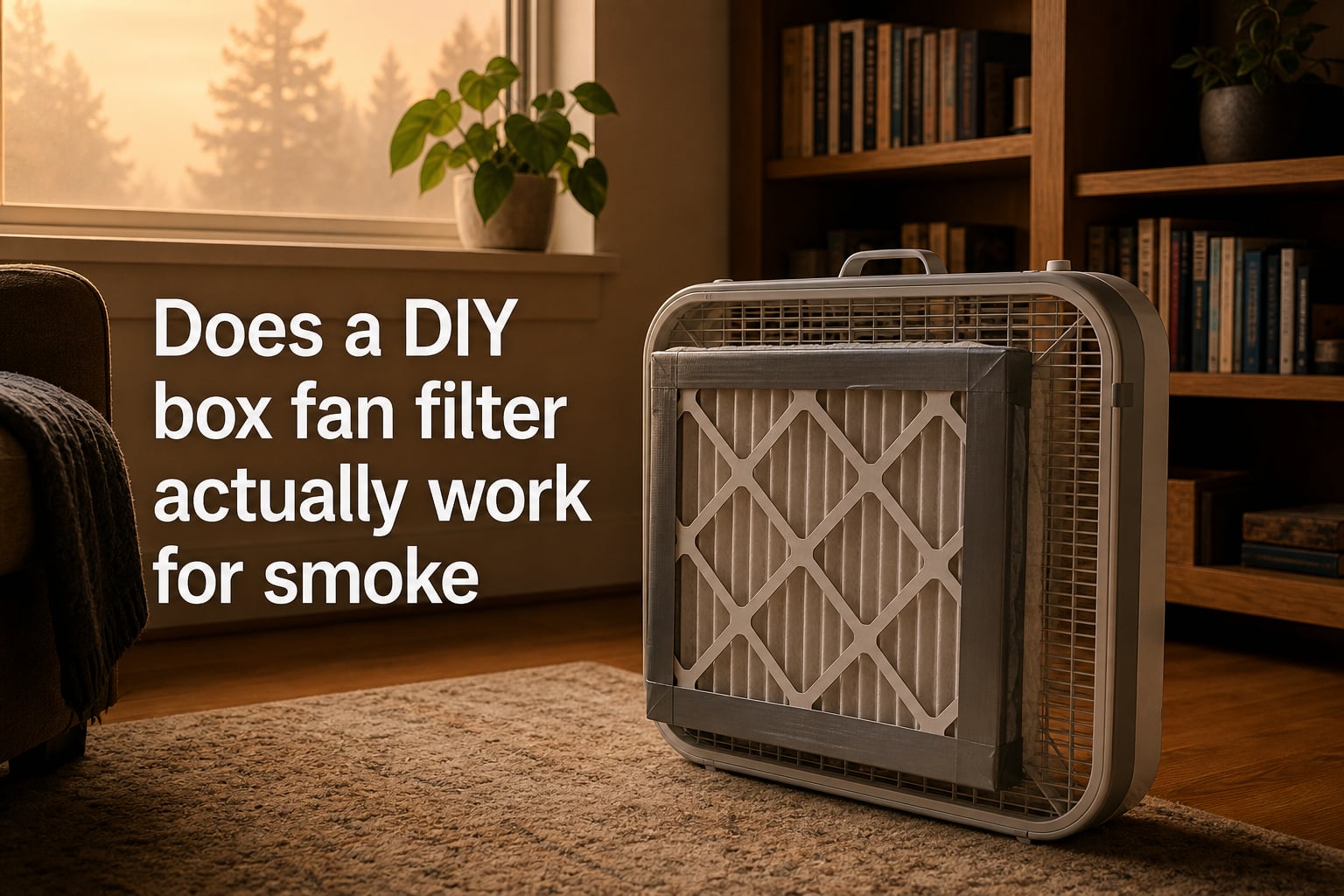
Yes, a DIY box fan filter actually works for smoke. EPA research published in 2026 confirms that attaching a MERV 13 furnace filter to a box fan can reduce smoke particle concentrations by up to 90% indoors. The agency’s field studies show these homemade air cleaners perform almost as well as commercial units costing ten times more.
This matters because wildfire smoke events are increasing in frequency and intensity across North America. When smoke fills the air outside, you need an affordable way to protect your indoor air quality. A DIY box fan filter smoke solution costs roughly $30-50 to build compared to $200-500 for a commercial air purifier with similar capacity.
In this guide, I’ll explain exactly how these filters work, what the science says about their effectiveness, and how to build one safely. I’ll also cover the limitations so you know what to expect from a homemade solution.
Table of Contents
What Is a DIY Box Fan Filter?
A DIY box fan filter is a homemade air purifier built from two main components: a standard 20-inch box fan and a high-efficiency furnace filter (MERV 13 or higher). You attach the filter to the back of the fan using tape, brackets, or cardboard, creating a simple device that pulls air through the filter media and captures airborne particles.
This concept gained widespread attention during the COVID-19 pandemic when researchers Richard Corsi and Jim Rosenthal developed what’s now called the Corsi-Rosenthal box. Their design uses four or five filters arranged in a cube around a box fan, dramatically increasing the filter surface area and improving airflow compared to a single-filter setup.
Unlike commercial air purifiers with sealed housings and variable speed motors, a box fan air filter relies on the fan’s existing motor and blade design. The filter media does the actual cleaning work. This simplicity is both the strength and the limitation of the approach.
Does a DIY Box Fan Filter Actually Work for Smoke?
Yes, a DIY box fan filter works effectively for wildfire smoke. Multiple studies, including peer-reviewed research from the EPA’s Office of Research and Development, confirm that these devices significantly reduce indoor smoke concentrations. The key is using the right filter rating and understanding what you’re measuring.
EPA researchers tested various DIY air cleaner designs in controlled laboratory conditions and published their findings in 2026. The results showed that a single-filter box fan setup achieved a Clean Air Delivery Rate (CADR) of approximately 100-150 cubic feet per minute for smoke particles. The Corsi-Rosenthal box with four filters reached CADR values of 300-500, comparable to commercial HEPA air purifiers rated for large rooms.
Field studies tell a similar story. The EPA’s ASPIRE-Health study tested DIY air cleaners in real homes during actual wildfire smoke events. Researchers found that running a properly built box fan filter reduced PM2.5 concentrations by 70-90% compared to rooms without air cleaning. Participants reported noticing improved air quality within 30-60 minutes of turning on the device.
Real-world effectiveness depends on several factors:
Filter rating (MERV 13 minimum, MERV 14-16 better)
Room size relative to CADR
How well windows and doors are sealed
Duration of operation
Filter condition (clogged filters reduce effectiveness)
User experiences from forums like Reddit’s r/AirPurifiers and r/AirQuality consistently match the research. People who built these devices during wildfire season report that air quality improved noticeably, with some saying their homemade units performed “as well as expensive purifiers” they had used previously. The Corsi-Rosenthal box design earned particular praise for handling heavy smoke loads.
The Science: How Box Fan Filters Remove Smoke Particles
Box fan filters work through mechanical filtration. As the fan blades spin, they create negative pressure that pulls room air through the attached filter media. The filter contains layers of synthetic fibers arranged in a dense matrix. Particles in the air stream collide with these fibers and become trapped through three primary mechanisms.
Interception occurs when particles follow air streamlines that pass close to filter fibers. Even though the particle doesn’t directly hit the fiber, it gets close enough to touch and stick. This mechanism is especially important for particles in the 0.1-1 micron range.
Impaction happens when larger particles cannot follow the curved air streamlines around fibers. Their momentum carries them straight into the fiber surface, where they adhere. This captures most particles larger than 1 micron.
Diffusion affects the smallest particles, those below 0.1 microns. These particles move erratically due to Brownian motion, randomly bumping into fibers and getting captured.
Wildfire smoke consists primarily of particulate matter in the PM2.5 range, meaning particles smaller than 2.5 microns in diameter. These particles are small enough to penetrate deep into your lungs and even enter your bloodstream. A MERV 13 filter captures at least 50% of particles in the 0.3-1.0 micron range and an even higher percentage of larger particles. This makes particulate matter filtration effective for typical smoke conditions.
Clean Air Delivery Rate (CADR) measures how quickly an air purifier delivers clean air to a room. You calculate it by multiplying the airflow rate through the filter by the filter’s efficiency. A box fan might move 1,000-2,000 cubic feet per minute on high speed, but the filter reduces this flow due to resistance. The remaining airflow, multiplied by the percentage of particles captured, gives you the CADR. Higher CADR means faster air cleaning.
MERV Rating Explained: Why MERV 13 Matters for Smoke
MERV stands for Minimum Efficiency Reporting Value, a standard developed by the American Society of Heating, Refrigerating and Air-Conditioning Engineers (ASHRAE). The rating scale runs from 1 to 16, with higher numbers indicating better particle capture. Understanding MERV rating explained helps you choose the right filter for smoke.
MERV ratings break down into these categories:
MERV 1-4: Captures less than 20% of particles 3-10 microns. Good for basic dust but ineffective for smoke.
MERV 5-8: Captures 20-70% of particles 3-10 microns. Better for dust and pollen but still inadequate for fine smoke particles.
MERV 9-12: Captures 50-89% of particles 1-3 microns. Starts becoming useful for smoke but not optimal.
MERV 13-16: Captures 50-95% or more of particles 0.3-1.0 microns. This is the range you need for effective smoke air filtration.
Why does MERV 13 matter specifically? It’s the minimum rating that effectively captures particles in the 0.3-1.0 micron range where most wildfire smoke falls. Lower-rated filters let too many fine particles pass through. A MERV 13 furnace filter provides the baseline protection you need without excessively restricting airflow.
You can go higher if available. MERV 14, 15, and 16 filters capture even smaller particles with higher efficiency. However, they create more resistance to airflow, which reduces how much air your box fan can move. This tradeoff between filtration efficiency and airflow rate affects the overall CADR. Some users report that MERV 14-16 filters work well with newer, more powerful fans, while older fans struggle to push air through the denser media.
What about HEPA filters? True HEPA filters must capture 99.97% of particles 0.3 microns in size, exceeding even MERV 16 performance. However, HEPA filters create so much resistance that a standard box fan cannot effectively pull air through them. This is why commercial air purifiers use specially designed fans with more powerful motors. For a DIY solution, MERV 13-16 is the practical range.
CADR Performance Data: What the Numbers Say
EPA research provides concrete air filtration CADR numbers for different DIY air cleaner designs. Understanding these figures helps you set realistic expectations and choose the right design for your space.
Here’s how the main designs compare for smoke particle CADR:
Single filter on box fan (basic): 100-150 CADR for smoke. Good for small rooms up to 150 square feet.
Single filter with cardboard shroud: 140-210 CADR for smoke. The shroud improves efficiency by preventing air from bypassing the filter edges.
Corsi-Rosenthal box (4 filters): 300-500 CADR for smoke. Handles rooms up to 500-700 square feet effectively.
Corsi-Rosenthal box (5 filters, cuboid design): 400-600 CADR for smoke. Maximum capacity for large spaces.
For comparison, a typical commercial HEPA air purifier rated for a large room might have a smoke CADR of 200-400. A high-end unit could reach 400-600 CADR. Notice that a well-built Corsi-Rosenthal box matches or exceeds these commercial units while costing a fraction of the price.
The cardboard shroud deserves special mention. EPA testing found that adding a simple cardboard frame around the filter edges, forcing all air through the filter rather than allowing it to slip around the sides, increased CADR by approximately 40%. This modification costs almost nothing but significantly improves performance.
What does CADR mean for your room? A rule of thumb from air quality experts suggests you want enough CADR to clean the entire room’s air volume about 5 times per hour during a smoke event. Calculate your room’s air volume by multiplying square footage by ceiling height (typically 8 feet), then multiply by 5 to get the needed hourly CADR. Divide by 60 to get CADR per minute.
For example, a 400 square foot room with 8-foot ceilings contains 3,200 cubic feet of air. Cleaning it 5 times per hour requires 16,000 cubic feet per hour, or about 267 CFM. A Corsi-Rosenthal box with 300+ CADR handles this easily. A single-filter design at 120 CADR would need about 2 hours to achieve the same air cleaning that the Corsi-Rosenthal box provides in under an hour.
How to Build a DIY Box Fan Filter: Step-by-Step
Building a basic box fan air filter requires minimal tools and about 15-30 minutes. I’ll walk you through two designs: the simple single-filter version and the more powerful Corsi-Rosenthal box.
Materials Needed (Basic Single-Filter Design)
20-inch box fan (must be manufactured 2012 or later)
20×20 inch MERV 13 (or higher) furnace filter
Duct tape or packing tape
Optional: Cardboard for shroud
Step-by-Step Instructions: Basic Single Filter
Step 1: Check your fan’s manufacture date. Look for a label or stamp on the fan housing showing when it was made. Fans built before 2012 may lack safety features like thermal fuses that prevent overheating when airflow is restricted. Use only 2012+ fans for this project.
Step 2: Identify the filter direction. Most furnace filters have an arrow printed on the side indicating airflow direction. This arrow should point in the direction air moves, which for a box fan means pointing toward the fan (the air intake side).
Step 3: Position the filter. Place the filter against the back of the box fan where air enters. The filter should cover the entire intake area without blocking the fan’s control buttons.
Step 4: Secure the filter. Use duct tape or packing tape to attach the filter edges to the fan housing. Apply tape around all four edges, pressing firmly to create a seal. Avoid covering too much of the filter surface with tape, as this reduces the effective filtering area.
Step 5: Add a cardboard shroud (optional but recommended). Cut strips of cardboard about 2-3 inches wide. Tape these around the outer edges of the filter, creating a frame that extends back toward the fan housing. This prevents air from sneaking around the filter edges and forces all air through the media, improving CADR by up to 40%.
Step 6: Test the airflow. Plug in the fan and run it on low speed first. Listen for any unusual sounds and check that air flows freely through the filter. If the fan strains or makes grinding noises, the filter may be too restrictive. Try a lower MERV rating or check that nothing blocks the intake.
Materials Needed (Corsi-Rosenthal Box)
20-inch box fan (2012 or later)
Four 20×20 inch MERV 13+ furnace filters (or five for cuboid design)
Duct tape
Cardboard (for the base)
Step-by-Step Instructions: Corsi-Rosenthal Box
Step 1: Arrange the filters in a cube. Stand four filters on their edges and arrange them in a square, creating a box shape. The filters should form walls around an empty center space. Make sure the airflow arrows on all filters point inward toward the center.
Step 2: Tape the filter seams. Use duct tape to seal the corners where filters meet. Run tape along both the inside and outside of each seam. This creates an airtight box with filters forming the walls.
Step 3: Create the base. Cut a piece of cardboard to sit on top of the filter cube, or place the entire assembly on a cardboard base. This closes the system so air can only enter through the filter walls.
Step 4: Mount the fan. Place the box fan on top of the filter cube, positioned to pull air up through the filters and out through the fan. The fan should sit with its intake facing down toward the filter cube opening.
Step 5: Secure the fan. Tape the fan to the filter assembly using generous amounts of duct tape. The fan needs to stay securely mounted while running. Some builders use straps or wooden frames for additional support.
Step 6: Test the complete assembly. Run the fan on low speed initially, then increase to higher speeds. The Corsi-Rosenthal box should move substantial air through all four filter walls. You can feel airflow by holding your hand near each filter surface.
Common Build Mistakes to Avoid
Wrong filter direction: Airflow arrows must point toward the fan intake. Backward filters don’t work properly and may shed filter fibers into the air.
Using pre-2012 fans: Older fans lack thermal protection and pose fire risk when airflow is restricted.
Taping over too much filter area: Keep tape on the edges only. Covering the filter surface reduces effectiveness.
Poor seals: Gaps around filter edges let air bypass the filter entirely. Test by holding a tissue near seams while the fan runs; it should not flutter from air leaks.
Running on high speed continuously: High speed creates more noise and uses more electricity. Medium or low speed often works well for sustained operation.
Safety Considerations: Are Box Fan Filters Safe?
The most common safety concern about DIY box fan filters involves fire risk. People worry that blocking airflow with a filter might cause the fan motor to overheat. This concern is legitimate for older fans but addressed by proper equipment selection.
Underwriters Laboratories (UL) conducted safety testing on box fan filters for the EPA study. They found that fans manufactured after 2012 include thermal fuses that shut off the motor if temperatures rise too high. This safety feature prevents fire even when airflow is partially blocked by a filter. The EPA explicitly recommends using only fans made in 2012 or later for this reason.
What happens if you use an older fan? Pre-2012 fans may lack thermal protection and can potentially overheat. However, the UL testing found that even when fans ran until failure (which took hours in extreme conditions), they did not ignite or create fire spread. Still, the risk is not zero, and using a modern fan eliminates it entirely.
Other safety considerations include:
Electrical safety: Keep fans away from water. Do not run them on wet surfaces or in bathrooms during showers.
Stability: Box fans can tip over. Place them on stable surfaces where they won’t fall, especially the taller Corsi-Rosenthal boxes.
Cord management: Avoid tripping hazards. Secure cords away from walkways.
Children and pets: Fan blades can cause injury. Consider a fan grille or placing the unit where curious hands cannot reach.
Continuous operation: Fans are designed for extended use, but check periodically for unusual sounds, smells, or heat.
Is it safe to leave a box fan filter running overnight? Yes, with the proper equipment. Use a 2012+ fan with thermal protection. Run it on low or medium speed to reduce noise and wear. Many people run their units continuously during multi-day smoke events without issues.
DIY Box Fan Filter vs Commercial Air Purifier
Comparing a DIY air purifier vs commercial air purifier reveals tradeoffs in several categories: cost, performance, noise, and convenience.
Cost: A basic single-filter box fan setup costs approximately $30-50 total (fan: $20-30, filter: $10-20). A Corsi-Rosenthal box runs $70-100 with four filters. Commercial air purifiers with equivalent CADR cost $150-400 or more. Replacement filters cost similar amounts for both (MERV 13 furnace filters vs HEPA cartridges), though commercial units may have longer filter life due to pre-filters.
Performance: A well-built Corsi-Rosenthal box matches or exceeds commercial HEPA purifiers in CADR. The EPA research found 300-500 CADR for smoke from the 4-filter design, comparable to commercial units rated for large rooms. Basic single-filter designs underperform commercial units but still provide meaningful air cleaning.
Noise: Box fans are louder than commercial air purifiers. A box fan on high speed produces 60-70 decibels, while a quality HEPA purifier might run 40-55 decibels on comparable speeds. This is a significant difference if you plan to run the unit continuously, especially overnight. Many users run box fan filters on low or medium speed, which reduces noise but also CADR.
Convenience: Commercial units offer features DIY solutions lack: variable speeds, air quality sensors, timers, remote controls, and compact designs. Box fan filters require manual control and lack smart features. However, their simplicity means fewer things to break.
When to choose DIY: You’re on a budget. You need multiple units for a large home or community space. You cannot find commercial purifiers during a wildfire emergency. You want a backup option.
When to choose commercial: Noise is a major concern (especially for bedrooms). You want convenience features. You have the budget. You need a compact, attractive unit for a living space.
Filter Maintenance and Replacement Guide
During active wildfire air quality events, filters load with particles quickly. Understanding when and how to replace them keeps your air cleaner working effectively.
How often should you change the filter? It depends on smoke intensity and runtime. In moderate smoke conditions (AQI 100-200), a filter might last 2-4 weeks of continuous use. In heavy smoke (AQI 200+), that drops to 1-2 weeks. Very heavy smoke (AQI 300+) can visibly load a filter in just a few days.
Signs your filter needs replacement:
Visible gray or black discoloration on the filter surface
Reduced airflow from the fan (you can feel less air movement)
Increased noise from the fan straining against resistance
Rising indoor particle counts if you have an air quality monitor
To extend filter life, some users add a pre-filter layer. A simple furnace filter (MERV 8-10) placed in front of the MERV 13 filter captures larger particles first, leaving the expensive high-efficiency filter for fine particles. This works especially well for dust-heavy environments. However, adding layers increases airflow resistance, so monitor performance.
Replacement filter costs vary. Standard 20×20 MERV 13 furnace filters typically cost $10-20 each at hardware stores. Buying in bulk during the off-season can reduce costs. Commercial HEPA cartridges cost $30-80 depending on the brand.
What about cleaning filters? Unfortunately, you cannot effectively clean MERV 13+ filters. The particles become embedded in the fiber matrix. Vacuuming the surface removes some dust but leaves most trapped particles in place. Once a filter is loaded, replacement is your only option.
Limitations: What Box Fan Filters Cannot Do
While effective for particle filtration, box fan filters have important limitations. Understanding these helps you set realistic expectations.
Gases and VOCs: Wildfire smoke contains gases alongside particles. Volatile organic compounds (VOCs), carbon monoxide, and other gases pass right through standard particulate filters. To capture gases, you need activated carbon or charcoal filtration, which standard furnace filters don’t provide. Some users add a thin carbon sheet layer, but this significantly increases airflow resistance and reduces CADR.
Odor removal: Smoke smell comes from both particles and gases. Your box fan filter removes the particulate component, which reduces odor significantly. However, the gaseous component causing lingering smells requires carbon filtration. Many users report that particle filtration alone reduces smoke smell by 70-80%, with the remaining odor dissipating over hours to days after smoke clears outside.
Room size limits: A single basic unit handles small rooms well. Large open floor plans or whole-house air cleaning requires multiple units. The Corsi-Rosenthal box performs better for large spaces but still has limits. Calculate your needed CADR based on room volume.
Noise: Box fans weren’t designed for continuous quiet operation. Running them 24/7 during a multi-day smoke event creates background noise that some find disruptive, especially for sleeping. Lower speeds help but reduce cleaning capacity.
Sealed environments: Your DIY filter only cleans air inside a relatively sealed room. If windows leak smoke or you constantly open doors, incoming smoke overwhelms the filter’s capacity. Creating a dedicated clean air room with windows and doors taped shut maximizes effectiveness.
Tips for Maximizing Effectiveness During Smoke Events
Building a box fan filter is just the first step. How you use it affects results significantly.
Create a clean air room: Choose one room in your home, ideally a bedroom, where you can maintain the cleanest air. Close windows and doors. Use weather stripping or tape to seal gaps. Run your air filter continuously. This gives you a space to retreat to when outdoor smoke is heaviest.
Supplement with HVAC: If you have central heating or cooling, set the system to recirculate (no outside air intake) and upgrade your HVAC filter to MERV 13. This adds whole-house filtration to supplement your room-based unit.
Close windows early: When smoke arrives, close windows before indoor air quality degrades. Preventing smoke entry is easier than removing it afterward.
Use multiple units for large spaces: A single Corsi-Rosenthal box handles a large room, but two units clean the air faster and provide redundancy. Consider building one for each major living area.
Run continuously during events: Particles constantly infiltrate from outside. Running your filter non-stop during smoke events maintains air quality rather than trying to recover after degradation.
Monitor air quality: An inexpensive air quality monitor (PM2.5 sensor) helps you know when to run filters harder and when conditions improve. Without data, you’re guessing at effectiveness.
FAQs
Can a box fan filter help with smoke?
Yes, a box fan filter helps significantly with smoke. EPA research confirms that attaching a MERV 13 filter to a box fan reduces smoke particle concentrations by 70-90% indoors. Users report noticeable air quality improvement within 30-60 minutes of turning on a properly built unit.
Do air purifiers really get rid of smoke smell?
Air purifiers reduce smoke smell by removing the particulate matter that carries much of the odor. HEPA or MERV 13 filters capture about 70-80% of smoke odor, with the remaining gaseous component requiring activated carbon filtration. Most users find particle filtration alone makes indoor air much more tolerable during smoke events.
Does putting a filter on a box fan work?
Yes, putting a MERV 13 filter on a box fan works effectively for air cleaning. The fan pulls air through the filter media, trapping particles like smoke, dust, pollen, and other airborne contaminants. EPA testing shows this simple combination achieves CADR values comparable to commercial air purifiers, especially when using the Corsi-Rosenthal box design with multiple filters.
Do box fan filters remove odors?
Box fan filters with standard MERV 13 particulate filters remove approximately 70-80% of smoke odor by capturing the particles carrying the smell. However, they cannot remove gases and VOCs that cause remaining odor. Activated carbon or charcoal filters are needed for complete odor removal, but these significantly restrict airflow and reduce particle filtration performance.
Conclusion
A DIY box fan filter for smoke works. EPA research and real-world testing confirm these homemade air cleaners effectively reduce smoke particles indoors by 70-90% when built correctly with MERV 13 filters and used in appropriate-sized spaces. They offer a cost-effective alternative to commercial air purifiers, especially valuable during wildfire season when commercial units sell out.
The science is straightforward: a MERV 13 filter traps the fine particulate matter that makes wildfire smoke dangerous. Box fans provide the airflow. Together, they create a functional air cleaning system for a fraction of the cost. The Corsi-Rosenthal box design amplifies this effectiveness to match or exceed commercial units.
Safety is manageable when you use a fan manufactured after 2012 with built-in thermal protection. Limitations exist — gases and odors require additional filtration, noise can be significant, and room size matters. But for particle filtration during smoke events, a properly built DIY box fan filter smoke solution delivers meaningful protection for your indoor air quality.
If you live in a wildfire-prone region, consider building one or more of these units before smoke season arrives. Having a clean air room ready before the next event gives you time to test and refine your setup. Your lungs will thank you when the next smoke event arrives.