
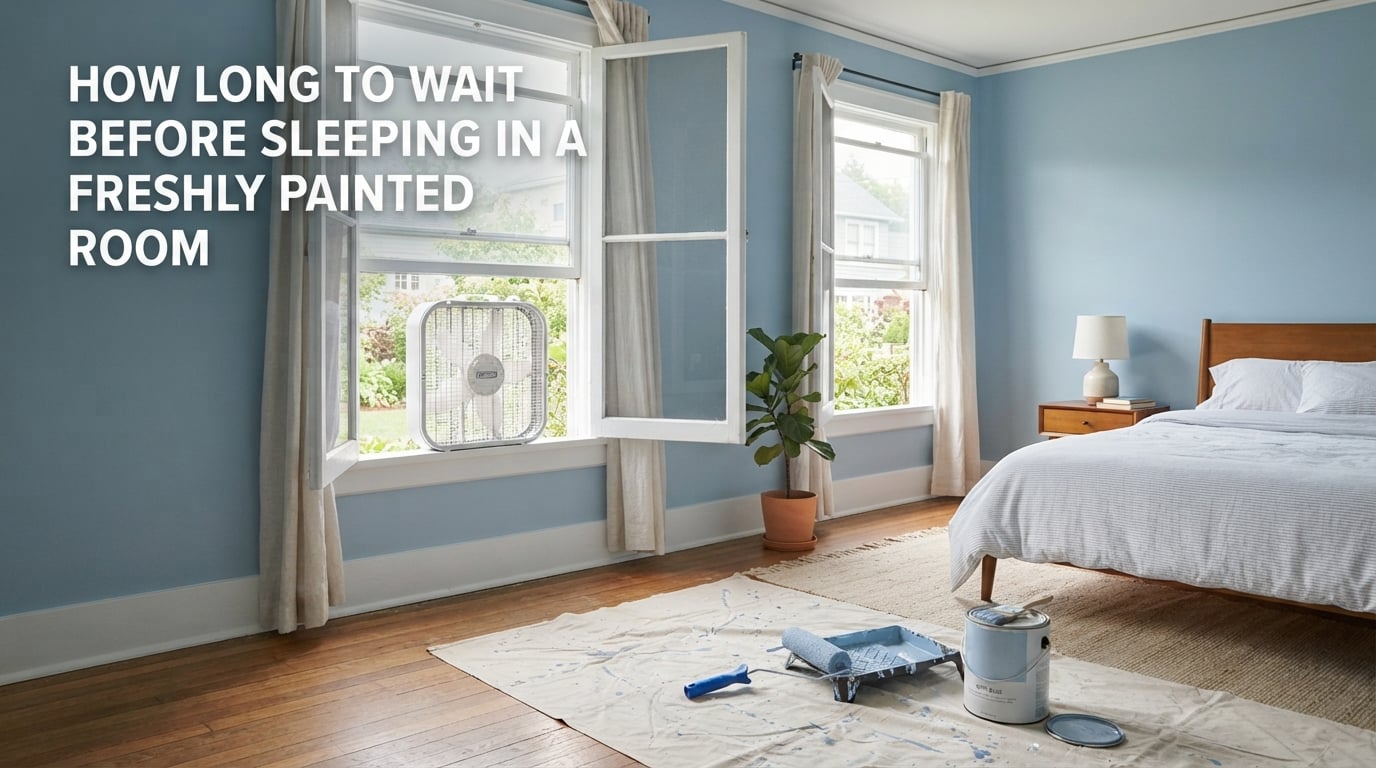
You just finished painting your bedroom and the walls look fantastic. But now you are staring at the clock wondering: how long to wait before sleeping in a freshly painted room? The short answer is 24 to 72 hours, depending on the type of paint you used and how well you can ventilate the space.
Zero-VOC paints may be safe in as little as 2 to 4 hours with good airflow, while oil-based paints can take a full 72 hours before the room is safe for sleeping. Getting this wrong means exposing yourself to volatile organic compounds (VOCs) that can cause headaches, nausea, and respiratory irritation overnight.
Our team dug through contractor guidelines, medical expert recommendations, CPSC safety publications, and dozens of real homeowner experiences on forums to build this complete guide. We break down exact wait times by paint type, share a night-by-night timeline that no competitor covers, and give you practical steps to speed up the process safely.
Table of Contents
What Are VOCs and Why Are Paint Fumes Dangerous?
VOCs, or volatile organic compounds, are chemicals that evaporate at room temperature. Paint releases these compounds into the air as it dries through a process called off-gassing. This off-gassing can continue for days, and in some cases weeks, after the paint looks completely dry.
Common VOCs found in paint include formaldehyde, benzene, toluene, and xylene. The Consumer Product Safety Commission (CPSC) has documented that these chemicals can reach concentrations up to 1,000 times higher indoors than outdoors during and immediately after painting.
Short-term exposure to paint fumes can cause a range of uncomfortable symptoms. The most commonly reported effects include:
Headaches and dizziness
Nausea and upset stomach
Eye, nose, and throat irritation
Respiratory irritation and coughing
Fatigue and difficulty concentrating
Long-term exposure to elevated VOC levels is linked to more serious health concerns. Research from the National Institutes of Health (NIH) has associated prolonged VOC exposure with liver damage, kidney damage, and central nervous system effects. While a single night in a freshly painted room is unlikely to cause long-term harm, the short-term symptoms alone can make for a miserable next day.
Forum users on Reddit’s Home Improvement communities consistently report waking up with splitting headaches after sleeping in rooms painted just hours earlier. One user described it as “the worst hangover of my life, except I had not been drinking.” These real experiences match what medical professionals warn about.
The good news is that VOC concentrations drop dramatically within the first 24 hours with proper ventilation. The key is knowing exactly how long your specific paint needs before the room becomes safe for an extended stay like sleeping.
How Long to Wait Before Sleeping in a Freshly Painted Room: Time by Paint Type
The wait time depends almost entirely on the type of paint you applied. Different formulations release VOCs at different rates and in different concentrations. Here is the breakdown our team compiled from manufacturer specifications, painting contractor recommendations, and health agency guidelines.
Zero-VOC paint: Wait 2 to 4 hours with active ventilation. These paints contain fewer than 5 grams of VOCs per liter. Brands like Benjamin Moore Natura and Behr Premium Plus Zero fall into this category. You can typically sleep in the room the same night if windows are open and fans are running.
Low-VOC latex paint: Wait 12 to 24 hours. These water-based paints contain fewer than 50 grams of VOCs per liter. Most modern interior latex paints sold in 2026 meet this standard. Give it overnight with windows open and a fan circulating air.
Standard latex paint: Wait 24 to 48 hours. Traditional water-based latex paints emit moderate VOC levels. Wait at least one full day, and ideally two, before sleeping in the room.
Oil-based paint: Wait 48 to 72 hours minimum. Oil-based paints and alkyd formulations release significantly higher VOC concentrations. They also take longer to dry fully. Government safety agencies recommend avoiding freshly oil-painted rooms for at least 2 to 3 full days.
Primer coats: Most interior primers follow the same timeline as the paint type they match. Oil-based primers require the same 48 to 72 hour window as oil-based paint. Water-based primers align with latex paint times.
If you used multiple products (for example, an oil-based primer under latex paint), use the longest wait time from the products involved. The oil-based primer will continue off-gassing even after the latex topcoat is applied.
Night-by-Night Timeline: What to Expect After Painting
One thing we noticed across every competitor article is that none of them break down what actually happens hour by hour after you paint. This timeline fills that gap so you know exactly what is happening in your room.
Hours 0 to 12: Peak VOC Period
VOC concentrations are at their highest during the first 12 hours after application. The paint is still wet or tacky, and chemical emissions are rapid. The room will have a strong paint smell that is immediately noticeable when you walk in. This is absolutely not a safe window for sleeping, regardless of paint type.
During this period, run fans pointing outward through windows and keep interior doors open to other rooms if possible. Cross-ventilation is your best tool right now.
Hours 12 to 24: Fumes Beginning to Dissipate
The paint is dry to the touch in most cases by this point, but dry-to-touch does not mean safe-to-sleep. VOC levels are dropping but still elevated well above safe thresholds for extended exposure. The smell will still be noticeable, though less intense than during the first 12 hours.
For zero-VOC and low-VOC paints, this window may be approaching safe levels with continuous ventilation. For standard latex and oil-based paints, the room is still not ready.
Hours 24 to 48: Noticeable Improvement
By the 24-hour mark, most water-based paints have reduced their VOC emissions significantly. The smell should be faint or barely noticeable with good ventilation. For zero-VOC and low-VOC paints, the room is generally safe for sleeping at this point.
Standard latex paints are usually approaching safe levels, but sensitive individuals may still experience mild symptoms. Oil-based paints are still off-gassing at meaningful levels and require continued ventilation.
Hours 48 to 72: Generally Safe for Most People
By 48 hours, standard latex paint rooms are safe for most healthy adults. The VOC emissions have dropped to a fraction of their initial levels. Oil-based paint rooms are approaching safe thresholds but may still cause issues for sensitive individuals.
This is the window where government safety agencies generally give the green light for occupancy. The CPSC and EPA guidelines point to 2 to 3 days as the standard recommendation for most paint types.
Beyond 72 Hours: Safe for Sensitive Groups
After 72 hours, even oil-based paint rooms have reached safe VOC levels for nearly everyone. Parents of infants, pregnant women, and people with respiratory conditions should feel confident at this stage. The paint may continue to off-gas at trace levels for weeks, but concentrations are well below harmful thresholds.
Factors That Affect Paint Drying and VOC Dissipation
The timelines above assume average conditions. Several variables can speed up or slow down how quickly your painted room becomes safe for sleeping. Understanding these factors helps you make better decisions about timing.
Ventilation is the single most important factor. A room with two windows open on opposite walls and a fan running will clear VOCs in half the time of a closed room. Without any airflow, paint fumes can linger for weeks instead of days.
Temperature plays a bigger role than most people realize. Paint dries fastest and off-gasses most efficiently between 50 and 80 degrees Fahrenheit. Below 50 degrees, the drying process slows dramatically and VOCs linger longer. Above 80 degrees, paint may dry too quickly on the surface while remaining wet underneath, trapping VOCs in the film.
Humidity levels matter significantly. Ideal humidity for paint drying is 40 to 50 percent. High humidity above 60 percent slows evaporation and extends the time needed before the room is safe. If you live in a humid climate, consider running a dehumidifier to speed things along.
The number of coats affects wait time. Two coats mean roughly double the VOC load compared to a single coat. If you applied primer plus two finish coats, expect the longer end of the recommended wait range for your paint type.
Room size and airflow patterns also influence dissipation. A small bedroom with one window will hold VOCs longer than a large open room with multiple windows. Painting a 10-by-12 bedroom concentrates fumes more than painting a 20-by-20 living room with the same amount of paint.
Signs It Is Safe to Sleep in a Freshly Painted Room
Time guidelines give you a framework, but your own senses are the final check. Here is how to verify the room is actually ready before you spend the night.
1. The paint smell is gone or barely detectable. Walk into the room after being outside for at least 10 minutes. If you cannot smell paint, or the odor is extremely faint, that is a strong sign VOC levels have dropped significantly.
2. The walls are completely dry to the touch. Press your fingertip against the paint in an inconspicuous spot. It should feel completely solid with no tackiness or softness. Dry-to-touch is a minimum requirement, though remember it does not guarantee safe VOC levels on its own.
3. No visible haze or fumes in the air. Shine a flashlight across the room in dim lighting. If you see any shimmering or haze in the air beam, solvents are still actively evaporating. Wait longer.
4. The 15-minute test. Sit in the room with the door closed for 15 minutes. If you develop a headache, feel dizzy, or notice any throat or eye irritation, the room is not ready. If you feel completely fine after 15 minutes, it is likely safe for sleeping.
Warning signs the room is NOT safe: Any noticeable paint smell, any headache or nausea after entering, any visible air haze, or any respiratory discomfort whatsoever. If you notice any of these, leave the room immediately and give it more time.
How to Speed Up Paint Drying and Clear Fumes Faster
If you need the room ready sooner, several strategies can cut your wait time by 30 to 50 percent. These methods work with the paint’s natural drying process rather than masking the problem.
Cross-ventilation is your most powerful tool. Open a window on one side of the room and another window or door on the opposite side. Place a box fan in one window pointing outward to pull air out, and another fan across the room pointing inward to push fresh air in. This creates a continuous airflow path that flushes VOCs quickly.
Strategic fan placement matters. A single fan pointing out a window removes more VOCs than multiple fans just circulating air inside the room. You want to move contaminated air out and bring fresh air in, not just stir the fumes around. Run fans continuously for at least 24 hours after painting.
Air purifiers with activated carbon filters help. Standard HEPA filters do not capture VOCs because the molecules are too small. However, air purifiers with thick activated carbon filters can adsorb VOC molecules from the air. One Reddit user in the r/HomeImprovement community confirmed that running a carbon-filter purifier cut their wait time from 24 hours to about 14. Look for units specifically rated for chemical and odor removal.
Temperature control accelerates drying. Set your thermostat between 70 and 75 degrees Fahrenheit. If you have a space heater, running it at a moderate setting helps, but never use a gas heater in a freshly painted room as combustion and paint fumes are a dangerous combination.
Run a dehumidifier if humidity is above 50 percent. Lower humidity speeds evaporation of both the water and solvents in paint. This is especially helpful in bathrooms, basements, or homes in humid climates during summer months.
Natural odor absorbers provide modest help. Bowls of white vinegar, baking soda, or activated charcoal placed around the room can absorb some airborne compounds. Sliced onions are an old painter’s trick, though they add their own odor. Halved lemons work similarly. These methods help with smell but do not significantly reduce VOC levels, so do not rely on them alone.
Special Considerations: Babies, Children, Pregnant Women, and Sensitive Groups
Not everyone reacts to paint fumes the same way. Children, infants, pregnant women, the elderly, and people with respiratory conditions all need extra caution and longer wait times.
Infants and toddlers are the most vulnerable. Their respiratory systems are still developing, and they breathe more air per pound of body weight than adults. Parents on Reddit’s r/Parenting forum consistently report waiting 2 to 3 full days before letting babies sleep in freshly painted rooms. For a nursery painted with standard latex paint, wait at least 72 hours. For zero-VOC paint, 24 to 48 hours is the minimum we recommend.
Pregnant women should take extra precautions. While the research on paint fumes and pregnancy is not conclusive, most obstetricians recommend minimizing chemical exposure during pregnancy. Wait at least 48 to 72 hours, and longer for oil-based paints. The CPSC specifically advises pregnant women to avoid freshly painted rooms whenever possible.
People with asthma, allergies, or COPD need longer wait times. Respiratory conditions make airway tissue more sensitive to chemical irritants. Even low levels of VOCs that would not bother a healthy adult can trigger symptoms in someone with compromised respiratory function. Wait the full 72 hours regardless of paint type.
The elderly may be more sensitive to VOC exposure. Reduced lung capacity and other age-related health factors can amplify the effects of paint fumes. If an older family member will sleep in the room, extend the wait time to the longer end of the range for your paint type.
Nursery-specific guidance: Paint the nursery at least a week before the baby’s expected arrival. This gives you a comfortable buffer beyond even the most conservative wait recommendations. Use zero-VOC paint if possible, and keep the room well-ventilated for the entire week.
Common Mistakes to Avoid
Even well-informed homeowners make errors when it comes to paint safety. Here are the mistakes we see most often.
Confusing dry-to-touch with safe-to-sleep. Paint can feel completely dry within 2 to 4 hours but still emit harmful VOC levels for days. Surface dryness tells you nothing about chemical emissions. Always use time guidelines and the smell test, not just touch.
Relying on smell alone. Some VOCs, like formaldehyde, have no strong odor at low concentrations but are still present at levels that can cause symptoms. Use smell as one indicator, not the only one. The 15-minute exposure test is more reliable.
Closing windows too early. Many people close everything up once the paint looks dry, trapping remaining VOCs inside. Keep windows open and fans running for at least 24 hours, even after the paint appears fully dry.
Using ozone generators. Some guides suggest ozone generators to remove paint odors. Ozone itself is a lung irritant and can react with paint chemicals to create new harmful compounds. The EPA explicitly advises against using ozone generators in occupied spaces.
Painting over old oil-based paint with latex without proper priming. This can cause the new paint to fail and may actually extend off-gassing as the underlying layers react. Always identify your existing paint type before repainting.
FAQs
Is it okay to sleep in a room that is freshly painted?
It depends on the paint type and how long you wait. Zero-VOC paints are safe after 2 to 4 hours with ventilation. Standard latex paints need 24 to 48 hours. Oil-based paints require 48 to 72 hours. Never sleep in a room the same day it was painted with standard or oil-based paint, as VOC levels are dangerous during the first 12 hours.
How long after painting a room can someone sleep in it?
For zero-VOC paint, wait 2 to 4 hours with good ventilation. For low-VOC latex, wait 12 to 24 hours. For standard latex paint, wait 24 to 48 hours. For oil-based paint, wait 48 to 72 hours. Sensitive groups including infants, pregnant women, and people with respiratory conditions should wait at least 72 hours regardless of paint type.
How long does a room need to air out after being painted?
A room should air out for at least 24 hours with windows open and fans running for most water-based paints. Oil-based paints need 48 to 72 hours of active ventilation. Keep cross-ventilation going continuously rather than opening windows briefly, as VOCs dissipate gradually over time.
How long are paint fumes harmful?
Paint fumes are most concentrated and harmful during the first 12 to 24 hours. VOC levels drop significantly by 48 hours and reach safe levels by 72 hours for most paints. Trace off-gassing can continue for weeks, but at concentrations well below harmful thresholds after the first few days.
What happens if I sleep in a room with paint fumes?
Sleeping in a room with active paint fumes can cause headaches, nausea, dizziness, throat and eye irritation, and respiratory discomfort by morning. Some people report symptoms similar to a bad hangover. Long-term harm from a single exposure is unlikely, but repeated exposure to high VOC levels is linked to liver, kidney, and nervous system effects.
Is it safe to sleep in a freshly painted room while pregnant?
Most doctors recommend waiting at least 48 to 72 hours before sleeping in a freshly painted room during pregnancy. Use zero-VOC paint if possible and extend wait times. The CPSC specifically advises pregnant women to avoid freshly painted rooms. Consult your obstetrician for personalized guidance based on your trimester and health history.
Final Thoughts on Paint Safety and Wait Times
Knowing how long to wait before sleeping in a freshly painted room comes down to your paint type, ventilation quality, and personal sensitivity. Zero-VOC paints need just 2 to 4 hours with airflow. Standard latex needs 24 to 48 hours. Oil-based paints need 48 to 72 hours. For infants, pregnant women, and anyone with respiratory issues, extend every timeline to at least 72 hours.
When in doubt, wait longer. A night on the couch is a small inconvenience compared to waking up with a pounding headache and nausea. Use cross-ventilation, keep fans running for a full 24 hours, and always do the 15-minute room test before committing to a night’s sleep.
Choose zero-VOC or low-VOC paint for bedrooms and nurseries whenever possible. The extra few dollars per gallon saves you days of waiting and eliminates nearly all health concerns. Your lungs will thank you.