
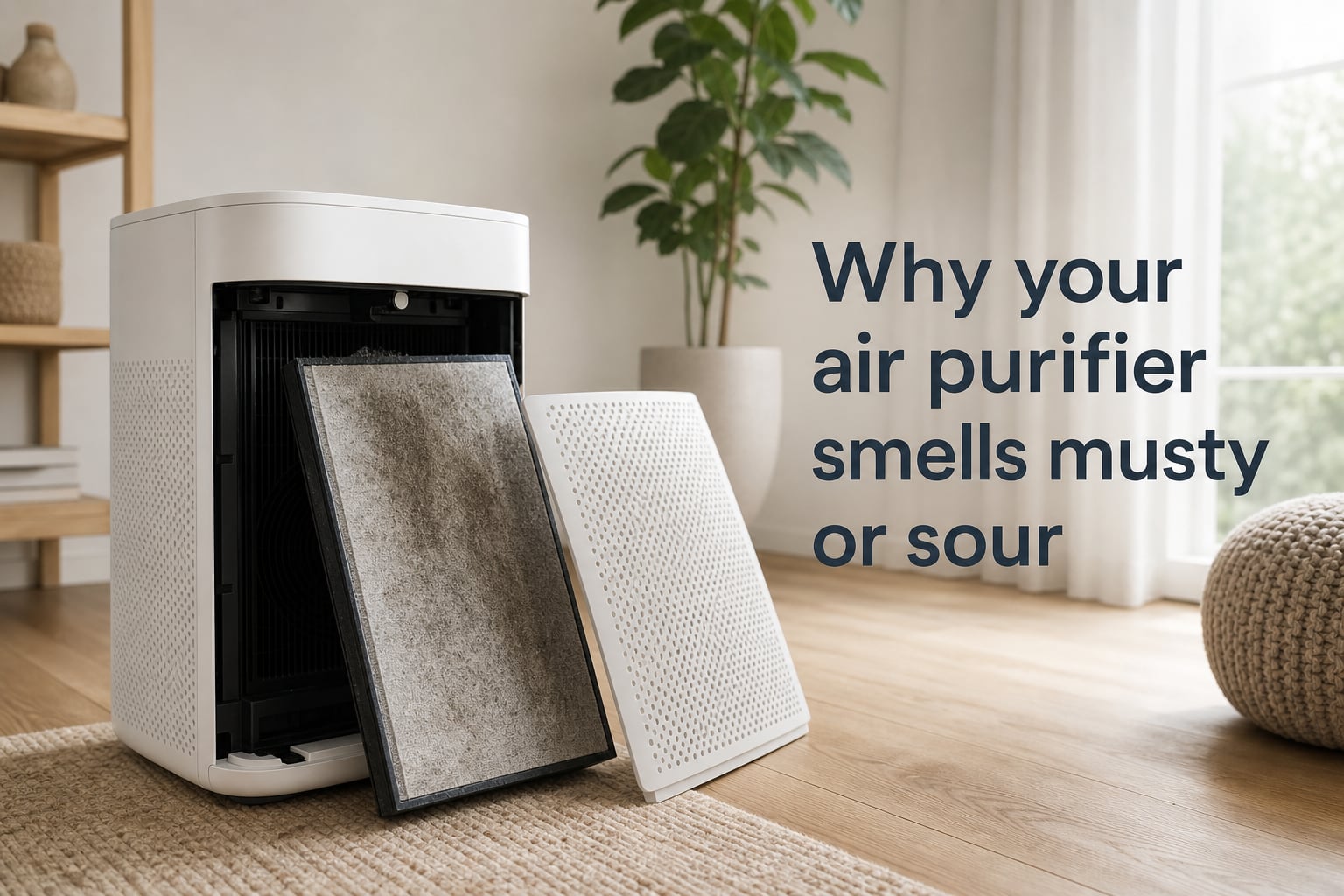
You bought an air purifier to make your home smell cleaner, not worse. Yet here you are, noticing a damp, sour, or even moldy odor every time the fan kicks on. If your air purifier smells musty, you are not imagining it, and you are definitely not alone. Thousands of homeowners report the same frustrating problem in online forums every month.
The irony is sharp: the very device meant to clean your air may be circulating mold spores and bacteria throughout your living space. The good news is that an air purifier that smells bad is almost always fixable. The bad news is that ignoring it can actually make your indoor air quality worse than having no purifier at all.
In this guide, we will walk through exactly why air purifiers develop musty and sour smells, how to diagnose your specific odor type, and what to do about it. We have tested and researched the most common causes across major brands like Levoit, Coway, Winix, and Dyson. By the end, you will know whether you need a simple filter swap or a deeper cleaning routine.
Table of Contents
The Quick Answer: Why Does My Air Purifier Smell Musty?
An air purifier smells musty or sour because trapped moisture and organic particles have created the perfect breeding ground for mold and bacteria inside the unit. The three most common culprits are a saturated activated carbon filter, mold growth on the HEPA filter, or standing water in the base.
When filters capture mold spores, dust, pet dander, and cooking particles over months of use, those materials begin to decompose. Add humidity above 60 percent and you have ideal conditions for microbial growth. The purifier then blows that sour, damp smell right back into your room.
Here is the immediate action plan: turn off and unplug the unit, inspect all filters for discoloration or dampness, replace any filter that is more than six months old, and clean the interior with a diluted vinegar solution. We will cover each step in detail below.
Smell Type Diagnostic Guide: What Your Purifier Odor Means
Different smells point to different problems. Before you start tearing apart your unit, use this diagnostic guide to identify what is causing the odor. I have organized these by urgency so you know which smells require immediate action.
Understanding the specific type of smell your air purifier emits will save you time and money. You might need a simple filter replacement, or you might need to stop using the unit entirely for safety reasons.
| Smell Type | Most Likely Cause | Urgency Level |
|---|---|---|
| Musty, damp, basement-like | Mold or mildew growth on filter or interior | High – Replace filter immediately |
| Sour, rancid, vinegary | Bacteria decomposing trapped organic matter | High – Deep clean and replace filter |
| Wet dog, animal-like | Saturated carbon filter with pet dander buildup | Medium – Replace carbon filter |
| Chemical, plastic, new-car | New unit off-gassing from manufacturing materials | Low – Usually resolves in 1 to 2 weeks |
| Burning, electrical, hot | Overheating motor, wiring issue, or dust on heating element | Critical – Stop using immediately |
| Fishy or metallic | Failing electrical components or melting plastic | Critical – Stop using and contact manufacturer |
| Sharp, metallic, chlorine-like | Ozone emission from ionizer or UV-C technology | Medium – Disable ionizer function |
If your air purifier smells like burning or fish, unplug it right now and stop reading. Contact the manufacturer or replace the unit. Those smells indicate an electrical fire risk that no amount of cleaning will fix.
Why Air Purifiers Smell Musty or Sour: The Four Main Causes
Now that you have identified your smell type, let us dig into what is actually happening inside your machine. Understanding the root cause makes prevention much easier. There are four primary reasons an air purifier develops a bad odor.
Cause 1: Saturated or Dirty Filters
This is by far the most common reason an air purifier smells bad. Every air purifier relies on a series of filters to trap airborne contaminants. A typical unit has three stages: a pre-filter for large particles, a HEPA filter for fine particles, and an activated carbon filter for odors and gases.
The activated carbon filter is usually the first to cause smell problems. Carbon works through adsorption, meaning it physically traps odor molecules and VOCs (volatile organic compounds) in its porous structure. Once those pores fill up, the carbon can no longer capture new odors. Worse, the trapped organic material begins to break down and release sour smells back into the airflow.
How fast does this happen? It depends entirely on your environment. In a home with pets, a smoker, or high cooking activity, a carbon filter can saturate in as little as 3 months. In a cleaner environment, it might last 6 to 12 months. The HEPA filter itself can also develop odors when it becomes loaded with decomposing organic matter like dead skin cells, pet dander, and pollen.
A useful benchmark from our research: HEPA filter effectiveness can drop to roughly 50 percent after 6 months of continuous use in an average household. If your filters are older than that, you have likely found your culprit.
Cause 2: Mold and Bacteria Growth Inside the Unit
This is the second most common cause and the one with the most serious health implications. Air purifiers are designed to move air, and moving air carries moisture. When humid air passes through a filter that has trapped organic material, you get the perfect recipe for microbial growth.
Mold needs three things to grow: moisture, a food source, and warmth. A dirty air purifier filter provides all three. Mold spores that your purifier has captured from the room are already sitting on the filter. Add humidity above 60 percent and room temperature, and those spores begin to colonize.
The musty smell you notice is actually the gas that mold produces as it grows, called microbial volatile organic compounds or MVOCs. These gases are what give mold its characteristic earthy, damp odor. When your purifier blows air through a moldy filter, it distributes those MVOCs, along with new mold spores, throughout your room.
Users on Reddit communities like r/AirPurifiers frequently report this exact scenario. One common complaint involves Levoit Core 300 units developing mold smell within weeks, particularly when placed in basements or bathrooms. The carbon filter saturates quickly in these humid environments, creating the damp conditions mold loves.
Bacteria create a different smell profile. Rather than musty, bacteria produce sour or rancid odors as they decompose trapped organic matter. This is why some purifiers smell like sour milk or dirty laundry rather than a damp basement.
Cause 3: New Unit Off-Gassing
Not all bad smells indicate a problem. If your air purifier is brand new and smells like plastic, chemicals, or a new car interior, you are likely experiencing off-gassing. This is the release of VOCs from the manufacturing materials, adhesives, and packaging.
Off-gassing is completely normal for new appliances and typically resolves within 1 to 2 weeks of continuous use. The smell comes from the plastic housing, the activated carbon filter shedding fine dust, and the adhesives used in filter construction. Running the purifier on its highest setting in a well-ventilated room speeds up the process.
However, there is an important distinction to make. A mild chemical smell that fades over days is normal. A strong, headache-inducing chemical odor that persists beyond two weeks could indicate a defective unit or a manufacturer using low-quality materials. In that case, contact the seller for a replacement.
Reddit users frequently ask whether the dusty or cardboard smell from new Philips and Coway units is normal. In almost every case, experienced users confirm it is standard off-gassing from the activated carbon filter and recommend giving it a week or two to dissipate.
Cause 4: Ozone and Ionizer Technology
Some air purifiers use ionizer technology or UV-C light as part of their cleaning process. These features can produce a distinct sharp, metallic, or chlorine-like smell that some users find unpleasant or concerning.
Ionizers work by releasing negatively charged ions into the air, which attach to airborne particles and make them heavy enough to fall out of the air. Some ionizers, particularly older or poorly designed models, can produce ozone as a byproduct. Ozone has a sharp, distinctive smell similar to the air after a thunderstorm.
The EPA has issued clear warnings about ozone exposure. According to their guidelines, even relatively low amounts of ozone can cause chest pain, coughing, shortness of breath, and throat irritation. Long-term exposure may reduce lung function and worsen respiratory conditions like asthma.
If your purifier has a PlasmaWave feature (common in Winix models), an ionizer setting, or a UV-C light, and you notice a metallic or bleach-like smell, try disabling those features. The HEPA and carbon filtration will still work, and the smell should disappear. If you have respiratory conditions, you may want to avoid ozone-producing technologies entirely.
How to Fix a Musty or Sour Air Purifier: Step-by-Step
Now for the part you came here for. Here is the exact procedure to eliminate musty and sour smells from your air purifier. Follow these steps in order, and do not skip the drying phase.
Step 1: Turn Off and Unplug the Unit
Safety first. Never open or clean an air purifier while it is plugged in. Unplug the unit and move it to a well-ventilated area, preferably outdoors or in a garage.
Step 2: Remove and Inspect All Filters
Open the unit according to the manufacturer instructions and remove each filter. Lay them out and inspect for visible mold, dark discoloration, dampness, or a strong sour smell. If any filter shows signs of mold growth, it must be replaced, not cleaned. Mold can penetrate deep into filter material where surface cleaning cannot reach.
Step 3: Replace Saturated Filters
As a general rule, if your carbon filter is more than 6 months old or your HEPA filter is more than 12 months old, replace them. Cleaning a HEPA filter with water or vacuuming it will not remove trapped odors and can damage the delicate fiber structure. Carbon filters cannot be effectively cleaned once saturated.
Step 4: Deep Clean the Interior
While the filters are out, clean the inside of the unit. Mix a solution of one part white vinegar to three parts water. Use a soft cloth to wipe down the interior surfaces, the fan blades, and the filter housing. Vinegar kills mold and bacteria without leaving harmful residues. Avoid spraying liquid directly onto any electrical components.
Step 5: Clean or Replace the Pre-Filter
The pre-filter catches large particles like hair and lint. Many pre-filters are washable. Rinse it under warm water, let it dry completely, and reinstall it. If your pre-filter is damaged or heavily soiled, replace it. A clogged pre-filter reduces airflow and causes the other filters to work harder and saturate faster.
Step 6: Dry Everything Completely
This step is non-negotiable. Every component must be completely dry before reassembly. Any residual moisture will restart the mold growth cycle. Let the unit and all parts air dry for at least 24 hours in a well-ventilated space. Using a fan to speed up drying is fine.
Step 7: Reassemble and Run on High
Once everything is dry and new filters are installed, reassemble the unit. Run it on the highest setting for 30 to 60 minutes in an empty room to clear out any residual odors from the cleaning process. Then return it to its normal location.
If the smell persists after all of this, you likely have mold growing in the motor housing or internal ducts that cannot be accessed without disassembly. At that point, replacing the unit is usually more cost-effective than professional cleaning.
Preventing Air Purifier Odors: A Maintenance Schedule
The best fix for a smelly air purifier is to prevent the problem from happening in the first place. Consistent maintenance costs far less than emergency filter replacements or a new unit. Here is the maintenance schedule we recommend based on filter manufacturer guidelines and real-world user experience.
Print this schedule or set calendar reminders. Most people forget about filter maintenance until the smell becomes impossible to ignore, which means the filter is already heavily contaminated.
| Component | Standard Home | Pets or Smoking | High Humidity / Basement |
|---|---|---|---|
| Pre-filter (clean) | Every 2 to 4 weeks | Every 1 to 2 weeks | Every 1 to 2 weeks |
| Activated carbon filter (replace) | Every 6 months | Every 3 to 4 months | Every 3 months |
| HEPA filter (replace) | Every 12 months | Every 8 to 10 months | Every 6 to 8 months |
| Full unit deep clean | Every 6 months | Every 3 months | Every 3 months |
Beyond filter replacement, environmental control plays a massive role in preventing odors. Here are the additional steps that make the biggest difference.
Control Your Humidity
Keep indoor humidity between 30 and 50 percent. This is the sweet spot identified by the EPA and cited across multiple authoritative sources. Below 30 percent, your air becomes too dry. Above 60 percent, mold growth accelerates rapidly. If you run your air purifier in a basement or bathroom, pair it with a dehumidifier. The dehumidifier removes excess moisture from the air before it reaches your purifier filters.
Position Your Purifier Correctly
Place your air purifier at least 6 inches away from walls and furniture to ensure proper airflow. Avoid corners and enclosed spaces where humid air gets trapped. If possible, elevate the unit off the floor, especially in basements where cold floors create condensation.
Never Add Essential Oils
Many users try to mask bad smells by adding essential oils to their air purifier. This is a mistake. Essential oils can damage the HEPA filter fibers, clog the carbon filter pores, and leave sticky residues that attract more dirt. Some manufacturers will void your warranty if they detect essential oil residue. If you want fragrance, use a separate diffuser in a different part of the room.
Vacuum the Exterior Regularly
Dust on the exterior of your purifier gets pulled into the intake and loads up your pre-filter faster. Wipe down the outside weekly and vacuum around the unit to reduce the particle load.
Health Impacts of Running a Smelly Air Purifier
This is the section most competitors skip, and it matters more than you might think. Running a moldy or bacteria-laden air purifier is not just unpleasant, it can actively harm your health.
When mold grows on a filter, the purifier becomes a mold spore distribution system. Instead of capturing mold spores, it releases them back into your air at a higher concentration than before. This is particularly dangerous for people with allergies, asthma, or compromised immune systems.
The American Lung Association has documented that exposure to mold can trigger allergic reactions, asthma attacks, and respiratory infections. Common symptoms of mold exposure include coughing, wheezing, throat irritation, nasal congestion, and skin irritation. Prolonged exposure can lead to more serious respiratory conditions.
Bacteria growing in a sour-smelling purifier can also spread airborne pathogens. While the bacteria themselves may not cause infection through inhalation alone, the decomposition byproducts can irritate airways and worsen existing conditions.
Who is most at risk? Children, elderly adults, pregnant women, and anyone with respiratory conditions like COPD, asthma, or cystic fibrosis. If anyone in your household falls into these categories, do not delay in addressing a smelly air purifier. Stop using the unit until you can replace the contaminated filters.
If you have been running a musty purifier for weeks or months and are experiencing unexplained respiratory symptoms, talk to your doctor. Mention the mold exposure so they can consider it in their diagnosis.
FAQs
Will air purifiers get rid of musty smells?
Yes, a properly maintained air purifier with an activated carbon filter will reduce musty smells in your home. The carbon filter adsorbs odor molecules, while the HEPA filter captures mold spores that cause musty odors. However, if your air purifier itself is the source of the musty smell, it will make the problem worse until you clean or replace the filters. Pair your purifier with a dehumidifier for best results in damp environments.
Do air purifiers help with norovirus?
Air purifiers with true HEPA filters can capture some airborne virus particles, but norovirus spreads primarily through direct contact and contaminated surfaces, not through the air. An air purifier should be part of a broader hygiene strategy that includes handwashing and surface disinfection, not a standalone solution for norovirus prevention.
Would an air purifier help with COPD?
Yes, air purifiers with HEPA filtration can help COPD patients by removing airborne irritants like dust, pollen, pet dander, and smoke that trigger flare-ups. However, it is critical to keep the purifier clean. A moldy or dirty purifier will worsen respiratory symptoms rather than relieve them. Avoid ozone-producing ionizers if you have COPD, as ozone irritates the lungs.
How often should I replace air purifier filters?
Replace your activated carbon filter every 3 to 6 months and your HEPA filter every 6 to 12 months. Homes with pets, smokers, or high humidity require more frequent replacement. Clean the pre-filter every 2 to 4 weeks. Following a consistent maintenance schedule prevents the filter saturation and mold growth that cause musty and sour smells.
Is a musty air purifier dangerous?
A musty air purifier can be dangerous if the smell is caused by mold growth. Running a moldy purifier distributes mold spores and microbial compounds throughout your home, which can trigger allergies, asthma attacks, and respiratory irritation. If you suspect mold in your purifier, stop using it immediately and replace all contaminated filters before resuming use.
Why does my air purifier smell like wet dog?
A wet dog smell typically means your activated carbon filter is saturated with pet dander and organic particles. As these materials decompose, they release a distinctive animal-like odor. Replace the carbon filter and clean the pre-filter to resolve the smell. Pet owners should replace carbon filters every 3 to 4 months.
When to Replace Your Air Purifier Entirely
Sometimes the problem extends beyond a simple filter swap. Knowing when to replace the whole unit versus just the filters can save you from throwing good money after bad. Here are the signs that your air purifier has reached the end of its useful life.
Consider replacing the entire unit if the smell persists after a complete filter replacement and deep clean. This indicates mold or bacteria have colonized areas inside the motor housing or internal ductwork that you cannot access or clean effectively.
Replacement is also warranted if your filters cost nearly as much as a new unit. Many users on Reddit report frustration that replacement filters for some models approach or exceed the cost of buying a brand new purifier. In those cases, investing in a unit with more affordable replacement filters makes long-term financial sense.
Other red flags include the motor running louder than before, reduced airflow despite clean filters, visible cracks or damage to the housing, and a unit that is more than 5 years old. Older units may also use outdated filtration technology that cannot match current HEPA standards.
Conclusion: Take Action on Your Smelly Air Purifier Today
An air purifier that smells musty or sour is a clear signal that something inside the unit needs attention. Whether it is a saturated carbon filter, mold growth from excess humidity, or off-gassing from a new purchase, the fix is usually straightforward once you identify the cause.
The key takeaways are simple: replace filters on schedule, keep humidity between 30 and 50 percent, clean the unit regularly with a vinegar solution, and never ignore persistent odors. A well-maintained air purifier should make your home smell cleaner, not worse.
Do not wait until the smell becomes unbearable or health symptoms appear. Check your filters today, note the last replacement date, and set up a maintenance calendar. Your lungs, and everyone in your household, will thank you for it.