
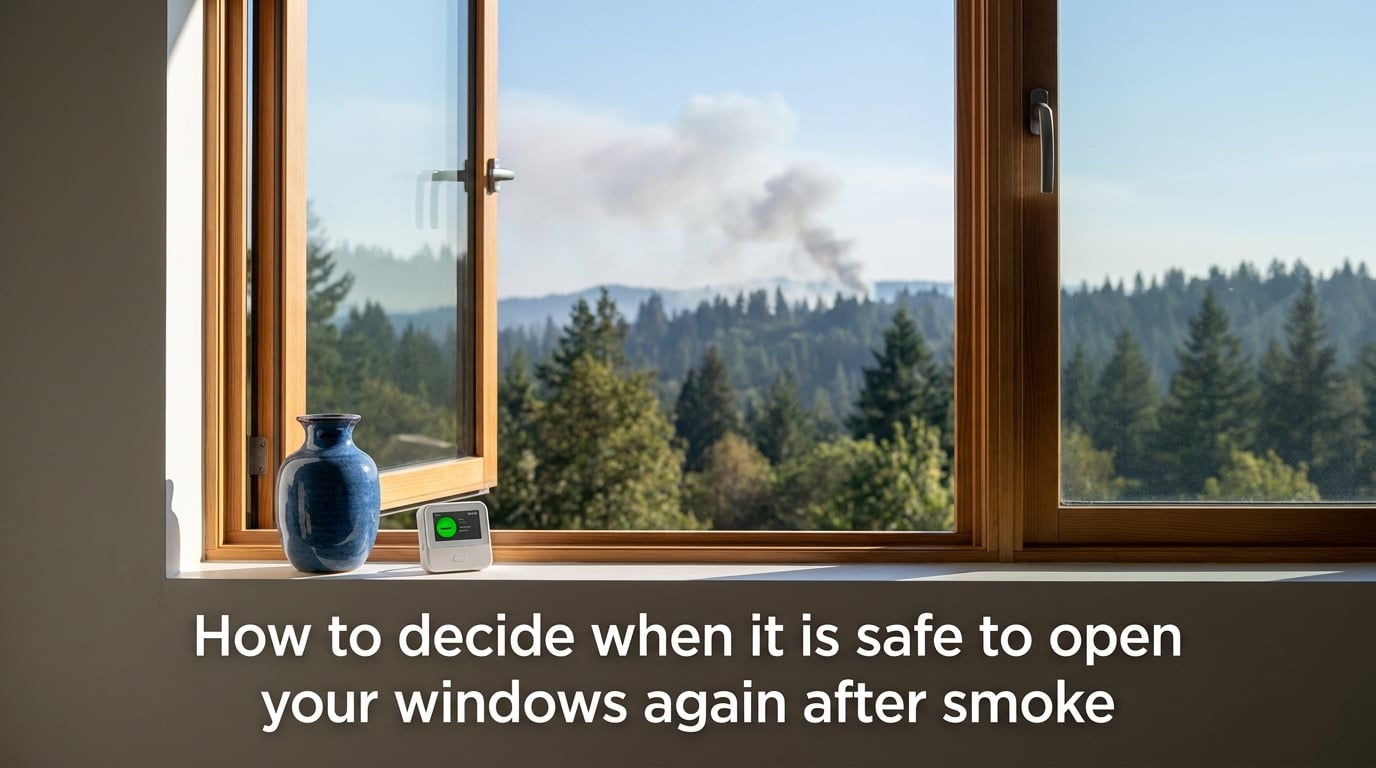
When is it safe to open windows after smoke? In most situations, open them when the outdoor Air Quality Index (AQI) is in the Good range of 0–50, and usually when it is Moderate at 51–100 if nobody in your home is especially sensitive to smoke. Close them once AQI reaches 101, and keep them closed at 151 or above.
That quick rule is a starting point, not a promise. The source of the smoke, a nearby active fire, a lingering indoor odor, local wind, and the health needs of children, older adults, pets, or anyone with asthma can all call for a more cautious choice.
We know the uneasy part is the gray area: the sky may look clear, the weather may be pleasant, and you may still wonder whether opening a window will bring smoke particulates back indoors. This guide turns that question into a short check you can repeat each time conditions change.
Table of Contents
AQI is the first number to check before you open windows
AQI is a public scale for air pollution. For smoke events, the number often reflects PM2.5, the very small particulate matter that can travel deep into the lungs and can enter a house through open windows, gaps, and mechanical ventilation.
Check a local, current AQI reading rather than trusting the view from your window. Smoke can be higher aloft than at ground level, can drift in after a wind shift, and can leave the air looking better before the fine-particle reading has improved.
| AQI range | What it means for windows after smoke | A practical action |
|---|---|---|
| 0–50: Good | Outdoor air is the best window-opening opportunity. | Open windows to air out the home, while watching for a new smoke plume or odor. |
| 51–100: Moderate | Often reasonable for a short airing-out period, but it is the judgment zone. | Open cautiously if household members are not smoke-sensitive; recheck the reading and stop if odor enters. |
| 101–150 | Smoke-sensitive people may be affected. | Close windows and reduce outside-air intake where possible. This is the point to stop treating open windows as routine. |
| 151 or higher | Outdoor air is poor enough that bringing it indoors is generally a bad trade. | Keep windows closed, stay indoors as much as practical, and use filtered indoor air if available. |
The number is more useful than a single color label because it gives you a stopping point. Communities discussing wildfire smoke often agree on one thing: uncertainty is less stressful when the household has a set threshold instead of reopening windows whenever the haze seems lighter.
It is safe to open your windows again after smoke when outdoor air is good or moderate and the source is no longer affecting your home
Use this five-step framework whenever you are deciding whether to restart normal ventilation after wildfire smoke, prescribed burns, a smoky fireplace, or another outdoor source. It is meant to replace guesswork with a brief, repeatable check.
Step 1: Check the current AQI and the nearby forecast
Look at the latest local AQI before opening a window. A favorable reading is more convincing when the forecast does not show smoke returning soon, because an hour of fresh air is not helpful if a plume is expected to move through right afterward.
If your source reports a pollutant-specific value, look for PM2.5 during a wildfire or smoke episode. AQI is still the action number for the household, but knowing that fine particles are driving it explains why the air can irritate lungs even when the smell is faint.
Step 2: Check whether the smoke source is still active nearby
A low or improving reading does not make an active structure fire, burning debris, or a close wildfire irrelevant. Follow any local evacuation, shelter, fire-department, or public-health instruction first; a window decision must never override an official safety direction.
For smoke from cooking or a fireplace, the source may be indoors rather than outdoors. Turn off the source, let visible smoke clear, and use the exhaust route that sends air outside if that route does not pull outdoor smoke into the home.
Step 3: Apply a stricter standard for sensitive people and pets
If a child, older adult, pet, or person with asthma, COPD, heart disease, or another breathing condition is in the home, treat Moderate AQI as a reason to pause and assess rather than an automatic green light. A person who has already had coughing, wheezing, chest tightness, or eye irritation during the event should stay with cleaner, filtered indoor air until conditions are clearly better.
We recommend agreeing on this stricter household rule before the next smoke day. It prevents a healthy adult’s comfort with a breeze from becoming the standard for someone who may react more strongly.
Step 4: Start with a short test opening
Open one or two windows for a brief interval instead of opening the whole house immediately. Stay nearby, notice whether an outdoor smoke odor enters, and close the windows if the odor becomes distinct or anyone feels irritation.
An indoor air quality monitor can make this step less subjective. Watch the indoor PM2.5 trend after opening the window; a rising reading is a practical sign that outdoor particulates are getting inside.
Step 5: Recheck after wind or weather changes
Smoke conditions can shift across a day, so a safe morning choice may not remain safe by late afternoon. Check again before reopening windows, especially when winds change direction, a new fire report appears, or a smoky smell returns.
PM2.5 is the smoke pollutant that makes a clear-looking day misleading
PM2.5 means particulate matter small enough to be measured in microns. Wildfire smoke is a common source, but smoke from a house fire, a wood burner, a neighboring cigarette, cooking, and prescribed burns can also affect indoor air quality.
These particles can remain airborne, settle on surfaces, and become disturbed again during aggressive cleaning. How long smoke stays in the air after a fire has no single clock: it depends on the amount of smoke, ventilation, the size of the room, and whether outdoor conditions are actually cleaner than indoor conditions.
That is why “the smoke has cleared” is not a full decision rule. Visible haze tells you something about larger particles and density, but AQI and PM2.5 information give a better guide to the fine particles that matter for breathing.
A smoke source changes the decision even when AQI looks similar
Wildfire smoke is usually an outdoor-air problem, so windows stay closed while AQI is elevated and can reopen after the local reading improves. A small cooking event is different: if outdoor air is clean, opening a window and running a vented kitchen exhaust fan can help remove indoor smoke.
A home affected by a building fire is different again. Soot, damaged materials, and residues may make ordinary airing out inadequate, and fire officials, a qualified restoration professional, or public-health guidance may be needed before normal occupancy and ventilation resume.
Carbon monoxide is a separate emergency question
Carbon monoxide is an odorless gas produced by incomplete combustion, while PM2.5 is particle pollution. AQI is not a carbon-monoxide alarm, and opening a window is not a substitute for a working CO detector or for leaving the area when a CO alarm sounds.
People often worry about CO poisoning after a window was accidentally left open during wildfire smoke. Brief outdoor smoke exposure does not automatically mean CO poisoning, but severe headache, dizziness, weakness, nausea, confusion, chest pain, fainting, or a CO alarm needs immediate action: get to fresh air and seek emergency help according to local instructions.
A short, controlled flush works best once outdoor air has improved
Once AQI is favorable and there is no nearby active source, cross-ventilation can replace stale air faster than opening a single window. Open windows on opposite sides of the home only while the outdoor reading stays in the range you have chosen, then close them again if smoke returns.
Morning versus evening is not a universal smoke rule. Check the actual AQI at the time you plan to ventilate, because smoke pooling, winds, and local topography can make either period better or worse in a particular neighborhood.
A brief test flush gives you a safer way to restart ventilation
- Check the outdoor AQI and look for active smoke notices.
- Close interior doors to rooms you do not need to air out first.
- Open two separated windows for a short test interval and keep an eye on indoor odor or an air quality monitor.
- Close the windows if outdoor smoke enters or the AQI changes upward.
- After airing out, run a portable air purifier with a HEPA filter if you have one, following the maker’s instructions for the room.
This approach also helps with smoke odor removal, but odor and particle cleanup are not identical. Wash fabrics and hard surfaces as appropriate after smoke has settled, replace HVAC filters if they are loaded or due for replacement, and do not stir visible soot into the air with dry sweeping.
During smoky conditions, set a central air system to recirculate when that setting is available and appropriate for the system. Avoid adding outdoor air through an open window or fan if the AQI is elevated.
Children, pets, older adults, and people with lung or heart conditions need a stricter rule
Smoke can irritate the eyes, nose, throat, and lungs, and it can make existing breathing or heart conditions harder to manage. Children breathe more air for their body size, and pets can also be affected by poor air quality even though they cannot describe symptoms.
Keep windows closed earlier when anyone in the home is having symptoms, has been told by a clinician to limit smoke exposure, or simply finds the smell or irritation difficult to tolerate. A lower personal threshold is a sensible health decision, not an overreaction.
Secondhand smoke is not solved by opening a window
Opening a window may dilute smoke from a cigarette, but it does not remove the exposure completely and it can spread smoke to another part of the home. Keep children, pets, and people with respiratory disease away from the smoke source, and avoid relying on fans that merely move the smoke around.
There is no dependable “safe number of minutes” near secondhand smoke that applies to everyone. More concentrated smoke, smaller rooms, a child’s presence, and a person’s existing health condition all change the risk.
Symptoms are a reason to stop ventilating with smoky outdoor air
Coughing, wheezing, shortness of breath, chest tightness, worsening asthma symptoms, headaches, or unusual fatigue are reasons to close windows, move to cleaner air, and follow a clinician’s plan when one exists. Call emergency services for severe trouble breathing, chest pain, fainting, confusion, or other urgent symptoms.
Recovery after wildfire smoke inhalation also varies. Mild irritation may improve after exposure stops, while persistent, worsening, or concerning symptoms deserve medical advice rather than another round of window adjustments.
Humidity changes comfort but does not set a smoke-AQI cutoff
Humidity can affect comfort, condensation, and mold concerns, but it does not replace AQI as the smoke decision tool. Do not invent a humidity threshold for smoke safety; check outdoor pollution first, then account for damp conditions that could create separate moisture problems indoors.
A house fire calls for clearance and cleanup before normal ventilation
After a fire in your home, do not use the outdoor AQI alone to decide that the house is ready. Fire damage can leave soot, residues, and damaged materials inside even after outdoor smoke has dispersed.
Follow fire-department instructions about re-entry and have utilities, combustion appliances, and any suspected structural damage assessed when required. If you smell gas, hear a CO alarm, see visible soot, or have been told not to enter, leave the area and contact the appropriate emergency or restoration service.
Once the home is cleared for occupancy, air it out only when outdoor AQI is favorable and use cautious, controlled ventilation. This is one of the situations where the timeline depends on the incident and professional clearance, not on a generic number of hours.
Common questions have short AQI-based answers
At what AQI should windows be closed?
Close windows when AQI reaches 101 or higher, particularly during smoke events. At 151 or above, keep them closed and reduce outdoor-air intake where practical. People who are sensitive to smoke may choose a lower cutoff.
How long does smoke stay in the air after a fire?
There is no fixed timeline. Smoke can remain airborne or settle indoors depending on the amount of smoke, room size, ventilation, and whether outdoor air is cleaner. After a house fire, follow re-entry and cleanup guidance rather than relying on time alone.
How long should I air out a room after smoking?
If outdoor air is clean, start with a short, monitored cross-ventilation period and stop if smoke enters from outside. Opening a window dilutes indoor smoke but does not fully remove secondhand-smoke exposure, so keeping people away from the source remains important.
Can leaving a window open during wildfire smoke cause carbon monoxide poisoning?
Wildfire smoke exposure does not automatically mean carbon monoxide poisoning. AQI does not measure carbon monoxide, so use working CO alarms and treat an alarm or symptoms such as confusion, fainting, chest pain, or severe dizziness as an emergency.
At what humidity should I not open my windows?
Humidity does not provide a smoke-safety cutoff. Use current AQI and local smoke conditions to make the window decision, then consider humidity separately for comfort, condensation, and moisture concerns.
The safe choice is to follow AQI and your household’s health needs
To decide when it is safe to open your windows again after smoke, start with the outdoor AQI: open at 0–50, use extra judgment at 51–100, close at 101, and keep windows closed at 151 or above. Then adjust for an active fire, a return of smoke odor, and the people and pets who will breathe that air.
A short, monitored airing-out period is better than an all-or-nothing decision. Check the number again when weather changes, use filtered indoor air during poor conditions, and get emergency or medical help for a CO alarm or severe symptoms.