
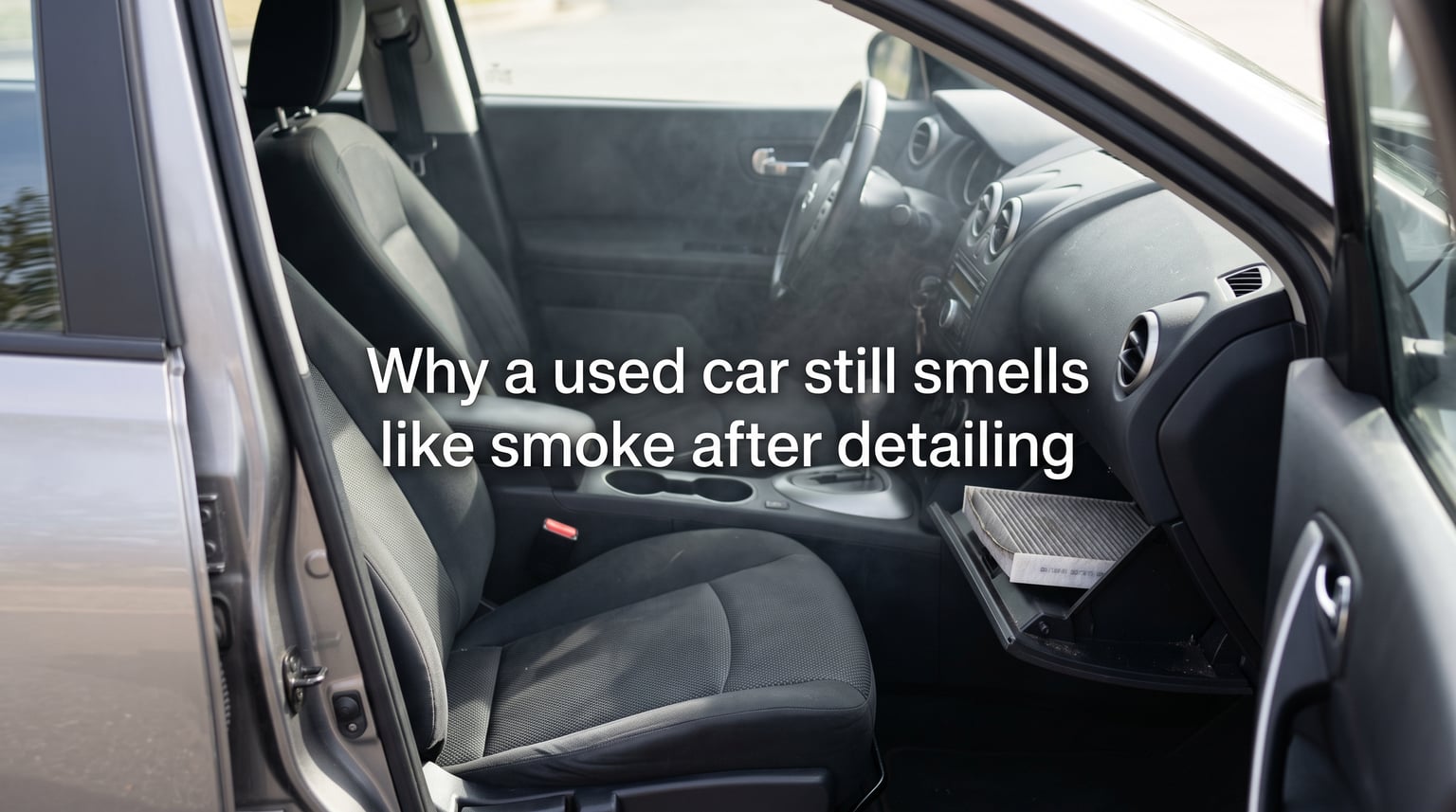
A used car still smells like smoke after detailing because smoke does not stay on the visible surfaces a standard detail reaches. It leaves third-hand smoke residue in porous upholstery, seat foam, carpet padding, headliner fabric, door panels, and the HVAC system, where it can release odor again when the cabin warms up or the fan runs.
If you are asking why used car smells like smoke after detailing, the short answer is that the detail likely cleaned or deodorized the cabin without fully removing every embedded source. A fresh scent right after pickup can make the problem seem solved, but it does not prove that the residue inside the car is gone.
That is frustrating, especially after paying for what sounded like a complete interior service. We think the honest answer matters more than a promise of an instant fix: a stubborn smoker car can need repeated source-cleaning and sometimes partial disassembly before the odor stops returning.
Table of Contents
Smoke persists in a used car after detailing because it is embedded below the surface.
Smoke is made of tiny particles and sticky residues, including nicotine and tar. Instead of resting only on leather, plastic, or glass, they settle into materials with open fibers and small air spaces.
A wiped dashboard can look clean while the odor source remains beneath the seat cover or behind a vent grille. This is why a car can smell acceptable while it is cool in a detail bay, then smell like cigarettes again after an afternoon in the sun.
Seat foam and carpet padding hold odor because they act like sponges.
Fabric seats are not a single layer. Under the visible upholstery are foam cushions, backing fabric, clips, and sometimes padding that can retain smoke particles far deeper than a light shampoo or surface steam pass reaches.
Carpet has a similar problem. Shampooing the top fibers may remove grime and some odor, but contamination can remain in the backing and padding below, particularly around the driver seat, rear seats, and floor areas near ashtrays or cup holders.
That is why smoke particles in car upholstery often create a smell that returns after cleaning. Moisture and warmth can make residue more noticeable, so a car may seem worse after humid weather or after passengers sit in the seats.
The headliner holds odor because its glue and foam backing are delicate.
The headliner is a frequent miss because aggressive scrubbing, saturation, and high heat can loosen its adhesive. A detailer may clean it lightly to avoid sagging, which is sensible, but a lightly cleaned headliner can still hold cigarette residue.
Smoke rises, so the roof area receives repeated exposure in a smoker vehicle. The fabric, thin foam backing, sun visors, grab handles, and the space around the dome light can all contribute to a deep set smoke odor car.
Door panels and trim retain residue because smoke reaches every enclosed surface.
Door cards often combine fabric, foam, plastic, weather seals, and cavities. Smoke can settle around window switches, speaker grilles, seat-belt openings, and the edges where panels meet the door frame.
These areas are easy to overlook during a quick detail because they do not look dirty. Yet they matter when the cabin is closed for hours and the odor has nowhere else to go.
The HVAC system releases smoke odor because air keeps passing through contaminated parts.
If the car smells like cigarette smoke when the air conditioning or heat comes on, look beyond the seats. The cabin air filter, intake area, evaporator housing, blower path, and vents can collect residue and then send the smell back through the cabin.
A fragrance sprayed into a vent may cover the odor briefly, but it does not clean the HVAC system. A contaminated filter is especially important because it is designed to sit in the airflow and can keep spreading an old smell every time the system operates.
A standard detail falls short when it cleans surfaces but does not remove the odor source.
Detailing is not one fixed service. One shop may include vacuuming, wiping, glass cleaning, and a fabric shampoo, while another may include extraction, steam, an HVAC treatment, and a cabin filter replacement.
Ask what was actually done rather than relying on the word “detail.” The difference between a surface refresh and smoke remediation is where the work happens: on the visible cabin surfaces versus inside foam, fabric layers, ducting, and hidden contact points.
Air fresheners fail as a permanent fix because they add a competing scent.
Sprays, hanging fresheners, and fragrance bombs can make the vehicle seem better for a day or two. Once that added scent fades, the original molecular odor is still free to return.
Baking soda may help absorb some airborne odor in a closed car, but it cannot pull years of nicotine residue out of foam or ductwork. Think of it as a minor supporting step, not the main treatment.
Ozone alone can disappoint because it does not remove physical residue.
Ozone treatment is often discussed for smoke odor because ozone reacts with some odor-causing compounds. It can be useful after thorough cleaning, but it is not a substitute for removing ash, washing residue, extracting contaminated fabric, and treating HVAC components.
Forum discussions repeatedly describe the same pattern: the vehicle smells better right after an ozone-only appointment, then the odor returns. That result usually points to residue that was never removed, not proof that the owner imagined the smell.
Removing the remaining smoke odor requires cleaning the sources in a deliberate order.
The practical goal is not to overwhelm the smell with fragrance. It is to identify the materials holding third-hand smoke and clean each one with a method that reaches it without damaging the interior.
Step 1: Remove loose sources before applying any deodorizer.
Empty the cabin, center console, door pockets, trunk, spare-tire well, and seat tracks. Look for old cigarette butts, ash, burned matches, discarded packaging, and absorbent personal items left by the former owner.
Vacuum seams, rails, carpet edges, vents, and under-seat areas slowly. Ash can work into cracks and fabric, and treating odor before removing it means you are working around an active source.
- Remove washable floor mats and clean both sides.
- Check the trunk liner and cargo-area side pockets.
- Inspect the ashtray or 12-volt socket area, even if the car has no obvious ashtray.
- Look beneath and behind rear-seat cushions where access allows.
Step 2: Replace the cabin air filter before judging the HVAC result.
Use the owner’s manual or service information to locate the cabin filter. A filter that has absorbed smoke can undermine otherwise good interior work, so replacement is usually a sensible early step rather than a final afterthought.
With the old filter removed, inspect the housing for visible debris and clean only as the vehicle maker permits. A new filter cannot clean the rest of the system by itself, but it prevents the old filter from continuing to add odor.
Step 3: Clean hard surfaces because smoke residue is not limited to fabric.
Clean glass, dashboard plastic, door trim, console surfaces, steering-wheel controls, seat-belt webbing, sun visors, and rubber seals with an interior-safe cleaner. Change cloths frequently; a cloth loaded with residue simply moves it to the next surface.
Pay attention to areas people touch or where smoke settles upward: visor edges, grab handles, mirror surrounds, the upper door frame, and the inside of windows. A greasy film on the glass can be a useful clue that residue is still present.
Step 4: Extract fabric and carpet because shampoo alone may not reach the backing.
For cloth seats and carpet, work with an upholstery-safe cleaner followed by measured rinsing and extraction. The aim is to lift loosened soil and residue out rather than leaving a lot of cleaner and moisture behind.
Do not soak seats or carpet. Excess water can lead to mildew, can move contamination deeper, and can create a second odor problem that makes it hard to tell whether the cigarette smell is improving.
A professional extractor may reach farther than a hand wipe, but even extraction has limits when foam is heavily contaminated. In severe cases, a technician may need to remove seat covers, address foam directly, or decide that replacement is more realistic than repeated surface treatment.
Step 5: Treat the headliner gently because its adhesive can fail.
Use a low-moisture method appropriate for headliner material and avoid saturating it. Work in small sections, support the fabric rather than pulling it, and do not assume a powerful cleaner is automatically the better cleaner.
If the headliner is heavily stained, smells strongest near the roof, or has begun to loosen, speak with an experienced interior specialist. Replacing a damaged headliner can cost far more effort than taking a cautious approach at the start.
Step 6: Clean the HVAC path because the fan can bring the odor back.
After the cabin filter is handled, an HVAC-safe cleaner can be applied according to its directions to the intake or accessible system area. The correct approach varies by vehicle, so avoid spraying unknown chemicals deep into vents or electronics.
Run the fan through different speeds and temperature settings after treatment. Test recirculation and fresh-air modes separately, since a smell that appears in only one mode helps narrow down whether the source is inside the cabin, in the intake, or in the system itself.
Step 7: Dry, ventilate, and reassess because a wet cabin hides the real result.
Leave windows open in a protected location or use moving air until fabric and carpet are fully dry. A closed, damp car is not a fair test of whether smoke odor removal worked.
Once it is dry, close the vehicle for several hours, then open it and smell before starting the fan. Repeat the test after the cabin has warmed in sunlight and again with the HVAC running; each test checks a different remaining source.
Professional smoke remediation is appropriate when the smell returns after complete source cleaning.
A reputable specialist should explain the scope before promising results. Ask whether the service includes filter replacement, fabric extraction, headliner treatment, HVAC cleaning, odor neutralization, and a follow-up evaluation after the cabin dries.
For an intense odor, professional work may involve deeper seat and carpet treatment, cleaning behind trim where practical, targeted enzyme odor neutralizers, and an oxidation step used only after physical cleaning. The order matters because a chemical treatment cannot replace removing the residue it is meant to address.
Replacement is sometimes the honest option when foam or trim remains contaminated.
Some cars have years of smoking history, burns, ash embedded in seams, and residue in several layers of the interior. When the odor is strongest in a particular seat, headliner, carpet section, or filter housing after repeated work, replacing that component may be the more dependable route.
This is also why a dealer’s quick deodorizing treatment can fall short. It may make a car easier to show, but it does not necessarily mean the prior owner’s smoke exposure has been remediated at depth.
Smoke odor can fade over days or persist for months because severity and treatment depth vary.
A lightly smoked-in car may improve greatly after one thorough cleaning and HVAC service. A car used daily by a smoker for a long period can need several rounds, a drying period between them, and further work after the first warm-weather test.
There is no reliable instant timeline. Community reports range from a smell returning right after a service to gradual improvement over many months, which is why anyone promising a permanent one-step result should explain exactly what sources they will clean.
The smell is likely gone when it does not return during normal stress tests.
Test the car after it has been closed overnight, after warm sun, and while the HVAC runs in both fresh-air and recirculation modes. Sit in every seating position, including the back seat, because a source can be localized.
Ask a nonsmoker who has not been riding in the car to check it as well. Odor fatigue is real: after spending hours cleaning, your nose can become less reliable than a fresh one.
Third-hand smoke matters in a used car because it affects comfort, health concerns, and resale.
Third-hand smoke is more than an unpleasant reminder of a previous owner. People on detailing forums often describe headaches or nausea around lingering smoke odor, and families with children or sensitive passengers may reasonably prefer a vehicle without that exposure.
This article cannot assess an individual health risk, so discuss persistent exposure concerns with a qualified health professional. From a practical ownership angle, disclose a continuing odor when selling the car and document any remediation work you have had done.
A pre-purchase odor check is useful, too. Smell the car with the windows closed, run the heat and air conditioning, inspect the headliner and seat seams, and do not let a strong fragrance be the only evidence that the car is smoke-free.
Frequently asked questions answer the common smoke-odor concerns directly.
How do you get rid of smoke smell in a car from a previous owner?
Remove ash and belongings, replace the cabin air filter, clean hard surfaces, extract upholstery and carpet without over-wetting them, treat the headliner carefully, and clean the HVAC path. Then dry the cabin completely and test it after it has been closed and after the fan runs. Persistent odor usually means one of those source areas still holds residue.
Can detailers remove smoke smell from a car?
Detailers can greatly reduce or remove smoke odor when they clean the residue in fabric, foam, carpet padding, headliner material, and HVAC components. A basic detail may not reach those areas, though, and ozone or fragrance alone can leave the source behind. Ask what depth of cleaning and follow-up testing the service includes.
How long does it take for a car to stop smelling like smoke?
A mild odor may improve after one thorough cleaning, while a heavily smoked-in car can need repeated treatments and a drying period between them. Judge the result after the cabin has been closed overnight, warmed by the sun, and tested with the HVAC on. If odor returns, another source still needs attention.
What do car dealers use to get rid of smoke smell?
Dealers may use interior cleaning, deodorizing products, cabin-filter replacement, HVAC treatments, ionizers, or ozone treatments. The result depends on whether they remove embedded smoke residue as well as treating the air. A fast deodorizing service can improve the first impression without fully cleaning foam, padding, headliner material, or ductwork.
Can you permanently get smoke smell out of a car?
It can be removed when the remaining sources are found and treated, but there is no guarantee from a surface clean or a scent product. Severe contamination in seat foam, carpet padding, the headliner, or HVAC components may need repeated work or replacement. A permanent result means the odor does not return after heat, time closed up, or fan use.
The practical next step is to treat a returning smoke smell as a source problem, not a scent problem.
Why used car smells like smoke after detailing comes down to depth: visible cleaning cannot always reach third-hand smoke in foam, padding, the headliner, door panels, and the HVAC system. Start with the cabin filter and loose debris, clean and extract each reachable material, then test the dry car under heat and airflow.
If the odor returns in one condition, use that clue rather than repeating the same fragrance treatment. A careful professional who explains what will be cleaned, what may need replacement, and when to retest gives you a far better chance of a cabin that genuinely smells clean.