
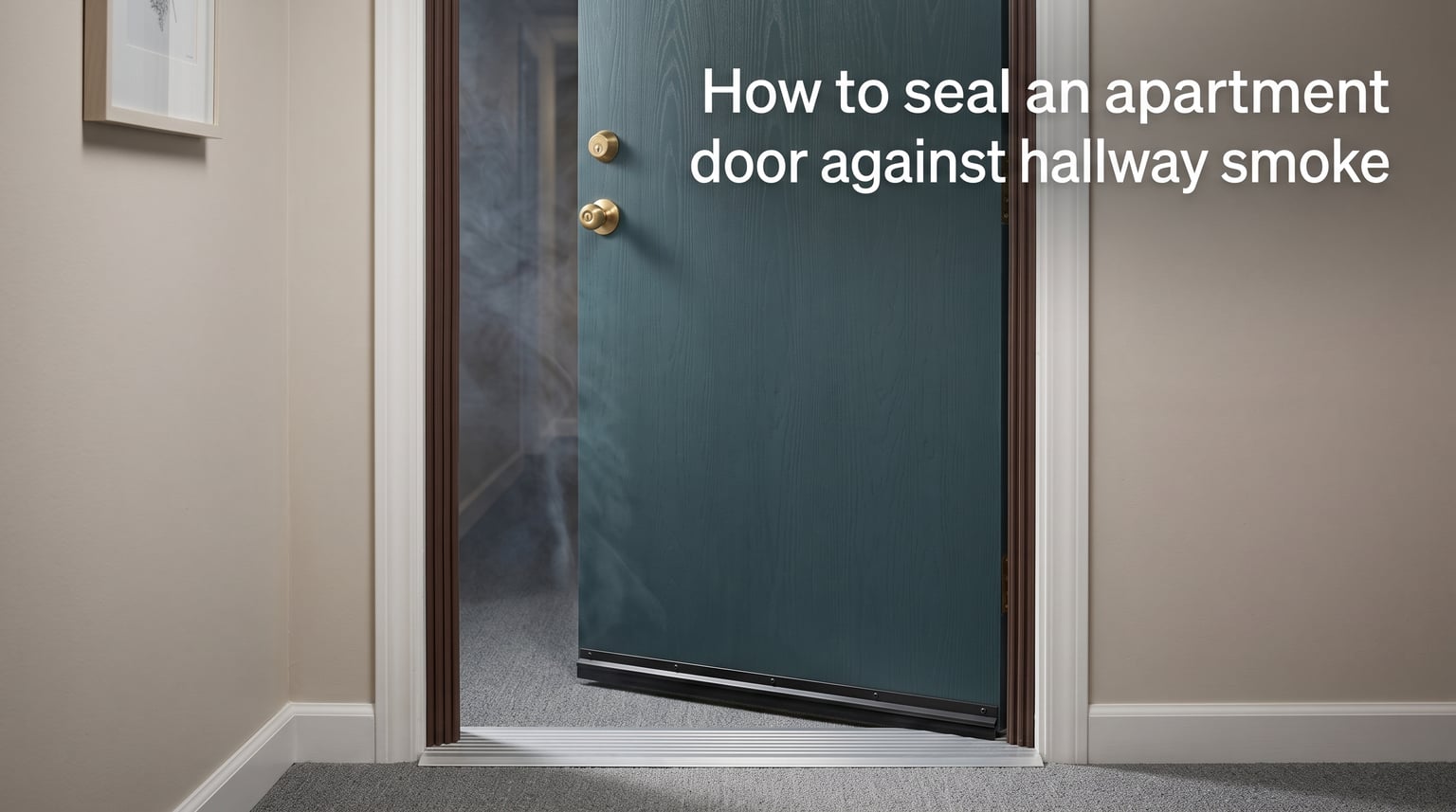
To seal an apartment door against hallway smoke, find every air gap around the top, sides, and bottom of the door, then fit weatherstripping on the frame and a correctly sized door bottom seal. The aim is to stop moving air, because cigarette odor and smoke particles follow the same leaks as a draft.
That sounds simple, but apartment entrance doors deserve a careful approach. A sealed-looking door can still leak at one compressed corner, below an uneven threshold, or through a nearby duct that makes the door seem like the source.
This guide explains how to seal an apartment door against hallway smoke without guessing, including renter-friendly choices and the point at which the building manager needs to step in. I would start with diagnosis rather than buying a pile of materials, since a small gap can undo otherwise solid work.
Direct answer: Clean and dry the door jamb, use a continuous perimeter seal on the top and latch-side frame, add a door sweep or door bottom seal that just meets the threshold, then retest with daylight and a tissue. If odor remains while the door passes those tests, investigate vents, ceiling openings, and shared-wall penetrations instead of adding more material to the door.
Table of Contents
Smoke enters through moving air and pressure differences.
Hallway smoke reaches an apartment when air moves from a higher-pressure area to a lower-pressure area through openings. The openings can be obvious, such as a visible gap under the door, or tiny, such as a loose strip at the door jamb.
Odor does not need a wide opening. If you can feel a draft near the perimeter seal, air carrying smoke odor can travel there too.
Building systems can change the direction of that movement. Exhaust fans, stairwell pressure, elevator movement, outdoor wind, and a bathroom fan operating in your unit can pull hallway air toward the apartment entrance.
A door leak is often easiest to notice at the bottom.
The door bottom gap is usually the largest uninterrupted path, especially where a threshold is worn or uneven. A door sweep, brush seal, or draft stopper can help there, but it must match the clearance and still let the door close and latch normally.
Top and side gaps matter just as much. Thin silicone rubber seal or suitable self-adhesive weatherstripping creates a continuous smoke barrier only when it contacts the closed door all the way around.
Air sealing helps with sound, but it does not make a door soundproof.
Air leaks weaken both odor control and sound control, so sealing gaps may reduce hallway noise as a side benefit. A small gap can have an outsized effect on sound insulation, but a lightweight hollow door can still transmit sound through its surface after every edge is sealed.
For smoke, the first priority is the air path. Do not mistake acoustic foam, decorative panels, egg cartons, or a heavy curtain for an air seal; none replaces a fitted gasket and door bottom seal.
You should map the gaps before applying weatherstripping.
Checking first prevents the common error of attaching foam tape where the door never touches it. It also gives you a before-and-after record if you need to show a landlord that smoke intrusion persists.
The daylight test reveals visible perimeter gaps.
Turn off the room light during the day, stand inside with the door closed, and look around the top, hinges, latch edge, and threshold. Daylight is a strong clue that air can pass through that spot.
Ask someone you trust to stand in the hallway if a second set of eyes would help. Do not wedge the door open in a way that blocks a shared exit or interferes with other residents.
The tissue test shows where air is moving.
With the door closed, hold a narrow strip of tissue near each edge without trapping it in the door. A twitch toward the gap suggests airflow, and a repeated result during odor episodes is more useful than one quick check.
Test at different times if the smell comes and goes. A bathroom or kitchen exhaust fan can change the pressure in your apartment, so repeat the test with those fans off and then on.
A controlled odor observation is safer than creating smoke.
Do not create smoke, burn paper, or use an open flame to test leaks in a hallway or around a fire-rated entry door. Instead, note when you smell cigarette odor, close the door, run the tissue check, and record where the odor is strongest.
Some renters have used plastic sheeting temporarily over suspected areas to narrow down a path. Treat that only as a brief diagnostic measure while you are home, and never cover a peephole, lock, latch, or any component that affects safe exit.
Tip: Make a simple sketch of the door and mark daylight, tissue movement, and odor locations. I find this keeps the repair focused: one line for the top, one for the hinge side, one for the latch side, and one for the threshold.
You can seal an apartment door against smoke in five ordered steps.
Work from the door frame to the threshold, then test the closed door after each change. This order matters because a bottom seal adjusted before the perimeter seal may be set too aggressively and make the door hard to close.
Step 1 is to inspect the door, frame, and threshold.
Open and close the door slowly. Look for loose existing weatherstripping, cracked seals, a warped door, rubbing at the threshold, loose hinges, and areas where the latch does not pull the door snugly into the frame.
- Measure the top of the frame and both sides rather than assuming they are identical.
- Measure the gap under the door at the left, center, and right.
- Note whether the door swings inward or outward before selecting a sweep style.
- Check that the deadbolt, latch, closer, peephole, and fire label remain unobstructed.
Do not change strike-plate alignment or plane down a rental door without written permission. If the door is visibly warped or the frame is damaged, that is evidence for a maintenance request rather than a tape-only project.
Step 2 is to clean the contact surfaces.
Wipe the door jamb where the self-adhesive seal will sit, then let it dry fully. Adhesive placed on dust, oil, old loose foam, or damp paint tends to peel, leaving a gap that is easy to miss.
Remove only deteriorated, nonfunctional adhesive material that you are allowed to remove. Photograph the existing condition first if the apartment is rented.
Step 3 is to apply the top and side perimeter seal.
Choose a weatherstripping profile whose compressed thickness matches the gap you measured. Start at the top, press the strip along a straight cleaned surface of the frame, and continue down the sides so the ends meet cleanly at the corners.
Silicone rubber seals tend to spring back better than basic foam tape on a frequently used entrance door. Foam tape can work for a small, consistent gap, but a thick strip may prevent the door from latching or can flatten over time.
Close the door gently after fitting one side. The goal is light, even compression; the door should close, latch, and unlock without a shoulder shove or a hard slam.
Step 4 is to seal the door bottom without blocking operation.
For a consistent bottom gap, a door sweep mounted on the interior side can meet the threshold and block much of the airflow. A brush seal handles minor unevenness well, while a fitted drop-down seal is a more involved option that may require landlord approval.
A removable draft stopper can offer temporary help, particularly overnight, but it is not a complete substitute for a continuous door bottom seal. It can shift when the door moves and must never keep the door from opening freely.
Trim or adjust only according to the seal maker’s instructions, then open and close the door several times. Check that it does not drag so hard that it damages flooring or prevents the door closer from doing its job.
Step 5 is to retest and correct the weak point.
Repeat the daylight and tissue tests with the door fully latched. If one corner still leaks, inspect the seal’s position and compression before adding a second layer.
Layering tape often creates a door that will not latch and still leaves the original air path. A better fix is a different seal profile or an adjustment request for a damaged frame.
Warning: Apartment entry doors may be fire-rated and self-closing. Do not drill into them, disable a closer, tape the latch, cover a fire label, or fit a seal that stops the door from fully closing unless the property manager has approved the work.
The best material depends on the gap and whether the change must be removable.
There is no single “smoke-proof” strip that works on every apartment door. A good material is one that contacts the door consistently, survives repeated closing, and does not compromise the door’s required operation.
Weatherstripping works best on the top and sides of a door jamb.
Self-adhesive weatherstripping is a general name for compressible material applied around the frame. Silicone rubber gasket material is a strong choice for a busy entrance because it is flexible and rebounds after compression.
Foam tape is often easier to remove and can be renter-friendly, yet it is less forgiving of irregular gaps. Use it only where the closed door compresses it lightly and evenly.
A door sweep works best when the threshold is mostly level.
A sweep bridges the lower gap with a flexible blade. It is effective when installed at the proper height, but it can leave a leak at one end if the floor or threshold slopes.
A brush seal has bristles that follow small changes in the surface below the door. It may pass more air than a close-fitting blade in some settings, but it can be practical on an uneven threshold.
A draft stopper is a temporary supplement, not the primary repair.
A fabric draft stopper can reduce a noticeable draft under a closed door during a short period at home. It is removable and does not need adhesive, which is why renters often try it first.
It cannot seal the top or side gaps, and it may leave a path at the corners. Keep it clear of the door swing and move it before opening the door.
Foam tape belongs only on a verified small gap.
Foam tape is useful for a narrow gap seal behind a loose trim piece or on a stable section of the jamb. It is not a fix for a misaligned, bowed, or fire-door frame.
If you need to compress the tape flat to make the door latch, choose a thinner profile instead. The correct seal feels like a light cushion, not a barrier you have to force through.
Renter-friendly sealing starts with removable changes and written communication.
Many leases limit drilling, permanent adhesives, or changes to entry doors. Removable weatherstripping and a non-permanent draft stopper can be reasonable first measures, but take photos and review the lease before you begin.
Ask the landlord or manager in writing to inspect a damaged threshold, failed existing gasket, misaligned latch, or visible light around the door. Describe the condition, the time of day it occurs, and whether the smell is cigarette smoke, wildfire smoke, or another recurring odor.
The landlord should address defects that a removable seal cannot fix.
A damaged fire door, gap created by a loose frame, failed corridor ventilation, or smoke moving from another unit is not just a decorating problem. A property manager may need to repair the door assembly or investigate the building system.
Keep your messages factual. Attach dated photos of visible gaps and a short log of odor episodes rather than making claims you cannot document.
Your safety comes before a tighter seal.
Never add material that prevents the door from closing, latching, unlocking, or opening from inside. Do not block a shared corridor, alter a self-closing mechanism, or obstruct an escape route.
If the door has existing smoke or intumescent components, leave them in place. Those parts may expand or perform a specific protective function during a fire and are not interchangeable with ordinary foam tape.
Persistent smoke can be entering through ducts, ceilings, or shared walls.
When an apartment door passes the daylight and tissue tests but cigarette smell continues, the door may not be the main path. Forum discussions repeatedly point to ceiling penetrations, ducts, plumbing openings, and gaps around electrical boxes as overlooked routes.
I would test the room pattern before adding more weatherstripping. Notice whether the odor is strongest near a bathroom exhaust grille, kitchen cabinet, ceiling fixture, baseboard, or wall shared with another unit.
Exhaust can pull contaminated air into a unit.
Running a bathroom fan or range hood may lower pressure inside the apartment and draw air through any available leak. That does not mean you should stop ventilating when needed; it means a recurring pressure problem may need a building-level response.
Keep a log showing the odor timing and whether exhaust equipment was running. This gives a maintenance technician a clearer starting point than “the door smells smoky.”
Positive pressure is a building-science concept, not a DIY fan trick.
Positive pressure means a space has slightly higher air pressure than the adjacent area, so air tends to flow outward instead of inward. Professionals may evaluate pressure relationships alongside air sealing and ventilation when smoke migration is persistent.
Do not try to create positive pressure by blocking vents or altering HVAC equipment. That can create moisture, ventilation, combustion, or safety problems and may violate a lease.
Common quick fixes fail because they mask odor instead of stopping airflow.
Candles, fragrance sprays, and air fresheners may cover the smell briefly but do not block smoke particles or repair an air leak. Strong fragrances can also be unpleasant for people with asthma or chemical sensitivities.
- Do not use a towel as a permanent door bottom seal; it shifts and can interfere with opening.
- Do not attach thick foam where it keeps the latch from engaging.
- Do not rely on egg cartons, decorative acoustic foam, or a curtain to seal air gaps.
- Do not caulk a door shut, seal moving door edges with permanent caulk, or cover required door hardware.
- Do not assume the entrance door is the source when odor is strongest at a vent or ceiling opening.
An air purifier with suitable particle and odor filtration may reduce what remains in the room, but it is a supplement after source control and air sealing. It cannot correct a gap that constantly feeds hallway air into the apartment.
Health symptoms and building-wide smoke call for a documented escalation.
Secondhand smoke can be especially concerning for children, older adults, and people with asthma or other respiratory sensitivities. If odor exposure is causing symptoms, contact an appropriate health professional for personal medical guidance and notify the property manager promptly.
State the facts: where the odor appears, how frequently it occurs, what gaps you observed, what renter-friendly steps you already tried, and whether a household member is sensitive. Ask for a written inspection of the door, threshold, nearby penetrations, and ventilation pathways.
A professional assessment is appropriate when the leak is not limited to the door.
Maintenance staff, a qualified building professional, or an indoor-air specialist may be needed when there is widespread smoke migration, a suspected duct or ceiling pathway, a damaged fire-rated opening, or repeated failure after basic sealing. Building-wide air-sealing methods and ventilation diagnosis fall outside a typical renter’s DIY scope.
Do not wait for a perfect explanation before documenting the issue. A concise record of dates, odor locations, and photos supports a more useful conversation with management.
These common questions explain the limits of door sealing.
How to seal a door to prevent smoke from coming in?
Close the door, find gaps with daylight and a tissue test, clean the jamb, install a continuous weatherstripping seal along the top and sides, and fit a door sweep or door bottom seal at the threshold. Retest with the door latched. If odor persists despite no door airflow, investigate vents, ceilings, and shared-wall openings.
How to stop cigarette smoke smell in apartment from neighbors?
Start by documenting when and where the odor enters, then seal verified gaps around the apartment entrance door with weatherstripping and a fitted bottom seal. Avoid fragrance products that only mask the smell. If smoke comes through ducts, ceilings, or shared walls, report the pattern to the landlord or property manager because the solution may require building repairs or ventilation work.
How to make a door smell proof for smoke?
No ordinary apartment door is guaranteed to be fully smell proof, but you can greatly reduce smoke odor by making the perimeter seal continuous and closing the bottom gap with a properly fitted sweep, brush seal, or approved drop-down seal. The door must still close, latch, and open freely. Smoke entering through another building path will need a separate repair.
How to smoke in an apartment without smell spreading?
The responsible answer is not to rely on door sealing to contain smoke. Smoke and odor can travel through gaps, ducts, and shared building spaces. Follow the property’s smoking rules and local requirements, and choose an allowed outdoor location or avoid smoking rather than exposing neighbors through a multi-family building.
The practical way to seal an apartment door against smoke is to test, seal, and retest.
Begin with daylight and tissue checks, then use a continuous perimeter seal and a fitted door bottom seal that leaves the door safe and easy to operate. That ordered approach addresses the air leaks that carry hallway smoke without turning a rental repair into damage.
If cigarette odor remains after the door is sealed, shift attention to vents, ceilings, and shared walls, then give the landlord a short record of what you found. In 2026, the most useful next step is still the simplest one: identify the actual air path before trying to block it.