
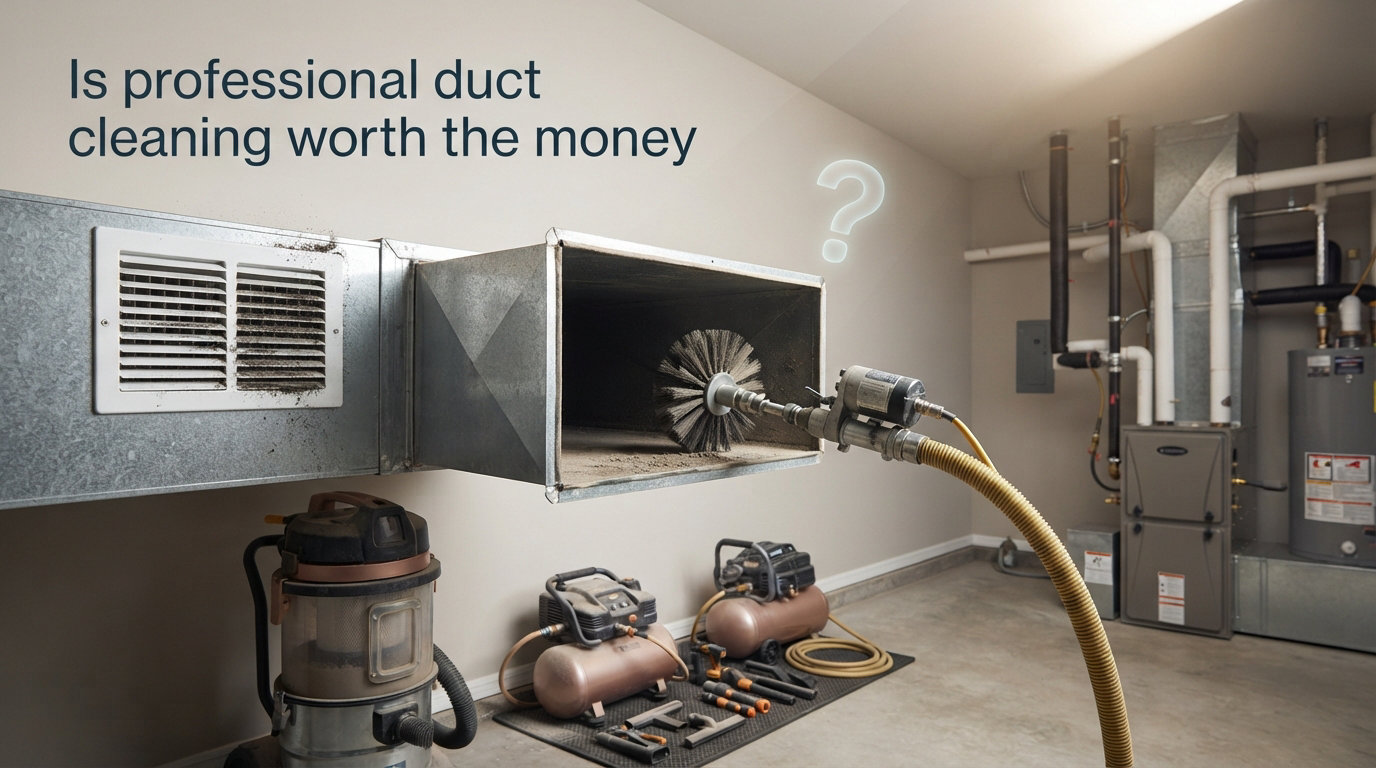
Homeowners hear opposite answers about duct cleaning everywhere. The EPA says routine cleaning is usually unnecessary. Local contractors run “$99 whole-house specials” every spring. I dug through the EPA guidance, the Wirecutter investigation, NADCA standards, and hundreds of homeowner forum threads to settle this for our readers.
The honest answer is that professional duct cleaning is rarely worth the money for a normal, well-maintained home. But there are five specific situations where I tell people to book it without hesitation. Below, I will walk you through both sides, what a fair price looks like in 2026, and how to spot the scams before you pay.
Table of Contents
Is Professional Duct Cleaning Worth the Money? The Short Answer
For most homes, professional duct cleaning is not worth the money. The EPA, Consumer Reports, and the Wirecutter investigative team all reach the same conclusion: if your HVAC system has clean filters, no visible mold, no pest problems, and no renovation debris, duct cleaning will not improve your indoor air quality or lower your energy bill in any measurable way.
That said, the service is genuinely worth the money when one of five conditions is present: visible mold inside the ductwork, rodent or pest infestation, severe post-renovation dust, a recently purchased older home with unknown history, or clogged ducts that are restricting airflow. In those cases, the cost of cleaning is small compared with the health and efficiency consequences of leaving the system alone.
I recommend treating duct cleaning as a targeted fix, not a maintenance habit. Spending hundreds of dollars on a routine cleaning every few years is one of the most common wasted expenses our team sees in household budgets.
What Is Professional Duct Cleaning?
Professional duct cleaning is a service that physically removes dust, debris, biological growth, and other contaminants from the components of your forced-air HVAC system. A proper job covers the supply and return ducts, the registers and grilles, the air handler, the blower motor, the evaporator coil, and the condensate drain pan.
The scope matters. There is a meaningful difference between a quick vacuum of the vent covers and a full-system cleaning. The first is a 30-minute job that does almost nothing useful. The second involves sealing the system, creating negative pressure with a HEPA-filtered vacuum, agitating debris with rotary brushes or air whips, and capturing the contaminants before they can recirculate.
Most professional jobs take between two and four hours for an average single-family home. Anything billed as a 60-minute whole-house cleaning is almost certainly a superficial pass, not a proper cleaning.
How Professional Duct Cleaning Works
A reputable duct cleaning crew starts by inspecting your system. They will look at filter condition, duct material (flex duct versus sheet metal requires different tools), and visible access points. They will then cut small access holes if needed and connect a high-powered vacuum to the trunk line.
With the vacuum running, the technicians run agitation tools through each branch of ductwork to dislodge debris. The vacuum pulls the loosened material out of the home. A proper crew also cleans the air handler, the blower wheel, the evaporator coil fins, and the drain pan, because contaminants collect there too.
After the work, the crew should seal any access holes with metal tape or mastic, not just duct tape. They should show you what they removed and walk you through before-and-after photos of your ducts. If none of those things happen, you did not get a real cleaning.
When Professional Duct Cleaning Is Actually Worth It
Duct cleaning becomes worth the money when you have a specific, identifiable problem inside the ductwork. Here are the five situations where I tell homeowners to go ahead and book a NADCA-certified contractor.
Visible Mold Growth Inside Ducts or HVAC Components
If you open a supply register and see dark, fuzzy growth on the interior surfaces of the duct or on the evaporator coil, you have a mold problem, not just a dust problem. Mold in HVAC systems spreads spores through every room of the house. Cleaning is the right call, but only after you have addressed the moisture source first.
Pest or Rodent Infestation in the Duct System
Mice, rats, squirrels, and insects leave droppings, nests, and carcasses inside ductwork. Beyond the contamination, they chew through flexible ducts and damage wiring. A cleaning plus exclusion work is the right move, and you should also call a pest control professional before the cleaning crew arrives.
After a Major Renovation or Construction Project
Drywall dust, sawdust, and silica from a remodel will travel through the returns and settle deep in the ductwork. No filter can catch all of it. If you have just finished a kitchen or bathroom remodel, a duct cleaning makes sense, especially if you skipped covering the returns during construction.
Buying an Older or Neglected Home
If you just closed on a 30-year-old home with unknown HVAC history, a one-time cleaning gives you a clean baseline. You get a professional inspection of the duct condition at the same time. It is not strictly required, but it is a reasonable part of due diligence.
Severe Clogs That Are Restricting Airflow
If some rooms are not getting airflow and a filter change did not fix it, the ducts themselves may be packed with debris. In that case, cleaning restores airflow and reduces strain on the blower motor. It is worth the money for the energy savings alone.
When Duct Cleaning Is NOT Worth It
The drawbacks of duct cleaning are real, and they are why I recommend against booking the service on a routine schedule. Here is what can go wrong, and why the EPA takes a neutral-to-skeptical stance.
Routine Cleaning Without a Trigger
If your filters are changed regularly and you have no visible contamination, cleaning will not produce a measurable improvement in air quality. The NADCA’s own position is that duct cleaning is not needed on a fixed schedule. It is only warranted when there is a problem to solve.
Cleaning Can Actually Cause Damage
Improper cleaning can damage flex duct, dent sheet metal, and dislodge insulation. It can also release a large cloud of dust into the home if the vacuum seal is not tight. A poorly trained crew can make indoor air quality worse, not better.
It Will Not Fix Allergy Symptoms
If you are booking duct cleaning hoping it will cure seasonal allergies, the research does not support that. Studies have not shown meaningful allergy relief from routine cleaning. A better MERV filter and a properly sized air purifier will outperform duct cleaning for allergy control.
The $99 Whole-House Special Is a Red Flag
Any quote that seems too good to be true usually is. We will cover the scam mechanics below, but the short version: $99 jobs almost always end at $500 or more once the crew is inside your home.
How Much Does Professional Duct Cleaning Cost?
A fair price for a full, proper duct cleaning on a single-family home in 2026 runs between $270 and $1,000, with most homeowners paying somewhere in the middle of that range. The exact number depends on the size of your system, the number of registers, the level of contamination, and the local labor market.
Factors that push the price higher include multiple HVAC systems (some homes have two or three), difficult access (ductwork in concrete slabs or tight crawlspaces), heavy contamination (post-fire, post-flood, or pest infestation), and the presence of a coil cleaning add-on. A reputable quote should spell out exactly what is included.
If a contractor quotes you $99 for “whole-house duct cleaning,” assume that is the starting price for one vent, not the whole system. Legitimate companies almost never advertise that low because the labor cost alone exceeds it. The $99 price is a marketing hook to get a foot in your door.
The Truth About Duct Cleaning Scams
The duct cleaning industry is largely unregulated at the state level, which is why scam tactics are common. Here are the red flags I have seen reported over and over in homeowner forums, and the warning signs to watch for.
Red flag 1: The $99 or “today only” special. Legitimate companies do not price below their own labor cost. If the technician arrives and the price jumps to $500 once they see your system, you are in a bait-and-switch.
Red flag 2: Free indoor air quality test. The technician pulls out a device, shows you a high reading, and tells you that your family is breathing dangerous air. The test is usually meaningless. Dust and VOCs in normal homes register on every cheap meter.
Red flag 3: Photos of “mold” that turn out to be lint or dust. Any technician who claims to see mold in your ducts without a lab sample is guessing. Most dark material in ducts is dust, not mold.
Red flag 4: Pressure to sign today for a discount. Scare tactics work because the decision feels urgent. A reputable contractor will give you a written quote and let you think about it.
Red flag 5: No NADCA certification or proof of insurance. If the contractor cannot show you a current NADCA certification, ask for their air systems cleaning specialist (ASCS) credential, and proof of general liability insurance, hire someone else.
Red flag 6: They will not show you what they removed. A proper cleaning produces visible debris in the vacuum collection. If you never see what came out of your ducts, the cleaning was cosmetic at best.
Red flag 7: They refuse to seal access holes properly. Hand the crew a flashlight and ask to see how they sealed the access points before they leave. Foil tape only, never duct tape.
How to Find a Reputable Duct Cleaning Company
If you have decided you do need a cleaning, the contractor you choose matters more than any other factor. A good crew does the job right. A bad one can damage your system or contaminate your air further. Here is the vetting process I walk friends through.
Look for NADCA certification. NADCA is the National Air Duct Cleaners Association. Their certification means the technician has passed an exam on proper cleaning procedures and agreed to follow their standards. You can verify a contractor’s certification directly on the NADCA website. NADCA-certified companies tend to charge more, but the work is significantly better.
Ask for a written, itemized estimate. The quote should list the number of vents, the number of returns, whether the air handler and coil are included, and any add-on costs. If the quote is a single line item with a single number, push back.
Ask these four questions before signing. First, will you clean the air handler and blower? Second, what vacuum equipment are you using, and is it HEPA-filtered? Third, how will you access the trunk lines? Fourth, can you provide references from the last 30 days?
Get at least three quotes. Prices for the same scope of work can vary by a factor of three in the same metro area. If one quote is far below the others, ask yourself why.
Check reviews carefully. Look for reviews that mention specific details: the number of vents cleaned, the time on site, before-and-after photos. Generic five-star reviews without substance are less helpful.
DIY Inspection: How to Check Your Own Ducts First
Before you spend anything, spend 30 minutes inspecting your own system. Most homeowners find that what they thought was a problem was actually normal dust buildup at the registers, which is normal and not a reason to clean.
Step 1: Turn off the HVAC system. Always kill power at the thermostat and the breaker before opening anything.
Step 2: Remove a few supply and return grilles. Use a screwdriver. Look inside with a flashlight. Normal dust on the interior of sheet metal ducts looks grey and powdery. Mold looks fuzzy and is often black, green, or pink. Pest droppings look like small dark pellets.
Step 3: Use a borescope or a phone endoscope. A $25 USB endoscope plugs into your phone and lets you see deep into the ducts without cutting anything open. This is the single best diagnostic tool for a homeowner.
Step 4: Inspect the evaporator coil and filter area. Pop the blower compartment door. If the evaporator coil is caked with dust or the drain pan has standing water and slime, that is more important to address than the ducts themselves.
Step 5: Replace the filter and run the system. If your air smells clean and rooms reach temperature normally, you probably do not need a professional cleaning. If something smells off, see visible growth, or you find pest activity, schedule the pro.
Preventive Maintenance: Better Than Cleaning
For most homeowners, the best answer to “is it okay to never clean air ducts?” is yes. A well-maintained HVAC system with the right filter rarely needs duct cleaning. Here is what to do instead, and what to expect if you switch to this approach.
Upgrade to a MERV 11 to MERV 13 Filter
A MERV 11 to 13 filter captures far more particulate matter than the cheap MERV 8 filters that come with most systems. That upgrade alone reduces the dust load inside your ductwork. Replace it every 60 to 90 days, or as recommended by the manufacturer.
Stick to a Real HVAC Maintenance Schedule
A yearly HVAC tune-up from a licensed technician catches problems before they become duct issues. They will clean the coil, flush the drain, check refrigerant, and inspect the ductwork for obvious damage. That single annual visit does more for indoor air quality than a duct cleaning every five years.
Control Moisture and Humidity
Mold cannot grow without moisture. Keep indoor relative humidity between 30 and 50 percent. Fix plumbing leaks under sinks, near air handlers, and around condensation lines as soon as you notice them. Address any water intrusion in the crawlspace or basement within 48 hours.
Consider an Air Purifier Instead
For allergy and asthma sufferers, a properly sized HEPA air purifier in the bedroom outperforms duct cleaning at a fraction of the ongoing cost. Move it from room to room as needed. This is what Wirecutter recommends instead of duct cleaning for most households.
Frequently Asked Questions
What are the drawbacks of duct cleaning?
The main drawbacks are cost without clear benefit for most homes, the risk of damage to flexible ductwork from improper agitation, the release of dust and contaminants during the cleaning process if the vacuum seal fails, and the prevalence of bait-and-switch pricing that turns a $99 quote into a $500 bill. For routine homes without a specific contamination problem, the drawbacks generally outweigh any benefit.
Does cleaning air ducts really make a difference?
In most homes, no. Studies by the EPA and independent researchers have not found measurable improvements in indoor air quality or HVAC efficiency from routine duct cleaning. It does make a measurable difference when there is visible mold, pest contamination, severe clogs, or major renovation debris in the system. In those specific situations, cleaning is justified.
Is duct cleaning a sham?
Duct cleaning is not inherently a sham. The service is real and can be valuable in specific situations, including mold remediation, pest cleanup, post-renovation cleanup, and severely clogged systems. The sham element comes from the industry’s aggressive marketing, bait-and-switch pricing, and scare tactics that push the service on homeowners who do not need it. The work itself, done by a NADCA-certified crew, is legitimate.
Is it okay to never clean air ducts?
Yes, it is generally okay to never clean air ducts. The EPA has never recommended routine duct cleaning on a schedule. If you change your filter regularly, control humidity, address water leaks promptly, and schedule yearly HVAC maintenance, your ducts can stay clean for the life of the system without a professional cleaning.
How often should air ducts be cleaned?
There is no fixed schedule. NADCA recommends cleaning only when there is a visible problem, not on a calendar basis. For most households, that means never, or once every 10 to 15 years if your system has never had an issue. Homes with pets, smokers, recent renovations, or allergy sufferers may need cleaning more often, but only after inspection confirms there is something to clean.
How long does professional duct cleaning take?
A proper duct cleaning on an average single-family home takes between two and four hours. Jobs that finish in under an hour are almost certainly superficial, since they do not allow time to access the air handler, blower, and trunk lines, or to seal the system properly. Multi-system homes or heavy contamination jobs can take a full day.
The Bottom Line on Duct Cleaning
So, is professional duct cleaning worth the money? For the typical homeowner in 2026, the answer is no. Skip the routine cleaning, change your filter on schedule, control moisture, and book a yearly HVAC tune-up instead.
If you have visible mold, a pest problem, post-renovation debris, or a recently purchased older home, professional duct cleaning is worth the money. Spend the time to find a NADCA-certified contractor, get three written quotes, and inspect your system with a flashlight and an endoscope before you sign anything.
Our team will keep this guide updated as new research comes out. If you want a closer look at MERV ratings, air purifier recommendations, or how to evaluate an HVAC maintenance contract, let us know.