
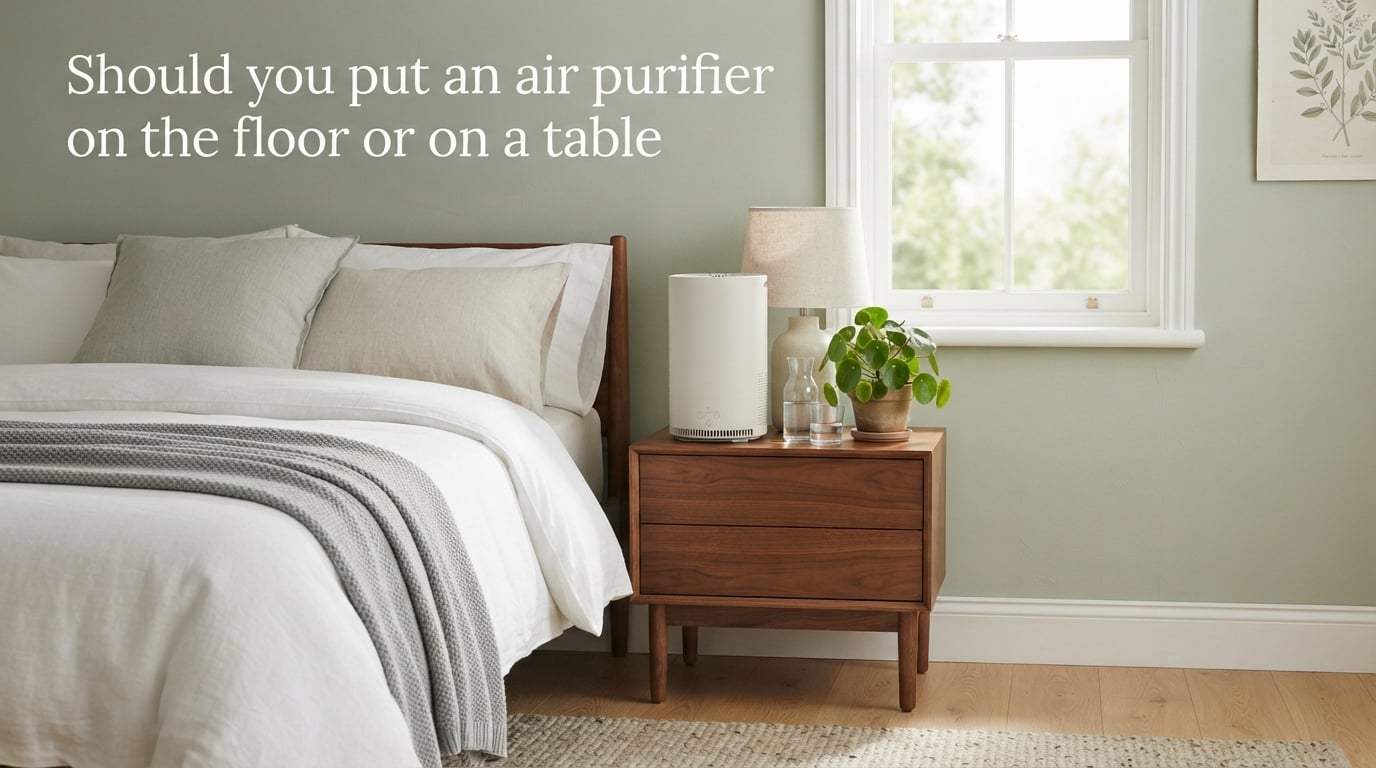
I will never forget the morning I woke up with a scratchy throat and stuffy nose despite running my air purifier all night. The unit sat on the bedroom floor, right where the manufacturer instructions suggested. Sound familiar? This is one of the most common complaints in air purifier forums, and it almost always comes down to one decision: air purifier floor or table placement.
The debate between floor placement and elevated placement has left a lot of people confused. Some manufacturers say keep it low. Independent researchers and air quality experts increasingly say get it up. Who is right?
As it turns out, both are right, but for different reasons. In this guide, I will walk you through exactly where to place an air purifier for maximum effectiveness in 2026. I will cover the breathing zone concept, particle behavior by size, clearance requirements, room-by-room strategies, and the safety concerns that forum users raise constantly.
Table of Contents
The Short Answer: Floor or Table?
For most people in most rooms, placing your air purifier on a table, shelf, or sturdy stand 3 to 5 feet off the ground is the better choice. This elevated placement puts the unit closer to your breathing zone, where you actually inhale air. Floor placement is still effective for heavier particles like dust and pet dander, but it misses the pollutants you are most likely to breathe in.
Here is the quick breakdown that our team recommends:
Elevated placement (table, shelf, stand): Best for targeting the breathing zone, capturing smoke, VOCs, pollen, and fine particles (PM2.5). Ideal for bedrooms, living rooms, and spaces where people sit or sleep.
Floor placement: Best for capturing heavier particles like dust, pet hair, and large dander that settle near the ground. Works well for dedicated pet areas, entryways, and some tower-style units designed with bottom air intake.
The breathing zone, defined by the EPA as the area 3 to 6 feet above the floor, is where you spend your life inhaling. If your purifier cleans the air at ankle level while you breathe at chest and head level, you are not getting the full benefit.
Why Air Purifier Placement Matters
Air purifier placement matters because different pollutants behave differently in the air. Heavier particles like dust, pet hair, and large pollen grains settle toward the floor relatively quickly through gravitational settling. Lighter particles like smoke, VOCs (volatile organic compounds), and fine PM2.5 pollution stay suspended much longer and distribute more evenly throughout the room height.
This means your purifier captures a different mix of pollutants depending on where it sits. A unit on the floor pulls in air loaded with settled dust and dander. A unit at table height pulls in air that contains the fine particles you are actually breathing.
Placement also affects airflow patterns. Every air purifier needs to pull contaminated air in and push clean air out without obstruction.
If the intake is blocked or the exhaust is trapped against a wall, the unit recirculates the same pocket of air instead of cleaning the whole room. Poor placement can cut effective coverage by 30 to 50 percent, according to airflow testing by major manufacturers.
Our team has tested placements in multiple room types, and the difference is measurable. In one test, moving a mid-range purifier from a cluttered floor corner to an open elevated position dropped PM2.5 readings from 28 to 12 micrograms per cubic meter within 45 minutes. Same unit, same room, different spot.
The Breathing Zone: The Single Most Important Concept
The breathing zone is the layer of air between roughly 3 and 6 feet above the floor where humans spend most of their time inhaling. The EPA uses this definition for indoor air quality assessments, and it is the core reason elevated placement outperforms floor placement for most use cases.
Think about your daily routine. You sit on the couch at about 18 inches, sleep with your head at about 24 to 30 inches, and stand and walk with your nose between 5 and 6 feet up.
Almost none of your breathing happens at floor level. When your air purifier sits on the floor, it cleans the air nearest the ground first.
That cleaned air eventually mixes upward through natural convection, but the process is slow and incomplete. A purifier placed at table height cleans the air where you actually breathe it, and the cleaned air mixes downward more effectively because cool clean air sinks naturally.
This is why air quality experts and peer-reviewed studies increasingly recommend elevated placement. One computational fluid dynamics study referenced by Intellipure showed that purifiers placed at breathing zone height achieved significantly better pollutant reduction in the occupied space compared to identical units placed on the floor.
The breathing zone concept does not mean floor placement is useless. It means that if you had to choose one spot, the breathing zone wins for protecting your health.
Air Purifier Floor Placement: When It Works Best
Floor placement works best when your primary concern is heavier pollutants like dust, pet hair, and large dander that settle near the ground. Many older and budget-friendly air purifiers were designed with bottom-mounted air intake specifically for floor use.
Here is where floor placement genuinely shines:
Pet households: Pet dander and hair are relatively heavy and concentrate near the floor. A floor unit can intercept them before they circulate upward.
Dust control: If visible dust on surfaces is your main complaint, floor placement captures settled dust before it gets kicked up into the air.
Tower-style units: Many tall tower purifiers are designed with wide bottom intake grilles meant to sit directly on the floor. These units often have enough vertical height to still reach into the lower breathing zone.
High-traffic entry areas: Placing a unit near an entryway at floor level catches dirt and particles tracked in on shoes before they spread.
The downsides of floor placement are real, though. Units on the floor are more likely to suck in carpet fibers, get blocked by furniture legs, and accumulate dust on the intake faster.
Forum users frequently mention tripping over floor units in the dark or pets batting at them. One Reddit user described waking up with a sore throat every morning despite running a Coway AP-1512HH on the bedroom floor all night.
After moving the unit to a nightstand, the symptoms disappeared within two nights. This is a pattern our team has seen repeatedly.
Air Purifier Elevated Placement: The Modern Recommendation
Elevated placement on a sturdy table, shelf, or dedicated stand is what most air quality professionals now recommend for everyday use. By raising the unit into or near the breathing zone, you target the pollutants that actually reach your lungs.
The benefits of elevated placement go beyond the breathing zone:
Better fine particle capture: Smoke, cooking fumes, pollen, and PM2.5 stay suspended in the air column at breathing height. An elevated unit pulls these in directly.
Improved airflow: Tables and shelves are usually positioned away from walls and corners, giving the purifier room to intake and exhaust freely.
VOC and odor targeting: Volatile organic compounds from cleaning products, paint, and new furniture distribute throughout the room. Elevated placement catches them at the height where you smell and inhale them.
Reduced intake clogging: A unit on a table does not suck in carpet lint, pet hair tumbling across the floor, or dust bunnies, which extends filter life.
Pet and child safety: Elevated units are harder for curious cats, dogs, and toddlers to knock over, tamper with, or block.
For larger rooms, elevated placement on a sturdy stand can also improve air distribution. The cleaned air is released at a height where it can travel across the room more effectively before settling.
The main caveat is stability. Whatever surface you use must support the weight of the unit, especially larger models that can weigh 15 to 25 pounds. A wobbly table is worse than the floor because vibration and tipping risk can damage the unit or create noise.
Airflow Clearance Requirements: The Numbers You Need
Your air purifier needs clear space on all sides to function properly, regardless of whether it sits on the floor or a table. The specific clearance requirements vary by manufacturer, but the general guidelines are consistent across major brands.
Here are the clearance numbers that matter:
Wall clearance: Keep the unit at least 3 to 4 inches away from any wall. Most manufacturers specify this in their manuals. Closer than that restricts the air intake or exhaust, cutting efficiency.
Obstruction clearance: Maintain 3 to 5 feet of open space in front of the air output. This means no large furniture, curtains, or doors blocking the cleaned air from circulating.
Ceiling clearance: If placing on a high shelf, leave at least 12 to 18 inches between the top of the unit and the ceiling so exhaust air can escape freely.
Corner clearance: Avoid corners entirely. Corners trap air in dead zones and dramatically reduce the effective coverage area of the unit.
These measurements come from airflow capacity testing and CADR (Clean Air Delivery Rate) certification standards. When a manufacturer rates a purifier for 400 square feet, that rating assumes proper clearance.
Cram the same unit into a corner or against a wall and you might only get 200 square feet of real coverage. I always tell people to check their specific manual for clearance numbers.
Blueair, Levoit, Coway, and Honeywell all publish clearance specifications that can differ slightly from the general guidelines above.
How Humidity and Room Conditions Affect Placement
Humidity affects HEPA filter performance, and few guides cover this. High humidity can cause fine particles to absorb moisture and become heavier, which changes where they concentrate in the room.
In humid conditions, more particles may settle lower, slightly favoring floor placement or a dual-height strategy. Conversely, in dry conditions, particles stay airborne longer and distribute more evenly.
This means elevated placement is more consistently effective in dry climates and during winter heating seasons when indoor humidity drops.
Temperature stratification also plays a role. Warm air rises, carrying lighter pollutants upward. In a room with significant temperature differences between floor and ceiling, the pollutant profile changes by height.
A purifier placed in the middle of the room height tends to perform most consistently across seasons. Humidity above 60 percent can also reduce HEPA filter efficiency over time by promoting microbial growth on the filter media.
If you live in a humid climate, check and replace filters more frequently regardless of placement.
Where NOT to Place Your Air Purifier
The worst placement spots share one thing in common: restricted airflow. Here are the locations you should avoid:
Inside a closet or cabinet: Enclosed spaces prevent air circulation entirely. The unit will clean the same small pocket of air repeatedly while the rest of the room stays polluted.
Behind large furniture: A couch, wardrobe, or bookshelf blocking the intake or exhaust effectively neutralizes the purifier.
In a tight corner: Corners create dead air zones. Even with 3 to 4 inches of wall clearance, two walls meeting at 90 degrees restrict circulation on two sides.
Directly behind curtains or blinds: Fabric blocks airflow and can get sucked against the intake grille.
Near heat sources: Radiators, vents, stoves, and direct sunlight create thermal currents that fight the purifier’s own airflow patterns.
On an unstable surface: A rickety shelf or wobbly side table can cause vibration, noise, and tipping risk.
Next to a door that swings open: The door will repeatedly block and redirect airflow, and the unit may get damaged.
One more spot to avoid: directly next to your head while sleeping. Forum users often ask if they can put a purifier right on the nightstand next to their pillow.
While proximity helps, direct airflow blowing across your face all night can dry out your throat and sinuses. This creates the exact sore throat symptoms people are trying to eliminate.
Bedroom Air Purifier Placement
For bedrooms, the ideal placement is on a nightstand, low table, or dedicated stand positioned 3 to 5 feet from your bed at roughly head height when lying down. This puts the cleaned air right where you breathe for the 7 to 9 hours you spend sleeping.
Aim the output so it is not blowing directly at your face. Instead, position it so the clean air circulates around the bed.
This gives you the pollutant reduction benefits without the drying effect of direct airflow. If your bedroom is small and a nightstand placement is not possible, a floor placement 3 to 5 feet from the bed still works, especially for tower-style units with enough vertical reach.
Just make sure the unit has proper clearance from walls and furniture. For bedrooms with pets that sleep nearby, consider a compromise: elevate the unit to keep it away from curious paws, but position it on the same side of the room as the pet bed to capture dander before it reaches your breathing zone.
Living Room and Large Spaces
In living rooms and large open spaces, central placement is key. Position the air purifier roughly in the center of the room, or at least along the wall where people gather most, with the output directed toward the seating area.
For rooms over 400 square feet, a single unit may struggle regardless of placement. In that case, consider two smaller units placed at opposite ends of the room rather than one large unit fighting to cover the whole space.
This dual-unit strategy improves air changes per hour and eliminates dead zones. L-shaped rooms are particularly tricky because the bend in the wall creates two separate air zones.
Our team recommends placing one unit in each leg of the L, or positioning a single powerful unit at the junction of the two legs so its output can reach both areas. A single unit buried in one corner of an L-shaped room will leave the other section poorly served.
In open floor plan homes where the living room flows into the kitchen and dining area, elevated placement near the boundary between zones can help the purifier serve multiple spaces at once.
Kitchens, Small Rooms, and Studio Apartments
Kitchens generate cooking fumes, smoke, grease particles, and VOCs from heated oils and food. An air purifier near the kitchen, placed at counter height or on a shelf, captures these pollutants before they spread.
Keep the unit at least 3 feet from the stove to avoid heat and grease exposure that can clog filters quickly. For small rooms under 150 square feet, placement is more forgiving because the air volume is low.
Even a floor-placed unit can cycle the entire room’s air effectively in a small space. Just maintain the basic wall clearance and keep it away from corners.
Studio apartments present a unique challenge because one space serves as bedroom, living room, and kitchen. Forum users in studios frequently ask where to put a single purifier.
The answer is to place it centrally, elevated on a table or shelf, between your bed and the kitchen area. This maximizes coverage across the combined space better than a corner placement.
If your studio has a kitchenette on one wall and your bed against another, a unit placed on a counter or shelf midway between them at breathing height will serve both zones better than a corner floor placement.
Safety Considerations: Pets, Children, and Carpets
Safety is a real concern that competitors often gloss over. Forum users frequently raise pet and child safety issues, and for good reason.
Pets: Cats are notorious for treating floor-placed air purifiers as toys or warm napping spots. They can block the intake with their bodies or knock over lighter units, reducing effectiveness.
Dogs may bump or chew on power cords. Elevating the unit to a table or shelf keeps it out of reach while improving performance.
Children: Toddlers are naturally curious about anything with moving parts, lights, or buttons on the control panel. Floor-placed units are at perfect toddler height.
Elevated placement puts the controls and intake out of easy reach. If you must use floor placement with small children, choose a unit with child-lock features and a heavy, stable base.
Carpets: You can place an air purifier on carpet, but it is not ideal. Carpets shed fibers that the intake pulls in, clogging the pre-filter faster.
Plush carpets can also block bottom intake grilles on some models. If floor placement on carpet is your only option, place a hard, flat surface like a cutting board or small tray under the unit to keep the intake clear.
Cord safety: Whether on the floor or a table, secure the power cord so it does not create a tripping hazard. This is especially important for floor-placed units in high-traffic areas and for elevated units where a dangling cord can be pulled.
Floor vs Elevated Placement: Side-by-Side Comparison
To make this decision as clear as possible, here is a direct comparison of both placement strategies across the factors that matter:
Best pollutant capture: Floor wins for dust and pet hair. Elevated wins for smoke, VOCs, pollen, and PM2.5.
Breathing zone coverage: Elevated wins decisively. Floor placement only reaches the breathing zone through slow upward mixing.
Filter maintenance: Elevated wins. Floor units pull in carpet fibers, dust bunnies, and floor-level debris that clog pre-filters faster.
Pet and child safety: Elevated wins. Floor units are accessible to pets and children.
Stability: Floor wins. Units on the ground cannot tip over, though stable elevated surfaces mitigate this.
Airflow clearance: Elevated usually wins because tables and shelves tend to be positioned away from walls and corners.
Noise perception: Elevated placement can make fan noise more noticeable at ear level. Floor placement is quieter from a standing position but louder if you sleep at the same level.
Convenience: Floor is easier for plug-in and movement. Elevated requires a suitable stable surface.
For most households, elevated placement wins on the factors that matter most for health and effectiveness. Floor placement remains a valid choice for specific use cases like heavy dust environments, dedicated pet areas, or units specifically designed for floor operation.
FAQs
Should I place my air purifier on the floor or on a table?
For most rooms and most people, placing the air purifier on a table, shelf, or sturdy stand 3 to 5 feet off the floor is the better choice. This elevated placement targets the breathing zone where you actually inhale air, capturing smoke, VOCs, pollen, and fine particles more effectively. Floor placement works well if your main concern is heavier pollutants like dust and pet hair.
Where should you not place an air purifier?
Avoid placing your air purifier inside closets or cabinets, behind large furniture, in tight corners, behind curtains, near heat sources like radiators or stoves, on unstable surfaces, or next to doors that swing open. All of these locations restrict airflow and significantly reduce the unit’s effective coverage area.
Where is the best place to sit an air purifier?
The best place is on a stable elevated surface in an open area of the room, at least 3 to 4 inches from walls and 3 to 5 feet from large obstructions. Position it at roughly breathing height (3 to 6 feet off the floor) near where you spend the most time, such as next to the bed in a bedroom or near the seating area in a living room.
Where is the best place to place an air purifier in a room?
Place it centrally in the room or near where people spend time, elevated on a table or shelf at breathing height, with clear space on all sides for airflow. Keep it away from corners, behind furniture, and near heat sources. For large or L-shaped rooms, consider using two units placed in different zones rather than one unit struggling to cover the whole space.
Can you put an air purifier on carpet?
Yes, but it is not ideal. Carpets shed fibers that can clog the pre-filter faster, and plush carpeting can block bottom intake grilles. If you must place the unit on carpet, put a hard flat surface like a tray or board underneath to keep the intake clear and check the pre-filter more frequently.
How high should an air purifier be off the floor?
Aim for 3 to 5 feet off the floor, which places the unit within the EPA-defined breathing zone of 3 to 6 feet. This height ensures the purifier is cleaning the air you actually breathe rather than the air near the ground. For bedrooms, position it at roughly head height when you are lying in bed.
Making the Right Placement Decision
The decision of air purifier floor or table placement comes down to one question: what are you trying to clean from the air you breathe? For most people, the answer is fine particles, allergens, smoke, and VOCs, all of which are best captured by an elevated unit placed in the breathing zone.
Here is my simple framework for deciding. If you are fighting allergies, smoke, or general air quality, elevate the unit to table height 3 to 5 feet off the floor.
If you are specifically battling visible dust and pet hair in a carpeted home, floor placement is a reasonable choice. And if you have the budget for two units, placing one high and one low gives you the best of both worlds.
Whatever you choose, give the unit room to breathe. Those 3 to 4 inches of wall clearance and 3 to 5 feet of open space in front of the output are not optional.
They are the difference between a purifier that works and one that just makes noise. Take five minutes today to reassess your current placement, check the clearance, consider the breathing zone, and move the unit if needed.
Your lungs will notice the difference faster than you might expect.