
If you wake up congested, sneezing, or reaching for allergy meds more mornings than you’d like, your air purifier placement might be the problem, not the purifier itself. After comparing notes with sleep specialists, allergy sufferers, and HVAC pros, one thing became clear: the same unit can be twice as effective or nearly useless depending on where it sits in the room. Here is exactly where to place an air purifier in a bedroom for the best results, based on EPA-backed guidance, real-world testing data, and the airflow science most guides skip.
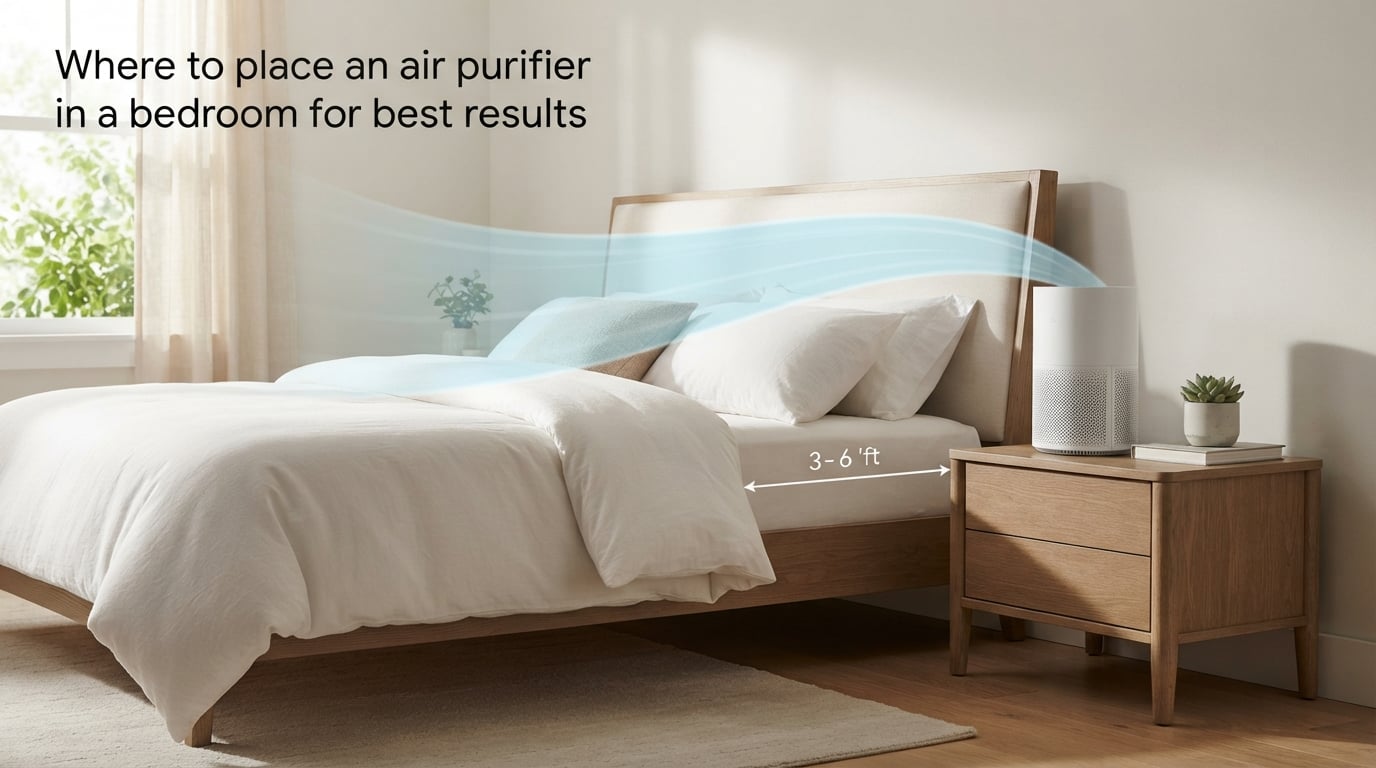
The short version: place your air purifier 3 to 6 feet from the head of your bed, elevated on a nightstand or small table, with at least 12 inches of clearance from any wall. Point the clean-air output toward your sleeping position without blasting it directly at your face. Keep the bedroom door closed while it runs.
That setup puts filtered air directly into your breathing zone, the small bubble of air around your head where you actually spend 7 to 9 hours every night inhaling. Get that zone clean and the rest of the room follows. Get it wrong and you are paying for electricity to clean air you never breathe.
Table of Contents
The Quick Answer: Best Placement in Under 30 Seconds
Best spot: On a nightstand or sturdy table, 3 to 6 feet from the head of your bed.
Height: Roughly level with or slightly above your mattress, around 24 to 36 inches off the floor.
Wall clearance: At least 12 inches, ideally 15 inches, on every side with an intake vent.
Air direction: Clean-air output aimed toward your pillow, not directly into your face.
Door status: Closed. Always closed while the unit runs overnight.
Run time: Continuous, on the lowest quiet setting that still moves enough air for your room size.
Follow those six rules and you have already solved 80 percent of bedroom air purifier placement problems. The rest of this guide explains the why behind each one, walks through the science, and covers the edge cases that quick summaries gloss over.
Where to Place an Air Purifier in a Bedroom: The Full Guide
Where to place an air purifier in a bedroom comes down to three variables that work together: distance from your bed, height off the floor, and clearance from walls and furniture. Get all three right and your unit runs at full effectiveness. Get any one wrong and you lose 30 to 50 percent of your cleaning power, sometimes more.
The reason placement matters so much comes down to physics. An air purifier only cleans the air that physically passes through its filter. The U.S. Environmental Protection Agency (EPA) explains this in its residential air cleaner guidance: a unit’s Clean Air Delivery Rate, or CADR, tells you how many cubic feet of clean air it produces per minute under ideal conditions. Ideal conditions means unobstructed airflow in every direction. Real bedrooms are almost never ideal, which is why effective CADR is usually much lower than rated CADR.
Translation: the same $200 purifier that hits its rated CADR in a test lab might deliver half that performance in your bedroom if you shove it in a corner behind a laundry hamper. Placement is the single biggest variable you control after buying the unit.
Distance From the Bed: The 3-to-6-Foot Rule
The sweet spot for bedroom placement is 3 to 6 feet from the head of your bed. That range shows up consistently across allergist-reviewed sources, HVAC testing data, and feedback from long-term air purifier users.
Why that specific distance? It is close enough that freshly filtered air reaches your breathing zone before it has time to mix with the rest of the room’s airborne dust, pollen, and pet dander. It is also far enough that the output is not blasting your face all night, which dries out sinuses and disrupts sleep.
Some sources push the recommendation out to 6 to 10 feet. That works in larger bedrooms where you want the unit to clean the whole room evenly rather than focus on the breathing zone. But for most standard bedrooms, 3 to 6 feet delivers better measurable results for the air you actually inhale overnight.
If your bedroom is too small to hit even 3 feet of clearance, do not panic. Place the unit as far from the bed as the room allows, elevate it off the floor, and run it on a higher fan speed. Small rooms clean faster anyway because there is less total air to filter.
Height and Elevation
Most airborne particles you care about, dust mite allergen, pet dander, pollen fragments, and fine PM2.5 pollution, do not settle neatly on the floor. They stay suspended in the lower 3 to 4 feet of room air, exactly the layer you sleep in.
That is why a nightstand or low table is the ideal platform. The purifier’s intake sits right in the particle layer where the problem actually lives, and the clean-air output lands near your pillow instead of getting lost under the bed.
Avoid placing the unit directly on the floor if you can help it. Floor placement pulls in dust bunnies, hair, and carpet fibers that clog filters faster, and the clean air tends to skim along the floor instead of reaching your head. More on the floor-versus-elevated debate in the section below.
Wall Clearance: Leave 12 Inches Minimum
This is the placement rule people break most often, and it costs them the most performance. Air purifiers need to pull air in from the sides and push it out the front, top, or both. Every inch of clearance you remove starves the unit of intake air.
The general rule is 12 inches minimum from any wall, with 15 inches being safer for units that have side or rear intake vents. Some manufacturers specify up to 18 inches in their manuals. Check your model’s documentation and follow whichever number is larger.
Clearance applies to furniture too. A nightstand shoved against the intake side, a dresser three inches away, curtains draped over the output vent, all of these choke airflow the same way a wall does. Walk around your purifier with a tape measure if you have to. Most people are shocked to find they have been suffocating their unit for months.
Understanding the Breathing Zone
The breathing zone is the single most useful concept for air purifier placement, yet most guides barely mention it. Once you understand it, every placement decision becomes obvious.
Your breathing zone is the roughly 2-foot bubble of air immediately around your nose and mouth while you sleep. It is the only air in the entire bedroom that ends up inside your lungs. The air across the room, the air near the closet, the air up by the ceiling, none of it matters for your allergy symptoms or sleep quality. Only the breathing zone matters.
This reframes the entire placement question. You are not trying to clean the bedroom. You are trying to clean a 2-foot bubble that follows your head around all night. The rest of the room cleans up gradually as a side effect.
Proper breathing zone placement means positioning the purifier so its clean-air output continuously refreshes that bubble without blowing directly into your face. Aim the airflow across the head of the bed, slightly above pillow level. The clean air mixes into the breathing zone and pushes contaminated air away from your face.
This is also why corner placement usually fails. A purifier in the corner cleans the corner beautifully. The air near your pillow, eight feet away, keeps recycling dust and allergens all night. The unit runs at full power and you still wake up stuffed up because it was cleaning the wrong air.
One more piece of breathing zone science worth knowing: effective CADR drops fast with distance. A purifier rated at 250 CADR might deliver 200 effective CADR at 3 feet from your bed, 120 at 6 feet, and under 60 at 12 feet. Distance from your head matters more than the spec sheet suggests.
Should Your Air Purifier Be on the Floor or Elevated?
This is one of the most-asked questions in air purifier forums, and the answer depends slightly on your floor type and room layout. But for most bedrooms, elevated wins.
Here is the case for elevating on a nightstand, side table, or low shelf. First, the intake sits at the height where the particles you actually breathe are concentrated. Floor-level dust and carpet fibers stay near the floor, while the finer allergens that trigger symptoms stay suspended higher up. Second, the clean-air output reaches your breathing zone instead of getting trapped under furniture. Third, elevation keeps the intake away from carpet fibers, pet hair tumbleweeds, and dust bunnies that would otherwise clog your HEPA filter twice as fast.
The case for floor placement is mostly practical. Large, heavy units are difficult to lift onto furniture. Some bedrooms genuinely have no free surface. And a few high-end units are explicitly designed to sit on the floor with a vertical airflow pattern that pushes clean air up toward the ceiling, where it then circulates back down.
If you must place the unit on the floor, follow these rules. Move it 12 to 18 inches away from the wall. Never put it under the bed, where the output gets blocked by the mattress and the intake pulls in dust trapped between the bed frame and the floor. Vacuum the floor around it weekly to slow filter clogging. And angle the clean-air output upward so the airflow has a chance to reach breathing height.
Under-bed placement deserves a special callout because it is universally discouraged and yet surprisingly common. The mattress blocks the output almost entirely, the intake suffocates on carpet dust, and the unit works twice as hard for half the result. If your only free spot is under the bed, you need to rearrange the room, not hide the purifier.
Door Closed or Open: What Actually Works
Close the door. That is the short answer, and it applies to almost every bedroom setup.
A closed door turns your bedroom into a contained air volume that the purifier can actually clean. An open door turns it into a hallway extension, and the unit spends the night fighting a losing battle against air from the rest of the house. Open doors are why people report their air purifier “doesn’t seem to do anything.”
The math backs this up. A typical bedroom is around 1,000 to 1,500 cubic feet of air. A mid-range purifier with a 200 CADR can fully cycle that volume every 5 to 7 minutes with the door closed, hitting 4 to 6 full air changes per hour. That is the threshold the EPA and allergy specialists recommend for genuine allergen reduction. Open the door and that same unit might only achieve 1 air change per hour, far below the level needed to make a measurable difference for allergies or asthma.
If you sleep with the door open for pets, kids, or airflow reasons, you can still get value from an air purifier, but expect to need a higher CADR unit and to run it on a faster, louder fan speed. The other option is a baby gate or pet door in the bottom of the bedroom door, which keeps the air sealed while still letting animals move through.
Windows follow the same logic. Closed is better. A cracked window in summer feels nice, but it dumps unfiltered outside air, pollen, and humidity straight into the breathing zone you are trying to protect. If you need ventilation, run the purifier on high for 30 minutes before bed with everything closed, then crack the window if you must while you sleep.
Air Purifier Placement Mistakes to Avoid
Most placement mistakes fall into a small set of repeat offenders. Here are the ones that quietly sabotage your air quality night after night.
1. Shoving the unit in a corner. Corners block airflow on two sides, cutting effective CADR by 30 to 50 percent. The unit cleans the corner beautifully and leaves the rest of the room, including your breathing zone, full of allergens. Pull it at least a foot away from both walls.
2. Placing it under the bed. The mattress blocks the output, the floor feeds the intake dust, and you effectively have no purifier. Rearrange the room instead.
3. Tucking it behind furniture. A dresser, laundry hamper, or stack of books in front of the intake starves the unit just like a wall does. Walk around it with a tape measure and clear anything within 12 inches.
4. Pointing the output directly at your face. Direct airflow dries out sinuses, irritates eyes, and can disrupt sleep. Angle the output across the head of the bed so clean air mixes into the breathing zone without hitting your face.
5. Placing it near heat sources or electronics. TVs, lamps, heating vents, and radiators create warm air currents that fight the purifier’s airflow pattern. Heat sources also force some units to work harder or trip thermal sensors. Keep the purifier at least 3 feet from any heat-producing device.
6. Running it only while you are awake. Air purifiers need time to clean a room. If you turn it off at bedtime, you are sleeping in air that has been collecting dust, dander, and VOCs all day. Run it for at least an hour before bed and leave it on, on the lowest quiet setting, all night.
7. Forgetting to replace the filter. A clogged HEPA filter reduces CADR faster than any placement mistake. Check the filter indicator monthly and replace on the manufacturer’s schedule, or sooner if you have pets or live in a dusty area.
8. Ignoring the unit’s airflow direction. Some purifiers pull air in from the back and push it out the front. Others intake from the sides and exhaust upward. Read the manual and orient the unit so the intake faces open room air, not a wall or headboard.
Special Bedroom Situations
Standard advice covers most bedrooms, but a few situations call for adjustments.
Small bedrooms under 100 square feet: You can place the unit almost anywhere that is not in a corner or under furniture. Aim for 3 to 4 feet from the bed if space allows. Smaller rooms clean faster, so a lower CADR unit is fine.
Large master bedrooms over 200 square feet: Center the unit between the bed and the main pollution source (usually the door or a pet bed). You may also benefit from two smaller units placed on opposite sides of the room rather than one large unit.
Bedrooms with pets: Place the purifier between the pet’s sleeping spot and your bed. This intercepts dander before it reaches your breathing zone. Expect to replace filters more often.
Bedrooms with HVAC vents: Do not place the purifier directly under or next to a supply vent. The HVAC airflow will fight the purifier’s circulation pattern. If the vent is in the ceiling, this is less of an issue than a floor or wall vent.
Bedrooms near a window facing a busy street: Keep the unit between the window and your bed, with the window closed. This intercepts traffic-related PM2.5 before it reaches your breathing zone.
Shared bedrooms with two sleepers: Place the purifier at the head of the bed, centered between both pillows, so the clean-air output reaches both breathing zones. Avoid placing it on one person’s nightstand only.
Frequently Asked Questions
What is the 2 3 rule for air purifiers?
The 2 3 rule is a simple placement guideline: keep your air purifier at least 2 feet away from any wall or furniture and at least 3 feet away from your bed. This gives the unit enough clearance to pull in air on all sides and prevents the output from blowing directly at your face while you sleep.
Should the bedroom door be closed when using an air purifier?
Yes. A closed door lets the air purifier cycle the entire room volume every 5 to 7 minutes, hitting 4 to 6 full air changes per hour. With the door open, that drops to around 1 air change per hour, which is rarely enough to reduce allergens meaningfully. Close the door whenever the unit is running.
How long should you run an air purifier in a bedroom?
Run it for at least 1 hour before bed to pre-clean the room, then leave it on the lowest quiet setting all night. Most allergy specialists recommend 8 to 12 hours of daily operation for a bedroom. Continuous running uses less electricity than you might expect on low speed and keeps the breathing zone consistently clean.
Where not to put air purifier?
Avoid placing your air purifier in a corner, under the bed, behind furniture, within 12 inches of any wall, near heat sources or electronics, in a bathroom attached to the bedroom, or directly in front of an HVAC vent. All of these locations choke airflow, block the intake, or fight the unit’s natural circulation pattern.
Where is the best spot to put an air purifier in a bedroom?
The best spot is on a nightstand or small table, 3 to 6 feet from the head of your bed, with at least 12 inches of clearance from any wall or furniture. Aim the clean-air output across the head of the bed so filtered air reaches your breathing zone without blowing directly into your face.
Is it okay to sleep next to an air purifier?
Yes, sleeping next to an air purifier is safe and often beneficial, as long as the unit is not blowing directly at your face. Most modern units are designed for overnight bedroom use with sleep modes that dim lights and lower fan noise. The only caveat is ozone-generating purifiers, which should never be used in occupied bedrooms.
Final Thoughts on Bedroom Air Purifier Placement
Knowing where to place an air purifier in a bedroom for best results comes down to one principle: get filtered air into your breathing zone. Put the unit 3 to 6 feet from the head of your bed, elevate it on a nightstand, keep 12 inches of wall clearance, aim the output across your pillow, close the door, and run it overnight. Do that consistently and you should notice the difference within a week, less congestion in the morning, fewer nighttime allergy flare-ups, and air that genuinely feels cleaner.
If you are shopping for a unit to go in that perfect spot, match the CADR rating to your room size and look for a true HEPA filter. The right purifier in the right place beats the wrong purifier in any place, every time.