
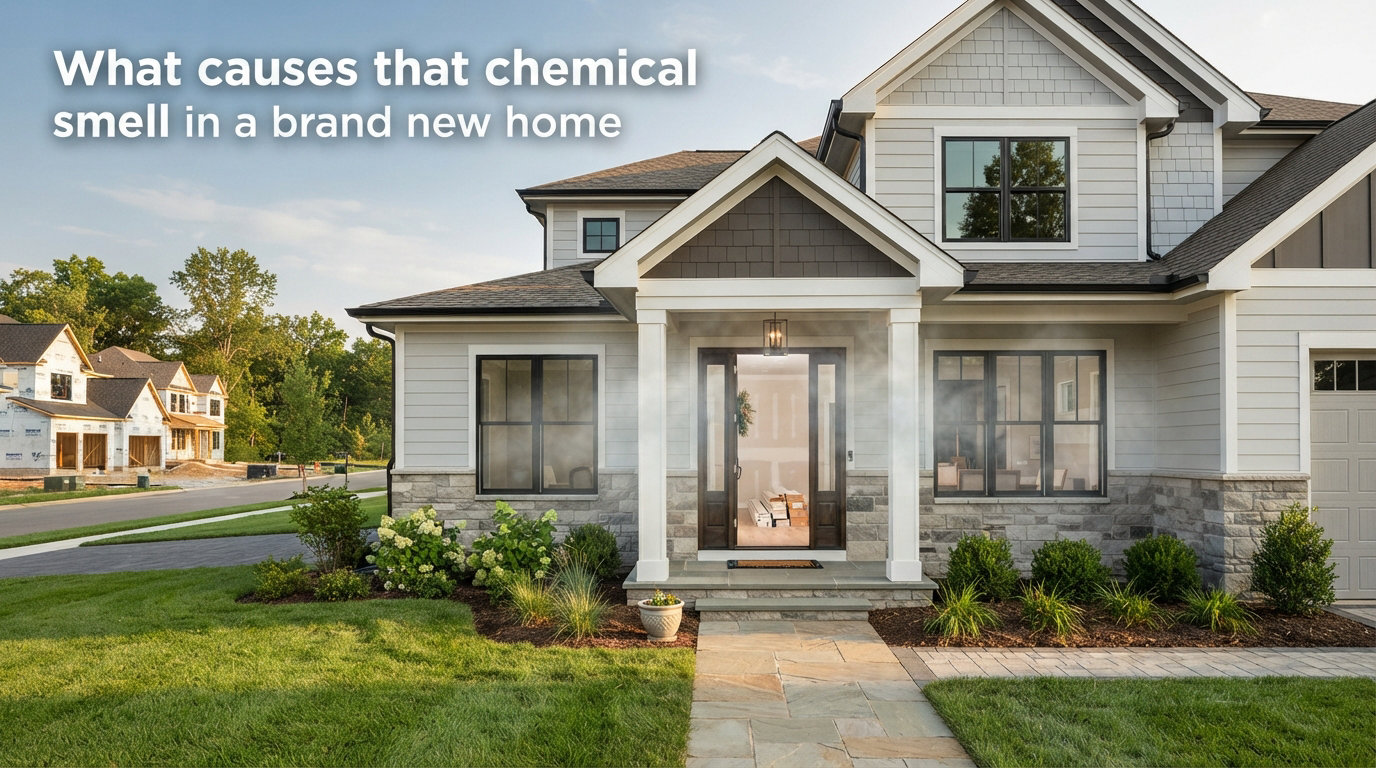
That sharp, almost sweet chemical scent that hits you the moment you walk into a brand new home is so common it has its own nickname: “new house smell.” Our team has spent the last several years tracking indoor air quality questions from new homeowners, and the story is almost always the same. The smell is noticeable the day you move in, lingers for months, and leaves you wondering whether it is harmless or something to worry about.
If you are asking what causes that chemical smell in a brand new home, the short answer is a process called off-gassing. New building materials, paints, adhesives, flooring, cabinets, and furnishings slowly release volatile organic compounds (VOCs) into the indoor air as they cure and settle. The mixture of those VOCs, plus a surprising amount of construction dust, is what your nose is actually picking up.
In this guide we break down exactly what is in that smell, where each chemical comes from, how long it typically lasts, what health effects to watch for, and the practical steps that actually reduce it. We have pulled from indoor air quality research, new construction case studies, and the real experiences of homeowners who have lived through it. By the end you will know whether the smell in your home is routine, when it crosses into something worth testing, and what to do next.
Quick spoiler before we get into the details: most new house smell is not an emergency, but it is also not something to ignore for months on end, especially if anyone in the household is pregnant, an infant, elderly, or has asthma. Let’s start with the science behind the smell.
Table of Contents
What Causes That Chemical Smell in a Brand New Home
The chemical smell in a brand new home is caused by off-gassing, the slow release of volatile organic compounds (VOCs) from new building materials, finishes, furnishings, and construction products. VOCs are carbon-based chemicals that evaporate at room temperature, and the most common one in new homes is formaldehyde. As those chemicals leave the materials and enter the air, they create the unmistakable scent people describe as “new.”
Off-gassing is a normal chemical process. The materials in your home, like the resin that binds engineered wood, the solvents in paint, and the plasticizers in vinyl flooring, were never fully stable to begin with. From the moment they are manufactured, they start shedding molecules, and heat, humidity, and time speed up that release, which is why a new house often smells strongest in the first few weeks and then fades.
The Role of VOCs and TVOC
Volatile organic compounds are the umbrella category, and there are hundreds of them. The total amount in your air is measured as TVOC, or total volatile organic compounds. Common VOCs in new construction include formaldehyde, benzene, toluene, xylene, ethylene glycol, and methylene chloride.
Each one has its own odor threshold, health profile, and source. TVOC levels above about 0.5 milligrams per cubic meter are often noticeable to most people, and levels above 1.0 mg/m3 are when symptoms like headaches and throat irritation tend to show up.
Formaldehyde Is the Star Player
If you had to pick one chemical responsible for that distinct “new” smell, it would be formaldehyde. Formaldehyde is a colorless gas with a sharp, slightly sweet odor, and it is used heavily in the resins that bind pressed-wood products like particleboard, medium-density fiberboard (MDF), and hardwood plywood. Cabinets, shelving, subfloors, and even some flooring adhesives are loaded with it.
The California Air Resources Board and the EPA both classify formaldehyde as a known human carcinogen with prolonged exposure. That classification is exactly why formaldehyde gets so much attention in new construction conversations.
Beyond Formaldehyde: Other Aldehydes
One thing many guides miss is that formaldehyde is not the only aldehyde in new construction. Higher aldehydes like acetaldehyde, hexanal, and nonanal are also released from wood products, paints, and coatings, and they actually contribute a large share of that “fresh” scent. Research on new building materials has shown that in the first weeks after construction, higher aldehydes can account for more of the odor than formaldehyde itself.
Higher aldehydes break down faster than formaldehyde. That faster breakdown is one reason the smell changes character over the first few months in a new home.
Construction Dust Amplifies the Problem
Not all of the smell is chemical vapor. Fine construction dust, drywall particles, sawdust, and concrete fines can carry chemical residues on their surface. When you smell a “new” house, part of what you are sensing is particulate matter that has absorbed VOCs and is releasing them back into the air.
This is why a thorough deep clean often makes a noticeable difference even before the actual off-gassing has fully run its course. The dust is carrying chemicals that ventilation alone cannot fully remove.
Why New Homes Smell Stronger Than Renovations
A full new build has every material off-gassing at once, whereas a renovation typically involves one or two. The combined effect stacks up quickly. Because many new homes are built tight for energy efficiency, there is very little natural air exchange to dilute the load.
The result is a higher indoor concentration than you would ever get from a single piece of furniture or one fresh coat of paint. This stacking effect is the core reason new construction smells so much more intense than a typical remodel.
Common Sources of VOCs and Chemical Smells in New Homes
Tracking the smell to its source means looking at every layer of the home, from the framing to the furniture. Here is where the chemicals actually come from, broken out by category so you can pinpoint which materials in your home are most likely responsible.
Building Materials and Engineered Wood
Pressed-wood products are the single largest source of formaldehyde in new construction. Particleboard, MDF, oriented strand board (OSB), and hardwood plywood are bound together with urea-formaldehyde resins that off-gas for months. Subflooring, wall sheathing, and the structural panels behind your drywall all contribute.
Insulation is another contributor that often gets overlooked. Spray foam insulation releases a mix of isocyanates and amine catalysts that can smell for weeks. Fiberglass batts are generally low-emission, but the binders used to hold the fibers together still release small amounts of formaldehyde.
Paints, Stains, and Coatings
Interior paint is one of the most obvious sources of new house smell. Even low-VOC and zero-VOC paints release some VOCs while drying, and the odor can linger for weeks after the walls look and feel dry. Wood stains, varnishes, polyurethane finishes, and the sealers used on cabinets and trim release a heavier load, including mineral spirits, aliphatic hydrocarbons, and aldehydes.
If your home has stained woodwork, sealed concrete floors, or custom cabinetry finished on site, expect a stronger smell than a home painted with off-the-shelf low-VOC wall paint.
Flooring, Carpet, and Adhesives
New carpet is famous for its smell, and that odor comes from a combination of the synthetic fibers, the latex backing, and the adhesives used to glue it down. 4-phenylcyclohexene (4-PCH) is the specific compound most people associate with “new carpet smell,” and it can off-gas for several weeks.
Vinyl plank and luxury vinyl tile release phthalates and other plasticizers. Laminate flooring contributes formaldehyde from its fiberboard core. Hardwood floors are lower-emission, but the finishes and the adhesives used during installation still contribute to total VOC load.
Cabinetry and Furniture
Ready-to-assemble cabinets, vanities, and shelving are typically made from MDF or particleboard finished with a thin veneer. Those products have the highest formaldehyde emission rates of any common household material. New upholstered furniture adds its own VOCs, including flame retardants, stain-resistant coatings, and the glues used in the frame and cushions.
If your kitchen and bathroom cabinets arrived flat-packed and were assembled on site, expect a noticeable spike in formaldehyde levels for the first three to six months.
Adhesives, Sealants, and Caulk
Construction adhesives, subfloor glue, silicone caulk, and the sealants used around windows and tubs all release VOCs as they cure. Many of these products take far longer to fully cure than the 24 to 72 hours listed on the label. Some construction adhesives continue off-gassing at low levels for months after installation, contributing to that lingering background scent.
Cleaning Products, Personal Care, and New Items
Not every contributor is part of the building itself. The cleaning products used during the final pre-move-in deep clean, the plastic packaging from new furniture, scented candles, air fresheners, and even personal care products can add to the chemical load. None of these are the main cause of new house smell, but they can extend how long the smell lingers and how strong it appears.
Construction Dust as an Amplifier
Fine particles from drywall sanding, saw cuts, and concrete work settle into every surface of a new home. Those particles absorb VOCs and re-emit them slowly. That slow re-release is one reason a deep clean and frequent dusting makes such a difference in how a new home smells.
If your home still smells months after move-in and you have not done a thorough top-to-bottom clean, this is one of the first things to address. Removing the dust removes a major reservoir of stored-up chemicals.
Health Effects of New House Smell and VOC Exposure
For most healthy adults, the new house smell is unpleasant but not dangerous at typical exposure levels. The concern grows with the concentration of VOCs, the length of exposure, and the sensitivity of the people living in the home. Here is what the research and clinical guidance actually say about the health effects.
Short-Term Symptoms
The most common short-term symptoms from VOC exposure are headaches, dizziness, eye, nose, and throat irritation, nausea, and a worsening of allergy or asthma symptoms. Many people describe feeling “foggy” or unusually tired after spending a full day in a brand new home with the windows closed. These symptoms usually clear up within hours of leaving the home and getting fresh air.
If you notice these symptoms only at home and they improve when you are away from the house, that pattern is a strong signal the indoor air is the trigger. Forum posts from new homeowners describe exactly this cycle, with headaches appearing after work and disappearing on weekends spent elsewhere.
Long-Term Risks
Long-term, repeated exposure to elevated VOC levels, particularly formaldehyde, is linked to more serious health concerns. Formaldehyde is classified as a known human carcinogen by the International Agency for Research on Cancer. Extended exposure is associated with nasopharyngeal cancer, myeloid leukemia, and respiratory conditions.
Benzene, which can show up from paints and stored fuels, is also a known carcinogen linked to leukemia. Reaching those levels of risk from a typical new home is uncommon, but chronic exposure at moderate levels over years, not weeks, is what public health agencies worry about. This is why reducing the load matters even when you do not feel sick.
Who Is Most Vulnerable
Some groups are far more sensitive to VOCs than others. Infants and young children breathe more air per pound of body weight and their respiratory systems are still developing. Pregnant people are advised to minimize VOC exposure, especially during the first trimester.
Older adults, anyone with asthma, COPD, or chemical sensitivities, and people with compromised immune systems all react to lower concentrations than the general population. Pets are also affected, and birds in particular are extremely sensitive to airborne chemicals and can show respiratory distress at levels humans cannot detect.
When the Smell Signals a Real Problem
A mild chemical scent that fades over a few weeks is normal. You should be more concerned if the smell is overwhelming after the first month, if it gets stronger when the home heats up, or if anyone in the household experiences persistent headaches, nosebleeds, skin rashes, or breathing difficulty.
Those are signs the VOC load is high enough to warrant air quality testing rather than just ventilation and patience. Trust the symptom pattern over your own sense of smell, since olfactory fatigue can mask how strong the air really is.
How Long Does New House Smell Last
Most homeowners notice the strongest smell in the first two to six weeks after move-in, with a noticeable decline by the three-month mark. The most volatile compounds, like the solvents in paint and the higher aldehydes from finishes, evaporate fastest. By six months, the average new home smells significantly better to most people, and by one year, only the most sensitive noses and the highest-emission materials are still noticeable.
Why Some Homes Smell Longer
Not every home follows that timeline. The duration depends on the materials used, the total amount of new product in the home, and how well the home is ventilated. Homes with extensive MDF cabinetry, spray foam insulation, and site-finished wood floors can smell for a year or more, while homes built primarily with low-VOC materials and solid wood often smell fresh within weeks.
Temperature and Humidity Play a Big Role
Off-gassing is a chemical process, and like most chemical processes, it speeds up with heat and moisture. Homes in hot, humid climates off-gas faster initially but also release chemicals more aggressively. Homes in cold climates may off-gas more slowly during winter, only to smell stronger when heating systems kick on and warm the materials.
This is one reason so many homeowners report their new house smell getting worse in summer or when they run the heat for the first time. The materials were always emitting, but warmer temperatures push more VOCs into the air at once.
The Nose-Blindness Factor
Your nose adapts to constant odors within hours, which is why you stop noticing your own home’s smell even when visitors still pick it up immediately. This phenomenon is called olfactory fatigue. Do not assume the smell is gone just because you can no longer detect it.
Ask a friend who has not been in the home, or step out for several hours and re-enter, to get a more honest read on where the air actually stands. A second nose is one of the cheapest testing tools you have.
How to Reduce and Remove Chemical Smell in a New Home
Reducing new house smell comes down to three things: diluting the VOCs already in the air, speeding up the off-gassing process so materials release their chemicals faster, and removing the sources where possible. Here is what actually works, based on indoor air quality guidance and homeowner experience.
Ventilation Is the Single Most Effective Step
Nothing reduces VOC concentration faster than replacing indoor air with outdoor air. Open windows on opposite sides of the home to create cross-ventilation for at least 30 minutes a day, and do it more often in the first few weeks. Run bathroom and kitchen exhaust fans continuously during the first month, even when you are not cooking or showering, to pull stale air out.
If your home has a whole-house mechanical ventilation system like an HRV or ERV, run it at the highest setting for the first several weeks. These systems exchange indoor and outdoor air without wasting all your heating or cooling energy.
Air Purification With the Right Filter
A standard HEPA filter captures particles but does almost nothing for VOCs. To remove chemicals from the air, you need an air purifier with a thick activated carbon filter, ideally several pounds of carbon, not the thin pad found in cheap units. Activated carbon adsorbs VOCs and holds them, while HEPA handles the construction dust that carries chemical residues.
Run the purifier continuously in the rooms where you spend the most time, typically the bedroom and main living area. Replace the carbon filter on the manufacturer’s recommended schedule, because once carbon is saturated it stops working and can even re-release captured chemicals.
Bump Up Heat and Humidity, Then Ventilate
Because off-gassing speeds up with heat, you can intentionally push more VOCs out of the materials by warming the home. This strategy, sometimes called a “bake-out,” involves turning the heat up to around 85 to 90 degrees Fahrenheit for a few days while running ventilation. The materials release chemicals faster, and the ventilation carries them outside.
A modest humidity increase, around 50 to 55 percent, also helps release water-soluble formaldehyde from wood products. Always pair heat and humidity with active ventilation, otherwise you are just concentrating the chemicals indoors instead of removing them.
Deep Clean Every Surface
A top-to-bottom deep clean removes the construction dust that holds onto VOCs. Wipe down walls, baseboards, cabinets, and shelves with a damp microfiber cloth. Vacuum all floors with a HEPA vacuum, including under appliances and inside closets, then wash all windows, blinds, and light fixtures.
Clean the HVAC vents and replace the air filter, since construction dust loads filters fast. Many homeowners in forum discussions mention products like OdoBan and unscented enzymatic cleaners as effective for the deep clean stage. Avoid heavily scented cleaners, since they add new VOCs to the air you are trying to clear.
Remove or Isolate the Worst Offenders
If a specific item, like a new mattress, a piece of pressed-wood furniture, or a recently finished cabinet, is the dominant source, removing it or moving it to a garage or spare room to off-gas alone can drop the overall load quickly. Letting new furniture air out in a well-ventilated space for a week before bringing it inside is one of the simplest ways to keep VOCs out of your main living area.
Choose Low-VOC Materials Going Forward
If you are still in the planning or finishing stage, the certifications to look for are GREENGUARD Gold, UL 2884 (the formaldehyde standard), and Eurofins Indoor Air Comfort. Products carrying these labels have been tested for chemical emissions and meet strict thresholds. Formaldehyde-free plywood, solid wood furniture, low-VOC paints, and natural fiber rugs all reduce the total load.
Retrofitting an existing home is harder, but you can still swap the worst offenders over time. Replacing high-emission cabinetry or carpet is the single biggest upgrade most homeowners can make for indoor air quality.
When to Consider Air Quality Testing
If the smell is overwhelming after a month of ventilation, if anyone in the household has persistent symptoms, or if you simply want a baseline before settling in, professional air quality testing is worth the cost. A certified indoor air quality professional can measure TVOC levels, formaldehyde specifically, and particulate matter, then tell you whether the levels are within normal range or whether source removal is needed.
DIY formaldehyde test kits are available and affordable, but they are less accurate than professional testing. Use them as a screening tool, not a final answer.
FAQs
How to get rid of chemical smell in a new house?
Ventilate aggressively by opening windows on opposite sides of the home and running exhaust fans for at least 30 minutes a day. Add an air purifier with a thick activated carbon filter to capture VOCs, run a whole-home deep clean to remove construction dust that holds chemical residues, and consider a controlled heat bump (around 85 to 90 degrees Fahrenheit) with active ventilation to push VOCs out of materials faster.
How long does it take for a new house to offgas?
Most new homes off-gas the bulk of their most volatile chemicals within the first six weeks, with a noticeable improvement by three months. Materials like MDF cabinetry, spray foam insulation, and site-finished wood can continue off-gassing at lower levels for up to a year or longer. Heat and humidity speed up the process, while cold, closed-up homes extend it.
Why does my house suddenly smell like chemicals?
A sudden chemical smell usually means something has started off-gassing more aggressively, often because the home warmed up. Turning on the heat for the first time, a hot summer day, or high humidity can all push VOCs out of new materials like paint, flooring, cabinets, and adhesives. New furniture, a fresh renovation, or stored cleaning products can also trigger a sudden smell.
How to get rid of VOCs in a new house?
The fastest way to reduce VOCs is to dilute indoor air with outdoor air through cross-ventilation and exhaust fans. Add an air purifier with several pounds of activated carbon, run a deep clean to remove construction dust, control heat and humidity to speed up off-gassing, and remove or isolate the worst-emitting items like new pressed-wood furniture. If symptoms persist, professional air quality testing can pinpoint specific sources.
How long does it take for a new house smell to go away?
Most homeowners report the strongest smell fading within two to six weeks, with a major improvement by three months and a near-complete reduction by one year. Homes built with low-VOC materials may smell fresh within weeks, while homes with heavy MDF cabinetry and spray foam insulation can smell for over a year. Your nose also adapts, so the smell may be more noticeable to visitors than to you.
What does off-gassing smell like in a house?
Off-gassing smells sharp, slightly sweet, and chemical, often compared to fresh paint, new carpet, or a new car interior. Formaldehyde has a distinct pickling-type odor, while higher aldehydes from finishes contribute a fresher, almost floral note. The exact scent depends on the mix of materials, but the common thread is a synthetic, slightly irritating quality that fades over time.
Conclusion
The chemical smell in a brand new home is a normal byproduct of off-gassing, the slow release of VOCs like formaldehyde, higher aldehydes, and solvents from new building materials, paints, flooring, cabinetry, and furnishings. Most of the time it fades within a few months, but it is worth taking seriously, especially if anyone in the household is sensitive.
If you take away one thing from this guide, let it be this: what causes that chemical smell in a brand new home is predictable, measurable, and largely fixable with ventilation, a serious deep clean, an activated carbon air purifier, and patience. Test the air if symptoms persist, choose low-VOC materials whenever you renovate, and trust what your nose, and your visitors, are telling you.