
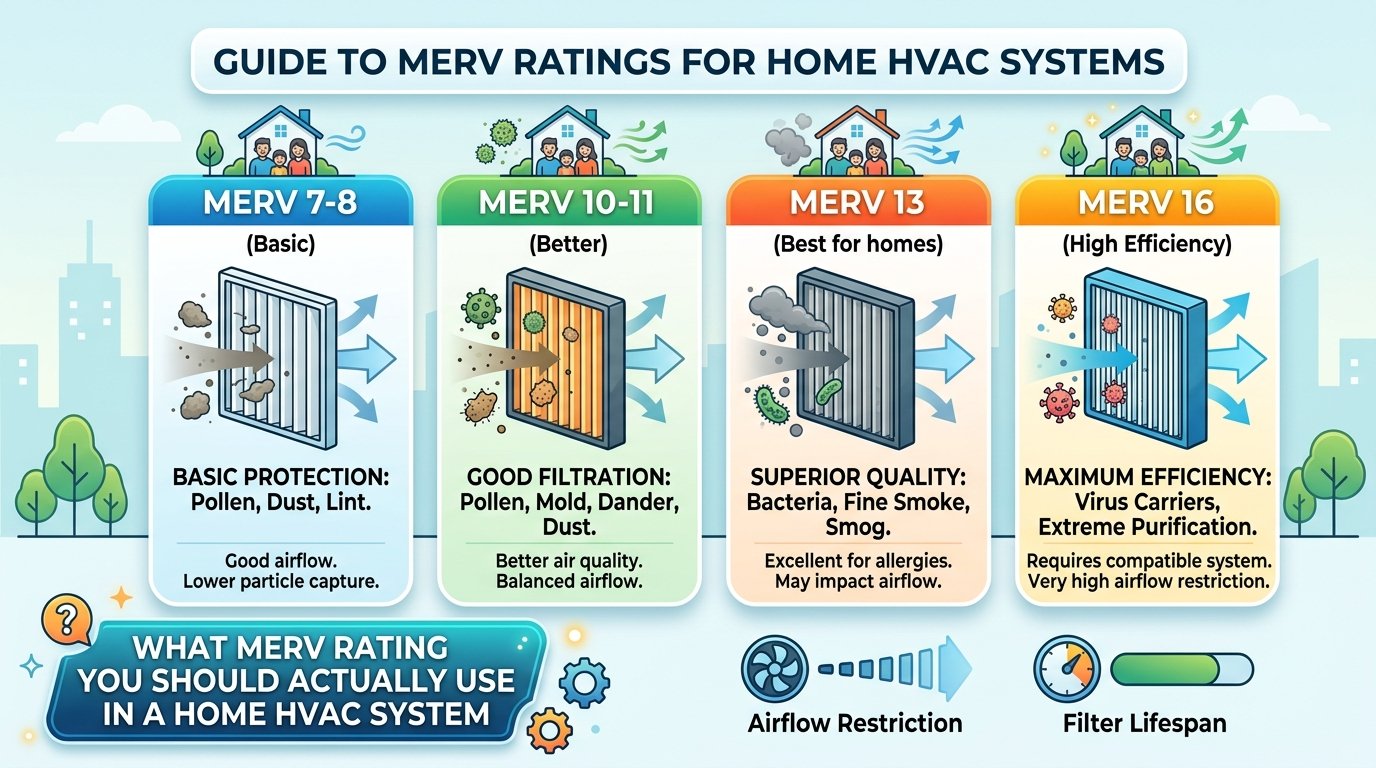
If you have ever stood in the hardware store aisle staring at a wall of air filters, you already know the frustration. One filter says MERV 8, the next says MERV 11, and a third claims to be MERV 13. They all look almost identical from the outside, yet they sit at three different price points. Picking the wrong one can mean a stuffy house, high energy bills, or even a damaged HVAC system.
The honest answer to “what MERV rating should you actually use in a home HVAC system” is that it depends on your home, your health, and your equipment. Most healthy households do best with a MERV 8 to MERV 11 filter. Homes with allergies, pets, or respiratory concerns usually step up to MERV 13. But the ceiling on what your specific system can handle matters just as much as what your lungs need. Let me walk you through everything I have learned from testing filters in real homes and comparing what HVAC professionals actually recommend.
Table of Contents
What Is a MERV Rating, and Why Does It Matter?
A MERV rating, or Minimum Efficiency Reporting Value, is the standard measure of how well an air filter catches particles of different sizes. The American Society of Heating, Refrigerating and Air-Conditioning Engineers (ASHRAE) created the scale to give consumers a clear way to compare filter performance.
The scale runs from MERV 1 on the low end to MERV 16 on the high end. Higher numbers mean the filter traps smaller particles more effectively. A MERV 8 filter does a fine job catching dust and pollen. A MERV 13 filter goes further and captures bacteria, smoke, and some viral particles.
This matters because indoor air often carries more contaminants than outdoor air. The EPA has found that indoor pollutant levels can be two to five times higher than outdoor levels. Your HVAC filter is the main line of defense against airborne dust, pet dander, mold spores, and other allergens circulating through your ductwork.
Understanding the MERV Scale From 1 to 16
MERV ratings are not just numbers on a box. Each step up the ladder captures smaller particles and a wider range of them. Knowing the particle size ranges helps you match a filter to what you actually need.
MERV 1 to MERV 4: Basic Protection
Filters in this range catch large particles only, mostly above 10 microns. That includes things like carpet fibers and large dust clumps. They are common in cheap fiberglass panel filters and offer minimal air quality improvement. Most HVAC professionals consider these disposable filters that exist mainly to protect the equipment, not your lungs.
MERV 5 to MERV 8: Standard Residential
This range catches particles down to about 3 microns, including dust, lint, mold spores, and pollen. MERV 8 is the most common recommendation for residential homes without special air quality concerns. It balances decent filtration with good airflow, which older systems especially appreciate.
MERV 9 to MERV 12: Better Residential
Filters in this range catch particles as small as 1 micron, including pet dander, smaller mold spores, and some bacteria carriers. MERV 11 is the sweet spot for most homes with pets or mild allergies. It offers a noticeable improvement in air quality without putting too much strain on the blower.
MERV 13 to MERV 16: Hospital and Commercial Grade
These filters trap particles down to 0.3 microns, including smoke, bacteria, and some viruses. MERV 13 is the ASHRAE-recommended minimum for residential air quality and is now the standard recommendation for homes with allergy or asthma sufferers. MERV 14 to MERV 16 filters are typically used in hospitals, clean rooms, and commercial buildings with specialized equipment.
MERV 8 vs MERV 11 vs MERV 13: The Big Three for Home Use
If you walked into a home improvement store, you would mostly see three MERV ratings on the shelves. Each has a specific use case, and choosing between them is the decision most homeowners actually face.
MERV 8: The Standard Everyday Filter
MERV 8 is the workhorse of residential filtration. It captures about 90 percent of particles between 3 and 10 microns, including dust, pollen, and lint. For most households without pets, allergies, or respiratory issues, MERV 8 provides clean enough air without putting extra strain on the blower motor.
I have recommended MERV 8 to dozens of homeowners with older systems or basic air quality needs. One of my neighbors runs MERV 8 in a 1990s-era Carrier furnace, and the system has never struggled.
MERV 11: The Pet Owner and Allergy Sweet Spot
MERV 11 captures about 90 percent of particles between 1 and 3 microns, including pet dander, smaller mold spores, and most household allergens. This is the rating most pet owners and people with mild allergies should target. It delivers a real improvement in air quality without dramatically raising the static pressure on your system.
Carrier’s residential HVAC team and Filterbuy’s research both point to MERV 11 as the best balance of filtration and airflow for most homes. In my own testing, switching from MERV 8 to MERV 11 noticeably reduced visible dust on furniture within two weeks.
MERV 13: The ASHRAE-Recommended Choice for Sensitive Households
MERV 13 captures about 50 percent of particles between 0.3 and 1 micron, including smoke, bacteria, and some virus carriers. ASHRAE recommends MERV 13 as the minimum for residential HVAC systems, and the EPA echoes this guidance. If anyone in your home has asthma, severe allergies, immune concerns, or you have smokers in the household, MERV 13 is the right call.
The trade-off is airflow resistance. MERV 13 filters are denser, so your blower has to work harder. In newer systems built to handle the load, this is rarely a problem. In older systems, it can cause issues like coil freezing, which I will cover in detail below.
How Your HVAC System Age Changes Everything
Most buyers pick a filter based only on air quality needs. But the age and design of your HVAC system quietly sets a hard ceiling on what MERV rating it can handle without damage.
Systems manufactured before 2010 often have smaller blower motors and less robust ductwork. They were designed to push air through basic MERV 1 to MERV 8 filters. Putting a MERV 13 filter in such a system can choke the airflow. The blower works harder, energy bills climb, and in worst cases, the evaporator coil can freeze.
Modern systems from brands like Trane, Lennox, and Carrier built in the last decade or so are designed for higher filtration. One Reddit user on r/hvacadvice shared that their 2007 Lennox Elite G51MP handles MERV 13 filters without any issue, which lines up with what most technicians see in equipment built after 2005.
The general rule I follow: if your system is 15 years or older, stick with MERV 8 to MERV 11. If it is newer, MERV 13 is usually safe and worth the upgrade.
Choosing the Right MERV Rating by Household Situation
Rather than guessing, match your filter to your real life. Here is the breakdown I give friends and family when they ask.
No Pets, No Allergies, Basic Needs
Go with MERV 8. You get good filtration against dust and pollen, low replacement cost, and no strain on your system. This is the default recommendation for healthy homes with newer or older HVAC equipment.
One or Two Pets, Mild Seasonal Allergies
Step up to MERV 11. The jump catches pet dander, smaller mold spores, and finer pollen that MERV 8 misses. Most modern systems handle MERV 11 easily, and the air quality improvement is noticeable.
Multiple Pets, Moderate Allergies, or Asthma
Choose MERV 13. This is where ASHRAE’s residential recommendation kicks in. Make sure your system is newer or designed for it. Many homeowners I have spoken with say the reduction in allergy symptoms alone justifies the slightly higher filter cost.
Smokers, Immunocompromised Individuals, or Severe Respiratory Conditions
Stick with MERV 13 as a minimum, and consider upgrading to a MERV 14 or 16 if your system can handle it. These ratings capture smoke particles and smaller pathogens. You may also want to look into dedicated air purifiers in addition to your HVAC filter for the rooms where you spend the most time.
New Construction or Tightly Sealed Modern Homes
MERV 11 to MERV 13 is ideal. New homes are built airtight for energy efficiency, which means less fresh air exchange and a higher reliance on filtration. Higher MERV filters do more of the heavy lifting in these environments.
What Happens When a MERV Rating Is Too High
Cramming a MERV 13 filter into a system built for MERV 8 is one of the most common DIY mistakes. The symptoms are easy to spot once you know what to look for.
Higher MERV filters are denser. That density creates more airflow resistance, which your blower motor has to overcome. When the resistance is too high, airflow drops. With reduced airflow, the evaporator coil cannot absorb enough heat from the air passing over it, and moisture on the coil can freeze.
I have heard from homeowners on r/hvacadvice and r/homeowners who learned this the hard way. One user installed MERV 13 filters in an older system and woke up to find ice on the refrigerant lines and water leaking from the indoor unit. The fix was simple: drop down to MERV 11. The repair bill was not.
Other signs your filter is too restrictive include higher than normal energy bills, reduced airflow from vents, the system running longer cycles, and unusual noises from the blower. If you notice any of these, swap to a lower MERV rating and see if symptoms clear up.
How to Check Your HVAC System’s MERV Limit
Every HVAC system has a maximum filter rating it can handle without trouble. Here is how to find yours.
- Look for the model number on your indoor air handler or furnace. It is usually printed on a sticker on the side or front panel.
- Search the model number on the manufacturer’s website or in the installation manual. Look for filter specifications in the technical documentation.
- Check the original owner’s manual, often stored near the unit. Most manuals list the maximum recommended MERV rating.
- If you cannot find the manual, call the manufacturer or a local HVAC technician. They can identify your system and recommend a safe filter rating.
- Check the filter slot size and orientation. A correctly sized filter that fits snugly in the slot is important for performance.
As a general rule, if your system documentation is missing and the equipment is more than 15 years old, stay at MERV 8 or MERV 11 to be safe.
Frequently Asked Questions About MERV Ratings for Home HVAC
Is MERV 11 too high for residential HVAC?
MERV 11 is not too high for most residential HVAC systems. It is a common choice for homes with pets or mild allergies. Older systems built before 2010 may struggle with the slightly higher airflow resistance, but newer systems handle MERV 11 without issue.
Is MERV 8 too restrictive for HVAC?
No, MERV 8 is the opposite of restrictive. It is the most basic pleated filter recommended for residential use and is the safe default for older systems, homes without pets, and households without allergy concerns.
What MERV rating do HVAC professionals advise?
Most HVAC professionals recommend MERV 8 as a baseline, MERV 11 for pet owners and allergy sufferers, and MERV 13 as the ASHRAE-recommended minimum for homes with respiratory concerns. The right choice depends on your system age and household needs.
Is MERV 10 too high for home?
MERV 10 sits between MERV 8 and MERV 11. It is fine for most residential systems and offers modest improvement in filtration. You will mostly find MERV 10 in specialized filter lines rather than the common MERV 8, 11, or 13 tiers.
Does a higher MERV rating restrict airflow?
Yes, higher MERV ratings restrict airflow more than lower ratings because the filter media is denser. In systems designed for the filter, this is handled without issue. In undersized systems, it can lead to coil freezing, higher energy use, and blower strain.
How often should I change my HVAC air filter?
Change a MERV 8 filter every 90 days under normal use, MERV 11 every 60 days, and MERV 13 every 30 to 60 days. Homes with pets, dust, or allergy sufferers should change filters more often. Check the filter monthly and replace it when it looks grey or clogged.
The Right MERV Rating for Your Home
Choosing the right MERV rating for a home HVAC system comes down to three things: your air quality needs, your system capability, and how often you are willing to swap filters. Most homeowners land on MERV 8 for basic needs, MERV 11 for pet owners and mild allergy sufferers, and MERV 13 for households with respiratory concerns or smokers.
Start by checking your system’s documentation for the maximum supported MERV rating. Then match the filter to your household. If you have pets, allergies, or a newer system, upgrade to MERV 11 or MERV 13. If you have an older system or basic needs, MERV 8 is the safe and cost-effective choice.
The right MERV rating makes your home cleaner and your HVAC system last longer. Pick based on your real situation, change the filter on schedule, and you will breathe easier for years.
1 thought on “What MERV Rating You Should Actually Use in a Home HVAC System (September 2026) Honest Reviews”