
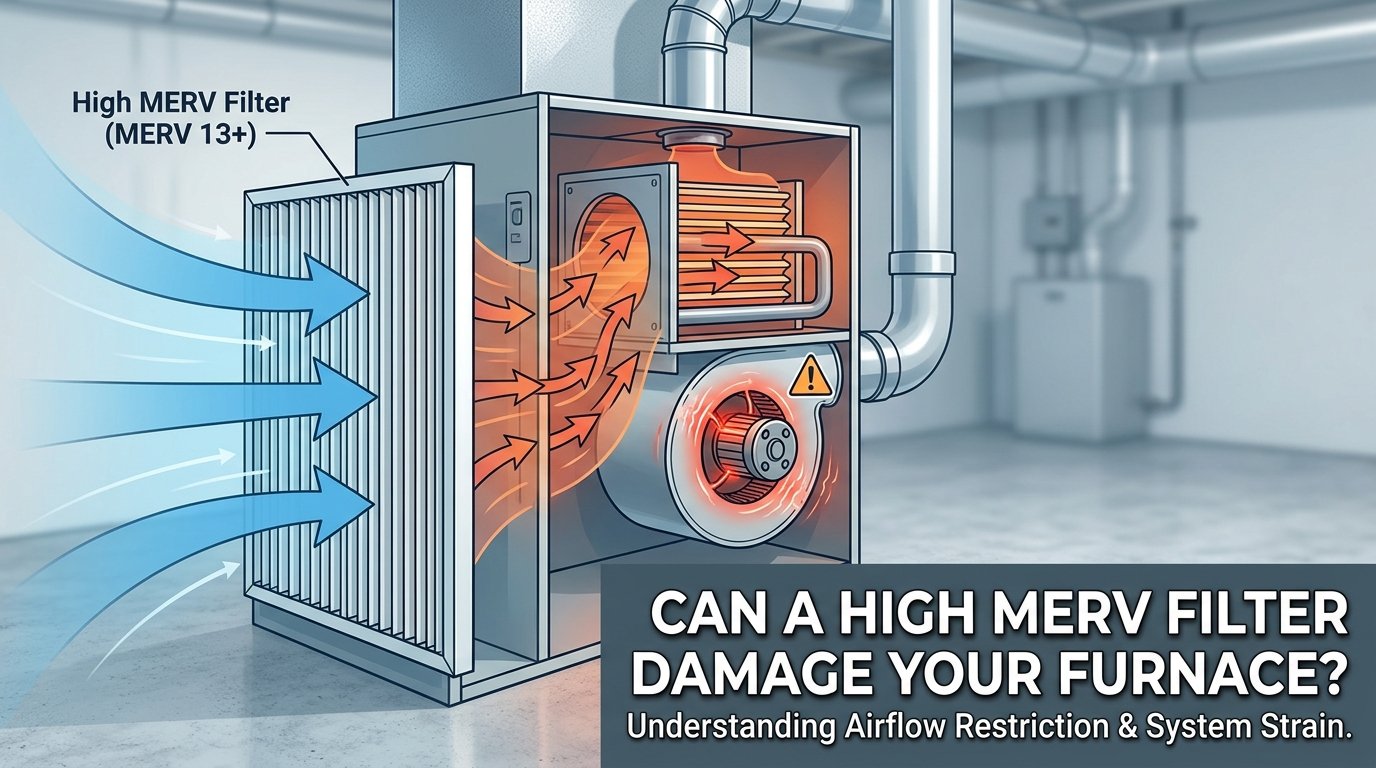
Yes, a high MERV filter can damage your furnace, but only when the rating is too aggressive for your specific system. The problem is not the MERV number itself. The problem is airflow restriction. If the filter catches more particles than your blower can push air through, the furnace overheats, short-cycles, and over time stresses the heat exchanger. Most modern furnaces handle MERV 11 to MERV 13 just fine, especially with a 4-inch or 5-inch media cabinet. Older single-stage systems with 1-inch slots often struggle above MERV 8 or MERV 9.
I have been digging into HVAC forums, EPA guidelines, and contractor advice for the last few weeks. The story is more nuanced than most filter packaging suggests. Let me walk you through what I learned.
Table of Contents
What Is a MERV Rating and How Does It Work
A MERV rating is the Minimum Efficiency Reporting Value, a scale developed by ASHRAE that rates how well an air filter captures particles between 0.3 and 10 microns in size. Higher numbers mean tighter filtration. A MERV 8 filter catches dust and pollen. A MERV 13 filter also catches bacteria and smoke. A MERV 16 filter approaches HEPA-level performance for residential use.
Here is the scale that matters for most homes:
- MERV 1-4 – Basic fiberglass, catches only large dust
- MERV 6-8 – Pleated residential standard, traps dust mites and pollen
- MERV 9-12 – Better residential filtration, captures mold spores and pet dander
- MERV 13-16 – Hospital-grade range, catches bacteria, smoke, and most allergens
For context, a human hair is about 70 microns wide. Mold spores sit around 2 to 10 microns. Smoke particles can be as small as 0.3 microns. That is the size range MERV ratings measure.
Can a High MERV Filter Damage Your Furnace
The short answer is yes, but the damage comes from airflow restriction, not from the filter itself. Think of it like a screen door versus a sealed storm door. Both stop bugs, but one lets in more air. A MERV 13 filter in a 1-inch slot is like stuffing a storm door into a screen door frame. The furnace has to push harder to move air through.
When airflow drops below what your furnace was designed for, three things happen. First, the heat exchanger gets hotter than intended because less air is moving across it to carry heat away. Second, the blower motor works harder and runs hotter, sometimes drawing more amperage. Third, the furnace starts short-cycling because the high-temperature limit switch trips to protect the system. None of that kills a furnace overnight, but the cumulative effect over months is real damage.
One homeowner on r/hvacadvice reported their furnace overheating and shutting down repeatedly after switching to a MERV 12 filter in a 1-inch slot. The technician who came out immediately pointed to filter restriction. That matches what ASHRAE and most furnace manufacturers warn about.
Common Myths About High MERV Filters
There is a lot of confusion floating around about MERV ratings, especially on Reddit and YouTube. Let me clear up the myths I see most often.
Myth: Higher MERV is always better. Not true. A MERV 13 filter does no good if your blower cannot move enough air through it. The “better” filter is the one that matches your system and filter cabinet depth.
Myth: A 1-inch filter and a 4-inch filter at the same MERV rating perform the same. Wrong. A 4-inch or 5-inch filter has much more surface area. More surface area means lower pressure drop at the same MERV rating. This is why media cabinet upgrades are often recommended when switching to higher MERV.
Myth: Running without a filter is fine for a few days. Never do this. Dirt on the heat exchanger and blower wheel is far more expensive to fix than any filter restriction problem. If your filter is too restrictive, the right answer is a different filter, not no filter.
Myth: MERV 14 means HEPA. Close, but not quite. True HEPA filters are rated at 99.97 percent efficiency at 0.3 microns. MERV 14 captures 75 to 84 percent in that range. It is excellent filtration, but not HEPA.
When a High MERV Filter Actually Causes Problems
The damage scenarios are specific. A high MERV filter will not hurt your furnace if the system was designed for it. The trouble starts when three conditions line up.
Condition 1: A 1-inch filter slot with a MERV rating above 9. The slot is too shallow to give the filter enough surface area.
Condition 2: An older furnace with a single-speed blower. These blowers have fixed torque and cannot compensate for added resistance.
Condition 3: Static pressure above 0.5 inches water column. Most furnaces are designed to operate below this number. You can measure it with a manometer, but the warning signs show up first.
The signs to watch for include the furnace running longer than usual to reach temperature, the outer cabinet feeling hotter than normal, cold spots in the home, and the limit switch tripping. If you see these after a filter change, the filter is the prime suspect.
Static pressure is the resistance air meets as it moves through the system. Picture blowing through a thin coffee stirrer versus a milkshake straw. Higher MERV filters in tight cabinets create more of that resistance. Furnaces are designed for a specific static pressure range, usually 0.3 to 0.5 inches water column. When you exceed that, efficiency drops and components run hot.
How to Choose the Right MERV Filter for Your Furnace
Here is what I do, and what most licensed contractors recommend.
Step 1: Check your furnace manual. Manufacturers list a recommended MERV range right in the spec sheet. Carrier, Trane, and Bryant all publish these guidelines.
Step 2: Use the deepest filter cabinet your system supports. If your furnace has a 4-inch or 5-inch media cabinet, use it. This lets you step up to MERV 11 or MERV 13 without choking airflow.
Step 3: Stick to MERV 8 if you have a 1-inch slot and an older furnace. Pleated MERV 8 is a huge upgrade over the old fiberglass panel and works with virtually any residential system.
Step 4: Replace the filter on schedule. Even the right filter becomes too restrictive when it is clogged. A 1-inch filter should be swapped every 60 to 90 days. A 4-inch media filter can usually go 6 to 12 months.
Step 5: Get a static pressure test if you are unsure. Any HVAC contractor can run this in 5 minutes. It is the single best measurement of whether your filter is too restrictive.
For people in wildfire zones or with serious allergy concerns, MERV 13 in a 5-inch cabinet is the sweet spot. You get hospital-grade filtration without choking the system.
Frequently Asked Questions
Is MERV 11 too high for residential HVAC?
MERV 11 is safe for most modern residential HVAC systems when paired with a 4-inch or 5-inch filter cabinet. In a 1-inch slot, it can restrict airflow on older single-stage furnaces. Check your furnace manual for the manufacturer’s recommended MERV range.
Are high MERV filters bad for HVAC?
High MERV filters are only bad when the rating exceeds what your specific furnace and filter cabinet can handle. The damage comes from reduced airflow, which overheats the heat exchanger and strains the blower motor. Match the filter to your system, not the highest MERV you can buy.
Is MERV 10 too high for home?
MERV 10 is generally fine for most homes and represents a solid upgrade from the basic MERV 8 pleated filter. It captures smaller particles like mold spores and pet dander without significantly restricting airflow in standard 1-inch filter slots.
Is it better to run a furnace with a dirty filter or no filter?
Run a furnace with a dirty filter. A dirty filter is still better than no filter at all because it blocks large debris from coating the blower wheel and heat exchanger. The right move when a filter feels too restrictive is to swap to a lower MERV rating or a deeper cabinet, not to leave the slot empty.
The Bottom Line on High MERV Filter Damage Furnace Risk
A high MERV filter can damage your furnace, but only when it restricts airflow beyond what your blower can handle. The fix is not to avoid high MERV filters entirely. The fix is to match the filter to your system. Use MERV 8 in a 1-inch slot. Use MERV 11 to MERV 13 in a 4-inch or 5-inch media cabinet. Replace filters on schedule and have a technician measure static pressure if anything feels off. That balance gives you cleaner indoor air and a furnace that runs the way it should for years to come.