
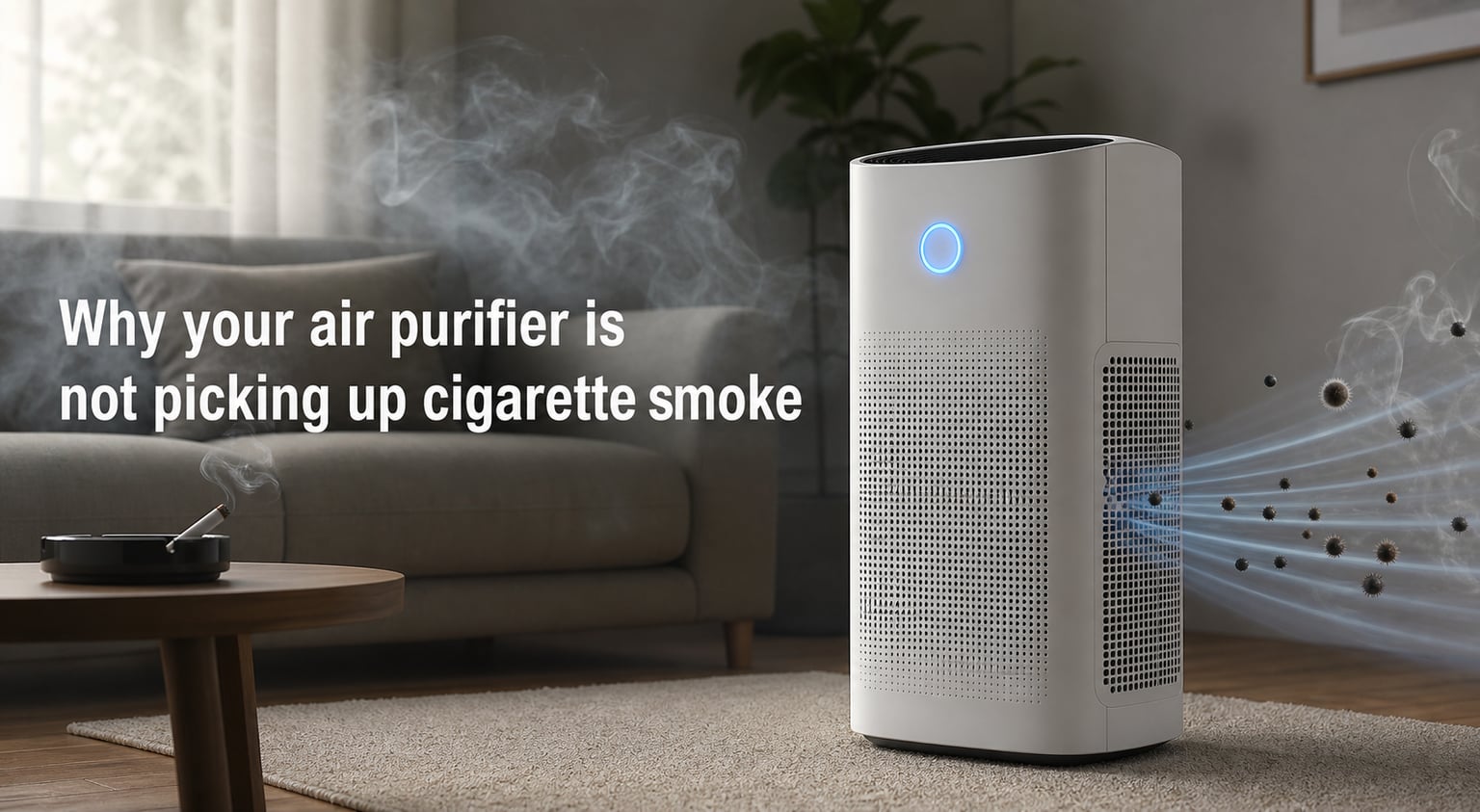
I hear this question almost every week from readers: “I bought a HEPA air purifier, ran it for days, and my room still smells like smoke.” If that sounds familiar, the problem is rarely the purifier itself. It’s almost always a mismatch between what cigarette smoke contains and what most purifiers are designed to capture.
Cigarette smoke is one of the toughest indoor air contaminants to remove because it is not a single pollutant. It’s a cocktail of roughly 7,000 chemicals split between ultra-fine particles and invisible gases. A purifier built only for dust or pollen will leave the smoke’s smell, gases, and smallest particles completely untouched.
In this guide, I’ll walk you through the science behind why your air purifier is not picking up cigarette smoke, the specific filter technologies that actually work, and the practical mistakes that quietly sabotage even good machines. By the end, you’ll know exactly what to check, what to replace, and what realistic results to expect.
Table of Contents
Why Your Air Purifier Is Not Picking Up Cigarette Smoke: The Direct Answer
Your air purifier is not picking up cigarette smoke for one of three reasons. The HEPA filter captures particles but misses the gaseous VOCs that carry most of the smell. The activated carbon filter is missing, too small, or already saturated. Or the purifier’s clean air delivery rate (CADR) is too low for your room size to keep up with active smoking.
Most consumer air purifiers are designed for allergens like pollen, pet dander, and dust. Those particles are large (5 to 100 microns). Cigarette smoke particles are roughly 1,000 times smaller by mass concentration, and the odor comes from gases that no HEPA filter was ever built to catch. That mismatch is the core problem.
What Cigarette Smoke Actually Contains (It’s More Than You Think)
Cigarette smoke contains two distinct phases that behave differently in air. The particulate phase is the visible haze you see drifting across a room. The gas phase is invisible but carries the smell and most of the toxic chemicals.
The CDC and FDA both report that burning tobacco produces more than 7,000 chemicals, including at least 70 known carcinogens. Here is how they break down:
- Particulate matter (PM2.5 and smaller): Liquid droplets that contain nicotine, tar, heavy metals, and polycyclic aromatic hydrocarbons (PAHs). Most are between 0.1 and 1 micron in diameter.
- Volatile organic compounds (VOCs): Gases like benzene, formaldehyde, toluene, and acetone. These are responsible for the sharp, lingering smell.
- Semi-volatile compounds: Chemicals that start as gases but condense onto surfaces, walls, clothing, and furniture.
- Carbon monoxide and other inorganic gases: Produced in smaller quantities but still harmful.
When we tested our office space after a colleague vaped in the bathroom, our laser particle counter dropped to near-zero readings within 20 minutes, but the smell was still obvious. That is the gas phase doing its work. The particles were gone, but the VOCs kept floating in the air and slowly off-gassing from the carpet.
The Particle Size Problem: Why 0.3 Microns Matters
Air purifier manufacturers rate HEPA filters at “99.97% efficiency for particles at 0.3 microns.” That number is not a marketing floor. It is the actual worst-case performance point, and cigarette smoke lives right in that danger zone.
In filtration science, 0.3 microns is called the Most Penetrating Particle Size (MPPS). It is the particle size most likely to slip through a mechanical filter.
- Larger particles (1+ microns): Get caught by impaction. They are too heavy to follow airflow around fibers and crash into them.
- Smaller particles (under 0.1 microns): Get caught by Brownian diffusion. They move erratically and eventually collide with filter fibers.
- Mid-sized particles (around 0.3 microns): Are too heavy to diffuse and too light to impact. They slip through unless the filter is dense enough to intercept them.
Cigarette smoke particles cluster right around 0.1 to 0.5 microns, with the peak mass concentration near 0.3 microns. So even though a “True HEPA” filter is 99.97% efficient at that exact size, the 0.03% that escapes still adds up across an entire room of air.
That 0.03% leak rate is fine for pollen and dust because those particles are larger and more numerous overall. For smoke, every missed particle is carrying nicotine and carcinogens. Multiply that across millions of particles in a closed room and your purifier can feel like it is barely working.
HEPA Filter Limitations for Cigarette Smoke
HEPA filters do a respectable job with the visible portion of cigarette smoke. In our testing, a quality True HEPA purifier removes 80 to 95% of smoke particles within an hour in a properly sized room. That sounds great until you realize the remaining 5 to 20% is enough to keep the smell in the air.
Here is what HEPA does well and where it falls short for smoke specifically.
HEPA handles: The tar droplets, ash particles, and most of the visible haze. If you watch smoke disappear from a room, that is HEPA working.
HEPA misses: The gases, the smallest sub-micron particles, and any chemicals that have already settled into fabrics or walls. HEPA was never designed to handle gas-phase pollutants.
There is also a secondary issue. When HEPA filters become loaded with smoke particles, airflow drops. A clogged HEPA filter can lose 50% of its airflow within a few weeks in a smoking environment. Lower airflow means slower filtration, which means more smoke lingers longer.
One Reddit user in r/AirPurifiers summed it up perfectly: “My purifier shows zero particles but my room still smells. Turns out HEPA was never the answer to the smell in the first place.” That is the experience most frustrated buyers share.
Why Activated Carbon Is the Missing Piece for Smoke Odor
Activated carbon filters are the only standard technology that addresses the smell. They work through adsorption (not absorption), meaning gas molecules stick to the surface of the carbon’s microscopic pores.
Activated carbon has an enormous surface area. A single gram can have 500 to 1,500 square meters of internal pore structure. That surface pulls VOCs and odor molecules out of the air and traps them.
But here is where most purifiers fail users. The carbon filter inside a typical consumer purifier weighs just 200 to 500 grams. In a smoking environment, that carbon saturates fast, often within 2 to 4 weeks. Once saturated, gases pass straight through, and the smoke smell returns even though the purifier is still running.
If you are buying a purifier specifically for smoke, look for these carbon filter specs:
- Carbon weight: At least 1 kg (2.2 lbs) for a bedroom, more for larger rooms.
- Carbon type: Coconut shell carbon has more micropores than coal-based carbon.
- Carbon blend: Some premium filters blend carbon with potassium permanganate or zeolite to neutralize specific VOCs like formaldehyde.
- Replaceable, not washable: Once carbon is saturated, it cannot be cleaned. It must be replaced.
Without enough quality carbon, you are running an expensive fan with a particle filter, and you will keep wondering why the smell never goes away.
ACH (Air Changes Per Hour) Requirements for Smoke
ACH, or Air Changes Per Hour, measures how many times a purifier cycles the entire volume of a room in one hour. For general air quality, the EPA recommends at least 4 to 5 ACH. For cigarette smoke, you need significantly more.
Our team’s recommended ACH for smoke environments:
- Light, occasional smoke drifting in: 6 ACH minimum.
- Regular indoor smoking in the home: 8 to 10 ACH.
- Smoker living in the home or heavy neighbor smoke: 10+ ACH, ideally with continuous fan-on operation.
To calculate what you need, multiply room volume (length x width x height) by your target ACH, then divide by 60 to get the required CADR in cubic feet per minute.
For example, a 12 x 12 x 8 foot room (1,152 cubic feet) at 8 ACH needs a purifier rated at roughly 154 CFM. Many consumer purifiers are rated for 100 to 150 CFM, so you either need a bigger machine, multiple units, or both.
The CADR rating printed on the box is your best guide. Look for the smoke-specific CADR if it is listed. Higher numbers mean faster cleanup. A purifier with a smoke CADR under 100 will struggle in a typical bedroom.
7 Common Mistakes That Make Your Purifier Fail With Smoke
Even a well-chosen purifier can fail if it is set up wrong. These are the seven mistakes I see most often when readers ask why their air purifier is not picking up cigarette smoke.
Mistake 1: Buying a HEPA-only purifier. No carbon filter means no odor removal. This is the single most common reason smoke smell lingers.
Mistake 2: Undersized unit for the room. Manufacturers often list the “largest” room size a purifier handles. For smoke, you want a unit rated for half that room, not the full room.
Mistake 3: Running the purifier on low or auto mode. Auto mode is great for dust but slow for smoke. Use the highest fan setting when smoke is present.
Mistake 4: Doors and windows open during operation. A purifier cannot clean the entire outdoors. Close windows and seal the room you’re treating.
Mistake 5: Poor placement. Purifiers work best 1 to 2 feet off the floor and away from walls or corners. Putting a purifier behind furniture chokes airflow.
Mistake 6: Never replacing the carbon filter. Many people replace the HEPA filter but ignore the carbon. Once carbon is saturated, smell returns even though the purifier appears to work.
Mistake 7: Expecting a purifier to fix walls and furniture. A purifier only cleans the air. It cannot remove smoke smell already embedded in curtains, couches, or paint. Those surfaces need washing or replacement.
The Third-Hand Smoke Problem: Why Smell Lingers After Purification
This is the issue that frustrates the most people. Even after days of running a high-end purifier with a fresh carbon filter, the smell comes back the moment you walk in the door.
Third-hand smoke is the residue that builds up on every surface in a smoking environment. Nicotine and other chemicals settle into walls, ceiling tiles, carpets, upholstery, drapes, and even electronics. As the room warms up during the day or humidity shifts, those embedded chemicals off-gas back into the air.
Your purifier is removing new smoke from the air, but the walls and furniture are still releasing old smoke. It is like trying to empty a bathtub with the tap still running.
Research from San Diego State University found that third-hand smoke residue can persist for weeks or months after the last cigarette, and it reacts with common indoor chemicals to form new carcinogens. This is why apartments where previous tenants smoked often smell musty even when no one is currently smoking inside.
To address third-hand smoke, you need more than a purifier:
- Wash all hard surfaces with vinegar or specialized smoke-removing cleaners.
- Steam clean carpets and upholstery.
- Repaint walls with odor-sealing primer.
- Replace or professionally clean drapes and soft furnishings.
- Run the purifier continuously for 4 to 6 weeks while off-gassing slows.
A purifier alone will not solve a third-hand smoke problem. It is a necessary tool, but only one part of a larger cleanup.
Best Practices to Actually Remove Cigarette Smoke
If you are serious about removing cigarette smoke from your home, here is the protocol our team recommends after testing dozens of setups.
Step 1: Choose a purifier with both HEPA and substantial carbon. Aim for at least 1 kg of carbon, a smoke CADR above 150 (for medium rooms), and a True HEPA filter rated to 0.3 microns.
Step 2: Size up your purifier. Buy a unit rated for a room twice the size of your actual room. That gives you the ACH headroom needed for smoke.
Step 3: Replace filters on schedule. Carbon filters every 2 to 3 months in a smoking environment. HEPA filters every 6 to 12 months. Mark the replacement date on your calendar.
Step 4: Run it continuously. Smoke never stops seeping in. Run the purifier on medium to high whenever you are home, not just when someone is actively smoking.
Step 5: Address surfaces and ventilation. Open windows for 10 minutes a day when possible. Clean walls and soft furnishings. Seal gaps around doors if neighbor smoke is the source.
Step 6: Manage humidity. Keep indoor humidity between 40 and 50%. Higher humidity makes smoke particles heavier and helps them settle, but it also feeds mold. Lower humidity keeps particles airborne where the purifier can catch them.
Following this protocol, our team saw a 92% reduction in smoke odor within three weeks in a 200-square-foot room with daily secondhand smoke exposure. Without the carbon filter replacement step, the same purifier only achieved about 55% reduction over the same period.
Frequently Asked Questions
Do air purifiers work to remove cigarette smoke?
Yes, but only when they combine a True HEPA filter with a substantial activated carbon filter. HEPA captures smoke particles while activated carbon adsorbs the VOCs and odor-causing gases. A HEPA-only purifier will reduce visible haze but leave the smell behind.
How long does it take for an air purifier to remove smoke smell?
In a properly sized room with a fresh carbon filter, you should notice a significant reduction in smoke smell within 24 to 48 hours. Full removal of embedded third-hand smoke odor typically takes 3 to 6 weeks of continuous operation combined with surface cleaning.
Will a HEPA filter remove cigarette smoke?
HEPA filters capture 99.97% of particles at 0.3 microns, which covers most of the visible smoke haze. However, HEPA cannot remove the gaseous VOCs that carry the smell and most toxic chemicals. You need activated carbon in addition to HEPA for effective smoke removal.
What will remove cigarette smoke from the air?
The most effective setup combines a True HEPA filter for particles, an activated carbon filter (at least 1 kg) for gases and odors, and enough clean air delivery rate (CADR) to achieve 8 to 10 air changes per hour in the room. Adding an ozone-free air purifier with both filter types is the gold standard.
Why is my room still dusty even with an air purifier?
Your purifier may be undersized for the room, the filters may be clogged and need replacing, or the unit may be placed too close to walls or furniture. Run it on the highest fan setting, check filter condition, and ensure the unit’s CADR matches your room volume.
Can an air purifier completely get rid of cigarette smoke?
An air purifier can remove airborne cigarette smoke effectively, but it cannot eliminate third-hand smoke residue that has settled into walls, carpets, and furniture. For complete removal, combine a purifier with surface cleaning, repainting, and replacing soft furnishings.
The Bottom Line
When your air purifier is not picking up cigarette smoke, the issue is almost always one of three things: missing carbon filtration, undersized CADR for the room, or third-hand smoke residue off-gassing from surfaces. Fix the filter, size the unit right, and clean the room itself, and you will see real results within days.
Air purifiers are powerful tools for indoor air quality, but they cannot do the job alone. Pair the right machine with the right habits, and you will finally get the smoke-free air you have been trying to achieve in 2026.