
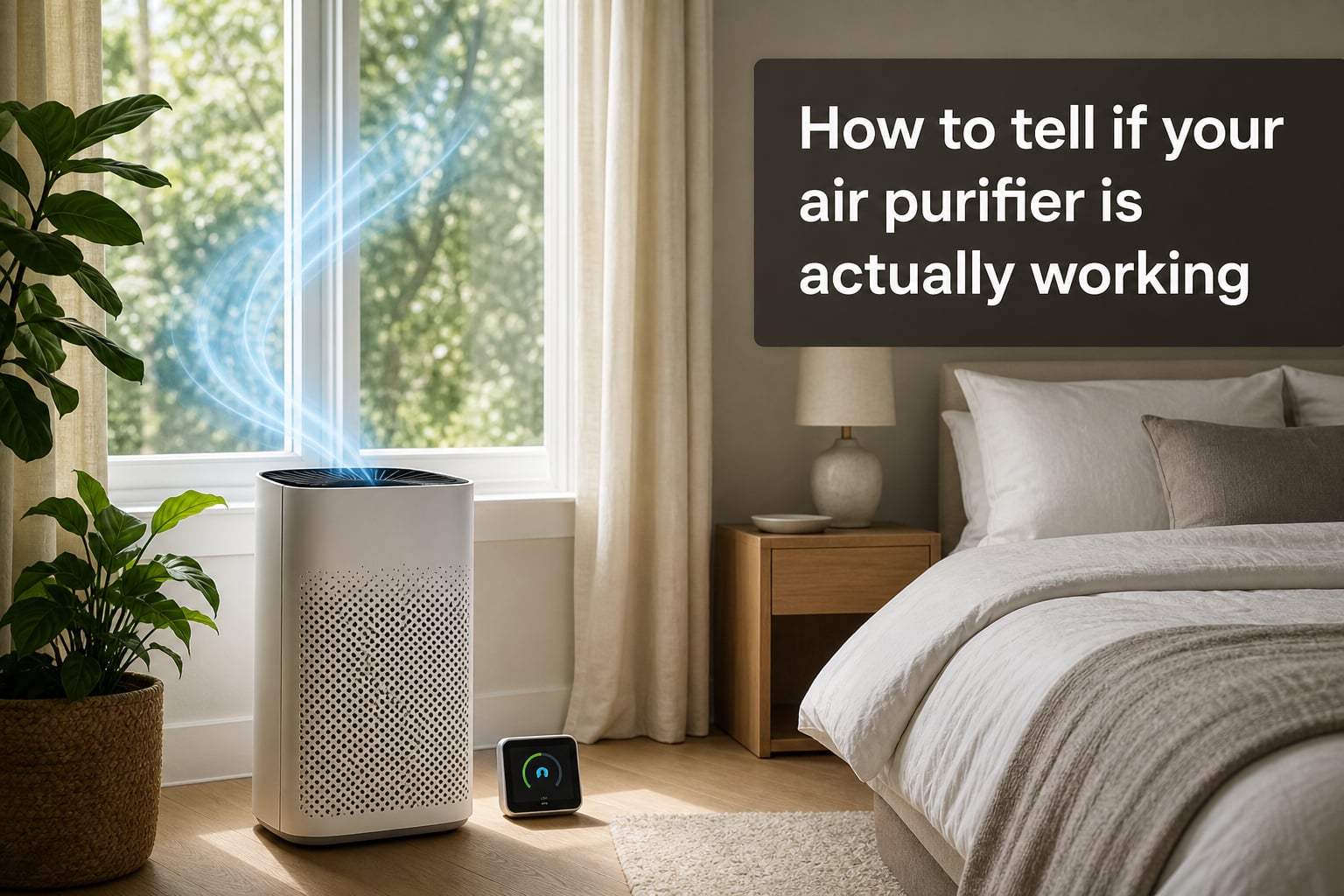
Knowing how to tell if your air purifier is actually working can feel oddly difficult. A purifier does not vacuum dirt into a visible bin, and its best result is often air that looks and smells like nothing at all.
Look for a combination of steady outlet airflow, fewer lingering odors, slower dust buildup, sensible air-quality readings, and gradual relief from particle-related symptoms. None of those signs alone proves performance, but several moving in the same direction are meaningful evidence that the unit is cleaning the air in its room.
The fastest checks take minutes; the more useful checks take days. This guide separates a working fan from effective room cleaning, shows how to test the difference safely, and explains what to fix when the signs are missing.
Table of Contents
Your air purifier is working when several measurable signs improve
A working air purifier draws room air through its filters and releases filtered air back into the room. You can tell it is doing its job when air moves from the outlet, particle or air-quality readings improve under comparable conditions, dust and odors are less persistent, and the unit is sized and placed to circulate the room.
Start with this short list before deciding that a purifier is doing nothing:
Feel the outlet airflow. It should be steady when the fan is set above its lowest setting.
Check for a response to ordinary indoor pollution. An air-quality display or separate particle sensor may change after cooking, cleaning, or opening a window, then recover as the room clears.
Compare dust over a week. The same wiped surface should need less frequent attention when the purifier is used consistently.
Notice odor clearance. Pet and cooking odors should become less persistent, though particle filters and odor filters do different jobs.
Track symptoms cautiously. Allergy symptoms may ease over two to three weeks when airborne allergens are part of the problem.
Tip: Use two or three checks together. I would trust a steady airflow plus a PM2.5 trend or a dust comparison far more than a single indicator light.
Strong, steady airflow confirms that the purifier can circulate air
Stand near the outlet vent with the purifier switched on and the fan set to a medium or higher level. You should feel a consistent stream of air leaving the unit, even if it is not forceful enough to move objects across the room.
Do not block the intake or outlet to test it, and do not put fingers, paper, or fabric into a grille. A weak or absent outlet stream can point to a blocked intake, a packed filter, a fan setting that is too low, packaging left on a filter, or a mechanical problem.
A tissue test can show direction, not cleaning performance
Hold a small piece of tissue a short distance from, rather than against, the outlet. It should stir in the outgoing air; near the intake, it may pull gently toward the unit.
This is an airflow check, not an air purifier test for particle removal. A fan can move air while a dirty, incorrectly installed, or unsuitable filter limits how well the purifier cleans it.
A changing air-quality display can be useful when you read it as a trend
If your purifier has an air quality indicator, watch how it behaves across normal changes in the room instead of expecting one fixed color all day. Cooking, outdoor air, cleaning, pets, and people can affect the sensor, while auto mode may raise and lower the fan in response.
A display that never changes is not automatic proof of failure. It may mean the air is stable, the sensor needs cleaning, the display reports a different pollutant than you expect, or the unit is positioned where it is not sampling the rest of the room well.
Slower dust buildup shows a useful long-term result
Dust reduction is one of the more practical signs an air purifier is working, but it is not an overnight result. A purifier can capture airborne particles; it cannot remove every particle already settled on shelves, floors, bedding, or furniture.
Pick one flat surface away from the unit, wipe it clean, and note the date. Keep your usual cleaning routine and run the purifier consistently for about a week, then compare how quickly a visible film returns with what you normally see.
For a fair comparison, do not change several variables at once. A week with open windows, heavy cleaning, construction nearby, shedding pets, or unusually high traffic is not directly comparable with a quiet week.
A repeatable dust check gives you a better answer than a glance
Use the same surface, the same time interval, and the same room conditions whenever possible. You can make a simple note of the date, fan setting, window habits, and whether you vacuumed or dusted more than usual.
Dust on surfaces is also affected by larger particles that settle quickly, so a purifier may help without making every tabletop spotless. Treat less dust as supporting evidence rather than the only result that matters.
Faster odor clearance suggests the odor filter is contributing
Cooking smells and pet odors offer a familiar real-world check because people notice them quickly. After an ordinary odor source has ended, run the purifier in the same room with doors and windows in their usual positions, then notice whether the smell fades sooner than it typically does.
Odor clearance depends heavily on the filter media meant to absorb gases, often called a carbon filter. A HEPA filter is designed to capture particles, so it should not be judged by odor removal alone.
Warning: Do not create smoke, burn materials, or spray strong chemicals just to test a purifier. Use normal household conditions, and ventilate as appropriate for the source rather than relying on a purifier to make unsafe air safe.
Persistent odors can reveal a filter or room-condition issue
If odors never improve, first check whether the model includes odor-focused filter media and whether that filter is due for replacement. Strong, ongoing sources such as cooking, trash, mold, or pet areas can keep adding odor faster than the purifier can reduce it.
Outdoor air, open doors, and a purifier placed in a different room can also restart the problem. Removing or ventilating the source remains important; the purifier is one part of indoor-air management.
Gradual symptom changes can support the case, but they do not prove it alone
For people affected by airborne allergens, dust, or smoke, improved comfort may be the benefit that matters most. Research gathered for this topic points to two to three weeks as a reasonable period to watch for a pattern in allergy symptoms, not a promise of a personal result.
Keep a brief record of symptoms, sleeping conditions, window use, pets in the room, and time spent indoors. That record is more useful than trying to remember whether one random day felt better.
Symptoms have many causes, including outdoor pollen, illness, humidity, medication changes, and allergens carried on clothing. If symptoms are severe, new, or worsening, seek advice from a qualified health professional rather than using a purifier result as a diagnosis.
You can test an air purifier at home without special equipment
At-home checks work best when they answer one question at a time: Is the unit moving air, is it lowering particles, or is it helping with a real room issue? Run tests under routine conditions and write down the setting and time so the result is not just a guess.
The airflow test confirms that the mechanical basics are functioning
Turn the unit on, select a medium or high fan speed, and feel for a steady outlet stream. Then inspect the intake area for a wall, curtain, furniture, or a thick layer of dust that could restrict circulation.
Next, check that every filter is seated correctly and that all shipping plastic has been removed. Many apparent air purifier not working problems start with an installation step that is easy to miss.
The PM2.5 comparison gives the most objective household evidence
A separate particle sensor or air quality monitor can make the before-and-after comparison clearer. Put it in a stable location in the room, away from the purifier outlet, a kitchen plume, and an open window, then observe PM2.5 readings under similar conditions with the purifier on.
PM2.5 means fine particulate matter small enough to remain airborne and be measured as a concentration. Watch the direction and repeatability of readings rather than expecting one magic number, because sensor models and daily conditions vary.
For a simple comparison, note a baseline, run the purifier at a stated fan speed for a set period, and record the reading again. Repeat on another day before drawing a conclusion, because a falling number may also reflect the source stopping or outdoor conditions changing.
The 48-hour turn-off comparison can reveal a difference you stopped noticing
After using the purifier consistently, many people become used to the room and no longer notice its effect. A controlled 48-hour turn-off comparison can make the contrast easier to detect without inventing a pollutant source.
Choose a normal two-day period and record the purifier setting, window habits, cleaning, cooking, and any monitor readings for the room.
Turn the purifier off for up to 48 hours while keeping routine conditions as similar as practical.
Note dust, odor persistence, and particle readings if you have a monitor.
Turn the purifier back on and compare the next similar period, not a single moment.
Skip this comparison if someone in the home is sensitive to smoke, allergens, or other pollutants that make a break from filtration unwise. The test is optional; it is not worth creating discomfort or exposure for proof.
You should expect different signs on different timelines
Mechanical operation is immediate, while room-level results are gradual. Separating those timelines helps avoid the common mistake of calling a purifier ineffective because a shelf still looks dusty after one afternoon.
Within minutes: outlet airflow, fan-speed changes, and a responsive air-quality display may be noticeable.
Within hours: a particle sensor may show a downward trend after a temporary particle source ends, depending on room size, airflow, and outside air.
Within about a week: reduced dust buildup may become easier to see on a repeated surface check.
Within two to three weeks: some people may notice a pattern in allergy-related comfort when airborne allergens are relevant and other conditions stay similar.
A purifier cannot erase particles and gases as fast as they are continually introduced. It also cannot clean a whole home from one closed-bedroom location, so judge results in the room it is intended to cover.
CADR, ACH, and HEPA explain whether the purifier can clean your room
Airflow alone is not the whole story. Capacity and filter type determine whether a working unit has a realistic chance of reducing particles in the space where you use it.
HEPA filtration captures particles, while gas filtration addresses odors differently
HEPA is a filter category used to capture airborne particles such as dust and allergens. It is relevant when your goal is particle reduction, while odor clearance depends on filter media that can absorb gases.
That distinction explains why you might see lower particle counts yet still notice a cooking smell. It also explains why an odor result does not tell you everything about particle filtration.
CADR describes how quickly a unit delivers cleaned air for a pollutant category
CADR, or clean air delivery rate, is a capacity measure that helps compare how much cleaned air a purifier can provide. Higher CADR can support quicker particle reduction in an appropriately sized room, but placement, fan speed, filter condition, and new pollution entering the room still matter.
Check the room-size guidance in your unit documentation and match it to the room where you run it. A purifier can be perfectly functional yet seem weak if it is asked to cover a much larger or more open area than intended.
ACH describes how often the room air is cleaned over time
ACH means air changes per hour. In purifier guidance, it helps describe how frequently the unit can process the room’s air volume under stated conditions.
The useful question is not whether the fan is loud; it is whether the purifier’s capacity, at the setting you actually use, fits the room. A low fan speed may be comfortable for sleeping but produce slower changes than a higher setting used during cooking, cleaning, or smoky outdoor conditions.
Most missing results come from filters, placement, settings, or capacity
When an air purifier seems ineffective, work through the physical basics before assuming the unit has failed. These are the recurring causes seen in competitor research and community discussions.
A blocked or incorrectly installed filter can sharply limit performance
Unplug the purifier before opening it, then consult its instructions to check filter orientation and seating. Look for shipping wrap left on a new filter, obvious damage, or a heavily loaded filter that needs replacement according to the manufacturer guidance.
A filter indicator is a reminder, not a laboratory measurement of the air in your home. If your room has heavy dust, pets, smoke exposure, or frequent cooking, inspect the filter condition rather than treating the light as the only decision-maker.
Clear space around the intake and outlet helps the unit clean the room
Place the purifier where air can enter and leave freely. Avoid tight corners, furniture pressed against the intake, curtains over vents, and locations where the outlet blows directly into a wall.
Keep it in the room where you want the benefit, especially for sleeping or allergy relief. A unit in a hallway cannot reliably substitute for circulation in a closed bedroom.
A higher fan setting may be needed during a particle event
Auto mode and low fan settings can be useful for everyday operation, but they may not move enough air for a quick recovery after cooking or cleaning. Try a higher setting for a period, then compare airflow and monitor trends under similar conditions.
Check timers, schedules, child locks, and app settings as well. A unit that switches off or returns to a low setting may look like it is failing when it is following a saved mode.
An undersized purifier cannot overcome a large or open space quickly
Open floor plans, high ceilings, open doors, and frequent window opening increase the air volume and the flow of new particles. In those conditions, the result may be slower even when the purifier itself is working properly.
Close the room when appropriate, reduce the pollution source, and test the purifier in its intended space. If there is still no airflow after filter and setting checks, follow the manufacturer troubleshooting steps or arrange service.
Consistent use and sensible maintenance keep the results meaningful
Run the purifier consistently in the room you are evaluating. Turning it on only after an odor or dust event makes it harder to see its normal effect and gives it less time to reduce airborne particles.
It is generally reasonable to use an air purifier while sleeping if the unit is in good condition, its cord and vents are unobstructed, and you follow its safety instructions. Choose a fan setting you can tolerate, but remember that a quieter setting often means slower air circulation.
Clean the exterior and any prefilter only as the unit instructions allow. Do not wash, vacuum, or reuse a main filter unless the documentation specifically says it is washable, because damage can reduce performance.
Practical routine: Check airflow monthly, inspect the intake and prefilter during normal cleaning, note filter changes, and use the same dust or PM2.5 check whenever performance is in doubt.
Your air purifier is doing something when evidence agrees across more than one check
The best answer to how to tell if your air purifier is actually working is not a single light, a loud fan, or one good day. Confirm airflow first, then look for repeatable room-level evidence through dust, odor, PM2.5, or symptom patterns over an appropriate timeframe.
If the evidence is missing, fix the filter, placement, settings, and room-capacity mismatch before judging the unit. Start today with the outlet airflow check and one week of notes on a single dust surface or a monitor reading.
Common questions have practical answers
What is the 2 3 rule for air purifiers?
The phrase is not a universal performance standard. Treat it as a prompt to check the unit documentation for room coverage and air changes per hour, then run the purifier in the room it is meant to serve. CADR, room volume, fan setting, filter condition, placement, and new pollution entering the room determine how quickly air improves.
How many hours a day should you use an air purifier?
Use an air purifier consistently in the room where you want cleaner air, especially while sleeping or when you are home. Continuous use gives it time to keep reducing airborne particles, while use only after an event produces slower results. Follow the unit instructions and use a fan setting that balances comfort with needed airflow.
How soon will you notice a difference with an air purifier?
You can check airflow immediately. A monitor may show a particle trend within hours after a temporary source ends, dust changes may take about a week, and allergy-related comfort can take two to three weeks to show a pattern. Results vary with the room, source strength, filter type, capacity, placement, and fan speed.
Is it okay to sleep with an air purifier on all night?
Yes, it is generally fine to run a properly maintained air purifier overnight when you follow its safety instructions, keep vents clear, and use an undamaged cord. Put it in the bedroom with space around the intake and outlet. A lower setting is quieter, although a higher setting circulates air faster.
How do I know if my air purifier is actually doing anything?
Check for steady outlet airflow, then compare repeatable signs such as dust buildup, odor persistence, and PM2.5 trends. A separate monitor gives the most objective household comparison when placed away from the outlet and used under similar conditions. Also check filter installation, placement, room size, and fan setting before judging results.
How long until an air purifier starts working?
The fan and filter begin processing air when the unit is on, but visible or noticeable results are gradual. Airflow is immediate, a monitor can show changes within hours under stable conditions, dust can take a week to compare, and symptom patterns can take two to three weeks. Continuous new pollution will slow results.
How do you tell if there is a difference in the room when the air purifier is on?
Use a before-and-after approach rather than relying on memory. Keep the room routine similar, record dust or PM2.5 readings with the purifier on, and compare a normal period with a short turn-off period if it is safe for everyone in the home. Repeat the comparison because one day can be affected by windows, cooking, pets, or outdoor air.