
You change your furnace filter, and two weeks later it looks like it has been in there for months. Sound familiar? This is one of the most common frustrations homeowners face with their HVAC systems, and the good news is that it almost always has an identifiable cause.
When a furnace filter gets dirty faster than the manufacturer’s recommended replacement schedule, something in your home or system is pushing more particles through the filter than expected. That could be a thermostat setting, a leaky duct, a shedding pet, or even the filter type you purchased.
I have talked with HVAC technicians, dug through homeowner forums, and tested different filter setups myself to figure out what makes filters clog prematurely. The answer almost always comes down to six key factors that you can identify and fix without calling a professional.
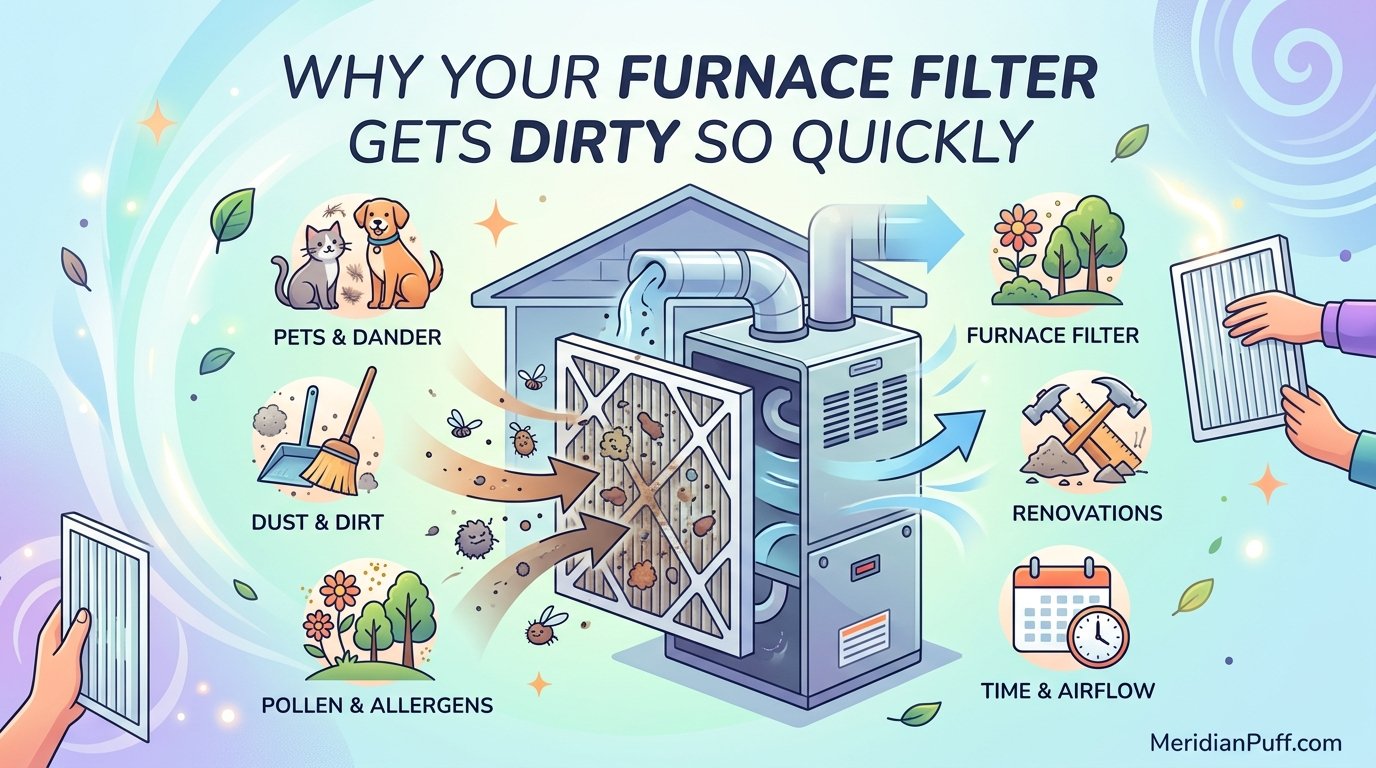
Your furnace filter gets dirty so quickly because of some combination of these six causes: a high-MERV pleated filter that captures more particles, your thermostat fan being set to ON instead of AUTO, pets shedding dander and hair, leaky return ducts pulling in unfiltered dusty air from your attic or crawl space, an improperly sized or kinked filter allowing airflow bypass, and seasonal spikes in dust and pollen during heavy heating or cooling periods.
Table of Contents
Why Your Furnace Filter Gets Dirty So Quickly: The 6 Main Causes
Let us walk through each cause in detail. For every cause, I have included a practical fix you can implement right away. Most of these you can diagnose yourself in under 15 minutes.
Understanding which of these factors applies to your home is the fastest way to stop replacing filters every two weeks.
Cause 1: High-Efficiency Pleated Filters and MERV Ratings
If you recently upgraded to a pleated filter with a higher MERV rating, that is likely the main reason your filter fills up faster. Higher-efficiency filters trap more particles by design, which means they also load up with debris more quickly.
MERV stands for Minimum Efficiency Reporting Value, and it measures how effectively a filter captures particles between 0.3 and 10 microns. A MERV 8 filter captures larger particles like dust and pollen. A MERV 13 filter captures finer particles like bacteria and smoke. The trade-off is that higher MERV ratings mean denser filter material that fills with trapped particles much sooner.
Fiberglass filters, the thin blue ones that cost a few dollars, have a MERV rating of 1 to 4. They let most small particles pass right through, which is why they look clean even after months of use. That is not because your air is clean. It is because the filter is not actually catching anything meaningful.
A pleated filter with a MERV 11 or 13 rating does the opposite. It captures dust, pollen, pet dander, mold spores, and even some bacteria. All of those particles accumulate on the filter surface, turning what used to be a clean white pad into a grey mat within weeks.
This is actually a sign your filter is doing its job. The dirt you see on the filter is dirt that is not circulating through your home. But if you are tired of swapping filters constantly, you might be using a higher MERV rating than your home actually needs.
For most homes without severe allergies, a MERV 8 to 10 pleated filter strikes a good balance between air cleaning and reasonable replacement frequency. If you have allergy sufferers in the household, you may need that MERV 13 despite the faster clogging.
Cause 2: Thermostat Fan Set to ON Instead of AUTO
This is one of the most overlooked causes, and it is also one of the easiest to fix. Check your thermostat right now. If the fan setting is switched to ON, your HVAC blower motor runs 24 hours a day, 7 days a week, regardless of whether the furnace or air conditioner is actively heating or cooling.
That means your furnace filter is constantly filtering air. Every minute of every day, your system pulls air through the return vents, passes it through the filter, and pushes it back out through the supply vents. Even when you are sleeping or away from home, the filter is working.
The AUTO setting only runs the fan when the furnace or air conditioner is actively heating or cooling. That cuts filter runtime significantly, often by 60 to 80 percent depending on your climate and how often your system cycles on.
I have seen homeowners report that switching from ON to AUTO doubled or tripled their filter life. One Reddit user in the HVAC advice community noted that their monthly filter replacement turned into a quarterly task just by making this single change.
Some people prefer the ON setting because it keeps air circulating and can even out temperature differences between rooms. That is a legitimate benefit. But if you use the ON setting, expect to replace your filter roughly twice as often.
The ON setting also increases your electricity bill since the blower motor draws power continuously. Running the fan constantly can add $15 to $50 per month to your electric costs depending on your system and local rates.
Cause 3: Pets, Pet Dander, and Hair
If you have dogs or cats, this one is almost certainly contributing to your fast-clogging filter. Pets constantly shed hair and microscopic skin cells called dander, both of which get pulled into your HVAC return vents and trapped by the filter.
A single medium-sized dog can shed enough dander and hair to noticeably darken a furnace filter within two to three weeks. Multiple pets multiply this effect significantly.
Pet dander is particularly troublesome because it is extremely small. The particles measure between 2.5 and 10 microns, which means they are large enough to be caught by a MERV 8 filter but small enough to stay airborne for long periods. Your HVAC system keeps recirculating them until the filter finally captures them.
This is why many pet owners find that the 90-day replacement schedule on filter packaging simply does not apply to their homes. With two or more shedding pets, you may need to check your filter every 30 days and replace it every 45 to 60 days.
Regular grooming and vacuuming help reduce the amount of pet hair and dander that reaches your HVAC system. Brushing your pets outside and using a vacuum with a HEPA filter can extend filter life by several weeks.
If you have a pet that sheds heavily, consider a lower MERV filter for your main HVAC system and use a standalone room air purifier near pet areas. This splits the filtering workload and keeps your main filter from overloading.
Cause 4: Leaky Air Ducts Pulling in Unfiltered Air
This cause is harder to spot but extremely common. According to ENERGY STAR, the typical home loses 20 to 30 percent of conditioned air through duct leaks. But the problem runs both ways. Leaky return ducts do not just let air escape. They also pull unfiltered air in.
Return ducts carry air from your rooms back to the furnace. They are supposed to be sealed so that all returning air passes through the filter. But if there are gaps, cracks, or loose joints in the return ductwork, the system pulls in air from wherever the leak is located.
If your return ducts run through your attic, crawl space, or basement walls, those areas are loaded with dust, insulation fibers, and debris. Your furnace blower creates negative pressure inside the return ducts, and that pressure sucks in dusty air through every crack and gap before it ever reaches the filter.
This means your filter is working overtime, catching not just the dust from your living space but also the heavy dust load from your attic or crawl space. That is why some homeowners see black filters after just two weeks even in homes that appear clean.
Common signs of leaky return ducts include higher-than-normal energy bills, uneven heating or cooling between rooms, excessive dust on furniture, and filters that are dirty on specific days even when the home seems clean.
A professional duct inspection and sealing can solve this problem permanently. Mastic sealant and specialized tape designed for ductwork can close most leaks. The investment typically pays for itself through lower energy bills and longer-lasting filters.
Cause 5: Wrong Filter Size or Improper Installation
Filter size matters more than most people realize. If your filter is slightly too small for the slot, unfiltered air flows around the edges instead of passing through the filter media. This bypass means your filter looks clean while dust is actually pouring straight into your furnace.
But the opposite problem also occurs. A filter that is slightly too large may bend, kink, or buckle when forced into the slot. Forum discussions on Reddit reveal that kinked filters are a surprisingly common cause of both dirty filters and poor system performance.
When a filter is kinked, the folded material creates gaps. Air takes the path of least resistance, flowing through those gaps instead of the filter media. You end up with a filter that has dirty streaks and clean patches, indicating uneven airflow.
Always check the printed dimensions on your old filter before buying replacements. Furnace filter slots are sized to specific dimensions, and even a half-inch difference matters. If your slot takes a 16x25x1 filter, do not try to squeeze in a 16x25x2.
Installation direction is equally important. Every filter has an arrow indicating airflow direction. The arrow should point toward the furnace blower, not away from it. Installing the filter backward reduces its efficiency and can cause it to load up unevenly.
If your filter housing has bent tracks or a warped frame, the filter may not seat properly even if it is the correct size. A quick visual inspection each time you replace the filter can catch gaps before they cause problems.
Cause 6: Seasonal Factors and HVAC Usage
The time of year plays a bigger role in filter dirtiness than most homeowners expect. During peak heating and cooling seasons, your HVAC system runs more frequently, which means more air passes through the filter each day.
In winter, furnaces run long cycles to maintain comfortable temperatures. Every heating cycle pulls air through the filter, and winter air tends to be drier, which keeps dust and particulates airborne longer rather than settling onto surfaces.
Summer brings its own challenges. Air conditioning removes humidity from the air, and the condensation process can cause filters in humid climates to trap moisture along with dust. Damp filters clog faster and can even develop mold if left unchanged too long.
Spring and fall introduce pollen. If you live in an area with heavy tree or grass pollen, your filter can turn yellow or green-tinted within days. Pollen particles are small enough to penetrate through open windows and doors even when your HVAC system is off.
New construction and home renovation projects create a massive spike in airborne dust. Drywall sanding, sawdust, insulation installation, and flooring projects all generate fine particles that will overwhelm a furnace filter in days. If you are renovating, plan to change your filter weekly until the project is complete.
Even having your ducts professionally cleaned can cause a temporary spike in filter dirtiness. The cleaning process dislodges accumulated debris, and your filter captures that material over the following weeks.
Signs Your Furnace Filter Needs Changing
Waiting exactly 90 days to change your filter assumes average conditions. Your home is not average, and neither is your air. Here are the signs that tell you it is time for a replacement regardless of the calendar.
Hold your filter up to a light source. If you cannot see light passing through the media, the filter is fully loaded and needs replacing. A functional filter should still allow some light through even when slightly dirty.
Check for color change. A clean filter is typically white or off-white. A filter that has turned grey, brown, or black is saturated with captured particles. Grey dust is normal household dirt. Black residue may indicate soot from candles, cooking, or a combustion issue that warrants professional inspection.
Reduced airflow from your vents is another clear sign. If you hold your hand near a supply vent and the airflow feels weaker than usual, a clogged filter is the most likely culprit. Your system has to work harder to push air through a loaded filter.
Unusual furnace behavior can also point to a dirty filter. Short cycling, where the furnace turns on and off frequently, often results from restricted airflow causing the system to overheat and shut down for safety.
Higher energy bills without a change in usage patterns can mean your system is straining against a clogged filter. Check your filter before assuming your furnace is failing.
How to Make Your Furnace Filter Last Longer
Now that you know what causes rapid clogging, here are the practical steps you can take to extend your filter life without sacrificing indoor air quality.
Switch your thermostat fan to AUTO. This single change can add weeks to your filter life and lower your electric bill. The fan will still run during heating and cooling cycles, which is all you need for comfort.
Match your MERV rating to your actual needs. If you do not have severe allergies or respiratory conditions, a MERV 8 filter cleans your air adequately while lasting longer than a MERV 13. Reserve high-MERV filters for homes where health concerns justify the more frequent replacements.
Consider upgrading to a thicker filter if your system accommodates one. A 4-inch or 5-inch pleated filter has four to five times the surface area of a standard 1-inch filter. More surface area means the filter can hold more particles before restricting airflow, often extending replacement intervals to six months or more.
Vacuum and dust your home regularly, focusing on areas near return air vents. The less dust that enters your ductwork, the less your filter has to capture. Use a vacuum with a HEPA filter to avoid recirculating fine particles.
Groom pets frequently and keep them off furniture near return vents. Regular brushing removes loose hair before it becomes airborne. If possible, position pet beds and crates away from return air grilles.
Have your ductwork professionally inspected and sealed. This is the single most impactful fix if leaky return ducts are the cause. Sealed ducts also improve system efficiency and reduce energy costs.
Double-check your filter size and installation every time you replace it. Make sure the airflow arrow points toward the blower and that the filter sits flush in its track with no gaps around the edges.
Keep windows and doors closed during high-pollen seasons and heavy dust events. Every time you open a window, you introduce a fresh supply of particles that your filter will eventually have to capture.
What Happens If You Ignore a Dirty Furnace Filter
Running your HVAC system with a clogged filter does more than waste energy. It can cause real damage that costs thousands to repair.
A dirty filter restricts airflow, forcing your blower motor to work harder to pull air through. Over time, this added strain can burn out the motor, which typically costs $400 to $1,500 to replace depending on your system.
Restricted airflow also causes your heat exchanger to overheat. In gas furnaces, repeated overheating can crack the heat exchanger, creating a carbon monoxide risk. A cracked heat exchanger replacement often costs $1,000 to $3,000, and many homeowners end up replacing the entire furnace instead.
Your energy bills climb as the system runs longer to reach the target temperature. A severely clogged filter can increase energy consumption by 15 percent or more, which adds up quickly during peak heating and cooling months.
Indoor air quality also suffers. When a filter is fully loaded, it can no longer capture new particles. Those particles recirculate through your home, aggravating allergies, asthma, and other respiratory conditions.
FAQs
Why is my furnace filter so dirty after 2 months?
Your furnace filter gets dirty after 2 months because of factors like a high-MERV pleated filter, pets shedding dander, leaky return ducts pulling in dusty air from your attic, your thermostat fan being set to ON, or seasonal spikes in dust and pollen. Identify which cause applies to your home and address it to extend filter life.
How many hours should a furnace filter last?
A standard 1-inch furnace filter should last 1,500 to 3,000 run hours, which translates to 1 to 3 months under normal use. Thicker 4-inch or 5-inch filters can last 3,000 to 6,000 hours, or up to 6 to 12 months. Homes with pets, leaky ducts, or the thermostat fan set to ON will see shorter lifespans.
Is it better to run a furnace with a dirty filter or no filter?
Neither is good, but running with a dirty filter is less harmful than running with no filter. A dirty filter restricts airflow and forces the system to work harder. No filter at all allows dust and debris to coat your furnace components, which causes permanent damage. Always replace a clogged filter rather than removing it entirely.
Why is my furnace filter black after 1 month?
A furnace filter that turns black after one month usually indicates soot from candles, cooking smoke, or a combustion problem in your furnace. It can also be caused by leaky return ducts pulling in dusty attic or crawl space air. If you suspect a combustion issue, have a professional inspect your furnace immediately for safety.
How long does it take for a furnace filter to get dirty?
Under normal conditions, a furnace filter takes 60 to 90 days to need replacement. However, homes with pets, high-MERV filters, leaky ducts, or the fan set to ON can see filters get dirty in 2 to 4 weeks. New construction and renovation dust can dirty a filter in under a week.
Will a furnace shut down if the filter is dirty?
Yes, a severely dirty furnace filter can trigger the high-limit safety switch, causing your furnace to shut down. This safety mechanism prevents the heat exchanger from overheating due to restricted airflow. If your furnace short cycles or stops producing heat, check the filter first before calling a technician.
Wrapping Up: Taking Control of Your Furnace Filter
Understanding why your furnace filter gets dirty so quickly puts you in control of your HVAC system instead of at its mercy. The six causes covered here, from filter type and thermostat settings to pets, duct leaks, installation issues, and seasonal factors, account for nearly every case of premature filter clogging.
Start with the easiest fixes first. Check your thermostat fan setting, verify your filter size and installation, and evaluate whether your MERV rating matches your actual needs. Then move on to the bigger projects like duct sealing if the simpler solutions do not solve the problem.
A clean filter protects your equipment, lowers your energy bills, and keeps your indoor air healthy. The few minutes you spend diagnosing the cause will save you money and frustration for years to come.