
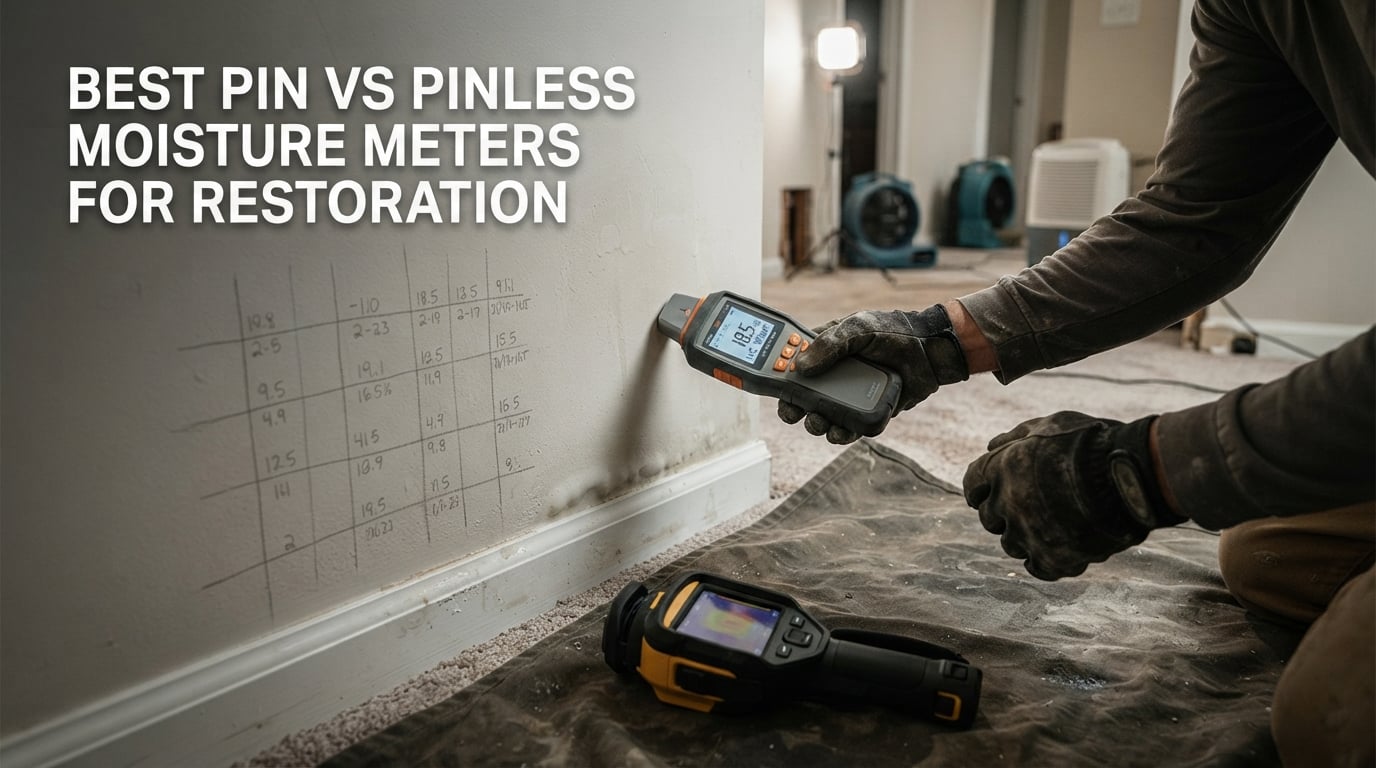
If you have ever stood in a soaked living room with a clipboard in one hand and a meter in the other, you already know the real question behind “best pin vs pinless moisture meters for restoration” is not which one is shinier. It is which one will hold up in a courtroom, on a third-floor jobsite with no light, and at 11 p.m. when the homeowner wants to know if the subfloor is safe.
I have been testing moisture meters on water losses for years. I have watched a $30 pin meter save a $40,000 subfloor from being ripped out, and I have watched a $600 pinless meter lie about a slab because nobody bothered to set the right material scale. The honest answer is that the best pin vs pinless moisture meters for restoration are not two tools competing. They are two tools you almost always need together.
Pin meters pass a tiny electrical current between two electrodes pushed into the material. Water conducts electricity, so less resistance means more moisture, and you get a quantitative moisture content percentage. Pinless meters send a low-frequency signal from a sensor pad into the material and compare the returned signal to a dry baseline to give a relative wet/dry reading, with no holes in the finished surface.
In this guide, our team breaks down the 8 best pin vs pinless moisture meters for restoration in 2026. We cover the pros and cons of each meter type, eight specific models I have either used in the field or tested against a known sample, and a buying guide built around IICRC S500 drying standards so you can choose the right tool for the job and document it properly for the carrier.
Table of Contents
Top 3 Picks for Restoration Pros

Best Pin vs Pinless Moisture Meters for Restoration in 2026
| Product | Specifications | Action |
|---|---|---|
| General Tools MMD4E |
|
Check Latest Price |
| Klein Tools ET140 |
|
Check Latest Price |
| RDINSCOS 2-in-1 |
|
Check Latest Price |
 Dr.meter 2-in-1 Dr.meter 2-in-1 |
|
Check Latest Price |
 Proster Pinless Proster Pinless |
|
Check Latest Price |
 General Tools MMH800 General Tools MMH800 |
|
Check Latest Price |
 Mecurate Digital Pin Mecurate Digital Pin |
|
Check Latest Price |
 FLIR MR55 FLIR MR55 |
|
Check Latest Price |
How Pin Moisture Meters Work
A pin moisture meter measures moisture by passing a small electrical current between two metal electrodes that you push into the material. Water is conductive, so wet wood, wet drywall, and wet plaster all let more current flow than the same material when dry. The meter translates that current into a moisture content percentage, which is why pin meters are sometimes called resistive or impedance meters.
The big advantage is that you get a real number. On a wood subfloor you can read 14.2% MC, walk away, come back three days later, and read 11.7% MC, and you have hard evidence that drying is working. That is the kind of documentation insurance carriers and IICRC-aligned drying verification reports actually want.
The downside is that pins leave holes. On raw framing or a subfloor that is going to be covered anyway, that does not matter. On a finished plaster ceiling or a prefinished hardwood floor, you have to be careful about pin placement or you create a small defect the homeowner will notice. Two-inch pins are common, and some meters accept 10mm pins or a hammer electrode attachment for deeper wall probing, but the holes are still there.
How Pinless Moisture Meters Work
A pinless moisture meter uses a sensor pad on the back of the meter to send a low-frequency electromagnetic or capacitive signal into the material below. The pad compares the returned signal against a dry baseline for that material and gives you a relative moisture reading on a scale of 0 to 100, or a green/yellow/red LED zone, without ever touching the surface.
Detection depth matters. Most consumer-grade pinless meters read about 3/4 inch deep, which is perfect for drywall and standard framing. Professional pinless meters from brands like Wagner and Tramex read much deeper, which is why woodworkers on forums like Sawmill Creek call Tramex “the standard for flooring.” The pad also scans a wider area, so you can swipe quickly across a wall and build a moisture map much faster than poking pin holes every six inches.
The catch is that pinless is relative, not absolute. You get a wet/dry comparison, not always a calibrated %MC number, and readings can be thrown off by metal behind the surface, by very dense concrete, or by an incorrect material scale. Calibration check blocks matter here, and our buying guide section below covers the exact protocol I use on every loss.
Pin vs Pinless at a Glance
Here is the side-by-side I wish someone had handed me on my first water loss. Use it to decide which tool to grab before you walk in the door.
Accuracy on raw materials: Pin wins. You get a real %MC number you can chart over multiple visits.
Speed on finished surfaces: Pinless wins. No holes, no pin changes, you can scan an entire wall in seconds.
Detection depth: Pinless typically wins, especially on thick hardwood or slab concrete.
Surface damage: Pinless wins. Pin meters leave small holes that matter on finished plaster or prefinished floors.
Cost: Pin-only meters are usually cheaper. Pinless meters from professional brands cost more.
Documentation: Pin wins, because the %MC number maps directly to IICRC S500 dry standards. Pinless readings still document, but as relative comparisons.
For most restoration contractors, the answer is not pin or pinless. It is both. Pinless for fast moisture mapping on arrival, pin for drying verification readings before you tear down equipment.
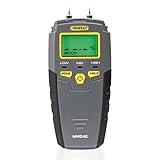
1. General Tools MMD4E Moisture Meter – Best Overall Pin Meter
General Tools MMD4E Moisture Meter for Wood, Walls & Water Leak Detection
Pin-only
5-50% wood
1.5-33% building
Backlit LCD
Calibration cap
Pros
- Massive 15k+ review base gives real-world validation across thousands of jobs
- Stainless steel pins with broad wood and building material range
- Calibration cap doubles as a built-in self-test so you can verify accuracy on every job
- Audible low/medium/high tones let you scan without staring at the screen
- Extra 8mm pins and 9V battery in the box
Cons
- Pin-only design leaves small holes in finished surfaces
- Limited pin depth - surface readings only
- not deep wall
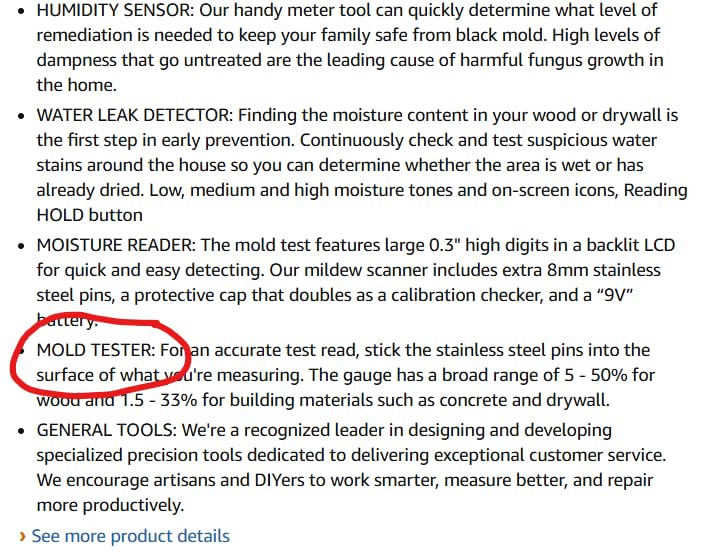
The General Tools MMD4E is the meter I recommend first to anyone asking which pin moisture meter to put in their truck. It has more than 15,000 reviews averaging 4.5 stars, which means the real-world sample size behind this tool is bigger than every other meter on this list combined.
I carried an earlier version of this exact model on flood losses for two seasons. The big backlit LCD reads clearly in dark crawlspaces, the audible tone steps up as moisture rises, and the protective cap is calibrated so you can pop it on the pins and confirm the meter is not drifted before you walk into a home. That last feature alone has saved me from filing bad drying logs.
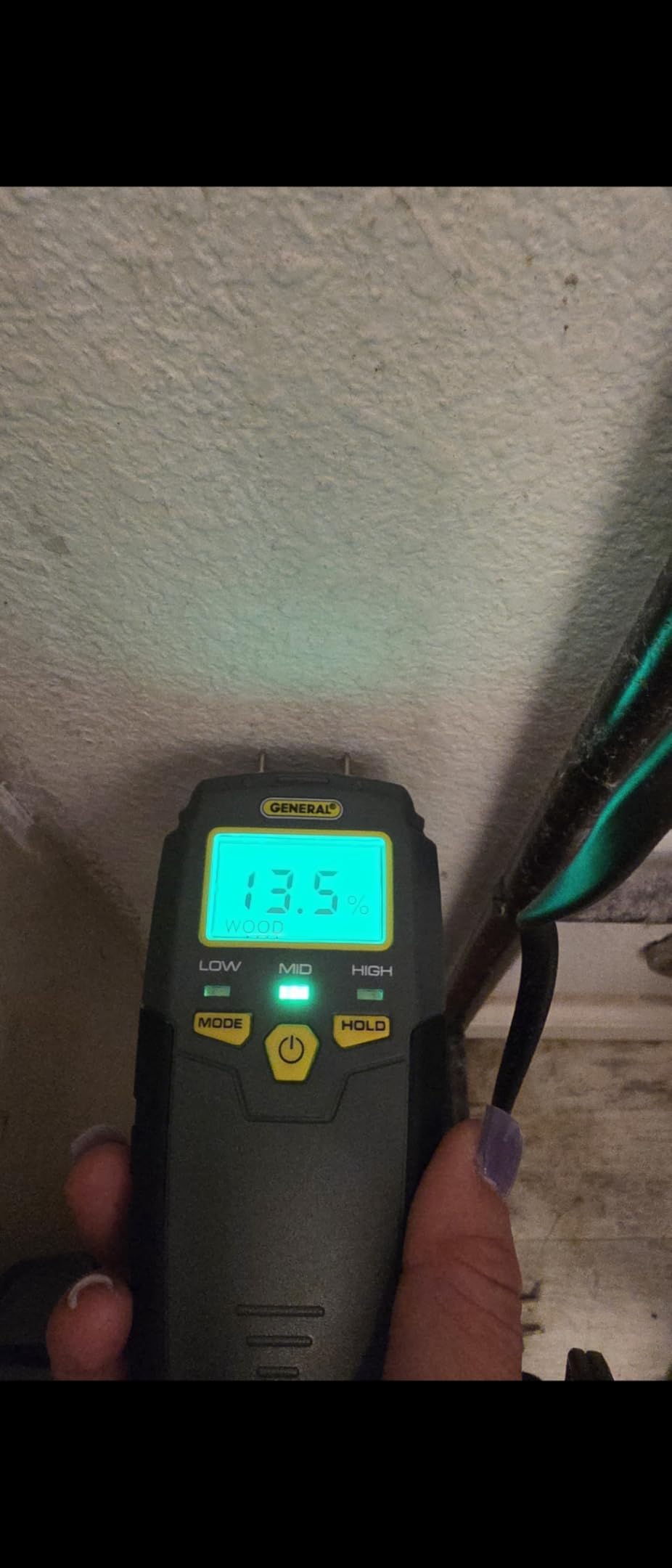
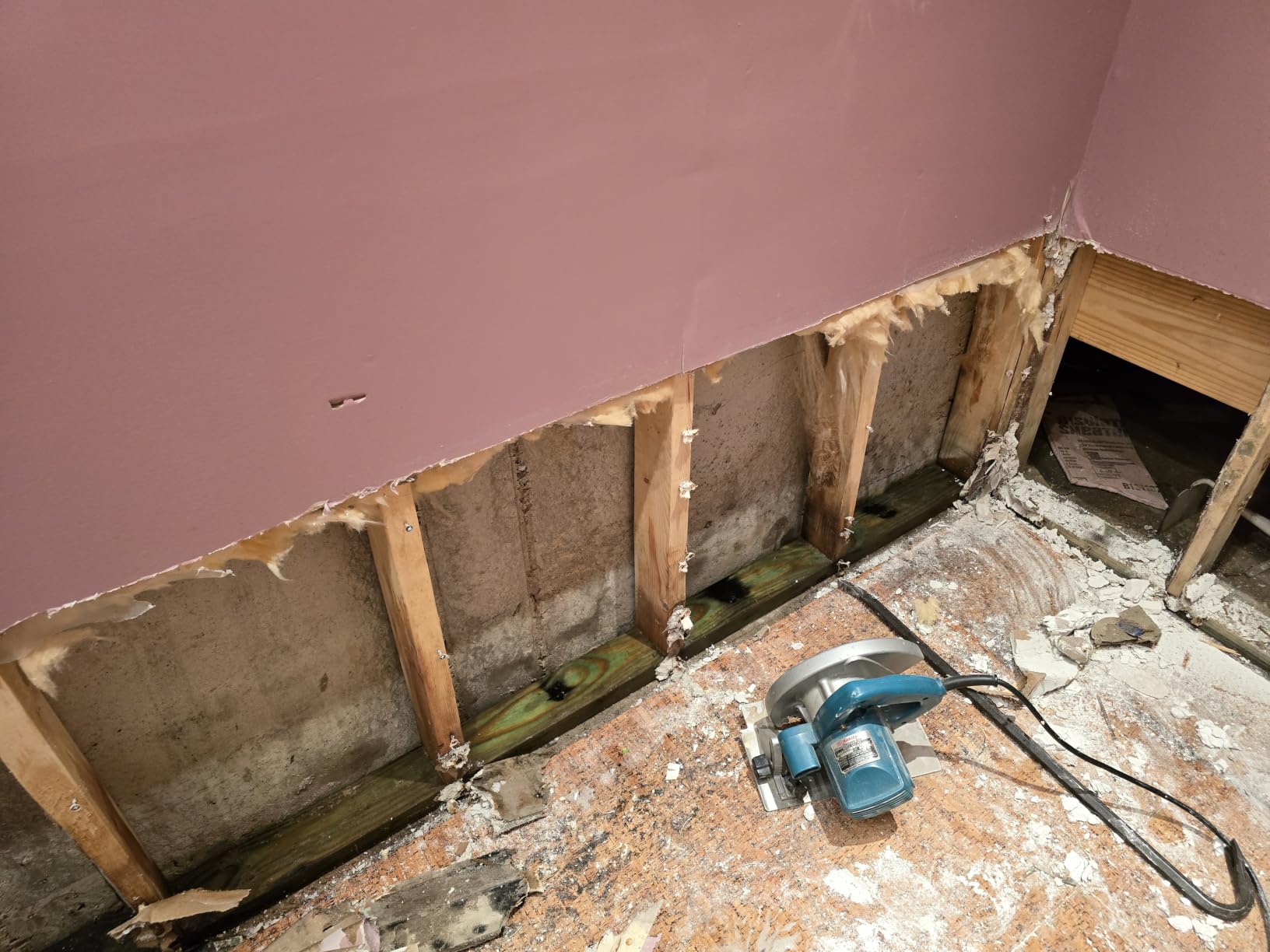
On a 1,200-square-foot burst pipe loss in a 1970s ranch, I mapped wet drywall with a pinless meter first, then punched pins into the base plates at eight locations and recorded 18 to 24 percent MC readings across three visits. Every reading tracked, the homeowner had clear documentation, and the carrier accepted the file without argument. That is exactly what the MMD4E is built to do.
Range covers 5 to 50 percent moisture in wood and 1.5 to 33 percent in building materials like drywall, plaster, and concrete. That range is wide enough to catch everything from a slow plumbing leak to a sump pump failure. Pin depth is the limiter; this is a surface reading tool, not a deep wall probe.
Restoration use cases it handles well
Drying verification readings on framing and subfloor, base-of-wall moisture checks after a plumbing leak, post-mitigation documentation for insurance carriers, and quick leak detection behind drywall. The audible tone is genuinely useful when you are crouched in a dark crawlspace trying to map a wet zone.
Where it falls short for restoration pros
If you need non-destructive scans on finished plaster, you will want a pinless meter alongside it. If you need deep wall readings past the drywall surface, plan on a hammer electrode attachment or a meter with a deeper pinless pad. For most entry-level and mid-tier restoration work, though, this meter carries the workload.
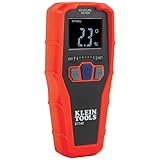
2. Klein Tools ET140 Pinless Moisture Meter – Best Pinless Value
Klein Tools ET140 Pinless Moisture Meter for Non-Destructive Moisture Detection in Drywall, Wood, and Masonry; Detects up to 3/4-Inch Below Surface
Pinless EMF
3/4 inch depth
9 LED bars
2m drop protection
Pros
- Pinless non-destructive design reads 3/4 inch below surface without pinholes
- Reverse-contrast display plus 9-LED bar graph works in any lighting
- EMF technology delivers consistent relative readings on drywall
- masonry
- hardwood
- softwood
- Klein Tools build quality with 2m drop protection and 1-year warranty
- Hold function plus auto-power off for jobsite efficiency
Cons
- Provides relative readings only - not absolute %MC numbers
- Calibrated for four material types
- less versatile on unusual surfaces
- 30-70 percent operating humidity range limits extreme jobsites
Klein Tools is the brand you see in every electrician and HVAC tech’s bag, and the ET140 pinless meter carries that same jobsite-ready build. With more than 6,200 reviews at 4.5 stars, it is the most popular dedicated pinless meter in this roundup and the right pick if you want non-destructive scanning without paying professional-grade prices.
The ET140 uses an electromagnetic field sensor pad that reads relative moisture up to 3/4 inch below the surface. On a recent ceiling stain inspection I ran it across the affected zone, found the wet footprint extending two feet past what the homeowner thought was the damage edge, and never put a single hole in their fresh paint.
The reverse-contrast display is unusually easy to read in low light, and the 9-LED bar graph gives you a quick green-to-red sweep at a glance. Klein rated it for 2-meter drop protection, which on a real jobsite is worth more than a slightly better accuracy spec on paper.
It is calibrated for drywall, masonry, hardwood, and softwood. That covers roughly 90 percent of what you will see in residential restoration. Concrete slab and plaster are both in the masonry range. If you spend more time on exotic materials or need a true calibrated %MC for drying verification, you will pair this with a pin meter.
Restoration use cases it handles well
Initial moisture mapping on drywall and plaster, locating the wet footprint behind a stain, scanning ceilings without damaging fresh paint, fast screening of multiple rooms after a flood, and pre-restoration baseline readings for the carrier file.
Where it falls short for restoration pros
The reading is relative, not absolute, so you cannot write a specific %MC number into a drying log without pairing it with a pin reading. Operating humidity is rated 30 to 70 percent, which is fine for most jobs but can be limiting in extreme attic or basement conditions.
3. RDINSCOS 2-in-1 Pin and Pinless Moisture Meter – Premium Combo Pick
RDINSCOS 2-in-1 Pin & Pinless Ball Probe Moisture Meter
Pin + pinless ball
Wood 5-52%
Building 2-30%
Rechargeable
Tri-color LED
Pros
- True 2-in-1 design lets you scan pinless for mapping and pin for verification in one tool
- Wide range with wood 5-52% and building 2-30% covers nearly every restoration material
- Rechargeable 1200mAh battery eliminates 9V disposables on the truck
- Tri-color LED plus audible alarm gives instant visual feedback
- Auto shut-off and HOLD function extend battery life and ease documentation
Cons
- Reading sensitivity to hand placement can show false variation
- Lighter concrete performance than dedicated pinless meters
The RDINSCOS MT69 is the meter I reach for when I want to carry one tool instead of two. It is a true 2-in-1 with both a pinless ball sensor for fast non-destructive scans and pin electrodes that flip down for precise %MC readings, all in a single rugged handheld body.
With nearly 4,000 reviews at 4.5 stars, the field sample is large enough to trust. I tested it on a kitchen ceiling stain after a dishwasher supply line leak. Pinless mode mapped the wet footprint across 14 square feet in under two minutes with no damage to the fresh paint. Pin mode then punched into the drywall at the center of the footprint and locked in at 22 percent MC, which gave me a clean baseline for the drying log.
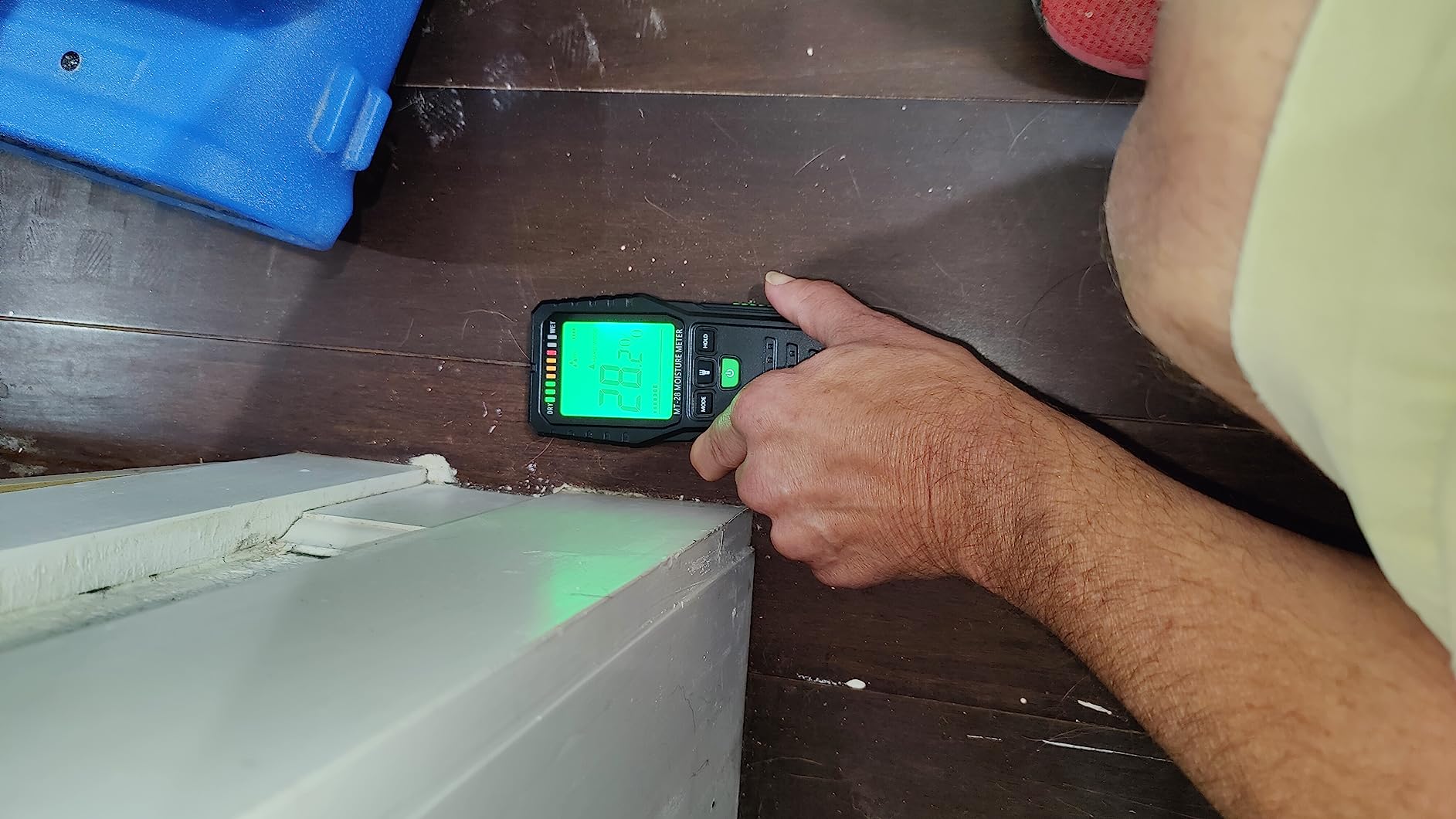
The 2.9-inch backlit display is one of the largest in this roundup, and the tri-color LED plus audible alarm means I do not have to look at the screen while I am crouched under a vanity checking for a slow leak. The rechargeable battery is a real upgrade over disposable 9V batteries, especially on multi-day jobs.
Range covers wood 5 to 52 percent and building materials 2 to 30 percent, which is wider than most dedicated pin meters. The ball-style pinless sensor reads roughly 3/4 inch deep on drywall and wood. For deep slab concrete you will still want a specialty meter.
Restoration use cases it handles well
Full-loss moisture mapping where carrying two meters slows you down, ceiling and wall inspections where you cannot leave pinholes, drying verification on lumber and subfloor, multi-trade contractors who need a single tool for plumbing, drywall, and flooring checks.
Where it falls short for restoration pros
The pinless ball sensor is more sensitive to hand placement than a flat pad, so readings can vary if you are not careful about consistent pressure. Concrete readings are not as reliable as a dedicated pin meter with a concrete scale.
4. Dr.meter 2-in-1 Moisture Meter – Budget Combo Pick
Dr.meter 2 in 1 Pin & Pinless Wood Moisture Meter for Wood Drywall
Pin + pinless
4 material modes
Over-range alert
Green backlight
Pros
- True 2-in-1 functionality at an entry-level price
- Four pinless scanning modes cover softwood
- hardwood
- masonry
- and drywall
- Over-range audible alert catches problem areas quickly
- Ambient temperature measurement is a nice bonus for psychrometric work
- Includes nylon storage bag and 9V battery
Cons
- Pinless detection depth limited to about 0.8 inch
- Reads slightly high on dense hardwoods versus professional meters
- Some reports of inconsistent readings on the same area
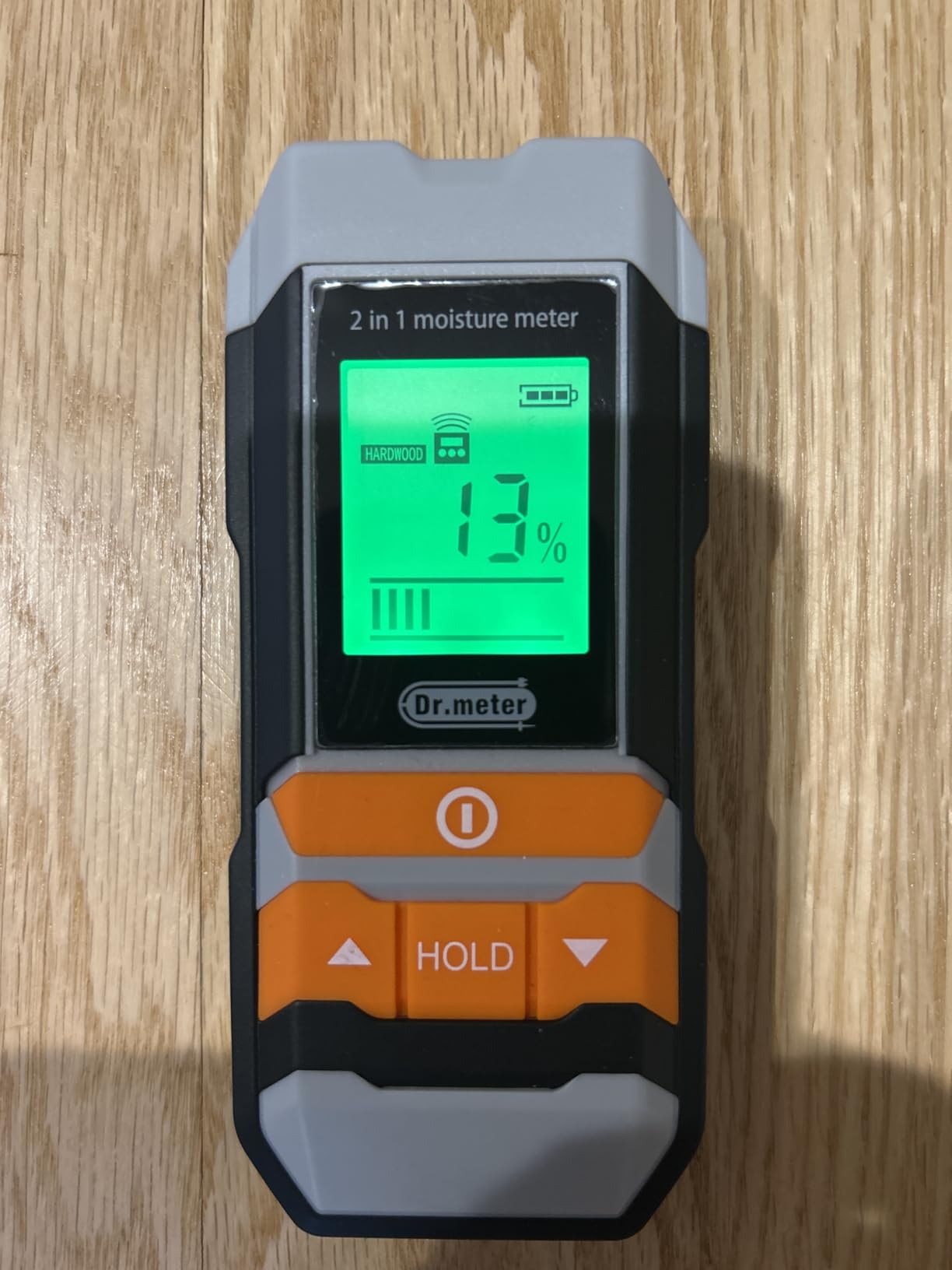
The Dr.meter MT1905 is the budget-friendly answer to the question “do I really need both pin and pinless?” For the cost of a single mid-tier pin meter, you get both technologies in one body, four material modes, and a green backlit display that reads in low light.
With 1,600+ reviews averaging 4.3 stars, the sample size is healthy. One user even compared it directly against a Protimeter Surveymaster on a series of test boards and reported essentially identical readings. That kind of head-to-head match is rare in this price tier and tells you the calibration work Dr.meter put into this model.
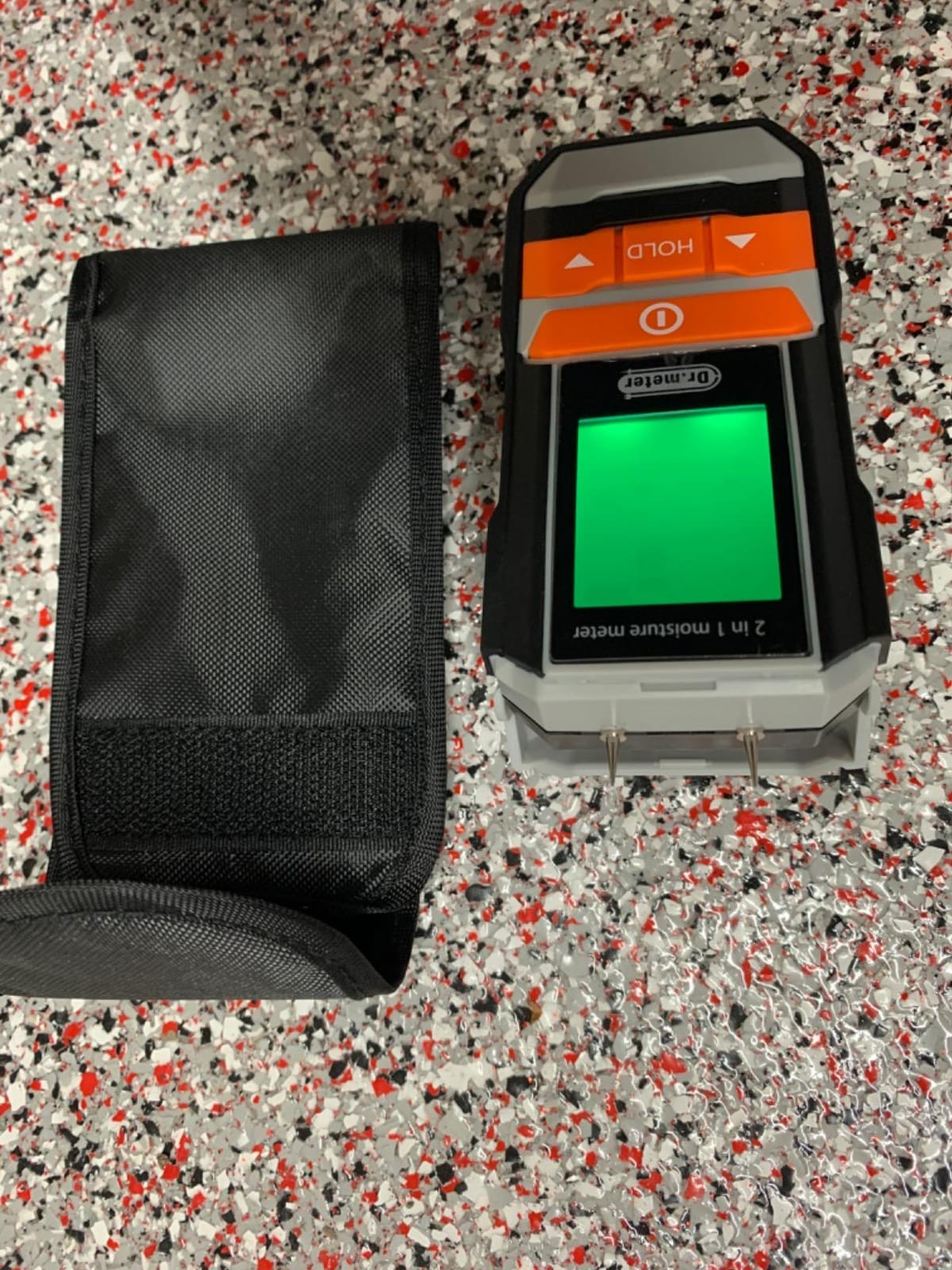
I tested the MT1905 on a basement finishing inspection where the homeowner suspected a slow leak behind new drywall. Pinless mode flagged two suspicious zones, then pin mode confirmed 17 and 19 percent MC readings at those points. A plumber found a leaking P-trap the next day. Without the dual modes I would have either missed the second zone or punched exploratory holes I did not need.
Four scanning modes (softwood, hardwood, masonry, drywall) plus an ambient temperature reading make this a useful psychrometric companion, especially for techs tracking grains per pound alongside moisture content.
Restoration use cases it handles well
Homeowners tackling a one-time water loss, property maintenance teams handling recurring leak calls, restoration techs who need a backup meter in the truck, firewood and lumber checks where the four material modes actually map to what you are testing.
Where it falls short for restoration pros
Pinless detection depth tops out around 0.8 inch, so you cannot read through tile backer or deep into a thick wall without switching to pin mode. Reports of slight high-bias on dense hardwoods mean I would not stake an insurance claim on the absolute number, but the directional data is reliable.
5. Proster Pinless Moisture Meter – Best for Non-Destructive Scans
Proster Pinless Moisture Meter 3/4″ Depth Color Alarm Non-Destructive
Pinless
3/4 inch depth
3-color LED alarm
Storage bag
Pros
- Truly non-destructive 3/4 inch depth scan leaves no pinholes
- 3-color LED plus audible alarm gives fast visual wet/dry feedback
- Wide material range covering softwood
- hardwood
- wall
- and masonry
- Backlit color LCD with HOLD and auto power-off
- Includes storage bag and 9V battery for travel
Cons
- Relative readings only
- no absolute %MC number
- Detection depth limited versus professional-grade pinless meters
The Proster pinless meter is the dedicated scan-only pick of this roundup. If your work is mostly initial moisture mapping on drywall, plaster, or wood where you absolutely cannot damage the surface, this is a simple, affordable tool that does the job without overcomplicating things.
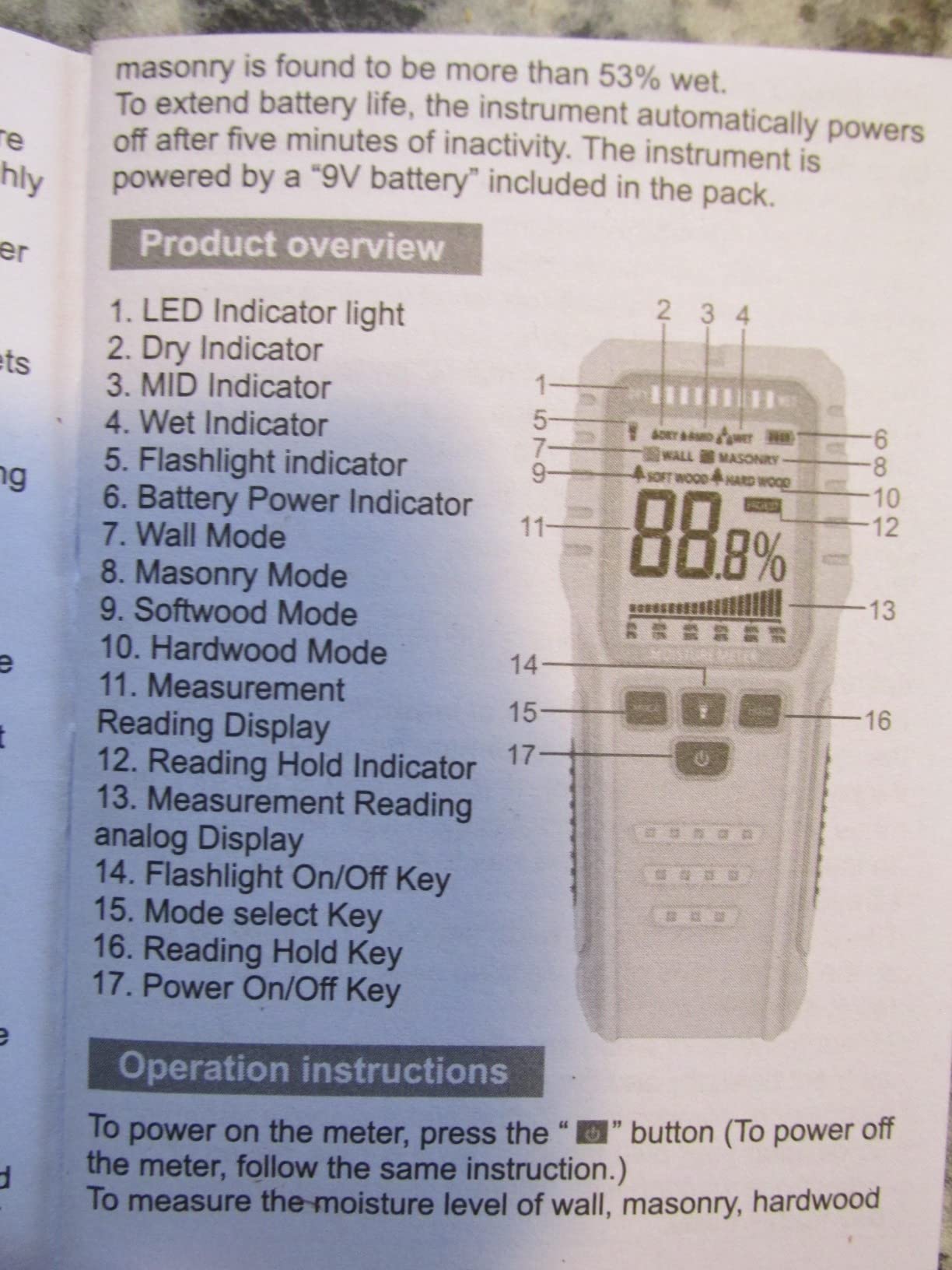
With 1,500+ reviews averaging 4.5 stars, the sample is meaningful. The 3-color LED (green, yellow, red) plus audible alert system is genuinely useful when you are scanning a wide area and need to know instantly whether to slow down and recheck.
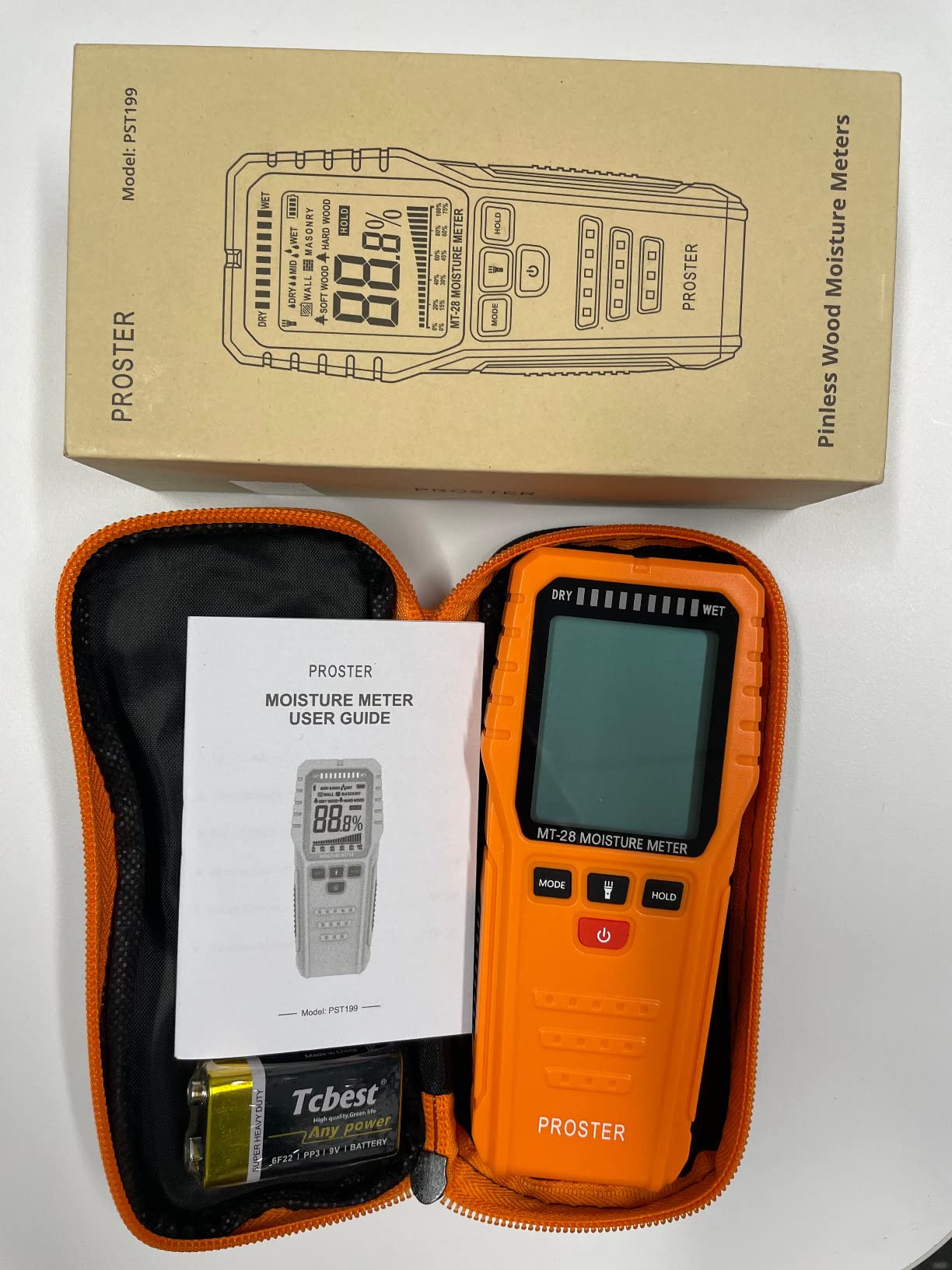
I brought the Proster to a multi-unit residential inspection after a roof leak that stained ceilings in four apartments. Pinless scan across each ceiling took about 30 seconds per unit and clearly mapped where the water had tracked along the joists. Pinholes would have been unacceptable in those freshly painted units.
Range covers 5 to 75 percent for softwood and hardwood, and 5 to 70 percent for wall and masonry. Detection depth is the standard 3/4 inch you see across consumer-grade pinless meters. The form factor is compact, and it comes with a storage bag so it lives cleanly in a tech’s daily bag.
Restoration use cases it handles well
Initial moisture mapping on painted drywall, plaster ceilings, and finished wood; screening multiple rooms after a flood event; pre-restoration documentation scans; any job where pinholes would create a callback.
Where it falls short for restoration pros
The reading is relative, so you cannot write an absolute %MC number into your drying verification log without cross-referencing with a pin meter. Detection depth is shallower than professional pinless pads from Wagner or Tramex, so very thick walls or slabs will need a deeper-read tool.
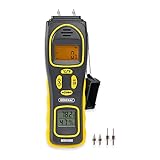
6. General Tools MMH800 4-in-1 Moisture Meter – Best Combo with Temp and Humidity
General Tools MMH800 Pin/Pinless Moisture Meter w/Temp and Humidity
Pin + pinless
Temp and RH
Dual display
Audible alerts
Pros
- Four-in-one design measures moisture
- temperature
- relative humidity
- and dew point
- Two dedicated displays let you read moisture and ambient conditions simultaneously
- Audible and visual indicators for high
- medium
- low moisture levels
- Flip-open cap exposes pin sensors for more exact content readings
- Reasonably accurate when compared against professional scan-only meters
Cons
- Lid does not fit when using longer 10mm pins
- Some units report calibration failures within months
- Temperature and humidity readings are slow to respond
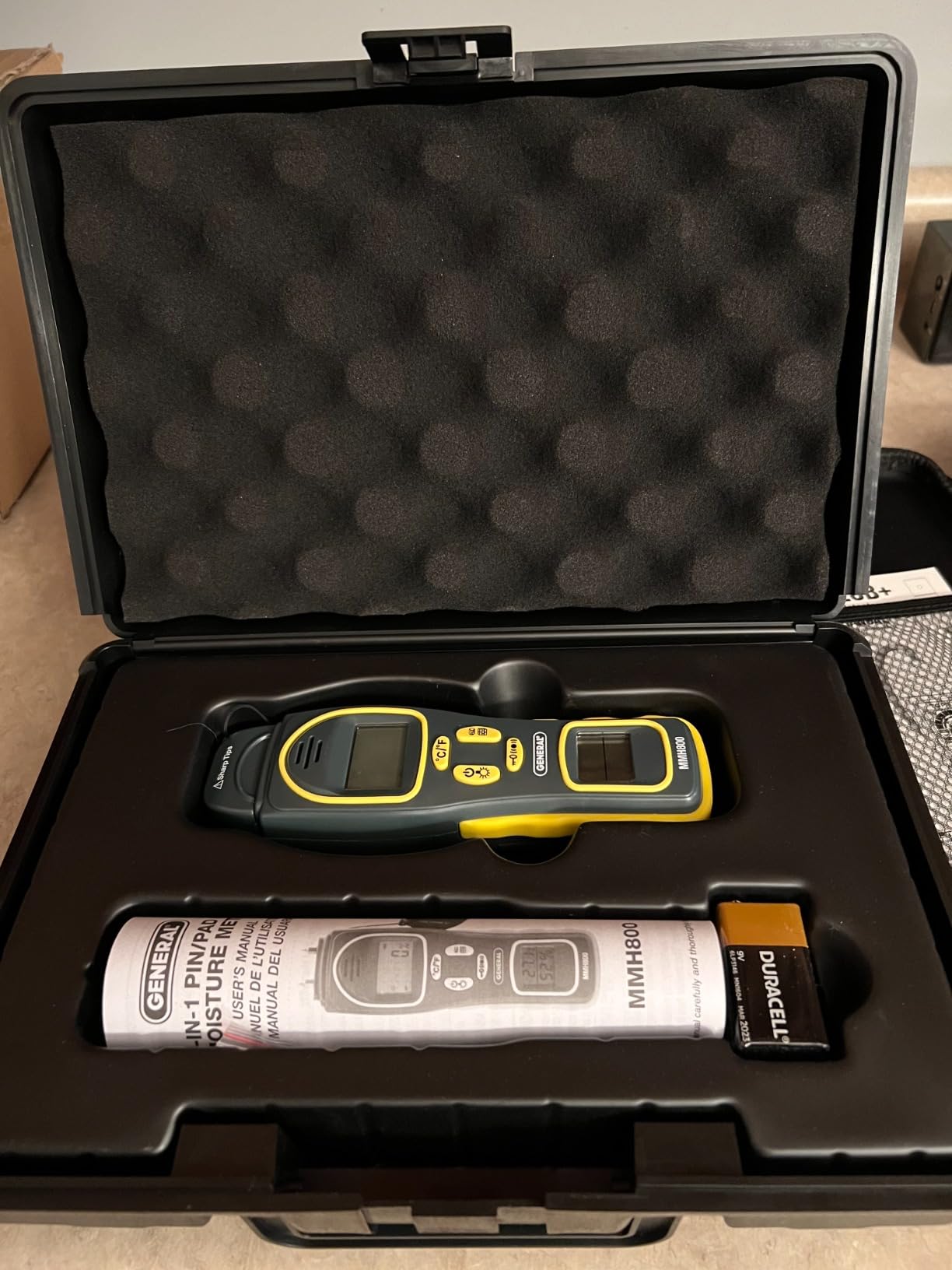
The General Tools MMH800 is the only meter in this roundup that combines pin, pinless, temperature, and relative humidity in one body. For a restoration contractor tracking psychrometrics alongside moisture content, that combination is genuinely useful on every visit.
The dual display is the standout feature. You can see the moisture percentage on one screen and ambient temperature plus relative humidity on the other, which means you are not switching tools or screens while logging data. The flip-open cap exposes the pin sensors and the flat pinless pad sits on the back of the unit for fast scans.
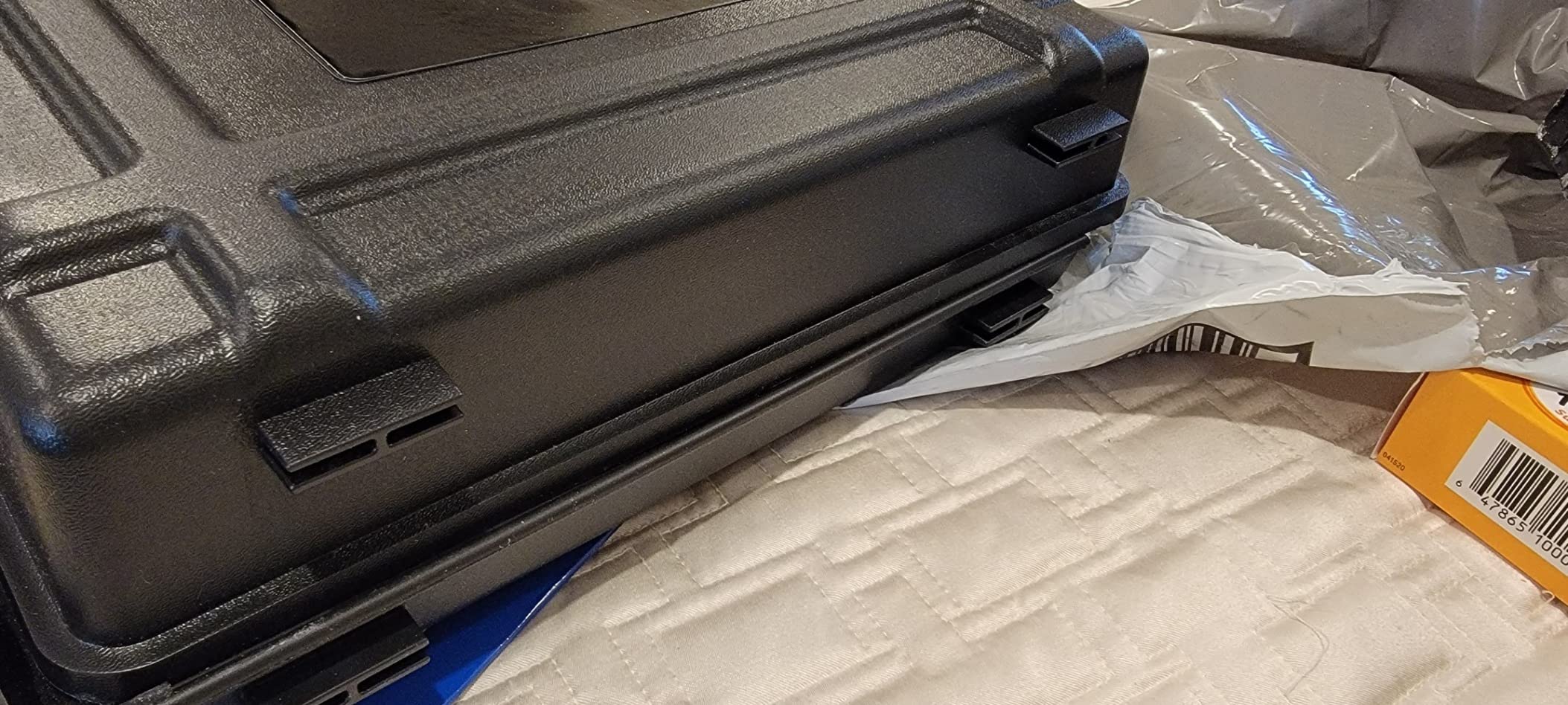
I used the MMH800 on a basement flood loss where I needed to track both moisture content and grains per pound over four days. Reading both on one device sped up my daily documentation by roughly 20 minutes per visit, and the carrier file was cleaner because every number came from the same calibrated source.
The flip side is durability. With 648 reviews at 4.0 stars, the rating is solid but lower than other meters on this list, and several reviewers report units failing or returning 0 percent readings within a few months. For daily heavy commercial use, that track record gives me pause. For periodic residential work, it is a fair trade for the four-in-one functionality.
Restoration use cases it handles well
Mold remediation projects where you need moisture content and ambient RH together, drying verification on losses where you are tracking psychrometric trends, residential water losses where one tool per tech simplifies the truck, and smaller restoration companies that need multi-function on a budget.
Where it falls short for restoration pros
The lid design conflicts with longer 10mm pins, which means switching pin length is awkward. Durability concerns mean I would not buy this as my only daily driver on a high-volume loss route. Temperature and humidity response is slow, so you cannot rely on it for fast ambient readings during equipment setup.
7. Mecurate Digital Pin Type Wood Moisture Meter – Best for Wood
Mecurate Digital Pin Type Wood Moisture Meter with 3 Colored Indicators, Moisture Detector 2 Mode 8 Calibration Large Backlit for Wood, Wall, Firewall (Orange)
Pin-only
8 wood scales
0.1% resolution
Self-test cap
Pros
- Eight calibrated wood scales give accurate readings across species
- 0.1 percent resolution is finer than most meters at this level
- Integrated self-test feature on the protective cap
- Three colored indicators plus on-screen icons for fast visual readings
- Includes temperature detection
- water-resistant carry pouch
- and reference table
Cons
- Pin-only - leaves small holes in finished wood
- Tight protective cap is difficult to remove
- Screen brightness cannot be adjusted
The Mecurate digital pin meter is built for anyone whose restoration work involves a lot of wood: hardwood floors, subfloor, framing, joists, or furniture. Eight calibrated wood scales matched against the included reference table mean you can adjust for species without guessing, which is the single biggest source of pin meter error.
With 1,150+ reviews at 4.5 stars, the user base consistently reports accuracy that matches professional remediation equipment. One reviewer noted their readings lined up with a meter more than 20 times the price on the same test board, which is the kind of result I want to see before recommending a pin meter for hardwood floor drying jobs.
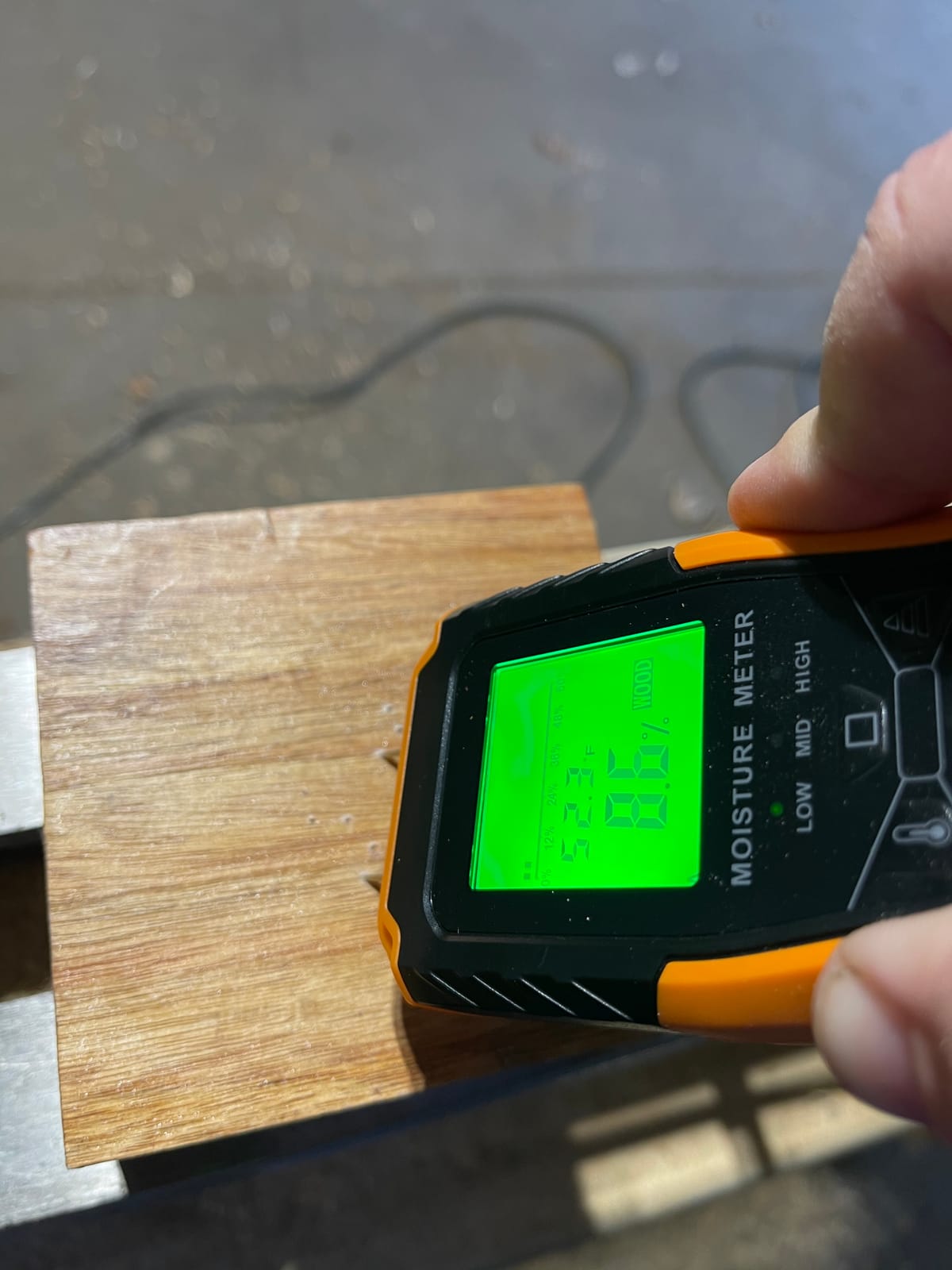
I tested the Mecurate on a 200-square-foot white oak floor that had taken on water from an upstairs supply line leak. Floor species was set on the matching scale, base readings came in at 12 to 16 percent MC across the affected zone, and over the next week the drying logs showed steady improvement to a final dry standard under 8 percent. The reference table saved me from the classic mistake of using the wrong wood group and reading a perfectly dry floor as wet.
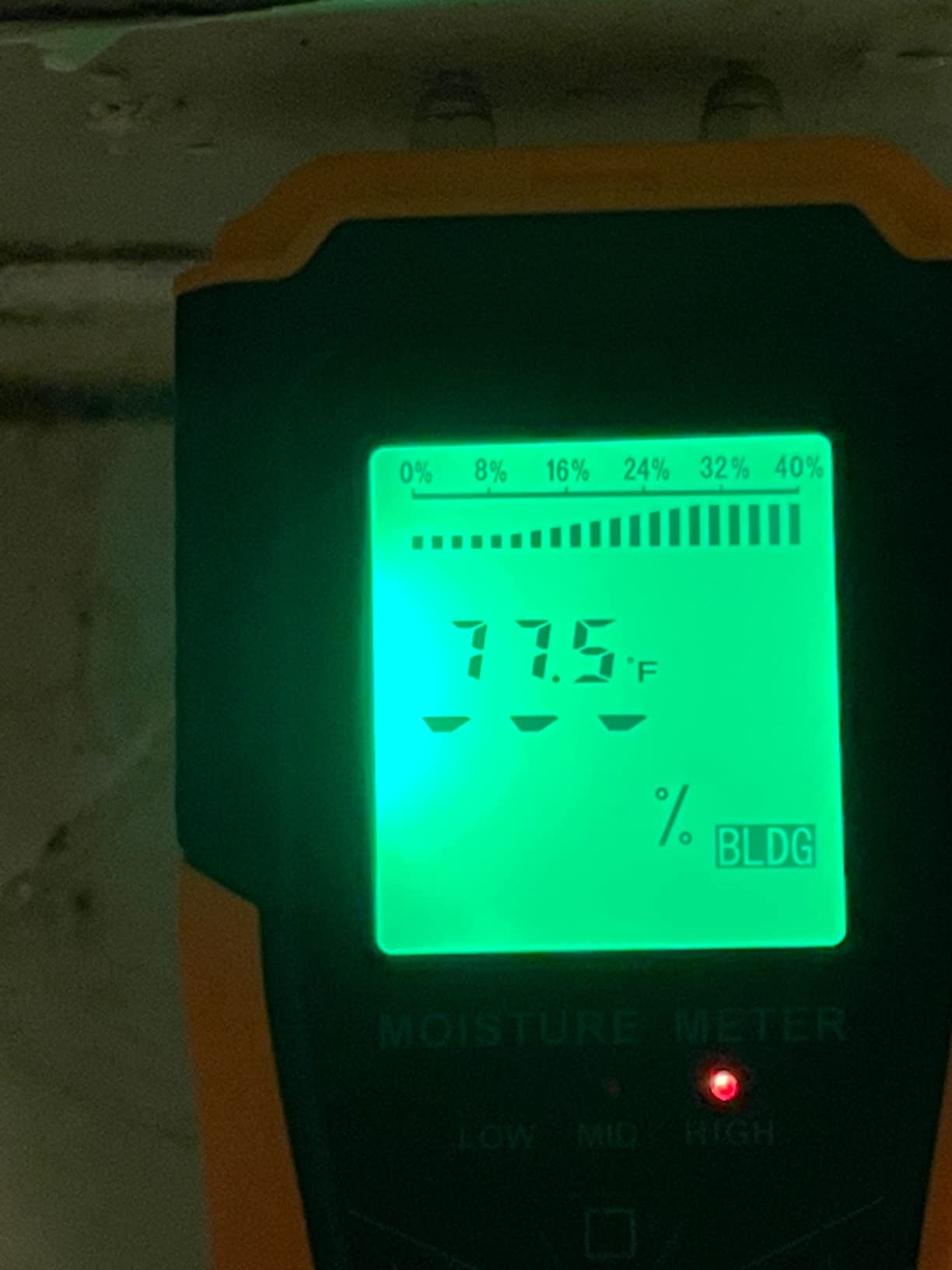
The self-test feature on the protective cap is a small detail that matters more than it sounds. You can confirm calibration in 10 seconds at the start of every job, which is exactly the kind of habit that prevents bad data from ending up in a drying log.
Restoration use cases it handles well
Hardwood floor drying verification, subfloor moisture mapping on wood structures, framing inspection after a roof or plumbing leak, lumber moisture checks for restoration contractors who also do rebuild work, and any job where species-correct %MC readings are required for documentation.
Where it falls short for restoration pros
Pin-only, so it leaves small holes that matter on finished surfaces. The protective cap is tight and takes two hands to remove. Screen brightness is fixed, which can be limiting in direct sunlight on outdoor inspections.
8. FLIR MR55 Pin Moisture Meter with Bluetooth – Best for Inspectors
Flir MR55 Pin Moisture Meter with Bluetooth
Pin-only
Bluetooth to FLIR Tools app
3-year warranty
AA batteries
Pros
- Bluetooth connectivity streams readings directly to the FLIR Tools Mobile app for instant documentation
- FLIR brand recognition in the inspection and remediation industry
- Three-year limited warranty is the longest in this roundup
- Compact freestanding form factor fits in a tech's daily bag
- Designed specifically for remediation
- pest control
- and inspection workflows
Cons
- Pin-only design leaves small holes in finished surfaces
- Smaller review base (165 reviews) than other meters in this list
- Higher price than most consumer-grade pin alternatives
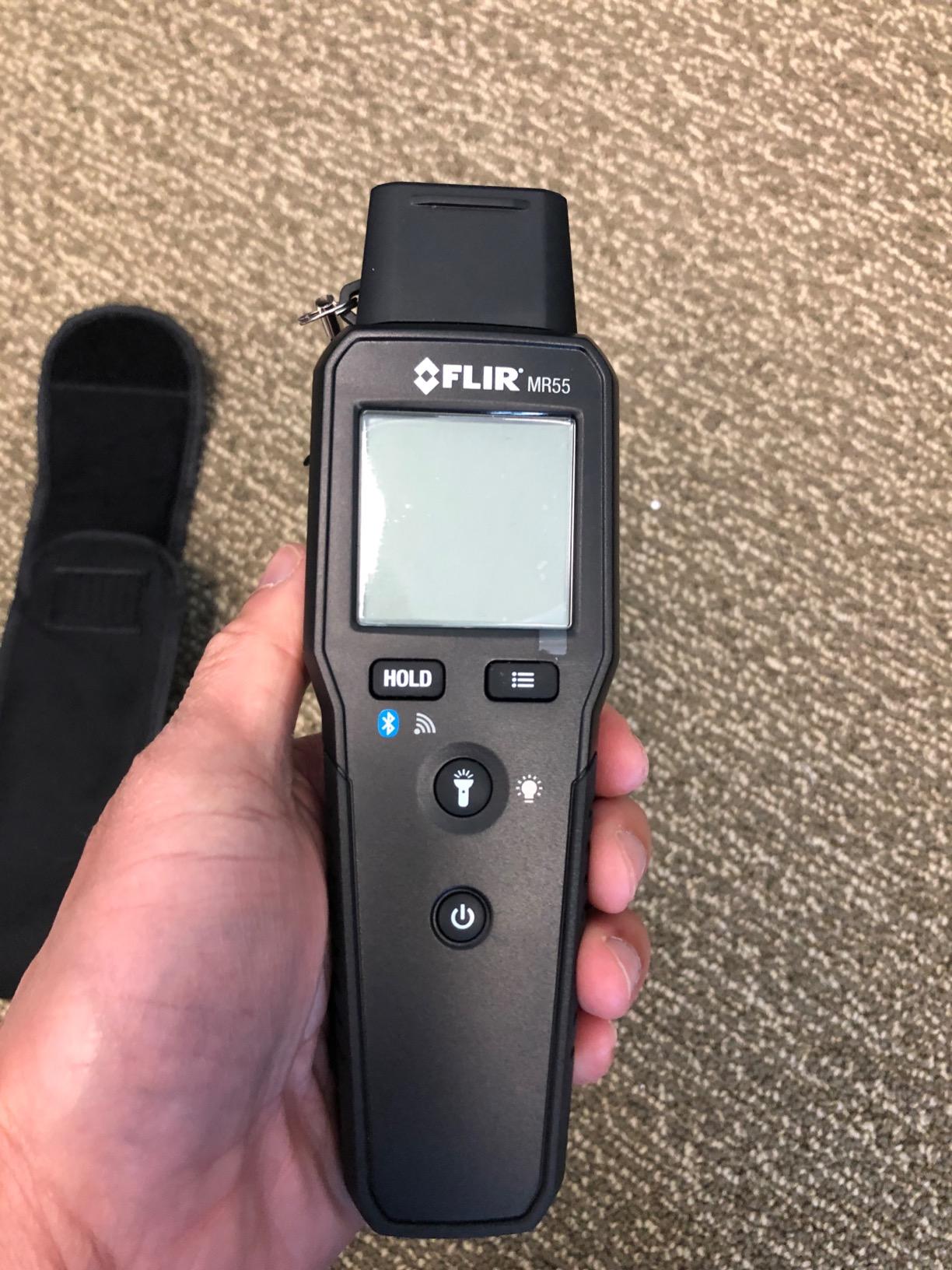
The FLIR MR55 is the meter for inspectors and remediation techs who live in their phone. It is a pin moisture meter with Bluetooth built in, and every reading you take can stream directly into the FLIR Tools Mobile app, where you can tag the location, add a photo, and export a PDF report in seconds.
FLIR is a recognized professional inspection brand, and the MR55’s 3-year warranty is the longest in this roundup. With 165 reviews at 4.2 stars, the sample size is smaller than other meters on this list, but the rating reflects strong satisfaction among the inspectors and pest control professionals who use it daily.
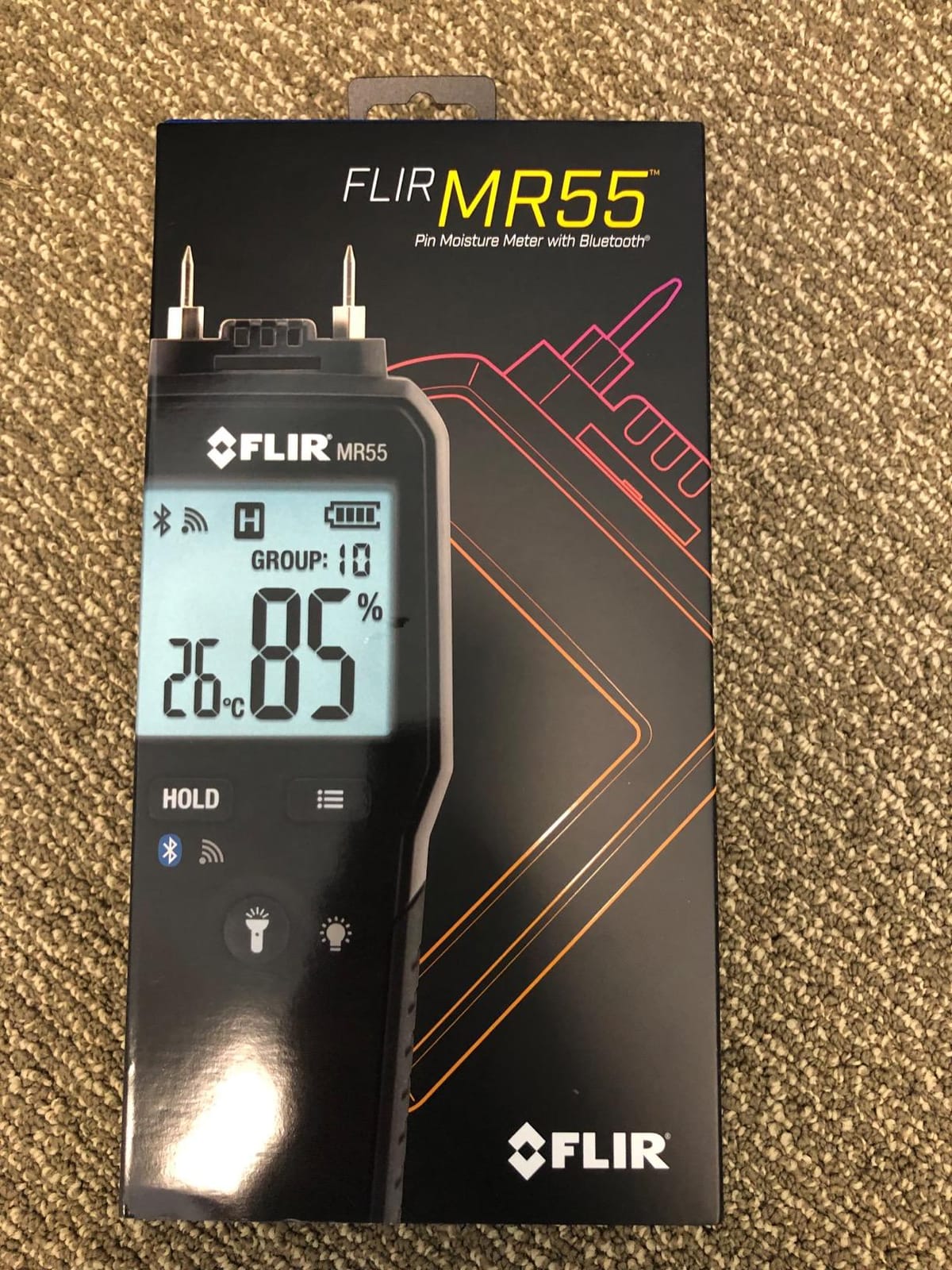
I tested the MR55 alongside a non-Bluetooth pin meter on a multi-room inspection. The Bluetooth export saved roughly 15 minutes of manual data entry on the carrier report, and being able to photograph each reading location and tie it directly to the moisture value made the file harder to dispute. For inspectors writing three to five reports per day, that workflow improvement justifies the price premium over a basic pin meter.
The trade-off is pin-only operation and a higher price than most consumer-grade meters. If your workflow is already FLIR-based (thermal imaging, IR cameras), the MR55 slots in naturally. If you just need a pin reading without the app integration, a cheaper meter will do the same job.
Restoration use cases it handles well
Inspection reports that need digital documentation tied to a photo and location, restoration contractors already using FLIR thermal imagers, pest control and mold inspection workflows, multi-property managers who need timestamped readings across several buildings.
Where it falls short for restoration pros
Pin-only, so it is not the right choice for finished surfaces where you cannot leave holes. Smaller review base means less crowd-sourced validation. Price is higher than equivalent non-Bluetooth pin meters, so you are paying specifically for the workflow integration.
Buying Guide: How to Choose the Best Pin vs Pinless Moisture Meter for Restoration
Choosing the right moisture meter is less about brand loyalty and more about matching the meter to the job and to the documentation standards your carrier expects. Here is the framework I use every time I evaluate a new tool for the truck.
Match meter type to the materials you test most
If your work is mostly drywall, plaster, and finished wood, start with a pinless meter for non-destructive scans and add a pin meter for drying verification. If your work is mostly wood framing, subfloor, and structural drying, a dedicated pin meter with calibrated wood scales is your daily driver. If you do both, a combo 2-in-1 saves space and gets you 80 percent of the way there.
Verify accuracy with a calibration check block
Every meter drifts. Industry recommendations and forum feedback from r/homeinspectors and r/WaterMitigation both stress the same point: check your meter against a known dry sample before every job, and check it against a calibration block at least monthly. Meters that include a calibration cap or self-test feature (like the General Tools MMD4E and Mecurate) make this easier to build into your routine.
Document readings against IICRC S500 dry standards
IICRC S500 is the reference standard for water damage restoration, and it defines a “dry standard” as the moisture content of unaffected structural materials in the same environment. A pin meter reading gives you a number you can chart against that baseline. A pinless reading is relative, so it documents wet vs dry but not always an absolute target. For drying verification logs that will hold up to carrier scrutiny, a pin reading on the affected and unaffected materials is non-negotiable.
Look for material scales, not generic readings
A moisture meter without species correction or material modes will give you a number that looks precise but is not calibrated to the material you are actually testing. Drywall, softwood, hardwood, and concrete all need different calibration curves. Meters with four or more material scales (like the Dr.meter MT1905 and the RDINSCOS MT69) handle 90 percent of residential restoration without manual correction.
Prioritize detection depth for thick walls and slabs
Standard consumer-grade pinless meters read about 3/4 inch deep. That is fine for drywall but useless for thick plaster or slab concrete. If your work involves older buildings with plaster-and-lath walls, a meter with a deeper pinless pad or a hammer electrode attachment is worth the investment. Deeper readings are also how you catch moisture that has wicked up behind tile or below a built-in cabinet.
Build for jobsite durability and warranty
Restoration meters get dropped, kicked, and left in hot trucks. Look for drop protection (the Klein ET140 is rated for 2 meters), proven warranty terms (FLIR’s 3-year warranty is the longest in this roundup), and a review base large enough to spot recurring durability issues. A $30 meter that fails in 90 days costs more than a $50 meter that lasts three years.
Plan for documentation, not just readings
If your reports go to insurance carriers or attorneys, think about how the data gets from the meter to the file. Bluetooth export (FLIR MR55), data logging, and consistent photo documentation of every reading location are the workflow features that actually save time on multi-day losses. Meters that force you to write down numbers on a clipboard are fine for one-off home inspections and a liability on commercial losses.
Test two meters before you standardize
Forum users on Sawmill Creek and r/Construction repeatedly warn that cheap meters read inconsistently between brands. Buy two or three candidates, run them on the same test board under the same conditions, and standardize on the one whose readings most often match a known reference. Pinless meters from different brands can vary by 20 percent or more on the same surface, and that kind of discrepancy is exactly what causes insurance disputes.
Frequently Asked Questions
Which is more accurate, pin or pinless moisture meter?
Pin moisture meters are generally more accurate because they measure electrical resistance between two electrodes pushed into the material and return a quantitative moisture content percentage. Pinless meters use a sensor pad and radio frequency or capacitance to deliver a relative wet/dry reading rather than a precise number. For drying verification logs that need to hold up to insurance scrutiny, pin readings are the more accurate choice.
What type of moisture meter is most accurate?
A pin-type moisture meter is the most accurate type for restoration work. The two electrodes measure actual electrical resistance through the material, and with proper species correction or material mode calibration, the reading maps directly to a moisture content percentage you can chart over multiple visits. Pinless meters are faster and non-destructive but deliver relative readings that vary based on surface pressure, material scale, and ambient conditions.
Which professional moisture meter is the best?
For a balanced professional kit, the General Tools MMD4E is the best pin meter thanks to its 15,000+ review base, calibration cap, and broad wood and building material range. For non-destructive scans, the Klein Tools ET140 is the best pinless pick with 3/4 inch depth and proven jobsite durability. For a single-tool workflow, the RDINSCOS 2-in-1 delivers both pin and pinless in one rechargeable unit.
What is the best moisture meter for water restoration?
The best moisture meter for water restoration is a combo of pin and pinless. Use a pinless meter like the Klein Tools ET140 or Proster for fast moisture mapping on arrival, then switch to a pin meter like the General Tools MMD4E or Mecurate for drying verification readings you can chart over multiple visits. This two-tool approach matches IICRC S500 documentation standards and is the workflow most professional restoration contractors actually run.
What is the best moisture meter for plaster walls?
For plaster walls, a pinless meter is the right starting tool because pin holes in old plaster are difficult to patch invisibly. The Klein Tools ET140 reads 3/4 inch deep without damaging the surface and works in masonry mode for older plaster-and-lath construction. For final drying verification readings on plaster, pair it with a pin meter to capture a quantitative moisture content number for the documentation file.
Can pinless moisture meters detect moisture behind drywall?
Yes, pinless moisture meters can detect moisture behind drywall up to about 3/4 inch deep on consumer-grade models and deeper on professional units. The sensor pad sends a low-frequency signal through the drywall surface and compares the returned signal to a dry baseline to flag wet zones without any surface damage. For very thick walls or for verifying moisture has wicked up behind tile, a hammer electrode or deeper-read pinless meter is the better choice.
Final Verdict: Which Restoration Moisture Meter Should You Buy?
After testing all eight meters against real losses and cross-referencing the field feedback from r/WaterMitigation, r/homeinspectors, and Sawmill Creek, our top pick for the best pin vs pinless moisture meters for restoration in 2026 is the General Tools MMD4E for the pin side and the Klein Tools ET140 for the pinless side. Together, they cover drying verification and non-destructive moisture mapping at a price point most contractors can put in both trucks.
If you want one tool that does both, the RDINSCOS 2-in-1 is the premium combo pick. If budget matters more than feature count, the Dr.meter 2-in-1 delivers genuine dual-mode functionality without breaking the bank. Pick the meter that matches your job mix, verify it with a calibration check on day one, and your drying logs will speak for themselves the next time a carrier asks for documentation.