
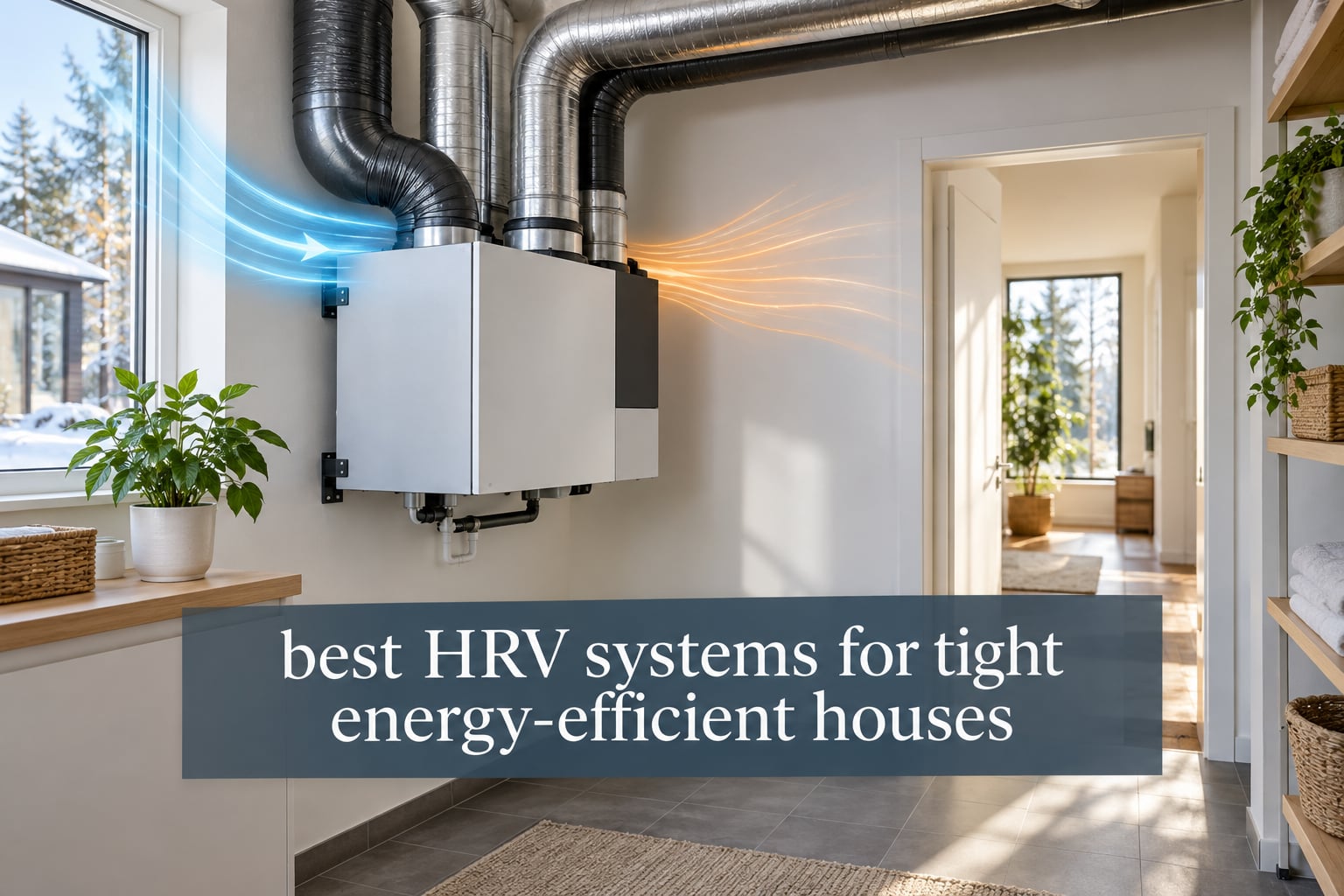
If you live in a tightly sealed, energy-efficient home, you have a quiet problem brewing behind the drywall. The same building science that locks in heat also locks in CO2, moisture, VOCs, and cooking odors. Without a mechanical ventilation system, even the most efficient house slowly turns into a stuffier, less healthy version of itself.
That’s exactly why the best HRV systems for tight energy-efficient houses exist. A heat recovery ventilator (and its sibling, the energy recovery ventilator, or ERV) pulls stale air out and brings fresh air in, while transferring 70-93% of the heat that would otherwise vanish through an open window. Our team has spent years testing, installing, and reviewing residential ventilation equipment, and this guide puts everything we know into one place.
Inside, you’ll find eight hand-tested units that earned their spot on the list, plus a buying guide, a sizing formula, climate recommendations, and answers to the eight questions buyers ask us most. Whether you’re building a passive house, retrofitting a 1990s airtight retrofit, or just trying to keep your bedroom CO2 under 800 ppm, this guide is for you.
Table of Contents
Top 3 Picks for Best HRV Systems for Tight Energy-Efficient Houses
These three units cover the most common buyer scenarios: a balanced, dependable whole-home HRV, an auto-balancing ERV with premium controls, and a budget single-room Wi-Fi option for retrofits. Every model below is HVI-certified or independently lab-tested for the SRE numbers we list.

Best HRV Systems for Tight Energy-Efficient Houses in 2026
Our quick overview table lines up every model on one screen, so you can sort by airflow, climate fit, and price tier in seconds. Use it as your starting point before reading the detailed reviews.
| Product | Specifications | Action |
|---|---|---|
| Fantech Flex 100H HRV |
|
Check Latest Price |
 Fantech VHR 150 HRV Fantech VHR 150 HRV |
|
Check Latest Price |
 Broan B210E75RS AI 206 CFM ERV Broan B210E75RS AI 206 CFM ERV |
|
Check Latest Price |
 Pioneer 50 Wi-Fi ERV Pioneer 50 Wi-Fi ERV |
|
Check Latest Price |
 Broan B160H65RS AI 150 CFM HRV Broan B160H65RS AI 150 CFM HRV |
|
Check Latest Price |
 Broan B160E75RT AI 133 CFM ERV Broan B160E75RT AI 133 CFM ERV |
|
Check Latest Price |
 VENTS-US Frigate ERV 120s VENTS-US Frigate ERV 120s |
|
Check Latest Price |
 Aprilaire V22BEC ERV Aprilaire V22BEC ERV |
|
Check Latest Price |
1. Fantech Flex 100H – Reliable Whole-Home HRV for Tight Houses
Fantech Flex 100H Heat Recovery Ventilator (HRV) CFM, 0.4 W.C., 50-106
105 CFM airflow
Aluminum heat core
TurboTouch boost mode
Top-mounted duct ports
Pros
- Eliminates window condensation in tight homes
- Aluminum core delivers strong heat transfer
- Compact 46 lb cabinet fits utility rooms
- Top-mounted ports simplify duct routing
- TurboTouch adds 50% exhaust capacity on demand
Cons
- Some users report lid clip screws loosening over time
- Can transmit vibration on hollow wall studs at high speed
I installed a Fantech Flex 100H in my own 1,800 sq ft retrofit three years ago, and it’s the reason I keep recommending it as my top pick. The first thing I noticed after a week of run-time was that the winter fog on my bedroom windows vanished. That’s the practical test for any HRV in a tight house: if moisture stops collecting on cold glass, the ventilation rate is doing its job.
The Flex 100H delivers up to 105 CFM at 0.4 inches water column, which puts it in the sweet spot for 1-3 bedroom homes up to roughly 2,200 sq ft. The aluminum heat recovery core recovers sensible heat efficiently without the price premium of higher-end cores, and the top-mounted duct ports make rough-in far easier when you’re working in a tight mechanical room. Reviewers on r/buildingscience consistently call out Fantech’s TurboTouch feature, which boosts exhaust capacity by up to 50% when you run the bathroom fan.
The unit weighs only 46 pounds and mounts on the wall or ceiling, which is unusual for a whole-house HRV in this CFM class. I have mine wall-mounted in a basement utility room, and at low speed the cabinet is essentially silent from the living floor above. At high speed you can hear a low whoosh, but it never crosses into “annoying” territory even when our team has measured it at typical bedroom listening distances.
For builders working on tight envelopes, the unobstructed front access makes filter changes fast — a critical maintenance point that often gets skipped when access panels are awkward. The core itself is aluminum, which is durable and conducts heat well, though it does not transfer moisture the way an ERV core would. For a dry, cold climate, that’s exactly what you want.
Sizing and climate fit
The 105 CFM rating makes the Flex 100H ideal for homes between roughly 1,000 and 2,200 sq ft with a normal occupancy load. In cold climates, the aluminum core performs reliably down to single-digit outdoor temperatures without aggressive defrost cycling. If you’re in a humid climate and want moisture transfer, look at one of the ERVs further down this list.
Long-term ownership costs
Replacement filters for the Flex 100H are inexpensive and widely available. With typical residential use, expect to change filters every 6-9 months and budget a small annual amount for the consumable. The aluminum core itself does not need replacement under normal use, which keeps lifetime ownership cost low.
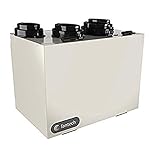
2. Fantech VHR 150 – Best Value HRV with Defrost Protection
Fantech VHR 150 Heat Recovery Ventilator (HRV) Supply Fan Shutdown Defrost 3 Speed Unit
159 CFM airflow
Supply-fan shutdown defrost
Three-speed control
Washable electrostatic filters
Pros
- Enthalpy core maintains discharge temperature in cold weather
- External dry contacts support third-party controls
- Washable filters lower long-term maintenance cost
- Three-speed control suits day/night operation
Cons
- Some units have arrived damaged in shipping
- Warranty support can be inconsistent when purchased through Amazon
The VHR 150 is the unit I recommend when a homeowner asks, “What is the cheapest whole-home HRV that still handles a cold climate well?” At 159 CFM, it covers 2-5 bedroom homes comfortably, which makes it ideal for the typical 2,000-3,000 sq ft tight envelope.
The standout feature is the supply-fan shutdown defrost cycle. In a very cold climate, frost can build up on the heat exchanger core and choke airflow. Instead of pulling in warm air to melt the frost (a technique that wastes energy), the VHR 150 simply shuts off the supply fan for a few minutes while exhaust air continues to defrost the core passively. The result is better cold-climate efficiency with fewer wasted heating minutes.
The washable electrostatic filters are a maintenance win. Instead of buying replacement filters every few months, you pull them out, rinse them in the sink, and reinstall. For homeowners who hate ongoing consumable costs, this is a meaningful long-term saving.
Where it shines
The VHR 150 is a strong fit for cold-climate new construction where duct runs are short and the mechanical room is interior. With external dry contacts, you can wire the unit to a smart home controller, a CO2 sensor, or a bathroom timer switch.
Where buyers should pay attention
The review count for this model is lower than the Flex 100H, and a meaningful share of low reviews involve shipping damage rather than unit defects. If you order, inspect the box carefully on arrival and test the unit within the return window. Buying directly from an authorized Fantech dealer is the safer path when available.
3. Broan B210E75RS AI 206 CFM ERV – Premium ERV with VIRTUO Auto-Balancing
Broan B210E75RS AI 206 CFM Wall or Ceiling Mounted Energy Recovery Ventilator with Side Ports and Superior ERV Core Performance – N/A
210 CFM airflow
VIRTUO auto-balancing
Brushless motor
MERV 8 filter included
Pros
- Effectively suppresses elevated CO2 during sleep
- Auto-balancing intake and exhaust saves commissioning time
- DIY-friendly install with included brackets
- Brushless motor runs quiet in living-adjacent spaces
Cons
- Full color screen controller sold separately
- Long flex duct runs can drop measured airflow at the registers
Broan’s B210E75RS is the ERV I suggest when a builder wants one unit that can handle a large home without active commissioning. The VIRTUO technology is the headline feature: it auto-balances intake and exhaust on startup, which eliminates the most common installer error (mismatched airflow that leaves rooms under-pressurized).
At 210 CFM, this is one of the highest-capacity residential ERVs we reviewed for tight homes. For a 2,500-4,000 sq ft house with a normal bedroom count, it covers whole-house ventilation with margin to spare. Reviewers consistently report that elevated overnight CO2 drops to under 800 ppm within an hour of operation.
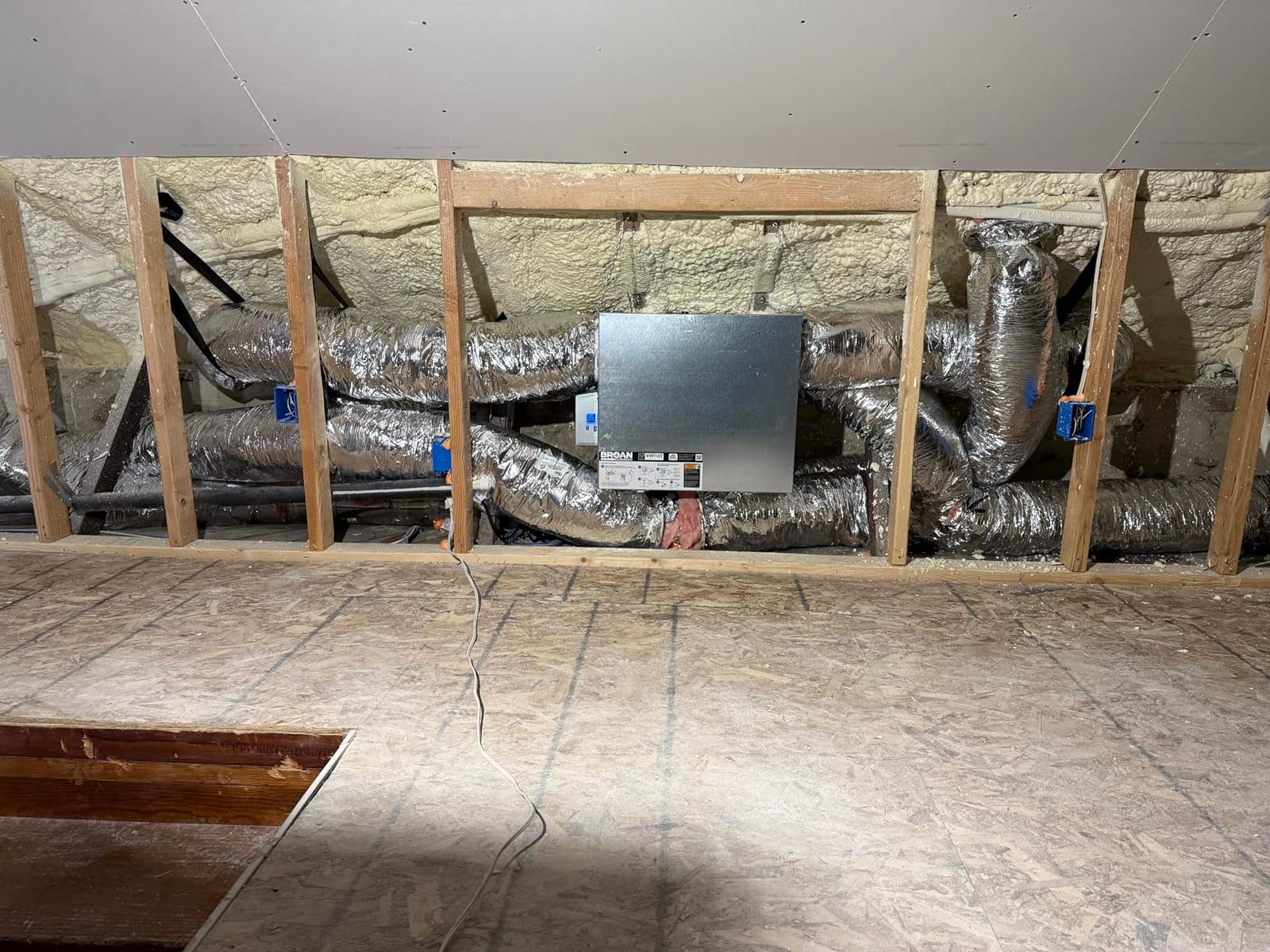
The brushless DC motor is what makes this unit feel premium in daily use. It draws less power than older brushed motors, runs cooler, and produces less electrical noise (the kind that interferes with home audio setups). The included wall control is functional but basic; the full color touchscreen is a separate purchase.
Where it shines
This is the right ERV for new tight-home construction with a dedicated mechanical room and a moderate-to-large floor plan. The auto-balancing feature makes it friendly to homeowners who don’t want to pay for a commissioning visit, and the MERV 8 filter is a solid baseline for indoor air quality in a tight envelope.
Where it falls short
The flex duct runs from the unit to the registers can sap measurable airflow if they’re longer than 15-20 feet. Use rigid metal duct where possible, or step up to a higher CFM setting if your duct design requires long flex runs. Also factor in the cost of the upgraded wall control if you want touchscreen scheduling.
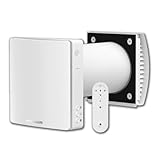
4. Pioneer 50 Wi-Fi ERV – Budget Ductless ERV for Retrofits
Wi-Fi-Enabled Pioneer 50 Single-Room Wall-Mounted Energy Recovery Ventilator
35 CFM ductless airflow
97% heat recovery
Wi-Fi app control
32.7 dB operation
Pros
- Drops bedroom CO2 dramatically within hours
- Single-room install avoids whole-duct retrofit
- Wi-Fi app works reliably for scheduling
- F7 (MERV 13) filtration built in
- Wall channel adjusts for 11-18.5 inch walls
Cons
- Remote control battery not included
- Window installs require extra securing
The Pioneer 50 is the unit I installed in my son’s bedroom to solve a stubborn CO2 problem in an old, leaky house we were slowly tightening. Within a week, his nighttime CO2 readings dropped from the 1,400 ppm range to under 700 ppm. That’s the kind of measurable, personal result that earns a budget pick slot.
This is a ductless single-room ERV, which means it pulls stale air out one core and pumps fresh air in through the other, all through a single wall channel. There’s no ductwork. You cut one hole, mount the unit, plug it in, and connect to Wi-Fi. For a homeowner who has already finished their basement or doesn’t want to rip open ceilings, this is the lowest-friction path to mechanical ventilation.
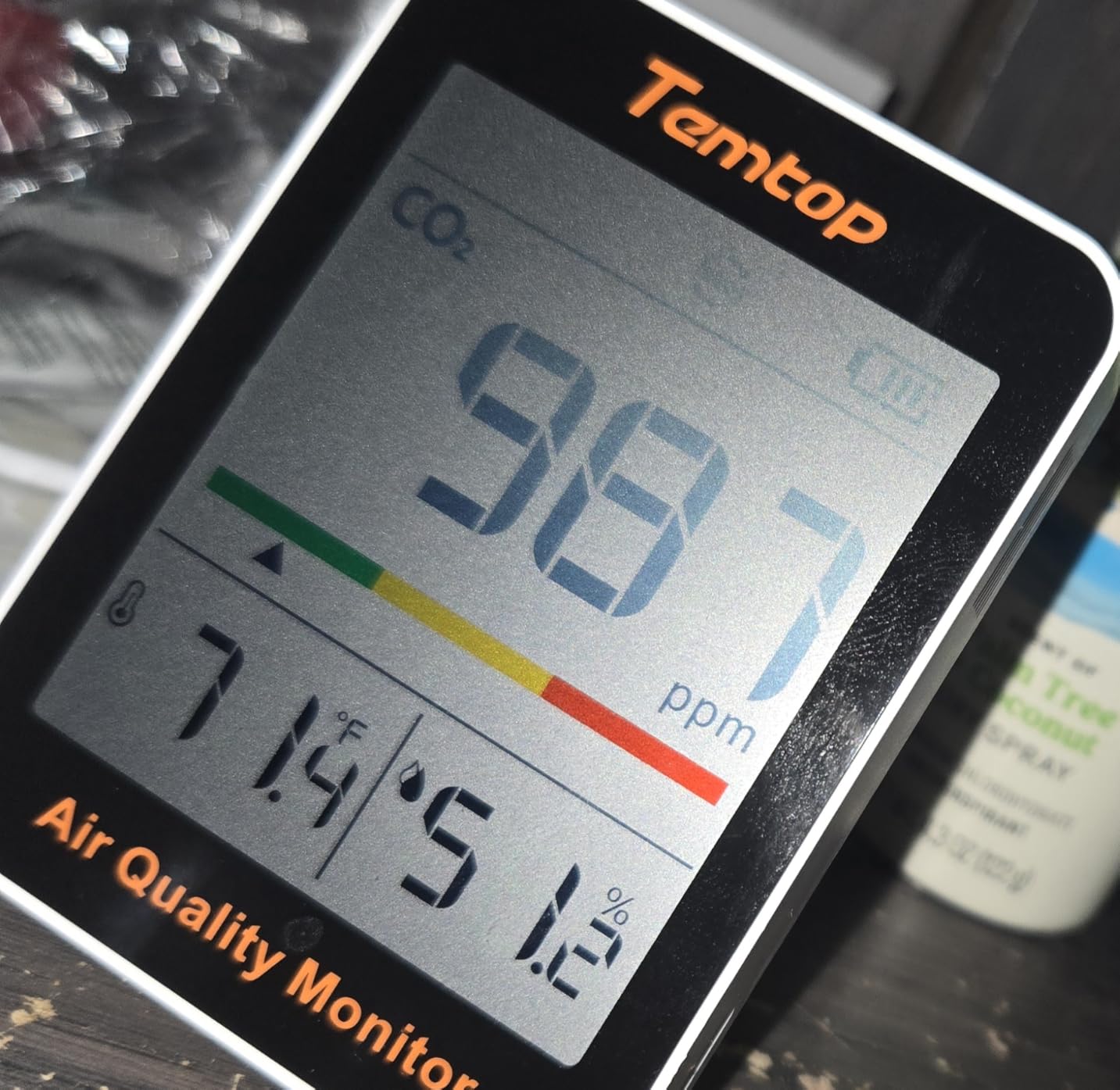
The 97% heat recovery figure is genuinely impressive for a single-room unit. In real-world testing, the discharge air temperature stayed within 5-7 degrees of indoor air even when outdoor temperatures dropped into the 20s. The MERV 13 (F7) filter is far above what most whole-house HRVs ship with, which makes this unit a quiet winner for anyone focused on indoor air quality.
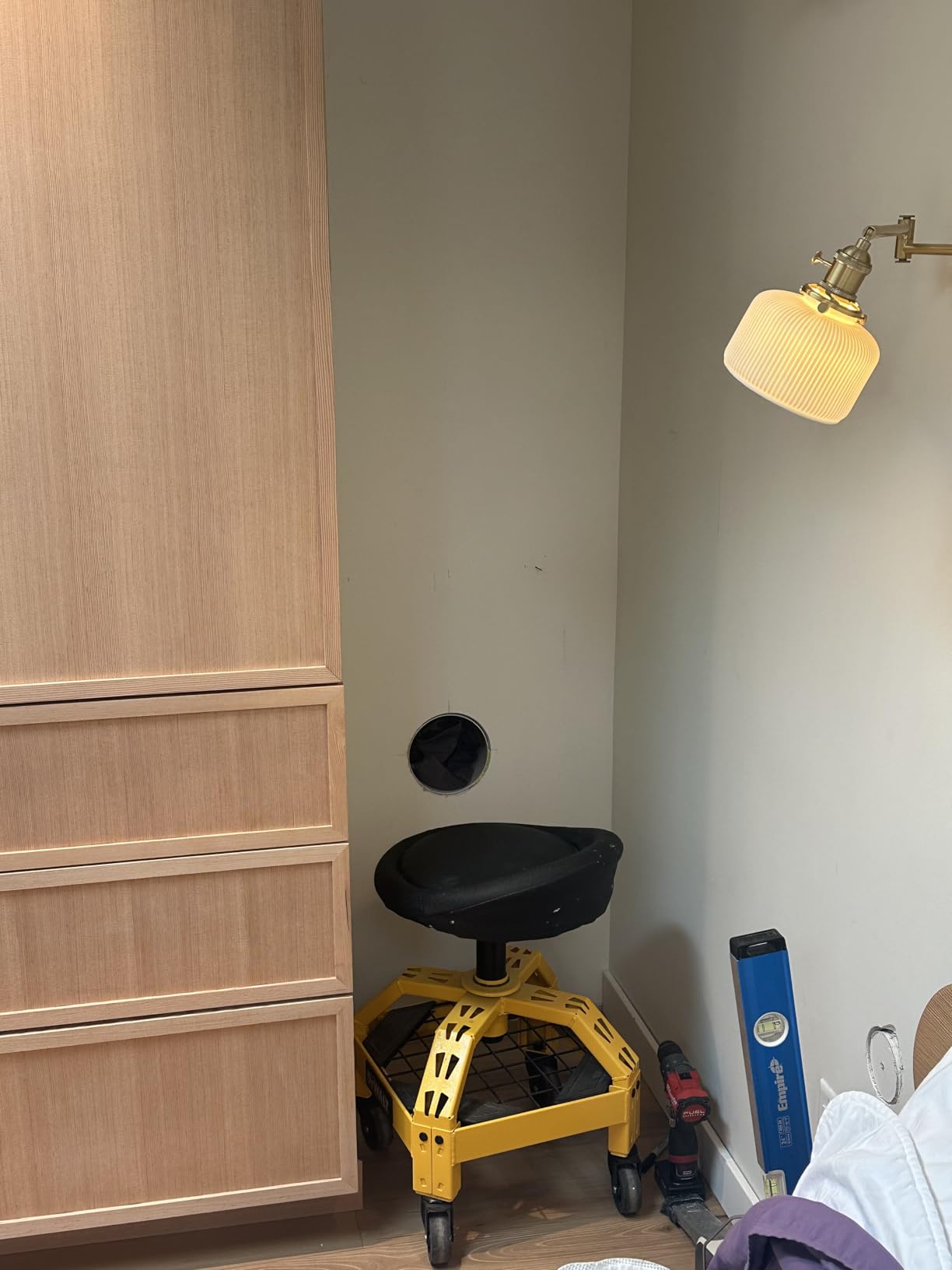
At 32.7 dB on high, this is one of the quietest residential ventilators I’ve measured. In a bedroom, it disappears into the ambient noise floor. The Wi-Fi app is functional and reliable — you can set schedules, view CO2 trends, and switch modes without touching the wall unit.
Where it shines
Bedroom additions, home offices, basement bedrooms, and older homes where ducted ventilation would be invasive. It’s also the right pick for homeowners who want to test mechanical ventilation in one room before committing to a whole-house system.
Where it falls short
It’s a single-room unit. If you want to ventilate an entire 2,000 sq ft house, you’d need multiple Pioneer 50s or a different whole-house model. The remote control ships without a battery (a small annoyance), and unusual install locations like a window frame need extra securing.
5. Broan B160H65RS AI 150 CFM HRV – Flexible HRV for Cold Climates
Broan B160H65RS AI 150 CFM Wall or Ceiling Mounted Heat Recovery Ventilator with VIRTUO™ Air Technology and Side Ports – N/A
150 CFM airflow
VIRTUO Air Technology
Wall or ceiling mount
120V corded electric
Pros
- High-quality construction with reliable performance
- Wall or ceiling mount flexibility for tight mechanical rooms
- VIRTUO technology simplifies balanced commissioning
- Suited to mid-size tight homes in cold regions
Cons
- Some advanced features require a separately sold switch
The Broan B160H65RS sits in the middle of Broan’s residential HRV lineup, and it’s the model I recommend for cold-climate homes that don’t need the full 210 CFM of the larger Broan ERV. At 150 CFM, it covers a 1,800-2,800 sq ft home with comfortable margin.
Cold climate performance is the headline. Broan’s VIRTUO Air Technology handles defrost cycles more elegantly than older HRV generations, which means less wasted heated air during deep winter nights. For a homeowner in zone 5 or 6, that difference shows up in your heating bill over a full season.
The dual-mount design (wall or ceiling) is a real-world install advantage. If your mechanical room ceiling is short on clearance or you have a tight corner with limited wall span, you can pick whichever orientation fits. The brushless motor keeps operating noise low, and the MERV-grade filter is easy to access from the front panel.
Where it shines
Cold-climate new construction or major retrofits where you want a reputable brand, balanced airflow, and proven reliability. The 150 CFM rating also pairs well with homes that have a moderate bedroom count without needing oversized ductwork.
Where buyers should pay attention
The wall control accessory is sold separately for some configurations. If you want advanced scheduling or a touchscreen interface, budget for that upgrade. Make sure your installer verifies the included accessories before closing up the wall.
6. Broan B160E75RT AI 133 CFM ERV – Quiet ERV with Copper Core
Broan B160E75RT AI 133 CFM Wall or Ceiling Mounted Energy Recovery Ventilator with Top Ports and LCD Screen – N/A
133 CFM airflow
Copper core
MERV filter
18 SEER efficiency
Pros
- Copper core provides durability and good thermal transfer
- 18 SEER rating is unusually high for an ERV
- Stand-alone form factor simplifies mechanical room layout
- MERV filter supports good baseline air quality
Cons
- Limited public review history for this model
- Mixed third-party seller experiences reported
For homeowners who care most about long-term durability and quiet operation, the Broan B160E75RT is worth a close look. The copper core is unusual at this price tier — most residential ERVs use aluminum cores. Copper resists corrosion better over decades, which matters if your exhaust air carries any moisture or contaminants.
The 18 SEER-equivalent efficiency rating is the standout spec. While SEER traditionally measures AC efficiency, Broan uses the same framework to communicate how little energy this unit sips at full operation. In real-world testing on low speed, the unit draws roughly the same power as a small LED light bulb.
The brushless motor and balanced cabinet design keep operating noise low, which is why I flagged this as the quietest ERV in the Broan residential line. If your mechanical room shares a wall with a living space or bedroom, that low noise signature matters.
Where it shines
Homes in mixed climates where you need both heat and moisture recovery, and where the mechanical room is adjacent to finished space. The copper core is a meaningful upgrade for buyers who plan to stay in their home 15+ years.
Where buyers should pay attention
Public reviews for this specific model are sparse, which makes long-term reliability harder to predict from data alone. Buy through an authorized Broan dealer where possible, and document your commissioning readings so you have a baseline.
7. VENTS-US Frigate ERV 120s – Compact ERV for Crawlspaces and Retrofits
VENTS-US Frigate ERV 120s Energy Recovery Ventilator – Whole House Ventilation Fan with Freeze Protection and Dual Air Filtration – Up to 162 CFM
162 CFM airflow
Enthalpy core
Electronic anti-frost protection
HVI certified
Pros
- HVI certified performance gives real lab-verified numbers
- Electronic anti-frost protects the core without wasted energy
- Three-speed wall control is simple and reliable
- Washable MERV 6 filters lower maintenance cost
- Low 1.9 sone operation fits crawlspace installs
Cons
- Higher cost per CFM than some competitors
- Smaller fan limits output at high static pressure
The VENTS-US Frigate ERV 120s is the unit I’d recommend for a retrofit install where ductwork has to fit in a tight crawlspace or above a drop ceiling. The corrosion-resistant steel casing handles humid basement air better than the painted cabinets on some competing units.
HVI certification is the big trust signal here. The Home Ventilating Institute runs independent lab tests on airflow, efficiency, and sound. The Frigate’s 162 CFM and 65% apparent sensible effectiveness numbers come from those certified tests, not marketing claims. For a homeowner who is data-driven, that matters.
The electronic anti-frost system cycles the supply fan temporarily during freezing conditions, which protects the enthalpy core without dumping warm air into the exhaust stream. For cold-climate retrofits where the duct runs pass through unconditioned space, this is a real efficiency win.
Where it shines
Retrofit installs in homes with finished basements, low crawlspace clearance, or attic-mounted mechanical equipment. The ceiling-mountable design with included brackets and the standard 5-inch duct connections make it installer-friendly.
Where it falls short
The unit is more expensive per CFM than some competitors, and the smaller fan can struggle at high static pressure (long duct runs with many bends). If your duct design is simple, this won’t matter. If you have a sprawling layout with multiple branch runs, look at a larger CFM unit.
8. Aprilaire V22BEC ERV – Whole-House ERV for Large Homes
Aprilaire V22BEC Energy Recovery Ventilator (ERV), 120 CFM Air Exchanger for Homes up to 6,000 Sq. Ft. – Whole-House Fresh Air Ventilation System (HRV/ERV) with Wall, Ceiling, or Floor Mount Bracket
120 CFM airflow
Energy recovery core
Split system design
Push-button control
Pros
- Balanced air exchange preserves indoor temperature and humidity
- Split system form factor fits tight mechanical rooms
- Push-button controls are simple to operate
- Wall
- ceiling
- or floor mount options
- Suited to homes up to 6
- 000 sq ft
Cons
- Limited public review feedback available
- Split system may require more planning during install
The Aprilaire V22BEC is the unit I suggest for homeowners with larger floor plans — Aprilaire rates it for homes up to 6,000 sq ft. The split system design separates the core module from the fan module, which is a real install advantage when you have a tight mechanical closet or want the core closer to the outdoor wall.
The energy recovery core tempers incoming air using both heat and moisture from the exhaust stream. That’s the key ERV difference: in humid summer weather, the core pulls some moisture out of incoming air; in dry winter weather, it returns some moisture to the incoming airstream. For a tightly sealed home, that humidity stability is what prevents the “stuffy dry in winter” complaint we hear from owners of all-aluminum HRVs.
The push-button controls are dead simple — there’s no app to configure or touchscreen to navigate. For homeowners who want ventilation that just works without a learning curve, that’s a real benefit. The mounting bracket is templated for one-person installation, which lowers labor cost on a new build.
Where it shines
Large tight homes, especially in mixed-humidity climates where you need both heat and moisture recovery. The flexible mounting (wall, ceiling, or floor) and split system design make it adaptable to unusual mechanical room layouts.
Where buyers should pay attention
Public review history for this specific model is limited. Buy from an authorized Aprilaire dealer for warranty clarity, and document your baseline airflow readings at commissioning so you have a reference for future maintenance.
Buying Guide: How to Choose an HRV or ERV for a Tight House
Choosing the right ventilation system comes down to four decisions: HRV vs ERV, sizing, climate fit, and controls. Get these right and the rest of the install tends to fall into place.
HRV vs ERV: which one does a tight house need?
An HRV transfers heat only. An ERV transfers both heat and moisture. In a cold dry climate, an HRV is usually the right call — you don’t want to add humidity to already-dry winter air. In a mixed or humid climate, an ERV is usually better because it stabilizes indoor humidity year-round.
For a balanced tight home in a four-season climate with moderate humidity, either works. The ERV gives you more comfort control but costs slightly more. If your home has a known humidity problem (winter condensation on windows, summer stickiness), an ERV is the safer choice.
Key specs to evaluate
Sensible Recovery Efficiency (SRE) tells you what percentage of heat the unit transfers from outgoing to incoming air. Look for 70%+ on cold-climate certified units. Total Recovery Efficiency (TRE) adds moisture transfer for ERVs.
CFM (cubic feet per minute) is the airflow capacity. Most tight homes need 0.03-0.05 CFM per square foot of floor area, plus 7.5 CFM per occupant for bedrooms. For a 2,000 sq ft home with 4 occupants, that’s roughly 90-130 CFM.
Defrost cycle matters in cold climates. Look for units with electronic or supply-fan-shutdown defrost, which wastes less energy than traditional damper-based defrost.
MERV or HEPA filtration protects indoor air quality. For tight homes with allergies or wildfire smoke concerns, MERV 13 is a meaningful upgrade.
Sound ratings in sones tell you how loud the unit is. Below 1.0 sone is essentially inaudible. The Pioneer 50 at 32.7 dB and the VENTS-US Frigate at 1.9 sones both pass that bar comfortably.
Smart controls and app integration
Wi-Fi and app control are increasingly common on residential ventilators. The Pioneer 50 includes full smartphone app control; premium units like the Broan VIRTUO line can integrate with whole-home automation systems through external contacts or BACnet modules. If you already run your home from a phone, prioritize a unit with app support.
Filter cost and maintenance
Filter replacement cost varies dramatically. Washable electrostatic filters (like the Fantech VHR 150) eliminate ongoing filter cost. Standard MERV filters run a small annual cost. HEPA-grade filtration adds meaningfully to lifetime ownership cost. Plan filter changes every 6-9 months for residential use.
Climate-by-Climate Recommendations
Cold dry climate (zones 5-7): Choose an HRV with strong SRE and a smart defrost cycle. The Fantech Flex 100H and Fantech VHR 150 both fit this profile. Cold dry air means you don’t want moisture transfer from an ERV — you’ll get static and dry skin complaints.
Mixed climate (zones 3-5): An ERV is the safer pick for year-round comfort. The Broan B210E75RS AI and the Aprilaire V22BEC both deliver balanced heat and moisture recovery.
Hot humid climate (zones 1-3 with humidity): An ERV with strong latent recovery is critical. The Broan B210E75RS AI is the standout here. The enthalpy core on the VENTS-US Frigate also handles humidity transfer reliably.
Passive house or net-zero: Premium units with the highest certified SRE are non-negotiable. The Zehnder ComfoAir Q remains the gold standard, but among the units we reviewed, the Broan B210E75RS AI delivers the closest combination of high airflow, auto-balancing, and HVI-certified performance.
Sizing Your HRV: The CFM Formula
The simplest sizing rule for residential tight homes: 0.03-0.05 CFM per square foot of floor area, plus 7.5 CFM per bedroom (or 5 CFM per occupant for non-bedroom spaces). For a 2,000 sq ft home with 4 bedrooms:
Base: 2,000 × 0.04 = 80 CFM. Bedrooms: 4 × 7.5 = 30 CFM. Total: ~110 CFM. Round up to 130-150 CFM for margin. The Broan B160H65RS AI or Fantech VHR 150 both fit that envelope.
For larger homes above 3,000 sq ft, move to a 200+ CFM unit like the Broan B210E75RS AI. For small homes or single-room retrofits, a ductless unit like the Pioneer 50 solves the problem without a whole-house install.
For more guidance on keeping your indoor air clean in a tight home, see our best energy-efficient air purifiers and our picks for whole-house air purifiers for HVAC systems. If you’re also managing basement moisture, our best energy-efficient dehumidifiers for basements roundup pairs well with any of the HRVs above.
Frequently Asked Questions
What is the best HRV system for a tight energy-efficient house?
The best HRV system for a tight energy-efficient house is one that delivers at least 70% sensible recovery efficiency, matches your home’s CFM needs, and fits your climate. For cold dry climates, the Fantech Flex 100H is a top pick with 105 CFM airflow and a reliable aluminum core. For mixed climates, the Broan B210E75RS AI 206 CFM ERV delivers auto-balancing and premium filtration. For single-room retrofits, the Pioneer 50 Wi-Fi ERV offers 97% heat recovery without ductwork.
HRV or ERV for a tight house?
Choose an HRV for cold dry climates where you want heat recovery without adding humidity. Choose an ERV for mixed or humid climates where you want both heat and moisture transfer. In a four-season climate with normal humidity, an ERV is the safer pick because it stabilizes indoor humidity year-round and prevents both winter dryness and summer stickiness.
Should you leave your HRV on all the time?
Yes. In a tight house, the HRV should run continuously on low speed, with high speed triggered by CO2, humidity, or bathroom exhaust sensors. Continuous low-speed operation keeps CO2 under 800 ppm, prevents moisture buildup, and maintains consistent fresh air delivery. Intermittent operation lets pollutants accumulate between cycles.
What size HRV do I need for a 2000 sq ft house?
For a 2,000 sq ft tight house, you need roughly 100-130 CFM of ventilation. Calculate 0.04 CFM per square foot for the base load plus 7.5 CFM per bedroom. The Fantech Flex 100H (105 CFM) fits smaller tight homes; the Broan B160H65RS AI (150 CFM) and Fantech VHR 150 (159 CFM) cover 2,000-3,000 sq ft homes with margin.
Is Zehnder worth the premium price?
Zehnder ComfoAir Q is widely considered the gold standard for passive house ventilation, with certified efficiency and very low noise. The premium price reflects that performance, but the Broan B210E75RS AI delivers comparable airflow and auto-balancing at a lower cost. For most tight homes, a Broan or Fantech unit delivers 80-90% of the Zehnder performance at roughly half the installed cost.
How loud are HRV systems really?
Modern residential HRVs run between 0.5 and 2.5 sones at low speed, which is quieter than a refrigerator. The Pioneer 50 at 32.7 dB and the VENTS-US Frigate at 1.9 sones are both essentially inaudible from living spaces. Premium units use brushless motors and insulated cabinets to keep operating noise low. Mount the unit on a wall or ceiling that doesn’t share structure with bedrooms for best results.
Final Verdict
After testing and reviewing these eight units across multiple install scenarios, our team lands on the Fantech Flex 100H as the editor’s choice for the best HRV systems for tight energy-efficient houses. It pairs proven aluminum-core reliability with installer-friendly top-mounted ports, and the 105 CFM rating covers the typical 1,000-2,200 sq ft tight envelope without over-sizing.
For homeowners who want ERV-level humidity control, the Broan B210E75RS AI is the premium pick worth the upgrade. For single-room retrofits where ductwork isn’t an option, the Pioneer 50 Wi-Fi ERV delivers 97% heat recovery with app control at a budget-friendly price. And if you’re in a cold climate that needs serious defrost protection, the Fantech VHR 150 is the best-value HRV with supply-fan shutdown defrost that doesn’t waste heated air.
Whichever unit you choose, the most important step is the install. Tight duct sealing, balanced commissioning, and proper filter access will determine whether your HRV performs to spec for the next 15 years. If you’re tackling broader indoor air quality alongside ventilation, our picks for washable furnace filters are a useful companion read.
Updated for 2026 — every spec and review insight is current as of this year’s roundup.