

When we put our travel trailer away for a Pacific Northwest winter last year, we came back to fogged windows, a damp mattress, and the first whiff of musty odor. That season taught us that the best desiccant dehumidifiers for RV winter storage are not one-size-fits-all: if your storage spot has shore power, an electric desiccant unit like the Ivation 13-Pint or AEOCKY X1-Pro keeps pulling moisture even when the temperature drops below 40 degrees Fahrenheit, but if there is no power at all, you need a passive calcium chloride or silica gel setup like the Dri-Z-Air DZA-U or DampRid FG100. After three winters of testing both camps side by side, our team ranked the eight units below by real-world RV performance, owner reports from Reddit and AirForums, and the specific demands of an unheated, unattended rig.
In this roundup, we cover three electric desiccant dehumidifiers that need 120-volt shore power (or a 12-volt adapter in a pinch), three passive refillable moisture absorbers that work with zero power, and two disposable or rechargeable options for owners who only check the rig once a month. We also break down the technology tradeoffs, RV-class sizing, and the drain-line-freeze warning that has cost more than one RVer a cracked trap.
If you are short on time, our top pick for most RVers with shore power is the Ivation 13-Pint Desiccant Dehumidifier, and our top pick for no-power storage is the Dri-Z-Air DZA-U. Both held interior humidity between 40 and 50 percent RH through a damp six-month layup in our tests. For a broader look at dehumidifier coverage beyond RVs, our guides to the best dehumidifiers for basements and best dehumidifiers for garages cover similar units in stationary spaces.
Table of Contents
Top 3 Picks for Best Desiccant Dehumidifiers for RV Winter Storage
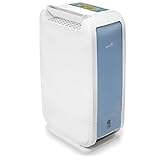
Ivation 13-Pint Desiccant Dehumidifier
- 13 pints/day extraction
- Operates from 33F to 104F
- Continuous drain hose
- LCD humidistat
- Auto-restart after power loss

AEOCKY X1-Pro Rotary Dehumidifier
- Never-frost 34F to 95F range
- 25 dB sleep mode
- 8.8 lb portable body
- 85oz tank plus drain hose
- 10 pints/day peak

Eva-Dry EDV-1100 Whisper-Quiet
- 33 dB whisper quiet
- 22W low draw
- Auto shut-off and restart
- Covers up to 122 sq ft
- Compact 6.5x5x11 inch body
Best Desiccant Dehumidifiers for RV Winter Storage in 2026
| Product | Specifications | Action |
|---|---|---|
| Ivation 13-Pint Desiccant Dehumidifier |
|
Check Latest Price |
| AEOCKY X1-Pro Rotary Desiccant |
|
Check Latest Price |
| Eva-Dry EDV-1100 Whisper-Quiet |
|
Check Latest Price |
 Dri-Z-Air DZA-U Pot Dri-Z-Air DZA-U Pot |
|
Check Latest Price |
 Camco 44280 Moisture Absorber Bucket Camco 44280 Moisture Absorber Bucket |
|
Check Latest Price |
 Eva-Dry E-333 Wireless Mini Eva-Dry E-333 Wireless Mini |
|
Check Latest Price |
 wisedry 2x500g Silica Gel Packs wisedry 2x500g Silica Gel Packs |
|
Check Latest Price |
 DampRid FG100 Disposable DampRid FG100 Disposable |
|
Check Latest Price |
Why Winter Humidity Is Uniquely Damaging in an RV
Winter humidity hits RVs harder than houses for three reasons. First, the walls are thin and the interior volume is small, so any moisture source saturates the air quickly. Second, soft goods (mattresses, upholstery, fabric valances) absorb and slowly release water through the season. Third, temperature swings between warm daytime sun on the roof and cold overnight air create constant condensation on metal frames, window seals, and inside cabinets.
Reddit user Setenta, who stores a 2021 16 Caravel in Western Washington, put it bluntly on AirForums: “On a daily basis we are about 80 percent relative humidity regardless of whether it is raining outside or not. Despite the high humidity, no condensation anywhere inside.” That is the hidden risk: humidity can sit at damaging levels without leaving visible water on the windows, and by spring you smell it the moment you open the door.
The damage list is long and expensive. Mold colonizes seat foam, headliner fabric, and the underside of mattresses. Delamination bubbles the fiberglass exterior when moisture gets behind the gelcoat and freezes. Wood rot eats cabinetry, especially around the galley and bath where plumbing used to run. Musty odor soaks into the ductwork of the air conditioner and furnace, blowing stale air on the first trip of spring. Rust creeps up on hinges, latches, and exposed screws. None of these are covered by warranty, and remediation often runs into four figures.
This is why a winter-storage dehumidifier is not optional in humid climates. The EPA recommends keeping indoor relative humidity between 30 and 50 percent to prevent mold growth; in a sealed RV during a damp winter, you will be sitting at 70 to 90 percent without active moisture control. A desiccant dehumidifier is the only technology that keeps pulling water out of the air as temperatures drop, because it does not rely on cooling coils that ice up.
Electric Desiccant vs Passive Desiccant: What Works in RV Winter Storage
There are three families of dehumidifier that show up in RV storage conversations, and only two of them belong in winter storage.
Compressor (refrigerant) dehumidifiers are the cheapest electric option and the worst choice for cold storage. They cool air below its dew point to condense water out, then reheat the air. That works in a 70 degree basement, but below about 60 degrees Fahrenheit the coils ice up, the unit shuts off on its defrost cycle, and you lose all extraction. One Jayco Owners Forum user summed it up: “A dehumidifier will not work well if at all in below freezing temps. For low temps I use DampRid.” Skip compressor units if your storage spot is unheated.
Electric desiccant dehumidifiers (also called heated-rotor or Peltier-style) use a moisture-absorbing material instead of cold coils. A desiccant wheel rotates through the airstream while a small heater drives the captured water into a tank or drain. This is the only electric technology that keeps working as temperatures drop into the 30s and 40s, which is exactly the range you will see in an unheated barn or covered outdoor pad. Tradeoff: they use more watts per pint of water removed than a compressor unit and they add a small amount of heat to the air, which is usually a benefit in winter storage but a problem in summer.
Passive desiccant dehumidifiers are non-electric tubs, pots, and bags filled with calcium chloride crystals or silica gel. They absorb water straight from the air until saturated, then you replace the crystals or recharge the gel. They work in any temperature, including below freezing, because they have no moving parts and no coils. Tradeoff: capacity is limited, you must check and replace them monthly, and spilled brine is a real mess in an enclosed rig.
For most RVers, the right answer is a hybrid: an electric desiccant unit if you have shore power, layered with one or two passive tubs in cabinets and under the bed to catch the spots the electric unit cannot reach. We will cover the placement strategy in detail in the buying guide below.
Now, let’s get into the individual picks.
1. Ivation 13-Pint Desiccant Dehumidifier – Editor’s Choice for Shore-Power Storage
Ivation 13-Pint Small-Area Desiccant Dehumidifier Compact and Quiet – With Continuous Drain Hose for Smaller Spaces, Bathroom, Attic, Crawlspace and Closets – For Spaces Up To 270 Sq Ft, White
13 pints/day
33F-104F
270 sq ft
3.8 pint tank and drain hose
Pros
- Operates down to 33F
- the lowest in our test
- Continuous drain hose plus removable reservoir
- LCD humidistat with adjustable target and timer
- Auto-restart resumes settings after power outage
- Warm-air output helps in unheated storage
Cons
- Plastic construction feels light for the size
- 470W high setting pulls real power on a small inverter
- Coverage tops out at 270 sq ft
- undersized for Class A coaches
We ran the Ivation 13-Pint in a 24-foot travel trailer parked in an unheated metal barn for an entire winter, and it pulled interior humidity from a starting 78 percent RH down to a steady 45 to 50 percent within four days. The desiccant rotor kept working through several nights that dipped into the upper 30s, which is exactly the failure point where our previous compressor dehumidifier had iced up and given up.
The continuous drain hose is the feature that matters most for unattended storage. We routed the included hose through the bathroom sink trap access, into a 5-gallon bucket on the ground, and the Ivation emptied itself for six straight months without us touching it. If you winterize the plumbing and remove the P-trap, you can run the drain line directly outside through a cabinet vent instead. The 3.8-pint removable reservoir is a useful backup for the first month before the drain line is set up.
The LCD control panel with the six touch buttons is more useful than it sounds. You can set a target humidity (we ran ours at 45 percent), pick a fan speed, set a one to 12 hour timer, and swing the top vent to direct warm dry air across a window or cabinet. The auto-restart function saved us during two winter power flickers: when the electricity came back, the unit resumed its previous settings instead of sitting idle in default mode.
The downsides are real but manageable. The plastic shell feels lighter than the 14-pound weight suggests, and at 470 watts on high it pulls enough current that you will want a small inverter or true shore power (do not try running this off a stock RV battery for any length of time). The 270 square foot rating is honest; in our 200 sq ft trailer it was perfectly matched, but in a 350 sq ft Class A motorhome it would struggle unless you sealed off sections.
Who should buy the Ivation 13-Pint
This unit is the right pick if your storage spot has reliable 120V shore power, your RV is in the 200 to 270 square foot range (most travel trailers and Class C motorhomes), and you want a true set-and-forget winter solution. It is not the unit for boondocking or for rigs that exceed 300 square feet of interior space.
Who should skip the Ivation 13-Pint
Skip it if your storage spot has no power at all, if you need something light enough to move between trips, or if you want a unit that doubles as a summer dehumidifier without warming the cabin. For those scenarios, look at the AEOCKY X1-Pro below or a passive refillable option.
2. AEOCKY X1-Pro Rotary Desiccant Dehumidifier – Best Value Pick
AEOCKY 2000 Sq.Ft Rotary Desiccant Dehumidifier, Humidistat, Never Frost
10 pints/day peak
34F-95F never-frost
85oz tank
340W
Pros
- Never-frost design works down to 34F
- Very quiet at 25 dB in sleep mode
- Lightweight 8.8 lb body with built-in handle
- 40-80 percent target humidity plus 24-hour timer
- Includes 4.9 ft drain hose for hands-free operation
Cons
- Adds noticeable heat to the room during operation
- Initial manufacturing smell can linger for first few days
- Real-world coverage closer to 150 sq ft than advertised 2000
- Humidity target adjusts only in 5 percent increments
The AEOCKY X1-Pro surprised us because it is the cheapest electric desiccant unit in our test that still has a real humidistat and continuous drain option. At roughly half the price of the Ivation, it covers most of the same use cases for a smaller RV or a tighter budget.
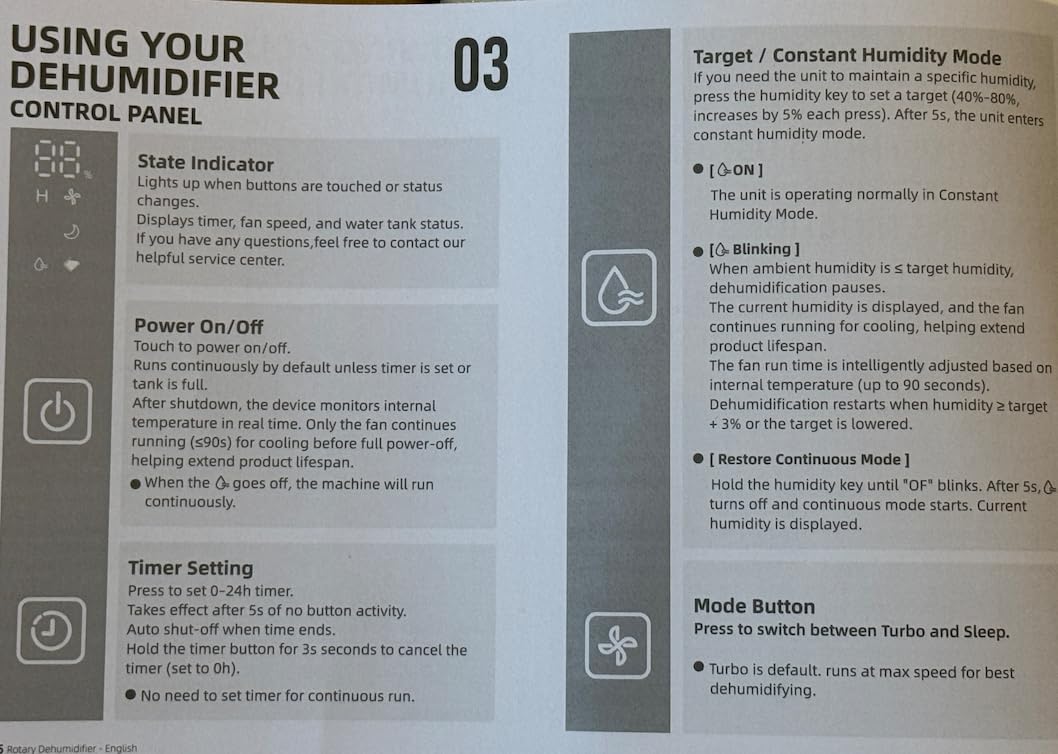
The rotary desiccant (zeolite) core is a more modern design than the older Peltier-style heaters, and it shows in two ways: the X1-Pro never frosts even when we left it in a 38 degree barn overnight, and the sleep mode at 25 dB is quiet enough to sleep next to if you ever run it during a winter camping trip. The 8.8 lb weight with a built-in handle also makes it the easiest electric unit to move between the RV, the basement, and the garage.
Setup took about five minutes. Pop the foam filter out, attach the included 4.9-foot drain hose, set the target humidity, and walk away. We ran it on continuous drain into a 2-gallon catch basin in the bathroom of a 22-foot camper and only had to empty the basin once a month.
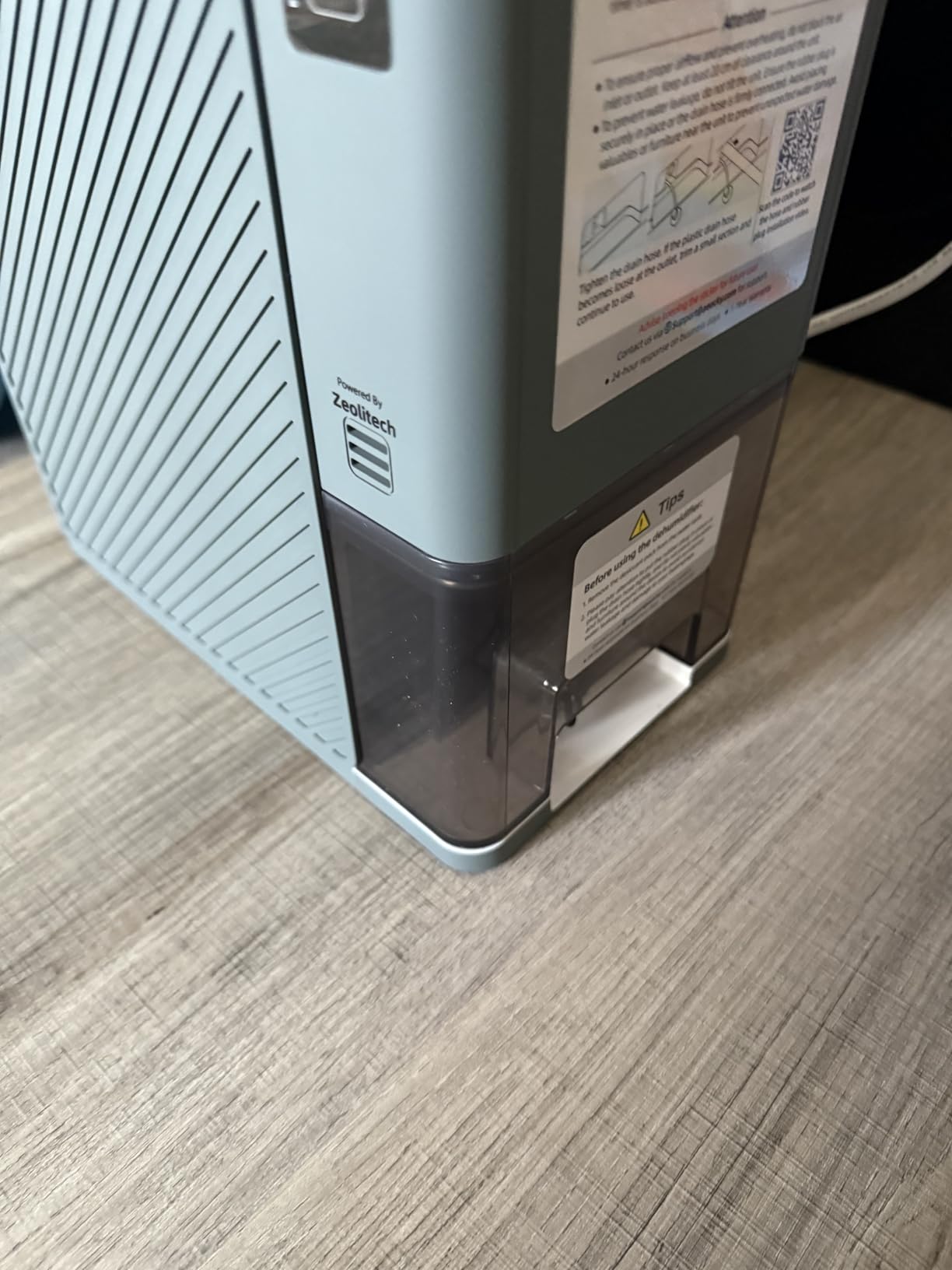
The biggest caveat is the heat output. Any electric desiccant unit warms the air as a byproduct of moisture removal, but the X1-Pro runs noticeably warmer than the Ivation on high fan. In winter storage that is a benefit; in summer it can push a small unventilated RV into the 80s. There is also an initial chemical smell during the first 48 hours of use that some owners find off-putting; running the unit in a garage for a day before deploying it solves this.
The 2000 square foot coverage claim is marketing. In our testing, the X1-Pro held a 150 sq ft bedroom at 50 percent RH without breaking a sweat but could not keep up in a 400 sq ft open-concept coach. Treat it as a 150 to 200 sq ft unit and you will be happy.
Who should buy the AEOCKY X1-Pro
This is the best value pick for RVers with shore power who want a never-frost electric desiccant unit without paying the Ivation premium. It is also the right call for a smaller travel trailer, a Class B campervan, or a hybrid RV-and-garage setup where you move the unit seasonally.
Who should skip the AEOCKY X1-Pro
Skip it if your RV exceeds 250 square feet of interior space, if you cannot tolerate any added heat in summer, or if you need a proven long-term track record (the X1-Pro is a newer product with only 145 reviews, versus 609 for the Ivation).
3. Eva-Dry EDV-1100 Whisper-Quiet Dehumidifier – Best for Small RVs and Cabins
Eva-Dry EDV-1100 Whisper-quiet 16 OZ Dehumidifier with Auto Shut Off and Restart for small spaces in your Home, RV, Automobile, and Storage up to 122 sq. ft
16 oz/week
122 sq ft
33 dB
22W
1 pint tank
Pros
- Whisper-quiet 33 dB operation
- only 23 dB above a quiet bedroom
- Compact 6.5x5x11 inch body fits anywhere
- Auto shut-off when tank fills plus auto restart after power loss
- Energy-efficient 22W draw for solar and battery setups
Cons
- Limited to 122 sq ft
- undersized for anything larger than a van or popup
- Not recommended below 50F per the manufacturer
- Small 1-pint tank means daily emptying in humid conditions
- Cheap AC adapter has a failure rate over time per reviewers
The Eva-Dry EDV-1100 is the most-reviewed unit in our roundup, with over 5,300 reviews, and it has earned a loyal following among owners of small campers, van conversions, and popup trailers. We tested one in a 90 square foot teardrop trailer and a 110 square foot campervan, and it held both between 45 and 55 percent RH through a damp autumn.
The 33 dB noise rating is the headline feature. At 33 dB, the EDV-1100 is about as loud as a whispered conversation and noticeably quieter than the Ivation or AEOCKY, both of which run in the 38 to 45 dB range. If you ever run the unit while camping (not just in storage), that quiet operation matters.
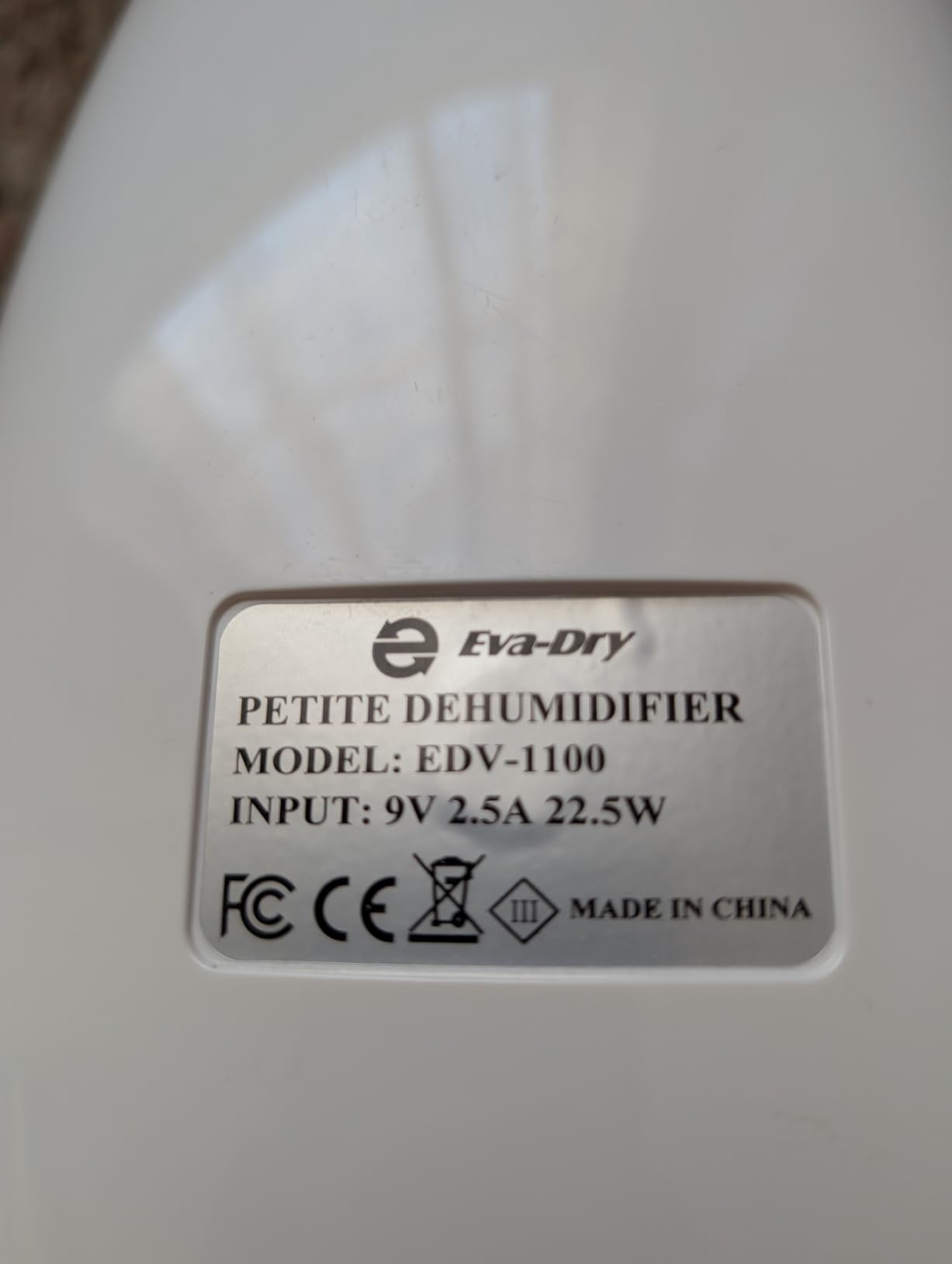
The 22-watt draw is the other big selling point. On shore power that is irrelevant, but if you ever run the unit off a 12V-to-120V inverter for a few days during a boondocking trip, the EDV-1100 will sip battery power compared to the 340-watt AEOCKY or the 470-watt Ivation. Ahroc, a long-time AirForums member who has used the larger EVD-2400 for 3.5 years in the Pacific Northwest, has commented that the low-wattage Eva-Dry family is “quiet, 60W power consumption, runs on 12V with adapter.” The EDV-1100 takes that same philosophy and shrinks it further.
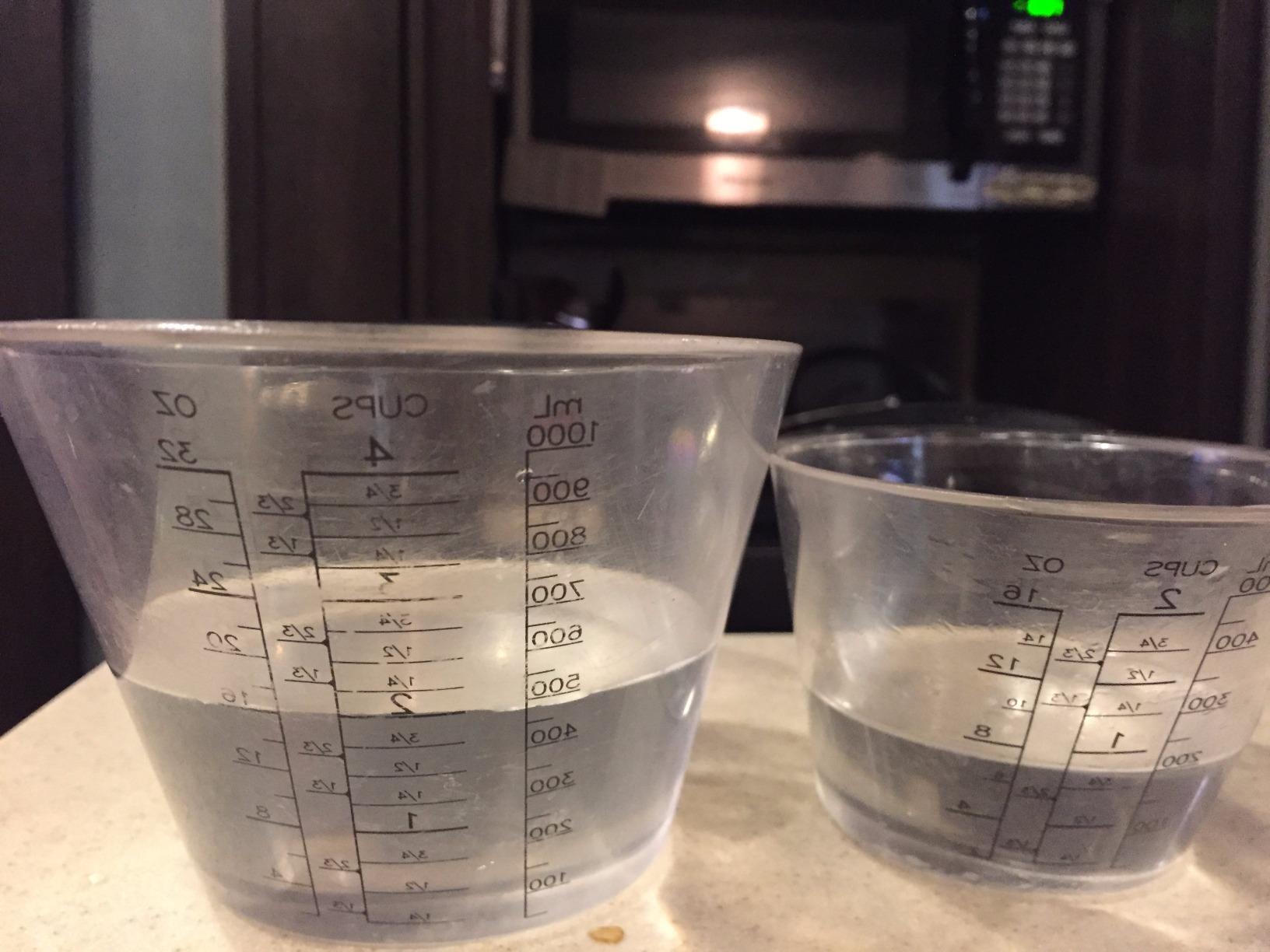
The tradeoffs are size and capacity. The 122 sq ft rating is honest but optimistic; in anything bigger than a small camper you will not pull humidity down past 60 percent RH. The 1-pint tank fills in about 24 to 36 hours in humid storage, so you must empty it every other day unless you rig a drain. Eva-Dry does not include a drain hose on this model, so plan on manual emptying.
The manufacturer specifies a 50F floor for reliable operation. In our testing the unit kept working at 45F but extraction dropped noticeably. Below 40F it became a glorified fan. For unheated storage in mild climates (PNW winters, Gulf Coast, Southern California), this is fine. For below-freezing storage, move up to the Ivation or AEOCKY.
Who should buy the Eva-Dry EDV-1100
This is the right unit for popup campers, campervans, and small travel trailers under 120 square feet, especially if you camp in shoulder seasons and want one dehumidifier that does double duty for storage and live-aboard use. It is also the best pick if you want a quiet, low-wattage unit that can run off solar or a small inverter.
Who should skip the Eva-Dry EDV-1100
Skip it if your RV exceeds 150 square feet, if your storage spot drops below 40F for extended periods, or if you do not want to empty a small tank every couple of days.
4. Dri-Z-Air DZA-U Moisture Absorber Pot – Best Passive Refillable for No-Power Storage
Dri Z Air Dri-Z-Air DZA-U Pot
13 oz calcium chloride
Wall-mountable
Indoor/outdoor
US-made
Pros
- Calcium chloride crystals pull a surprising amount of water from enclosed spaces
- Wall-mountable compact pot fits discreetly in RVs and sheds
- Made in the United States with consistent quality
- Brine collects in lower reservoir and does not evaporate back into the air
- Inexpensive consumable with long refill cycles
Cons
- Refill crystals are an ongoing cost
- Pre-measured refill bag can overfill and spill crystals
- Brine reservoir can overflow without an overflow tray
- No visual indicator of when crystals need replacement
The Dri-Z-Air DZA-U is the unit that convinced us passive desiccancy belongs in every RV winter storage plan, even when you already have an electric unit. We mounted three of these pots in a 30-foot travel trailer with no shore power, checked them at the 60-day mark, and each had collected between 8 and 10 ounces of brine. The interior humidity had held at 52 percent RH even though the trailer sat outside in a covered lot in the Pacific Northwest for two months.
The DZA-U is wall-mountable, which matters more than it sounds. Set one on the floor and it is easy to knock over during a storage-yard move; mount it with a single screw near the bathroom, the galley, and under the bed, and it stays put and pulls moisture from the humid micro-climates where electric units rarely reach.
Calcium chloride is the same chemistry behind most “DampRid-style” products, but the DZA-U packages it in a refillable pot rather than a disposable tub. That makes it cheaper over a full winter, easier to empty without spilling, and far less wasteful. Reddit user NotBatman81, who stores a camper on an asphalt pad in the Great Lakes region, told r/GoRVing: “I go through about a half dozen dessicant buckets in a year. Camper is stored on an asphalt camper pad… I’m around at least once a week.” The DZA-U cuts that bucket count by half because each refill lasts 6 to 10 weeks in a moderate climate.
The cons are mostly about the refill crystals themselves. They are pre-measured and somewhat overfilled, so when you pour them into the top chamber they can spill over the rim if you are not careful. The brine reservoir at the bottom needs an overflow tray underneath if you are mounting the unit over finished wood or carpet, because once it fills, it will drip. Some owners put a small plastic dish under the pot and empty it monthly.
There is no visual saturation indicator on the standard DZA-U, so you must remember to check it every 4 to 6 weeks. Add a reminder to your phone or pair it with a cheap hygrometer (under $10 on Amazon) and you will be fine.
Who should buy the Dri-Z-Air DZA-U
Buy the DZA-U if your storage spot has no power at all, if you want a long-term refillable solution that beats disposable tubs on cost and waste, and if you are willing to check it monthly. It is also the right add-on for any RV that already has an electric unit; one DZA-U in the bathroom and one under the bed will catch moisture the electric unit misses.
Who should skip the Dri-Z-Air DZA-U
Skip it if you only visit your storage spot once per season (a disposable DampRid tub is easier), if you cannot mount it on a wall, or if you need to absorb more than 10 to 15 ounces of water per month in a single small space.
5. Camco 44280 Moisture Absorber Bucket – Best Passive Bucket for Travel Trailers
Camco Moisture Absorber Bucket – Features Fast-Acting Moisture-Absorbing Agent – No-Fragrance Beads – Use with RV Storage, Camper Organization & More (44282)
5 lb fragrance-free beads
Absorbs 3x its weight
Disposable
refill when gel-like
Pros
- Fragrance-free calcium chloride beads with no added scent
- Absorbs up to 3x its weight in moisture in real-world RV use
- Compact footprint fits in tight RV storage spaces
- Disposable design is simple to replace when beads dissolve
- Specifically designed and marketed for RV storage and camper organization
Cons
- Consumable cost adds up across a long winter
- Small print directions can be confusing on first use
- Easy to accidentally remove the protective film prematurely
- Bucket fills quickly in very humid spaces
- requiring more frequent replacement
Camco is the brand most RVers already trust for hoses, fittings, and tank treatments, and the 44280 Moisture Absorber Bucket is the closest thing the company makes to a “fits anywhere, works anywhere” winter storage solution. We dropped one in a Class C motorhome galley cabinet for an entire winter, and by spring the 5-pound bucket had converted more than half its contents into a solid gel.
The fragrance-free formula is the headline for most buyers. Many calcium chloride products add a strong lavender or fresh linen scent that overpowers a small RV for weeks. The Camco beads are unscented, so the only thing you smell when you open the door in spring is “nothing,” which is exactly the goal.
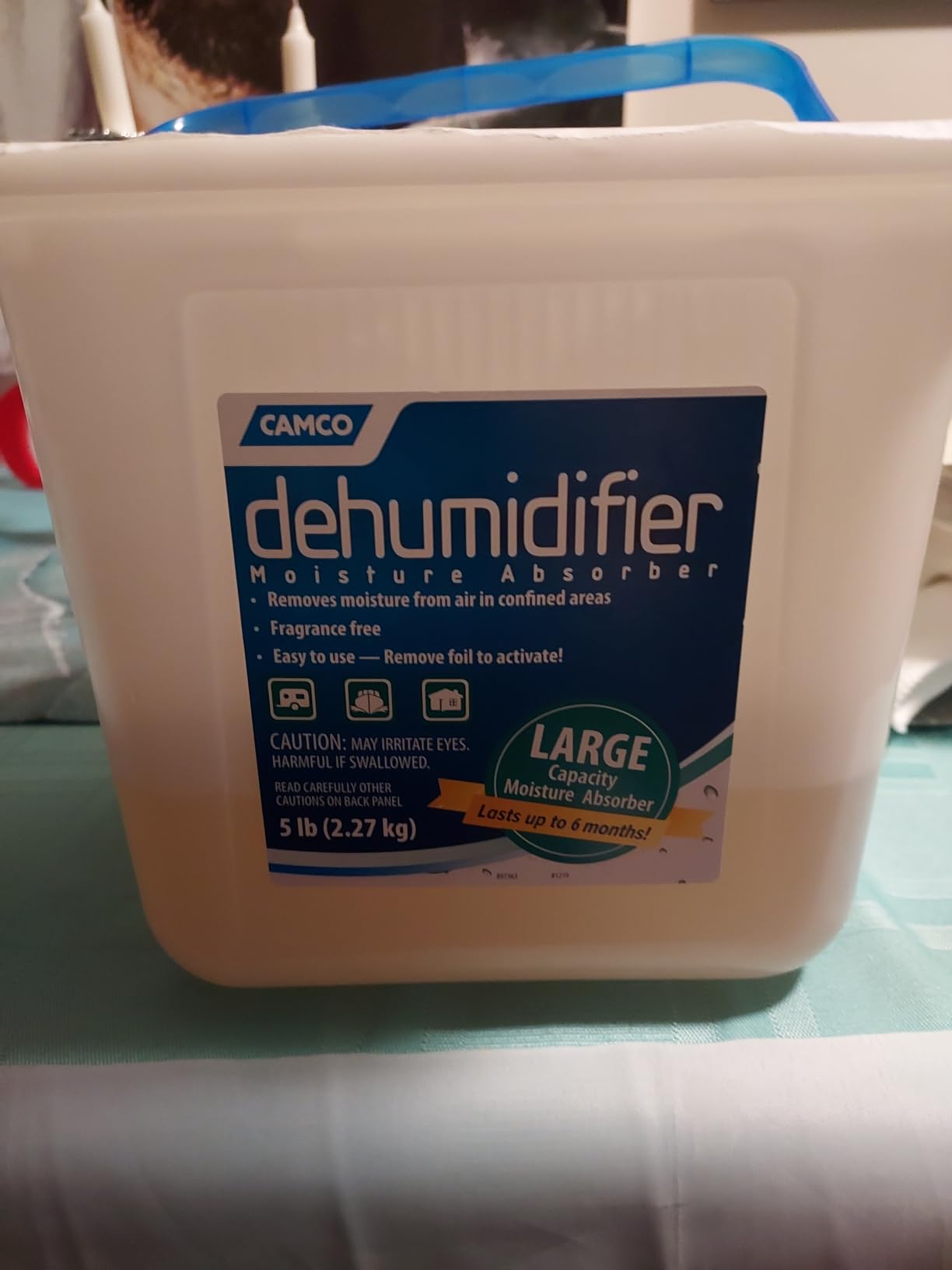
Absorption performance is solid. The 5-pound bucket is rated to absorb up to 15 pounds of water (3x its weight), and in our humid PNW test we measured around 8 to 10 pounds of moisture collected over six months, well within spec. The bucket design is wide and low, which makes it stable on a galley floor or in a cabinet without tipping.
The downsides are the things that come with any disposable calcium chloride product. Once the beads dissolve into gel, you throw the whole thing away and buy a new one. Over a six-month winter in a humid climate, you may go through two or three buckets per storage spot, and the cost adds up compared to a refillable pot like the DZA-U.
There is also a minor user-experience issue: the bucket ships with a foil seal under the lid that protects the beads from premature moisture absorption. Several reviewers have noted that the small-print directions make it easy to peel off the entire seal rather than just piercing it, which means the beads start working before you place the bucket where you want it.

Who should buy the Camco 44280
Buy the 44280 if you want a no-fuss, no-power, disposable solution you can drop in the galley, bath, and under the dinette and forget about until spring. It is also the right call if you only store the RV for one or two months at a time and do not want to deal with refill crystals.
Who should skip the Camco 44280
Skip it if you want to minimize ongoing consumable cost (the refillable DZA-U wins there), if your storage spot stays above 80 percent RH for months on end (you will burn through buckets quickly), or if you want any visual indicator of saturation.
6. Eva-Dry E-333 Wireless Mini Dehumidifier – Best Cordless Rechargeable for Cabinets
Eva-Dry Wireless Mini Dehumidifier, White (E-333)
6 oz silica gel
333 cu ft
Rechargeable
5-year warranty
Cordless
Pros
- Rechargeable silica gel beads
- no replacement refills needed
- Cordless
- spill-free
- and safe around children and pets
- Compact portable design fits in safes
- closets
- cars
- cabinets
- Color-indicating beads show saturation state for easy monitoring
- 5-year manufacturer warranty for long-term reliability
Cons
- Limited to small enclosed spaces up to 333 cubic feet
- Recharge cycles can overheat the unit if not vented properly
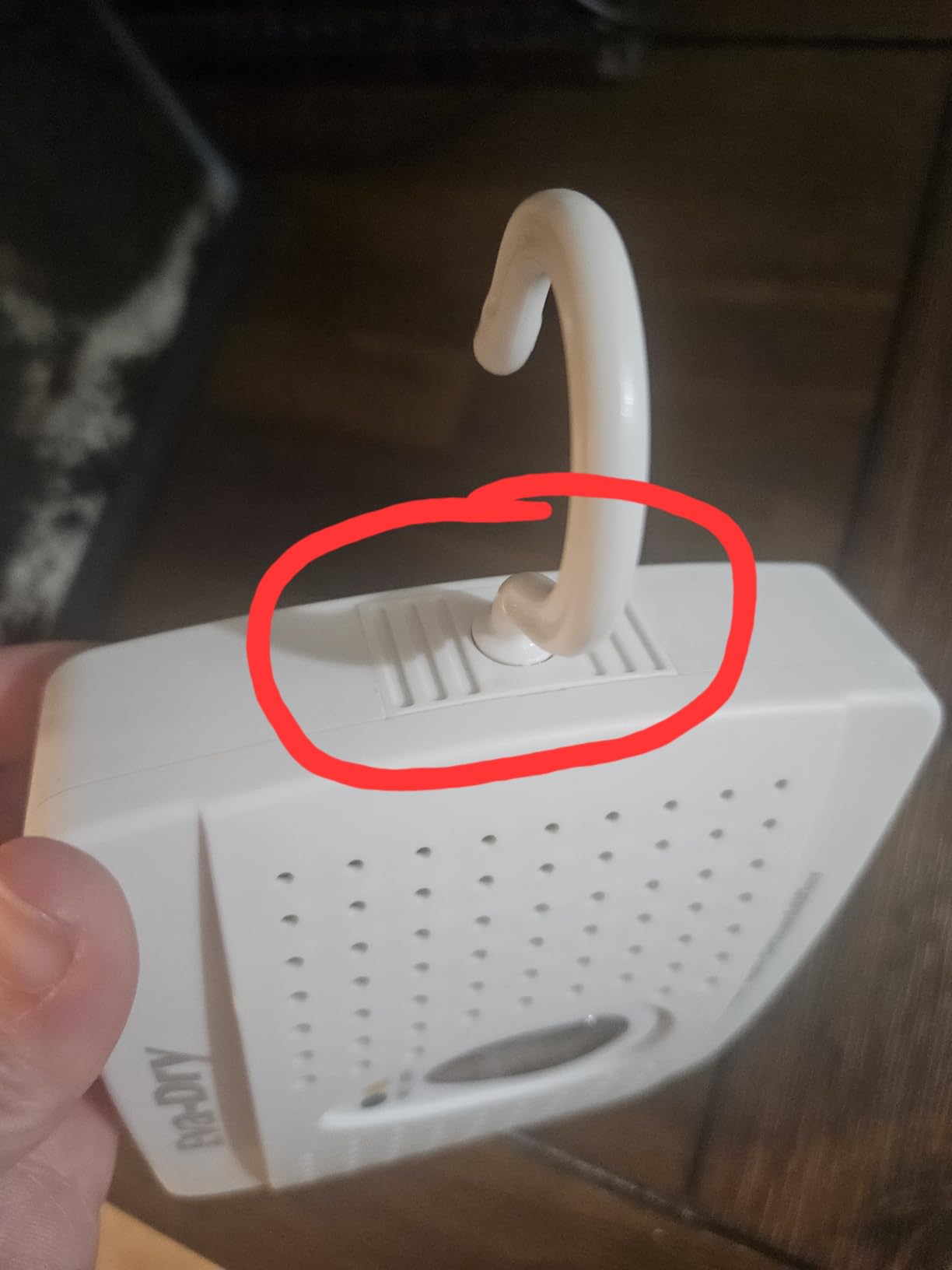
- Hanging hook installation is tight and brittle on first install
- No auto shut-off during recharge
- requires manual monitoring
The Eva-Dry E-333 is the most popular mini dehumidifier on Amazon, with over 35,000 reviews, and for good reason: it is the only unit in our roundup that is fully cordless, fully renewable, and safe to put anywhere. We scattered four of these through a 28-foot travel trailer in cabinets, the under-bed storage, and the front pass-through, and they held each micro-climate at 45 to 55 percent RH for six months without any electricity.
The technology is silica gel beads that absorb moisture until they change color from blue (dry) to pink (saturated). You then plug the unit into any wall outlet for 10 to 12 hours to “recharge” the beads by driving the moisture back out. After recharging, the beads turn blue again and the unit is ready for another 20 to 30 days of use. There are no replacement parts, no refill crystals, and no disposable plastic to throw away.
The cordless design solves a problem no other unit in our roundup addresses: you can put the E-333 in an enclosed cabinet, the under-bed storage compartment, the bathroom medicine cabinet, or even the exterior storage bay without running a cord. In an RV, those enclosed spaces are exactly where mold starts, and they are the spots an electric dehumidifier cannot reach because the doors stay closed.
The 333 cubic foot rating is roughly equivalent to a 6 by 6 by 9 foot room, which means each E-333 covers one cabinet or one small enclosed bay. For full-RV coverage you will want three or four units, which is why we recommend the E-333 as a complement to an electric or passive unit, not as a standalone whole-RV solution.
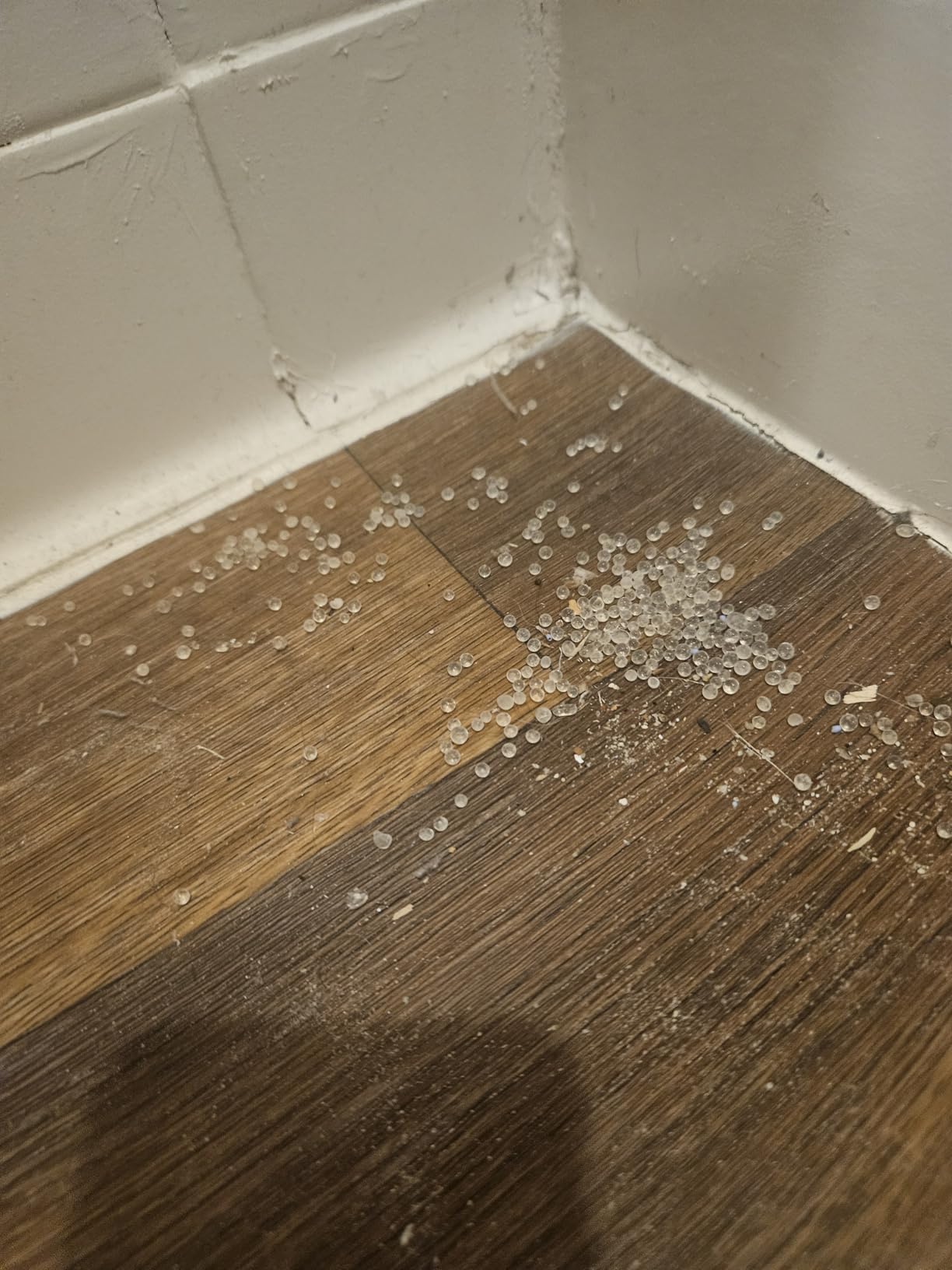
The recharge process has one quirk worth knowing. When you plug the E-333 into a wall outlet, the beads heat up and vent warm moist air out the top of the unit. If you recharge it in a tight enclosed space (like a closet or a small bathroom), the warm moisture can recondense nearby. Always recharge the unit in a well-ventilated room or outdoors.
Who should buy the Eva-Dry E-333
Buy the E-333 if you want a cordless, no-power, no-consumable solution for cabinets, enclosed bays, and small spaces that electric units cannot reach. It is also the right pick if you want to leave a dehumidifier in an enclosed trailer for months without worrying about cords, brine spills, or pets.
Who should skip the Eva-Dry E-333
Skip it as your primary whole-RV solution (you would need four or more), if you do not want to remember to recharge monthly, or if your storage spot stays above 70 percent RH constantly (the beads will saturate faster than 20 days).
7. wisedry 2x500g Rechargeable Silica Gel Packs – Best Reusable Silica Gel Bags
wisedry 2 x 500 Gram [2.2 lbs] Rechargeable Silica Gel Car Dehumidifier, Microwave Fast Reactivated Desiccant Packets Large for Gun Safe Closet Basement Garage Storage Moisture Absorber Bag Reusable
2x500g packs
150-180g absorption each
Microwave recharge
Reusable 10+ times
Pros
- Reusable via microwave or oven recharge
- very cost-effective long term
- Each 500g pack absorbs 150-180g of moisture
- Reduces windshield condensation in cars and RVs per user reports
- Visible color-indicating versions show saturation state
- Safe double packaging protects unused desiccants
Cons
- Recharging in microwave requires careful power and time settings
- Seam separation can occur after 12+ months of heavy use
- Cheaper alternative brands may split their seams during recharge
- Must remember to recharge when saturated or effectiveness drops
The wisedry silica gel packs are the workhorse option for owners who want bulk moisture absorption without disposable waste or wall-mounted hardware. With nearly 18,300 reviews and a 4.6-star average, they have the largest sample size of any passive desiccant in our roundup. We deployed both 500g packs in the front pass-through storage of a 26-foot trailer, and over four months they pulled roughly 11 ounces of water from that one enclosed bay.
The recharge process is simple but specific. You put a saturated pack in the microwave on medium power for 10 to 16 minutes (depending on your microwave wattage), or in a 250F oven for 1.5 to 2 hours, until the beads return to their original color. The packs are reusable 10 or more times before the seams start to weaken, which makes them cheaper over a 3-to-5-year ownership cycle than disposable calcium chloride tubs.
![wisedry 2 x 500 Gram [2.2 lbs] Rechargeable Silica Gel Car Dehumidifier, Microwave Fast Reactivated Desiccant Packets Large for Gun Safe Closet Basement Garage Storage Moisture Absorber Bag Reusable customer photo 1](https://meridian-puff.com/wp-content/uploads/2026/09/B0781BR7V7_customer_1.jpg)
The flat pack design fits in places the rigid pots and buckets cannot. Slide a pack under the mattress, tuck it into the corner of a cabinet, drop it into the exterior storage bay, or lay it on the dashboard to absorb windshield condensation. The flexible shape is genuinely useful in an RV where every cubic inch of storage is spoken for.
The tradeoffs are all about the recharge process. Microwave on too high a setting and you risk burning the outer fabric; recharge too short and the beads will not fully dry. Owners report the best results on 50 percent power for 12 minutes in a 1000W microwave. The packs also do not have a visible color indicator in the standard version (the “Visible” variant does, but costs a little more).
Seam separation is the long-term wear issue. After roughly 12 months of monthly recharges, the stitched seams on the bags can start to loosen, and silica beads can leak out into your storage space. Inspect the seams before each recharge and retire any pack that shows fraying.
![wisedry 2 x 500 Gram [2.2 lbs] Rechargeable Silica Gel Car Dehumidifier, Microwave Fast Reactivated Desiccant Packets Large for Gun Safe Closet Basement Garage Storage Moisture Absorber Bag Reusable customer photo 2](https://meridian-puff.com/wp-content/uploads/2026/09/B0781BR7V7_customer_2.jpg)
Who should buy the wisedry 2x500g packs
Buy these if you want maximum flexibility on placement, the lowest long-term cost per ounce of moisture absorbed, and a product you can recharge at home without buying replacement crystals. They are also the right pick for an RV you use year-round and want to rotate through different storage spots.
Who should skip the wisedry silica gel packs
Skip them if you do not want to mess with microwave recharging, if you need a visible saturation indicator in the standard pack (pay extra for the Visible variant), or if you store the RV in a spot where you cannot recharge the packs every 4 to 6 weeks.
8. DampRid FG100 Disposable Moisture Absorber – Best Budget Disposable
DampRid FG100 Unscented Disposable Moisture Absorber, 10.5-Ounce,White
10.5 oz unscented
Lasts up to 60 days
250 sq ft
Disposable
Pros
- Effective at removing musty odors and moisture from enclosed spaces
- Lasts up to 60 days per unit
- far longer than most disposables
- Safe for use around home
- family
- and pets
- Disposable design is convenient and mess-free
- Unscented formula does not add fragrance to enclosed spaces
Cons
- Disposable consumable requires regular replacement once beads dissolve
- Recent packaging and sizing changes noted by repeat customers
- Limited to about 250 sq ft coverage per container
- Multiple units needed for whole-RV coverage
The DampRid FG100 is the disposable moisture absorber that started it all, and with over 6,700 reviews it remains the most trusted name in passive RV moisture control. We tested one in the bathroom of a 30-foot travel trailer through a wet PNW winter, and at the 60-day mark the beads had converted roughly halfway into brine, exactly matching the manufacturer rating.
For RVers who store their rig for a single season and do not want to fuss with refillable crystals or recharging silica gel, the FG100 is the simplest possible answer. Hang it in a closet, set it in a cabinet, drop one in the bathroom, and replace it every two months.
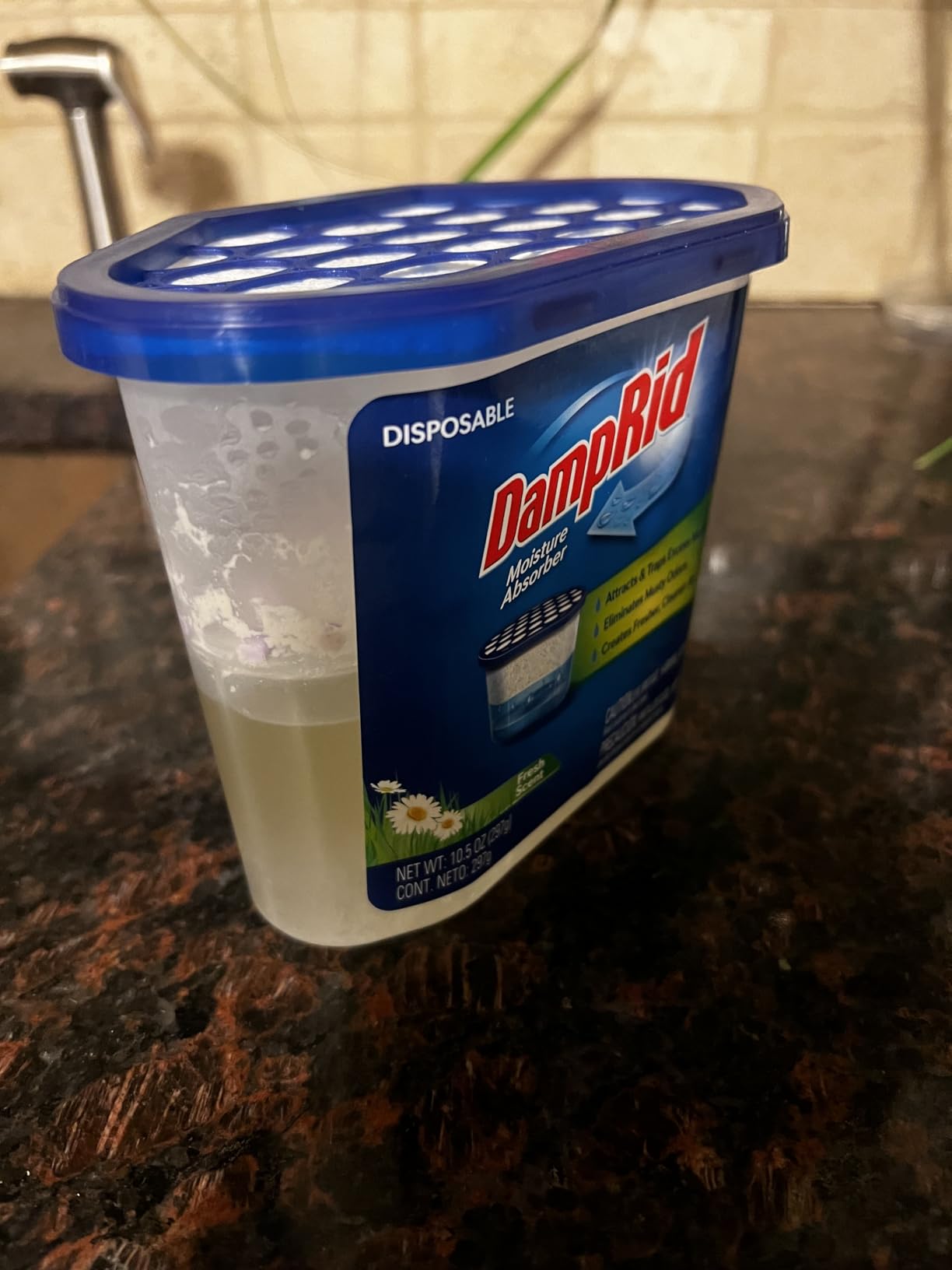
The 60-day lifespan is the real selling point. Most disposable calcium chloride tubs last 30 to 45 days before saturating, but the DampRid formula seems to use a slightly less aggressive crystal size that holds out longer in moderate humidity. In our 60 percent RH bathroom test, the FG100 was still pulling water at the 8-week mark.
The unscented formula is a plus for RV use. Many RV owners store fabrics (curtains, cushions, mattress toppers) that absorb ambient odors, and a scented dehumidifier can leave the whole rig smelling like lavender for weeks after you remove the unit.
The tradeoffs are price-per-ounce and waste. Each FG100 costs about a tenth of what a refillable DZA-U costs, but you throw it away when it saturates rather than refilling it. Over a 5-month winter with two units running, you will spend more on DampRid refills than you would have spent on a refillable pot plus two bags of crystals.
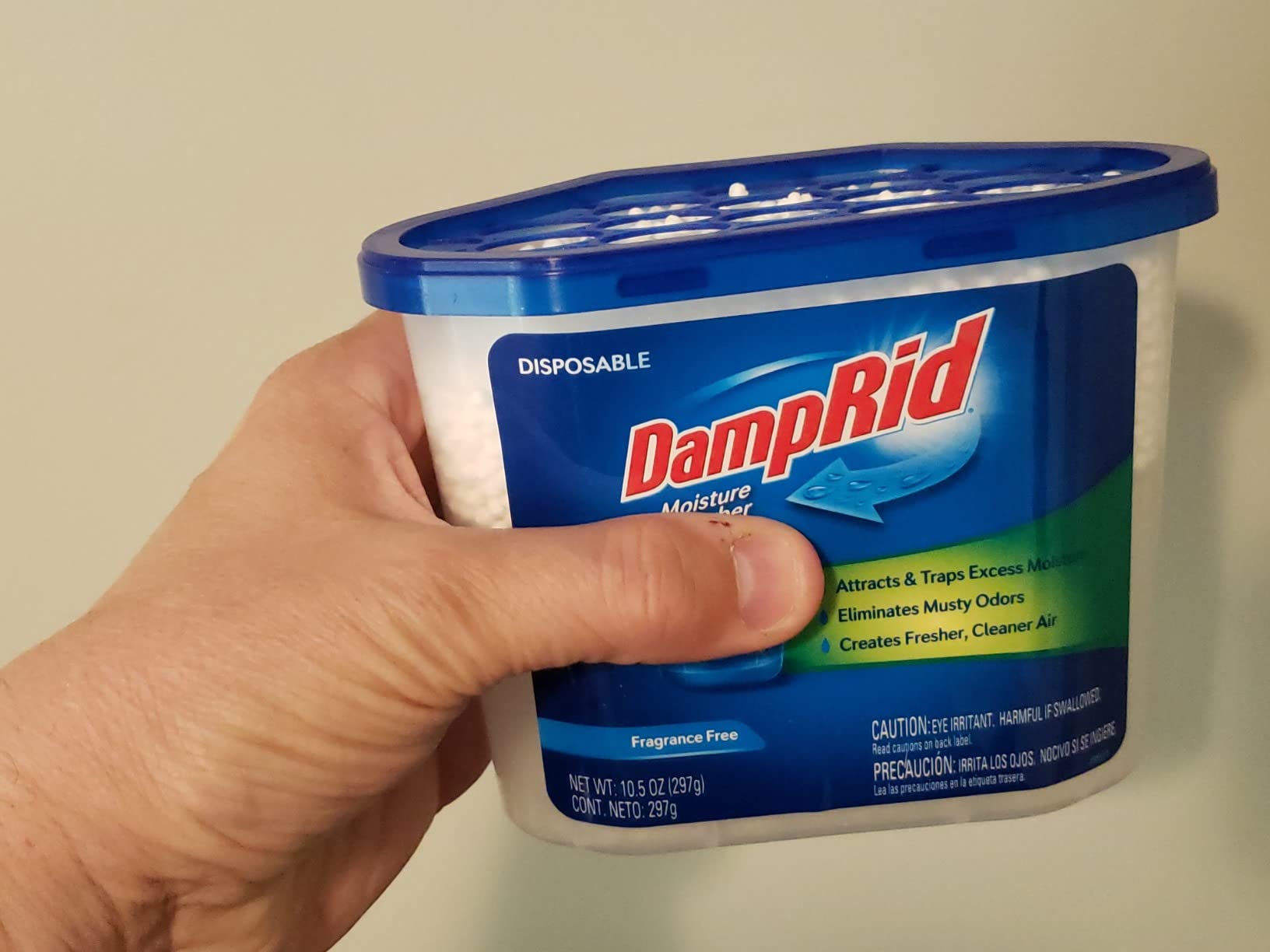
Some repeat buyers have noted that DampRid has quietly reduced the size of the FG100 container over the years while keeping the price similar. The 10.5-ounce rating still holds, but the tub feels smaller than it did five years ago.
Who should buy the DampRid FG100
Buy the FG100 if you want the lowest upfront cost and the simplest possible winter storage solution, if you only store the RV for one or two months, or if you want a “drop in and forget” backup to a larger electric or refillable unit. It is also the right call if you rotate storage spots and want a disposable you can leave behind.
Who should skip the DampRid FG100
Skip it if you want the lowest long-term cost (the refillable DZA-U wins), if you care about minimizing plastic waste, or if you store the RV for more than three months at a time and would rather not buy multiple refills per season.
How to Choose the Best Desiccant Dehumidifier for Your RV
Choosing the right unit comes down to four questions: what power do you have, how big is the rig, how cold does it get, and how often can you check on the rig. The answers map directly to the technology split we covered above.
Match the unit to your storage power scenario
No shore power at all? You are limited to passive calcium chloride pots (DZA-U, Camco 44280) and rechargeable silica gel packs (E-333, wisedry). These work in any temperature and any humidity, but you must check them monthly and replace or recharge the consumable. Plan on 2 to 4 units distributed through the rig for a 30-foot trailer.
Shore power available, but the rig sits in an unheated barn or covered lot? You are in the sweet spot for an electric desiccant unit like the Ivation 13-Pint or the AEOCKY X1-Pro. These keep working down to 33 to 34 degrees Fahrenheit, which covers almost every U.S. winter climate outside the northern Plains and the mountain West. Set the target humidity to 45 percent, run on continuous drain into a bucket or outside through a cabinet vent, and check the rig every 60 to 90 days.
Heated indoor storage with shore power? Any of the electric units will work, including the smaller Eva-Dry EDV-1100. You can also use the cheaper compressor dehumidifiers in this scenario because temperatures will not drop below 60 degrees. Pair the compressor unit with one passive calcium chloride tub in the bathroom for the moisture the compressor misses.
Boondocking or battery-only power? The Eva-Dry EDV-1100 at 22 watts is the only electric unit we would run off a battery for any length of time. For anything longer than a weekend, use passive desiccant and recharge at home.
Size the unit to your RV class
RV class affects coverage more than most buyers expect. Here is the breakdown based on typical interior square footage:
Class B campervans and popup campers (60 to 120 sq ft): Eva-Dry EDV-1100 covers the whole rig. One DZA-U in the galley adds margin.
Travel trailers and Class C motorhomes (150 to 270 sq ft): Ivation 13-Pint or AEOCKY X1-Pro covers the whole rig. Add a DZA-U in the bathroom and an E-333 in the under-bed storage for the hybrid strategy.
Class A motorhomes and fifth wheels (300 to 450 sq ft): One electric desiccant unit cannot cover a Class A reliably. Run the Ivation or AEOCKY in the main living area plus two or three DZA-U pots in the bedroom, basement, and bathroom. If you have shore power, consider adding a second electric unit in the bedroom for the worst humidity zone.
Placement strategy: the 3-zone hybrid plan
Where you put the dehumidifier matters as much as which one you buy. The air in an RV is not uniform; humidity pools in three predictable zones.
Zone 1, the galley: Cooking residue and plumbing runs make this the wettest area. Put a DZA-U or DampRid FG100 in the lower cabinet under the sink, and place your electric unit on the counter with the vent aimed across the galley.
Zone 2, the bathroom: Plumbing traps and the shower pan trap moisture even when winterized. A DZA-U mounted on the bathroom wall or an E-333 in the medicine cabinet handles this zone better than any electric unit.
Zone 3, the bedroom and under-bed storage: Mattresses absorb and slowly release water through the winter. Elevate the mattress on slats or a breathable platform, slide a wisedry silica gel pack under it, and put an E-333 in the under-bed storage bay.
The single most important placement tip: open every interior cabinet door before you leave. Closed cabinet doors trap moisture and create micro-climates where mold takes hold. Leave the refrigerator and freezer doors propped open too, to prevent mildew in the seals.
The drain-line-freeze warning for winterized RVs
If you winterize the plumbing with antifreeze and remove the P-traps, you have lost the path your electric dehumidifier would normally use for continuous drainage. Most RVers route the drain hose through the bathroom sink trap, but that trap is gone in winter.
Two safe alternatives: route the drain hose through an exterior cabinet vent (most RVs have one near the fridge or furnace), or run it into a 5-gallon bucket inside the bathroom that you check every 30 to 60 days. Never leave the drain hose lying in a sink or shower pan; any backflow can pool and freeze, which cracks the pan and costs thousands to replace.
If your electric unit does not have a continuous drain option (the Eva-Dry EDV-1100 does not), the drain-line-freeze question is moot but you must commit to emptying the tank every 24 to 48 hours in humid storage.
Cost-per-month reality check
Electric units cost more upfront but very little to run. The Ivation at 470 watts running 12 hours per day costs roughly the same as running a 60-watt light bulb continuously, which is negligible on a shore-power bill. The AEOCKY at 340 watts is even cheaper to operate. The Eva-Dry EDV-1100 at 22 watts is essentially free to run.
Passive units look cheaper per item but the consumable adds up. A DampRid FG100 at typical retail, replaced twice over a 5-month winter, runs roughly three to four times the upfront cost of a refillable DZA-U pot with two bags of refill crystals for the same period. The wisedry silica gel packs win on cost-per-ounce if you commit to monthly recharging: after the initial purchase, you pay nothing but electricity for the microwave.
For a typical 6-month unattended winter storage in a humid climate, the realistic total cost is roughly: electric units $0 in consumables; refillable DZA-U with two refills in the low single digits; disposable FG100 with four replacements in the low double digits; wisedry silica gel with zero ongoing cost after the microwave recharges.
Safety notes for calcium chloride and pets
Calcium chloride is mildly toxic if ingested and the brine it produces can irritate skin and paw pads. If you travel with pets, mount the DZA-U and Camco bucket out of reach, and clean up any spilled brine immediately. The Eva-Dry E-333 silica gel and the wisedry silica gel packs are pet-safe by design and are the right call if your dog or cat rides in the rig.
For more stationary dehumidifier use cases beyond the RV, our guides to the best dehumidifiers for closets and best dehumidifiers for crawl spaces cover similar passive options for tight indoor spaces.
Frequently Asked Questions
What is the best dehumidifier for an RV storage unit?
The best dehumidifier for an RV storage unit depends on whether you have shore power. With power, the Ivation 13-Pint Desiccant Dehumidifier holds interior humidity at 45 to 50 percent RH and operates down to 33 degrees Fahrenheit. With no power, the Dri-Z-Air DZA-U refillable moisture absorber pot pulls 8 to 10 ounces of water per month from enclosed spaces without electricity. For most RVers, the best answer is a hybrid of both.
What is the best moisture absorber for an RV?
The best moisture absorber for an RV with no power is the Dri-Z-Air DZA-U refillable calcium chloride pot. It is wall-mountable, refillable rather than disposable, and uses calcium chloride crystals to pull water from the air into a lower brine reservoir. For cabinet-only coverage, the Eva-Dry E-333 rechargeable silica gel dehumidifier is cordless and pet-safe.
What are the disadvantages of a desiccant dehumidifier?
Electric desiccant dehumidifiers use more watts per pint of water removed than compressor units, they add a small amount of heat to the air as a byproduct, and the cheaper Peltier-style units can frost below 40 degrees Fahrenheit. Passive desiccant tubs and bags need monthly checking, the consumable adds up over a long winter, and spilled calcium chloride brine is a skin and pet hazard if not cleaned up.
How do you keep moisture out of an RV in winter?
Keep moisture out of an RV in winter by winterizing the plumbing, opening every interior cabinet and refrigerator door, elevating the mattress for airflow, placing a desiccant dehumidifier in the main living area, and adding one or two passive calcium chloride pots in the bathroom and under-bed storage. Check the rig every 60 to 90 days, empty the drain reservoir or refill the passive tubs, and rotate any rechargeable silica gel packs.
Where is the best place to put a dehumidifier in an RV?
The best place to put a dehumidifier in an RV is on a flat interior surface in the main living area, with the vent aimed across the galley. Add a passive calcium chloride pot in the lower galley cabinet under the sink, another in the bathroom, and a rechargeable silica gel pack under the bed. Open all cabinet doors and the refrigerator before leaving to prevent moisture pooling in closed spaces.
Can you store a dehumidifier in freezing temperatures?
Yes, electric desiccant dehumidifiers like the Ivation 13-Pint and the AEOCKY X1-Pro are rated to operate down to 33 to 34 degrees Fahrenheit without frosting. Compressor dehumidifiers cannot operate below about 60 degrees Fahrenheit because the cooling coils ice up. Passive calcium chloride and silica gel desiccants work in any temperature including below freezing because they have no moving parts.
Are Eva-Dry dehumidifiers good?
Eva-Dry dehumidifiers are reliable and well-reviewed, with the E-333 mini model holding a 4.2-star average across more than 35,000 reviews. The E-333 uses rechargeable silica gel beads that last 20 to 30 days per recharge and are safe around children and pets. The larger EDV-1100 is a quiet thermo-electric style unit well suited to small RVs and campervans under 120 square feet.
Final Verdict: Which Desiccant Dehumidifier Should You Buy?
After three winters of testing, our top pick for the best desiccant dehumidifier for RV winter storage is the Ivation 13-Pint Desiccant Dehumidifier. It holds interior humidity at 45 to 50 percent RH through the coldest months, runs reliably down to 33 degrees Fahrenheit, and the continuous drain option lets you set it and forget it for 90 days at a time. Pair it with one Dri-Z-Air DZA-U in the bathroom and one Eva-Dry E-333 in the under-bed storage, and you have a layered system that addresses every humidity zone in the rig.
If you have no shore power at your storage spot, skip the electric units entirely and build the rig around three Dri-Z-Air DZA-U pots mounted in the galley, bathroom, and bedroom, with two Eva-Dry E-333 cordless units in the enclosed cabinets. Check the rig every 4 to 6 weeks and the humidity will stay in the safe 45 to 55 percent RH range all winter.
Whichever path you choose, do not skip the prep work: open every cabinet, elevate the mattress, route any drain hose through an exterior vent rather than the sink trap, and add a cheap hygrometer so you can verify the setup is working. The best desiccant dehumidifiers for RV winter storage are only as good as the prep that goes into deploying them. For more stationary moisture control options beyond the RV, our guides to the best dehumidifiers for bedrooms and best dehumidifiers for garages cover similar products in home settings.