
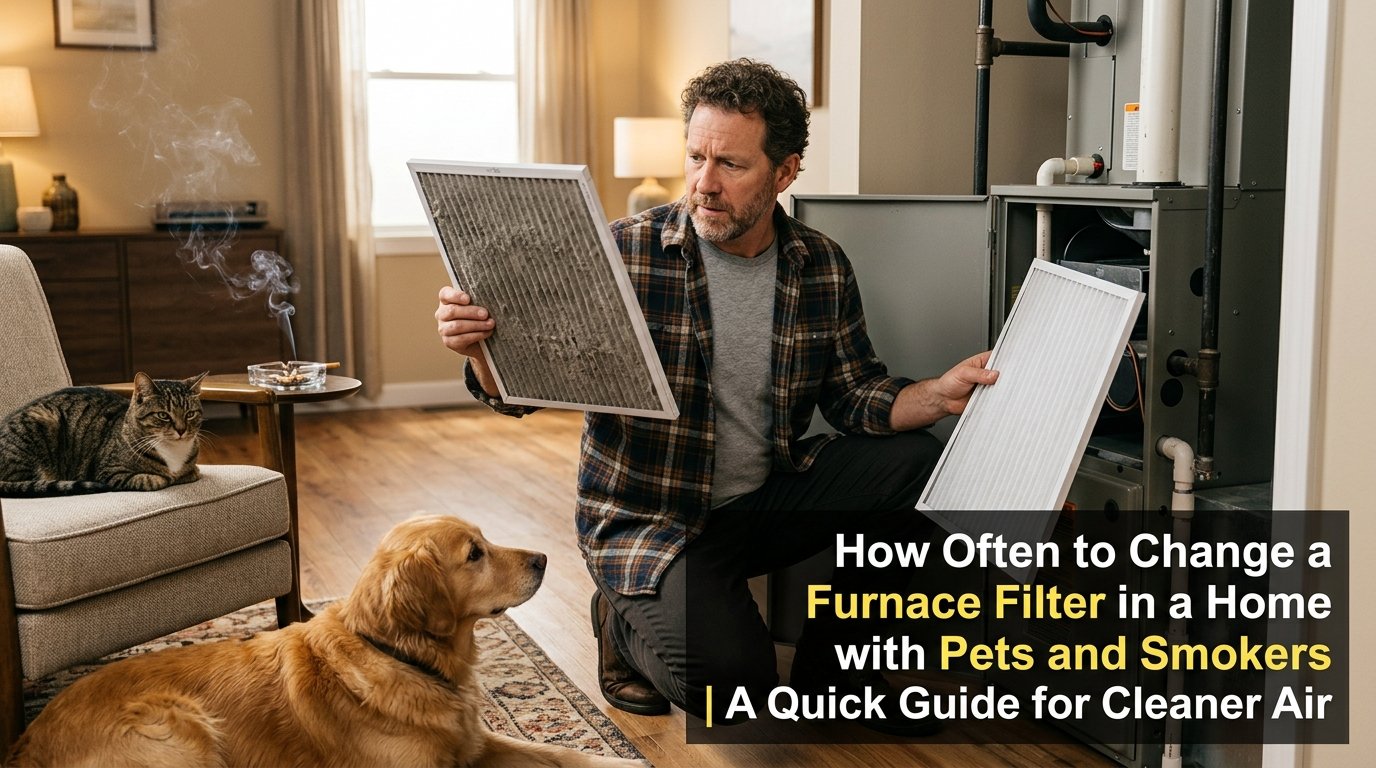
If you share your home with both shedding pets and someone who smokes, your furnace filter is working overtime every single day. Pet dander floats, smoke particles cling, and both settle into the same filter that protects your HVAC system. So how often to change a furnace filter in a home with pets and smokers?
Here is the short answer: every 20 to 30 days for a standard 1-inch filter. That is roughly twice as often as a pet-only home and three times as often as a home with no pets or smokers. I learned this the hard way after running a 1-inch filter for 60 days in a two-dog, one-smoker household and finding it almost completely grey and clogged.
This guide breaks down exactly why pets and smokers create a double burden on your filter, how to build a personalized schedule, and which signs tell you it is time to swap filters immediately. By the end, you will know your ideal interval, your target MERV rating, and how to protect both your HVAC equipment and your family’s air.
Table of Contents
How Often to Change a Furnace Filter in a Home with Pets and Smokers: The Quick Answer
The combined load of pet dander and cigarette smoke clogs filters faster than either factor alone. Here is a quick reference for your replacement interval.
Change your furnace filter every 20 to 30 days if you live with one or more pets and at least one regular smoker. For a 4-inch or 5-inch media filter, you can stretch that to 60 to 90 days because the deeper pleats hold more debris before airflow drops.
Here is how that compares to other household types so you can see the difference:
No pets, no smokers: every 90 days
One pet, no smokers: every 60 days
Multiple pets, no smokers: every 30 to 45 days
One smoker, no pets: every 30 to 45 days
Pets and smokers combined: every 20 to 30 days
If you run your HVAC fan continuously, lean toward the shorter end of each range. Pet hair and smoke residue move through your ducts nonstop, and a filter that lasts 30 days on auto mode may only last 20 with the fan always on.
Why Pets and Smokers Require More Frequent Filter Changes
Pets and smokers each tax your filter in different ways, and the combination is more than the sum of its parts. Understanding what is happening inside that filter helps explain the aggressive 20 to 30 day schedule.
Pet dander is the bigger culprit than visible hair. Dander is made of microscopic skin flakes that stay airborne for hours. Dogs and cats shed enough dander daily to coat the inside of your ductwork, and the allergens in dander trigger respiratory irritation even in people without diagnosed allergies.
Pet hair is the second problem. Long-haired breeds like Golden Retrievers, Mini Aussies, and Maine Coon cats pull visible tufts of fur into return vents. Hair mats across the filter surface and creates a physical barrier that blocks airflow before the filter’s rated capacity is reached.
Cigarette and cigar smoke adds a sticky, tar-laden layer on top. Smoke particles are sub-micron, smaller than most dander, and the tar they carry coats the filter media. That sticky residue then traps more pet dander and dust than the filter would catch on its own, accelerating clogging.
The combination is brutal. Smoke tar essentially glues pet dander and hair to the filter media, which means you cannot just blow it off or vacuum it clean. Once that sticky residue bonds with the dander, the filter is done and must be replaced.
I noticed this firsthand when comparing two filters side by side after 30 days in the same home. The pet-only filter was dusty but still passed air. The pet-plus-smoke filter was visibly darker, smelled stale, and barely let any light through when I held it up to a lamp.
Recommended Change Intervals by Household Type
Building a personalized schedule starts with knowing your household factors. Use this breakdown to dial in your exact interval.
One cat, no smokers: Change every 60 days. Cat dander is potent but lower in volume than dog hair, so a quality pleated filter lasts about two months.
One short-haired dog, no smokers: Change every 45 to 60 days. Short coats shed less hair but dander is still present.
One long-haired or heavy-shedding dog: Change every 30 to 45 days. Breeds like Labs, Huskies, and German Shepherds push the upper limit.
Multiple pets (two or more dogs or cats): Change every 30 days. The cumulative dander load roughly doubles with each animal.
One indoor smoker, no pets: Change every 30 to 45 days. Smoke tar coats the media steadily.
Pets plus one smoker: Change every 20 to 30 days. The tar-dander interaction cuts filter life significantly.
Pets plus multiple smokers: Change every 15 to 20 days. This is the most demanding scenario for any residential filter.
If you use a 4-inch or 5-inch media filter rather than a standard 1-inch, multiply these intervals by roughly 2 to 2.5. The deeper pleated media simply has more surface area to load before airflow is restricted.
Signs Your Furnace Filter Needs Changing Right Now
Schedules are guidelines, but your filter will not always follow the calendar. Watch for these warning signs between scheduled changes.
Visible dust and discoloration: Hold the filter up to a light. If you cannot see light through at least half of it, replace it.
More dust settling on furniture: A clogged filter stops capturing dust, so it recirculates back into your living space.
Weak airflow from vents: Restricted airflow means your filter is choking the system, not just running inefficiently.
Lingering pet or smoke odor: A saturated filter stops removing odors and can even start re-releasing trapped smells.
Higher energy bills: A clogged filter makes your blower motor work harder, which shows up on your monthly utility bill.
More allergy or asthma symptoms: If someone in the home starts sneezing or coughing more, the filter may be saturated and passing particles back into the air.
HVAC short cycling: If the system turns on and off frequently, restricted airflow could be overheating the unit.
I keep a reminder on my phone to check the filter every two weeks. A quick visual takes 30 seconds, and catching a clogged filter early prevents HVAC strain.
How to Check Your Furnace Filter (Step-by-Step)
Checking your filter is simple, but a few safety steps matter, especially when smoke residue makes the filter slippery or messy.
Step 1: Turn off the HVAC system. Use the thermostat or the switch on the unit itself. Never pull a filter while the fan is running, because loose debris can get sucked into the blower.
Step 2: Locate the filter slot. Most filters sit in the return air vent or in a slot on the furnace itself. The slot usually has a removable cover or a hinged door.
Step 3: Slide the filter out carefully. Note the direction of the airflow arrow printed on the frame. You need to put the new filter in pointing the same way.
Step 4: Inspect against a light source. Hold it up to a window or lamp. A clean filter lets light through evenly. A clogged filter looks dark, matted, or streaked with grey and brown, especially in a pet-plus-smoke home.
Step 5: Decide replace versus reuse. Most residential filters are disposable. Washable electrostatic filters exist, but smoke tar does not rinse off easily, so disposable is usually the better choice for smoker households.
Step 6: Install the new filter with the arrow pointing toward the furnace. A backwards filter reduces efficiency and can cause the same airflow problems you are trying to solve.
Step 7: Write the install date on the frame. A Sharpie note like “Installed September 2026” removes the guesswork next month.
MERV Rating Guide for Homes with Pets and Smokers
Choosing the right MERV rating matters as much as the change interval. Too low and particles slip through. Too high and you choke airflow, which stresses your blower motor.
MERV stands for Minimum Efficiency Reporting Value. It rates how effectively a filter captures particles between 0.3 and 10 microns. Higher numbers mean smaller particles are captured.
Here is a practical guide for pet and smoker households:
MERV 1 to 4: Captures only large dust and lint. Not recommended for pets or smokers. These are cheap fiberglass filters that need changing every 30 days anyway.
MERV 6 to 8: Captures dust mites, mold spores, and some pet dander. Acceptable for light pet homes but lets most smoke particles through.
MERV 9 to 12: Captures fine dander, lead dust, and larger smoke particles. The sweet spot for pet and smoker homes. MERV 11 is my go-to recommendation.
MERV 13 to 16: Captures bacteria, smoke, and most allergens. Excellent filtration but can restrict airflow on older or smaller HVAC systems. Check with an HVAC tech before going this high.
For the combined pet and smoker household, MERV 11 balances capture efficiency with airflow. If you have allergies or asthma in the home, MERV 13 is worth it, but verify your HVAC system can handle the extra resistance.
Avoid HEPA-rated furnace filters unless your system was specifically designed for them. True HEPA is too dense for most residential blowers and will cause performance problems within weeks.
Filter Type Comparison: Fiberglass vs Pleated vs Media
Filter material affects both capture efficiency and lifespan. Here is how the three main types perform in a pet and smoker home.
Fiberglass filters are the blue or white panel filters that cost a few dollars each. They catch large dust and hair but pass most dander and almost all smoke particles. Not a good choice for this household, no matter how often you change them.
Pleated filters are the standard recommendation. The folded media creates far more surface area in the same 1-inch frame, which means better capture and longer life. Pleated MERV 11 filters handle pet dander and most smoke particles well.
Media filters are the 4-inch or 5-inch cartridges used in newer HVAC systems or media cabinets. They have dramatically more surface area than 1-inch pleated filters, which means they last two to three times longer between changes. For a pet and smoker home, this is the upgrade worth making.
Electrostatic washable filters sound appealing because you never buy replacements. The problem is smoke tar. It coats the electrostatic fibers and does not rinse off with water. After a few months in a smoker home, a washable filter loses its charge and stops capturing particles. Skip these for this household.
My recommendation: pleated MERV 11 for budget flexibility, or a 4-inch media filter if your system supports it. The media filter pays for itself in fewer changes and better protection for your HVAC equipment.
What Happens If You Skip Filter Changes in a Pet and Smoker Home
Neglecting filter changes in a combined pet and smoker household has consequences that go beyond dirty air. Here is what actually happens.
Your HVAC system loses efficiency first. A clogged filter forces the blower motor to work harder, which raises your energy bill and shortens the motor’s lifespan. I have seen utility bills climb 15 to 25 percent in homes with severely clogged filters.
Indoor air quality drops sharply. Pet dander, smoke particles, and dust that the filter can no longer capture get recirculated through your home. For allergy sufferers and anyone with asthma, this means more symptoms and more medication.
The evaporator coil gets dirty. When a filter fails, debris passes through and coats the cold coil inside your furnace. A dirty coil reduces cooling capacity and can freeze up, causing expensive repair calls.
Lingering odors build up. A saturated smoke filter starts to re-release trapped odors back into your ductwork. The smell of stale smoke gets worse, not better, the longer you wait.
In severe cases, the heat exchanger can crack. Restricted airflow causes the furnace to overheat, and a cracked heat exchanger is a safety hazard that requires full furnace replacement. This is the consequence HVAC technicians warn about most.
Seasonal Considerations: Winter, Summer, and Allergy Seasons
Seasons change how hard your filter works, and your replacement schedule should flex with them.
In winter, the furnace runs constantly in cold climates, which means air cycles through the filter more often. Plan for shorter intervals from December through February, especially in a pet and smoker home.
In summer, the air conditioner pulls the same air through the same filter. High humidity makes smoke tar stickier and pet dander heavier, so the filter loads faster. June through August typically requires the same 20 to 30 day interval.
Spring and fall bring pollen. Even if no one in the home has pollen allergies, the extra particle load adds to the dander and smoke your filter is already handling. Check the filter every two weeks during peak pollen months.
If you run the fan continuously year-round to balance temperatures, expect to change filters at the short end of every range. Continuous fan mode moves air through the filter 24 hours a day, which means it loads three to four times faster than auto mode.
Tips for Maintaining Air Quality Between Filter Changes
A filter is one tool, not the whole solution. These habits help extend filter life and keep air cleaner between changes.
Vacuum pet areas weekly. Less hair on the floor means less hair pulled into your return vents.
Brush pets outdoors. Removing loose fur before it becomes airborne reduces dander load dramatically.
Designate a smoking area. Even a single outdoor smoking spot, or a well-ventilated room with a dedicated air purifier, cuts the smoke that reaches your furnace filter.
Run a portable air purifier in high-traffic rooms. A HEPA air purifier near the litter box, dog bed, or smoking room captures particles before they reach the central system.
Wash pet bedding in hot water every week. Bedding is a major dander reservoir.
Keep return vents clear. Do not push furniture against return vents, and vacuum the vent covers monthly.
Change filters on a recurring calendar reminder. Consistency matters more than perfection.
Small changes add up. A friend with two dogs and a partner who smokes inside cut her filter changes from every 20 days to every 30 days just by adding a portable HEPA purifier in the living room.
FAQs
How often should I change my furnace filter with pets?
With pets, change your furnace filter every 30 to 60 days depending on pet count and shedding level. One short-haired cat can stretch to 60 days, while multiple heavy-shedding dogs usually need a new filter every 30 days.
What happens if you haven’t changed your air filter in 2 years?
After two years without a change, your filter is likely completely clogged with dust, dander, and debris. This restricts airflow, raises energy bills, stresses the blower motor, and can cause the evaporator coil to freeze or the heat exchanger to crack. Replace it immediately and have an HVAC technician inspect the system.
What is the best furnace filter for a house with pets?
A pleated MERV 11 filter is the best choice for most pet homes. It captures fine dander and hair without overly restricting airflow. For homes with multiple pets or allergy sufferers, MERV 13 offers stronger capture but check that your HVAC system can handle the extra resistance.
How often do you really need to change furnace filters?
Standard homes without pets or smokers can go 90 days between changes. Pet owners should change every 30 to 60 days, smoker households every 30 to 45 days, and homes with both pets and smokers every 20 to 30 days for a 1-inch filter.
What is the best furnace filter for pets and allergies?
A MERV 11 to 13 pleated filter is best for pet allergies because it captures fine dander particles. If your HVAC system supports it, a 4-inch or 5-inch media filter in the MERV 11 to 13 range lasts longer and captures more allergens between changes.
Putting It All Together
Knowing how often to change a furnace filter in a home with pets and smokers comes down to one rule: every 20 to 30 days for a standard 1-inch filter, and every 60 to 90 days for a 4-inch or 5-inch media filter. The tar-and-dander combination is the most demanding residential scenario, so do not rely on the generic 90 day rule that fits standard homes.
Start by checking your current filter today. If it has been more than 30 days in a pet and smoker home, swap it out. Then mark your calendar for the next change, write the install date on the new filter frame, and build the habit. Your HVAC system, your energy bill, and your lungs will all notice the difference within the first week.