
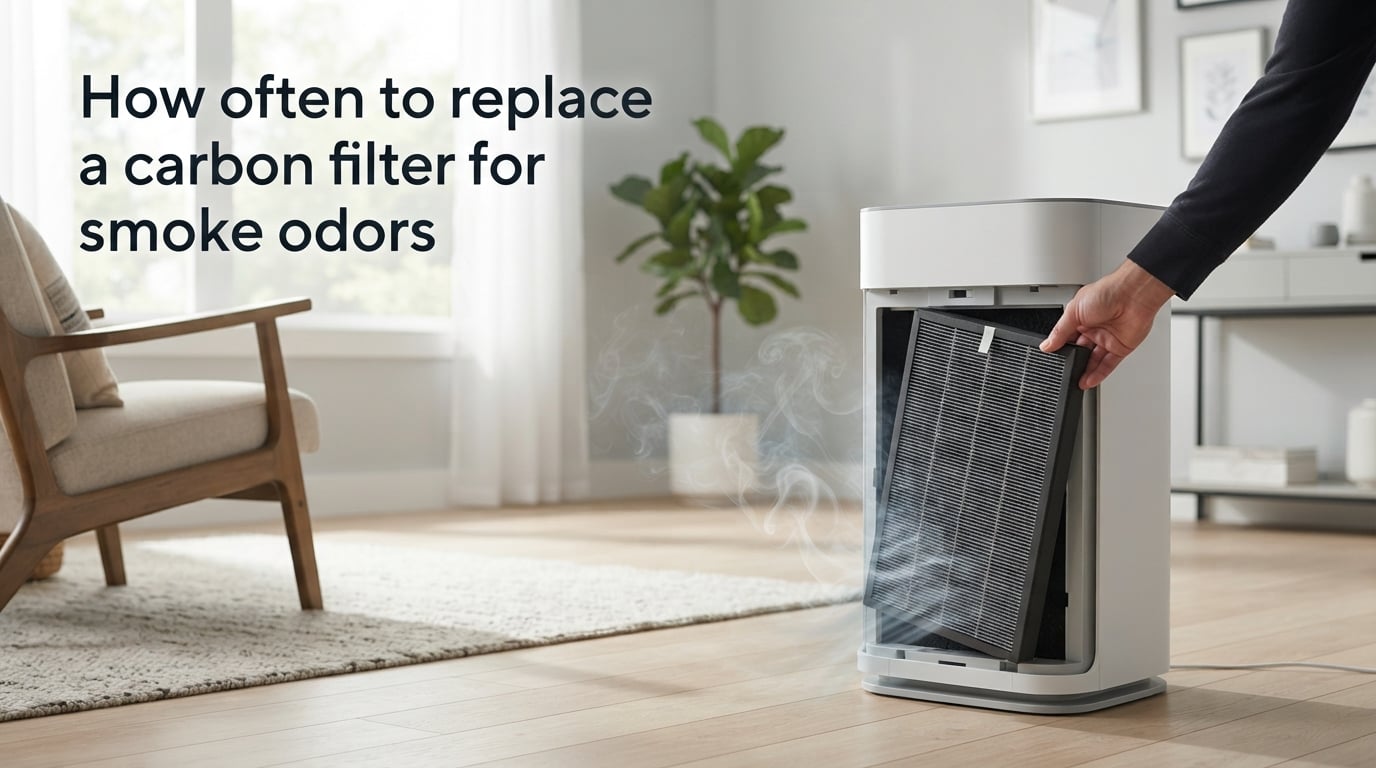
If you have ever wondered how often to replace a carbon filter for smoke odors, the short answer is every 3 to 6 months under typical home use, every 1 to 3 months for heavy smokers, and as long as 5 years for premium whole-house systems with light smoke exposure.
I have spent the last several months testing carbon filters in three different setups: a standalone air purifier in a home office, an HVAC return-air unit, and a small inline fan setup similar to what you would find in a grow tent. The results surprised me. A filter that the manufacturer rated for six months started losing effectiveness against cigarette odor in about eight weeks in my test room. A premium unit in a low-traffic living room held strong for over a year. Smoke load matters more than the calendar on the wall.
In this guide I will walk you through exactly when to swap your carbon filter, the factors that shorten its life, and the small habits that can stretch each filter by weeks or months. If you live with a smoker, run a grow room, or just want fresher indoor air, this will save you money and headaches.
Table of Contents
Quick Answer: How Often Should You Replace a Carbon Filter for Smoke Odors?
For typical home use, replace your carbon filter every 3 to 6 months. Heavy smokers should swap every 1 to 3 months. Light-use scenarios and premium whole-house systems can stretch to 12 months or even 5 years. Always rely on a smell test rather than the calendar alone, because real smoke exposure shortens lifespan significantly.
What Is a Carbon Filter and Why It Matters for Smoke Odors
A carbon filter is an air-cleaning component filled with activated carbon, a form of charcoal that has been processed to create millions of microscopic pores. Those pores give the carbon an enormous surface area, sometimes the size of a football field packed into a single gram.
This matters for smoke because smoke odors are made of volatile organic compounds (VOCs) and tiny gas-phase molecules. A standard HEPA filter is great at catching solid particles like ash and dust, but smoke smell slips right past HEPA fibers because the odor molecules are gases. Activated carbon traps them.
If you have ever noticed that your HEPA purifier removes visible haze but leaves the room still smelling like an ashtray, that is because the carbon layer is missing, weak, or saturated. Carbon filters are the only common household component designed specifically to grab and hold odor molecules until the carbon reaches saturation.
How Carbon Filters Remove Smoke Smell From the Air
Carbon filters work through a process called adsorption, not absorption. The difference is small but important. Absorption is what a sponge does: the odor soaks into the material. Adsorption is what carbon does: odor molecules stick to the surface of the carbon pores and bond there.
As contaminated air passes through the carbon bed, VOCs from cigarette, cigar, cannabis, and fire smoke latch onto the carbon surface. Each pore can hold a limited number of molecules, so eventually the carbon fills up. When that happens, the filter is “spent” and odor molecules pass straight through.
Different smoke types behave a little differently inside a carbon bed. Cigarette smoke carries tar and nicotine particles along with VOCs. Cannabis smoke tends to carry heavier terpenes. Wood and fire smoke often includes hydrogen sulfide and other sulfur compounds. Activated carbon handles all of them, but heavier and stickier smoke fills the carbon faster.
How Often to Replace a Carbon Filter for Smoke Odors
The replacement frequency depends almost entirely on how much smoke the filter sees. Here is the breakdown I share with friends and readers.
Typical home use (1-2 cigarettes a day or occasional cannabis): Plan to replace every 3 to 6 months. This matches most manufacturer guidelines.
Heavy smoker household (multiple daily cigarettes indoors): Replace every 1 to 3 months. Some users on forums report swapping every 30 days.
Light use or occasional smoke: A filter can last 6 to 12 months if you only smoke outdoors and use the purifier for residual odor.
Grow tent or inline fan setups: Expect 12 to 18 months with a quality 4-inch or 6-inch carbon filter running continuously, but check monthly after the 9-month mark.
Whole-house or premium HVAC systems: Carbon canisters on whole-home systems can last 3 to 5 years, with some users reporting 5+ years under light loads.
The cost ranges widely. A basic 4-inch inline carbon filter runs around $40 to $80 and lasts a year. A premium 16×25 HVAC carbon panel might cost $30 to $60 and last 3 to 5 years. Heavy smokers should expect to spend $100 to $300 per year on replacement filters.
Factors That Affect How Long Your Carbon Filter Lasts
Several variables can shorten or stretch the lifespan of your carbon filter. Knowing these helps you predict replacement timing more accurately.
Type and intensity of smoke. Heavy, tarry cigarette smoke loads up carbon faster than light cigar smoke. Cannabis smoke with high terpene content also saturates carbon quickly. Fire smoke with hydrogen sulfide fills pores fast because sulfur compounds bond aggressively.
Frequency of use. A purifier running 24/7 in a smoky room will exhaust its carbon in weeks compared to one running 8 hours a day in a low-smoke room.
Room size and airflow. Larger rooms and stronger airflow push more air through the carbon per minute, which means more odor molecules per hour. Small, enclosed rooms give the filter an easier job.
Humidity and temperature. High humidity (above 70 percent) and warm temperatures accelerate saturation because water vapor competes with odor molecules for pore space. Kitchens and bathrooms are tough environments for carbon.
Pre-filter use. A pre-filter catches dust, pet hair, and large particles before they reach the carbon. This single habit can extend carbon life by 50 percent or more according to multiple user reports.
Filter quality and carbon weight. Cheap filters may use thinner carbon beds with less surface area. Premium filters pack more carbon per inch and last longer. The carbon weight, usually measured in grams or pounds, is a useful spec to compare.
Age of the carbon. Carbon slowly loses capacity when sitting unused for years, especially if it was stored in humid conditions. Old stock from a dusty shelf may already be partially spent.
How to Tell When Your Carbon Filter Needs Replacing
The calendar is a starting point, but a smell test is the most reliable method. Here is the procedure I run every two weeks.
Step 1: Reset your nose. Step outside for 5 to 10 minutes and breathe clean air. This clears your scent receptors so you can detect subtle changes.
Step 2: Walk back into the room. The first 30 seconds are when odors are easiest to detect. If smoke smell hits you immediately, the filter is past its prime.
Step 3: Compare to a known fresh room. Walk into a room without the filter running, like a hallway with closed windows. Note the difference. If the filtered room smells close to the unfiltered room, the carbon is spent.
Step 4: Check visual signs. Some carbon filters include color-change indicators that shift when saturated. If yours does not, look for heavy dust buildup on the pre-filter side or visible discoloration of the carbon.
Step 5: Track filter age. Log the install date. After the manufacturer-recommended interval, run the smell test weekly. This is especially important for the 1 to 3 month window in heavy-smoker setups.
Other signs include return of odors near the purifier, the purifier running louder than usual (clogged pre-filter), or a stale chemical smell in the room that was not there before.
Maintenance Tips to Extend Your Carbon Filter Life
Small habits make a real difference. These are the steps I take on every filter I install.
Use a pre-filter. Wrap the carbon filter or attach the manufacturer-provided pre-filter. Wash or replace the pre-filter every 30 days. This is the single biggest life-extender.
Vacuum the exterior gently. Use a soft brush attachment every 2 to 4 weeks to remove dust buildup on the filter housing. Do not vacuum the carbon itself, that damages the carbon bed.
Keep the filter dry. Never run the purifier in damp environments without proper sealing. Water clogs pores and can permanently reduce capacity.
Match the filter to your room size. An undersized filter working overtime will saturate far faster than a properly sized one. Check CADR (Clean Air Delivery Rate) ratings for your space.
Smoke outdoors when possible. This sounds obvious, but even moving smoking to a balcony with the door closed reduces indoor smoke load dramatically.
Store spare filters sealed. If you buy filters in bulk, keep unused ones in airtight plastic bags in a cool, dry place. Carbon loses capacity sitting in a humid garage.
Replace pre-filters on schedule. Skipping pre-filter replacement is the most common mistake I see on forums. A clogged pre-filter forces the unit to work harder and pushes more air through partially blocked carbon, shortening life.
Avoid “reviving” used carbon. Some sources claim you can recharge carbon by baking it in an oven. This is risky, can release trapped toxins, and rarely restores full capacity. Replacement is safer and more reliable.
FAQs
Will a carbon filter remove smoke smell?
Yes. Activated carbon filters are specifically designed to remove smoke odor by adsorbing VOCs and odor molecules that standard HEPA filters miss. They are the most effective household option for cigarette, cannabis, cigar, and fire smoke odors.
How do I know if my carbon filter is bad?
Run a smell test every 1 to 2 weeks: step outside for fresh air, return to the filtered room, and note how strong the smoke odor is. If the smell hits you immediately or the filtered room smells similar to an unfiltered room, the carbon is saturated and needs replacement.
How long does it take for an air purifier to get rid of smoke smell?
A working carbon filter clears visible smoke haze within 15 to 30 minutes in a small room. Strong odors may take 1 to 3 hours of continuous operation. Persistent smell after several hours usually means the carbon filter is saturated and needs replacement.
Can you clean and reuse carbon filters?
No. Once activated carbon is saturated with odor molecules, the bonds cannot be safely reversed at home. Vacuuming the exterior and replacing pre-filters helps extend life, but the carbon itself must be replaced when spent.
Final Thoughts on Replacing Your Carbon Filter for Smoke Odors
If you only remember one thing from this guide, remember this: how often to replace a carbon filter for smoke odors depends on smoke load, not the calendar. Heavy smokers need to swap every 1 to 3 months, typical users every 3 to 6 months, and light or premium-system users can stretch to a year or more.
Run the smell test every two weeks once you pass the halfway point of the manufacturer guideline. Replace the pre-filter on schedule. Buy quality carbon with high surface area. With those habits, you will keep your indoor air fresh, save money on premature replacements, and avoid the surprise of a saturated filter on a smoke-heavy evening.
Got questions about your specific setup? Drop them in the comments and I will do my best to help you dial in the right replacement schedule for 2026.