
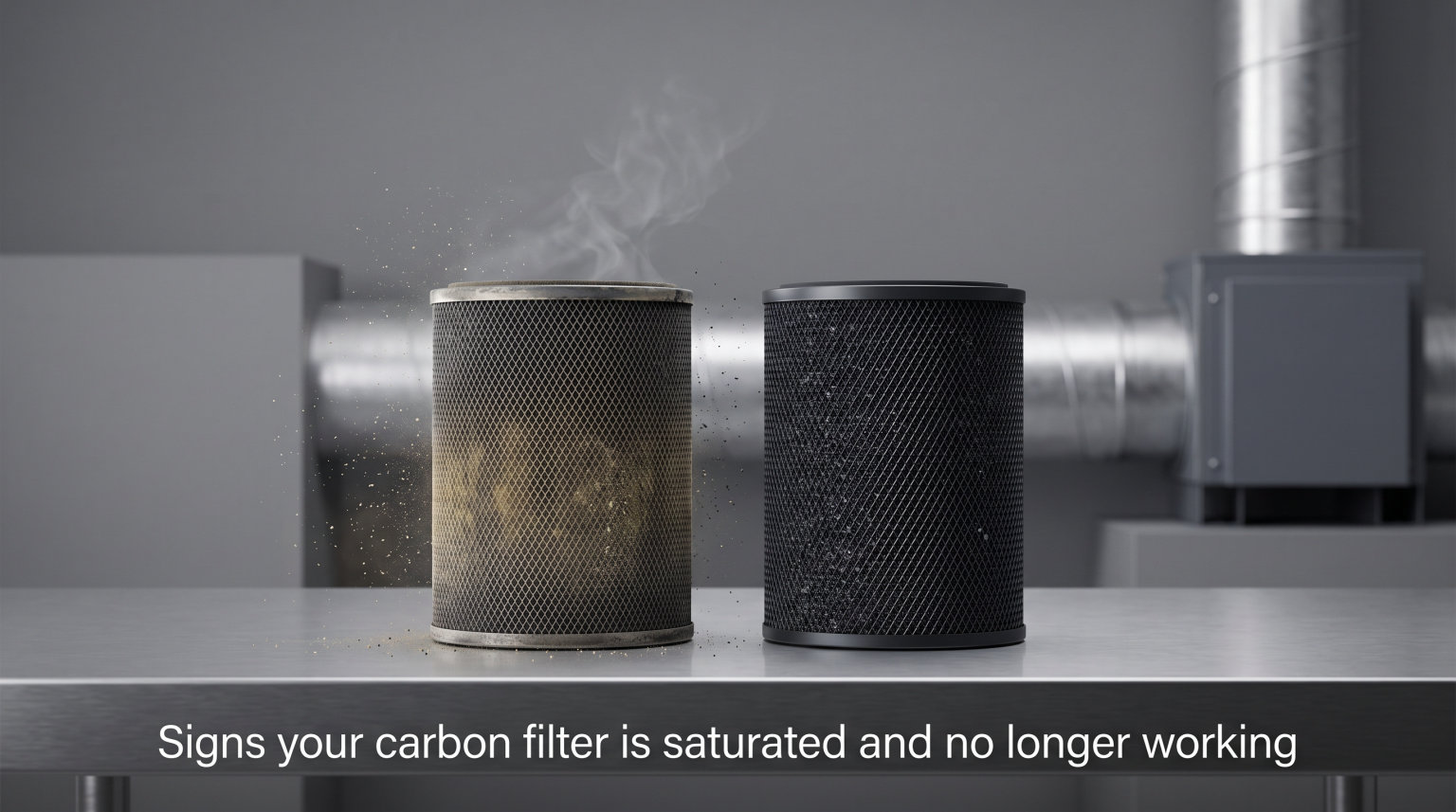
If you rely on an activated carbon filter for clean water or fresh air, knowing the signs your carbon filter is saturated and no longer working can save you from consuming contaminants you think are being removed. Carbon filters are silent workers that trap chlorine, volatile organic compounds (VOCs), odors, and a long list of other impurities through a process called adsorption.
But that process has a hard limit. Once the carbon’s surface area fills up with trapped molecules, the filter stops doing its job and can even release captured substances back into your water or air.
The tricky part is that carbon filters rarely announce their failure with a dramatic event. There is no warning light, no alarm, and usually no obvious drop-off on day one. Instead, they fade slowly over weeks or months.
Many people only realize something is wrong when they notice a smell returning or a strange taste creeping back into their water. By that point, the filter has often been exhausted for a while already.
Our team has spent years testing and monitoring carbon filters across different applications, from under-sink water systems to grow room exhaust setups and aquarium canister filters. Across all of them, the pattern is the same. The most reliable warning signs appear well before the obvious taste or odor changes show up.
This guide walks you through every major sign that your carbon filter is saturated, how to test it at home in under a minute, and how long filters actually last by application type. Whether you are filtering drinking water, cleaning indoor air, managing a grow room, or maintaining an aquarium, you will find specific guidance for your setup as of 2026.
Table of Contents
What Is Carbon Filter Saturation?
Carbon filter saturation happens when the activated carbon inside your filter has adsorbed as many contaminant molecules as it physically can. Every piece of activated carbon contains millions of microscopic pores that create an enormous internal surface area where molecules get trapped.
When water or air passes through, contaminant molecules stick to those pore surfaces through a process called adsorption. Once every available site is occupied, the carbon has nothing left to offer and new contaminants simply pass through untreated.
Think of it like a parking lot. Each pore is a parking space and each contaminant molecule is a car. Once every space is filled, no more cars can park, and the excess flows right past.
This is what we call saturation, and it marks the point where your filter has reached its full adsorption capacity. At this stage, the filter provides no protection at all.
Saturation does not happen all at once. As the filter nears its limit, a process called “breakthrough” begins where contaminants start slipping through the carbon bed in small amounts.
At first, the quantity breaking through is tiny and completely undetectable. Over days or weeks, it grows until you finally notice a smell or taste that should not be there.
This gradual failure explains why a carbon filter can seem fine one week and clearly exhausted the next. It has actually been declining the whole time, and the carbon was just catching enough to keep the warning signs below your threshold of detection.
A related term you may encounter is “heel capacity,” which refers to residual contaminants that remain permanently trapped within the carbon matrix. The working capacity is the portion of adsorption that actively protects you during normal use.
Once the working capacity is consumed, replacement is overdue even if the filter still looks normal on the outside. This is why calendar-based replacement alone is not enough to catch early exhaustion.
Signs Your Carbon Filter Is Saturated and No Longer Working
The clearest signs your carbon filter is saturated and no longer working fall into five categories: smell, taste, visual changes, flow rate, and time. Most people only notice the first two, but the other three give you earlier and more reliable warnings.
Returning odors. This is the most common and recognizable sign of all. If you successfully filtered out a smell before and it is coming back, the carbon is exhausted.
For water filters, this often shows up as a chlorine smell returning to your tap water. For air purifiers and grow room filters, you may notice the original odor creeping back into the room.
Changes in taste. Water that tasted clean may develop a metallic, sour, or chemical taste. Some people describe it as a flat or stale flavor.
This happens because the carbon is no longer removing chlorine, chloramines, and dissolved organics that affect flavor. The taste shift means the filter is well past its useful life.
A sour or chemical smell from the filter itself. This is a sign many users miss entirely. When you hold a carbon filter close to your nose and detect a sour, acidic, or chemical odor coming directly from the media, the carbon is saturated.
Fresh carbon has little to no smell at all. The trapped compounds are now off-gassing back out instead of staying trapped.
Discoloration or carbon fines. For water filters, look for gray or black specks in your water. These are carbon fines breaking loose as the carbon structure degrades.
For air filters, visible darkening or a powdery residue around the filter housing signals wear and breakdown. Both indicate the media is past its prime.
Reduced flow rate or pressure drop. As carbon media breaks down and channels form inside the bed, water or air may struggle to pass through. If your filter is suddenly slow or your air purifier fan seems to work harder, the carbon bed may be compromised.
The key takeaway is that taste and odor returning are late-stage signs. Flow changes, visual inspection, and the direct smell test give you days to weeks of advance notice before those obvious problems appear.
The Smell Test: How to Check Your Carbon Filter
The smell test is the fastest and simplest way to check whether your carbon filter is saturated. You can perform it in under a minute with no tools or test kits required.
It works for both air and water carbon filters. It is the method most experienced users and forum communities trust above all others for quick, reliable detection.
Here is how to perform the smell test in three steps.
Step 1: Remove or expose the carbon media. For an air purifier or grow room filter, take the carbon filter out of the housing. For a water filter, remove the cartridge so you have direct access to the carbon media itself, not just the plastic housing around it.
Step 2: Hold the carbon close to your nose. Bring the filter media to within 1 to 3 centimeters of your nose. Focus on the center of the carbon bed where the most contact with air or water occurs, and take a slow, gentle sniff.
Step 3: Interpret the smell. Fresh, working carbon has almost no scent at all. If you detect a sour, acidic, chemical, or sweet fruity smell, the filter is saturated and off-gassing trapped compounds.
A sweet or floral smell from an air purifier exhaust is a well-known saturation indicator that users on air purifier forums report frequently. Trust what your nose tells you over any calendar date.
One important note on this method: the smell test tells you whether the carbon is exhausted right now, but it does not predict remaining lifespan. If the test result is borderline, repeat it in a few days to see if the smell has grown stronger.
A filter that is on the edge of saturation will produce a stronger smell quickly as more compounds break through the carbon bed. Catching that trend early gives you time to order a replacement before total failure.
For water filter cartridges, you can run a variation of this test. Fill a glass with filtered water and let it sit for a minute, then smell the surface from about 5 centimeters away. If you detect chlorine or any chemical odor that your tap water has, the filter is no longer removing it effectively.
Visual Signs: What to Look For
Visual inspection can reveal saturation and structural breakdown before your nose or taste buds catch on. You should check your filter visually every time you open the housing, which ideally means every few weeks for actively used systems.
For water filters, look for these specific visual cues. Carbon fines appearing as black or gray specks in filtered water indicate the media is breaking apart and losing its structure.
A cartridge that looks noticeably darker, sludgy, or coated in residue has likely absorbed far beyond its working capacity. Cloudy or discolored water from a previously clear output is a red flag that demands immediate attention.
Some users on water treatment forums report finding their filters heavily discolored after only four months, well short of the manufacturer’s recommended replacement window. This confirms that real-world conditions often exhaust carbon faster than lab-tested estimates suggest.
For air purifier and grow room filters, check the carbon media for compression and settling. Over time, carbon granules pack down and leave gaps or channels through the bed.
If you see uneven density, visible holes, or a powdery dust layer instead of distinct granules, the bed has degraded. The outer pre-filter may also show dark staining that was not present when the filter was new.
Take a photo of your filter when it is fresh out of the package. Having a reference image makes it much easier to spot gradual changes months later when your memory of the original state has faded.
Flow Rate and Pressure Changes
Changes in how water or air moves through your system are among the earliest measurable signs of carbon filter saturation. Because these changes happen gradually over time, they are easy to miss until you compare against a known baseline measurement.
For water filtration systems, a noticeable drop in flow rate or water pressure often signals that the carbon bed is clogging. As activated carbon adsorbs contaminants, the granules can swell, break apart, or compact together.
Sediment trapped alongside the carbon adds to the restriction. If your faucet is delivering water noticeably slower than it did a month ago and nothing else in your plumbing has changed, the carbon cartridge is a prime suspect.
For air purifiers and grow room exhaust systems, watch for changes in fan behavior. A saturated or degrading carbon filter increases resistance against airflow, and the fan may run louder, vibrate more, or cycle to higher speeds.
In grow rooms, growers often notice their inline fan pulling less air, which raises humidity and temperature as a secondary effect on the growing environment. This secondary impact can damage crops before you even realize the filter is the root cause.
To track this effectively, note your baseline flow rate or fan speed when the filter is brand new. Check it every two to four weeks for changes.
A 20 to 30 percent reduction in flow is a strong indicator that replacement time is approaching. This holds true even if the smell and taste of your output are still acceptable at that point.
Pressure gauges are available for whole house systems and provide an objective reading. If you see a pressure drop of 10 to 15 psi across the filter housing compared to when the cartridge was installed, the carbon bed is restricting flow and needs attention.
How Long Do Carbon Filters Last?
Carbon filter lifespan depends heavily on the application, the contaminant load, and the volume of water or air passing through the system. There is no universal answer that covers every situation, but there are reliable ranges based on real-world use data from active user communities.
The single biggest factor is contaminant concentration in your source water or air. A carbon filter processing municipal water with moderate chlorine will last far longer than one filtering well water high in iron, sulfur, or dissolved organics.
Similarly, an air purifier carbon filter in a clean home will outlast one in a grow room or a kitchen with heavy daily cooking. Your specific environment sets the pace of exhaustion.
Here are typical real-world lifespans by application type. These ranges are based on what users actually report in forums and communities, not just manufacturer claims, which forum users consistently note are optimistic by a significant margin.
Under-sink and refrigerator water filters generally last 3 to 6 months with normal household use. These compact cartridges have a limited carbon volume and face steady daily demand from every faucet use.
Whole house carbon filters typically run 6 to 12 months depending on total water volume and incoming contaminant levels from the municipal or well supply. Larger tanks hold more carbon, which extends the service interval.
Aquarium canister carbon lasts roughly 3 to 4 weeks with continuous use. It handles a heavy biological and chemical load in a compact space that exhausts the media quickly.
Air purifier carbon filters usually last 3 to 6 months in typical home conditions with moderate odor and VOC exposure. Homes with pets, smokers, or heavy cooking will see shorter lifespans.
Grow room carbon filters face high humidity and dense organic odors, and they often need replacement every 6 to 12 months. Some manufacturers claim 18 to 24 months of service life, but real-world testing rarely confirms those numbers.
Range hood and cooker hood carbon filters generally last 3 to 6 months with regular cooking activity. Grease and cooking vapors load the carbon heavily with each use.
Flow volume matters as much as calendar time. A filter that processes 50 gallons per day will exhaust faster than one processing 10 gallons per day, even if they are the same model in the same application.
Track your actual usage alongside calendar dates for the most accurate prediction of when your specific carbon filter is saturated and no longer working. This combined approach beats relying on a replacement sticker alone.
What Happens If You Keep Using a Saturated Filter
Running a saturated carbon filter is worse than having no filter at all in certain scenarios. Once the adsorption capacity is fully exhausted, the filter stops removing contaminants from your water or air.
In specific conditions, it can actually release previously trapped compounds back into the stream passing through it. This means your filter becomes a source of contamination rather than a barrier against it.
This phenomenon is called desorption or displacement. When a new contaminant molecule enters the carbon bed and has a stronger attraction to the carbon surface than a previously adsorbed compound, it can push the older molecule free.
The older contaminant then exits the filter and enters your drinking glass or your room. Essentially, your filter becomes a slow-release source of the very substances it was supposed to remove.
For drinking water, this means chlorine, chloramines, VOCs, and even trace pharmaceuticals that were captured weeks or months ago can start appearing in your water supply. Users on homebrewing and water treatment forums report strange metallic or chemical tastes appearing suddenly after months of clean water.
That abrupt change is often a desorption event in progress. The filter is not just failing to remove new contaminants but is actively adding old ones back into your water.
For air purification, a saturated filter can begin off-gassing captured odors and VOCs back into the room. Grow room operators describe a sweet chemical smell from their exhaust ducting that signals the carbon is releasing compounds rather than capturing new ones.
Health impacts depend on what contaminants are present in your source water or air. Low levels of chlorine or common VOCs may cause mild effects for most people.
But if your water source contains agricultural runoff, industrial chemicals, or bacteria-promoting organic matter, running an exhausted filter means you are consuming those contaminants while believing they are being removed. The safest approach is proactive replacement before signs appear.
Waiting for obvious signs like returning taste and odor means you have already been running partially saturated media for weeks. That gap between actual exhaustion and detected failure is the window where unwanted exposure occurs.
Signs Specific to Your Application
Different applications produce different saturation signals, and understanding the patterns for your specific setup makes early detection much easier. Here is what to watch for across the most common carbon filter uses that our team has tracked.
Whole House and Under-Sink Water Filters
For whole house and under-sink water filtration, the first sign is usually a faint chlorine smell returning to your water. This is often detectable by smell before you can taste it.
Next comes a change in taste, frequently described as metallic, chemical, or flat. If you have a clear filter housing, watch for the cartridge darkening or developing a visible gradient of trapped material from inlet to outlet.
Check for carbon fines by filling a white cup with filtered water and looking for dark specks settling at the bottom. Any specks present mean the carbon structure is breaking apart inside the cartridge.
Refrigerator Water Filters
Refrigerator water filters are compact cartridges with a small carbon volume, and they exhaust quickly under regular use. Watch for slower water dispensing and a taste that gradually shifts toward the flavor of your unfiltered tap water.
Ice cubes may develop an off odor or a cloudy appearance as the filter loses its ability to remove dissolved solids and chlorine from the supply line. These signs indicate the small carbon bed is fully spent.
Air Purifier Carbon Filters
The earliest sign of saturation in an air purifier carbon filter is a subtle change in the smell of the exhaust air. Fresh carbon produces neutral, clean output that smells like nothing at all.
As saturation approaches, users report a sweet, floral, or fruity smell coming from the exhaust grille. This is the carbon off-gassing captured VOCs and odors rather than adsorbing new ones.
You may also notice that cooking smells and pet odors linger longer in the room than they used to. If odors that the purifier previously handled now persist, the carbon layer needs replacement.
Grow Room Carbon Filters
Grow room filters work under extreme conditions with high humidity and dense organic odors passing through constantly. The first sign is usually plant odors escaping through the exhaust despite a seemingly functional filter setup.
Because grow room filters face constant heavy loads, many experienced growers replace them on a strict schedule rather than waiting for signs to appear. Even a small breakthrough in this application can be significant and immediately noticeable to anyone nearby.
Aquarium Filters
Aquarium carbon handles both chemical load and some biological processes simultaneously. Watch for water clarity dropping, a yellowish tint developing in the water column, or odors from the tank increasing between water changes.
Aquarium carbon should be replaced every 3 to 4 weeks because it also serves as a colonization surface for bacteria. Carbon left in place too long can contribute to nutrient issues and phosphate release back into the tank water.
When to Replace Your Carbon Filter
You should replace your carbon filter at the first reliable sign of saturation, not at the first sign of obvious failure. By the time taste and odor return to your water or air, the filter has been exhausted for a period of time already.
Acting on earlier signals protects you from consuming or breathing contaminants during that undetected gap. The goal is to replace before you notice any decline in your water or air quality.
Here is a practical replacement checklist. If any one of these conditions applies to your filter, it is time for a new cartridge or media refill.
You detect a sour, chemical, or sweet smell from the carbon media itself when performing the smell test. Your filtered water or air has a returning odor or taste that the filter previously removed successfully.
You see carbon fines, discoloration, or cloudiness in your filtered water output. These visual cues mean the carbon structure has broken down past the point of useful service.
Your flow rate or fan performance has dropped noticeably from the baseline you recorded when the filter was new. A 20 to 30 percent reduction means the carbon bed is clogging or channeling.
You have reached the upper end of the real-world lifespan range for your specific application type. Do not wait beyond this point even if everything still seems fine on the surface.
For users who want a simple tracking system, set two reminders on your phone or calendar. Set one at the midpoint of the expected lifespan to perform the smell test and a visual check.
Set another at the upper limit to replace the filter regardless of whether signs have appeared. This dual-check approach catches filters that exhaust early due to higher-than-expected contaminant loads in your specific environment.
Keep a small log of replacement dates and any observations you make during checks. Over two or three replacement cycles, you will develop a clear picture of how long your specific filter lasts under your actual conditions.
This personal data is far more accurate than relying on manufacturer guidelines alone, which forum communities consistently report as optimistic by 20 to 40 percent compared to real use. Trust your own observations and tracking data above all else.
The goal is to replace proactively rather than reactively. A carbon filter is inexpensive compared to the potential cost of consuming the contaminants it was designed to remove from your daily water and air supply in 2026.
Frequently Asked Questions
How to know if a carbon filter is saturated?
Perform the smell test by holding the carbon media 1 to 3 centimeters from your nose. Fresh carbon has almost no scent. If you detect a sour, acidic, chemical, or sweet smell, the filter is saturated and off-gassing trapped contaminants. You can also watch for returning odors, taste changes, carbon fines in your water, and reduced flow rate.
What is the lifespan of a carbon filter?
Carbon filter lifespan varies by application. Under-sink water filters last 3 to 6 months. Whole house filters run 6 to 12 months. Aquarium carbon lasts about 3 to 4 weeks. Air purifier carbon filters typically last 3 to 6 months. Grow room filters usually need replacement every 6 to 12 months. Actual lifespan depends on contaminant load and daily usage volume.
How to tell if a carbon filter is bad?
A carbon filter is bad when it shows returning odors or tastes, produces a sour or chemical smell from the media itself, releases carbon fines into your water, shows visible darkening or degradation, or causes a noticeable drop in flow rate or air pressure. Any one of these signs means the filter has exceeded its adsorption capacity.
How do you tell when your carbon filter needs to be replaced?
Replace your carbon filter when the smell test shows off-gassing, when filtered water or air shows returning contaminants, when you see visual signs like discoloration or carbon fines, when flow rate drops 20 to 30 percent from your recorded baseline, or when you reach the upper end of the real-world lifespan for your specific application type.
Why does my carbon filter smell?
A carbon filter smells when it has become saturated and is off-gassing previously trapped compounds. Fresh activated carbon has almost no scent. A sour, acidic, chemical, sweet, or fruity odor coming from the filter media means the adsorption sites are full and contaminants are being released back into your water or air instead of being captured.
Can I clean and reuse a carbon filter?
Standard activated carbon filters cannot be effectively cleaned or reused at home. Some users try rinsing or baking the carbon, but this removes only a small fraction of trapped contaminants and does not restore the original adsorption capacity. Once a carbon filter is saturated, full replacement with fresh media is the only reliable option.
Conclusion
Recognizing the signs your carbon filter is saturated and no longer working comes down to checking five things on a regular basis. Smell the media directly, watch for returning odors and tastes, inspect for visual changes, track flow rate against a baseline, and keep a replacement log based on real-world lifespan ranges for your application.
The smell test remains the single most useful tool you have available. It takes under a minute, costs nothing, and catches saturation earlier than any other method our team has tested.
Pair it with a simple calendar reminder and a visual check every few weeks, and you will never be caught off guard by an exhausted filter again. Remember that by the time taste and odor return, the filter has been saturated for a while already.
Acting on the earlier signs keeps your water and air genuinely clean rather than just seemingly clean. Replace proactively, track your actual replacement intervals over time, and trust your own observations over manufacturer timelines.