
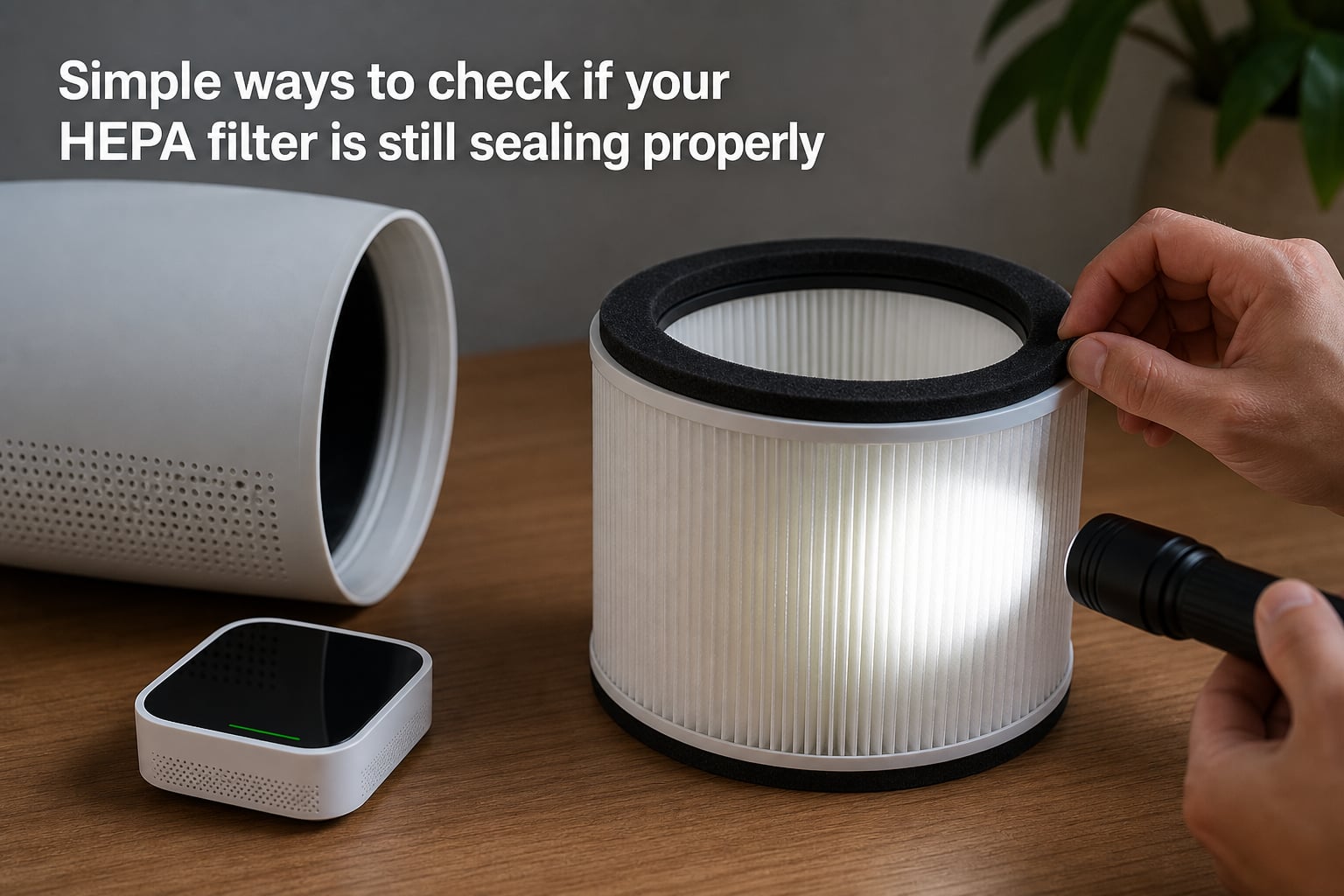
A HEPA filter only works if every particle of air actually passes through the filter media. When the seal around that media fails, dirty air sneaks past the filter and right back into your room. I have spent years testing air purifiers in dusty, pet-filled homes, and the number one issue I see is not a worn-out filter. It is a filter that looks perfect but is leaking around its edges.
This guide walks you through simple ways to check if your HEPA filter is still sealing properly, using tools you already have at home. You will learn five practical testing methods, the warning signs of a failed seal, and exactly when to replace versus clean your filter. No professional equipment required for most of these checks.
Table of Contents
What Is a HEPA Filter Seal?
A HEPA filter seal is the airtight connection between the dense filter media and the plastic or metal housing that holds it in place. Think of it as the gasket on a refrigerator door. If that gasket cracks or compresses, cold air leaks out no matter how powerful the compressor is. The same principle applies to your air purifier, vacuum, or HVAC system.
True HEPA filters capture 99.97% of particles down to 0.3 microns in diameter. That includes pollen, dust mites, pet dander, smoke particles, and most bacteria. But this filtration only happens when air is forced through the fiberglass or polypropylene media itself.
It helps to understand the difference between two parts that people often confuse. The gasket is the foam or rubber strip that creates the airtight border between the filter cartridge and the machine. The filter media is the pleated material inside that actually traps particles. Either one can fail independently, and both need to be checked during a HEPA filter inspection.
Most residential air purifiers use a press-fit gasket design, where the filter cartridge pushes into a track. Some higher-end units use a twist-lock mechanism. Aftermarket replacement filters sometimes have slightly different tolerances than original equipment, which is a common cause of seal problems I see in forum discussions.
Why HEPA Filter Seal Integrity Matters
When a HEPA filter seal fails, unfiltered air takes the path of least resistance around the filter instead of through it. This is called bypass airflow, and it can cut your effective filtration efficiency dramatically. A gap of just a few millimeters around a filter edge can reduce overall particle capture from 99.97% to below 50%.
The consequences show up in real ways. Allergy sufferers notice more sneezing and congestion despite running their purifier constantly. Pet owners see dust accumulating faster on surfaces. People with asthma may experience more frequent symptoms because the fine particles that trigger attacks are no longer being captured.
There is also a mechanical cost. When air leaks around a filter, the motor works harder to maintain airflow, which increases energy consumption and shortens the lifespan of your device. I have seen air purifiers draw 15 to 20% more power when a filter seal is compromised compared to a properly sealed unit.
Seal integrity matters most for people who rely on clean air for health reasons. If you run a HEPA filter for wildfire smoke, severe allergies, or immune sensitivity, even a small bypass leak can expose you to harmful particles. This is why hospitals and cleanrooms test their HEPA filters professionally on a strict schedule.
Simple Ways to Check If Your HEPA Filter Is Still Sealing Properly
You do not need specialized equipment to verify your HEPA filter is still sealing properly. Here are five methods I use regularly, ranked from easiest to most thorough. Most take under five minutes and require only a flashlight, your hands, and a bit of attention.
Each method tests a different aspect of seal performance. I recommend doing at least two or three of these together for a more reliable assessment. If multiple methods point to a problem, you can trust the result.
The Flashlight Light Test
The flashlight test is the single most reliable DIY method for checking HEPA filter seal integrity. I first learned this technique from an air quality technician, and Reddit users in the r/AirPurifiers community consistently recommend it as their go-to verification method.
Here is the step-by-step procedure I follow. First, remove the filter from your air purifier and take it to a dark room or wait until evening. Second, hold a bright LED flashlight against the back side of the filter, pointing toward you. Third, look at the front face of the filter from about a foot away.
What you are looking for matters. A small amount of diffuse glow through the pleated media is normal, because no HEPA filter is completely opaque. But if you see bright pinpoints of light, concentrated beams at the edges, or light streaks along the gasket line, those indicate gaps where air can bypass the filter.
Edge leaks point to a gasket or housing problem. Pinpoint leaks through the media itself suggest physical damage to the filter material, such as a tear or puncture. Either situation means the filter is no longer doing its job effectively.
The Airflow Hand Test
This method checks whether air is moving evenly through the filter or escaping around the sides. It works best while the air purifier is running at its highest speed setting.
Start by turning on your air purifier to maximum fan speed. Let it run for about thirty seconds to establish full airflow. Then slowly move your cupped hand around the outer edge of the filter housing, where the filter cartridge meets the machine body.
You should feel a slight, even pull of air drawing into the intake on all sides. If you feel a strong rush of air at one specific spot, or if you feel warm air pushing outward at the seam, that indicates a leak. Bypass air often feels noticeably different from normal intake because it is moving through a narrow gap at higher velocity.
This test is less precise than the flashlight method, but it is great for quickly confirming a problem you already suspect. I use it as a follow-up check after replacing a filter to make sure I seated the cartridge correctly.
Visual Gasket and Housing Inspection
Sometimes the easiest way to check if your HEPA filter is still sealing properly is to simply look at the components. A thorough visual inspection can catch problems before they affect air quality.
Remove the filter and examine the gasket, which is the foam or rubber strip running around the edge of the cartridge. Look for cracks, permanent compression flat spots, tears, or sections that have come loose from their adhesive. A healthy gasket should be slightly springy and maintain consistent thickness all the way around.
Next, inspect the filter housing inside your air purifier. Look for warping, cracks, or bent tracks where the filter seats. Plastic housings can warp over time, especially if the unit runs hot or sits in direct sunlight. Even a slight warp can prevent the filter from pressing evenly against the gasket.
Finally, check for dust streaks. If you see gray or dark streaks radiating from the filter seat outward into the clean side of the housing, that is a visual record of air bypassing the filter over time. A properly sealed filter leaves clean housing surfaces on the downstream side.
The Sound or Whistle Test
Air forced through a narrow gap makes noise. This makes your ears a useful tool for detecting HEPA filter seal failures.
Turn on your air purifier and listen carefully near the filter compartment. A properly sealed unit produces a smooth, consistent fan sound. If you hear a high-pitched whistling, hissing, or chirping noise, air is likely escaping through a gap in the seal.
Rattling is a different warning sign. If the filter cartridge rattles or shifts when you gently nudge the unit, it is not seated securely. I see this frequently with aftermarket replacement filters that are slightly undersized. Even when twist-lock mechanisms click into place, an ill-fitting cartridge can still vibrate and create micro-gaps that reduce filtration efficiency.
Try the sound test before and after reseating the filter. If the whistle disappears after you remove and reinstall the cartridge, the original installation was the problem. If the noise persists, the gasket or housing likely needs attention.
Air Quality Monitor Comparison
If you own a particulate matter sensor or air quality monitor, you have a data-driven way to evaluate filter performance. This is the method I trust most for objective verification.
Start by placing your air quality monitor in the same room as the running air purifier. Note the PM2.5 reading after the purifier has been running on high for one hour. Then temporarily remove the filter and block the intake with a piece of cardboard, so the fan runs but no air passes through any filter media.
Run the unit this way for another fifteen minutes and check the PM2.5 reading again. If the number barely changes between the filtered and unfiltered states, your filter seal is likely compromised. A properly sealed HEPA filter should produce a noticeable drop in particulate readings when functioning.
This test is not perfect, because room conditions fluctuate. But if your monitor consistently shows high particle counts despite hours of purifier operation, a seal leak is one of the first things to investigate.
Signs Your HEPA Filter Seal Has Failed
Beyond active testing, certain symptoms strongly suggest your HEPA filter is not sealing properly. I tell people to watch for these warning signs between routine inspections.
One clear indicator is visible dust or debris on the clean side of the filter housing. The downstream side, meaning the side after air passes through the filter, should stay clean. If you open your purifier and find dust on what should be the clean side, particles are getting around the filter rather than through it.
Another sign is worsening allergy or asthma symptoms despite running your purifier regularly. If you previously felt relief and now feel congested again without any change in environment, the filter may be leaking. Pay attention to whether symptoms improve right after a filter replacement and then gradually return.
Watch for discoloration patterns on the filter itself. A properly working filter darkens evenly across its surface as it loads with particles. If you see heavy discoloration at the center but clean edges, or streaks running along one side, airflow is not distributing evenly through the media.
Reddit users in the air purifier community share an interesting observation here. They note that when the exterior side of a filter gets dirty while the interior stays clean, the filter media is working but may have a bypass leak elsewhere in the system. This pattern tells you the filter itself is functional but the seal around it needs attention.
Finally, pay attention to your energy bill. A sudden increase in power consumption from an air purifier can indicate the motor is working harder due to airflow restrictions or bypass issues. While not definitive on its own, it pairs well with the other signs above.
Professional DOP and PAO Testing Explained
For residential users, the DIY methods above are more than sufficient. But if you work in a cleanroom, healthcare facility, or industrial setting, professional HEPA filter integrity testing is the gold standard.
The most common professional method is the aerosol photometry test, which has been used since the 1950s. Technicians introduce a challenge aerosol, traditionally DOP (di-octyl phthalate) or more commonly now PAO (polyalphaolefin), upstream of the filter. They then scan the downstream side with a photometer probe to measure particle penetration.
A properly sealed and intact HEPA filter should show penetration below 0.01% at the challenge particle size. Any reading above this threshold indicates either a seal leak or damage to the filter media. The test follows standards like ISO 14644-3 for cleanroom certification.
This level of testing is expensive and unnecessary for home air purifiers. But understanding how it works helps explain why seal integrity is taken so seriously in medical and manufacturing environments. If you are filtering for hazardous materials, mold remediation, or wildfire smoke at high concentrations, consider asking an HVAC professional about residential-grade filter integrity testing.
When to Replace vs Clean Your Filter
Knowing whether to replace or clean your HEPA filter depends on what you find during your seal inspection. The right choice protects both your air quality and your wallet.
Replace the filter if the gasket is cracked, compressed flat, torn, or missing sections. Gaskets cannot be effectively repaired, and a damaged gasket means the filter will never seal properly no matter how carefully you install it. Also replace the filter if the media itself shows tears, pinholes, or water damage.
Cleaning is only an option for washable HEPA filters, and true HEPA filters are generally not washable. Some manufacturers offer washable pre-filters that sit in front of the HEPA cartridge. These can be rinsed under cold water and air-dried completely before reinstallation. Never wash a non-washable HEPA filter, because water destroys the electrostatic charge and fiber structure that make it effective.
If you use aftermarket replacement filters, pay close attention to fit. Forum users frequently report that third-party filters rattle or sit loosely in housings designed for original equipment. I recommend sticking with manufacturer-branded replacements or verified-compatible aftermarket options that have consistent reviews mentioning proper fit.
Several factors shorten filter lifespan and accelerate seal wear. Homes with pets, high humidity, cooking smoke, or renovation dust will load filters faster. In these environments, inspect your seal every two to three months instead of the typical six-month schedule. Running your purifier on high speed constantly also compresses gaskets more quickly due to increased vibration and pressure.
FAQs
How to tell if a HEPA filter is working?
A working HEPA filter reduces visible dust, improves allergy symptoms, and lowers PM2.5 readings on an air quality monitor. You can verify performance with the flashlight test, the airflow hand test, and by comparing air quality readings before and after the purifier runs. If none of these show improvement, the filter or its seal may be compromised.
How do you test a HEPA filter?
The simplest at-home test is the flashlight method: remove the filter, hold a bright light against the back in a dark room, and look for light leaks at the edges or through the media. Combine this with the airflow hand test and a visual gasket inspection for a thorough assessment. For professional verification, technicians use aerosol photometry with DOP or PAO challenge particles.
How do you know if a HEPA filter needs replacing?
Replace your HEPA filter if the gasket is cracked or compressed, the media is torn or discolored unevenly, airflow has noticeably dropped, or allergy symptoms return despite regular use. Most residential HEPA filters need replacement every 6 to 12 months, though homes with pets or high dust levels may need changes every 3 to 6 months.
How to tell if a HEPA filter is washable?
Check the filter packaging or manufacturer documentation. True HEPA filters are almost never washable because water damages the fiber structure and electrostatic properties. Some units have a separate washable pre-filter that sits in front of the HEPA cartridge. If a filter is labeled as washable or permanent, follow the specific cleaning instructions, which usually involve rinsing with cold water only.
What does a bad HEPA filter look like?
A bad HEPA filter shows heavy gray or brown discoloration, visible tears or holes in the pleated media, a cracked or flattened gasket, and dust streaks on the clean side of the housing. Uneven discoloration, where one area is heavily loaded and another is clean, also indicates airflow problems. If the filter smells musty or sour, mold may have grown in the media.
Why test HEPA at 0.3 microns?
HEPA filters are tested at 0.3 microns because that is the Most Penetrating Particle Size, or MPPS. Particles of this size are the hardest for a HEPA filter to capture because they sit between the two main capture mechanisms of interception and diffusion. If a filter traps 99.97% of 0.3 micron particles, it performs even better on both larger and smaller particles.
Conclusion
Checking whether your HEPA filter is still sealing properly does not require special tools or professional training. The flashlight test, airflow hand test, visual gasket inspection, sound test, and air quality monitor comparison give you five reliable ways to verify seal integrity at home.
Make these checks part of your routine every two to three months, or whenever you replace a filter cartridge. Catching a seal failure early keeps your air purifier working at full efficiency and protects anyone in your home who depends on clean air for their health. A filter that looks clean but leaks around the edges is worse than no filter at all, because it gives you false confidence that your air is being purified when it is not.