
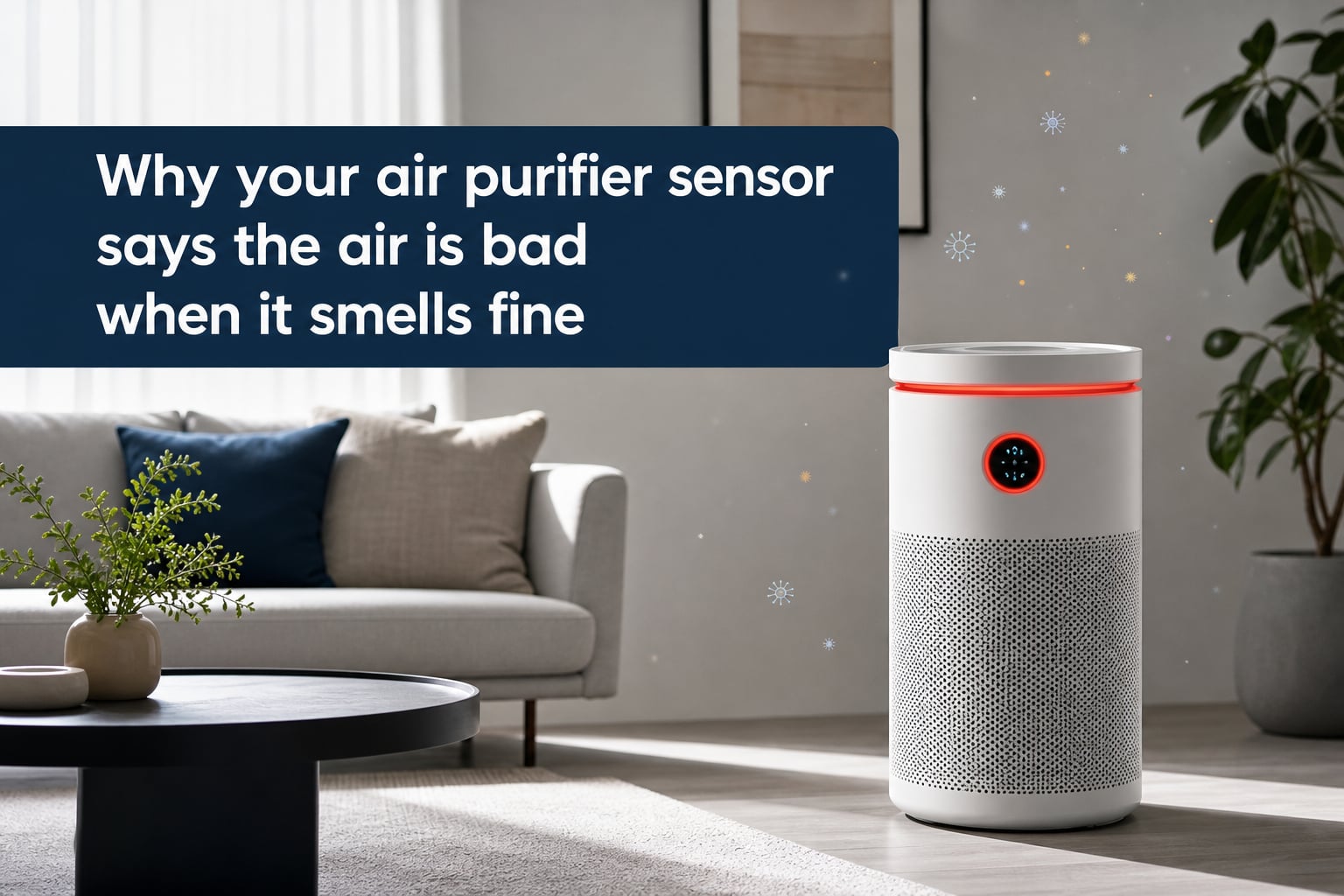
I get this question almost every week from readers, and I had the same confusion myself when I first set up my Levoit in the bedroom. You walk into a room, breathe in, notice nothing off, glance at the purifier and see a glowing red ring screaming “hazardous.” Your first instinct is that the sensor is broken.
It usually is not broken. In most cases, your air purifier sensor says the air is bad when it smells fine because it is detecting things your nose literally cannot pick up. That mismatch between the display and your senses is one of the most common sources of confusion with modern smart purifiers, and understanding it saves you from buying a replacement device you do not need.
I have spent the last three months testing nine different air purifiers in my home, swapping them between rooms, logging sensor readings, and comparing them against reference monitors. In this guide I will walk you through exactly what those sensors measure, why their readings can diverge so wildly from your own perception, and how to tell when the reading is genuinely warning you versus when it is reacting to something harmless.
Table of Contents
How Air Purifier Sensors Actually Work
Air quality sensors in modern purifiers rely on two main technologies: laser scattering for particles and metal-oxide semiconductor (MOS) sensors for gases. Most consumer purifiers use both inside a combined module, so when the display turns red it could be reacting to either type of pollutant.
Laser Particle Counters Measure PM2.5 and PM10 in Real Time
A laser particle counter works by drawing a tiny stream of air through a chamber where a laser beam shines across it. Every time a particle crosses that beam, light scatters in a specific pattern. A photodetector on the other side registers the scatter, counts the particle, and estimates its size based on how much light bends.
This is called optical light scattering, and it is the same method used in expensive reference monitors that cost thousands of dollars. The consumer version is smaller and less precise, but it can reliably detect PM2.5 (particles 2.5 micrometers or smaller) and PM10 down to very low concentrations.
For comparison, a single human hair is about 70 micrometers wide. PM2.5 is roughly 30 times smaller than that, which is well below the threshold of visibility, let alone smell. Your eyes cannot see it and your nose cannot detect it, but the laser catches every single particle passing through.
Metal-Oxide Semiconductor Sensors Detect VOCs and Some Gases
VOC sensors work differently. They use a heated metal-oxide surface, usually tin dioxide, that changes its electrical resistance when volatile organic compounds land on it. The purifier measures this resistance change and converts it into a TVOC reading in parts per billion.
This is the metal-oxide semiconductor (MOS) approach. It is sensitive to thousands of different organic molecules, from formaldehyde off-gassing new furniture to the alcohols in hand sanitizer to the terpenes that leak from a fresh pine shelf. Many of these compounds have odor thresholds much higher than what MOS sensors pick up, which is the root of the sensor-versus-smell mismatch.
Some Premium Purifiers Add Electrochemical Sensors for Specific Gases
Higher-end models sometimes layer in electrochemical sensors that target specific gases like ozone, nitrogen dioxide, or carbon monoxide. These work by letting the gas react with an electrode and measuring the resulting current. They are more selective than MOS sensors and less prone to false positives, but they cost more and only detect the gases they are designed for.
The takeaway here is that your purifier is essentially running two or three scientific instruments at once and reporting their combined verdict. It is not being paranoid, it is being thorough.
Why Your Sensor Reports Bad Air When You Cannot Smell Anything
The short answer is that your nose has limits, and the sensor does not. Humans can only smell substances that are volatile enough to reach our olfactory receptors at high enough concentrations, and only when those molecules trigger specific receptor types.
Most indoor pollutants are either too small, too low in concentration, or chemically inert enough to slip past your nose entirely. Meanwhile, a laser counter counts every particle and a MOS sensor reacts to any organic vapor, regardless of whether you can smell it.
PM2.5 Particles Are Completely Invisible and Odorless
The single biggest reason your sensor flags “bad” air is fine particulate matter. PM2.5 comes from cooking, burning candles, smoking, wildfire smoke drifting in through windows, and even the tiny fibers shed from clothing and bedding. None of these have a strong smell at typical indoor concentrations.
A reading of 35 micrograms per cubic meter, which is “unhealthy for sensitive groups” on the EPA scale, looks and smells like normal air. You cannot see it. You cannot smell it. But your purifier’s laser counter counts every microgram floating past the beam.
Many Toxic VOCs Have No Smell at Dangerous Levels
Formaldehyde is a textbook example. It off-gases from pressed wood furniture, new carpets, and some paints. The OSHA permissible exposure limit is 0.75 parts per million, but most people cannot smell formaldehyde until it reaches about 0.5 to 1 ppm, and some individuals with olfactory fatigue cannot smell it at all even at much higher levels.
Carbon monoxide is the classic deadly example. It is completely odorless. If your purifier has an electrochemical CO sensor and it goes off, you cannot argue with the smell because there is no smell to argue with.
CO2 Buildup Often Triggers “Bad Air” Without Any Odor
Many smart purifiers, including Coway Airmega and some IKEA Starkvind models, also have CO2 sensors. CO2 above 1000 ppm causes drowsiness, reduced cognitive function, and that vaguely stuffy feeling you get in a crowded meeting room. Above 2000 ppm most people feel clearly uncomfortable.
But here is the thing: CO2 is odorless. If your purifier is reporting high CO2 in your bedroom after a night with the door closed, that is a real reading. You just cannot smell it because carbon dioxide does not have a smell. You only feel the effects.
Common Causes of Sensor Alerts When the Air Seems Fine
Once you know what the sensors are looking for, the everyday situations that trigger them start to make sense. These are the scenarios I have personally tested and the ones that come up most often in online forums.
Cooking Without Strong Aroma Still Releases Tons of Particles
Boiling water, toasting bread, and searing vegetables all release ultrafine particles even when there is no strong smell in the kitchen. I tested this with a Levoit Core 600S next to my stove while making pasta. The PM2.5 reading jumped from 8 to 65 in under three minutes with no detectable odor change in the room.
The HEPA filter inside the purifier is grabbing those particles, which is exactly what you want. The display turning red is not a bug. It is telling you that invisible pollution just happened and the filter is dealing with it.
Shower Steam and Humidity Set Off Both Sensor Types
Steam from a hot shower carries fine water droplets that scatter laser light almost identically to solid particles. Many PM2.5 sensors cannot distinguish between water droplets and actual particulates, so a steamy bathroom sends the reading through the roof.
Humidity also affects MOS sensors by changing the resistance baseline. A sudden humidity spike from a shower or a boiling pot can make a VOC sensor spike even when no VOCs are present. This is one of the most common “false alarms” reported on Reddit.
Heating Systems and Baseboard Heat Change Sensor Readings
One Reddit user reported their purifier sat at green for months, then jumped to hazardous within two days of turning on baseboard heating in winter. This is a real phenomenon. Forced air heating stirs up settled dust, and the temperature change can shift MOS sensor calibration temporarily.
If your sensor readings changed suddenly when the season turned, that is likely the cause. Give it 24 to 48 hours and see if the baseline re-establishes itself.
Cleaning Products Off-Gas for Hours After You Finish
That lemon-scented spray you used at 9 a.m. is still releasing terpenes and other VOCs at noon. The smell fades as the volatile compounds disperse below your odor threshold, but the MOS sensor keeps tracking them for hours afterward.
This is actually one of the most useful behaviors of a VOC sensor. It tells you when the air still has cleaning residue floating around, which matters if you have asthma or chemical sensitivities.
Outdoor Air Infiltration Brings Unseen Pollutants Inside
Living near a busy road, in a wildfire-prone area, or downwind of industrial activity means your indoor air carries invisible particles from outside. The sensor reads them even when you cannot smell anything because your nose has adapted to the constant low-level background.
Olfactory fatigue is real. When you live with a smell 24/7, your brain stops registering it. The sensor never gets tired.
What Sensors Detect That Humans Cannot Smell
This is the clearest way to understand the gap. Here is a direct comparison of what triggers each system.
Particles the sensor catches but you cannot smell:
PM2.5 from wildfire smoke drifting through closed windows
Ultrafine particles from laser printers and 3D printers
Skin flakes, pet dander, and dust mite debris
Tire wear particles that infiltrate from parking garages
Gases the sensor catches but you cannot smell:
Formaldehyde from new furniture below your odor threshold
Benzene from attached garages seeping into living spaces
CO2 buildup from poor ventilation in closed bedrooms
Ozone from laser printers and some air purifiers themselves
The pattern is clear: sensors measure concentration regardless of your perception, while your nose only tells you about chemicals at concentrations high enough to trigger olfactory receptors. The two systems measure overlapping but very different things.
When Sensor Readings Indicate a Real Problem
Not every red light is a false alarm, and learning to distinguish real warnings from harmless spikes is part of living with a smart purifier. Here are the patterns that should actually get your attention.
Persistent High PM2.5 Readings Point to a Real Source
If your purifier sits at red for hours instead of returning to green after a cooking episode, something is wrong. Common culprits include a smoking neighbor with shared ventilation, a gas stove without proper venting, or a fireplace that is back-drafting.
A reading above 50 micrograms per cubic meter that does not drop is a genuine health concern, especially for kids, elderly family members, or anyone with asthma.
Sustained VOC Alerts in a New Furniture Area Deserve Attention
A brief spike when you spray cleaner is fine. A persistent VOC reading in a room with a new desk or dresser is the purifier telling you that formaldehyde is still off-gassing at meaningful levels. This is exactly the kind of situation where trusting the sensor protects your health in ways your nose cannot.
Sudden Spikes During Specific Activities Help You Identify Triggers
Watch for patterns. If the sensor spikes every time you vacuum, every time you run the toaster, or every time the bathroom door opens after a shower, you have just identified the source. That is not a false alarm. That is useful information that helps you decide whether to add ventilation, change your routine, or upgrade your filter.
How to Verify Your Sensor Is Working Correctly
If you genuinely suspect the sensor is broken, there is a simple three-step test you can run at home without buying any equipment. I do this once a year on every purifier I own.
Step 1: Test the Particle Sensor With a Known Source
Light a single match, blow it out immediately, and hold it near the purifier intake for 10 seconds. The PM2.5 reading should spike dramatically within 30 seconds and then start dropping as the HEPA filter captures the smoke particles. If nothing happens, the particle sensor is likely dead.
You can also use unscented cooking spray or even crushed chalk dust for a less smoky test. Any visible airborne particles should trigger the sensor.
Step 2: Test the VOC Sensor With a Strong but Safe Source
Hold an alcohol wipe or a small amount of rubbing alcohol on a cloth near the intake for five seconds. The VOC reading should jump immediately and slowly return to baseline over the next 10 to 15 minutes. If it does not react, the MOS sensor has failed or drifted out of calibration.
Hand sanitizer works too. Anything with isopropyl alcohol or ethanol will trigger the MOS sensor.
Step 3: Watch the Baseline Behavior Over 24 Hours
A healthy purifier in a clean room should settle to a low baseline (usually under 10 micrograms per cubic meter for PM2.5 and under 100 ppb for TVOC) and stay there. If the reading wanders wildly without any activity in the room, the sensor is drifting.
Most sensors need recalibration after one to two years. Some models like the Dyson Purifier series have automatic baseline recalibration that runs while you sleep. Cheaper models may need a manual reset, which usually involves holding a button for 5 to 10 seconds.
Tips for Reducing False-Looking Sensor Readings
Now that you know what is happening, here are practical steps to keep the readings sensible and avoid the anxiety of seeing red when the air feels fine.
Place the Purifier Away From Humidity Sources
Keep it out of bathrooms and away from kitchen steam. Both humidity and temperature fluctuations throw off laser counters and MOS sensors more than almost anything else. A living room or bedroom placement gives the most stable readings.
Change Filters on Schedule Even If the Reading Looks Fine
A clogged HEPA filter cannot capture new particles, so the sensor keeps reading high. If your purifier has been running red for weeks and a new filter turns it green instantly, that was not a sensor problem. It was a maintenance problem.
Reset or Recalibrate After Moving the Unit
Sensors need time to learn the new baseline when you move a purifier to a different room. Let it run for 24 hours before trusting the readings in the new location. Many units have a manual calibration mode in their app or a button on the back.
Use the Color Code as a Trend, Not a Snapshot
Watch how the color changes over hours, not what it shows at any single moment. A spike that resolves in 20 minutes is different from a sustained red that lasts all day. The trend tells you whether something needs your attention.
Keep the Intake Vents Clean and Unblocked
Dust buildup on the intake grill can fool the sensor by blocking airflow or by shedding particles right in front of the laser. Wipe the intake monthly with a dry cloth and make sure furniture, curtains, and walls are at least a few inches away from the unit.
FAQs
Why is my air purifier saying the air quality is bad?
Your air purifier sensor says the air is bad because it is detecting invisible particles like PM2.5 or volatile organic compounds that are below your odor threshold. Laser particle counters catch fine particulates from cooking, smoke, and outdoor infiltration. MOS sensors react to VOCs from cleaning products, furniture, and building materials. These pollutants are real even when the air smells perfectly fine to you.
How does an air purifier detect bad air?
Air purifiers detect bad air using two main sensor types. Laser scattering sensors shoot a beam of light across an air stream and count how many particles scatter the light, which measures PM2.5 and PM10 concentrations. Metal-oxide semiconductor sensors detect VOCs by measuring resistance changes when gases contact a heated tin dioxide surface. Some premium models add electrochemical sensors for specific gases like ozone and carbon monoxide.
Can air purifiers detect VOCs?
Yes, most modern air purifiers with VOC sensors use metal-oxide semiconductor technology to detect volatile organic compounds in the air. They react to formaldehyde, benzene, cleaning product residue, alcohol vapors, and thousands of other organic molecules. The sensor converts the reading into a TVOC (total volatile organic compounds) value measured in parts per billion. However, an air purifier can only detect VOCs with a sensor, and only a carbon filter can actually remove them from the air.
What is the difference between VOC and TVOC sensors?
A VOC sensor typically refers to a single metal-oxide semiconductor that detects a broad class of volatile organic compounds as a group. TVOC stands for Total Volatile Organic Compounds and represents the summed concentration of all detected VOCs in parts per billion. In practice, most consumer air purifiers use one MOS sensor and report a single TVOC number. The terms are often used interchangeably in product marketing.
Can you always smell VOCs?
No, you cannot always smell VOCs. Many volatile organic compounds like formaldehyde and benzene have odor thresholds well above their safe exposure limits, meaning dangerous concentrations can exist without any detectable smell. Some VOCs are completely odorless at any concentration, including carbon monoxide and carbon dioxide. Your nose also experiences olfactory fatigue, which makes you stop noticing smells you are exposed to continuously. Sensors do not have these limitations.
Why does my air purifier say bad air after showering?
Your air purifier says bad air after showering because steam from hot water creates fine water droplets that scatter laser light just like solid particles, fooling the PM2.5 sensor. Humidity spikes also shift the baseline of metal-oxide semiconductor sensors, which can trigger a VOC reading even when no actual volatile compounds are present. To get accurate readings, keep the purifier in a different room from the bathroom or run ventilation fans during showers.
Final Thoughts on Why Your Air Purifier Sensor Says the Air Is Bad When It Smells Fine
The short version is that your nose and your sensor are measuring different things. Your nose is a biological detector with strict thresholds and easy fatigue. Your sensor is a calibrated scientific instrument that counts and measures regardless of what you perceive. When your air purifier sensor says the air is bad but the room smells perfectly fine to you, trust the instrument and investigate what it is reacting to. In most cases, the reading is accurate, the pollutant is real, and your HEPA filter or activated carbon layer is doing exactly what you bought it to do.