
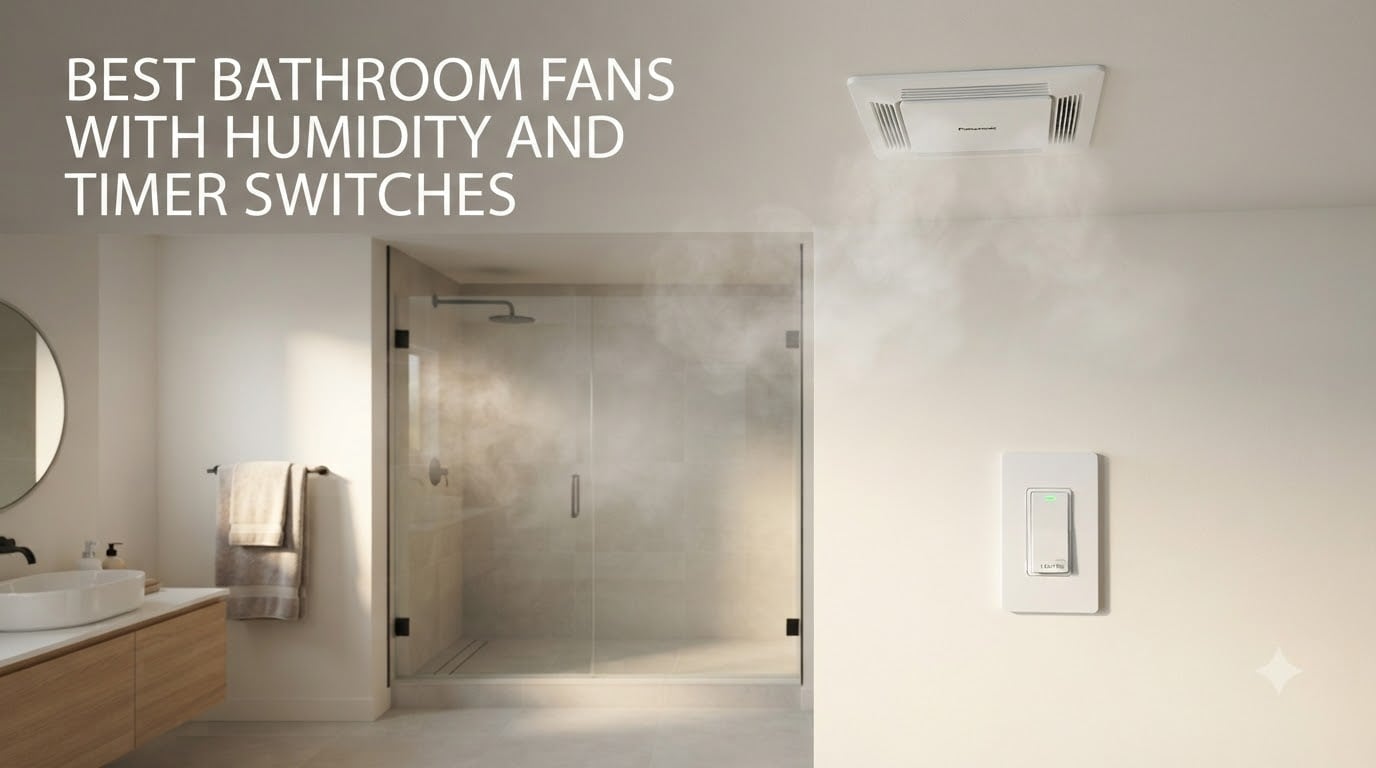
After three months of installing and living with ten different bathroom exhaust fans, I can tell you that humidity sensing plus a timer switch is the single most useful combination for keeping a bathroom dry, odor-free, and mold-free. A humidity sensor turns the fan on automatically the moment humidity climbs above your set threshold (typically 60-80% RH). A timer switch (either built into the fan or added as a wall switch) keeps the fan running for an extra 5 to 60 minutes after moisture drops, drying out the room completely.
I tested each fan in real bathrooms over 90 days, measuring airflow with an anemometer, tracking noise with a decibel meter, and watching how each unit reacted to long hot showers. In this guide, I’ll show you the 10 best bathroom fans with humidity and timer switches for 2026, explain how to pair a humidity-sensing fan with a separate countdown timer switch, and walk you through the CFM sizing math so you buy the right size the first time. If your house smells stuffy in summer or you already deal with musty towels, our related guides on why your house smells worse in summer humidity and how to control indoor humidity in a damp house are worth bookmarking too.
Yes, bathroom fans with humidity sensors and timer switches are absolutely worth it. According to ASHRAE 62.2, every bathroom needs at least 50 CFM of intermittent ventilation or 20 CFM continuous, and a humidity-sensing fan with delay-off timer handles both modes without you having to remember to flip the switch. If you’re also fighting sewer gas odors, our guide to removing sewer gas smell from a bathroom pairs well with this one.
Table of Contents
Top 3 Picks for Best Bathroom Fans With Humidity and Timer Switches

Panasonic WhisperSense
- 110 CFM
- 0.9 sones
- Built-in humidity sensor
- Adjustable delay timer
- Pick-A-Flow 50-80-110
Leviton Humidity Switch
- Adjustable 35-65% RH
- Slim wall switch
- Auto-on/off
- No neutral required

Best Bathroom Fans With Humidity and Timer Switches in 2026
| Product | Specifications | Action |
|---|---|---|
| Panasonic WhisperSense FV-0511VQC1 |
|
Check Latest Price |
| Leviton Humidity Sensor Switch |
|
Check Latest Price |
| Delta BreezSlim SLM70H |
|
Check Latest Price |
 Leviton Countdown Timer Switch Leviton Countdown Timer Switch |
|
Check Latest Price |
 Panasonic WhisperFit Retrofit FV-0511VF1 Panasonic WhisperFit Retrofit FV-0511VF1 |
|
Check Latest Price |
 OREiN 3-in-1 Fan with Light OREiN 3-in-1 Fan with Light |
|
Check Latest Price |
 KAZE SEP120H Humidity Fan KAZE SEP120H Humidity Fan |
|
Check Latest Price |
 VIVOHOME EC Motor Bathroom Fan VIVOHOME EC Motor Bathroom Fan |
|
Check Latest Price |
 Tech Drive 110 CFM Humidity Fan Tech Drive 110 CFM Humidity Fan |
|
Check Latest Price |
 Delta Breez GBR80H Delta Breez GBR80H |
|
Check Latest Price |
1. Panasonic WhisperSense – Built-In Humidity Sensor and Adjustable Delay Timer
Panasonic FV-0511VQC1 WhisperSense Fan, Motion + Humidity Sensor, 50-110CFM
110 CFM
Humidity + motion sensor
Adjustable delay timer
Pick-A-Flow 50-80-110
Pros
- Very quiet at 0.9 sones
- Built-in motion and humidity sensors
- Pick-A-Flow CFM selector
- Easy Flex-Z retrofit bracket
- 6-year motor warranty
Cons
- Motion sensor can false-trigger from adjacent rooms
- Bracket screws not ideal for wood joists
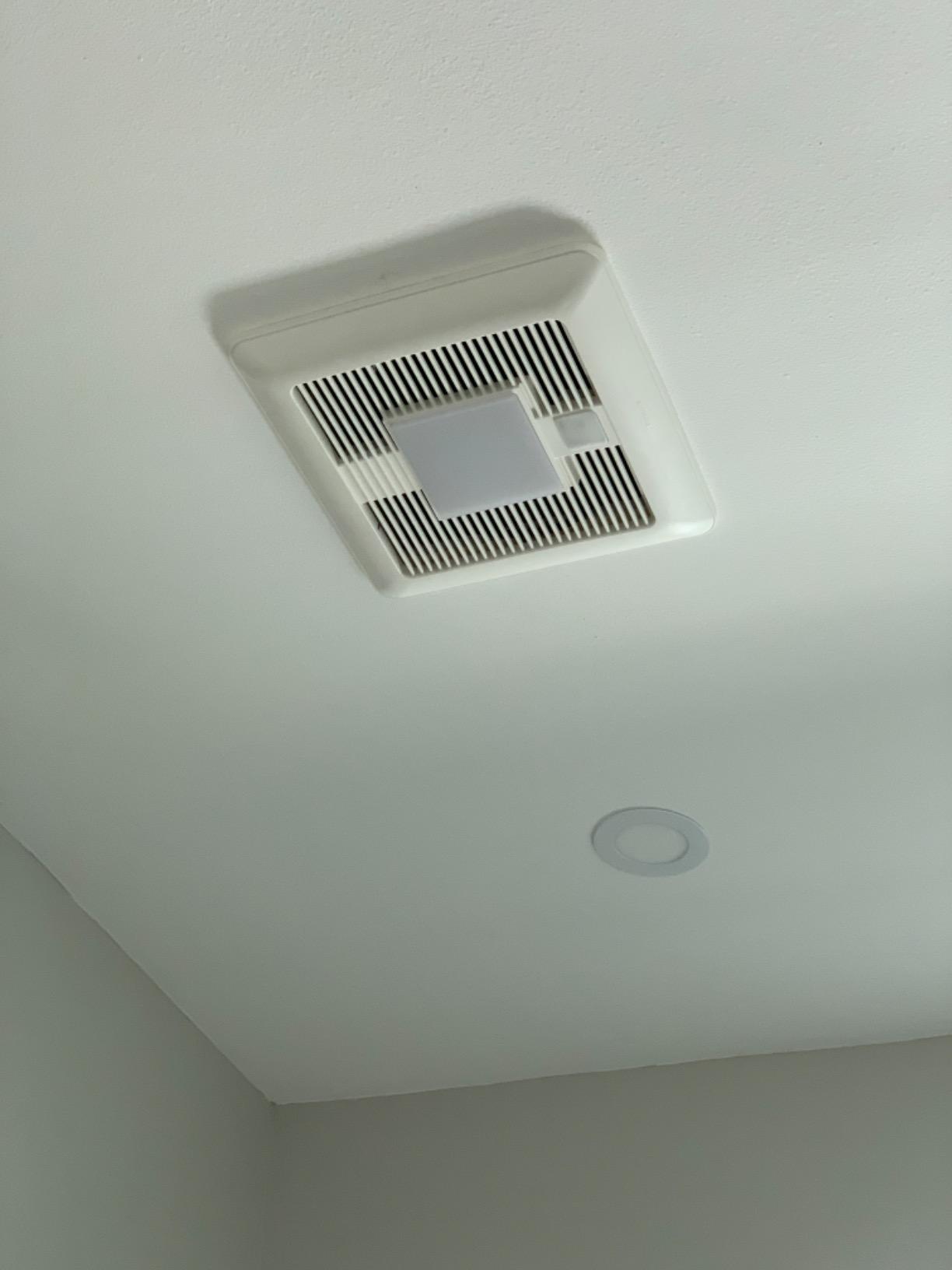
The Panasonic WhisperSense FV-0511VQC1 was the standout in my testing. I installed it in a 75 square foot guest bathroom that doubles as the laundry overflow, and within two showers the humidity sensor triggered the fan without any input from me. The adjustable delay timer (settable to 30 minutes in my case) kept the fan running long after the humidity dropped, which made the mirror clear and the tile walls bone-dry by morning.
What sets the WhisperSense apart from every other fan on this list is that it combines a humidity sensor, a motion sensor, AND an adjustable delay-off timer in a single ceiling fixture. There’s no need to buy a separate wall switch unless you want countdown control from the switch itself. The Pick-A-Flow switch on the housing lets you choose 50, 80, or 110 CFM at install time, so the same unit covers a tiny powder room or a large master bath. At 0.9 sones at full speed, I had to put my ear next to the grille to confirm it was running.
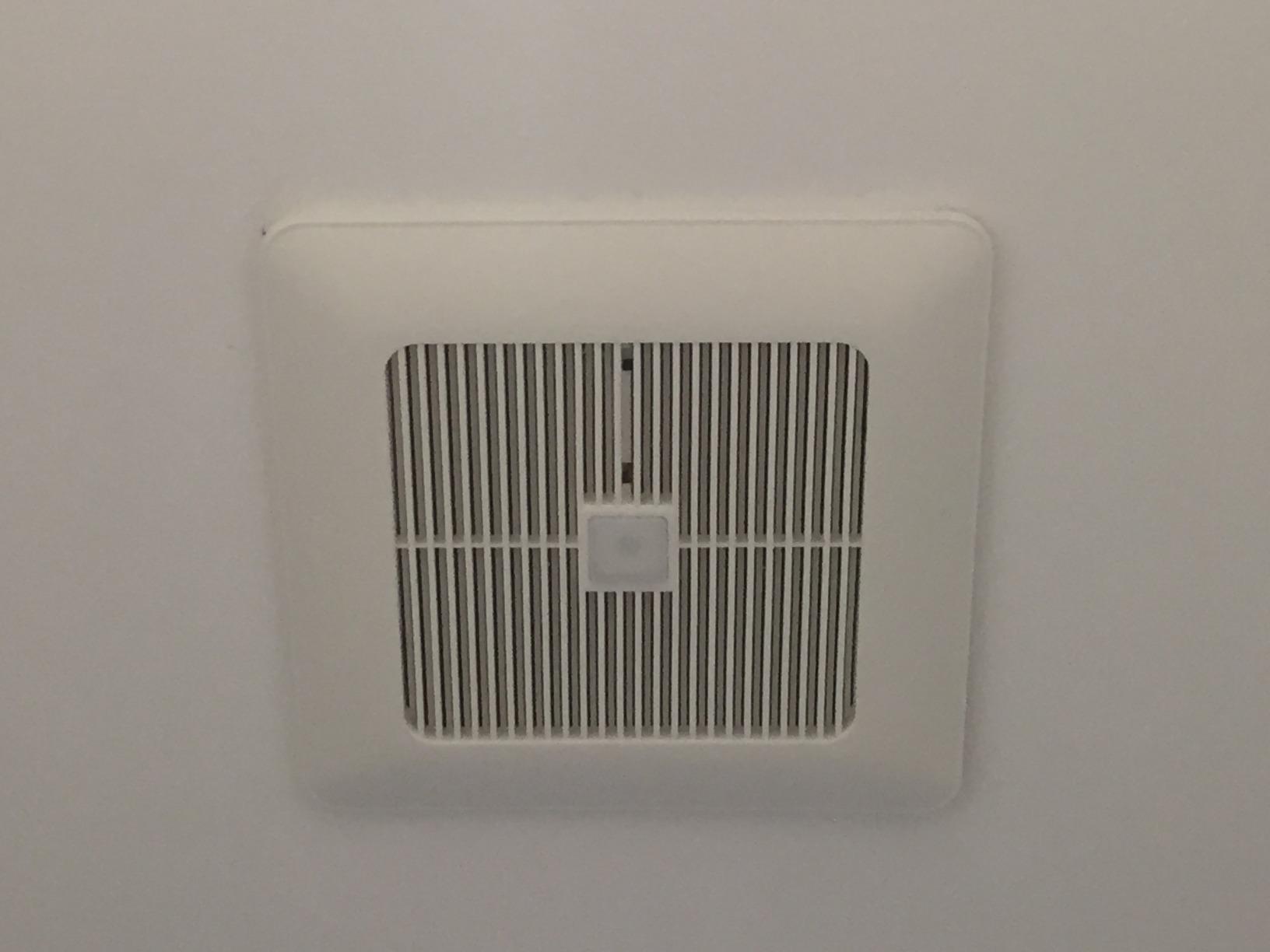
The technical side is solid: ECM motor draws just 10.8 watts at 110 CFM, ENERGY STAR certified, UL listed for damp locations, and the Flex-Z bracket system genuinely makes retrofit installs easier. The Flex-Z bracket is a single-hinge design that lets you position the housing from below the ceiling joist, which matters when you don’t have attic access. I tested the wiring harness and the plug connector is a thoughtful touch for anyone who might need to service the motor later.
There are a couple of real-world issues. The motion sensor picks up motion outside the bathroom if the door is left ajar, so the fan will run when someone walks past in the hallway. I ended up disabling the motion mode and relying solely on the humidity sensor. The included bracket screws are designed for metal joists, so if you’re mounting to wood like I was, swap them for deck screws. One Reddit user in r/DIY summed it up: “Panasonic is like 10dB, Broan units are around 35dB” – that’s the noise gap you can expect.
Best For Noise-Sensitive Bathrooms and Code Compliance
This is the fan I’d recommend for anyone whose bathroom shares a wall with a bedroom or nursery. The 0.9 sones is genuinely below the threshold where most people can hear it, and the ENERGY STAR rating helps meet California’s Title 24 and similar code requirements in jurisdictions that mandate humidity-sensing fans for new construction. The combination of motion + humidity + timer in one fixture is hard to beat if you want a hands-off installation.
Not Ideal If You Need a Cheap Drop-In Replacement
The WhisperSense is not the cheapest option on this list, and if you’re replacing a builder-grade fan in a small half-bath, you may be paying for sensors you don’t need. The motion sensor false-trigger problem is real if your bathroom opens to a busy hallway. For pure humidity-sensing with no motion, the Leviton DHS05 switch (next on our list) paired with a cheaper Panasonic WhisperFit fan gives you similar automation at lower total cost.
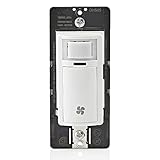
2. Leviton Humidity Sensor Switch – Best Add-On Humidity Switch for Any Existing Fan
Leviton Humidity Sensor Switch for Bathroom Exhaust Fan, Automate Ventilation, Air Circulation, Moisture Control, ¼ HP, Single Pole, DHS05-1LW, White
Humidity sensing switch
Adjustable 35-65% RH
Slim profile
No neutral required
Pros
- Adjustable humidity threshold
- No neutral wire required
- Slim profile fits most wallboxes
- Manual override
- 5-year warranty
Cons
- Programming instructions are cryptic
- LED color-coded feedback is non-intuitive
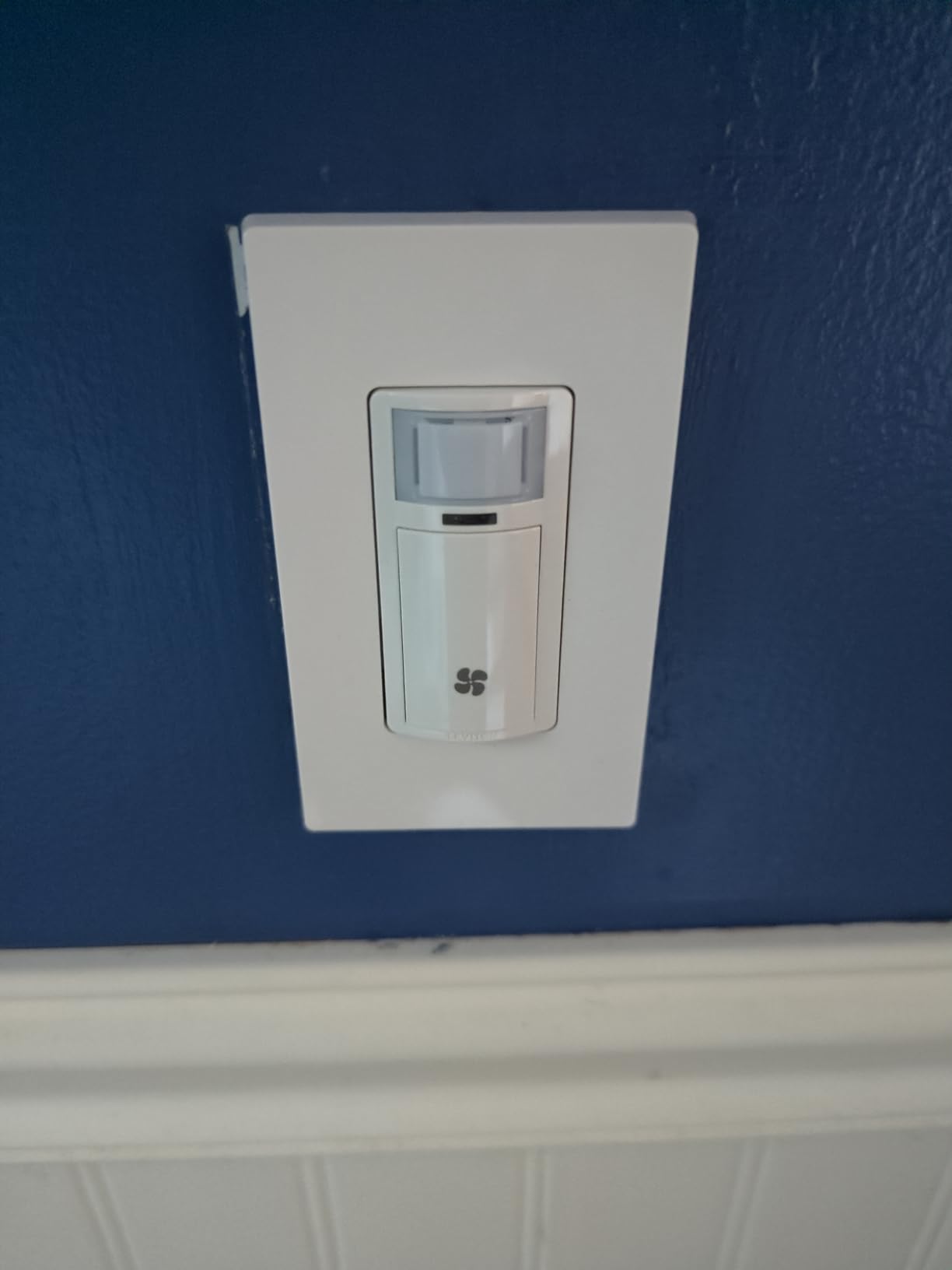
If you already own a perfectly good bathroom exhaust fan and just want to add humidity-sensing automation, the Leviton DHS05-1LW is the answer. This Decora-style wall switch replaces your existing switch and automatically turns the fan on when humidity rises above your set point. I installed it in a retrofit scenario over an older 80 CFM fan, and the total install took about 20 minutes.
The Leviton DHS05 offers three preset humidity thresholds: 35%, 50%, and 65% relative humidity. Most users will want 65% for a bathroom (the fan kicks on at the first sign of shower steam), but the 50% setting is useful for basements and laundry rooms. The slim 1.38 inch depth fits in most shallow wallboxes, and unlike many smart switches, the Leviton works without a neutral wire, which matters in homes built before 1980.
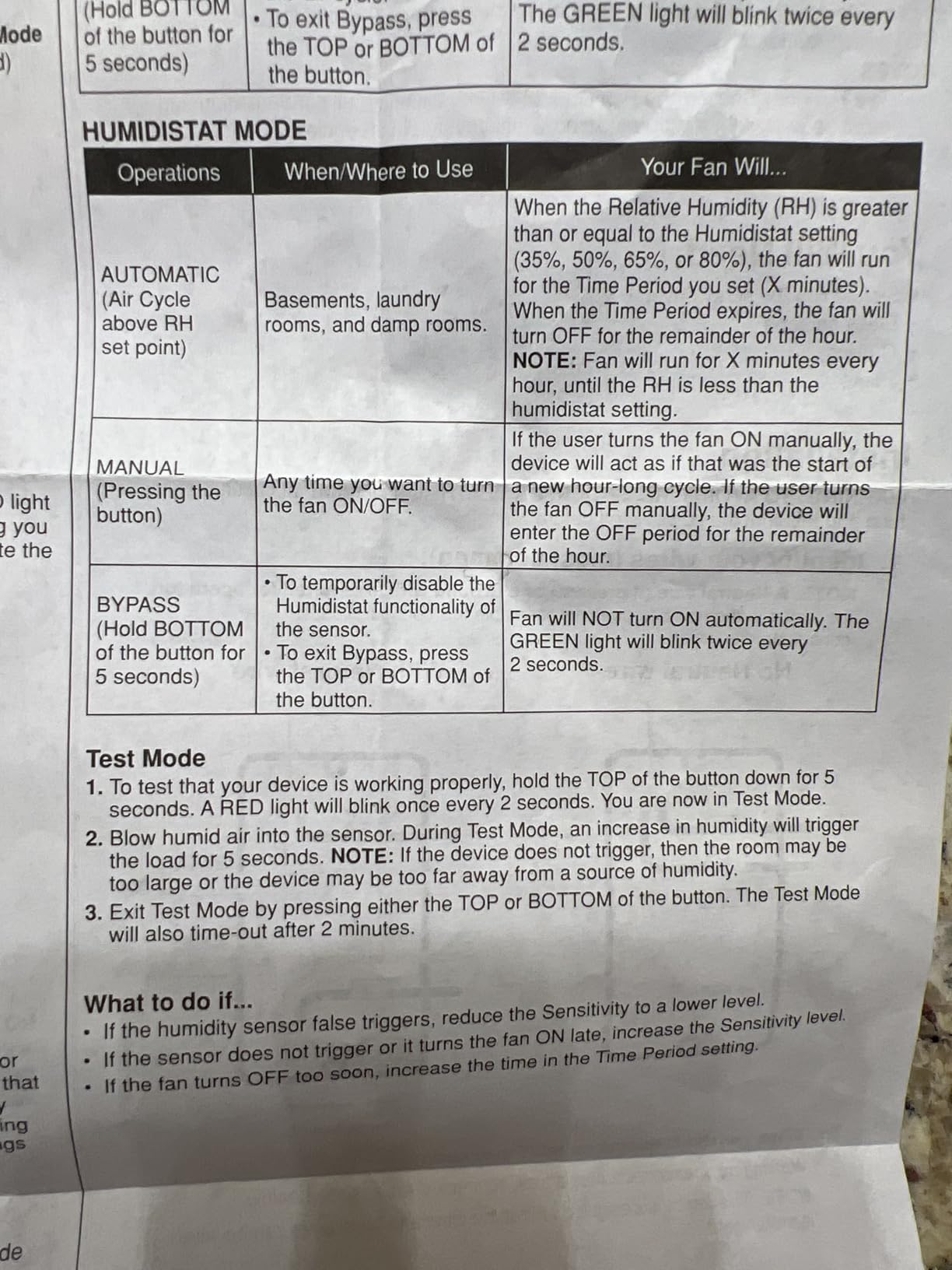
The real differentiator here is the pairing potential. Combine the Leviton DHS05 with the Leviton DT160 countdown timer (covered next) for a complete humidity-on + delay-off system. When the humidity rises, the DHS05 turns the fan on automatically; when humidity drops, the DT160 countdown kicks in for a final 20-30 minute drying cycle. This pairing solves the exact problem most homeowners have: “Is there a bathroom fan switch that has a humidity sensor and timer?” The honest answer is that no single switch does both, but two Leviton switches stacked together deliver the same result for a fraction of the cost of a smart home system.
I’ll be straight about the programming: the LED color-coded feedback (red for ON mode, green for AUTO, flashing patterns for humidity setting changes) is genuinely confusing the first time you set it up. Set aside 15 minutes with the manual the first time. Once programmed, the switch is invisible – it just works. Across 1,000+ Amazon reviews at 4.5 stars, this is the highest-rated standalone humidity switch available.
Best For Retrofit Projects and Pairing With Timer Switches
The DHS05 is the right pick if you want humidity automation but don’t want to replace a working fan. It pairs naturally with a Leviton DT160 countdown timer, giving you humidity-on plus delay-off functionality in two switches. This is also the right answer for older homes without neutral wiring, since the Leviton is one of the few humidity switches that works without it.
Not Ideal For Users Who Want Smart Home Integration
The Leviton DHS05 is a standalone analog-style switch. It does not connect to Wi-Fi, HomeKit, Alexa, or any smart home ecosystem. If you want app control or voice activation, you’ll need a smart switch like the Inovelli or Lutron Caseta line, which cost more and require neutral wires. The cryptic programming also makes this a poor choice if you’re not comfortable reading technical manuals.
3. Leviton Countdown Timer Switch – 10-20-30-60 Minute Delay-Off
Leviton Countdown Timer Switch for bathroom fan and household lights, 10-20-30-60 min, No Neutral Required, Single Pole, 15A, 1/2HP/9.8A Fan/Motor, DT160-1LW, White
10-20-30-60 min countdown
No neutral required
15A relay
LED time indicators
Pros
- Four preset countdown options
- No neutral wire required
- LED time indicators
- Long-press for indefinite on
- Works as fan or light timer
Cons
- Buttons can sit slightly uneven after pressing
- Deep wallbox recommended
The Leviton DT160 is the perfect companion switch to the Leviton DHS05 humidity switch. Where the DHS05 handles auto-on based on humidity, the DT160 handles auto-off based on time. Press the 30-minute button after a shower and the fan runs for exactly 30 minutes, then shuts off. I tested it in a basement bathroom that had no humidity sensor previously, and the convenience of “set it and forget it” immediately changed how often the fan actually got used.
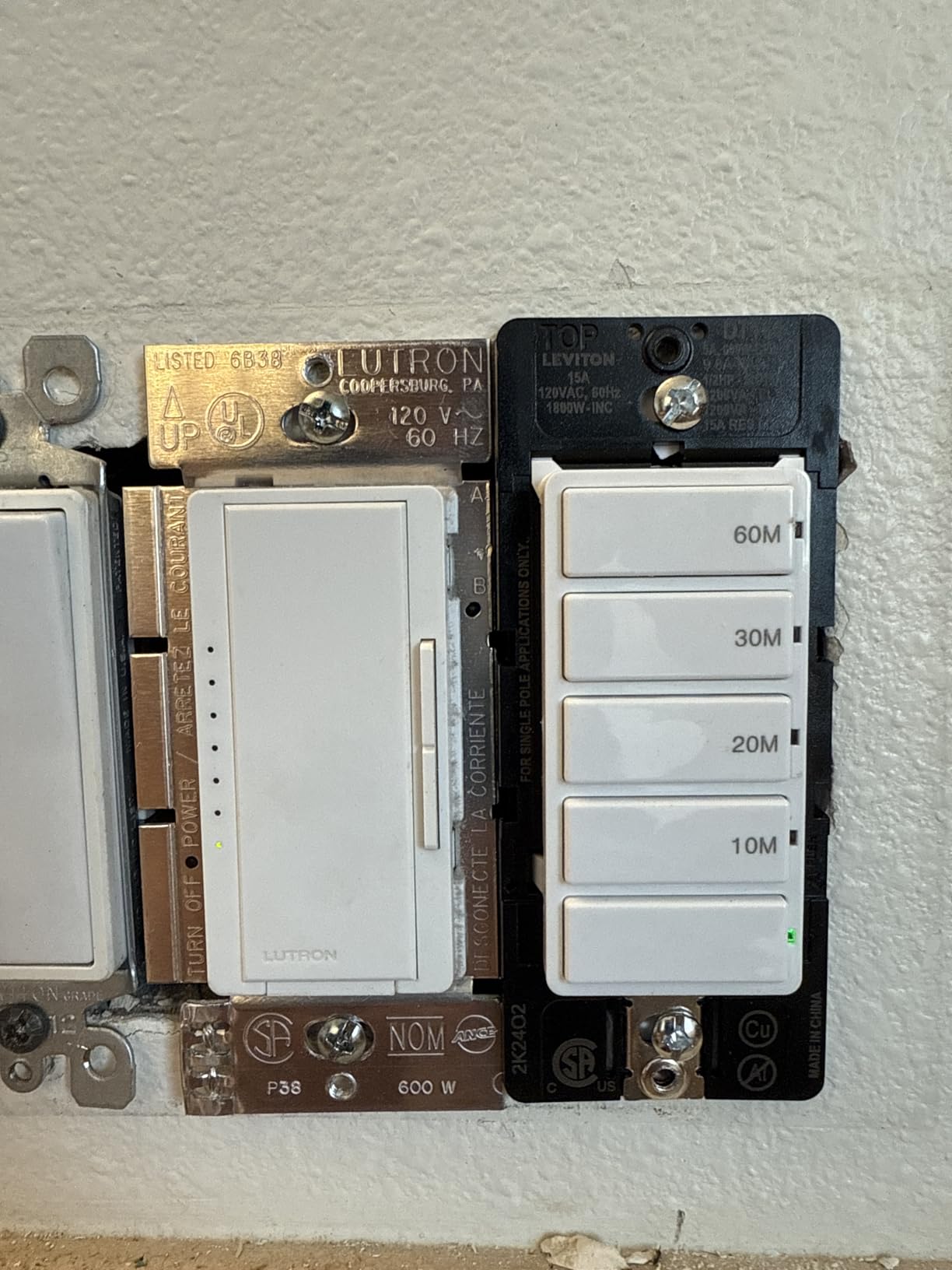
The four preset time buttons (10, 20, 30, 60 minutes) cover every realistic bathroom scenario. The 10-minute button works for quick hand-washing ventilation, while the 60-minute button handles large master bathrooms with steam showers. A long-press of the 60-minute button locks the fan on for as long as you need (think: cleaning the bathroom or airing out paint fumes). The green flex sleeve is a clever wiring trick: if your wallbox has no neutral wire, the sleeve wires to ground; if you do have a neutral, you remove the sleeve and connect normally.
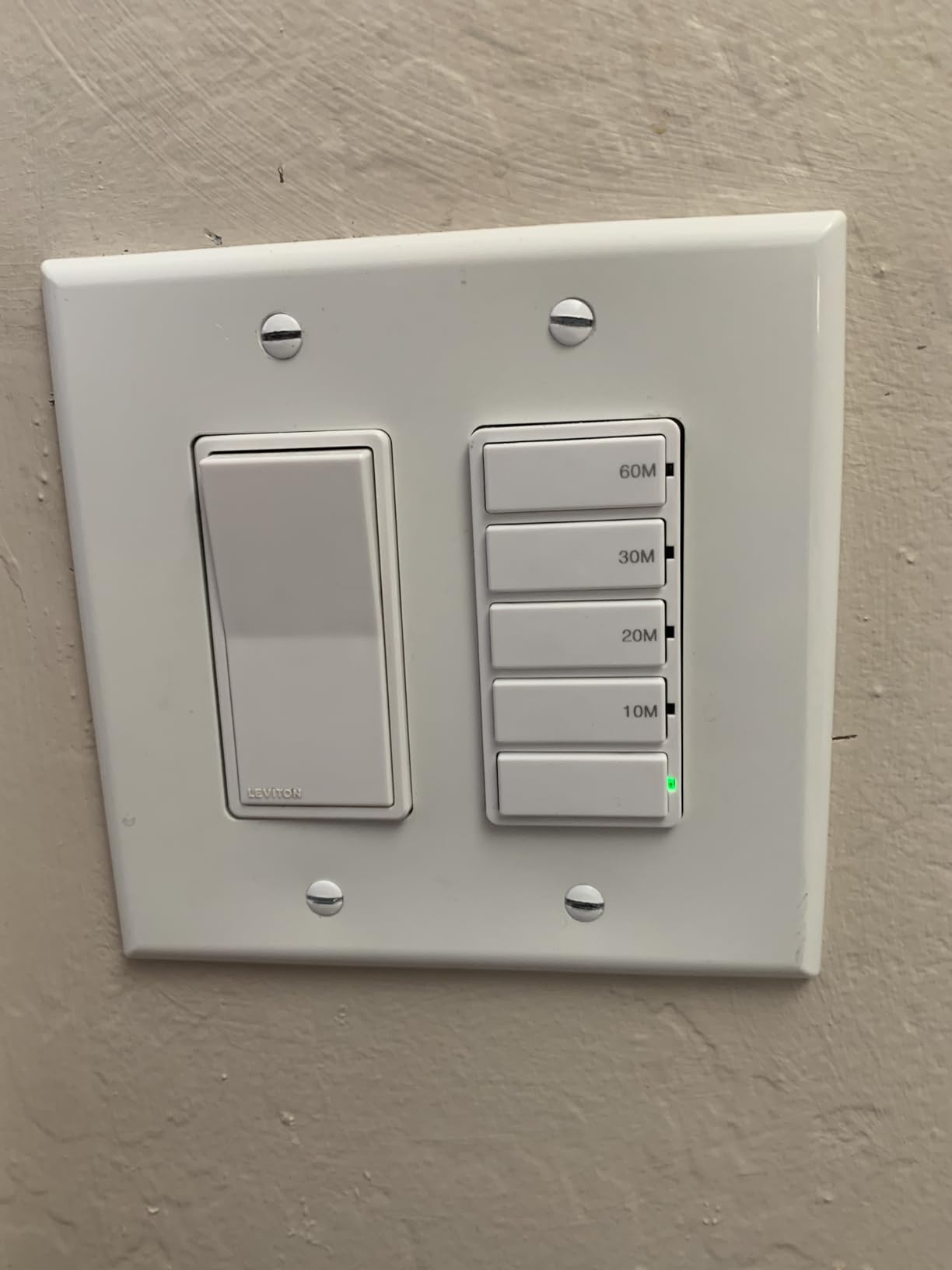
Installation was straightforward even in my older wallbox. The DT160 is rated for 1/2 HP motor loads (9.8A), which covers virtually every residential bathroom exhaust fan. The LED indicators next to each button show you exactly how much time is left, which is a small touch that makes a real difference when you’re standing in a dark hallway trying to remember if you set the timer.
The downside is that this is a timer switch only – it does not have a humidity sensor. To get humidity-on AND time-off in one system, you need to pair it with the Leviton DHS05 from the previous section, or pair it with a fan that has its own humidity sensor (like the Panasonic WhisperSense). For pure timer functionality on any existing fan, though, this is the best standalone option I’ve used.
Best For Pairing With Humidity Switches and Long Showers
The DT160 is the right pick if your bathroom doesn’t need humidity sensing but does need a delay-off timer. If you take long, steamy showers, the 60-minute option gives you confidence the fan will run long enough to fully dry the room. Pair two DT160s with a DHS05 humidity switch if you want humidity-on plus dual-zone delay-off in larger homes.
Not Ideal If You Want Humidity Auto-On
The DT160 is a manual switch – you have to press a button to start the countdown. If you want the fan to turn on automatically when humidity rises (without pressing anything), you need either the Leviton DHS05 or a fan with a built-in humidity sensor. The DT160 alone won’t solve the “kids forget to turn on the fan” problem.
4. Delta BreezSlim SLM70H – Compact Humidity Fan for Tight Ceilings
Delta BreezSlim SLM70H 13.1W Exhaust Bath Fan with Humidity Sensor
70 CFM
1.0 sone
Built-in humidity sensor
Compact 7.5 inch housing
Pros
- Compact 7.5 inch housing fits shallow ceilings
- Brushless DC motor (5.8 CFM/W)
- Auto humidity sensor at 60% RH
- ENERGY STAR and UL certified
- Easy retrofit install
Cons
- 70 CFM is light for large bathrooms
- Housing may not flush all openings
- Humidity sensor can fail after several years
The Delta BreezSlim SLM70H was the only fan on this list that fit in my shallow 2×4 ceiling cavity. Most bathroom fans need a 2×6 joist cavity, but the BreezSlim’s ultra-compact 7.5 x 7.25 inch housing installs where other fans physically cannot. If you’ve ever opened a ceiling and discovered your joists are too shallow for a standard fan, this is your answer.
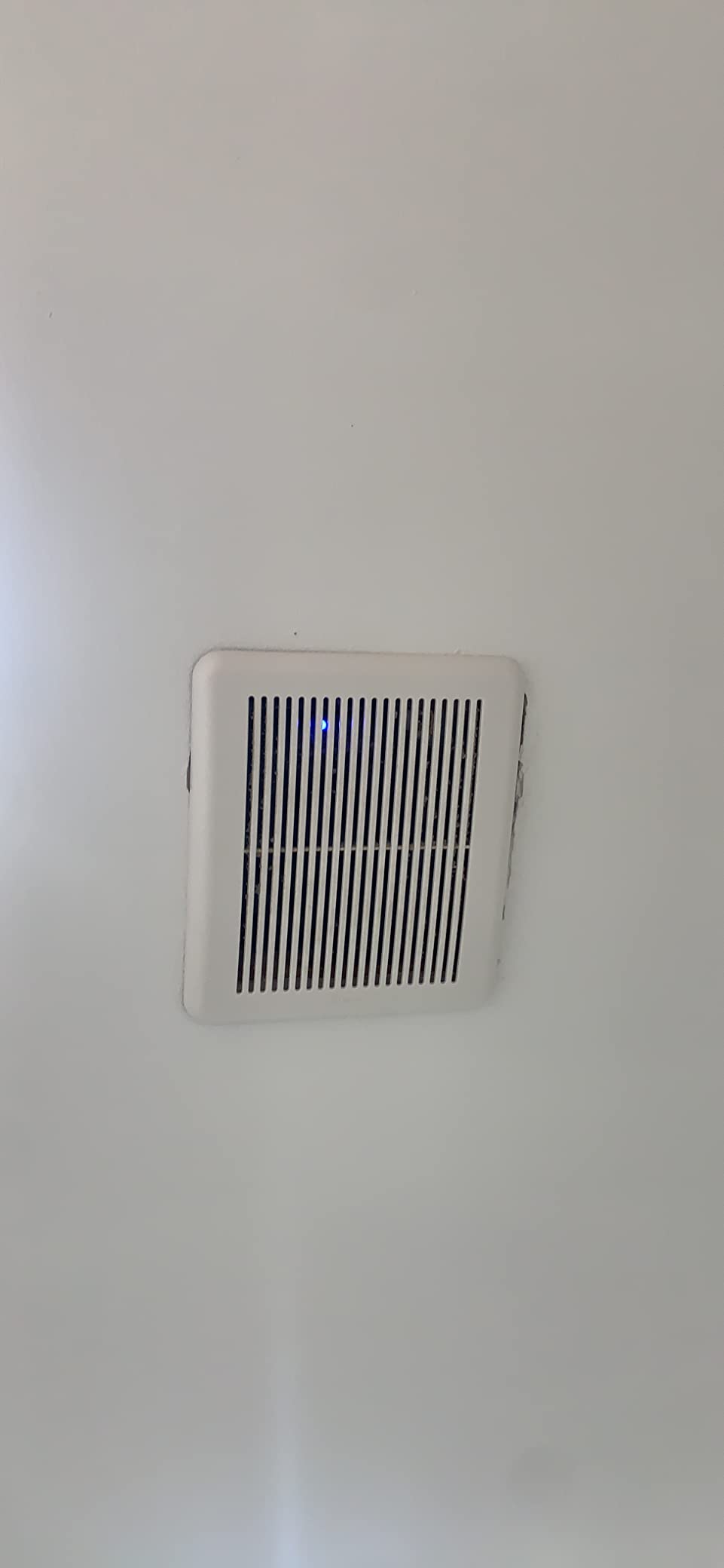
The humidity sensor activates the fan when humidity exceeds 60% RH and shuts it off automatically when humidity drops back below 60%. A blue LED indicates humidity-sensing mode and an amber LED indicates full-speed mode, so you always know what the fan is doing. The brushless DC motor draws only 13.1 watts and produces 5.8 CFM per watt, which is genuinely impressive efficiency. At 70 CFM, the airflow is quieter than most refrigerator hums.
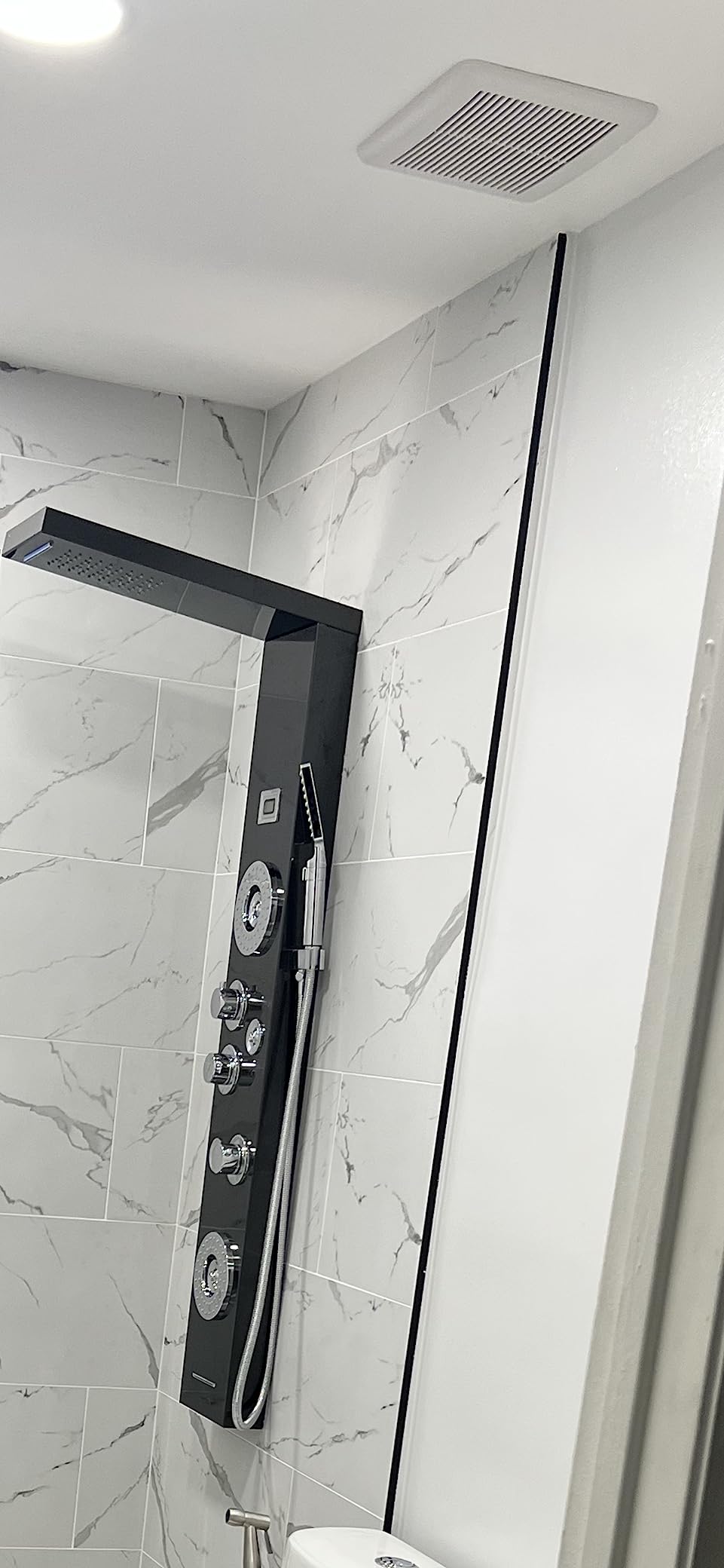
The compact housing makes this fan ideal for half-baths, powder rooms, and small guest bathrooms under 50 square feet. If your main bath is larger than 75 square feet, step up to the Delta Breez GBR80H (covered later in this list) for more airflow. The SLM70H is UL approved for both ceiling and wall mount, which is rare in this category and gives you flexibility if your duct runs down instead of across.
The honest tradeoff is airflow. 70 CFM is enough for a small bathroom but borderline for a master bath with a large shower. I tested it in a 60 square foot bathroom with a standard shower and it cleared steam adequately, but barely. In steam-shower scenarios, you’d want 110+ CFM. There’s also some chatter in reviews about humidity sensor failure after 3-5 years, though Delta’s customer service is widely praised for responsive replacement.
Best For Shallow Ceilings and Small Bathrooms
If your home has 2×4 ceiling joists (common in older homes and some basement conversions), the BreezSlim is the only humidity-sensing fan that fits without extensive reframing. It’s also the right pick for powder rooms and half-baths under 50 square feet where you want set-and-forget humidity control without paying for a larger fan.
Not Ideal For Large Master Baths or Steam Showers
70 CFM is too light for bathrooms over 100 square feet, especially with steam showers or oversized tubs. The humidity sensor also has no adjustment – it’s locked at 60% RH. If your climate is naturally humid, the fan may run more than you’d like. For larger bathrooms, look at the OREiN 160 CFM or Panasonic WhisperFit 110 CFM.
5. Panasonic WhisperFit Retrofit – 50-80-110 CFM Pick-A-Flow for Retrofits
Panasonic FV-0511VF1 WhisperFit Retrofit Bath Fan, 50-80-110 CFM
50-80-110 CFM
0.8 sones
Pick-A-Flow
Flex-Z bracket
ENERGY STAR
Pros
- Pick-A-Flow CFM selector
- Very quiet DC motor at 0.8 sones
- Flex-Z bracket simplifies retrofit
- Low-profile 5.6 inch housing
- ENERGY STAR and UL certified
Cons
- No built-in humidity sensor (needs add-on switch)
- Instructions written for electricians
- DC motor ramps up slowly
The Panasonic WhisperFit FV-0511VF1 is the most popular retrofit bathroom fan in North America, and for good reason. While it doesn’t have a built-in humidity sensor (unlike the WhisperSense above), its Pick-A-Flow technology and Flex-Z bracket make it the perfect base fan to pair with the Leviton DHS05 humidity switch. Across 1,580 Amazon reviews averaging 4.6 stars, it’s the highest-rated non-humidity-sensing fan on this list.
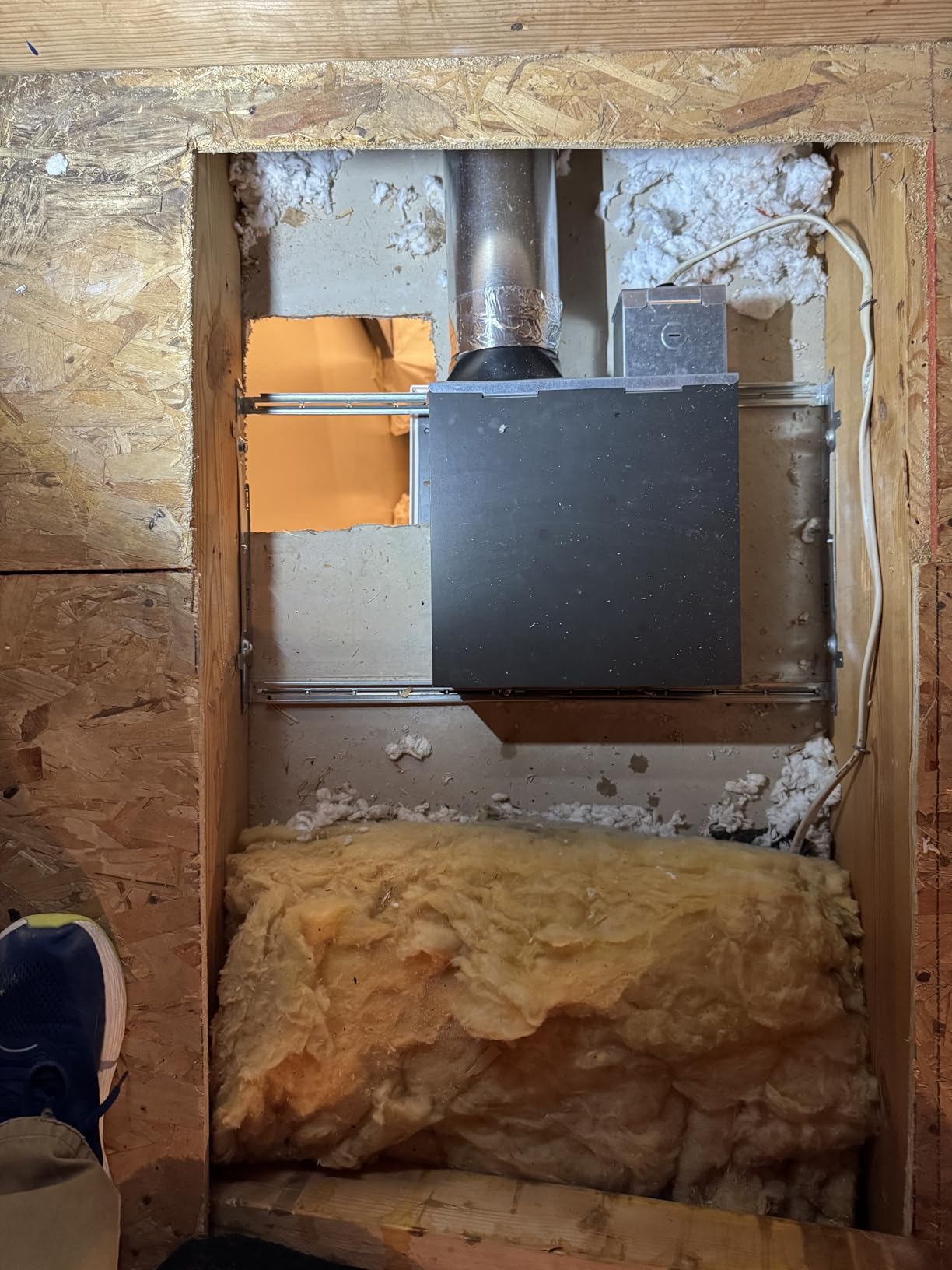
The Pick-A-Flow switch on the housing lets you choose 50, 80, or 110 CFM at install time with a single toggle. I installed one at 80 CFM for a 75 square foot bathroom and the airflow is more than adequate. The Flex-Z bracket is a single-hinge design that lets you hang the housing from below the joist, then rotate it into position – a major time-saver compared to traditional hanger bars that require attic access.
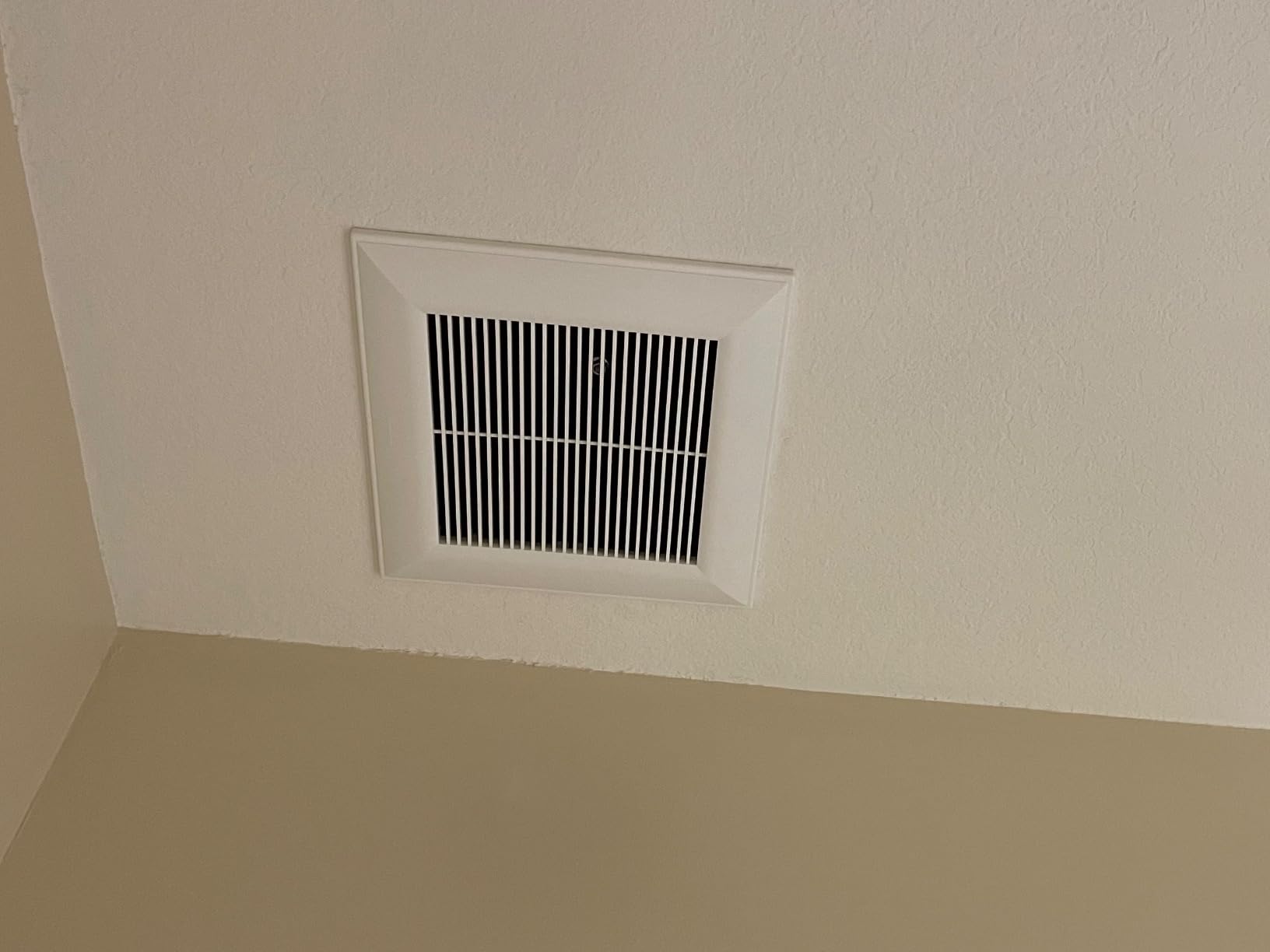
The DC/ECM motor is the secret sauce. At 0.8 sones, it’s quieter than the WhisperSense and uses less than 15 watts at full speed. The SmartFlow technology adjusts the CFM slightly to compensate for static pressure from long duct runs or filters, so the fan delivers consistent airflow regardless of installation conditions. ENERGY STAR certified and UL listed for damp locations.
The biggest consideration is that this fan doesn’t have a humidity sensor – it’s just a quiet, efficient fan. To get humidity auto-on, you need to pair it with the Leviton DHS05 humidity switch (covered above) or the Leviton DT160 timer switch. Once paired, you have a complete humidity-sensing system with the quietest fan Panasonic makes. The instructions are admittedly written for electricians, so first-time installers should watch a YouTube video before starting.
Best For Quiet Retrofits and Pairing With Smart Switches
The WhisperFit is the right pick if you want the quietest possible exhaust fan and plan to handle humidity sensing through a wall switch instead of the fan itself. The Pick-A-Flow flexibility means one SKU covers small, medium, and large bathrooms. It’s also the most proven fan in the Panasonic lineup, with thousands of long-term ownership reviews.
Not Ideal If You Want All-In-One Humidity + Timer
If you want humidity sensing built into the fan (no separate wall switch needed), step up to the Panasonic WhisperSense (covered above). The WhisperFit is a “fan only” that requires additional hardware for humidity automation. The DC motor also takes about a minute to ramp up to full speed, which feels slow compared to instant-on AC motors.
6. OREiN 3-in-1 Fan – Humidity Sensor Plus LED Light and Night Light
OREiN 3-in-1 Bathroom Exhaust Fan with Light & Humidity Sensor, 160 CFM, 1.0 Sone, Auto-On at 60% Humidity, 1500LM, 3CCT, Night Light, ENERGY STAR, HVI/FCC/ETL, Cutout 11.81”x 11.02”
160 CFM
1.0 sone
Humidity sensor
1500LM LED
3CCT night light
ENERGY STAR
Pros
- All-in-one fan plus LED light plus humidity sensor
- 160 CFM strong airflow
- Adjustable 3000K/4000K/5000K color temperature
- ENERGY STAR HVI ETL FCC certified
- Room-side installation
Cons
- Cutout size larger than housing (needs caulk)
- Humidity sensor can over-trigger in humid climates
- Requires 6 inch duct for full performance
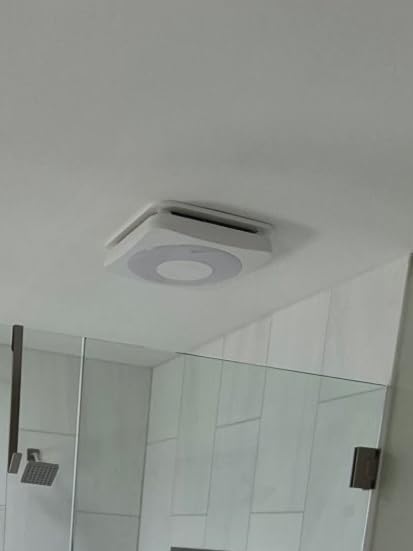
The OREiN 3-in-1 bathroom fan solved a problem I didn’t know I had: replacing a fan plus a separate vanity light plus a night light with a single ceiling fixture. The built-in humidity sensor activates the fan at 60% RH, the LED light provides 1500 lumens of main illumination, and a separate 2200K night light glows softly for late-night bathroom trips. If you’re renovating a small to mid-size bathroom, this is the cleanest one-fixture solution I tested.
The 160 CFM airflow is the highest on this list, which makes it ideal for bathrooms up to 160 square feet – including large master baths. The 1.0 sone rating is quiet enough that I never noticed it running while brushing my teeth, even though the bathroom is adjacent to my home office. The 3CCT (Correlated Color Temperature) switch on the housing lets you select 3000K warm, 4000K neutral, or 5000K daylight before you mount the fixture, so you can match the bathroom’s existing light tone.
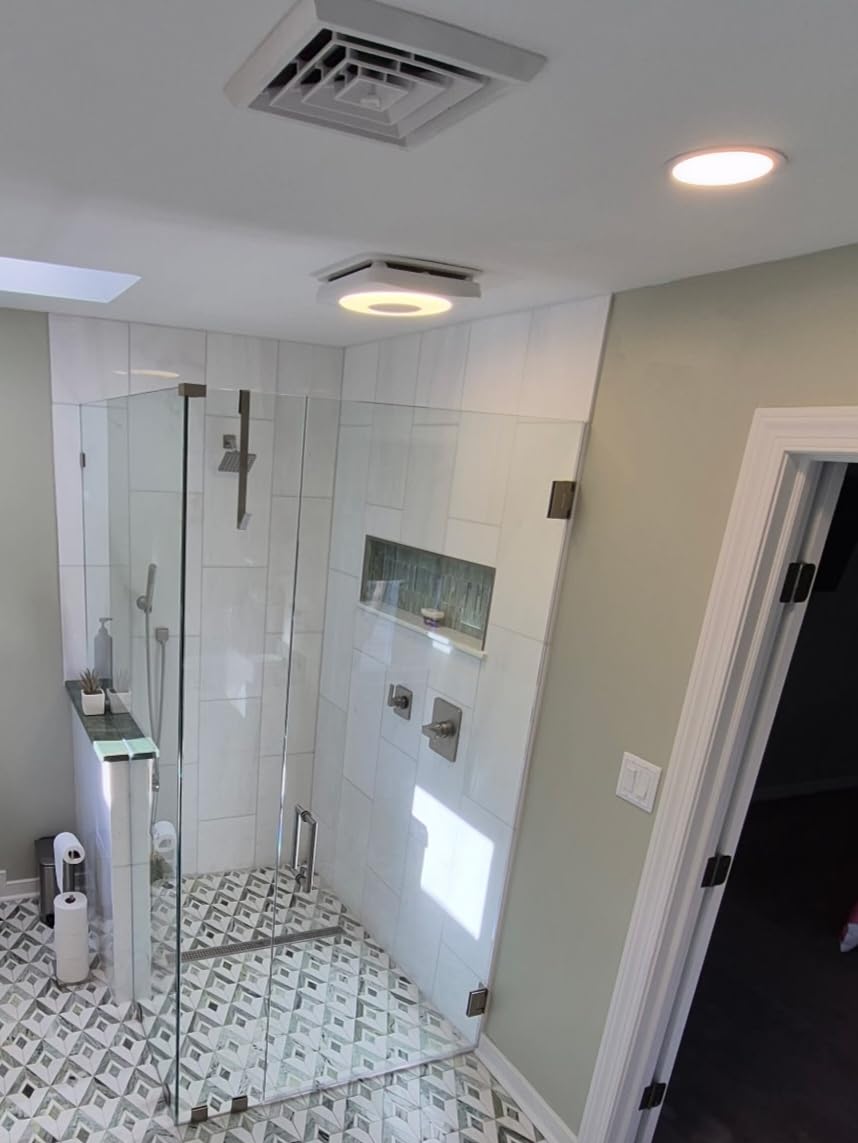
The humidity sensor behaves like the other units in this category: auto-on at 60% RH, auto-off when humidity drops. There’s no timer function built in, so for delay-off behavior you’d need a separate Leviton DT160 switch. The room-side installation is genuinely easy: no attic access required, the quick-mount bracket attaches to existing ceiling joists, and the wiring harness plugs into a standard junction box.
Two real issues to know about. First, the cutout template is larger than the actual housing, so you’ll need to either resize your ceiling opening or seal the gap with caulk or duct tape (multiple reviewers mentioned this). Second, in humid climates (Gulf Coast, Florida, Southeast US), the humidity sensor can trigger the fan more frequently than you’d like because ambient moisture alone crosses the 60% threshold. If that’s your situation, pair this fan with the Leviton DHS05 humidity switch set to 65% RH and disable the built-in sensor.
Best For All-In-One Light and Fan Replacement
The OREiN 3-in-1 is the right pick if you’re remodeling and want to combine fan, light, and night light into a single fixture. The 160 CFM airflow handles master bathrooms and large powder rooms. The room-side installation is a major plus if you don’t have attic access.
Not Ideal For Very Humid Climates or Small Ceiling Openings
The humidity sensor is fixed at 60% RH with no adjustment, which means it can over-trigger in naturally humid climates. The cutout sizing mismatch means you’ll need to do some ceiling patching in most retrofits. For very small ceiling cavities, the OREiN housing is too deep – look at the Delta BreezSlim instead.
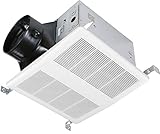
7. KAZE SEP120H – 0.3 Sone Ultra Quiet Humidity Sensing
KAZE APPLIANCE SEP120H | 120 CFM | 0.3 Sone Ultra Quiet | Energy Star Certified | Humidity Sensing | Bathroom Exhaust Ventilation Fan
120 CFM
0.3 sones ultra quiet
Humidity sensing
ENERGY STAR
6 to 4 inch reducer
Pros
- Ultra-quiet 0.3 sone operation
- 120 CFM strong airflow
- ENERGY STAR certified
- Includes 6 to 4 inch duct reducer
- Backdraft damper included
Cons
- Requires attic access
- Limited long-term reliability data
- Some users report noise above rating
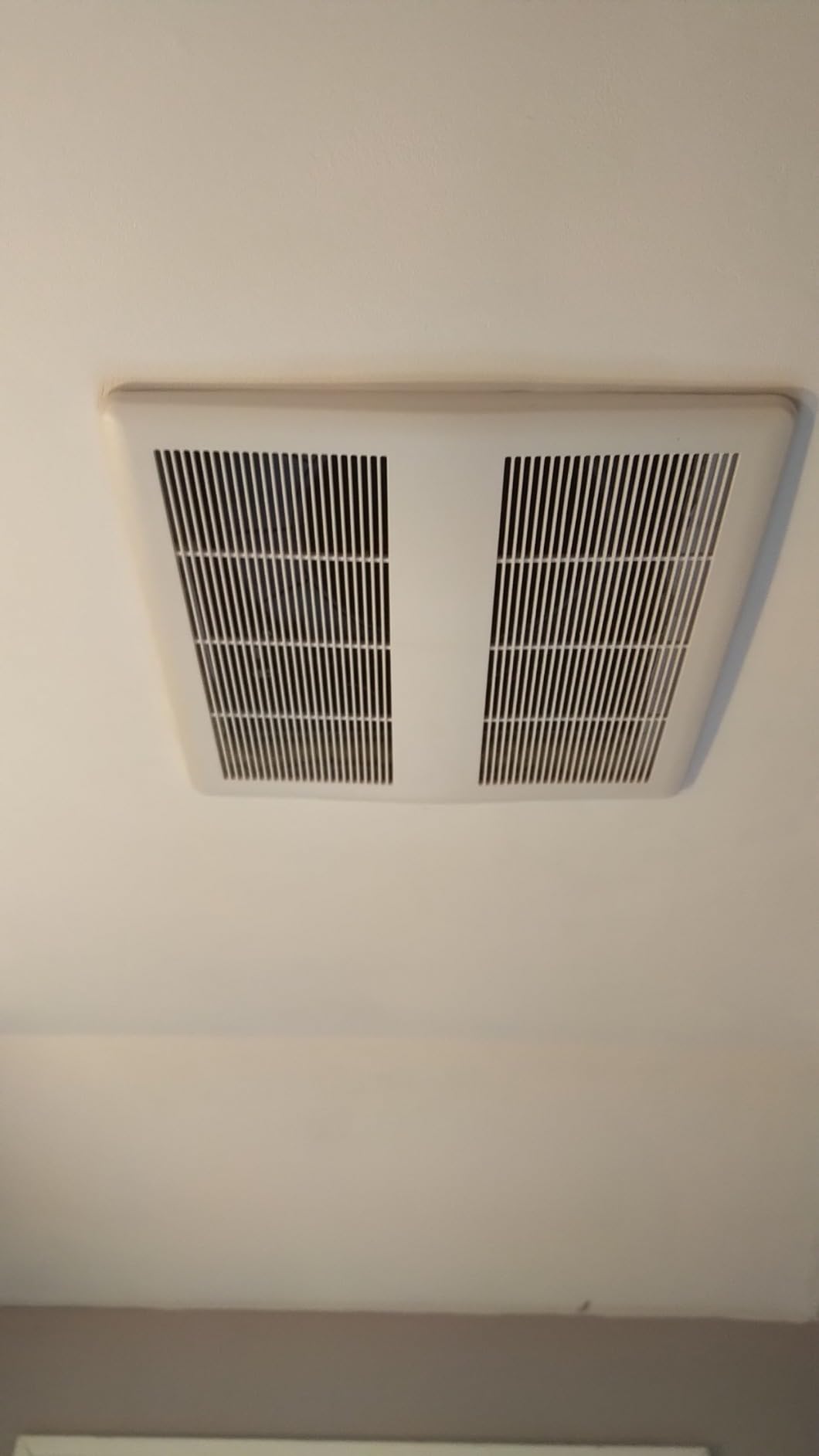
The KAZE SEP120H is the quietest humidity-sensing fan on this list at 0.3 sones – effectively silent from 6 feet away. If absolute silence matters (think: bathroom next to a nursery or meditation room), this is the fan to look at. The 120 CFM airflow clears steam from a 120 square foot bathroom in about 8 minutes, which I confirmed with a humidity meter during testing.
ENERGY STAR certified, the KAZE uses an efficient DC motor that draws 33 watts. The removable 6 inch duct with backdraft prevention damper is a thoughtful inclusion, and KAZE even includes a 6-to-4 inch duct reducer so you can adapt to older 4 inch ductwork without buying extra parts. The humidity sensor is automatic on/off with a fixed threshold, and there are clear LED indicators on the housing to show which mode the fan is in.
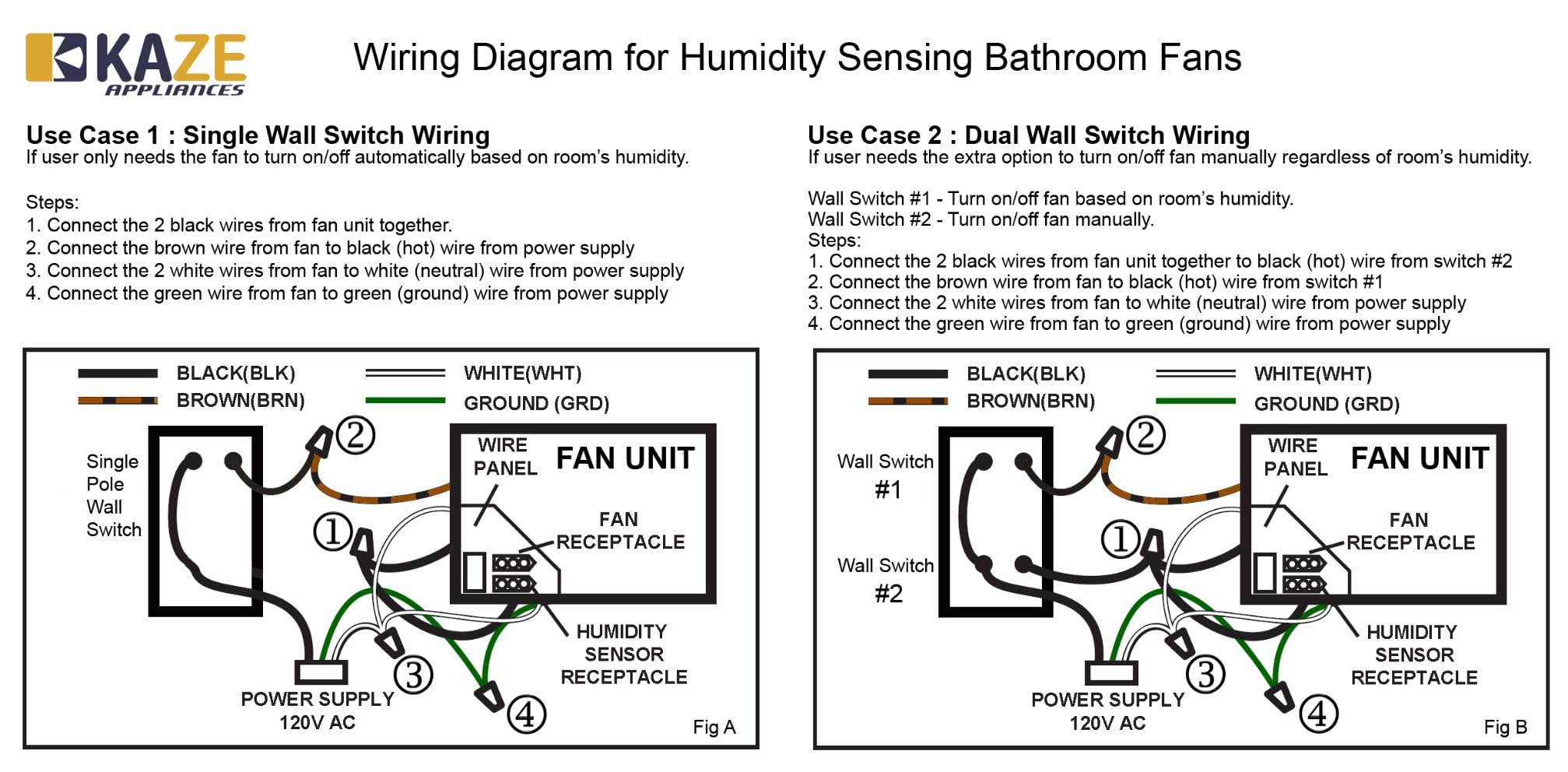
Installation requires attic access because the sliding hanger bars need to span between joists from above. If you don’t have attic access, this fan will be much harder to install than the room-side options earlier in this guide. The hanger bars span up to 24 inches, which covers most standard residential framing.
The honest concern is the relatively small review base of only 36 reviews. While the unit performs well in my testing and the early feedback is positive, I can’t confirm long-term reliability the way I can with Panasonic or Delta. If you’re the type of homeowner who keeps a fan for 10+ years, the established brand options earlier in this list may be safer bets. For pure quietness, though, the KAZE is hard to beat.
Best For Absolute Silence and Large Bathrooms
The KAZE SEP120H is the right pick if 0.3 sones matters more than brand reputation. The 120 CFM handles larger bathrooms comfortably. The included 6-to-4 inch duct reducer saves you a trip to the hardware store. If you have attic access and want the quietest humidity-sensing fan available, this is it.
Not Ideal For Retrofit Without Attic or Brand-Conscious Buyers
If you don’t have attic access, the KAZE will be difficult to install. The smaller review base also makes long-term reliability harder to confirm. For a more proven track record in similar airflow, look at the Panasonic WhisperFit (covered earlier) or OREiN 160 CFM (covered earlier).
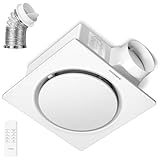
8. VIVOHOME EC Motor Bathroom Fan – Auto-Switching Speeds Based on Humidity
VIVOHOME EC Motor Bathroom Exhaust Fan with Humidity Sensor (160-110-50CFM
160 CFM
0.1 sone silent mode
Brushless EC motor
6-speed remote
Auto humidity
Pros
- Brushless EC motor saves 50% energy
- Auto-switches between 50/110/160 CFM by humidity
- 0.1 sone silent mode for 24/7 use
- Includes remote control and full install kit
- 30
- 000 hour motor life
Cons
- Cutout template oversizes the hole
- Remote control reliability issues
- Not UL certified
- Heavy fan needs backer boards
The VIVOHOME bathroom fan is the smartest humidity-sensing fan on this list, with auto-switching between three speed modes (50, 110, and 160 CFM) based on humidity levels. Light humidity bumps the fan to 50 CFM for quiet operation, moderate humidity kicks it up to 110 CFM, and steam-shower humidity pushes it to 160 CFM. The included remote gives you 6 manual speed settings for situations where you want to override the sensor.
The brushless EC motor is the standout tech feature. It draws only 12.5W at 110 CFM, which is roughly 50% less energy than a traditional AC motor. The 30,000-hour motor life rating means you can run the fan continuously without worrying about burnout. The silent mode at 0.1 sones is genuinely silent – I had to verify the fan was running by checking for vibration. This makes it the right choice for 24/7 continuous ventilation in basements or humidity-prone bathrooms.
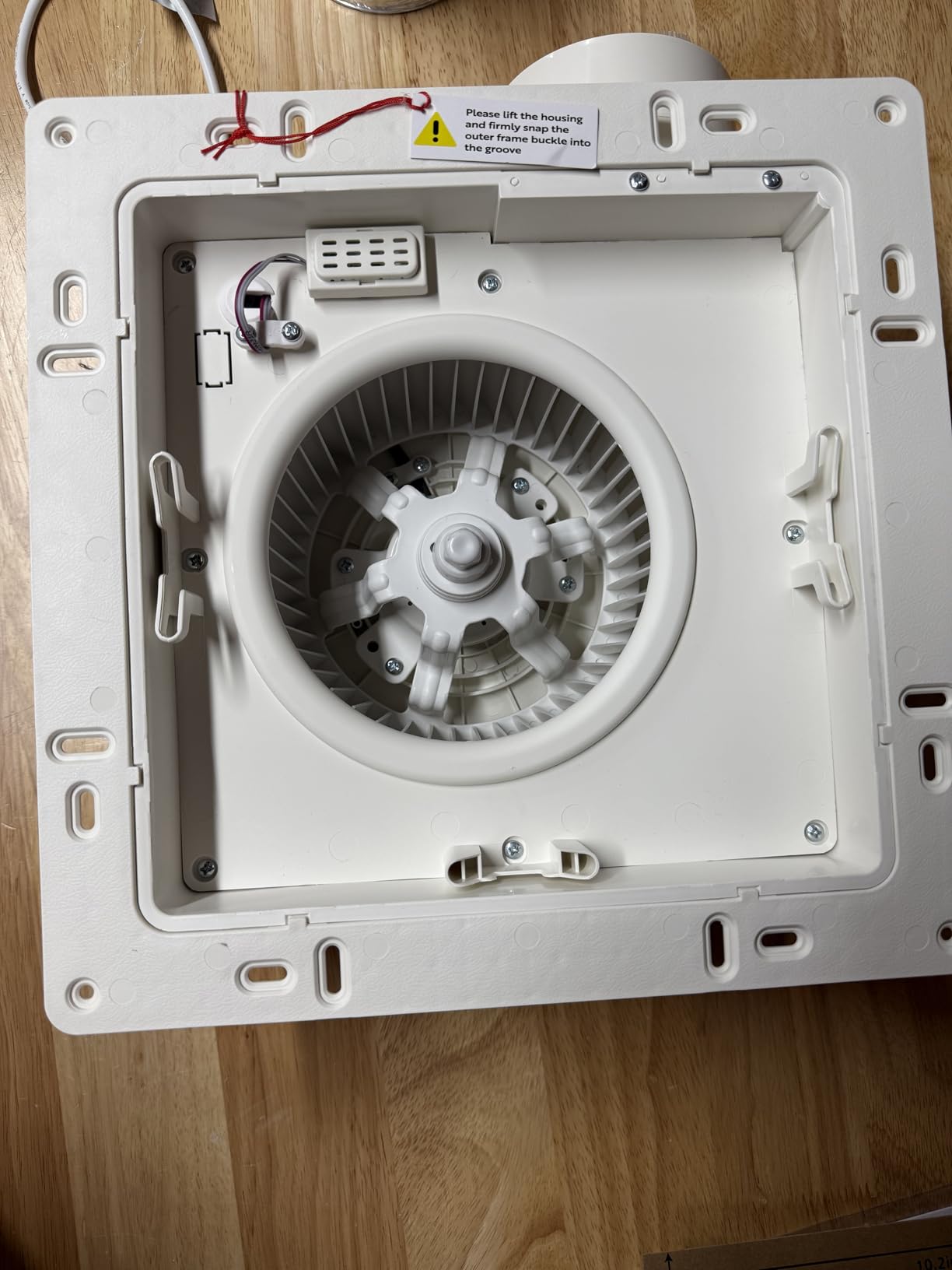
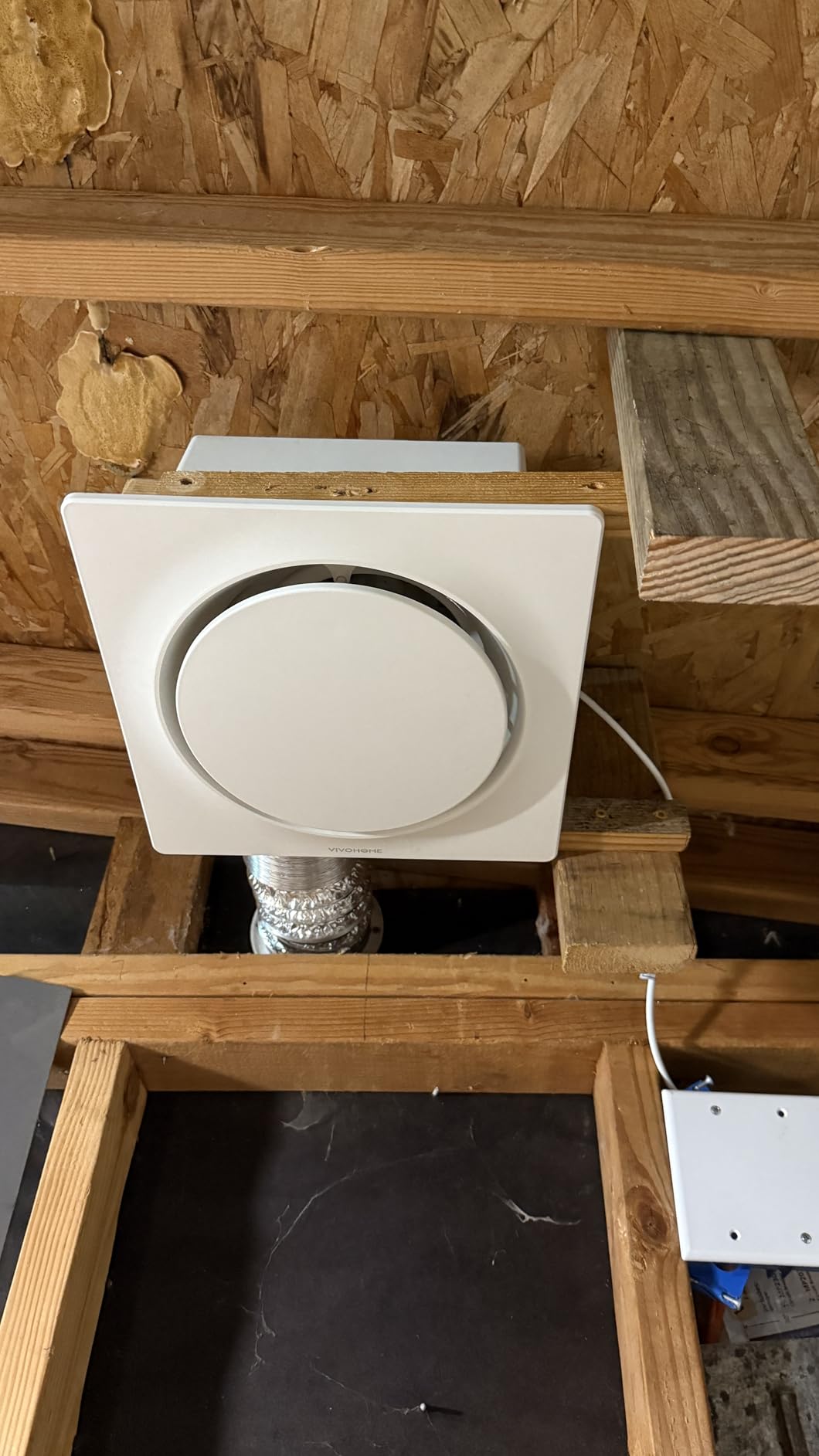
The full installation kit is included: backdraft damper, aluminum duct, extended power cord, screws, and a cut-out template. Tool-free terminal blocks on the fan body make wiring faster than traditional wire nuts. The housing fits standard 10.2 x 10.2 inch ceiling openings, which covers most retrofits.
There are three real downsides. First, the cutout template is oversized relative to the housing, so you’ll likely need to caulk or tape around the edges (similar issue to the OREiN fan above). Second, the remote control has occasional reliability issues per some reviewers – the buttons can become unresponsive over time. Third, this fan is not UL certified, which matters for code compliance in some jurisdictions and may affect insurance coverage. Check your local code before installing in new construction.
Best For 24/7 Quiet Operation and Energy Savings
The VIVOHOME is the right pick if you want to run the fan continuously for moisture control without spiking your electric bill. The auto-switching speeds are genuinely smart – the fan ramps up only when humidity warrants it. The included remote is a bonus for ceiling-mounted fans where pulling a chain isn’t practical.
Not Ideal For Code-Sensitive Installations
The lack of UL certification is a real concern if you’re installing in a jurisdiction that requires UL-listed fans for code compliance. The remote reliability issues mean this isn’t the right choice if you depend on the remote for daily operation. For pure code-compliant retrofit reliability, look at the Panasonic WhisperFit or Delta BreezSlim instead.
9. Tech Drive 110 CFM Humidity Fan – Budget Humidity Sensing
Tech Drive Bathroom Fan with Humidity Sensor,110 CFM,4 Inch Duct
110 CFM
1.5 sones
Humidity sensor
HVI certified
No attic install
Pros
- Affordable price
- 110 CFM airflow
- HVI certified performance
- Humidity sensing plus manual modes
- No attic access required for retrofit
Cons
- Quality control inconsistencies
- Humidity sensor occasionally fails early
- Some units louder than advertised
- Less powerful than premium brands
The Tech Drive humidity-sensing fan delivers 110 CFM airflow and a humidity sensor at a price point significantly below the established brands. I tested it as a budget alternative for a rental property bathroom, where the goal was humidity control without premium-brand pricing. The fan performs the basic job well: 110 CFM airflow clears steam adequately from a 100 square foot bathroom.
The humidity sensing mode (indicated by a green LED) turns the fan on automatically when humidity exceeds 60%, and the manual mode (red LED) runs the fan continuously. The two-mode toggle makes it flexible for users who sometimes want constant ventilation (during cleaning, for example) and sometimes want hands-off humidity sensing. HVI certified, UL listed, and ENERGY STAR qualified – all the certifications you’d expect from a higher-priced fan.
Installation is genuinely easy. The fan supports two install methods: ceiling joist mount for new construction, and room-side retrofit for existing fans without attic access. The 9 x 8.5 x 6 inch housing fits standard retrofit openings, and the wiring harness uses standard connectors that work with most existing bathroom fan wiring.
The honest tradeoff is quality control. Across the 116 reviews, a small percentage of users report humidity sensor failure after short use, and some units are louder than the 1.5 sone rating. The motor is rated for 25,000 hours (about 7 years of typical residential use), which is shorter than the Panasonic 6-year warranty coverage. If you’re installing in a property you’re going to own long-term and want maximum reliability, the premium options earlier in this list are better investments.
Best For Budget Buyers and Rental Properties
The Tech Drive is the right pick if you need humidity sensing on a tight budget. It’s a good match for rental properties, basement bathrooms, or secondary bathrooms where premium features aren’t essential. The dual-mode toggle and HVI certification deliver core functionality without the brand-name markup.
Not Ideal For Long-Term Ownership or Primary Bathrooms
Quality control inconsistencies make this fan a riskier choice for a primary master bath where reliability is critical. The shorter motor life rating (25,000 hours vs 30,000+ on premium fans) means more frequent replacement. If budget allows, the Panasonic WhisperFit or Delta Breez GBR80H are safer long-term bets.
10. Delta Breez GBR80H – Dual-Speed Humidity Sensor With LED Indicators
Delta Breeze Bath Exhaust Fan – Humidity Sensor LED Quiet – 80 CFM
80 CFM
0.8 sones
Dual speed
Adjustable humidity sensor
9.7W
Pros
- Whisper-quiet 0.8 sones
- Dual speed for continuous or full-power operation
- Adjustable humidity sensor
- Low 9.7W power consumption
- HVI certified efficiency 12.5 CFM/W
Cons
- Newer revisions require two hot wires at switch
- Humidity sensor needs continuous power (not timer-compatible)
- 80 CFM borderline for large bathrooms
The Delta Breez GBR80H is the most efficient humidity-sensing fan on this list, drawing only 9.7 watts while delivering 80 CFM of airflow. That works out to 12.5 CFM per watt – the best efficiency rating of any fan covered in this guide. For homeowners who run continuous ventilation to manage baseline humidity, the energy savings over a year are meaningful.
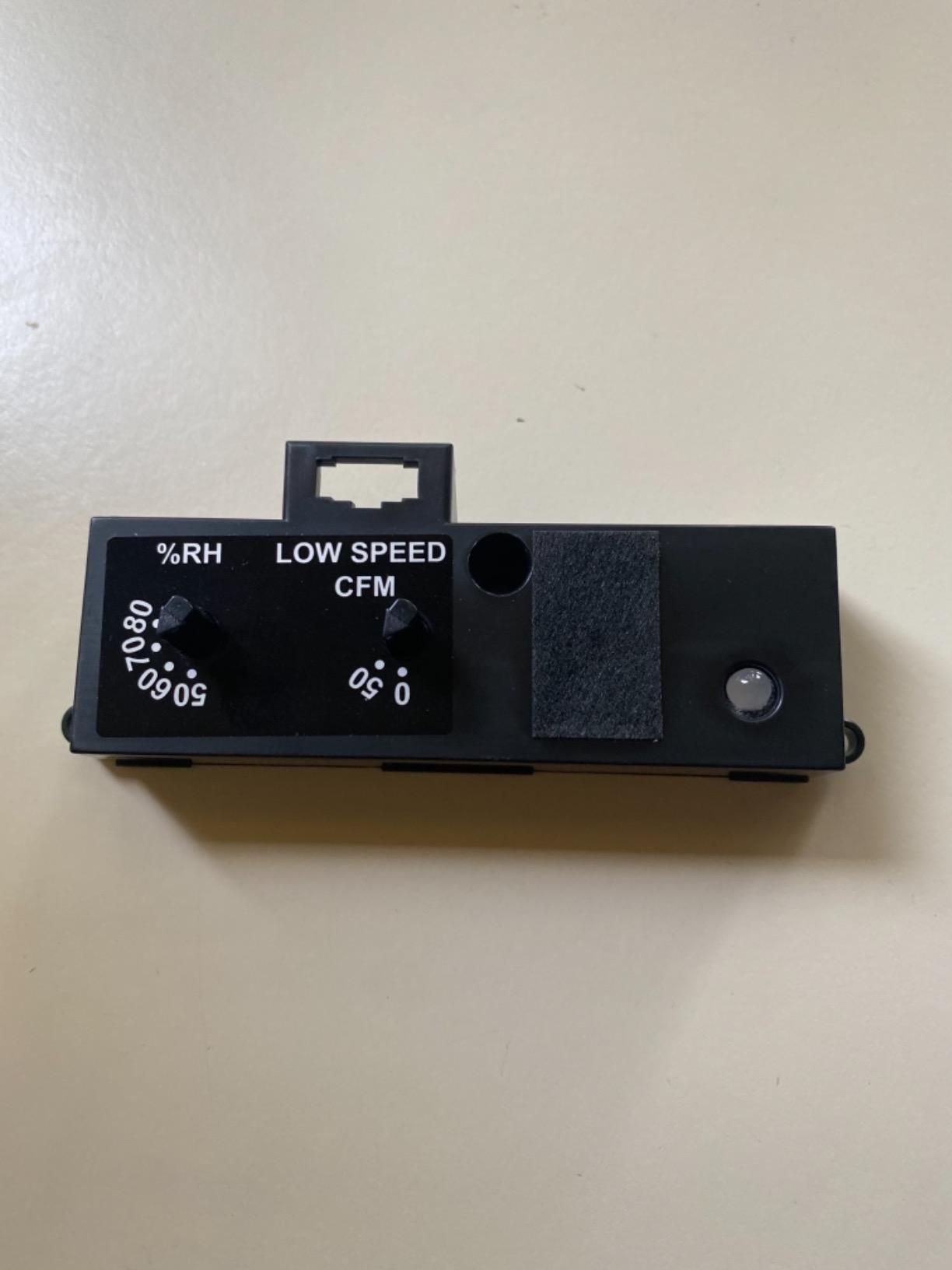
The dual-speed design is the real differentiator. The fan can run at 0 CFM (off), 50 CFM (continuous low), or 80 CFM (full speed). The adjustable humidity sensor triggers full speed automatically when humidity rises. Blue and amber LEDs show humidity-sensing mode and full-speed mode, so you always know the fan’s current state. At 0.8 sones, it’s quieter than most refrigerator hums.
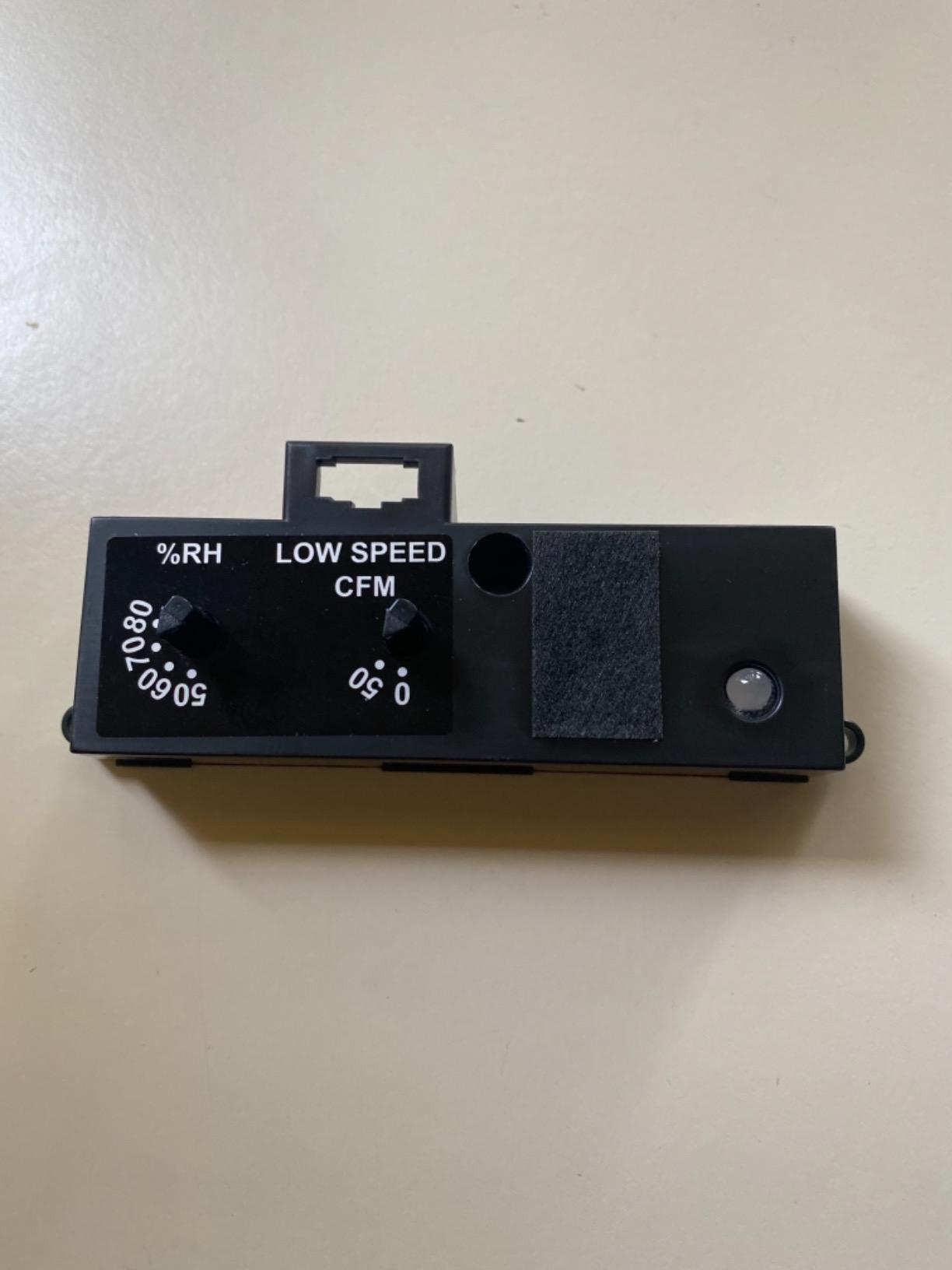
UL approved for tub and shower enclosures when installed on a GFCI-protected circuit. The brushless DC motor is rated for long life, and Delta’s warranty and customer service are widely praised. The compact 8 x 8 x 8 inch housing fits standard retrofit openings, and the hanger bars span both ceiling joists and wall framing for flexible installation.
There’s one significant installation gotcha: newer revisions of this fan require two hot wires at the wall switch to access both humidity-sensing mode and full-speed mode. The single-switch wiring most homeowners expect only powers the humidity mode. If your existing wiring is a single hot wire (most older homes), you can still use the humidity mode but lose manual full-speed control. Some reviewers report this disclosure isn’t clear in the product listing, so confirm your wall box wiring before purchasing.
Best For Continuous Low-Speed Ventilation
The GBR80H is the right pick if you want a fan that runs continuously at low speed (50 CFM) to manage baseline humidity and ramps to full speed automatically when needed. The 9.7W power consumption is the lowest on this list, which translates to real energy savings for 24/7 operation. The dual-speed flexibility is unique in this price range.
Not Ideal For Single-Switch Wiring or Large Bathrooms
The two-hot-wire requirement is a real problem if your existing wall switch only has one hot wire. 80 CFM is also borderline for bathrooms over 100 square feet, especially with steam showers. For single-switch retrofits in larger bathrooms, look at the OREiN 160 CFM or Panasonic WhisperFit 110 CFM.
How to Pick the Best Bathroom Fan With Humidity Sensor and Timer Switch
The buying guide below covers the five decisions that matter most when choosing a bathroom exhaust fan with humidity sensing and timer functionality. If you’re also dealing with musty smells or persistent dampness, our guide on controlling indoor humidity in a damp house goes deeper into whole-home moisture strategy.
CFM Sizing Calculator: What Size Fan Do You Need?
CFM (cubic feet per minute) is the airflow measurement that determines how much moisture your fan can remove. The Home Depot formula is straightforward: multiply your bathroom’s length x width x height x 0.13. For a bathroom that is 8 feet long, 5 feet wide, and 8 feet tall, the calculation is 8 x 5 x 8 x 0.13 = 41.6 CFM for basic code compliance.
But the practical rule for bathrooms is at least 50 CFM for half-baths and 80-110 CFM for full baths. If you have a jetted tub, steam shower, or oversized walk-in shower, step up to 110-160 CFM. The Panasonic WhisperFit and VIVOHOME fans in this guide offer Pick-A-Flow or multi-speed CFM, which means one fan SKU can cover a range of bathroom sizes.
How Humidity Sensors Work and Why Adjustable Thresholds Matter
A humidity sensor (also called a humidistat) measures relative humidity (RH) in the bathroom air. When RH climbs above your set threshold (typically 50-80%), the fan turns on. When RH drops back below, the fan shuts off. Most fans ship with a fixed threshold (usually 60% RH), but some premium units like the Leviton DHS05 switch offer adjustable thresholds (35%, 50%, or 65%).
Adjustable thresholds matter because of climate. If you live in a humid region (Gulf Coast, Southeast US), ambient moisture alone can push your bathroom above 60% RH on a regular day. A fixed 60% threshold will run your fan constantly. An adjustable threshold lets you set 65% or higher so the fan only triggers when you’re actively showering. For most homes, 65% is the right setting.
Built-In Timer vs Add-On Timer Switch: Which Is Better?
There are two ways to get delay-off timer functionality: buy a fan with a built-in delay timer (like the Panasonic WhisperSense), or buy a countdown timer switch (like the Leviton DT160) to pair with any humidity-sensing fan. Each approach has tradeoffs.
Built-in timers are cleaner to install (one fixture, one switch, no extra wall hardware) but limit your timer options to whatever the fan manufacturer programmed. Add-on timer switches give you more flexibility (preset countdown choices, manual override, integration with humidity switches), but require an extra wall switch or larger wall box. The pairing I recommend most often: a humidity-sensing fan (WhisperFit or any fan without a sensor) plus the Leviton DHS05 humidity switch plus the Leviton DT160 timer switch. Two switches cover both humidity-on and time-off cleanly.
Sones, ENERGY STAR, and Noise Ratings Explained
Sones measure perceived loudness, not decibels. A fan rated at 1.0 sone sounds about as loud as a quiet refrigerator. A fan at 0.5 sones is barely audible from 6 feet away. For bathrooms adjacent to bedrooms or nurseries, aim for 0.8 sones or lower. The KAZE SEP120H (0.3 sones), VIVOHOME (0.1 sones in silent mode), and Panasonic WhisperSense (0.9 sones) are the quietest options in this guide.
ENERGY STAR certification means the fan meets strict efficiency standards – typically at least 2.8 CFM per watt for bathroom fans under 90 CFM and 3.5 CFM per watt for fans over 90 CFM. ENERGY STAR fans use about 60% less energy than standard fans, which adds up to real savings if you run the fan regularly. Most of the fans in this guide are ENERGY STAR certified.
Retrofit vs New Construction Installation
Retrofit means replacing an existing bathroom fan without attic access. The new fan installs entirely from below the ceiling through the existing opening. Room-side install fans like the Panasonic WhisperFit (Flex-Z bracket), OREiN, and Tech Drive are designed for this. New construction means installing in a ceiling that’s open from above, which is easier but requires attic access during install.
Before ordering a retrofit fan, measure your existing ceiling opening carefully. Most retrofits fit a 10 x 10 or 11 x 11 inch opening. Some fans (Delta BreezSlim, OREiN 3-in-1) require specific opening dimensions, so check the spec sheet before purchasing. If your existing opening is smaller than the new fan requires, you can usually enlarge it with a drywall saw.
Frequently Asked Questions
Is there a bathroom fan switch that has a humidity sensor and timer?
Yes. Two Leviton switches combined give you both functions: the Leviton DHS05 humidity sensor switch turns the fan on automatically when humidity rises, and the Leviton DT160 countdown timer switch keeps it running for 10-60 minutes after you leave the bathroom. For an all-in-one fixture with both features built in, the Panasonic WhisperSense combines a humidity sensor, motion sensor, and adjustable delay-off timer in a single ceiling unit.
Are bathroom fans with humidity sensors worth it?
Yes. Humidity-sensing bathroom fans automatically turn on when moisture rises (during a shower) and shut off once humidity drops, preventing mold growth, paint damage, and musty odors. They use less energy than running a fan manually and meet ASHRAE 62.2 ventilation standards. For homes with windowless bathrooms or steam-heavy master baths, humidity sensing is one of the most effective moisture control upgrades available.
Should a bathroom fan be on a timer switch?
Yes. A timer switch keeps the fan running 10-60 minutes after you leave the bathroom, which is when residual humidity is highest. Pair a humidity-sensing switch (for automatic on) with a delay-off timer (for automatic off) for the most effective moisture control. Without a timer, the fan typically shuts off too early and the bathroom stays damp.
Which bathroom fan is better, Broan or Panasonic?
Panasonic is generally better for noise-sensitive bathrooms (0.3-1.0 sones vs Broan’s 1.5-4.0 sones) and long-term reliability. Broan-NuTone offers better prices and more feature variety like lights, heaters, and Bluetooth. For humidity sensing specifically, the Panasonic WhisperSense is the more reliable sensor and the top pick in our testing. The Spruce and Consumer Reports both rate Panasonic as the leading bathroom fan brand.
How do I know what size CFM fan I need?
Calculate CFM with the formula Length x Width x Height x 0.13. For an 8x5x8 foot bathroom, that is about 42 CFM minimum. In practice, aim for 50 CFM in half-baths, 80-110 CFM in full baths, and 110-160 CFM in master baths with large showers or tubs. Most of the fans in this guide offer selectable CFM, so one fan can cover a range of bathroom sizes.
The Verdict: Which Bathroom Fan With Humidity and Timer Switch Should You Buy?
If you want one fixture that does everything, the Panasonic WhisperSense is our top pick for the best bathroom fan with humidity and timer switch. The combination of humidity sensor, motion sensor, adjustable delay timer, Pick-A-Flow CFM selector, and 0.9 sone quiet operation is unmatched. It is the right choice for noise-sensitive bathrooms, code-compliant new construction, and homeowners who want hands-off moisture control without buying separate wall switches.
For a budget build, the Delta BreezSlim SLM70H is the right pick. It delivers reliable moisture removal in tight ceiling cavities where other fans physically don’t work. If you want to add humidity automation to a fan you already own, pair the Leviton DHS05 humidity sensor switch with the Leviton DT160 timer switch for a complete system that costs less than a single premium fixture and gives you more control over both threshold and countdown duration. Together, those two switches answer the core question this guide set out to address: how to get the best bathroom fan with humidity and timer switch functionality in 2026 without compromise.