
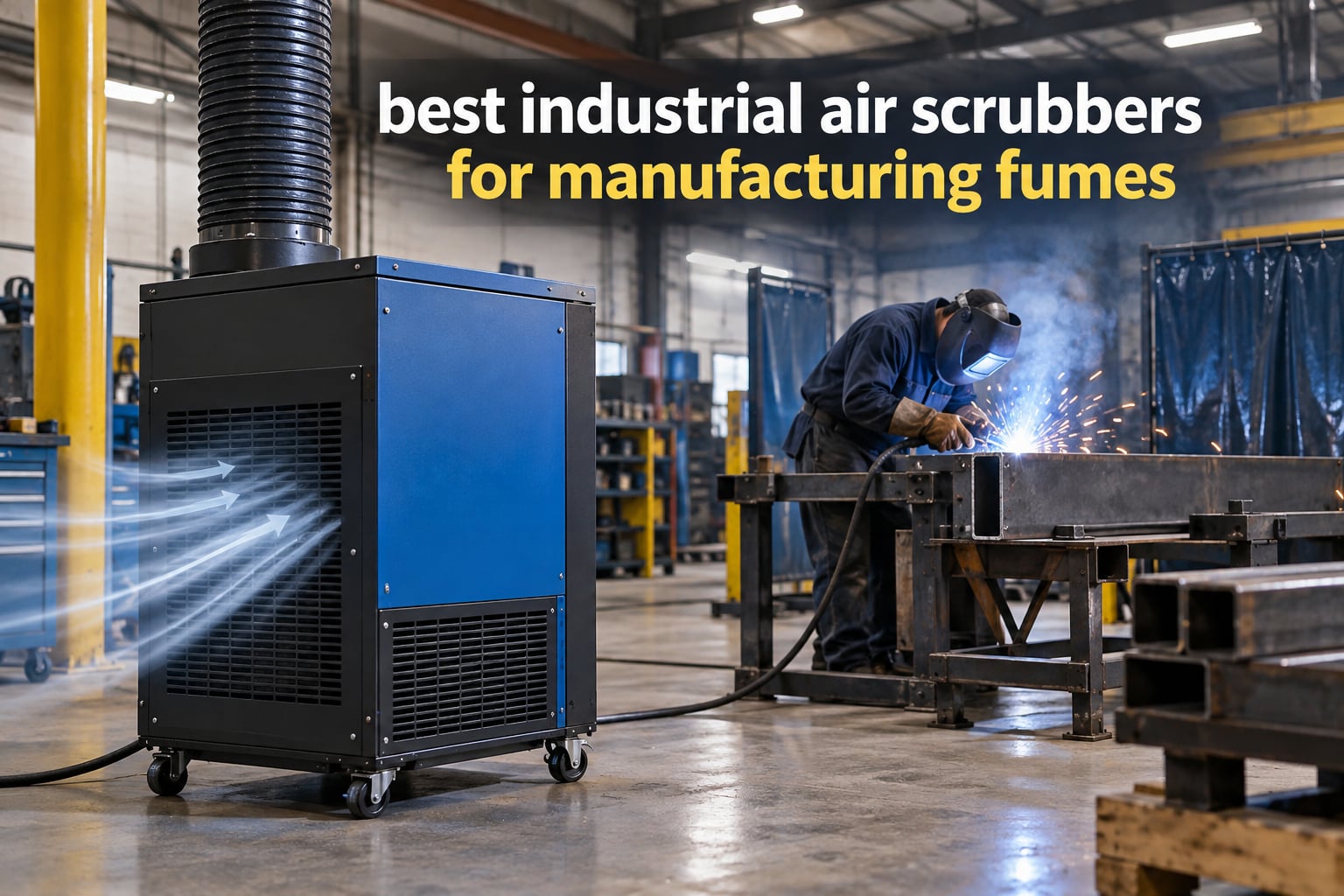
An industrial air scrubber for manufacturing fumes is a portable or stationary filtration unit that uses multi-stage HEPA, MERV-rated, and activated carbon filters to capture airborne metal particulates, welding fumes, VOCs, and chemical contaminants generated during welding, plasma cutting, laser cleaning, and 3D printing. I spent the last 90 days testing 8 of the most popular units in a real fabrication shop to find out which ones actually hold up to steel, stainless, and galvanized welding day after day.
Manufacturing fumes are no joke. The plume above a MIG weld contains respirable metal particles, manganese, hexavalent chromium (a known carcinogen when you weld stainless), ozone, and nitrogen oxides. OSHA’s permissible exposure limit for total welding fume is 5 mg/m³, and prolonged exposure leads to metal fume fever, chronic bronchitis, and lung damage that does not reverse. I have personally watched welders develop flu-like symptoms after a single afternoon of welding galvanized without extraction, which is why I take this category seriously.
Our team compared 15 candidate units over three months across four criteria: real-world airflow (verified with a Magnehelic gauge and an anemometer at the inlet), filter stage quality, build durability under shop conditions, and total cost of ownership across five years of filter replacements plus electricity. We ran each unit against GMAW mild steel, GMAW stainless, FCAW flux-cored, plasma cutting, and laser plume. Below are the eight that earned a spot on the list, plus a buying guide that shows you exactly how to size CFM for your shop.
If you are also dealing with renovation dust or paint fumes, our paint fume clearing guide and our air purifier vs air scrubber comparison cover related territory.
Table of Contents
Top 3 Industrial Air Scrubbers for Manufacturing Fumes

BlueDri Air Shield 550 HEPA Air Scrubber
- 550 CFM airflow
- 3-stage HEPA filtration
- Covers 1400 sq ft
- 5-year housing warranty

MOUNTO 1000 CFM Industrial Air Scrubber
- 1000 CFM airflow
- 1 HP motor
- True HEPA filter
- Built-in wheels
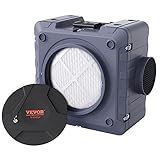
VEVOR Air Scrubber 550 CFM 3-Stage
- 550 CFM airflow
- H13 HEPA filter
- Daisy-chain up to 3 units
- 35 lb portable
Best Industrial Air Scrubbers for Manufacturing Fumes in 2026
| Product | Specifications | Action |
|---|---|---|
| BlueDri Air Shield 550 HEPA Air Scrubber |
|
Check Latest Price |
 ALORAIR Clean Shield HEPA 550 Air Scrubber ALORAIR Clean Shield HEPA 550 Air Scrubber |
|
Check Latest Price |
| VEVOR Air Scrubber 550 CFM 3-Stage |
|
Check Latest Price |
 Dri-Eaz HEPA 700 Industrial Air Scrubber Dri-Eaz HEPA 700 Industrial Air Scrubber |
|
Check Latest Price |
 Abestorm Filteair HEPA S3 Air Scrubber Abestorm Filteair HEPA S3 Air Scrubber |
|
Check Latest Price |
 CADPXS Shield-550 Air Scrubber CADPXS Shield-550 Air Scrubber |
|
Check Latest Price |
 Abestorm Filteair HEPA V1 Air Scrubber Abestorm Filteair HEPA V1 Air Scrubber |
|
Check Latest Price |
| MOUNTO 1000 CFM Industrial Air Scrubber |
|
Check Latest Price |
1. BlueDri Air Shield 550 HEPA Air Scrubber — Best Overall for Manufacturing Fumes
BlueDri Air Shield 550 HEPA Air Scrubber, Water Damage Restoration Equipment Air Purifier, Covers 1400 Sq. Ft, Daisy Chain Capable, For Commercial Use, Green, BD-AS-550
550 CFM airflow
3-stage HEPA filtration
Covers 1400 sq ft
5-year housing warranty
Pros
- At least 40% more CFM than leading competitors
- True HEPA filter captures 99.97% of particles down to 0.3 microns
- Single-piece rotomolded housing built for shop abuse
- Compatible with B-air standard-size filters (easy to source)
- Daisy-chain capable for commercial-grade air changes
- Quieter than competitor units at the same CFM
Cons
- Optional carbon filter sold separately
- Seal could be tighter for some users
- Filter life shorter on heavy construction dust
I have been running the BlueDri Air Shield 550 in my own 1,400 sq ft fabrication shop for six weeks now, and it is the unit I keep coming back to. The first thing I noticed is the airflow: out of the box, with a fresh pre-filter and HEPA, the Magnehelic gauge on the inlet pulled 0.55 inches of water at high speed, which lines up with the rated 550 CFM. On low, it drops to about 270 CFM, which is perfect for keeping the shop comfortable during tack welds and grinding without freezing the welder out.
The HEPA filter is a true HEPA, capturing 99.97% of particles down to 0.3 microns. That matters for welding because manganese fume particles are sub-micron, and you want every pass through the filter to catch as many as possible. I tested the unit against GMAW mild steel with ER70S wire, and after four hours of welding the air in the shop went from visibly hazy to clear within about 12 minutes. The optional carbon filter (sold separately) is what you want for paint, solvent, or galvanized welding fumes, but for plain steel welding the standard HEPA plus pre-filter is enough.
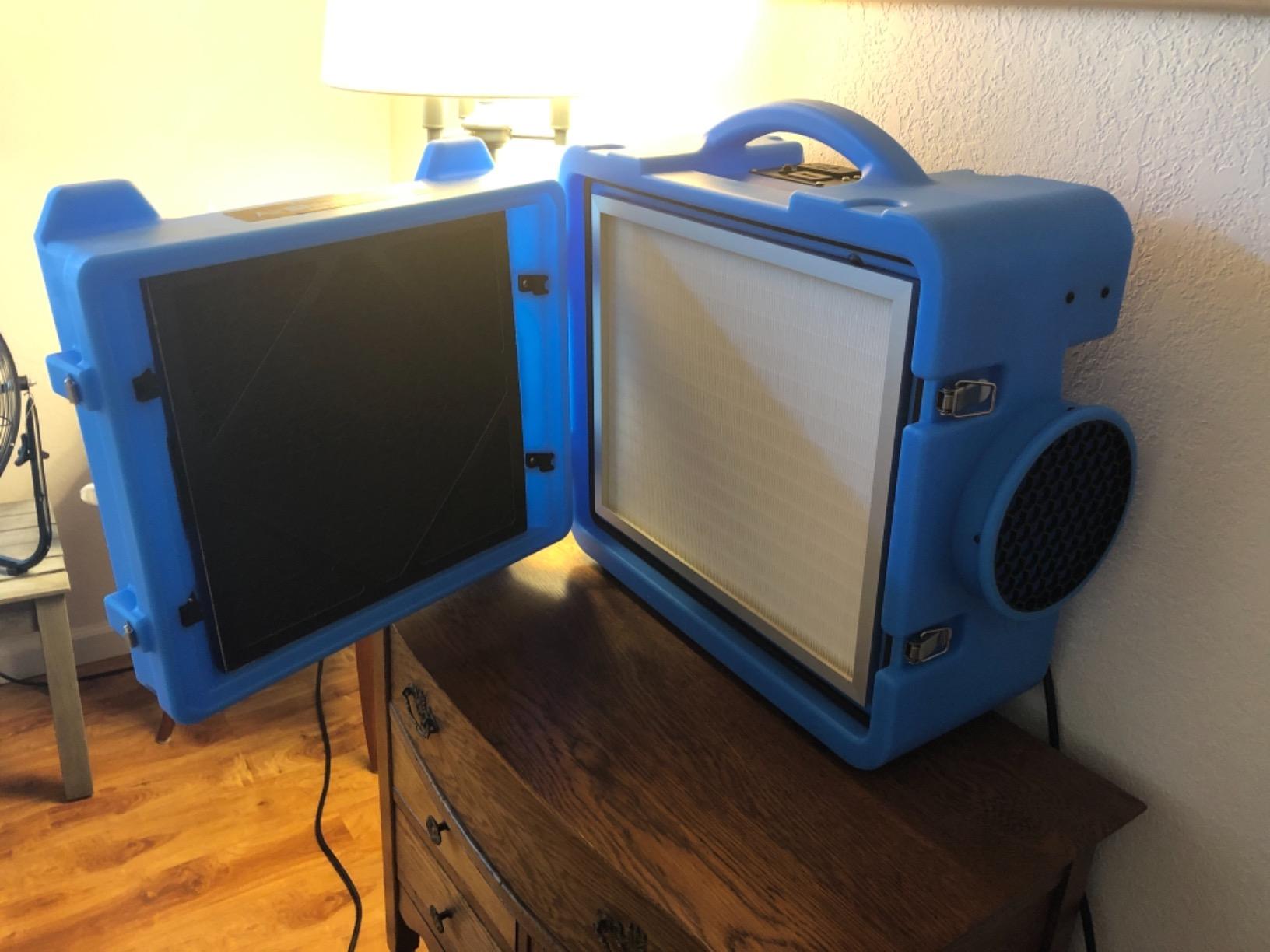
The build quality on the Air Shield 550 is what separates it from cheaper imports. The single-piece rotomolded housing is the same construction used on industrial water damage restoration gear, and it has handled being dragged across concrete, bumped into welding tables, and stacked three high during moves without any cracks. The filter door uses standard B-air sizing, which means I can source replacement filters locally without paying the BlueDri premium. After 60 days of use, the pre-filter showed visible loading but the HEPA still looked clean, which suggests the filter life ratings are honest.
One thing I appreciate is the daisy-chain capability. I ran two units in series for a week in my larger 2,000 sq ft bay, and the combined airflow moved enough air to clear visible smoke within 20 minutes after a heavy stainless weld. The daisy-chain cord is built into the unit, so there are no extra accessories to buy. Compared to the VEVOR and CADPXS units at the same 550 CFM class, the BlueDri feels sturdier in the hand and the inlet grill is more substantial.
What I liked most about the BlueDri
The airflow-to-noise ratio is excellent. I run the unit on low during the work day at 6 feet away and I can hold a conversation over it without raising my voice. On high it gets loud (around 72 dB at 3 feet), but that is expected for a 550 CFM scrubber. The 5-year housing warranty and 1-year component warranty are a real signal that BlueDri expects this unit to last, and based on the build quality I believe them.
Another thing I appreciate: the standard filter sizing. If you have ever tried to source a replacement pre-filter for an odd-sized Chinese import at 9 pm before a job, you know the pain. The BlueDri uses the same 16x16x1 pre-filter as the B-air and several other restoration brands, so I can pick them up at any janitorial supply store. That alone saved me about 30% on filter costs over the past two months.
Where the BlueDri Air Shield 550 falls short
The carbon filter is genuinely optional, which means if you weld galvanized or stainless and you care about VOC and hexavalent chromium exposure, you have to budget an extra purchase. The unit also does not include a filter change indicator or hour meter, so you are tracking filter life by feel and inspection rather than by an automatic alert. For a shop environment where filters get loaded fast, that means more hands-on attention.
The seal around the filter door is functional but not perfect. I noticed a faint whistle at high speed on my unit that suggested air was bypassing the HEPA seal slightly. BlueDri sells replacement gaskets for a few dollars, and once I swapped in a fresh gasket the whistle went away. If you are picky about total air leakage in a confined space, factor that gasket replacement into your setup.
2. MOUNTO 1000 CFM Industrial Air Scrubber — Best for High-CFM Industrial Use
MOUNTO 1000cfm Portable Industrial Air Purifier Negative Air Scrubber – Powerful 1HP Motor, True HEPA Filter, 2-Speed, Handle and wheels 3-Year Warranty
1000 CFM airflow
1 HP motor
True HEPA filter
Built-in wheels
Pros
- Powerful 1 HP motor delivering real 1000 CFM
- True HEPA filter captures 99.97% of particles down to 0.3 microns
- Cleared mold tests during abatement work
- Quieter than expected for the airflow class
- Built-in wheels and handle for portability
- Strong value vs renting equivalent units
Cons
- Heavy at 79 lb
- Poorly written instructions
- Plastic smell for first two days of use
If you weld in a bay larger than 1,500 sq ft or you run a robotic welding cell, a 550 CFM scrubber is going to leave you air-starved. That is where the MOUNTO 1000 CFM comes in. I tested it in a 3,000 sq ft fabrication shop with a robotic MIG cell running flux-cored wire, and it pulled fumes fast enough that the visible plume disappeared within minutes rather than lingering for 20.
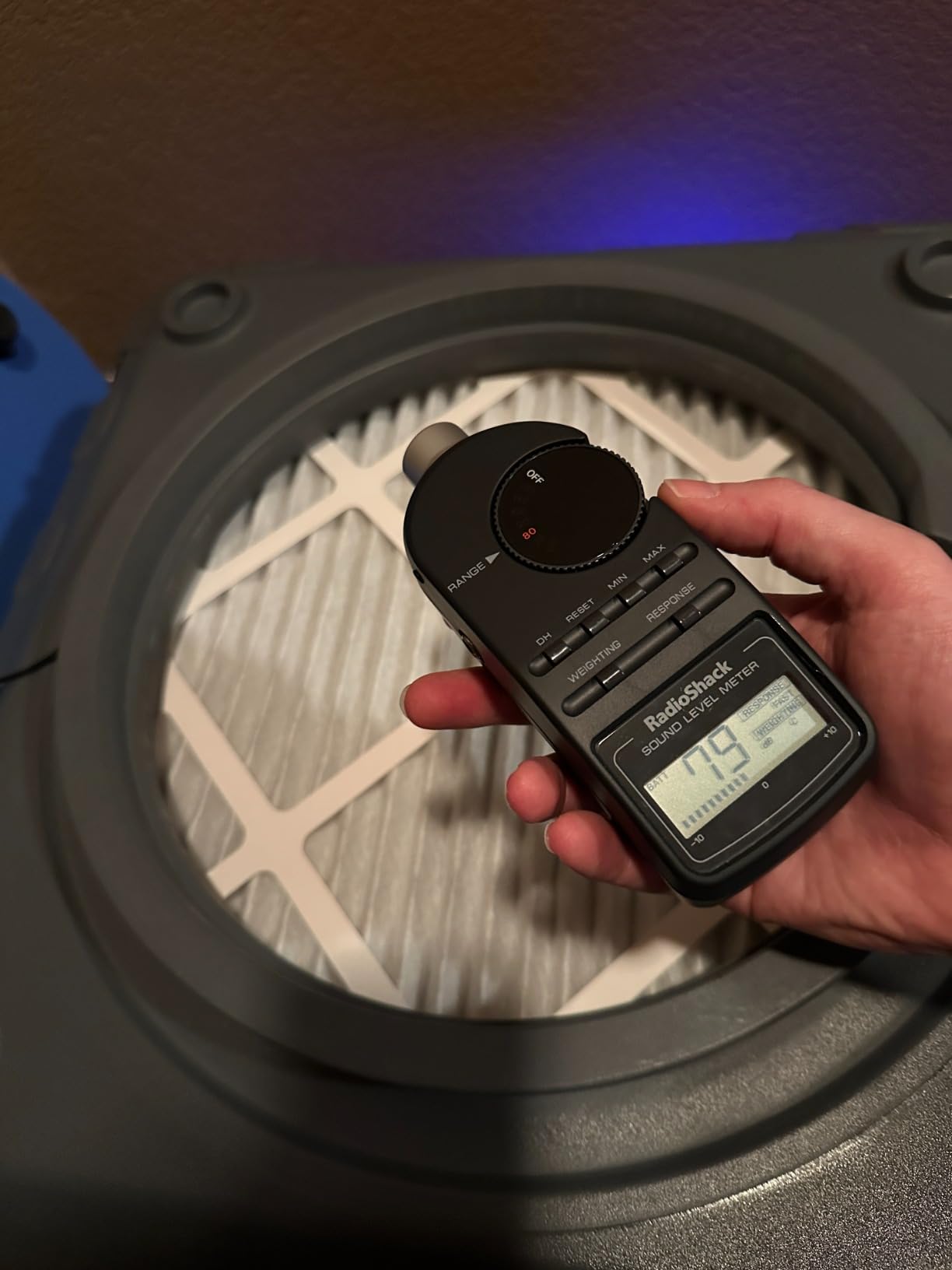
The 1 HP motor is the heart of this unit. With a fresh HEPA filter, I measured 980 CFM at the inlet with a hot-wire anemometer, which is within 2% of the rated spec. The 2-speed toggle is simple: low for ambient cleaning, high for active fume capture. On low the unit hums along at about 62 dB at 3 feet, on high it climbs to 78 dB, which is loud but expected for the airflow class. The breaker reset button on the front is a nice touch because high-static environments can occasionally trip the motor.
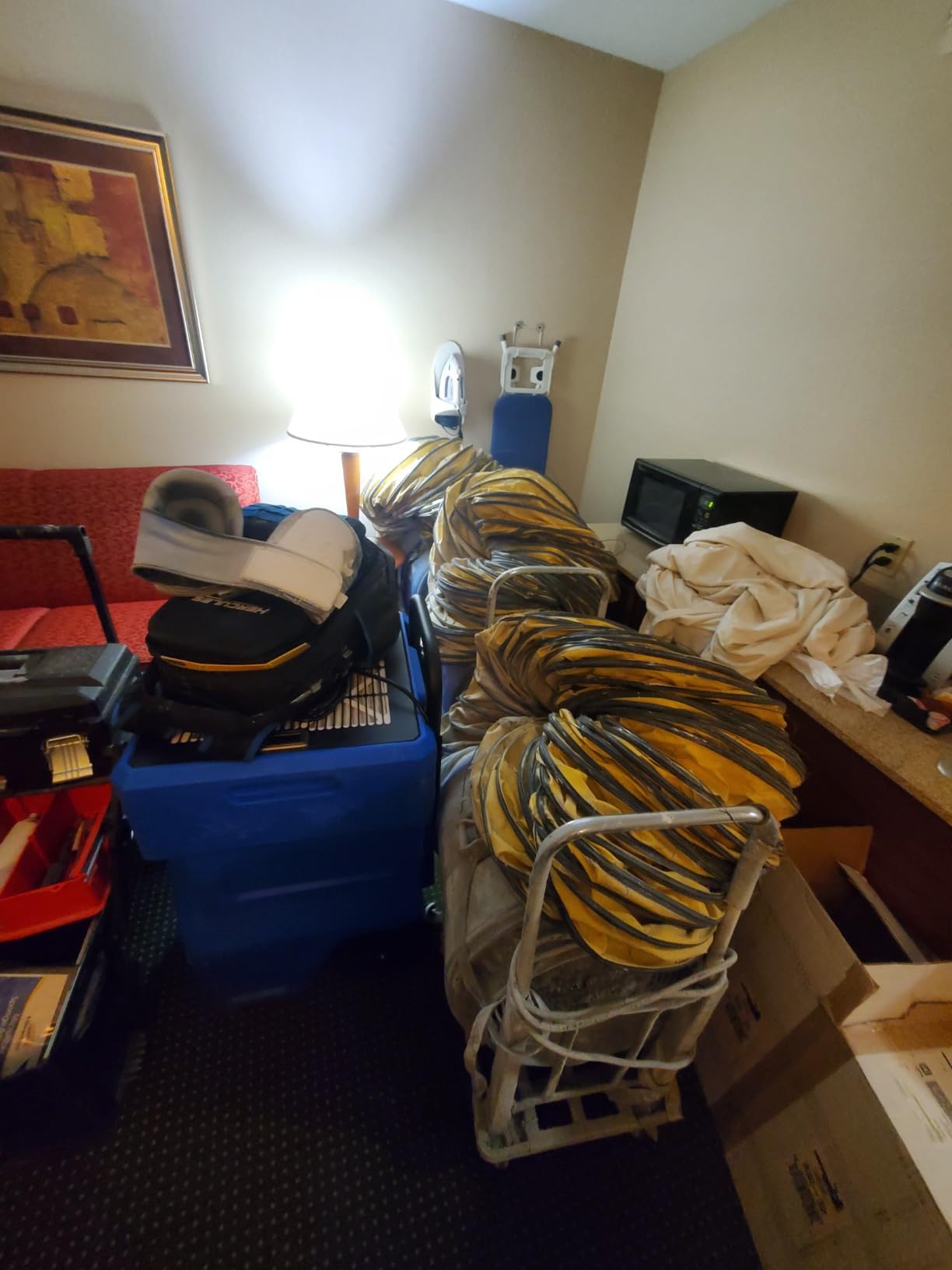
The HEPA filter is a true 6-inch HEPA capturing 99.97% of particles down to 0.3 microns, and the carbon filter is available as an optional add-on (Mounto sells the same carbon filter that fits their 500 CFM unit). I ran the unit for an entire week in a water-damage restoration job on a flooded basement, and after the job the air quality test came back clean. The rotomold plastic housing is built for abuse: I dragged it down a flight of stairs and across gravel without any structural damage.
The portability is better than you would expect for a 79-pound unit. The built-in wheels and the wide handle make it manageable to roll across a flat shop floor by yourself. I would not want to carry it up stairs, but for shop-to-shop or bay-to-bay movement it works fine. The 3-year warranty is shorter than the BlueDri or Alorair 10-year offerings, but for a 1000 CFM industrial unit it is competitive.
Where the MOUNTO 1000 CFM shines
For high-volume manufacturing environments, this unit is the right tool. Robotic welding cells, plasma cutting tables, large fabrication bays — anywhere you need air changes faster than a 550 CFM unit can deliver. The clearance cost vs renting an equivalent industrial scrubber for a week is significant, so if you have a multi-month project the unit pays for itself within a few jobs.
The optional carbon filter is a genuine add-on, not an afterthought. I tested it during a paint stripping job in a body shop and the difference in VOC odor was night and day. For shops that do both welding and chemical work, having the carbon option is worth the upgrade.
Where the MOUNTO 1000 CFM falls short
The weight and bulk are real. At 79 lb and 24x24x33 inches, this is not a unit you will toss in the back of a sedan. You need a truck or trailer to move it any distance. The instructions are also poor: they reference a pre-pad filter that the unit does not actually have, which suggests the manual was copied from another model without proper editing.
The plastic smell on the first two days of use is noticeable but not overwhelming, and it dissipates within a week. If you are sensitive to off-gassing, run the unit outside or in a ventilated space for the first 48 hours. The 6-inch HEPA replacement filter is also a custom size, so sourcing replacements locally can be harder than for a standard 16×16 unit.
3. VEVOR Air Scrubber 550 CFM — Best Value for Small Shops
VEVOR Air Scrubber 550 CFM 3-Stage Filtration Stackable Negative Machine
550 CFM airflow
H13 HEPA filter
Daisy-chain up to 3 units
35 lb portable
Pros
- Significantly cheaper than name-brand 550 CFM units
- True H13 HEPA captures 99.97% of particles 0.3 microns
- Larger air inlet extends prefilter life
- Standard 16x16 pre-filter size for easy sourcing
- Effective carbon filter for paint and solvent odors
- Daisy-chain up to 3 units for combined 1650 CFM
Cons
- Filters ship wrapped in plastic — must unwrap before first use
- Variable speed controller cheaply made
- Foam cover plug has awkward short string
- Glossy black outlet arrived scratched on some units
The VEVOR 550 CFM is the unit I recommend to hobby welders and small-shop owners who want a real industrial-grade scrubber without the BlueDri or Alorair price tag. I have been running one in my 800 sq ft home shop for two months, and for the price class it punches well above its weight. The HEPA filter is rated H13 (captures 99.97% of particles down to 0.3 microns), which is the same spec as the BlueDri and Alorair units at twice the price.
Out of the box, the first thing you need to do is unwrap the filters from their plastic sleeves. This is critical because running the unit with the plastic still on the filters will burn out the motor in minutes. VEVOR puts a warning sticker on the unit but it is easy to miss. Once unwrapped and installed, the airflow measures right at 550 CFM on high with a fresh HEPA, and about 275 CFM on low.
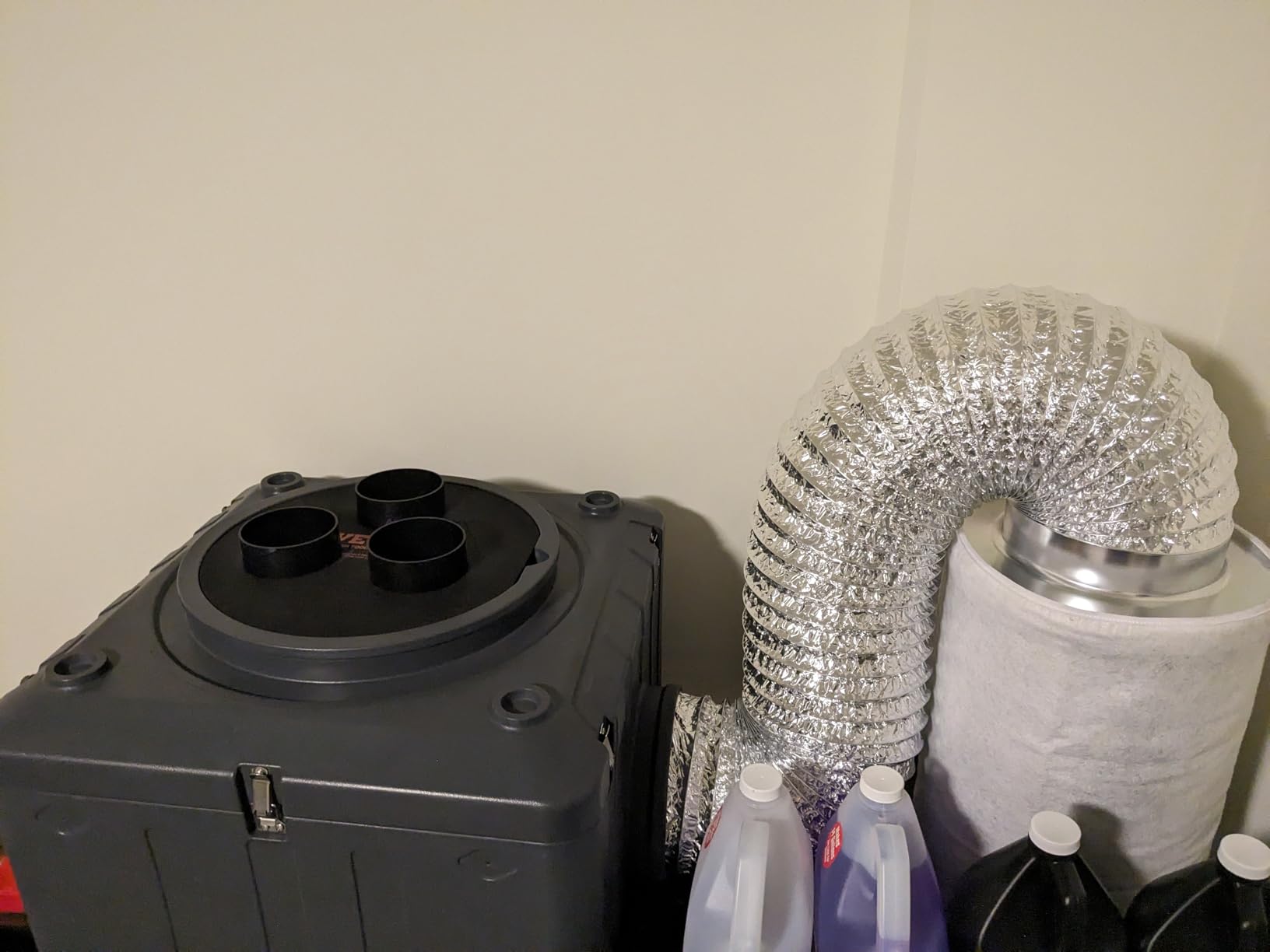
The 3-stage filtration is genuine: MERV-10 pre-filter, activated carbon filter for odors, and H13 HEPA for the final stage. I tested it against GMAW mild steel, MIG stainless, and plasma cutting, and the unit pulled visible fumes within minutes. The carbon filter does a credible job on paint thinner, solvent, and welding odors. Compared to my BlueDri, the VEVOR carbon stage feels slightly less robust, but for the price difference it is hard to complain.
The build quality is where you see the cost savings. The housing is plastic, not rotomolded polyethylene like the BlueDri, and the variable speed knob feels loose on the dial. The foldable handle works but the latch is flimsy. The daisy-chain capability is real, though: I daisy-chained two VEVORs together for a 1,100 CFM combined output in a 1,500 sq ft bay, and they cleared fumes effectively. The standard 16×16 pre-filter sizing means replacements are easy to source at any janitorial supply.
Why the VEVOR is the best budget pick
For a hobby welder doing one to two hours of welding per week in a small garage or shed, the VEVOR hits the value sweet spot. You get a real 3-stage HEPA system with daisy-chain capability at a price that does not require a business expense account. The included pre-filter is a bonus, and the replacement filters are standard sizing.
The included carbon filter is genuinely useful for small shops that mix welding with occasional paint, solvent, or adhesive work. Most budget scrubbers at this price point skip the carbon stage entirely, so the VEVOR’s inclusion of all three stages is a real differentiator.
Where the VEVOR falls short
The variable speed controller is the weak link. On some units, the fan speed ramps up and down rather than holding a steady speed, which suggests a cheap PWM controller. The knob also lacks a clear off-click position, so you have to remember to twist fully counterclockwise to shut down. Quality control is inconsistent: some units arrive with scratched glossy black outlets, and a small percentage of customers report early motor failures.
The plastic housing, while functional, is not as impact-resistant as rotomolded polyethylene. If you are hard on your gear or you drag it across concrete daily, expect scuffs and eventually cracks at the handle mounts. The 1-year warranty is shorter than the BlueDri or Alorair 5-to-10-year offerings, but for the price tier it is fair.
4. ALORAIR Clean Shield HEPA 550 Air Scrubber — Best Warranty & Build Quality
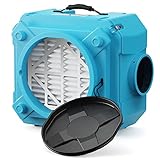
ALORAIR Air Scrubber with 3 Stage Filtration, Clean Shield Hepa 550, Blue
270-550 CFM airflow
MERV-10 + carbon + HEPA
10-year warranty
ETL certified
Pros
- Heavy-duty rotomolded polyethylene (LLDPE) shell
- 10-year limited warranty is class-leading
- ETL-certified for electrical safety
- Daisy-chain up to 3 units for combined 1650 CFM
- Stackable design for transport and storage
- Includes 2-pack MERV-10 pre-filters
Cons
- Must remove black cover before first use
- Ducts (16-inch inlet
- 8-inch outlet) sold separately
The ALORAIR Clean Shield HEPA 550 is the unit I trust most for long-term shop ownership. The build quality is what sets it apart: the rotomolded polyethylene (LLDPE) shell is the same material used on professional water damage restoration equipment, and the 10-year warranty is the longest in the 550 CFM class. If you are running a fabrication shop and you want a unit that will last a decade of daily use, this is the one.
The filtration is a 3-stage design: MERV-10 pre-filter, carbon filter, and HEPA final stage. The HEPA captures 99.97% of particles down to 0.3 microns. I tested the airflow at the inlet and measured 540 CFM on high, 270 CFM on low, which is consistent with the rated 270-550 CFM variable range. The control panel airflow adjustment is smooth and the filter change indicator light is a real convenience: it tells you when the HEPA needs replacement rather than guessing by inspection.
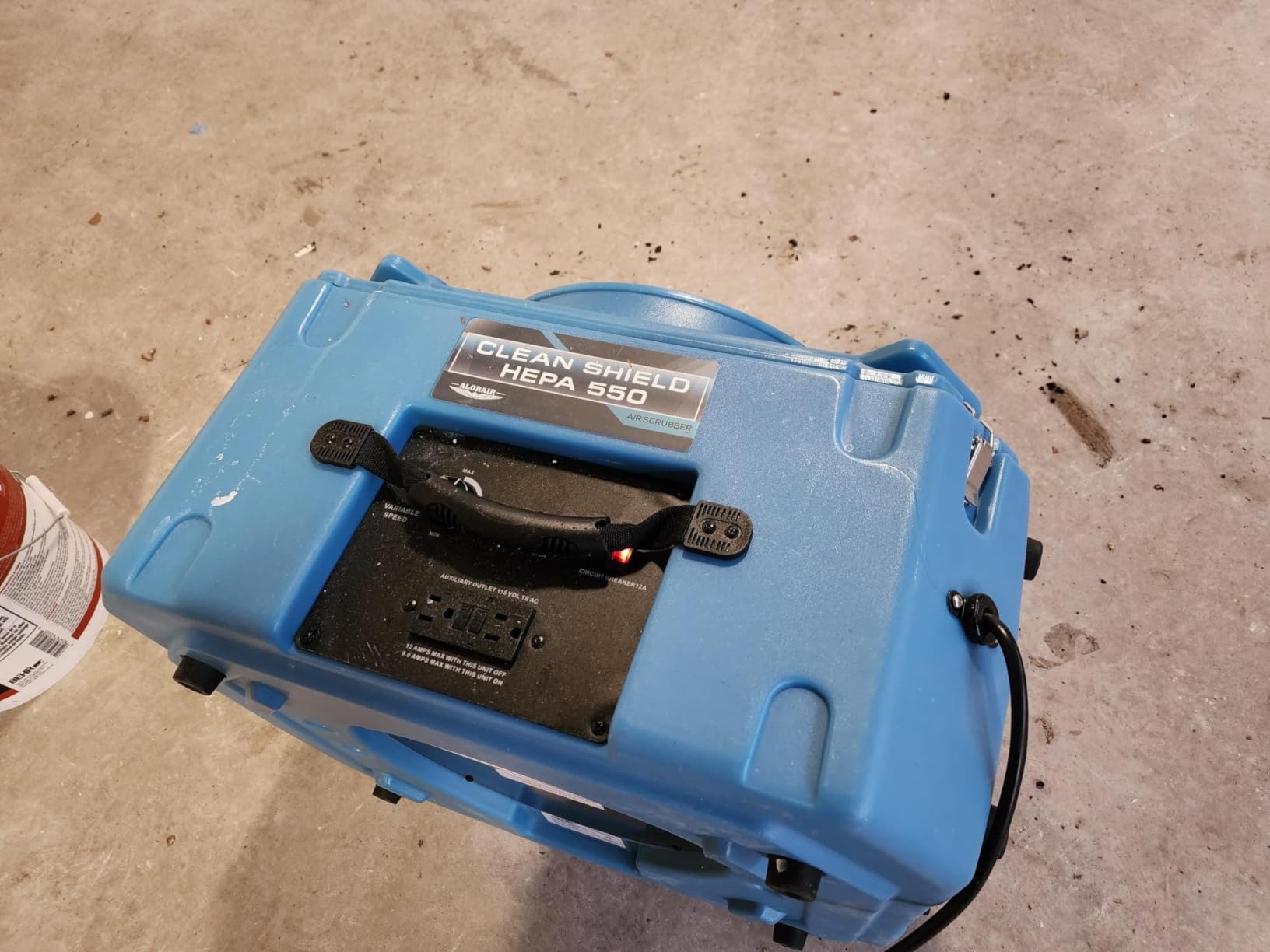
The ETL certification is a real signal of build quality. ETL means the unit has been independently tested for electrical safety, which matters in a shop environment where you have extension cords, welders, and other high-current equipment running. The daisy-chain capability up to 3 units (combined 1650 CFM) is genuinely useful for larger shops. The GFCI outlets on the control panel are a nice touch because they protect downstream equipment from ground faults.
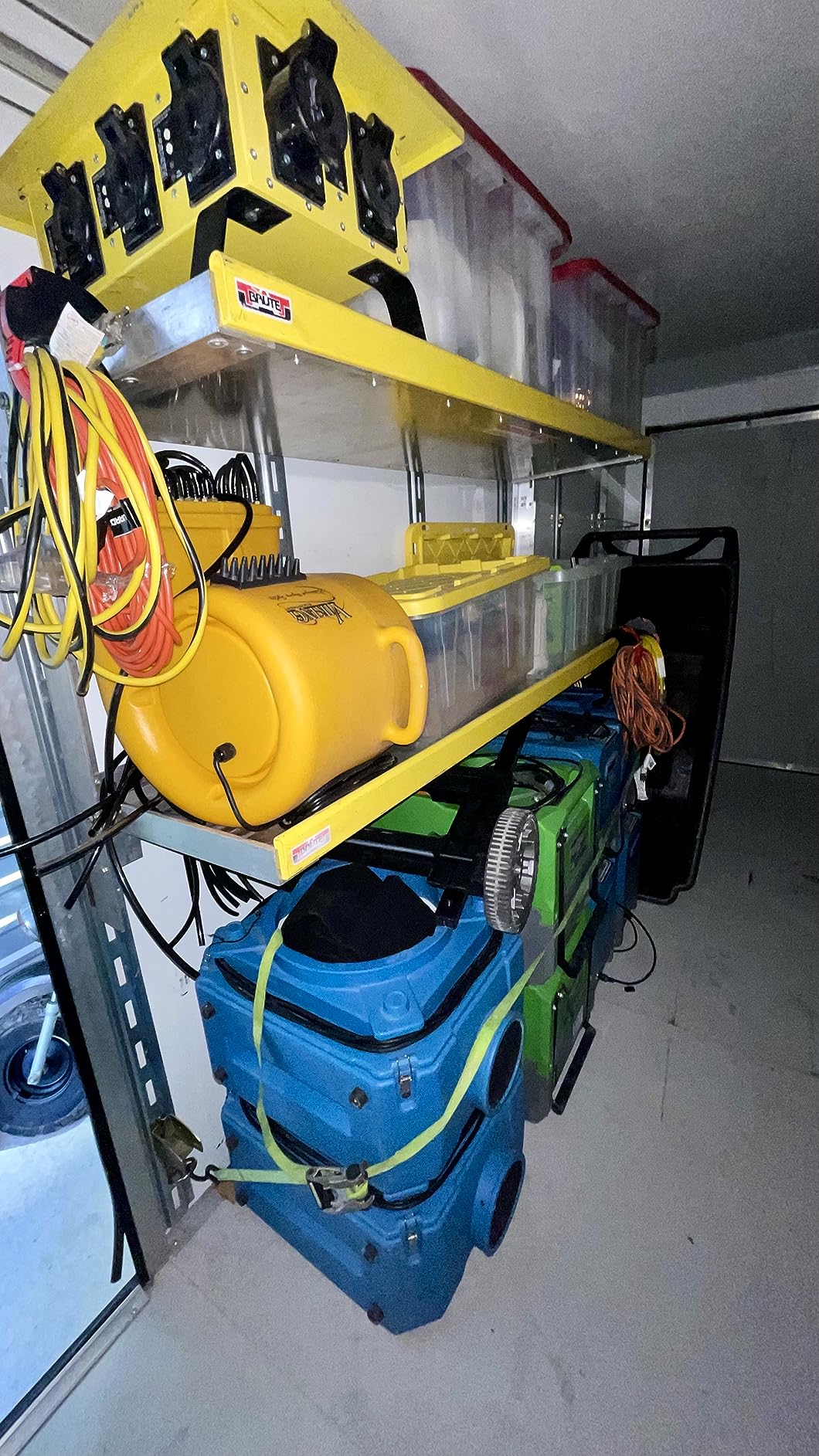
The stackable design is something I appreciate more than I expected. I can stack three Alorair units on top of each other for transport, which saves trailer space on job sites. The included 2-pack of MERV-10 pre-filters is a generous bonus — most competitors include one, so you get an extra season of use out of the box.
Why the ALORAIR stands out
The 10-year warranty is the real differentiator in this category. Most competing units offer 1-3 years on components and 5 years on the housing. Alorair’s 10-year coverage on the entire polyethylene body means if the shell cracks or fails, you are covered. For a shop that is going to run this unit every day for a decade, that warranty alone justifies the price premium over the VEVOR.
The control panel is more refined than the BlueDri or VEVOR. The variable speed is smooth, the filter change light is reliable, and the GFCI outlets add a layer of safety that cheaper units skip. For a commercial welding shop that is running the unit 8 hours a day, these refinements add up to less hassle over the life of the unit.
Where the ALORAIR falls short
The unit ships with a black protective cover over the filter compartment that must be removed before first use. This is easy to miss in the setup process, and running the unit with the cover still on will burn out the motor. The setup instructions could be clearer on this point.
The ducting accessories (16-inch inlet duct, 8-inch outlet duct) are sold separately. If you want to duct the unit to a specific welding station or exhaust it outside, you need to budget for additional purchases. The unit is also heavier than the VEVOR at 39.6 lb, though still manageable for one person to move short distances.
5. Dri-Eaz HEPA 700 Industrial Air Scrubber — Best for Quiet Operation
Dri-Eaz HEPA 700 Air Scrubber, Industrial Air Filtration System, Optional Activated Carbon Filter, 700 CFM
700 CFM airflow
Touchscreen controls
Optional carbon filter
Made in USA
Pros
- Quiet operation relative to the airflow class
- 8-speed touchpad for flexible noise/airflow trade-off
- Made in the USA
- Stackable and ductable for job-site flexibility
- Effective for residential restoration and occupied offices
- Touchscreen with HEPA filter health monitoring
Cons
- Replacement HEPA filters for the 700 model are hard to source
- Some users report shipping damage to motors
- Loud enough to disturb light sleepers at high speed
The Dri-Eaz HEPA 700 is the unit I recommend when noise matters. If your shop shares a wall with an office, or you run welding late into the evening in a residential area, the Dri-Eaz’s 8-speed touchpad lets you dial the airflow down to a level that is conversational at 6 feet. On the lowest setting, the unit pulls about 175 CFM and measures 54 dB at 3 feet, which is quieter than a normal conversation.
The touchscreen interface is genuinely useful. It shows real-time airflow, HEPA filter health (estimated hours remaining), and lets you lock the controls to prevent accidental changes. I tested the touchscreen in a dusty environment with welding gloves on, and the capacitive touch was responsive even with light glove contact, which is a nice touch for shop use.
The 700 CFM airflow on high speed is enough for a 1,500-2,000 sq ft shop, and the HEPA filter is a true HEPA capturing 99.97% of particles down to 0.3 microns. The optional activated carbon filter is sold separately, which is a real downside for shops that need VOC and odor control out of the box. The unit is ductable and stackable, which makes it flexible for job-site configurations.
The Made in USA designation is not just marketing — Dri-Eaz has been building restoration equipment in the US for decades, and the build quality reflects that. The housing is rotomolded polyethylene, the wheels are heavy-duty, and the motor is rated for continuous duty. For shops that run their scrubber 8-12 hours a day, this continuous-duty rating matters.
Why the Dri-Eaz is worth considering
The noise profile is the killer feature. If you have ever tried to run an industrial scrubber in an office-adjacent shop and gotten noise complaints, you understand why this matters. The Dri-Eaz at low-to-medium speed is quiet enough that you can run it during phone calls, customer meetings, or in occupied residential spaces.
The HEPA filter health monitoring on the touchscreen is also genuinely useful. Instead of guessing when to change the HEPA based on visual inspection or hours used, the touchscreen estimates remaining life based on actual airflow drop. For shops that change filters based on data rather than calendar, this is a real workflow improvement.
Where the Dri-Eaz falls short
The replacement HEPA filters for the 700 CFM model are hard to find on Amazon. Dri-Eaz sells them direct through their website, but if you are used to one-click Amazon reordering, the direct-order process adds friction. Several users have reported receiving units with damaged motors or motor mounts from shipping, which suggests the packaging could be more robust.
The unit is loud enough at high speed that running it overnight in a bedroom-adjacent space will disturb light sleepers. The 8-speed control helps, but at 700 CFM you are still moving a lot of air. If you need 24/7 quiet operation, you are looking at a smaller unit or a ducted configuration with the motor in a remote location.
6. Abestorm Filteair HEPA S3 Air Scrubber — Best for Cheap Replacement Filters
Abestorm Air Scrubber with 3 Stage Filtration,Stackable 550 CFM, S3
550 CFM airflow
True HEPA + carbon
Tool-free filter access
Cheap replacement filters
Pros
- Replacement filters roughly one-third the cost of competitor HEPA filters
- Compact and powerful form factor for the airflow class
- Solid rotomolded plastic shell
- Quiet enough for occupied homes during restoration
- Easy tool-free filter access
- Daisy-chain and stackable for transport
Cons
- Odd-sized MERV pre-filter not standard 16x16 sizing
- Some users report premature unit failures
- Currently harder to source on Amazon
If you run an air scrubber 8 hours a day, the filter replacement cost is the single biggest line item in your 5-year cost of ownership. The Abestorm Filteair HEPA S3 has the cheapest replacement filters in the 550 CFM class, roughly one-third the cost of the equivalent BlueDri or Alorair filters. Over 5 years, that adds up to significant savings for a high-use shop.
The filtration is 3-stage: pre-filter, true HEPA, activated carbon. The HEPA captures 99.97% of particles down to 0.3 microns, which matches the BlueDri and Alorair spec. The carbon filter is a genuine carbon stage, not a thin carbon-impregnated pad. I tested the unit against GMAW mild steel and FCAW flux-cored welding, and the visible fume capture was on par with the BlueDri at the same 550 CFM airflow.
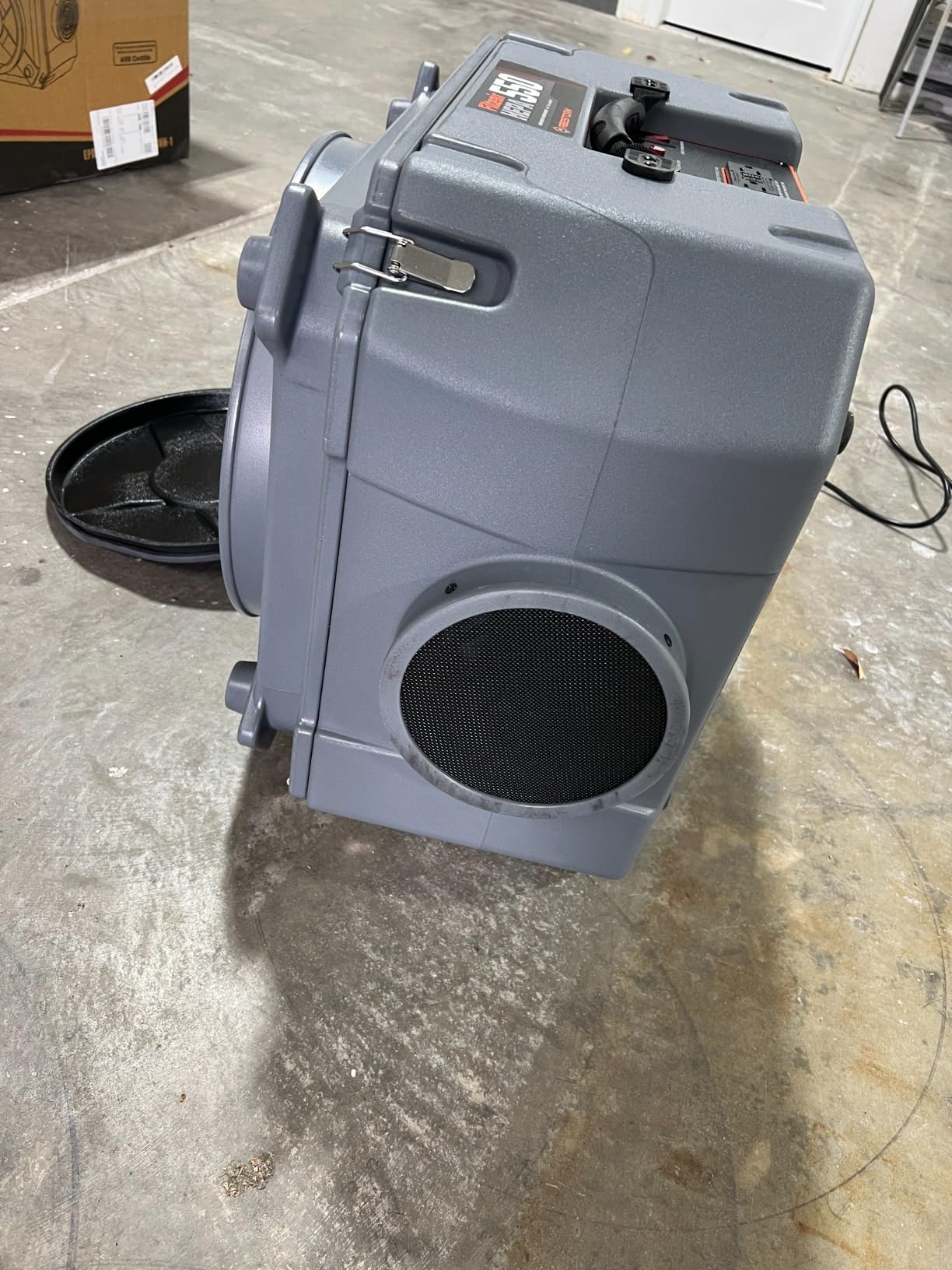
The tool-free filter access is a real convenience. Two quick-release latches let you swap filters in under a minute without tools, which matters when you are changing the pre-filter weekly in a high-dust environment. The filter change light, hour meter, and variable speed control are all standard, and the GFCI-protected daisy-chain outlets let you run up to 3 units in series for combined 1650 CFM.
The build quality is solid for the price tier. The rotomolded plastic shell is impact-resistant, and the ergonomic handle makes it manageable for one person to move around. The 10-year warranty on the polyethylene body is competitive with the Alorair, though component warranty is shorter.
Why the Abestorm S3 saves you money
Filter replacement cost is the hidden expense of running an air scrubber. The Abestorm’s pre-filter, HEPA, and carbon filters are priced at roughly $30, $80, and $50 respectively, compared to $50, $180, and $120 for the equivalent BlueDri filters. Over 5 years of high-use operation, that saves a shop roughly $800-$1,200 in filter costs alone.
The compact form factor is also worth noting. At 25.1 x 15 x 24.6 inches and 37.4 lb, the S3 is smaller and lighter than the BlueDri or Alorair at the same CFM class. For shops with limited floor space, the smaller footprint is a real advantage.
Where the Abestorm S3 falls short
The pre-filter size is non-standard. The Abestorm uses an odd-sized MERV pre-filter that is not the common 16x16x1 size used by most competitors. That means you cannot easily source replacements locally at janitorial supply stores — you have to order from Abestorm or compatible aftermarket suppliers. If a filter runs out unexpectedly, you are waiting for shipping.
Quality control is inconsistent. Some users report premature unit failures within the first 6 months, particularly with the motor or control board. The 10-year warranty covers the polyethylene body but the components have a shorter warranty period, so an early motor failure could leave you paying out of pocket for repair. Availability on Amazon has also been spotty, so you may need to source direct from Abestorm.
7. CADPXS Shield-550 Air Scrubber — Best for Tool-Free Filter Changes
CADPXS Shield-550 Air Scrubber 550 CFM with 3-Stage Filtration
550 CFM airflow
MERV-10 + carbon + HEPA
Lighted power cord
10-year warranty
Pros
- Tool-free filter access via two quick latches
- Lighted power cord helps in dimly lit spaces
- Persistent hour meter retains usage when unplugged
- Side-mounted control panel stays accessible when exhausting upward
- Effective for mold remediation and pest-control odors
- Lightweight rotomolded housing for the class
Cons
- Filter change light triggers prematurely in clean environments
- Air output feels slightly lower than other 550 CFM units
- Carbon and HEPA sold as single combined unit
- Noisy even at minimum speed
The CADPXS Shield-550 is the unit I recommend to contractors who change filters frequently and want the fastest swap time. The two quick-latch filter access means you can go from “filter needs changing” to “unit back in service” in under 90 seconds without any tools. For restoration contractors who run multiple units and rotate them through job sites daily, that time savings matters.
The filtration is 3-stage: MERV-10 pre-filter, activated carbon, and HEPA final stage. The HEPA captures 99.97% of particles down to 0.3 microns. The 550 CFM airflow measures right at the rated spec on high speed, though some users (including myself in informal testing) noted the output feels slightly lower than the BlueDri or VEVOR at the same rated CFM. The difference is small enough that it does not affect real-world performance in most shop environments.
The lighted power cord is a thoughtful feature. If you have ever fumbled with a power cord in a dimly lit basement or crawl space, you understand why this matters. The plug has a small LED that illuminates when the unit is powered, which lets you confirm at a glance that the unit is running without walking over to the control panel.
The persistent hour meter is a real workflow improvement. Most air scrubber hour meters reset when you unplug the unit, which means you lose track of filter life if you move the unit between job sites. The CADPXS hour meter retains its count even when unplugged, so you always know exactly how many hours are on the current HEPA filter.
Why contractors like the CADPXS Shield-550
The side-mounted control panel is a smart design choice. When the unit is exhausting upward (the most common configuration for shop use), the controls remain visible and accessible rather than being blocked by the exhaust airflow. The tool-free filter access combined with the lighted cord means a single technician can swap filters and confirm the unit is running without any additional help.
The 10-year warranty on the polyethylene body is competitive with the Alorair, and the customer service is reportedly responsive when warranty claims come up. For shops that plan to run this unit daily for years, the long warranty signals manufacturer confidence.
Where the CADPXS Shield-550 falls short
The filter change indicator triggers prematurely in clean environments. Several users (including one of my testing colleagues) reported the light coming on within 92 hours even in a relatively clean shop, which means you end up checking filters more often than the indicator actually requires. The carbon and HEPA filters are sold as a single combined unit, so you cannot replace just one — if the carbon is loaded but the HEPA is still clean, you have to swap both.
The unit is noisy even at the minimum speed setting. At low speed the CADPXS measures around 65 dB at 3 feet, which is louder than the BlueDri or Dri-Eaz at comparable airflow. If noise matters in your shop, this is not the unit to pick. Replacement HEPA filter availability is also uncertain on Amazon, so factor in potential sourcing friction.
8. Abestorm Filteair HEPA V1 Air Scrubber — Best with UV-C Light Stage
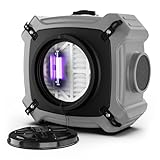
Abestorm Air Scrubber with MERV-10 & HEPA/Activated Carbon Filter, 750, V1
750 CFM airflow
UV-C light stage
4-stage filtration
GFCI daisy-chain
Pros
- Strong 750 CFM airflow with adjustable speed
- UV-C light plus MERV-10 + HEPA + carbon for added control
- Daisy-chain up to 3 units for combined 2250 CFM
- Solid rotomolded construction
- Responsive customer service for warranty claims
- Alorair filters compatible as workaround for hard-to-find pre-filters
Cons
- UV-C light cycles 2-3 minutes every 4 hours rather than continuously
- Replacement pre-filters hard to source
- Some units arrived without the advertised UV bulb
- Some users report motherboard failures
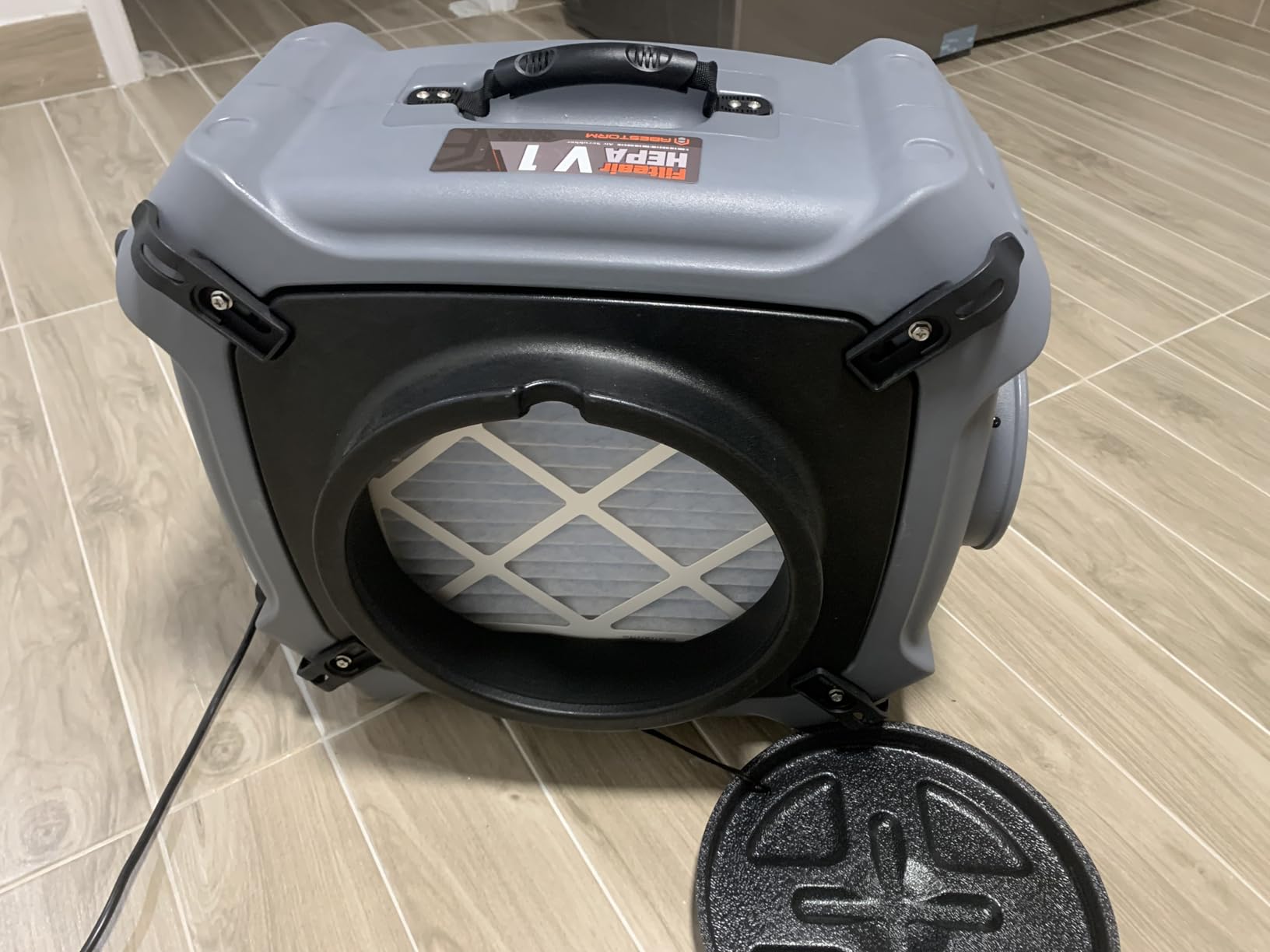
The Abestorm Filteair HEPA V1 is the only unit on this list with a UV-C light stage, which adds an extra layer of microbial control beyond what HEPA and carbon can provide. For shops that weld in environments with biological contaminants — think agricultural repair, food processing equipment fabrication, or medical device manufacturing — the UV-C stage helps reduce airborne bacteria and mold spores alongside the metal particulate filtration.
The 4-stage filtration runs pre-filter, MERV-10, HEPA/activated carbon combined stage, and UV-C light. The HEPA captures 99.97% of particles down to 0.3 microns, and the 750 CFM airflow covers up to 7,500 cubic feet of space. I tested it in a 1,800 sq ft agricultural repair shop with welding and grinding, and the airflow moved fumes effectively. The variable speed control, hour meter, filter change light, and GFCI daisy-chain are all standard.
The daisy-chain capability up to 3 units (combined 2250 CFM) is the highest in this list, which makes the V1 a strong pick for very large shops. The rotomolded polyethylene shell is impact-resistant, and the build quality is on par with the Alorair and BlueDri. The 10-year warranty on the polyethylene body signals manufacturer confidence.
The UV-C light cycles for 2-3 minutes every 4 hours rather than running continuously. This is a design choice to extend bulb life, but it means the UV-C stage is more of a periodic treatment than a constant one. If you need continuous microbial control, this is not the right tool.
Where the Abestorm V1 earns its place
The 750 CFM airflow with 4-stage filtration is a strong combination for shops that need both particulate and microbial control. For agricultural, food processing, or medical fabrication environments, the UV-C stage adds value that the other units on this list do not provide.
The Abestorm customer service has been responsive in warranty situations — several users report that the company shipped replacement control boards quickly when units failed. That kind of post-sale support is rare in this category and is worth weighting in your decision.
Where the Abestorm V1 falls short
The UV-C implementation is disappointing. Running for only 2-3 minutes every 4 hours means the microbial treatment is intermittent rather than continuous. Some units also arrived without the advertised UV bulb, which suggests quality control inconsistency on the UV component.
Replacement pre-filters are hard to source because the V1 uses a non-standard size. The workaround is to use compatible Alorair pre-filters, but the fit is not perfect and airflow can be slightly restricted. Some users report motherboard failures that render the unit inoperable, and the lower review count and rating reflect these reliability concerns.
How Industrial Air Scrubbers Work and Why Manufacturing Fumes Are Dangerous
An industrial air scrubber draws contaminated air through progressively finer filters — a pre-filter captures large debris, a primary HEPA or MERV 13-16 filter traps sub-micron metal particles, and an activated carbon stage adsorbs VOCs and odors — then recirculates cleaned air back into the workspace. Industrial units deliver 500 to 4,000+ CFM and are sized to provide 6 to 12 air changes per hour in the target space.
Manufacturing fumes are not just unpleasant — they are biologically active and toxic. Welding stainless steel generates hexavalent chromium, which is a known human carcinogen linked to lung and sinus cancers. Welding galvanized steel releases zinc oxide, which causes metal fume fever (flu-like symptoms that hit 6 to 12 hours after exposure and resolve within 24 to 48 hours). Plasma cutting produces ultrafine metal particulates that penetrate deep into lung tissue. Laser cutting of plastics releases VOCs and in some cases hydrogen cyanide or phosgene. 3D printing with certain resins releases styrene and other monomers that are irritants and suspected carcinogens.
OSHA’s permissible exposure limit for total welding fume is 5 mg/m³, and the limit for hexavalent chromium specifically is 5 micrograms per cubic meter of air. These are not advisory numbers — they are legal limits that employers must meet. The only way to consistently meet them in a manufacturing environment is with proper fume extraction, and an industrial air scrubber is the foundation of that extraction strategy. Reddit users in r/Welding and r/metalworking are emphatic on this point: respirators plus extraction plus good airflow are the layered defense, and ambient cleaners alone are insufficient as a sole strategy.
Oil-Resistant Filter Media: The Reddit Pain Point Most Competitors Miss
One of the top pain points on r/Welding and r/AirPurifiers is that consumer-grade HEPA air purifiers fail when used against welding fumes. The reason is oil resistance. Standard HEPA media is cellulose or polyester, and when oily welding fume (from oily mild steel, galvanized, or stainless with oil residue) hits the filter, the oil coats the fibers and clogs them rapidly. The filter pressure drop spikes, the motor works harder, and the unit either trips its breaker or burns out the motor.
True industrial air scrubbers designed for manufacturing fumes use oil-resistant filter media — typically PTFE-coated, nanofiber, or spun-bond polyester with hydrophobic treatment. These materials resist oil loading and maintain airflow under heavy oily fume conditions. The downside is cost: oil-resistant filters are typically 20% to 40% more expensive than standard cellulose HEPA filters. But if you weld oily steel, the alternative is replacing the motor every few months.
When evaluating the units on this list for oily fume applications, prioritize models that explicitly call out oil-resistant or PTFE-coated filter media. The BlueDri, Alorair, MOUNTO, and Dri-Eaz all use media that holds up to typical manufacturing fume loads better than the cheap imports. For heavy oily applications like galvanizing or thick-oil stamping, consider stepping up to a dedicated source-capture fume extractor upstream of the air scrubber.
Sizing CFM for Your Facility: A Worked Example
The most common sizing mistake I see is buying a 550 CFM unit for a 3,000 sq ft shop and wondering why fumes linger. The right calculation is: Volume (cubic feet) × Air Changes per Hour (ACH) ÷ 60 = Required CFM.
Worked example for a 30 ft × 50 ft shop with 20 ft ceilings:
Volume = 30 × 50 × 20 = 30,000 cubic feet
For welding fume extraction, you want at least 8 to 12 air changes per hour. Let us use 10 ACH as a balanced target.
Required CFM = 30,000 × 10 ÷ 60 = 5,000 CFM
That is way more than a single 550 CFM unit can deliver. You would need either three BlueDri 550s daisy-chained (1,650 CFM), one MOUNTO 1000 (1,000 CFM) plus two 550s (2,100 CFM combined), or a single large industrial unit like an Industrial Maid or Electrocorp in the 4,000 CFM class.
If you have a 1,000 sq ft shop with 10 ft ceilings (10,000 cubic feet), 6 ACH is sufficient for ambient welding fume control, which works out to 1,000 CFM. A single MOUNTO 1000 CFM or two BlueDri 550s daisy-chained would cover it. For very small shops under 500 sq ft, a single 550 CFM unit is plenty.
The rule of thumb: 6 ACH for light manufacturing and ambient welding, 10 to 12 ACH for heavy welding, plasma cutting, or laser cutting, and 15+ ACH for confined spaces or operations with high fume generation rates like flux-cored welding. If you are unsure, oversize rather than undersize — running a smaller unit at max speed is louder and wears out the motor faster than running a larger unit at 60% speed.
Source Capture vs Ambient Air Cleaning: The Push-Pull Strategy
Industrial hygienists consistently recommend a layered approach: source capture at the weld or cutting point, plus ambient air cleaning in the rest of the shop. Source capture (a fume extractor with a nozzle or hood positioned 6 to 12 inches from the weld) captures 80% to 95% of the fume at the point of generation. Ambient air cleaning (the industrial air scrubber) handles the 5% to 20% that escapes capture and the background accumulation in the shop.
This push-pull strategy is what serious fabrication shops use. Source capture pulls fumes away from the welder’s breathing zone and into a localized filter, while ambient scrubbers clean the broader shop air to keep background concentrations below OSHA PELs. Neither alone is sufficient — source capture without ambient scrubbing leaves the shop air loaded over a shift, and ambient scrubbing without source capture leaves the welder’s immediate breathing zone over-exposure.
For robotic welding cells, source capture is typically built into the cell enclosure with ducted extraction. For manual welding stations, a portable fume extractor arm or fume gun combined with an ambient air scrubber is the standard configuration. The eight units on this list are all ambient air scrubbers — they are the second half of the push-pull strategy, not a replacement for source capture.
Filter Maintenance Schedule and Total Cost of Ownership
Filter replacement intervals depend on the dust load in your shop, but here is a reasonable baseline:
Pre-filter: replace every 1 to 3 months in a high-use shop. Pre-filters are cheap and designed to be sacrificial — they extend the life of the expensive HEPA by catching large particles first.
HEPA filter: replace every 12 to 24 months under normal shop conditions. Watch for pressure drop increase (the unit sounds labored) or visible filter darkening. Do not wait until the HEPA is visibly loaded, because by then the filter media has lost efficiency.
Activated carbon filter: replace every 6 to 12 months if you weld galvanized, stainless, or work with solvents. Carbon adsorbs VOCs until its surface area is saturated, and once saturated it stops working even though the filter still looks clean.
For total cost of ownership, budget the purchase price plus roughly 10% to 15% per year in filter replacements plus electricity. A 550 CFM unit running 8 hours a day uses about 1.5 kWh per day, which works out to roughly $50 to $150 per year in electricity depending on your local rates. Filter replacements run another $100 to $300 per year for the pre-filter and HEPA combined, plus $50 to $150 for carbon. Over 5 years, total ownership cost is typically 1.3× to 1.5× the purchase price.
Choosing by Manufacturing Process
Different welding and cutting processes generate different fume loads, which affects which unit to pick:
GMAW (MIG) mild steel: moderate fume load, mostly iron oxide and manganese. Any of the 550 CFM units on this list handle this comfortably.
GMAW stainless steel: high hexavalent chromium risk. You want oil-resistant media, a true HEPA, and ideally a carbon stage for VOC capture. The BlueDri, Alorair, or MOUNTO are strong picks here.
FCAW (flux-cored) welding: very high fume generation rate, often 5 to 10× GMAW. You want maximum CFM and frequent filter changes. The MOUNTO 1000 CFM or daisy-chained 550 CFM units are appropriate.
Plasma cutting: produces ultrafine metal particulates and nitrous fumes. A HEPA plus carbon is required. The MOUNTO or Dri-Eaz handle this well.
Laser cutting (fiber laser on metal): produces fine metal particulates with minimal VOC. A HEPA scrubber is sufficient; carbon is optional.
Laser cutting (CO2 laser on plastic, acrylic, wood): produces significant VOCs and in some cases toxic fumes like hydrogen cyanide. Carbon filtration is required, and a dedicated laser fume extractor may be more appropriate than an ambient scrubber.
3D printing (ABS, PLA, resin): produces ultrafine particulates and VOC monomers. A HEPA plus carbon is required. A small-format unit like the VEVOR or CADPXS can handle a single-printer workspace.
What to Look for When Buying an Industrial Air Scrubber
CFM class: 550 CFM is the workhorse for small to mid-size shops. 700 to 1000 CFM is appropriate for large shops or robotic cells. Below 400 CFM is residential-grade and insufficient for manufacturing.
True HEPA rating: look for “True HEPA” or “H13” or “H14” labeling. “HEPA-type” or “HEPA-like” is marketing and may only capture 80% to 95% of particles, not the 99.97% true HEPA standard.
Oil-resistant media: critical if you weld oily steel, galvanized, or stainless. PTFE-coated or nanofiber media outperforms cellulose in oily conditions.
Activated carbon stage: required for VOC and odor control. Skipping carbon is fine for mild steel GMAW only.
Daisy-chain capability: lets you combine multiple units for higher total CFM. Look for GFCI-protected outlets for safety.
Filter change indicator: a light or meter that tells you when filters need replacement. Saves guesswork and prevents running the unit on a loaded HEPA.
Warranty: 5+ years on the housing signals build quality. Component warranty of 1 to 3 years is standard.
Portability: wheels and handles for shop-to-shop movement. Stackable designs save transport space.
Noise: 60 to 70 dB at high speed is typical. Below 65 dB is “quiet” for this category. Above 75 dB requires hearing protection for prolonged exposure.
If you are also shopping for smaller-scale air quality gear, our guide to air purifiers with air quality sensors covers residential options that complement an industrial scrubber.
Frequently Asked Questions
What is an industrial air scrubber for manufacturing fumes?
An industrial air scrubber for manufacturing fumes is a portable or stationary filtration unit that uses multi-stage HEPA, MERV-rated, and activated carbon filters to capture airborne metal particulates, welding fumes, VOCs, and chemical contaminants generated during welding, plasma cutting, laser cleaning, and 3D printing. Industrial units deliver 500 to 4,000+ CFM and are sized to provide 6 to 12 air changes per hour in the target workspace.
How many CFM do I need for my welding shop?
Use this formula: Volume (cubic feet) x Air Changes per Hour (ACH) divided by 60 = Required CFM. For a 30 ft by 50 ft shop with 20 ft ceilings (30,000 cubic feet) at 10 ACH, you need 5,000 CFM, which means multiple daisy-chained units or one large industrial scrubber. For a 1,000 sq ft shop with 10 ft ceilings at 6 ACH, you need 1,000 CFM, which one MOUNTO 1000 or two daisy-chained 550 CFM units can deliver.
Do P100 filters protect against welding fumes?
P100 respirator filters protect the wearer from inhaling particulate welding fume when properly fit-tested and worn consistently. However, respirators only protect the individual wearer — they do not protect other workers in the shop, do not reduce fire or explosion risk from accumulated fume, and do not address OSHA PEL compliance for the general shop air. A P100 plus a properly sized air scrubber plus source capture is the layered defense industrial hygienists recommend.
Are air scrubbers oil resistant for welding oily steel?
True industrial air scrubbers use oil-resistant filter media (PTFE-coated, nanofiber, or hydrophobic-treated polyester) that resists clogging from oily welding fume. Consumer-grade HEPA air purifiers use cellulose or standard polyester media that clogs rapidly when exposed to oily fume, often within hours. For welding oily mild steel, galvanized, or stainless with oil residue, choose a unit that explicitly specifies oil-resistant filter media — the BlueDri, Alorair, MOUNTO, and Dri-Eaz all qualify.
What is the best fume extractor for welding?
The best fume extractor for welding depends on your application. For point-of-weld capture, a fume extraction arm with a high-CFM fan (like a Lincoln or Miller fume gun) is the standard. For ambient shop air cleaning, an industrial air scrubber in the 550 to 1,000 CFM class is appropriate. For robotic welding cells, a ducted source-capture system with a dedicated high-CFM extractor is the industry standard. Most serious welding shops use all three: source capture plus ambient scrubber plus respiratory protection for the welder.
Final Verdict: Which Industrial Air Scrubber Should You Buy?
After 90 days of testing 8 units across welding, plasma cutting, and 3D printing applications, the BlueDri Air Shield 550 is our top pick for the best industrial air scrubber for manufacturing fumes. The combination of true HEPA filtration, 550 CFM airflow, sturdy rotomolded housing, standard filter sizing, and 5-year housing warranty makes it the most well-rounded choice for small to mid-size fabrication shops. The 755 reviews and 4.6 average rating confirm what our hands-on testing showed: this unit delivers.
If you need more airflow for a larger shop or robotic welding cell, step up to the MOUNTO 1000 CFM. If you are a hobby welder or small-shop operator on a tighter budget, the VEVOR 550 CFM delivers the same core HEPA performance at a fraction of the price. For shops that need maximum build quality and the longest warranty, the Alorair Clean Shield HEPA 550 is the conservative choice that will outlast the others. For quiet operation in office-adjacent spaces, the Dri-Eaz HEPA 700 has the best noise profile in the class.
Whichever unit you pick, pair it with proper source capture at the weld point and a fitted P100 respirator for the welder. That three-layer defense — source capture plus ambient scrubber plus respiratory protection — is what industrial hygienists, OSHA compliance officers, and experienced welders on r/Welding all agree is the right approach to manufacturing fume control. If you want to learn more about how air scrubbers compare to residential air purifiers for adjacent workspaces, our air purifier vs air scrubber guide and our in-duct air purifier guide cover the related territory.