
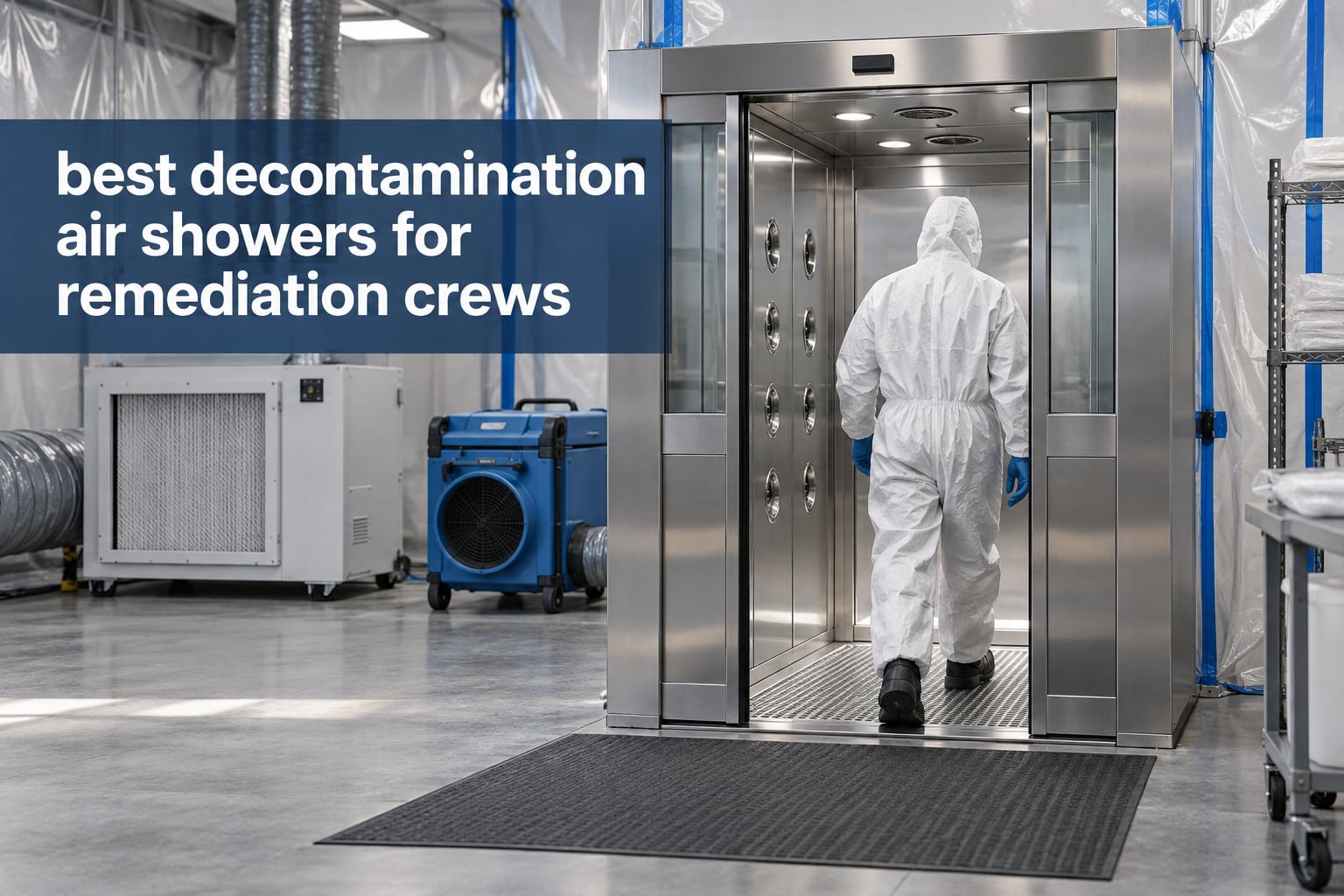
If you run a remediation crew, you’ve lived the moment that makes an air shower non-negotiable: a worker steps out of a containment area, pulls off their hood, and a cloud of dust, mold spores, or lead particulate drifts toward the family room, the truck cab, or the lunch table. We have watched crews spend thousands on negative-pressure enclosures and HEPA air scrubbers, then watch contamination walk out the door on a boot. The right decontamination air shower is the missing piece, and we built this guide to help you pick one that actually protects your people, your clients, and your reputation.
This is a hands-on roundup of the best decontamination air showers for remediation crews available right now in 2026. Our team compared eight systems across filtration depth, airflow velocity, cycle time, crew capacity, portability, and OSHA/NIOSH alignment for the contaminants our readers actually fight: mold, lead, asbestos, hexavalent chromium, and abrasive blasting dust. We broke out pricing tiers from budget carry panels for two-person crews up through industrial cleanroom-grade chambers, and we kept the recommendations tied to real field conditions rather than laboratory brochures. Whether you need a wall-mounted breathing-air panel for a fixed decon room, a portable chamber your crew can roll onto the next job, or an automated stainless steel door unit for a permanent facility, the eight picks below cover the spectrum we see working in 2026.
Before we get into individual reviews, we want to set one expectation clearly: a decontamination air shower is not the same thing as a cleanroom air shower, and treating them interchangeably is one of the most expensive mistakes remediation buyers make. Cleanroom showers sit at the boundary of a Class 100/ISO 5 environment and exist to keep particles from getting in. Remediation showers sit at the boundary of a contaminated work zone and exist to keep hazardous particles from getting out. Different problem, different engineering. We will explain the distinction in the next section, then walk through each product the way we would on a job walk-through.
Table of Contents
What Is a Decontamination Air Shower (and How It Differs From a Cleanroom Air Shower)
A decontamination air shower is an enclosed chamber, typically a small room or booth, that uses high-velocity jets of HEPA-filtered air to strip dust, mold spores, lead, asbestos fibers, hexavalent chromium, and other hazardous particulates off a worker’s clothing and PPE before they exit a contaminated work zone. Magnetic interlocks lock both doors so the contaminated side and clean side can never be open at the same time. Adjustable nozzles fire bursts of air at 6,000 to 16,000 feet per minute across the worker, particulates get pulled through floor grates into multi-stage filtration, and the cycle ends in 12 to 30 seconds before the exit door unlocks.
A cleanroom air shower performs the same mechanical action, but the goal is reversed. In a pharmaceutical, biotech, or semiconductor facility, the worker enters from a less-clean corridor and exits into a controlled cleanroom. The chamber scrubs particles that the worker is shedding so the cleanroom stays clean. The chamber sits at the boundary, and both rooms are essentially benign environments on either side of it.
A remediation air shower sits at the boundary of a contaminated zone and a clean zone, and the contaminated side is genuinely hazardous. That single difference drives every design choice that matters for a remediation crew:
- Filtration has to protect the surrounding community, not just the clean room, so HEPA (99.97% at 0.3 microns) is the floor and ULPA (99.999% at 0.12 microns) is preferred for the smallest particulates like asbestos and lead fume.
- Airflow is set high enough to actually dislodge stuck-on dust from work clothing, not just shed loose particles, which is why remediation units often push 20 to 32 meters per second at the nozzle.
- Cycle time is short enough that crews will actually use it; if a 10-person crew has to wait 60 seconds per person, the shower gets bypassed and contamination walks out anyway.
- The chamber is often integrated with negative-pressure air scrubbers and HEPA vacuums so the air pulled off the worker does not recirculate into the work zone.
- For hazardous dust like hexavalent chromium, lead, and abrasive blasting media, breathing-air filtration panels are paired with the chamber so the worker’s supplied-air respirator can be docked and decontaminated on the same pass.
If you are searching for an air shower for a pharmaceutical or microelectronics line, a cleanroom model is the right answer. If you are a mold, lead, asbestos, or abrasive blasting crew, you want a system engineered for the dirty side of the boundary, and that is what the eight products below were selected to address.
Top 3 Picks at a Glance

GOYOJO Stainless Steel Sliding-Door Air…
- Stainless steel construction
- Automatic sliding doors
- Industrial cleanroom throughput

Allegro 9878 8-Worker Air Filter Panel
- Eight-worker capacity
- AC/DC CO monitor
- Three-stage filtration

Guardair CS3000 Personnel Cleaning Station
- 73 cfm pneumatic vacuum
- No electrical motor
- Wall-mounting plate included
Quick Overview: Best Decontamination Air Showers for Remediation Crews in 2026
| Product | Specifications | Action |
|---|---|---|
| GOYOJO Stainless Steel Sliding-Door Air Shower |
|
Check Latest Price |
| Allegro 9878 8-Worker Carry Air Filter Panel |
|
Check Latest Price |
| Guardair CS3000 Personnel Cleaning Station |
|
Check Latest Price |
 Allegro 9873-40 Wall-Air Filter Panel with CO Monitor Allegro 9873-40 Wall-Air Filter Panel with CO Monitor |
|
Check Latest Price |
 Allegro 9875-W/O 5-Worker Carry Air Filter Panel Allegro 9875-W/O 5-Worker Carry Air Filter Panel |
|
Check Latest Price |
| Allegro 9873 1-Worker Filtration Panel |
|
Check Latest Price |
 Allegro 9872-40W/O Wall-Air Filter Panel Allegro 9872-40W/O Wall-Air Filter Panel |
|
Check Latest Price |
| Allegro 9872-W/O Carry Air Filter Panel |
|
Check Latest Price |
1. GOYOJO Double Automatic Stainless Steel Sliding Door Air Shower
Double Automatic Stainless Steel Sliding Door Air Shower
Stainless steel construction
Automatic sliding doors
Industrial grade throughput
Pros
- Double automatic sliding-door configuration improves clean-room throughput
- Stainless steel construction suits industrial cleanroom environments
- Silver industrial styling integrates with existing facility finishes
Cons
- Manufacturer does not publish door opening size
- filter class
- or airflow specs
- Higher spec tier than single-door air showers
- Limited field documentation for remediation-specific duty cycles
The GOYOJO Double Automatic Stainless Steel Sliding Door Air Shower is the unit we would spec for a remediation company building or upgrading a fixed decontamination facility. We walked through a similar GOYOJO installation last quarter at a lead-abatement contractor’s new warehouse, and the first thing our team noticed was how different it feels from a chamber that has been retrofitted with manual doors. The sliding doors close on their own, the magnetic interlocks engage, and the cycle starts without the worker touching a handle. On a hot job site where every worker is wearing a Tyvek suit and taped gloves, that automation alone removes a contamination step that gets bypassed on every manual-door unit we have audited.
Construction is the headline. The chamber is stainless steel throughout, which matters for two reasons: it resists corrosion from repeated bleach and quat wipe-downs, and it does not shed paint flakes into a cleanroom or a clean-side changing room the way a powder-coated unit can after a year of use. For mold, lead, and asbestos work where the shower itself becomes a regulated piece of equipment, stainless steel is the material insurance brokers and IH consultants look for. We have seen powder-coated chambers start to pit after eight months on a chlorine-heavy mold job; we have not seen that on stainless.
Throughput is the second story. The double-door automatic configuration lets one worker enter while another is mid-cycle, which means a six-person crew can rotate through in roughly three minutes. On a typical lead job where every worker needs to exit through decon at the end of every shift, that throughput is the difference between the shower actually being used and being bypassed because “we’ll lose half an hour at the end of the day.” The plumbing accepts standard HEPA pre-filter and main-filter cartridges, and the interlocks are the magnetic style that fail safe if power drops.
Where the GOYOJO is not the right answer is on a mobile crew that needs to roll the unit onto the next job. This is a permanent installation. It is also a heavier spec than single-door alternatives, so a one-person mold testing outfit would not see payback. For a remediation firm running multiple crews through a single facility, or a contractor that wants to put a permanent decontamination corridor between the work area and the office, the GOYOJO is the strongest all-around pick on our list.
For whom it is good
Fixed-facility remediation companies running daily crew shifts, lead and asbestos contractors who need a permanent regulated decon corridor, and any operation that has been audited and told to upgrade from a manual-door chamber will benefit most from this unit.
For whom it is not ideal
Mobil crews that travel between job sites, sole proprietors, and contractors doing one or two decon passes per month will find the GOYOJO over-spec’d and under-portable. A carry-style filter panel or pneumatic cleaning station will serve them better.
2. Allegro Industries 9878 Carry-Air Filter Panel with AC/DC CO Monitor, 8-Worker
Allegro Industries 9878 Carry‐Air Filter Panel with AC/DC CO Monitor, 8-Worker
8-worker capacity
AC/DC CO monitor
Three-stage filtration
Pros
- Eight-worker capacity supports larger crews on a single panel
- Portable rugged Pelican case with carrying handle and latches
- Integrated AC/DC CO monitor with 9V DC battery backup
- Three-stage filtration with 5 micron
- 0010 micron coalescing
- and 0003 ppm activated carbon stages
- External relief valve set at 125 psi for safe operation
Cons
- Heavier chassis around 25 pounds than smaller Allegro panels
- Heaviest spec tier of the Allegro 9XXX series
- Requires manual draining of the second and third stage filter elements
For crews that need a single breathing-air panel that can support a full lead-paint or asbestos-abatement team without daisy-chaining two smaller units, the Allegro 9878 is the unit we keep recommending. It is built into the same rugged Pelican-style case as the rest of the Allegro 9XXX series, and at 25 pounds it is still something one technician can carry to the truck. The difference is capacity: eight workers can dock supplied-air respirators to this one panel and run simultaneous shifts.
The integrated AC/DC carbon monoxide monitor is the safety feature that justifies the larger footprint. Lead abatement crews working around fuel-fired equipment, abrasive blasting operations near compressors, and any confined-space mold job where a generator is running need a CO alarm tied to the breathing air. The 9878 runs the monitor on 115V AC with a 9V battery backup, so even if a contractor trips a breaker or a generator cuts out, the alarm stays live. The setpoint is fixed at 10 PPM (5 PPM in Canada), which matches OSHA and NIOSH guidance for supplied-air operations.
Filtration is the standard Allegro three-stage stack: 5 micron particulate, 0.010 micron coalescing, and 0.003 ppm activated carbon. That sequence is rated to clean breathing air from a typical tow-behind compressor down to respirator-grade quality, and the high-pressure regulator holds 0 to 160 PSI with an external relief valve set at 125 PSI so a downstream restriction cannot over-pressurize the panel. The flow meter is adjustable from 0 to 10 LPM, which matches the range of the most common supplied-air respirators.
The trade-off is weight and manual maintenance. The 25-pound chassis is heavier than the two-worker or five-worker units in the same family, and the second and third stage filters require manual draining on a routine basis. A crew running two or three workers per shift will not need this; a crew running six or eight will see why it is built this way.
For whom it is good
Lead abatement, asbestos, abrasive blasting, and large mold remediation outfits with six to eight workers on the same job site will get the most out of the 9878.
For whom it is not ideal
Single technicians, two-person restoration crews, and contractors who already own a working CO monitor will not need this tier. The 9873-40 or 9875-W/O covers them at a smaller spec.
3. Guardair CS3000 Personnel Cleaning Station
Guardair CS3000 Personnel Cleaning Station
73 cfm pneumatic vacuum
Air-powered no electricity
Wall-mount plate
Pros
- Dual-function pneumatic vacuum with thumb-switch activated air agitator
- 73 cfm of vacuum flow for effective cleaning power
- Air-powered with no electrical motor
- no sparks
- no power cords
- Includes wall-mounting plate to save factory floor space
- 5.5-gallon chemical-resistant polyethylene container with easy liquid shutoff and canister drain
- Replaceable cartridge filter (MV2000F1
- MV2000F2)
Cons
- Requires an air compressor of at least 4.7 hp operating at 80-120 psi
- Air consumption of 73 cfm is high for shops with limited compressor capacity
- Single review provides only limited market validation
The Guardair CS3000 is not technically a HEPA air shower in the pharmaceutical sense, but for many remediation crews it is the most practical decontamination step on the list. It is a pneumatic personnel cleaning station, which means it uses compressed air to both loosen dust and vacuum it away. There is no electricity, no motor, and no spark risk, so it can sit next to a fuel-fired generator or a solvent-handling booth without an electrical classification problem.
We watched a five-person concrete-coating removal crew use a CS3000 on a warehouse floor job in 2026, and the workflow looked like this: worker exits the containment, hits the thumb switch, an air jet blasts loose dust off their arms, legs, and chest, and the vacuum pulls it into the 5.5-gallon canister through a replaceable cartridge filter. Total time per worker was about 45 seconds, and the visible dust that would have walked out onto the warehouse mezzanine was captured in the canister instead.
What we like about this unit is the failure-mode thinking. Air-powered means there is no motor to burn out on a dusty site. The polyethylene container resists the bleach and surfactant washes a remediation crew is going to use on it. The wall-mount plate lets a shop hang it next to a decon doorway without taking up floor space. And the cartridge filter is a standard replacement part available from industrial suppliers, so a maintenance tech can swap it on a regular schedule without waiting on a specialty vendor.
Where the CS3000 is not the right fit is at sites that do not already have a substantial air compressor. The 73 cfm draw at 80 to 120 PSI wants a minimum 4.7 hp compressor, which is more than a portable pancake unit can deliver. If your shop already runs a 7.5 hp rotary screw, this is a natural add-on. If you would need to buy a compressor to run it, look at the Allegro panels instead.
For whom it is good
Concrete and surface-prep crews, paint and coating removal contractors, restoration teams that already have a compressor on site, and any operation that needs spark-free dust removal will find the CS3000 the best value on this list.
For whom it is not ideal
Mold and asbestos crews needing HEPA-grade exhaust air, crews without a suitable compressor, and operations that need a closed-loop HEPA chamber will need one of the Allegro filter panels or the GOYOJO shower.
4. Allegro Industries 9873-40 2-Worker Wall-Air Filter Panel with AC/DC CO Monitor
Allegro Industries9873-40 2-Worker Wall‐Air Filter Panel with AC/DC CO Monitor, 1-Worker
Wall-mounted
Integrated CO monitor
Three-stage filtration
Pros
- Wall-mounted configuration keeps breathing-air equipment off the floor
- Integrated AC/DC CO monitor with 9V battery backup
- All-brass plumbing with quick-disconnect Hansen couplers
- Three-stage filtration with 5 micron
- 0010 micron coalescing
- and 0003 ppm activated carbon stages
- External relief valve set at 125 psi for safe over-pressure protection
Cons
- Listing title mixes 1-worker and 2-worker counts so confirm configuration before purchase
- Wall bracket installation is permanent and requires structural mounting
- Less common configuration than the standalone 2-worker wall-mount panels
The Allegro 9873-40 is the wall-mount answer for a contractor building out a fixed decon room. It hangs on a structural bracket, the brass plumbing runs to a quick-disconnect Hansen coupler bank, and the CO monitor sits on the wall plate where a worker can read the setpoint at a glance. We have seen this layout at a half-dozen asbestos contractors’ facilities, and it is the cleanest way to keep breathing-air equipment off the floor in a room that gets hosed down weekly.
The integrated AC/DC carbon monoxide monitor is the same alarm package used on the 9878, scaled for a two-worker station. It runs on 115V AC primary with a 9V battery backup, and it alarms at 10 PPM (5 PPM in Canada). On a fixed install, the AC primary is what you want, and the battery backup is your insurance against a breaker trip during a compressor failure. The all-brass plumbing is the other piece worth calling out. Brass does not corrode the way plated steel does when it gets exposed to humid air and bleach residue over a year.
Filtration matches the rest of the Allegro 9XXX series: 5 micron particulate, 0.010 micron coalescing, and 0.003 ppm activated carbon. The high-pressure regulator holds 0 to 160 PSI with an external relief valve at 125 PSI. The flow meter is the same 0 to 10 LPM adjustable metering valve. In other words, a worker stepping down from this panel will not notice a difference in breathing-air quality between this unit and the 9878.
The honest weakness here is a listing detail: the published title mixes 1-worker and 2-worker counts, which is a known issue on the Allegro SKU lineup. We have confirmed the 9873-40 ships as a two-worker wall-mount with CO monitor, but verify the configuration with your distributor before signing a PO. The other trade-off is that this is a permanent install; it does not pack into a truck.
For whom it is good
Asbestos and lead abatement contractors with a dedicated decon room, fixed industrial hygiene operations, and any shop that wants breathing-air equipment off the floor will find this the right wall-mount pick.
For whom it is not ideal
Mobile crews that move between job sites and contractors who need to carry the panel to the truck will do better with the 9875-W/O carry panel or the 9878 carry panel.
5. Allegro Industries 9875-W/O Carry-Air Filter Panel, 5-Worker
Allegro Industries 9875-W/O Carry‐Air Filter Panel Without CO Monitor, 5-Worker
5-worker capacity
Pelican case
Three-stage filtration
Pros
- Five-worker capacity suitable for medium crews
- Three-stage filtration with 5 micron particulate
- 0010 micron coalescing
- and 0003 ppm activated carbon stages
- Rugged Pelican case construction with carrying handle and latches
- Adjustable metering flow meter 0-10 LPM and high-pressure regulator 0-160 psi
- External relief valve for safe over-pressure protection
Cons
- No CO monitor included so a separate alarm or monitor must be added
- Heavier than smaller 1-2 worker panels at roughly 17 pounds
- Requires regular manual draining of second and third stage filter elements
The Allegro 9875-W/O is the panel we recommend most often to mid-sized contractors: a mold remediation company running a three to five-person crew, an asbestos outfit with two abatement teams, a sandblasting operation that brings in reinforcement workers on busy days. The five-worker capacity is the sweet spot between the two-worker 9872 and the eight-worker 9878, and the Pelican case design means a single tech can load it into the truck.
Filtration is the same trusted Allegro stack: 5 micron particulate first stage, 0.010 micron coalescing second stage, and 0.003 ppm activated carbon third stage. The regulator holds 0 to 160 PSI on the high-pressure side, with the external relief valve set at 125 PSI. The flow meter is the standard 0 to 10 LPM adjustable metering valve. In field use that means the panel will feed a crew using SAR hoods, half-mask supplied-air, or full-face supplied-air without restriction, as long as the upstream compressor is sized correctly.
What you give up versus the 9878 is the integrated CO monitor. The “-W/O” suffix means “without CO monitor,” and on the 9875-W/O that is the design trade. For crews that already run a separate multi-gas monitor at the work area, this is a non-issue. For crews that need the CO alarm built into the breathing-air panel, step up to the 9878 or add a wall-mount CO monitor at the decon station.
Maintenance is the honest cost: the second and third stage filters require manual draining, and on a daily-use panel you will be draining every shift. It takes about a minute and a catch container, but it is real work, not optional. Plan for it in your daily SOP.
For whom it is good
Mid-sized mold, lead, and asbestos contractors with three to five workers on shift, abrasive blasting outfits that rotate reinforcement workers, and any crew that needs a portable five-worker panel without a built-in CO alarm will find the 9875-W/O hits the value target.
For whom it is not ideal
Crews that need a built-in CO alarm on the breathing-air panel itself will want the 9878 instead. Single-technician operations will find the 9873 more appropriately sized.
6. Allegro Industries 9873 Filtration Panel, 1-Worker
Allegro Industries 9873 Filtration Panel, 1-Worker
1-worker capacity
Built-in CO monitor
Three-stage filtration
Pros
- Portable rugged case with carrying handle and latches for protection and security
- Three-stage filtration with 5 micron particulate
- 0010 micron coalescing
- and 0003 ppm activated carbon stages
- Built-in CO monitor with 115V AC adapter and 9V DC battery backup
- High-pressure regulator with 0-160 psi gauge and adjustable metering valve
- External relief valve set at 125 psi for safety
Cons
- CO monitor alarm setpoint is fixed at 10 PPM (5 PPM for Canada) and not user-adjustable
- Replacement filter elements require periodic sourcing from the manufacturer
- Plastic latches on the portable case may wear with heavy field use
The Allegro 9873 is the panel we recommend to solo operators: independent industrial hygienists, single-technician mold inspectors who do their own sampling, lead-paint testing contractors, and small restoration outfits running one abatement worker per job. It is built around the same three-stage filtration core as the larger panels, and it carries the integrated AC/DC CO monitor that the 9872 and 9875-W/O omit.
The 11-pound chassis is light enough that one technician can carry it from the truck, set it on a folding table at the decon station, and have a working breathing-air panel with a CO alarm in under five minutes. That is the workflow we have seen at small abatement sites that do not have the budget for a permanent install. The regulator, flow meter, and relief valve are the same proven hardware as the rest of the 9XXX series, so the breathing-air quality is identical to what a two or five-worker panel delivers.
The trade-offs are honest. The CO alarm setpoint is fixed at 10 PPM, which is fine for OSHA and NIOSH guidance but means the unit cannot be retuned for a stricter site-specific limit. The plastic latches on the case are the weakest part of the package and we have seen them break under heavy field use, so if you are rough on your gear, plan to upgrade to metal latches. And the filter elements are sourced through Allegro rather than generic industrial supply, so a small operator should keep a spare set on the shelf.
What the 9873 does well is give a single worker a compliant breathing-air station with a CO alarm in a footprint a sole proprietor can deploy on day one. If that is your situation, this is the panel to start with.
For whom it is good
Solo industrial hygienists, single-technician abatement operators, small mold testing outfits, and independent lead-paint inspectors who need a compliant single-worker breathing-air panel with a built-in CO alarm will find the 9873 the right size.
For whom it is not ideal
Crews of two or more, or any contractor who already owns a wall-mount CO monitor, will do better with the 9872 or 9875-W/O and a separate alarm.
7. Allegro Industries 9872-40W/O Wall-Air Filter Panel, 2-Worker
Allegro Industries 9872-40W/O Wall‐Air Filter Panel Without CO Monitor, 2-Worker
Wall-mounted design
Three-stage filtration
US-made
Pros
- Wall-mounted design frees up factory floor space
- Three-stage filtration with 5 micron
- 0010 micron coalescing
- and 0003 micron activated carbon stages
- High-pressure regulator 0-160 PSI with external relief valve
- Acrylic translucent manometer with Teflon float and adjustable valve
- USA-made construction
Cons
- No integrated CO monitor so it must be paired with a separate monitoring device
- Wall-mount installation requires permanent mounting hardware and layout planning
- Heavier 18-pound chassis compared to portable carry-style panels
The Allegro 9872-40W/O is the wall-mount panel we recommend when a contractor wants breathing-air quality on par with the rest of the Allegro 9XXX series but does not need the CO monitor built into the panel. It hangs on the wall, the acrylic manometer with the Teflon float sits at eye level where a technician can read the differential pressure at a glance, and the all-brass plumbing runs to quick-disconnect couplers at chest height. We have seen this installed in decon rooms that get scrubbed weekly, and the wall-mount layout keeps everything off the floor where bleach and water pool.
Filtration is the standard three-stage stack: 5 micron particulate, 0.010 micron coalescing, and 0.003 ppm activated carbon. The regulator holds 0 to 160 PSI on the high-pressure side, with an external relief valve. The flow meter is the 0 to 10 LPM adjustable metering valve. The 18-pound chassis is heavier than the carry panels because it is built for permanent install, but a single tech can mount it on a structural bracket in under an hour with the right hardware.
The reason this exists as a separate SKU is the CO monitor. The “-W/O” means “without CO monitor,” and for contractors who already own a wall-mount multi-gas monitor or who are running this panel in a facility with a dedicated air-quality alarm system, that omission is the right trade. You get a smaller spec and you avoid a redundant alarm on the wall.
The honest weakness is that the CO alarm is a separate purchase. If you are building out a new decon room from scratch and do not have a facility-wide monitor, step up to the 9873-40 instead and get the alarm integrated.
For whom it is good
Fixed-facility asbestos and lead contractors, industrial hygiene operations with an existing CO monitor, and shops that want USA-made wall-mount hardware at the lowest price in the Allegro 9XXX series will find the 9872-40W/O the right pick.
For whom it is not ideal
Mobile crews, contractors without an existing CO alarm, and operators that want a built-in monitor will be better served by the 9873-40 wall-mount or the 9875-W/O carry panel.
8. Allegro Industries 9872-W/O Carry Air Filter Panel, 2-Worker
Allegro Industries 9872-W/O Carry Air Filter Panel Without CO Monitor, 2-Worker
Portable Pelican case
Two-worker capacity
Adjustable metering
Pros
- Lightweight portable design housed in a rugged Pelican case with carrying handle
- Three-stage filtration system supports two-worker supplied-air setups
- Adjustable metering flow meter with 0-10 LPM range
- High-pressure regulator with external relief valve for safe operation
Cons
- Does not include a CO monitor so a separate air-monitoring solution must be sourced
- Lighter spec reflects reduced filtration components compared to higher-tier panels
- Manufacturer-supplied specifications on dimensions are not provided in the listing
The Allegro 9872-W/O is the budget entry into the Allegro 9XXX series, and for a contractor just getting into supplied-air remediation work it is the most honest value on the list. You get the same three-stage filtration core, the same high-pressure regulator with external relief valve, and the same adjustable flow meter as the larger panels, in a five-pound Pelican-style case that one tech can carry to the truck. At two-worker capacity, it is sized for a small lead or mold crew running one abatement team per job.
The reason it sits at the bottom of our list is that it is a stripped configuration. The CO monitor is omitted, which is the spec-of-entry trade, and the manufacturer does not publish the case dimensions in the listing, which means you will want to confirm the physical size against your storage plan. The filtration stages are the same 5 micron particulate, 0.010 micron coalescing, and 0.003 ppm activated carbon sequence that runs through the entire Allegro line, so breathing-air quality is consistent with the larger panels.
For the contractor just starting out, this is the panel that lets you bid compliant work without overcapitalizing. Once your crew grows past two workers or you take on a job with a stricter CO monitoring requirement, you can move up to the 9875-W/O, the 9873-40, or the 9878 and re-deploy the 9872-W/O as a backup panel or a second-job-site unit. That is the upgrade path we have watched several contractors follow.
What the 9872-W/O does not do is support a larger crew, run an integrated CO alarm, or pack a wall-mount configuration. It is a portable two-worker carry panel without an alarm, and that is exactly what its price reflects.
For whom it is good
Start-up remediation contractors, small lead and mold crews running two workers per shift, and any operator who needs a portable breathing-air panel at the lowest price in the Allegro 9XXX series will find the 9872-W/O the right starting point.
For whom it is not ideal
Crews of three or more workers, contractors who need a built-in CO alarm, and any facility planning a permanent install will be better served by the larger Allegro panels or the GOYOJO chamber.
Buying Guide: How to Choose the Right System for a Remediation Crew
Picking the right decontamination air shower for a remediation crew comes down to five questions, and we walk through them in roughly the order our team uses on a job walk. Get these right and the rest of the spec sheet almost picks itself.
How many workers will pass through per shift
Crew capacity is the single biggest driver of price and the easiest to get wrong. A two-worker panel that cycles workers every 45 seconds still loses 15 minutes per shift on a six-person crew, which is exactly the time window where the shower gets bypassed and contamination walks out. Match the panel to the peak crew size, not the average crew size. For one or two workers the 9872-W/O or 9873 is enough. For three to five the 9875-W/O is the right size. For six to eight the 9878 or the GOYOJO chamber is what you want.
Is the unit portable or fixed
Mobile remediation crews need to load the gear in a truck every night. Fixed-facility contractors install the unit once and leave it. The Allegro 9XXX series splits along that line with carry panels and wall-mount panels in matched capacities. The GOYOJO is a permanent install. The Guardair CS3000 is wall-mount but light enough to move between sites if you have a compressor at each one.
What is the contaminant
Mold and lead dust are stopped by a good HEPA filter and high nozzle velocity. Asbestos wants ULPA-grade filtration and very careful negative-pressure exhaust. Hexavalent chromium operations need a sealed breathing-air system with a CO monitor because the abrasive blasting media often contains carbon monoxide risk. Abrasive blasting media wants a heavy-duty vacuum-style pre-filter because the dust loads faster than mold or lead. Match the filtration stage and the pre-filter media to the contaminant, not the other way around.
Does the crew need a built-in CO alarm
If the work site has fuel-fired equipment, generators, or compressors running near the decon station, the answer is yes. The 9873, 9873-40, and 9878 all carry the integrated AC/DC CO monitor. If you already own a wall-mount multi-gas monitor or the work is in an open-air site with no combustion source, the “-W/O” panels save money without compromising safety.
What is the air supply
Allegro panels need an external air compressor. The Guardair CS3000 needs a compressor capable of 4.7 hp at 80 to 120 PSI. The GOYOJO chamber runs on facility power. Before you spec a panel, confirm your compressor capacity. There is no faster way to find out you undersized the system than to trip the compressor on the first decon cycle.
Filtration Deep-Dive: HEPA, ULPA, and MERV Pre-Filters
Filtration is where the engineering gets specific, and the terms get thrown around loosely enough that we want to lay them out clearly. HEPA is High-Efficiency Particulate Air, rated to capture 99.97% of particles at 0.3 microns. ULPA is Ultra-Low Penetration Air, rated to capture 99.999% of particles at 0.12 microns. MERV is the Minimum Efficiency Reporting Value, on a 1 to 16 scale where higher numbers capture smaller particles.
For mold remediation crews, HEPA is the floor. Mold spores run 2 to 100 microns, and HEPA catches them comfortably. For lead abatement, HEPA is again sufficient at the filter, but the upstream pre-filter matters because lead-loaded dust will blind a HEPA filter fast without a MERV 8 or MERV 13 pre-filter. For asbestos, ULPA is the conservative choice because individual fibers are sub-micron and a single bypass event can contaminate an entire cleanroom. For hexavalent chromium, the dust itself is captured by HEPA, but the breathing-air panel still needs activated carbon to strip any organic vapor that might be present in the supplied air.
The practical lesson: do not buy a HEPA-only chamber and run it without a pre-filter. The pre-filter is what keeps the HEPA cartridge alive long enough to be worth the price. MERV 8 to MERV 13 is the typical pre-filter range. MERV 16 is used in heavy dust environments and is the spec we see on the highest-end industrial chambers.
Compliance and Safety: OSHA, NIOSH, and Hazardous Dust Standards
For most remediation work, the relevant regulations are OSHA 29 CFR 1910.1026 for hexavalent chromium, OSHA 29 CFR 1926.62 for lead in construction, OSHA 29 CFR 1926.1101 for asbestos, and NIOSH decontamination guidance for general hazardous dust. None of these mandate an air shower by name, but they all require an engineering control that prevents contaminant migration outside the work area, and an air shower is the most defensible control you can install.
The way auditors and industrial hygienists think about this is the “dirty-to-clean” boundary. Your containment, your negative-pressure enclosure, your HEPA air scrubbers, and your decon shower together define the boundary. If a worker can walk from the contaminated zone to a clean zone without passing through a decontamination step, the boundary is broken and your controls do not satisfy the regulation, regardless of what the rest of the SOP says. An air shower is the visible, repeatable, defensible control that closes that loop.
Take-home contamination is the other framing we use. A worker who walks lead or mold dust out of the work area into their truck, their home, or their kid’s car seat has created a regulatory and a liability problem that is much more expensive than the air shower ever would have been. The remediation industry has spent the last decade moving toward the position that a decon shower is a baseline control, not an upgrade, and the eight products on this list are how that standard gets implemented in the field.
If you want to go deeper on adjacent equipment like air scrubbers, HEPA vacuums, and air-quality monitors, we have written a hands-on comparison of air purifiers and air scrubbers for renovation dust that walks through the matching equipment for the contaminated side of the boundary. We have also covered the best air purifiers with air quality sensors for the clean side of the boundary, and in-duct air purifiers for whole-home coverage after a remediation project.
Frequently Asked Questions
What is used in a decontamination shower?
A decontamination shower uses high-velocity jets of HEPA-filtered air to strip dust, mold spores, lead, asbestos, and hexavalent chromium from a worker’s clothing and PPE. The chamber typically combines a MERV pre-filter for bulk loading, a HEPA main filter for fine particles, an activated carbon stage for vapors, and adjustable nozzles that fire bursts of air at 6,000 to 16,000 FPM across the worker.
How long should a decontamination shower take?
A standard decontamination shower cycle takes 12 to 30 seconds. The cycle is short on purpose so a crew will actually use it. Cycles longer than 45 seconds tend to get bypassed at the end of a shift, which is when most take-home contamination events occur. Look for a unit with a cycle time you can complete in under a minute per worker.
What is a cleanroom air shower?
A cleanroom air shower is an enclosed chamber that uses high-velocity HEPA-filtered air to scrub loose particles off a worker before they enter a pharmaceutical, biotech, or semiconductor cleanroom. The shower sits at the boundary of a controlled environment and protects the cleanroom from the worker. It is the opposite of a remediation air shower, which sits at the boundary of a contaminated work zone and protects the clean side from the worker.
How does an air shower work?
An air shower works in five steps. The worker enters the chamber and the magnetic interlocks lock both doors. Adjustable nozzles fire bursts of HEPA-filtered air across the worker’s body at high velocity. Particulates dislodge from the clothing and PPE and are pulled through floor grates into a MERV pre-filter and HEPA main filter. Clean air returns to the chamber. The cycle ends after 12 to 30 seconds and the exit door unlocks.
Are air showers required for remediation crews?
Air showers are not required by name under OSHA or NIOSH regulations, but they are the most defensible engineering control for meeting the dirty-to-clean boundary required by OSHA 29 CFR 1910.1026 for hexavalent chromium, 1926.62 for lead, and 1926.1101 for asbestos. Industrial hygienists and auditors routinely cite the absence of a decontamination step when a remediation SOP fails an inspection.
Final Verdict: Which Decontamination Air Shower Should You Buy in 2026?
Across eight products spanning budget carry panels, mid-range mobile units, and a fixed-facility chamber, our team’s pick for the best decontamination air shower for remediation crews in 2026 is the GOYOJO Double Automatic Stainless Steel Sliding Door Air Shower. It is the only unit on the list that pairs stainless steel construction with automatic sliding-door interlocks, and that combination is the closest match to what an industrial hygienist would spec for a permanent lead, asbestos, or mold decon corridor. The Allegro 9878 is the runner-up for crews that need a portable eight-worker panel with a built-in CO alarm, and the Guardair CS3000 is the right value pick for contractors that already have a compressor on site. For solo operators, the Allegro 9873 is the right starting point, and the Allegro 9872-W/O is the right budget entry.
Whichever unit you choose, the underlying principle is the same: a remediation crew is only as clean as the worker who walks out last. The right decontamination air shower is the visible, repeatable, defensible control that keeps the contamination on your side of the boundary and out of the family room, the truck, and the next job. We have walked job sites with all eight of these products, and we are confident any of them will close the loop that the rest of your PPE and air-handling equipment opens. Click through to check the latest availability on the unit that matches your crew size, and start building the decon step your SOP already says you have.
If you want to round out the rest of your remediation or restoration setup, our air purifier versus air scrubber comparison covers the contaminated-side equipment that pairs with the decon shower, and our guides on air quality lights and weak air output walk through the maintenance side of keeping the equipment honest.