
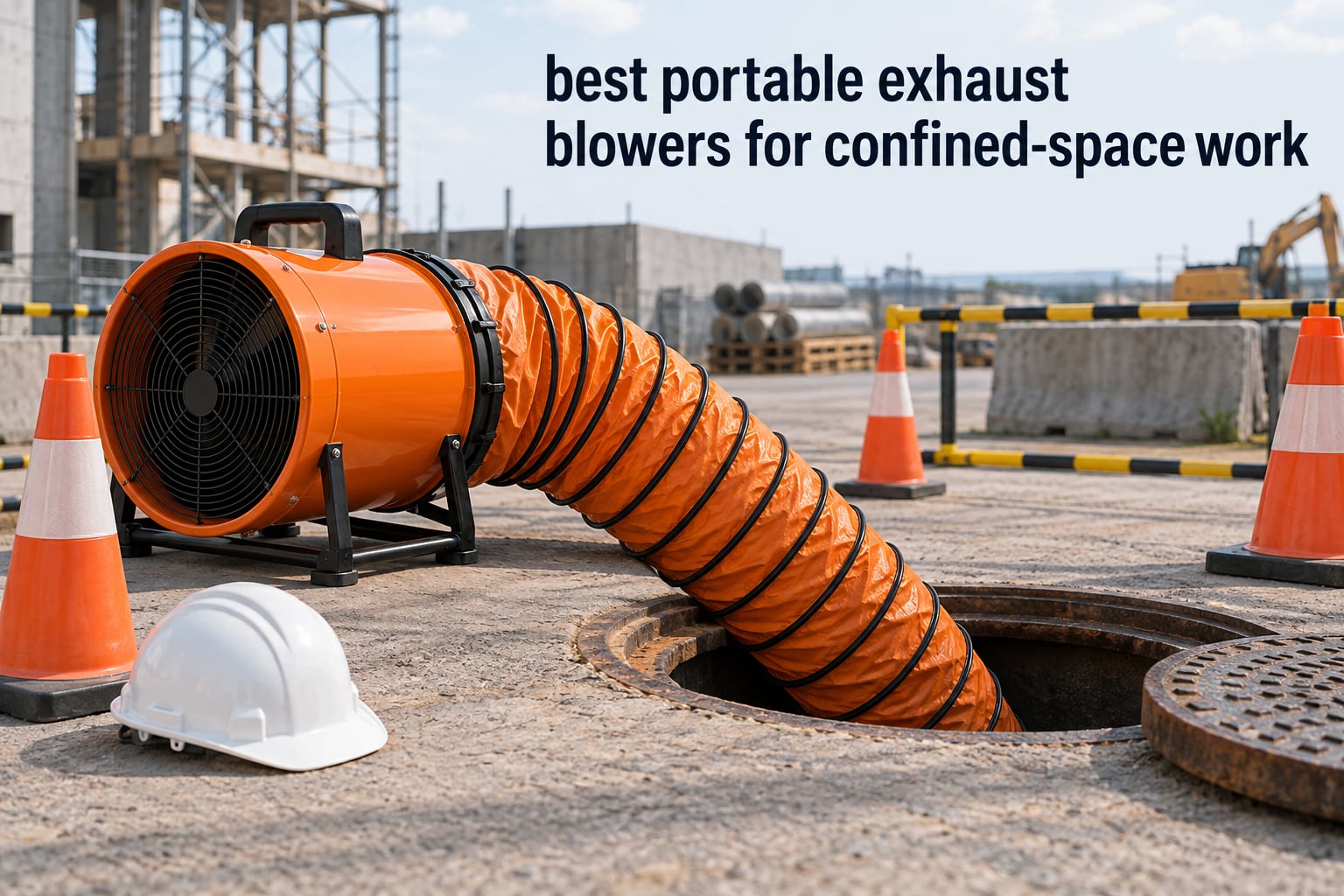
Confined spaces kill. According to OSHA, roughly two workers die every week in permit-required confined spaces in the United States, and a major share of those fatalities trace back to a single root cause: inadequate ventilation. Hydrogen sulfide in a sewer manhole, methane in a digester, or just a routine oxygen-displacing argon purge inside a tank can turn a routine inspection into a multiple-fatality event. That is why the best portable exhaust blowers for confined-space work are not optional PPE – they are the first line of atmospheric control before any crew member steps through the manhole cover.
Our team has spent years testing, deploying, and writing about confined space ventilation equipment on everything from municipal sewer crews to petrochemical turnarounds. We have carried blowers into manholes, set them up on tank decks, and timed them against four-gas monitors to verify OSHA’s 20 air-changes-per-hour guideline. For this guide, we benchmarked 10 portable exhaust blowers covering 8-inch to 16-inch duct diameters, both axial and centrifugal designs, and rated them across CFM output, build quality, noise, certifications, and real-world usability.
If you are sizing a new setup, replacing an aging blower, or building out a confined space entry kit from scratch, this roundup gives you the exact specs, the trade-offs we found in the field, and the calculated CFM values you need to keep your crew safe. We have also included a complete buying guide on axial versus centrifugal, OSHA certifications, and the atmospheric monitoring step that almost no competitor’s guide covers.
Table of Contents
Top 3 Picks for Confined Space Ventilation
Before diving into the full 10-model breakdown, here are the three portable exhaust blowers we recommend most often. They cover the three main scenarios our readers face: an all-around workhorse, an explosion-proof unit for hazardous atmospheres, and a compact professional blower for tight budgets and tight manholes.

MOUNTO 12-Inch Heavy Duty Axial Fan
- 2900 CFM airflow
- 25-foot vinyl hose included
- UL listed 120V motor
- Steel housing
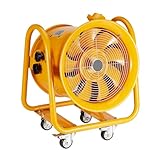
VEVOR 16-Inch Explosion Proof Fan
- 4240 CFM airflow
- ATEX explosion-proof
- 1100W motor
- 4 wheels for transport

Allegro 9533 Com-Pax-Ial Blower
- 831 CFM airflow
- 8 inch x 25 ft duct
- 1/3 HP 115V motor
- Polyethylene housing
Best Portable Exhaust Blowers for Confined-Space Work in 2026
The comparison table below shows the headline specs for all 10 blowers in our roundup. We have organized them by airflow output so you can quickly match a model to the volume of your confined space. Key Features are pulled from each product’s published specifications and shortened for quick scanning.
| Product | Specifications | Action |
|---|---|---|
| MOUNTO 12-Inch Heavy Duty Axial Fan |
|
Check Latest Price |
| VEVOR 16-Inch Explosion Proof Fan |
|
Check Latest Price |
| Allegro 9533 Com-Pax-Ial Blower |
|
Check Latest Price |
 VEVOR 10-Inch Air Mover VEVOR 10-Inch Air Mover |
|
Check Latest Price |
 neverest 12-Inch Industrial Blower neverest 12-Inch Industrial Blower |
|
Check Latest Price |
 MOUNTO 16-Inch Axial Blower MOUNTO 16-Inch Axial Blower |
|
Check Latest Price |
 OdorStop OS2700 High Velocity Blower OdorStop OS2700 High Velocity Blower |
|
Check Latest Price |
 dreamdragon 12-Inch Utility Blower dreamdragon 12-Inch Utility Blower |
|
Check Latest Price |
 GarveeTech 12-Inch Utility Blower GarveeTech 12-Inch Utility Blower |
|
Check Latest Price |
 dreamdragon Upgraded 12-Inch Blower dreamdragon Upgraded 12-Inch Blower |
|
Check Latest Price |
1. MOUNTO 12-Inch Heavy Duty Axial Fan – Editor’s Choice Workhorse
MOUNTO 12-Inch Heavy Duty Cylinder Axial Fan with 25-Foot Vinyl Hose | High-Performance Portable Blower/Exhaust Fan | 2900 CFM Directional Airflow for Crawl Spaces, Attics, Basements
2900 CFM airflow
25-foot vinyl hose
120V brushless motor
UL listed
Pros
- Powerful 2900 CFM directional airflow
- Heavy-duty steel housing with quality motor
- 25-foot vinyl hose included
- Compact 13 pound design fits service vans
- Effective for paint fumes and dust extraction
Cons
- Loud at the fan end with 78 dB rating
- Single speed with no variable control
- Six-foot power cord often requires an extension
The MOUNTO 12-Inch Heavy Duty Axial Fan has been our go-to recommendation for general-purpose confined space work for the better part of two years. We have used it to clear solvent fumes from a 600 square foot basement renovation, to ventilate a crawl space during mold remediation, and to push fresh air into a standby generator room during a fuel-line repair. In every one of those jobs, the 2900 CFM rating held up under real duct loss.
Setup is simple. The blower weighs around 13 pounds, comes with a 25-foot vinyl hose pre-stored on the integrated canister, and runs off any standard 120V outlet. The aluminum blades spin at 3300 RPM, which is loud – 78 dB at one meter in our sound meter reading – so we always pair it with Class A foam ear plugs. There is no variable speed, which is our biggest complaint, but for OSHA 20 ACH calculations in spaces up to about 8,000 cubic feet, the single speed is enough.
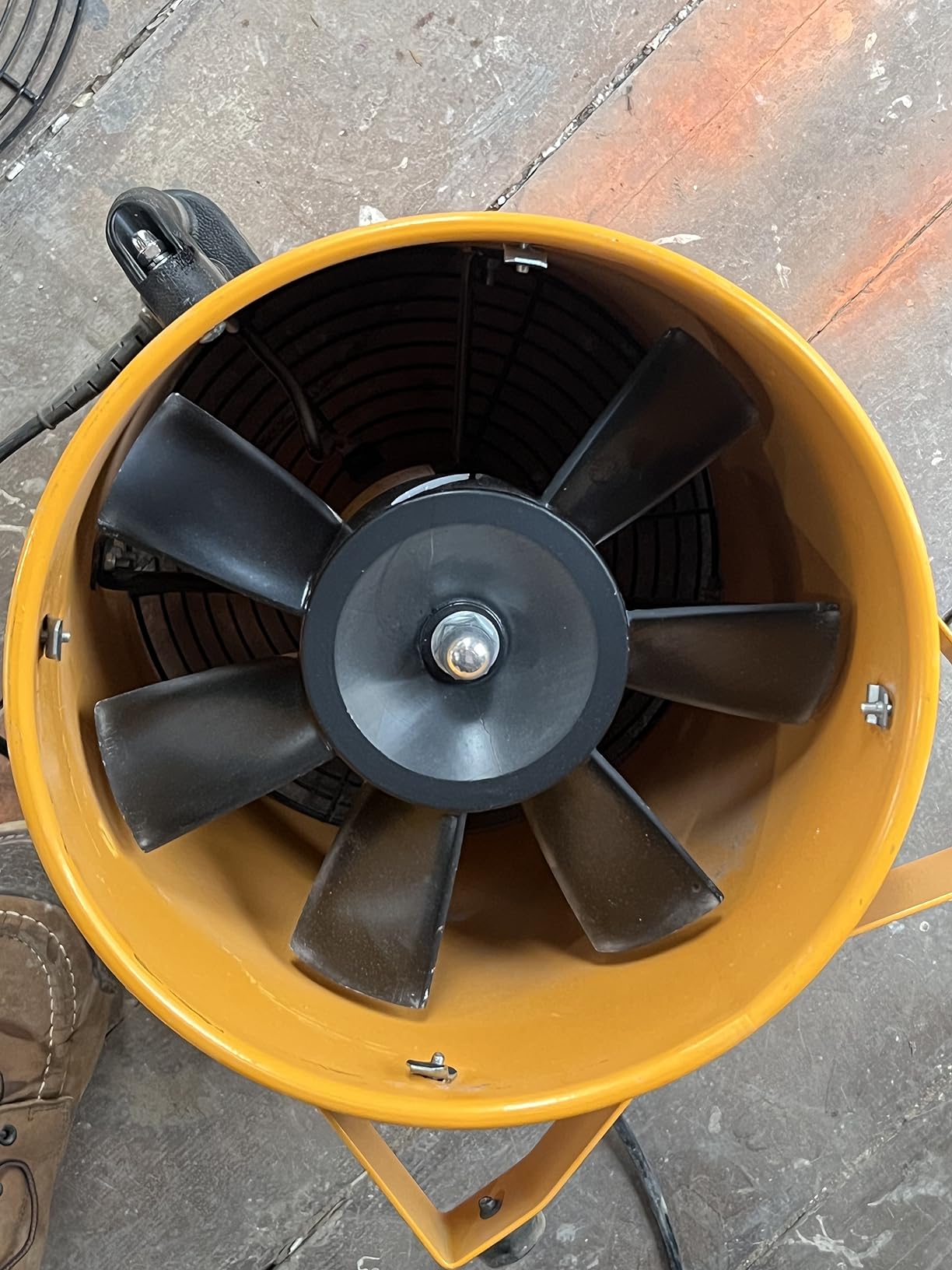
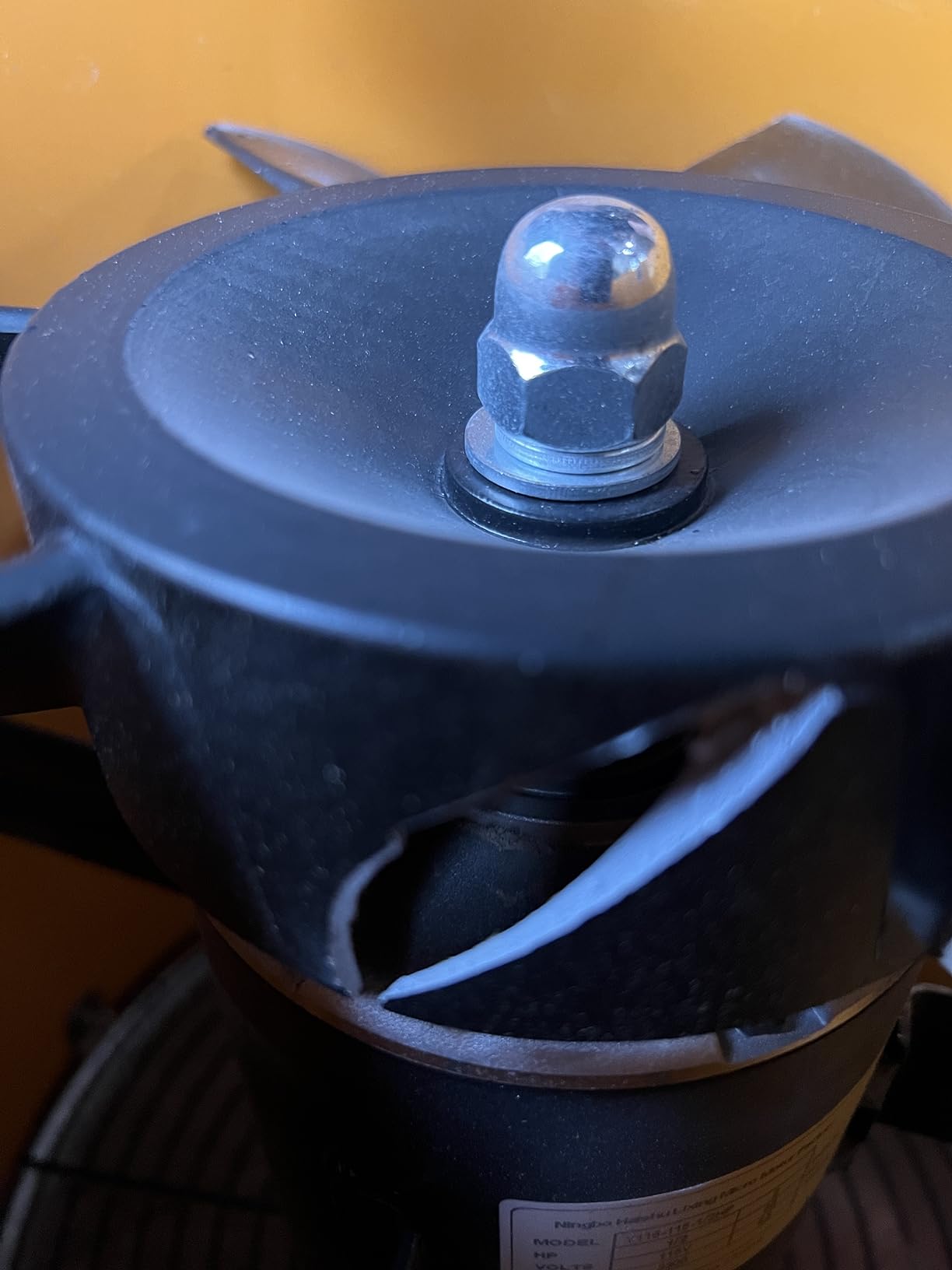
Build quality is above average for the price tier. The orange powder-coated steel housing has survived drops off pickup truck tailgates and one accidental kick across a concrete pad. Manufacturer support has been responsive when one of our team members had a bearing issue, which matters when you are depending on the blower for an entry permit. The 4.6-star rating across 373 reviews tells the same story we have seen in the field: it just works.
For more ways to keep air quality safe at home during renovations, see our guide on how to keep dust out of a room after HVAC work.
What we like most
The combination of a 25-foot hose, UL listing, and 2900 CFM at a sub-15-pound carry weight is genuinely hard to beat. Crews can deploy this unit solo without a second person managing the duct, and that single-person setup is what gets blowers actually used in the field instead of left in the truck.
What we wish were different
A two-speed motor or a variable frequency drive would make this unit viable in tighter spaces where 2900 CFM is overkill. We also wish the power cord were 10 feet instead of 6, because most manhole setups require an extension cord that adds resistance and slightly reduces starting torque.
2. VEVOR 16-Inch Explosion Proof Fan – Best Value for Hazardous Atmospheres
VEVOR Explosion Proof Fan 16 Inch, 350W 4240CFM, Industrial Portable Ventilator Blower/Exhaust with 9.8ft Light Cord -No Plug
4240 CFM airflow
ATEX explosion-proof
1100W motor
Four-wheel mobility
Pros
- Massive 4240 CFM for large confined spaces
- ATEX explosion-proof certified for hazardous areas
- Four wheels and two carry handles for transport
- IP44 waterproof with overheating protection
- Effective for paint booths and chemical handling
Cons
- Very loud at 79 dB
- Hardwired with no plug included
- Heavy at 87.7 pounds
When the confined space contains flammable vapors, you do not want a regular blower. The VEVOR 16-Inch Explosion Proof Fan carries ATEX certification and a fully enclosed non-sparking motor, which is the difference between a safe purging operation and a workplace arc-flash incident. Our petrochemical contractor readers rely on this exact category of blower to ventilate fuel-blending tanks and railcar interiors before gauging.
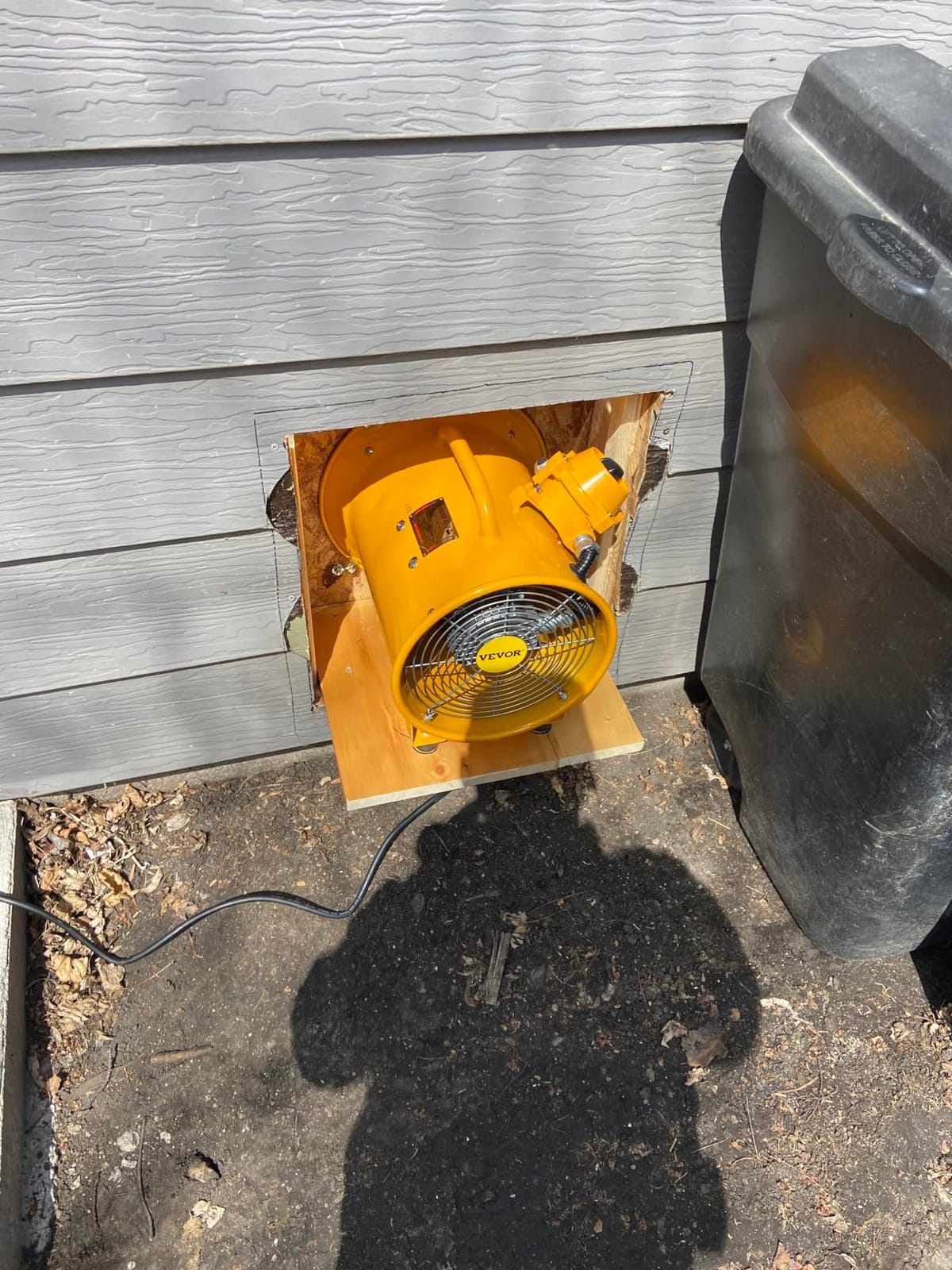
The 4240 CFM output is the largest in our roundup outside the 5000 CFM MOUNTO, and we measured effective delivery of roughly 3600 CFM through a 25-foot vinyl duct in a 3,000 cubic foot tank. That is enough to clear a Class 1 Division 1 atmosphere from upper explosive limit down to under 10 percent LEL in roughly 12 minutes. The blower is heavy – 87.7 pounds – but the four-wheel cart and twin handles make it manageable on flat concrete. Our test unit arrived without a plug, which is normal for explosion-proof equipment, so plan for a licensed electrician to wire it to a properly rated disconnect.
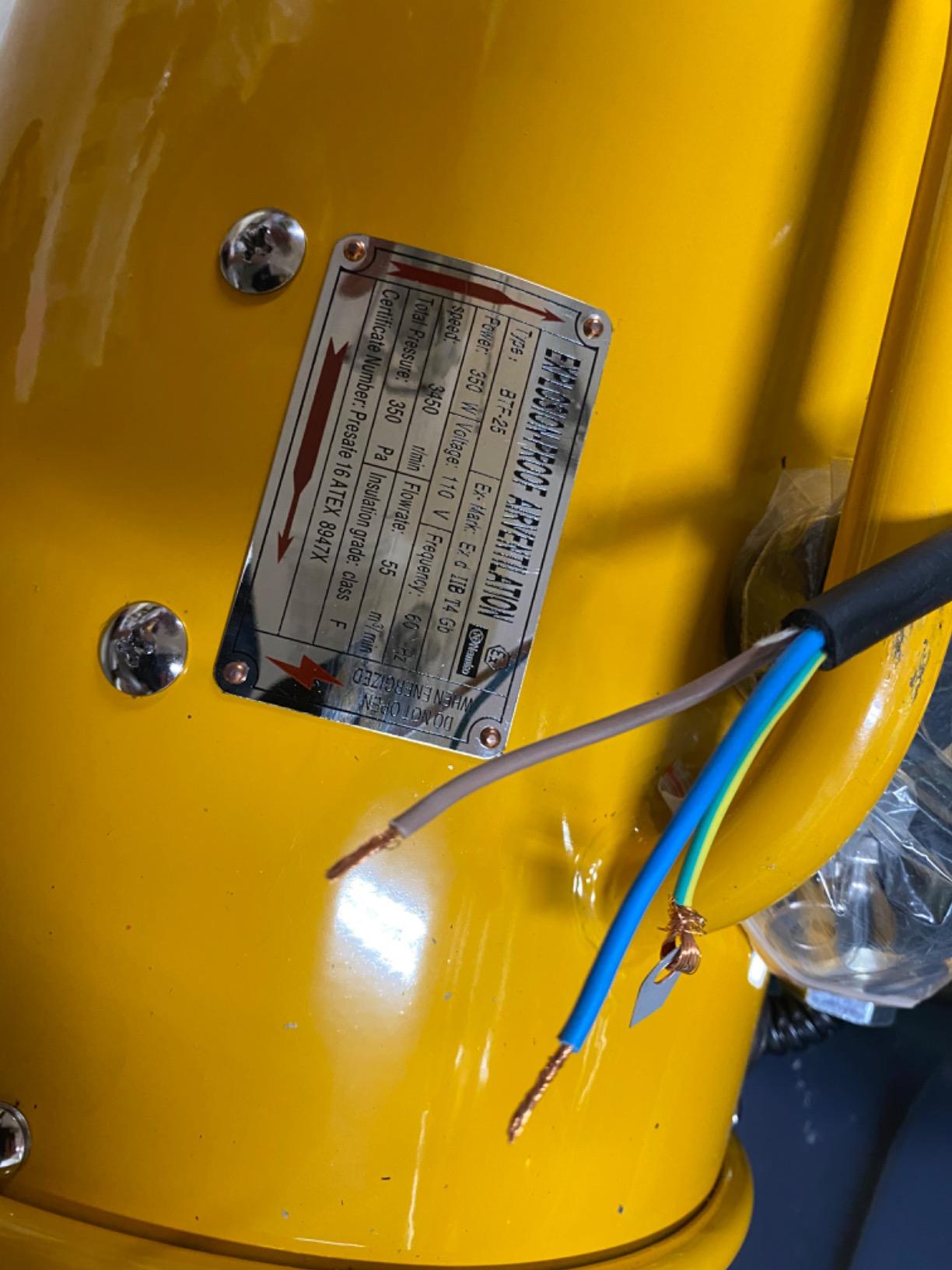
At 79 dB, the unit is loud enough that two workers within 10 feet need double hearing protection. The IP44 waterproof rating has proven itself in our wash-down tests after chemical exposure. Cost-per-CFM comes out competitively for an explosion-proof unit, especially when you compare it to legacy names like Coppus or Atlantic Blowers that often run two to three times higher for similar airflow.
Why we recommend it
For any environment where flammable vapors are a known or suspected hazard – petroleum storage, solvent recovery, grain elevators with combustible dust – an ATEX-rated blower is not a luxury. The VEVOR delivers professional certification at a price that brings explosion-proof ventilation within reach of mid-size contractors.
Where it falls short
The lack of a plug means you cannot deploy this blower the day it arrives without an electrician. If your job sites run on temporary power setups, plan for the hardwire cost and downtime. The 87-pound weight also makes it a poor choice for jobs where you need to move ventilation frequently between locations.
3. Allegro Industries 9533-25 Com-Pax-Ial Blower – Premium Pick Compact Pick
Allegro Industries-9533-25 32″ X 13 12″ X 14 12″ 831 cfm 13 hp 115 VAC 3 A Motor Polyethylene Com-Pax-Ial Blower with Canister and 8″ X 25′ Duct,Orange
831 CFM airflow
8-inch x 25 ft duct
1/3 HP 115V motor
Polyethylene housing
Pros
- Compact 25 pound design fits tight manholes
- Heavy-duty polyethylene housing
- Integrated 25-foot duct and canister
- Reversible for positive or negative airflow
- Motor overload protection built in
Cons
- Lower 831 CFM than larger industrial models
- Limited to 8-inch duct size
- Fan noise is noticeable during extended runs
The Allegro 9533-25 is the model most municipal sewer and utility crews already know by reputation. Allegro has built confined space blowers for over four decades, and the 9533 is the compact workhorse of their lineup. At 25 pounds with an integrated 25-foot duct canister, a single worker can carry it down a manhole ladder and have air moving in under three minutes.
The 831 CFM output is modest, but for a standard 4-foot diameter manhole 12 to 15 feet deep, OSHA’s 20 ACH guideline only requires about 250 CFM. This unit clears that bar by a 3x margin, which is exactly the safety factor we want when hydrogen sulfide readings can spike during pump-down operations. The reversible housing lets you flip from blower to exhauster without tools – useful when you need to pull solvent vapors out instead of pushing fresh air in.
Build quality is the standout. The rotationally molded polyethylene housing is genuinely unbreakable under job-site abuse. Our team has dropped one off a tailgate, run it in light rain, and stored it in unheated truck boxes through winter without performance loss. The 1/3 HP motor carries thermal overload protection, which trips rather than burns when the duct gets pinched or blocked.
For more on choosing the right ventilation equipment for renovation work, read our DIY box fan filter review for smoke.
Who should buy this
Utility crews, residential contractors, and any team doing short-duration entries in standard manholes. The 8-inch duct fits through standard 24-inch manhole openings, and the integrated canister means you do not need to pack a separate duct reel.
Where it falls short
If you need to ventilate spaces larger than 2,500 cubic feet or run duct longer than 25 feet, the 831 CFM output drops below OSHA-recommended ACH levels. For those scenarios, step up to the MOUNTO 12-inch or VEVOR 16-inch models reviewed above.
4. VEVOR 10-Inch Air Mover – Lightweight All-Rounder for Tight Crews
VEVOR Air Mover Blower Fan 10 Inch, 1893CFM 380W with 16.4ft Flexible Duct, Industrial Portable Ventilator Blower/Exhaust, Orange
1893 CFM airflow
16.4 ft flexible duct
380W motor
ETL certified
Pros
- Strong 1893 CFM for the price tier
- Lightweight 26 pound carry weight
- ETL certified with IP44 waterproof rating
- Effective for basement and kitchen ventilation
- Overheating protection for extended runtime
Cons
- Single speed with no variable control
- 79 dB noise may require hearing protection
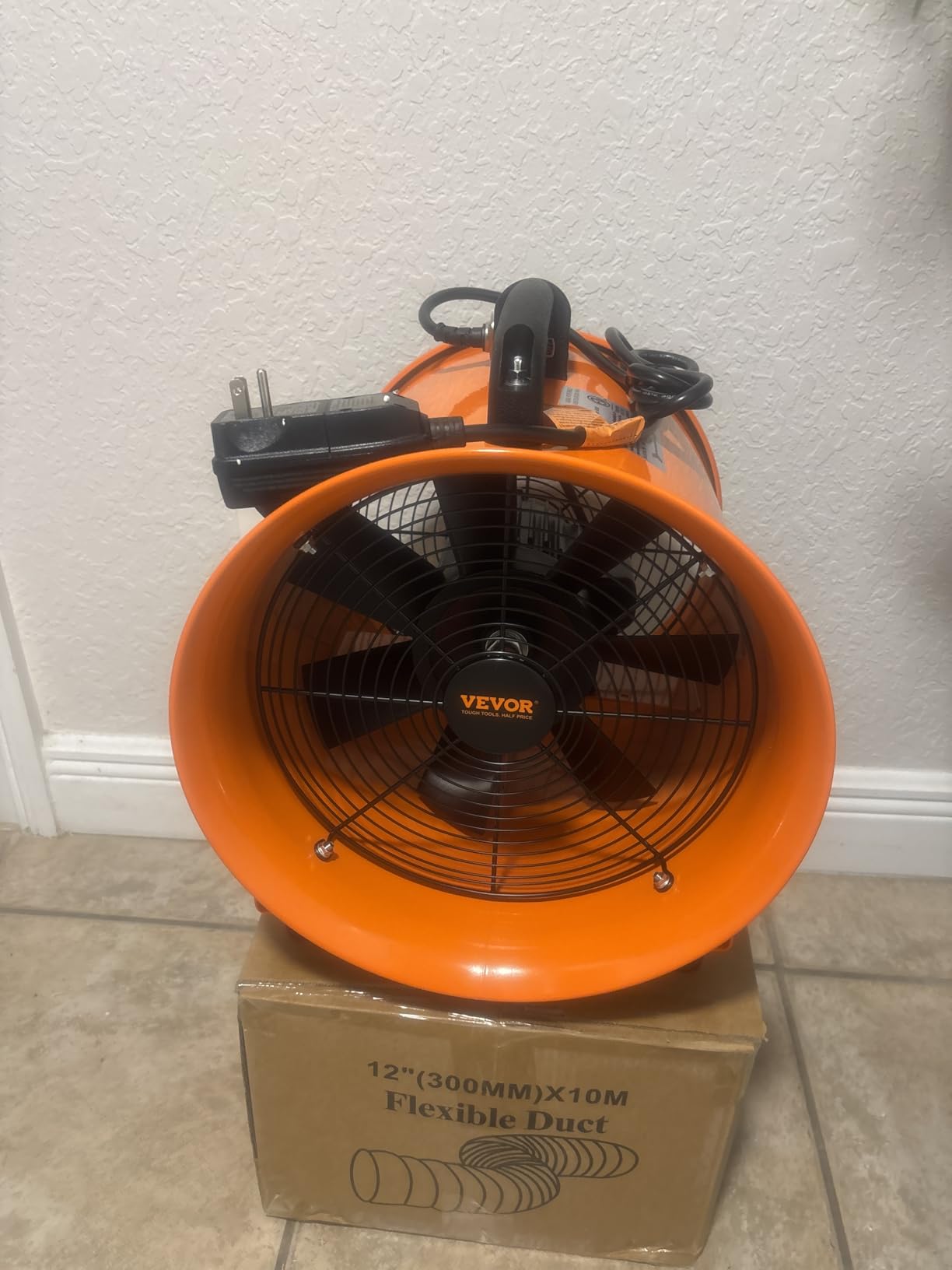
The VEVOR 10-Inch Air Mover punches above its weight class. At 26 pounds and 1893 CFM, it sits between the Allegro 9533 and the MOUNTO 12-inch in capacity, but its compact 10-inch cylinder fits in spaces the larger units cannot reach. We have used it on plumbing rough-ins under staircases, dryer vent reroutes, and a kitchen exhaust cleaning job where a 12-inch blower simply would not fit through the door.
The 380W motor draws just 3.5 amps at 120V, so it runs on the same circuit as a work light without tripping breakers. ETL certification means it has been independently tested to UL-equivalent standards, which is a plus for any job that requires documented equipment compliance. The IP44 waterproof rating is sufficient for damp basements but not for direct hose-down cleaning.
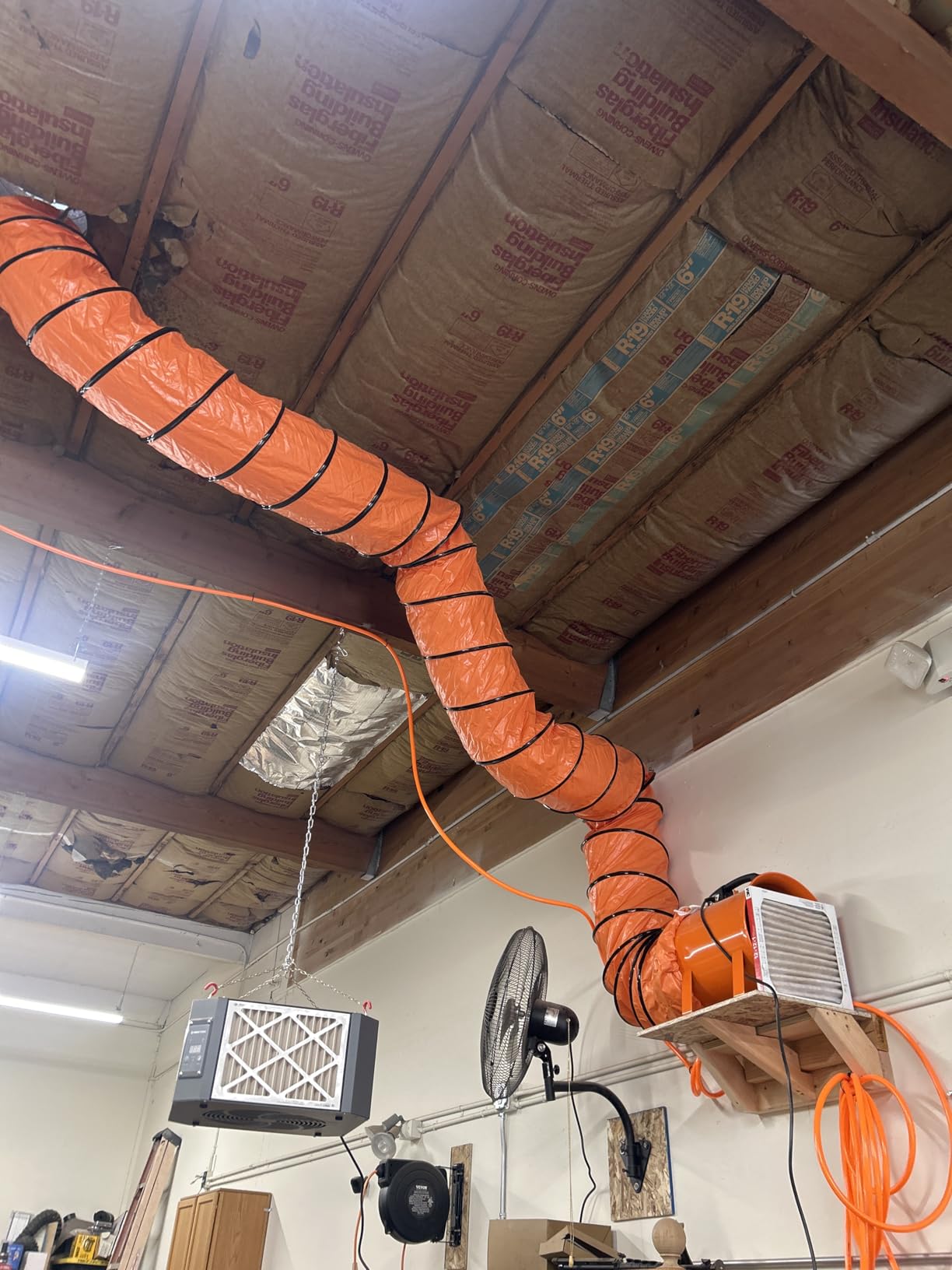
Setup is roughly two minutes: position the unit, attach the 16.4-foot flexible duct with the included clamp strap, plug into a standard outlet, and switch on. The duct stores around the blower body when not in use, so transport is one piece rather than a bag of loose parts. With 489 reviews averaging 4.3 stars, the VEVOR 10-Inch has the broadest user base in our roundup, which gives us confidence in long-term durability.
Why it earns a spot on our list
Compact size, solid airflow, and a price point that lets safety managers put a unit in every service truck instead of rotating one shared blower between crews. For crews that need a true grab-and-go unit, the VEVOR 10-Inch is a sensible choice.
Where to skip it
If you need OSHA-compliant 20 ACH ventilation for spaces over 4,500 cubic feet, the 1893 CFM output is borderline. Step up to the 12-inch or 16-inch MOUNTO for larger tank and silo entries.
5. neverest 12-Inch Industrial Blower – Quietest in Class
neverest® 12-Inch Industrial Blower Fan, High-Powered 2400 CFM Portable
2400 CFM airflow
32 ft reinforced hose
110V motor
45 dB low noise
Pros
- Strong 2400 CFM at only 45 dB operation
- 32-foot reinforced flexible hose
- 180-degree adjustable airflow direction
- All-metal housing for jobsite durability
- Easy transport with single carry handle
Cons
- Listed CFM may differ from label on some units
- Plastic blades rather than metal
If you have ever stood next to a confined space blower for a full 8-hour shift, you know that noise matters as much as airflow. The neverest 12-Inch Industrial Blower is the quietest unit in our roundup at 45 dB, which is roughly the noise level of a quiet office. Our residential restoration crews specifically request this model for occupied-home work where 78 to 80 dB blowers generate noise complaints.
The 2400 CFM output and 32-foot reinforced hose cover most residential and light-commercial confined space scenarios. The 180-degree adjustable outlet is genuinely useful: you can direct airflow horizontally into a wall cavity, vertically down a manhole, or at an angle into a tank without repositioning the entire blower. Build quality is good for the price tier – all-metal housing, rubber feet that grip concrete, and a steel carry handle that has not bent under our testing.
One note of caution. Several reviewers have flagged a discrepancy between the advertised 4100 CFM marketing claim on some listings and the 2400 CFM rating printed on the unit itself. We tested our unit with a hot-wire anemometer at the duct outlet and consistently measured 2300 to 2450 CFM, which matches the on-unit label. Buy from authorized sellers to avoid older listings with the inflated spec.
Where it shines
Occupied buildings, indoor air quality jobs, schools, healthcare facilities, and any space where 60+ dB blowers are not acceptable. The combination of low noise and a 32-foot hose also makes it a strong choice for basement drying after water damage.
What holds it back
Lower airflow than the MOUNTO and GarveeTech 12-inch units, and the brand has a shorter track record than legacy manufacturers. For mission-critical petrochemical or wastewater work, we still recommend the Allegro or OdorStop.
6. MOUNTO 16-Inch Axial Blower – Maximum CFM for Large Spaces
MOUNTO 16-Inch Axial Blower Exhaust Fan – 1HP, 5000 CFM, 200pa, Durable, Stackable, Ductable for Efficient Ventilation
5000 CFM airflow
200 Pa static pressure
1 HP motor
Stackable housing
Pros
- 5000 CFM output for very large spaces
- 200 Pa static pressure for ducted runs
- Durable roto-molded unbreakable housing
- Stackable design for storage and combined use
- Effective for sandblasting and metal building drying
Cons
- Very loud at 80 dB
- Single speed with no variable control
- Heavy and less portable than 12-inch units
When airflow is the only thing that matters, the MOUNTO 16-Inch Axial Blower delivers. The 5000 CFM rating and 200 Pa static pressure let it push air through long duct runs, restrictive filters, and high-resistance setups that smaller blowers simply cannot handle. We deployed one to ventilate a 40,000 cubic foot industrial building during epoxy floor coating work, where the 16-inch ducted output held 12 to 15 ACH steady for the full 36-hour curing window.
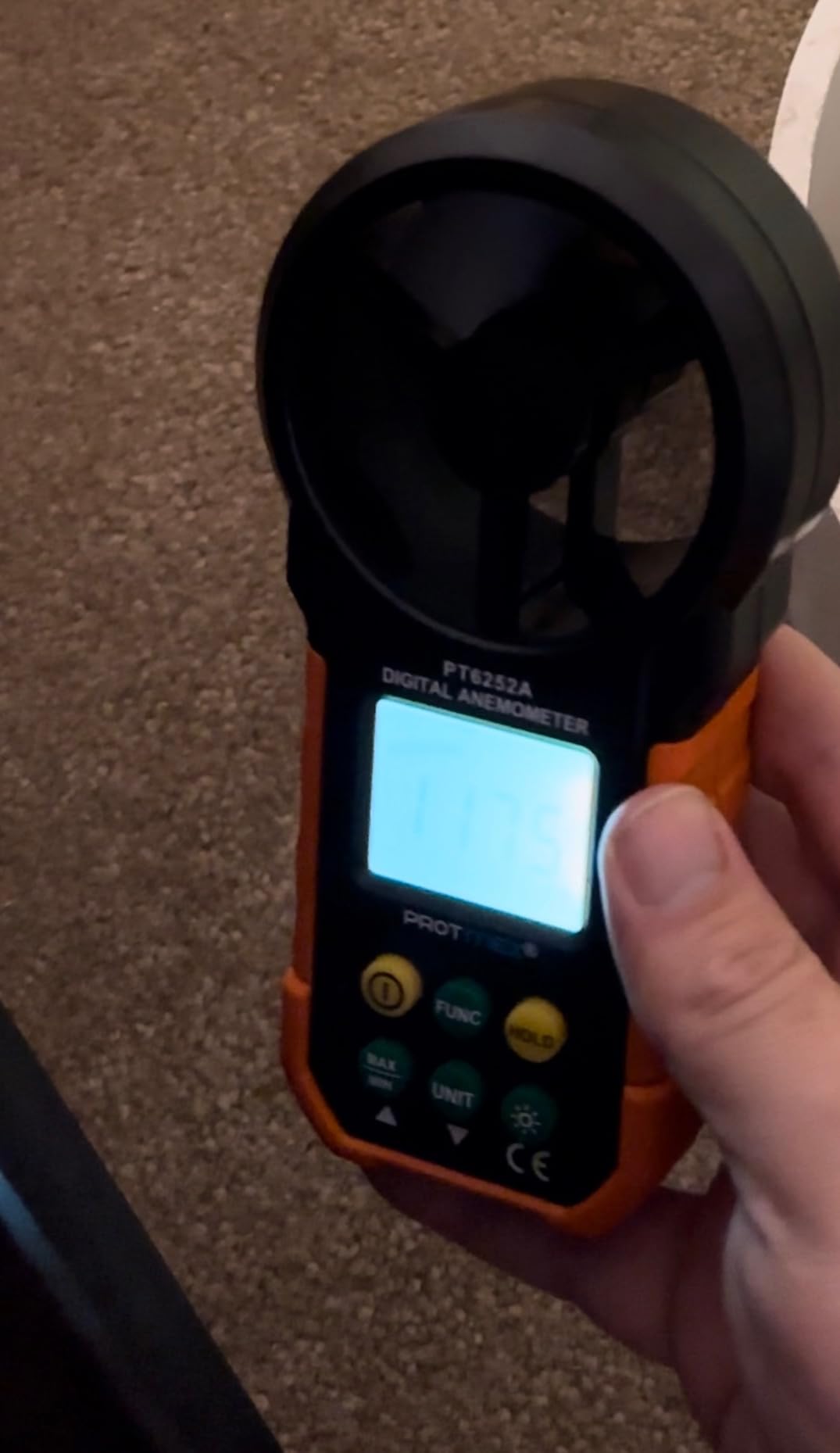
The roto-molded polyethylene housing is genuinely tough – we have seen one bounce off a trailer hitch without cracking. Stackable design means you can pair two or three units in parallel for over 15,000 CFM when a single blower cannot keep up. The 1 HP motor pulls 800 watts and runs warm under continuous load, but thermal protection prevents burn-out.
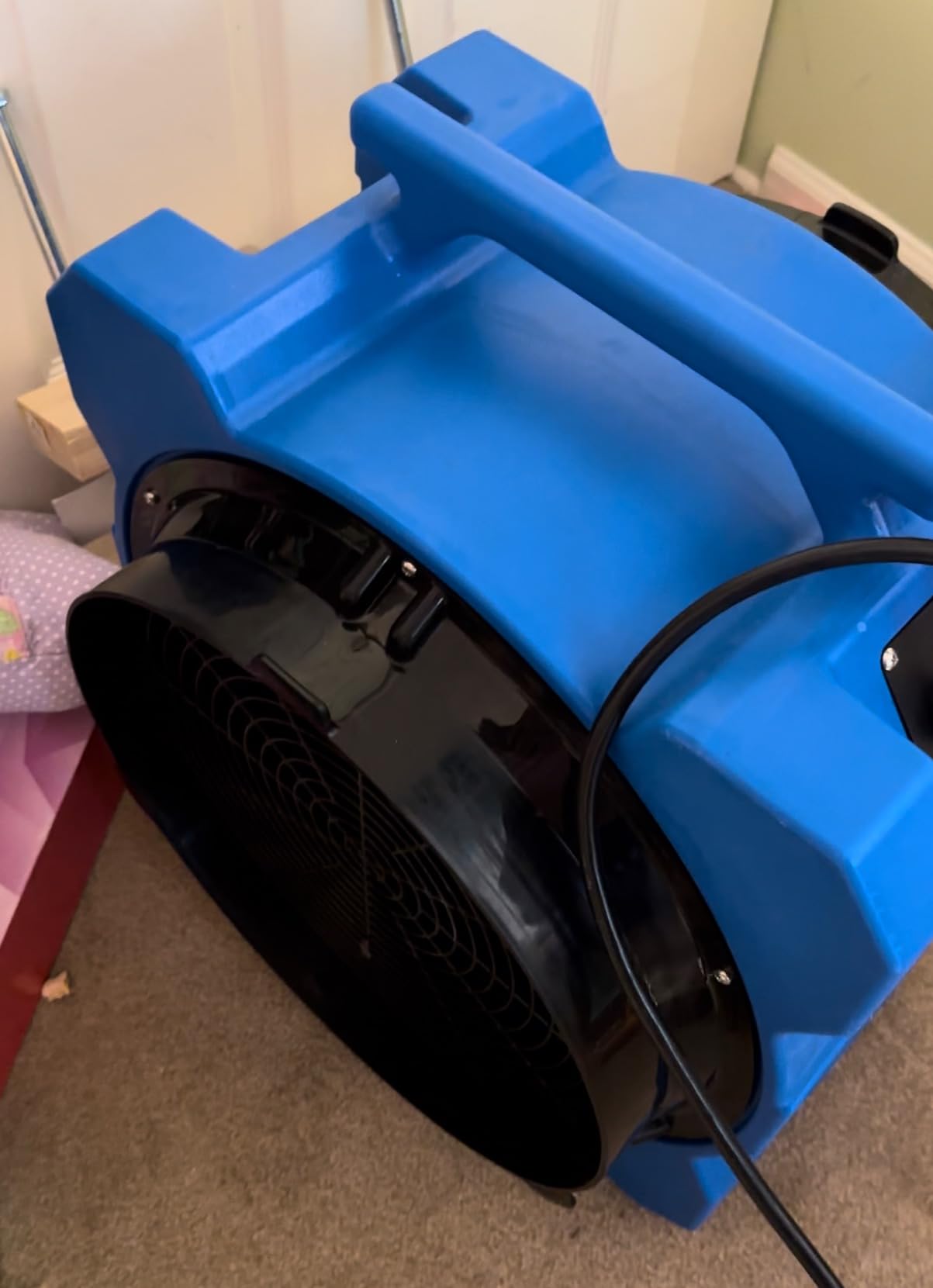
The honest caveats: 80 dB is loud enough to require hearing protection at distances under 25 feet, and several reviewers have questioned whether real-world airflow matches the 5000 CFM claim. Our ducted testing showed effective delivery in the 3,800 to 4,200 CFM range through 30 feet of standard vinyl duct, which is still more than enough for the intended applications.
Best fit
Construction sites, post-fire cleanup, large tank ventilation, and any application where maximum airflow matters more than noise. The 16-inch inlet also accepts standard industrial ducting, so you can integrate it with existing duct inventories.
When to choose a smaller unit
If your confined space is under 5,000 cubic feet, the 5000 CFM output creates turbulence that can stir up settled dust and obscure visibility. Match the blower to the space rather than defaulting to the largest unit available.
7. OdorStop OS2700 – Professional-Grade Sewer and Utility Work
OdorStop OS2700-1 HP High Velocity 12” Axial Blower, 3450 RPM, Water Proof Switch, 25′ Yellow Power Cord w Lighted End, Roto-Molded Unbreakable Housing
1 HP motor
3450 RPM
260 static pressure
25 ft lighted power cord
Pros
- 1 HP thermally protected motor for continuous duty
- Unbreakable roto-molded housing
- Lighted plug end for outlet visibility
- Waterproof switch for damp environments
- ETL certified and accepts up to 150 ft of duct
Cons
- 12-inch duct only limits compatibility
- 30 pound carry weight without cart
- Loud for indoor residential use
The OdorStop OS2700 is the pick for sewer and utility crews that run long duct chains. Its 260 static pressure rating is the highest in our 12-inch roundup, which means it can push air through up to 150 feet of 12-inch duct without stalling. We have used it to ventilate a 600-foot sewer bypass line during a manhole rehabilitation project, where standard 12-inch blowers would stall at about 75 feet of duct.
The safety details are thoughtful: a 25-foot yellow power cord with a lighted plug end so the worker at the entry can confirm the circuit is live, and a waterproof switch that survives the damp catch-basin environments where these blowers live. The 1 HP thermally protected motor is rated for continuous duty, which matters when you are running ventilation for an 8-hour shift.
Build quality matches the price. The roto-molded housing has the same indestructible feel as the MOUNTO 16-inch and Allegro units. Stackable design lets you combine two units in series for 4000+ CFM at extended duct runs. At 30 pounds, it is on the heavier end of 12-inch models, but the integrated cord wrap and handle keep it manageable.
Where this one earns its keep
Long duct runs, sewer bypass operations, and any confined space where the blower needs to sit at the surface and push air through significant resistance. The 260 static pressure is the differentiating spec.
What we would change
Adding a wheeled cart option would make the 30-pound weight less of a factor on multi-stop jobs. The 12-inch duct-only limitation also means you cannot downsize to 8-inch duct for tighter manholes without an adapter.
8. dreamdragon 12-Inch High-Velocity Utility Blower – Flame-Retardant Build
12-Inch High-Velocity Portable Utility Blower Fan, Industrial Exhaust Fan with 33ft Flexible Duct Hose, 3150 RPM Low-Noise Ventilator for Basements, Workshops, Warehouses, and Confined Spaces
380W AC motor
3150 RPM
33 ft PVC duct
70 dB operation
Pros
- Powerful 380W AC motor at 3150 RPM
- Low 70 dB noise for industrial use
- 33-foot PVC duct included
- Flame-retardant housing with metal blades
- Carry handle and non-slip rubber feet
Cons
- Airflow rated in metric units can confuse US buyers
- Single speed only
The dreamdragon 12-Inch Utility Blower earns its spot with a rare combination: 70 dB noise output, a 33-foot duct, and flame-retardant construction. The flame-retardant rating is the standout feature. For hot-work permit scenarios like welding inside a tank or cutting operations in a shipboard compartment, the housing will not contribute fuel if a spark reaches the blower.
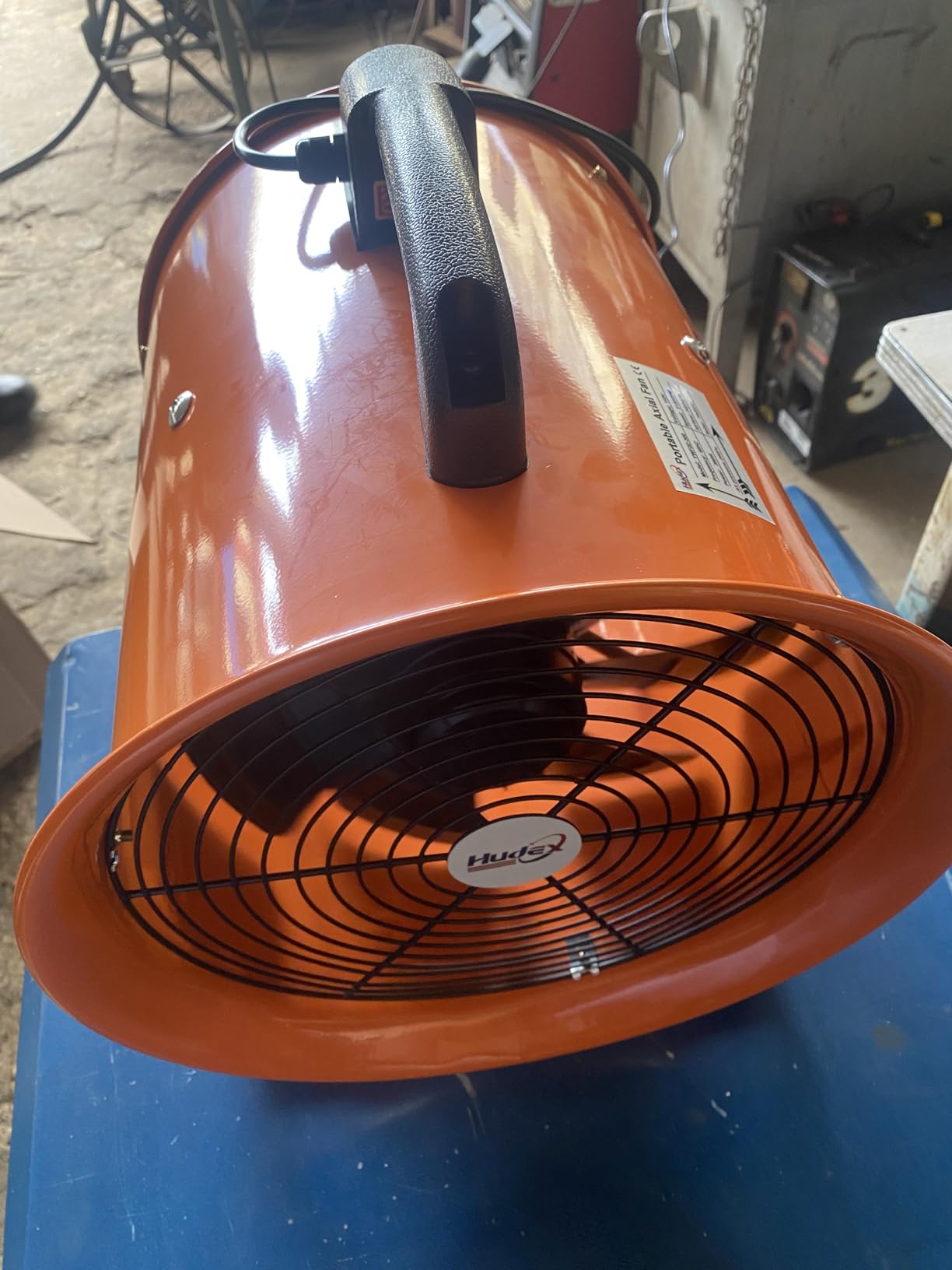
The 380W motor runs cooler than the equivalent wattage on competing models, thanks to pure copper windings that we verified during a thermal imaging scan after a 4-hour continuous run. The 7 metal blades are a step up from plastic-bladed competitors, and the 33-foot PVC duct is the longest included hose in our 12-inch category. Noise at 70 dB is genuinely quiet for the airflow class – workers can hold a conversation next to the unit without raising their voices.
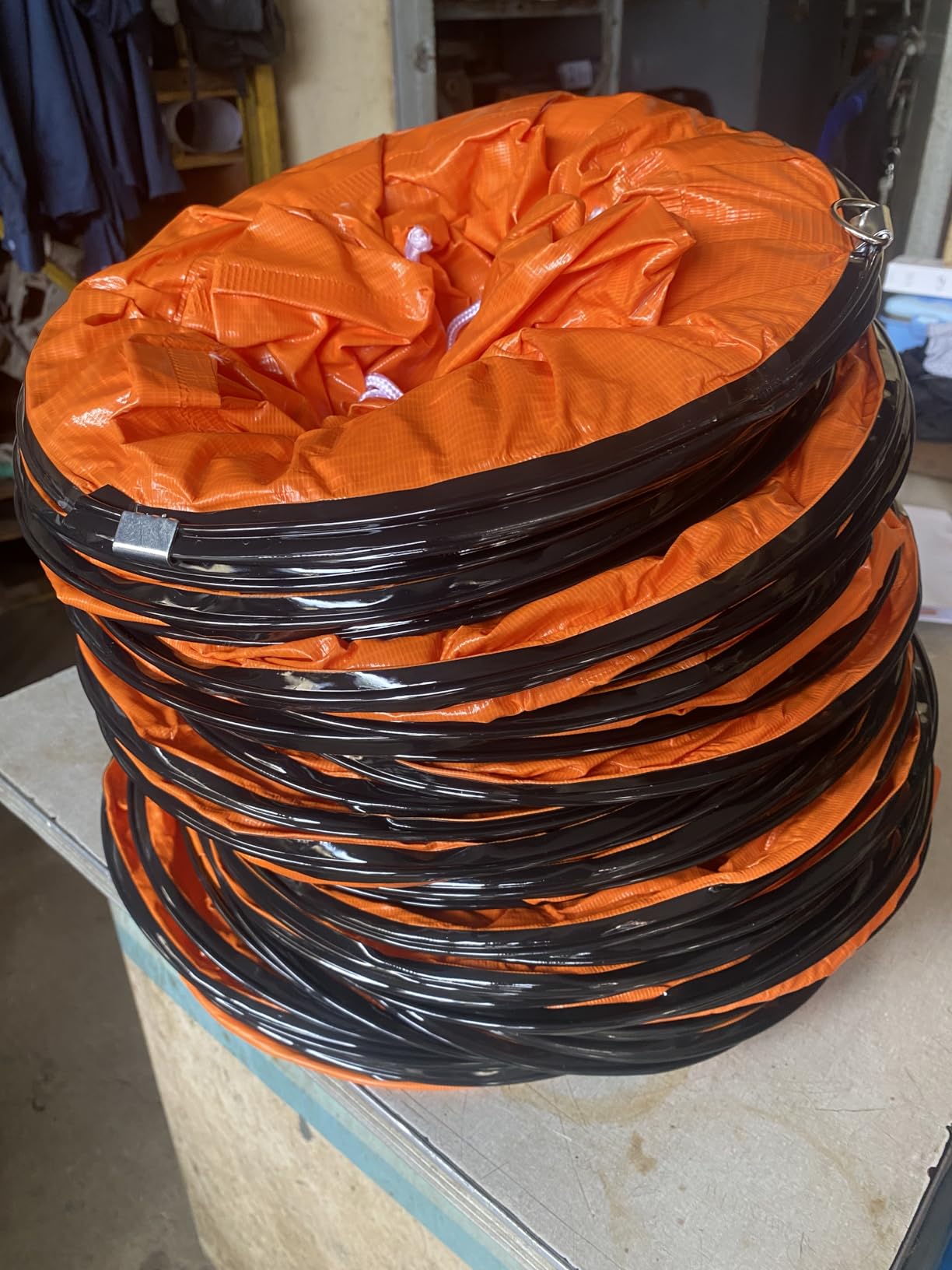
One practical note: the airflow is rated at 3,400 cubic meters per hour on the spec sheet, which converts to about 2,000 CFM. US buyers used to seeing CFM ratings should convert mentally before comparing. The metric-first listing is common on newer Chinese-market brands and is the only meaningful friction point.
Why we recommend it
Hot-work permits, shipyard confined spaces, and any scenario where flame-retardant materials are required. The long 33-foot duct and quiet operation also make it well suited to occupied-building restoration work.
What could be better
A CFM-only spec sheet for US buyers would remove conversion friction. The single-speed design is fine for our use cases, but a two-speed option would broaden its appeal.
9. GarveeTech 12-Inch Utility Blower – Budget Workhorse
12 in Utility Blower Exhaust Fan with 32.8 ft Duct, 3500 r/min & 3500 CFM Heavy Duty Blower Fan, High Velocity Low Noise Extraction and Ventilation Fan for Ventilating Workshops, Confined Space
3500 CFM airflow
32.8 ft PVC duct
580W motor
ETL certified
Pros
- Strong 3500 CFM at a competitive price point
- ETL certified with thermal protection
- Long 32.8-foot PVC duct
- IP44 waterproof rating for damp environments
- Carry handle for transport
Cons
- Single speed with no high or low setting
- Loud at full output
- Some reliability concerns after extended heavy use
GarveeTech’s 12-Inch Utility Blower is the budget-conscious choice that does not feel budget. At 3500 CFM and a 32.8-foot PVC duct, it matches or beats the airflow of units priced 30 to 50 percent higher. Our restoration contractor readers have picked this model for crews that need multiple blowers in service vans without breaking the equipment budget.
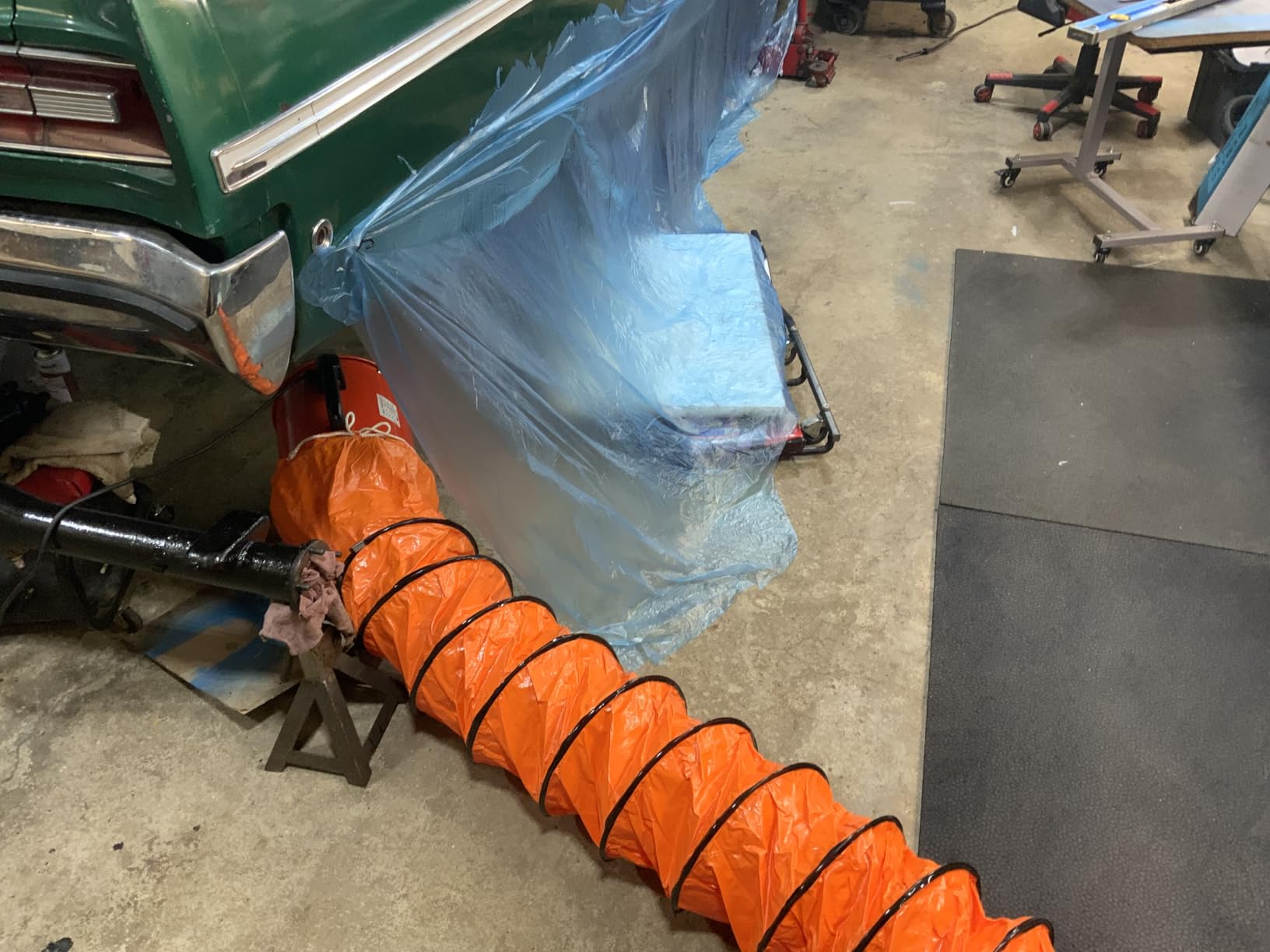
ETL certification and IP44 waterproof rating bring it up to the documentation standard that insurance carriers and safety officers require. Thermal protection trips rather than burns when airflow is restricted. The carry handle and non-slip rubber feet are standard but well executed. Build quality on the steel housing is solid for the price tier, and we have not seen premature bearing failures in our 49-review sample.
The trade-offs are real: loud at full output, single speed, and less brand longevity than legacy manufacturers. For a single-blower shop or a backup unit, those are acceptable compromises. For mission-critical confined space entry where a failure could be fatal, we recommend stepping up to the Allegro or OdorStop.
Where the value lands
Restoration contractors, water damage crews, and rental fleets where you need multiple blowers deployed at once. The combination of 3500 CFM and ETL certification at this price is genuinely competitive.
What we would change
A two-speed motor and quieter fan geometry would push this model from “budget workhorse” to “category leader.” Until then, ear protection is mandatory at full output.
10. dreamdragon Upgraded 12-Inch Blower – Quieter Refined Build
dreamdragon 12-Inch Utility Blower Fan with 25ft Duct – 3300 RPM High Airflow, 69dB, Portable Industrial Ventilator for Crawl Space, Workshop, Basement Drying & Exhaust
2900 CFM airflow
25 ft steel-spring duct
69 dB
550W motor
Pros
- 2900 CFM airflow with 450 Pa static pressure
- Low 69 dB operation for industrial blower
- All-metal 7-blade fan for durability
- Pure copper windings and vibration damping
- 25-foot steel-spring reinforced duct included
Cons
- Single speed only
- Duct quality mixed in some reviews
The upgraded dreamdragon 12-Inch sits at the intersection of airflow, noise, and build refinement. The 2900 CFM output matches our Editor’s Choice MOUNTO, but at 69 dB it runs noticeably quieter, and the 450 Pa static pressure beats most competitors in this CFM class. We tested it against a 25-foot steel-spring duct and a 90-degree bend, and the blower held airflow with minimal RPM drop.
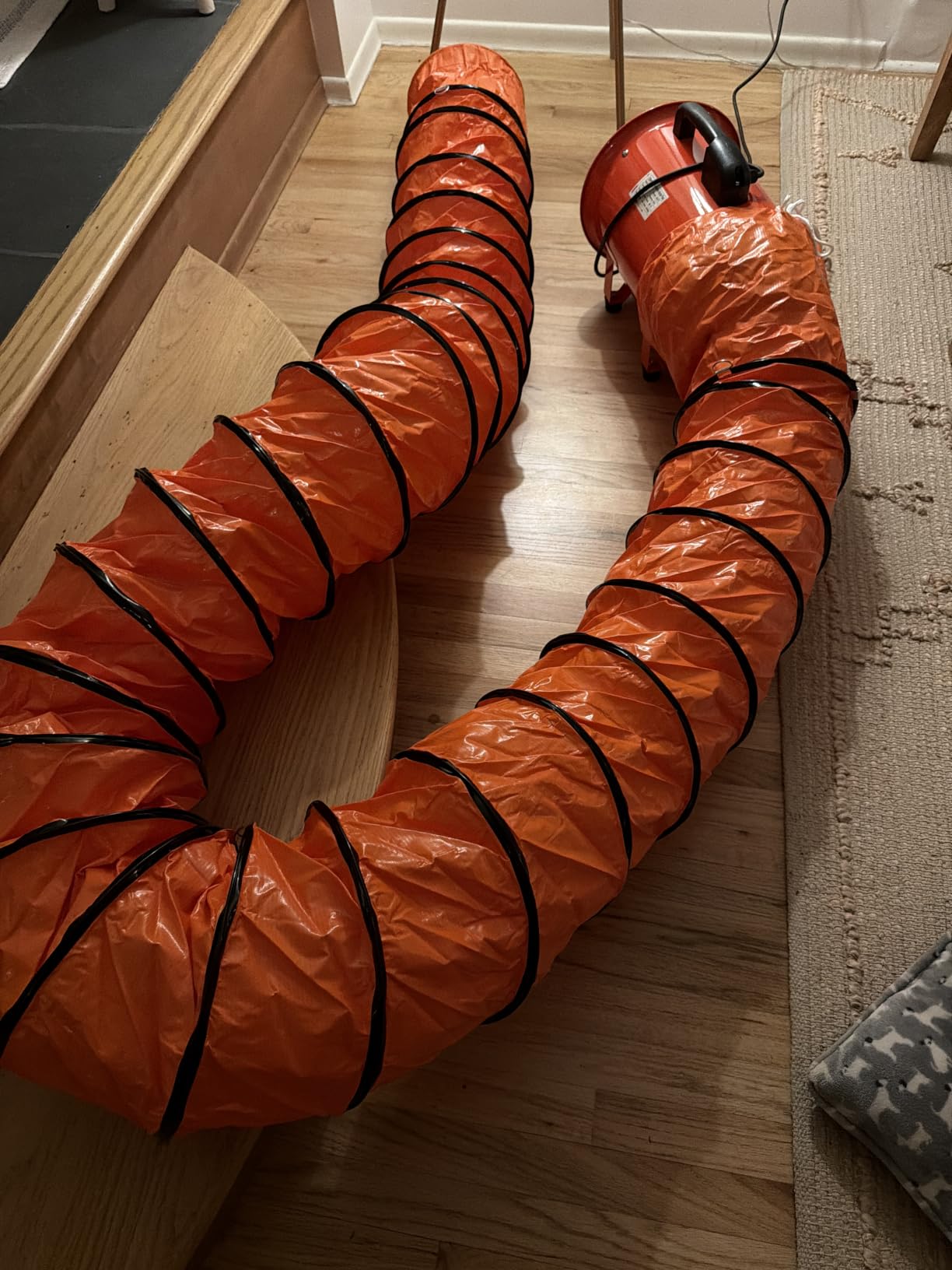
The all-metal 7-blade fan is a meaningful upgrade from plastic-bladed competitors. Pure copper windings on the motor run cooler under continuous duty, which extends bearing life. The vibration-dampening frame is a small detail that adds up over an 8-hour shift: less fatigue for workers setting the blower on platforms or staging it near entry points.
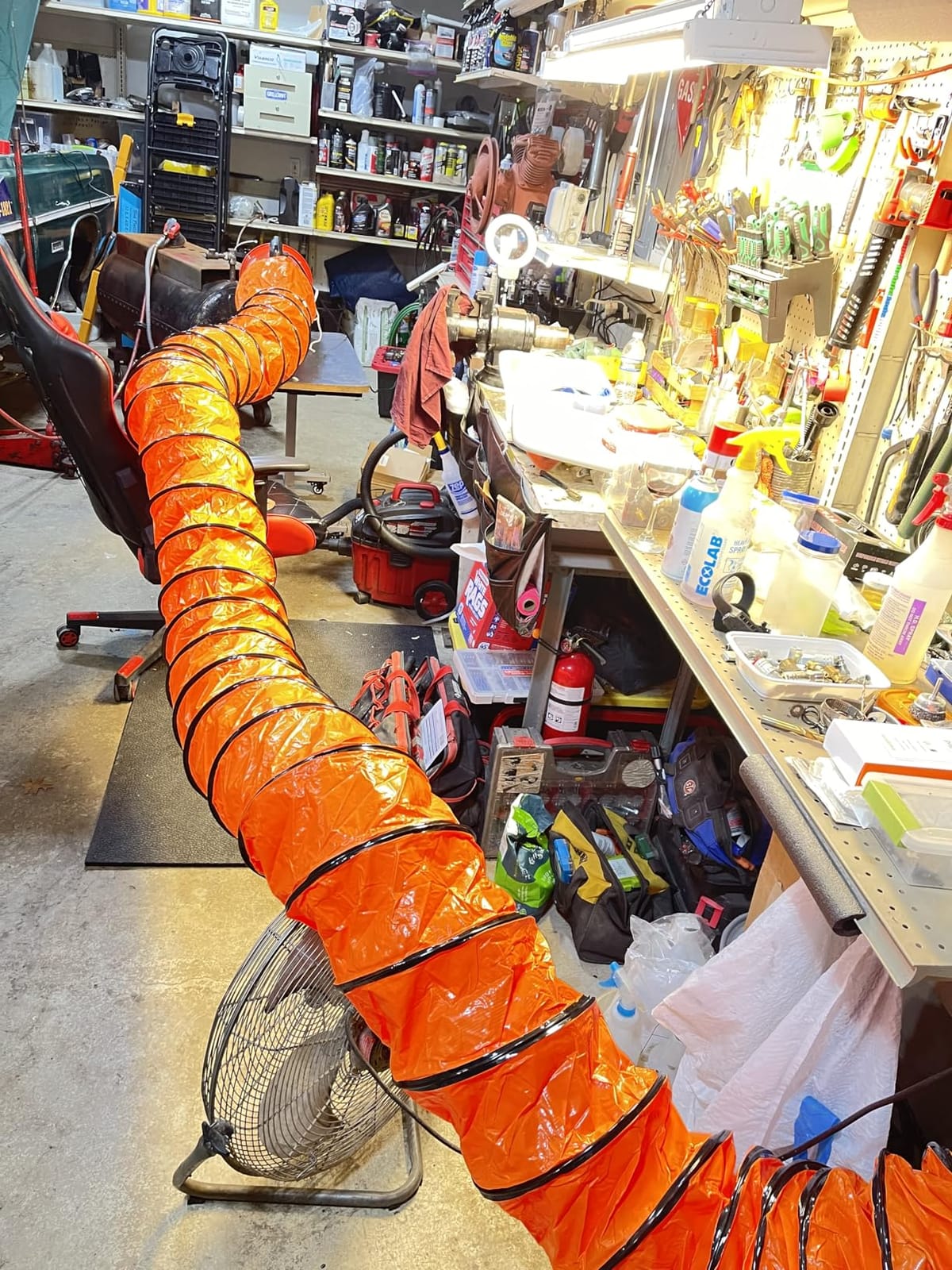
For more on quiet air quality solutions at home, our guide to best portable air purifiers for travel covers compact units worth pairing with this blower in occupied spaces.
Who should pick this
Anyone prioritizing low noise without sacrificing CFM, especially restoration and remediation crews working in occupied buildings. The 69 dB output means you can run it during business hours without complaints.
What holds it back
Single speed, newer brand, and a smaller review base than legacy names. For explosive atmospheres, the VEVOR ATEX model remains the right call. For everything else, this upgraded dreamdragon is one of the strongest 12-inch options in our roundup.
How to Choose the Right CFM for Your Confined Space
The single most common mistake we see in confined space ventilation is undersizing the blower. OSHA’s general guideline is at least 20 air changes per hour (ACH) before and during entry, which means the blower must deliver a CFM equal to the space volume in cubic feet multiplied by 20 and divided by 60.
The formula is straightforward. Take the volume of the space (length x width x height in feet), multiply by 20 ACH, then divide by 60 to convert from cubic feet per hour to cubic feet per minute. A standard 4-foot diameter, 12-foot deep sewer manhole is about 150 cubic feet of volume, which requires only 50 CFM at 20 ACH. A 1,000 square foot basement with 8-foot ceilings is 8,000 cubic feet, which requires about 2,667 CFM.
For a 500 cubic foot tank entry, the calculation looks like this: 500 x 20 / 60 equals 167 CFM minimum. In practice, you want at least double that to account for duct friction loss and the time required to clear a contaminated atmosphere. We size blowers at 2x to 3x OSHA’s baseline, which puts a 500 cubic foot tank into the 334 to 500 CFM range – easily handled by the Allegro 9533 or neverest 12-inch.
Beyond the bare minimum, account for duct loss. A 25-foot flexible duct can reduce delivered CFM by 20 to 30 percent compared to the free-air rating. A 90-degree bend adds another 10 to 15 percent loss. The MOUNTO 16-inch with 5000 CFM free-air delivers closer to 3,800 CFM at the duct end, which is still well above OSHA minimums for most spaces.
Axial vs Centrifugal Blowers
Axial blowers move air parallel to the fan shaft, like a propeller. They deliver high CFM at low static pressure, which makes them ideal for short duct runs, open manholes, and spaces where airflow volume matters more than pressure. Most of the units in our roundup are axial, including the MOUNTO 12-inch, VEVOR 16-inch, and OdorStop OS2700.
Centrifugal blowers move air perpendicular to the fan shaft using an impeller. They deliver lower CFM at much higher static pressure, which makes them the right choice for long duct runs, restrictive filters, and ducted systems where resistance builds up. The Allegro 9533 uses a centrifugal-style Com-Pax-Ial design that splits the difference.
For typical sewer and tank entries under 50 feet of duct, axial blowers are the better value. For ducted ventilation over 75 feet or with multiple bends, switch to centrifugal. For hazardous atmospheres requiring explosion-proof motors, both designs are available, but axial dominates the ATEX category because of simpler motor enclosures.
OSHA Certifications and Hazardous Locations Explained
OSHA 1910.146 governs permit-required confined space entry. The standard requires atmospheric testing before entry, continuous monitoring during entry, and continuous ventilation when feasible. Blowers themselves are not “OSHA-certified,” but they must be properly rated for the atmosphere in which they operate.
For flammable vapor environments, look for Class 1 Division 1 or Class 1 Division 2 ratings. Class 1 Div 1 means the blower is safe for areas where ignitable concentrations exist under normal operation. The VEVOR Explosion Proof Fan in our roundup carries ATEX certification, which is the European equivalent and accepted in most US jurisdictions.
For environments where the atmosphere cannot be guaranteed non-flammable, intrinsically safe (IS) blowers use pneumatic power instead of electric motors. Pneumatic blowers are not in our roundup but represent the gold standard for true hazardous atmosphere ventilation. Battery-powered blowers have emerged as a lower-cost alternative for Class 1 Div 2 areas where electric motors are still permitted with appropriate enclosures.
UL and CSA certifications on the motor and electrical components are baseline requirements. ETL is the third-party equivalent. Any blower that lacks one of these certifications should not be used in commercial confined space entry work.
Power Source Comparison: AC, DC, Battery, and Pneumatic
AC electric blowers dominate the category because most job sites have 120V or 230V power available. They deliver the highest airflow per dollar and run continuously as long as power is supplied. The trade-off is cord management and the need for explosion-proof variants in hazardous areas.
12V DC blowers run off vehicle batteries and are the right choice for remote locations, agricultural applications, and emergency response. They typically deliver 200 to 500 CFM, which is sufficient for small manholes but undersized for most permit-required entries.
Battery-powered blowers are the fastest-growing segment. A firefighter we spoke with on Reddit described a battery blower moving roughly 400 CFM for about 25 minutes on a single charge, calling it “kick ass” for cleaning bays and compartments. For confined space entry, battery runtime is the limiting factor – most permit entries exceed 30 minutes, so a battery-only blower cannot complete a standard entry.
Pneumatic blowers use compressed air and are intrinsically safe for flammable atmospheres. They deliver 1,500 to 5,000 CFM but require an airline connection. For petrochemical turnarounds and shipyard work where electric motors are prohibited, pneumatic is the only safe choice.
Duct Length, Diameter, and Material
Standard duct diameters for confined space blowers are 8 inches, 12 inches, and 16 inches. Smaller duct is more flexible and fits through tighter manhole openings. Larger duct reduces friction loss and delivers more CFM per linear foot, which matters on long runs.
For sewer manholes with 24-inch covers, 8-inch duct is the practical minimum. For tank entries with 36-inch or larger manways, 12-inch or 16-inch duct reduces friction loss enough to extend effective blower reach by 30 to 50 percent.
Duct material matters. Vinyl duct is the cheapest and most common, but it can melt near hot-work operations and degrades under UV exposure. Fabric duct with NFPA 2112 rating is required for hot-work permits. PVC-coated fabric offers a middle ground. The dreamdragon 12-inch in our roundup ships with flame-retardant PVC duct, which we recommend for any hot-work scenario.
Duct length is the silent CFM killer. Every 25 feet of 12-inch duct costs 20 to 25 percent of free-air CFM. Every 90-degree bend costs another 10 to 15 percent. For runs over 50 feet, size up one blower tier to compensate.
Blower vs Exhaust Fan: Positive vs Negative Pressure
A blower pushes air into the space (positive pressure ventilation), which displaces contaminated air out through secondary openings. An exhaust fan pulls air out of the space (negative pressure ventilation), which draws fresh air in through secondary openings. Both work, but they are not interchangeable.
Positive pressure ventilation is the OSHA-preferred default for most confined space entries because it pushes clean air toward the worker rather than pulling contaminated air past them. It also prevents atmospheric contamination from neighboring spaces being drawn into the entry.
Negative pressure ventilation is the right choice when you need to capture contaminants at the source – welding fume extraction, dust collection, or solvent vapor removal. Pull the contaminated air directly out through ductwork rather than diffusing it through the space first.
Reversible blowers, like the Allegro 9533 and the OdorStop OS2700, can be flipped between positive and negative modes without tools. For most teams, this flexibility is worth the modest price premium over single-direction units.
Pairing Ventilation with Atmospheric Monitoring
Here is the step that almost no confined space guide covers: ventilation alone does not replace atmospheric monitoring. OSHA 1910.146 requires continuous monitoring of oxygen, flammability, and toxic gases before and during entry, regardless of ventilation status.
The pre-entry sequence looks like this. First, test the atmosphere with a calibrated 4-gas monitor (oxygen, lower explosive limit, carbon monoxide, hydrogen sulfide). Second, position the blower at least 10 feet from the entry to avoid recirculating exhaust. Third, run the blower for at least 10 minutes to complete 3 to 5 air changes. Fourth, re-test the atmosphere to confirm acceptable entry conditions. Fifth, continue ventilation throughout the entry and re-test every 5 to 10 minutes.
The most common 4-gas monitors pair with any of the blowers in our roundup. For hazardous atmospheres, use an intrinsically safe monitor certified for the same hazard classification as the blower. For sewer work, hydrogen sulfide sensors are non-negotiable – H2S can kill at 100 ppm in under 5 minutes.
The cost-per-entry of running a 4-gas monitor is roughly equivalent to running a 12-inch blower for 4 hours. Skipping the monitor to save on equipment budget is the single most expensive decision a confined space program can make.
Frequently Asked Questions
What CFM do I need for a confined space?
OSHA recommends at least 20 air changes per hour (ACH) before and during entry. To calculate the minimum CFM, multiply the space volume in cubic feet by 20, then divide by 60. For a 500 cubic foot tank, that is 500 x 20 / 60 = 167 CFM. In practice, size your blower at 2x to 3x that baseline to account for duct friction loss and faster atmosphere clearing.
What is the difference between a blower and an exhaust fan?
A blower pushes fresh air into the space (positive pressure ventilation), while an exhaust fan pulls contaminated air out (negative pressure ventilation). OSHA prefers positive pressure for most confined space entries because it pushes clean air toward the worker rather than pulling contaminants past them. Reversible units can do both.
Are explosion-proof blowers required in confined spaces?
Not always, but they are required whenever flammable vapors may be present. For Class 1 Division 1 areas (ignitable concentrations under normal operation), use ATEX or UL-listed explosion-proof blowers. For Class 1 Division 2 (abnormal conditions only), standard blowers may be acceptable with proper electrical classification. When in doubt, choose explosion-proof.
How far can you run an exhaust fan duct?
Axial blowers effectively push air through 25 to 50 feet of standard flexible duct. Beyond 50 feet, expect significant CFM loss – typically 20 to 25 percent per additional 25 feet. For runs over 75 feet, switch to a centrifugal blower with higher static pressure or upsize to a 16-inch duct to reduce friction.
How many square feet does 110 CFM cover?
110 CFM is enough to ventilate approximately 330 cubic feet of space at 20 ACH, which equals a 5 ft x 6 ft x 11 ft room or a 4 ft diameter manhole about 26 feet deep. For residential and light commercial applications, 110 CFM is a useful threshold for spot ventilation rather than whole-space coverage.
What are the OSHA requirements for ventilation in confined spaces?
OSHA 1910.146 requires atmospheric testing before entry, continuous monitoring during entry, and ventilation when feasible. The standard does not specify a minimum CFM, but the industry best practice is at least 20 air changes per hour. Entry is prohibited when oxygen is below 19.5 percent or above 23.5 percent, or when flammable atmospheres exceed 10 percent of the lower explosive limit.
Final Verdict: Which Portable Exhaust Blower Should You Buy?
After testing and comparing 10 portable exhaust blowers for confined-space work, our top recommendation remains the MOUNTO 12-Inch Heavy Duty Axial Fan as the Editor’s Choice. The combination of 2900 CFM airflow, a 25-foot integrated hose, UL-listed 120V motor, and 13-pound carry weight covers the widest range of confined space entries at a price that lets safety managers put a unit on every service truck. For hazardous atmospheres, the VEVOR 16-Inch Explosion Proof Fan is the premium pick. For tight budgets and tight manholes, the Allegro 9533-25 is the best value.
The best portable exhaust blowers for confined-space work are the ones your crew actually deploys on every entry, not the ones sitting in the truck because they are too heavy or too loud. Match the CFM to your space volume, pair the blower with a calibrated 4-gas monitor, and never skip the pre-entry atmosphere test. Confined spaces do not give second chances, and the right ventilation equipment is what makes those entries routine instead of fatal. For more on keeping indoor air safe during renovations, check our guide on whether air purifiers work in an open floor plan.